University of Huddersfield Repository
Iqbal, Saqib
Aspects and Objects: A Unified Software Design Framework
Original Citation
Iqbal, Saqib (2013) Aspects and Objects: A Unified Software Design Framework. Doctoral thesis, University of Huddersfield.
This version is available at http://eprints.hud.ac.uk/id/eprint/18094/
The University Repository is a digital collection of the research output of the University, available on Open Access. Copyright and Moral Rights for the items on this site are retained by the individual author and/or other copyright owners. Users may access full items free of charge; copies of full text items generally can be reproduced, displayed or performed and given to third parties in any format or medium for personal research or study, educational or notforprofit purposes without prior permission or charge, provided:
• The authors, title and full bibliographic details is credited in any copy; • A hyperlink and/or URL is included for the original metadata page; and
• The content is not changed in any way.
For more information, including our policy and submission procedure, please contact the Repository Team at: [email protected].
Aspects and Objects:
A Unified Software Design Framework
A thesis submitted to the University of Huddersfield
in partial fulfilment of the requirements for
the degree of Doctor of Philosophy
By
SAQIB IQBAL
July 2012
Department of Informatics
2
Abstract
Aspect-Oriented Software Development provides a means to modularize concerns of a system which are scattered over multiple system modules. These concerns are known as crosscutting concerns and they cause code to be scattered and tangled in multiple system units. The technique was first proposed at the programming level but evolved up through to the other phases of the software development lifecycle with the passage of time. At the moment, aspect-orientation is addressed in all phases of software development, such as requirements engineering, architecture, design and implementation. This thesis focuses on aspect-oriented software design and provides a design language, Aspect-Oriented Design Language (AODL), to specify, represent and design aspectual constructs. The language has been designed to implement co-designing of aspectual and non-aspectual constructs. The obliviousness between the constructs has been minimized to improve comprehensibility of the models. The language is applied in three phases and for each phase a separate set of design notations has been introduced. The design notations and diagrams are extensions of Unified Modelling Language (UML) and follow UML Meta Object Facility (UML MOF) rules. There is a separate notation for each aspectual construct and a set of design diagrams to represent their structural and behavioural characteristics.
In the first phase, join points are identified and represented in the base program. A distinct design notation has been designated for join points, through which they are located using two diagrams, Join Point Identification Diagram and Join Point Behavioural Diagram. The former diagram identifies join points in a structural depiction of message passing among objects and the later locates them during the behavioural flow of activities of the system. In the second phase, aspects are designed using an Aspect Design Model that models the structural representation of an aspect. The model contains the aspect‟s elements and associations among them. A special diagram, known as the pointcut-advice diagram, is nested in the model to represent relationship between pointcuts and their related advices. The rest of the features, such as attributes, operations and inter-type declarations are statically represented in the model.
3
Copyright Statement
I. The author of this thesis (including any appendices and/or schedules to this thesis) owns any copyright in it (the “Copyright”) and s/he has given The University of Huddersfield the right to use such Copyright for any administrative, promotional, educational and/or teaching purposes.
II. Copies of this thesis, either in full or in extracts, may be made only in accordance with the regulations of the University Library. Details of these regulations may be obtained from the Librarian. This page must form part of any such copies made.
4
Acknowledgements
First and foremost I would like to extend my sincerest thanks to my supervisor, Dr. Gary Allen, whose expertise, experience and knowledge taught me the meaning of research and the way good research can be carried out. I am extremely grateful for his invaluable guidance, mentorship and more importantly his patience with me. Without his consistent support and encouragement, this thesis would not have become a reality.
Secondly, I would like to appreciate my university and my department for generously funding this research. I deeply commend their efforts to support PhD students for making a strong research base in the university. I also owe them thanks for financially supporting me to attend conferences during the period of this research.
I would also like to thank my friends and research fellows, Mr. Munir Naveed and Mr. Shahin Shah, for always being out there for me whenever I found myself down and depressed due to the burden of this research.
5
Table of Contents
ABSTRACT... 2
COPYRIGHT STATEMENT ... 3
ACKNOWLEDGEMENTS... 4
TABLE OF CONTENTS ... 5
LIST OF FIGURES... 7
LIST OF TABLES ... 9
CHAPTER 1: INTRODUCTION ... 11
1.1 INTRODUCTION ... 11
1.2 RESEARCH GOALS AND OBJECTIVES ... 13
1.3 APPROACH... 14
1.4 CONTRIBUTION ... 15
1.5 STRUCTURE OF THE THESIS ... 17
CHAPTER 2: ASPECT-ORIENTATION AND REQUIREMENTS ENGINEERING... 19
2.1 INTRODUCTION ... 19
2.2 SEPARATION OF CONCERNS ... 20
2.3 CROSSCUTTING CONCERNS ... 21
2.3.1 Scattered Code and Tangled Code Problems ... 21
2.4 ASPECT-ORIENTATION ... 22
2.5 ASPECT-ORIENTED PROGRAMMING ... 23
2.5.1 Aspects and Key Elements ... 24
2.6 SYMMETRIC AND ASYMMETRIC ASPECT-ORIENTATION ... 25
2.6.1 Symmetric Aspect-Oriented Approaches ... 25
2.6.2 Asymmetric Aspect-Oriented Approaches ... 27
2.7 COMPARISON OF ASPECT-ORIENTED REQUIREMENTS ENGINEERING APPROACHES ... 30
2.8 DISCUSSION ... 31
2.9 CHAPTER SUMMARY ... 31
CHAPTER 3: ASPECT-ORIENTED DESIGN APPROACHES ... 33
3.1 SOFTWARE DESIGN ... 33
3.2 ASPECT-ORIENTED DESIGN ... 33
3.3 ASPECT-ORIENTED DESIGN AND MODELLING APPROACHES ... 34
3.3.1 Aspect-Oriented Design Modelling (AODM)... 38
3.3.2 Theme/UML Design Methodology ... 42
3.3.3 Motorola Weavr Approach ... 45
3.3.4 Aspect-Oriented Architecture Modelling (AAM) ... 47
3.3.5 Aspect-Oriented Software Development with Use Cases (AOSD/UC) ... 50
3.3.6 The JAC Design Notation ... 53
3.3.7 Klein’s Approach for Behavioural Aspect Weaving ... 55
3.3.8 State Chart and UML Profile (SUP) Approach ... 57
3.4DISCUSSION ... 59
3.5CHAPTER SUMMARY ... 59
6
4.1.INTRODUCTION ... 60
4.2.MOTIVATION ... 61
4.3.ASPECT-ORIENTED DESIGN LANGUAGE (AODL) ... 62
4.3.1. How to use AODL ... 65
4.3.2. Join Point Design ... 66
4.3.3. Pointcut Design ... 75
4.3.4. Aspect Design ... 86
4.3.5. Weaving Process Design ... 89
4.3.6. Pointcut Table ... 96
4.5.CHAPTER SUMMARY ... 97
CHAPTER 5: APPLICATION OF AODL ... 98
5.1.INTRODUCTION ... 98
5.2.CASE STUDY:CAR CRASH CRISIS MANAGEMENT SYSTEM ... 99
5.4.2. Crisis Scenario of a Car Crash Crisis Management System ... 99
5.4.3. Identified Aspects ... 100
5.4.4. Use Case Diagram of Car Crash Case Study ... 101
5.4.5. Application of AODL to Car Crash Crisis Management ... 101
5.4.6. Discussion ... 117
5.3.SPACEWAR GAME CASE STUDY ... 118
5.5.2. Identified Aspects in the System ... 118
5.5.3. Application of AODL to SpaceWar Game ... 118
5.4.DISCUSSION ... 139
5.5.CHAPTER SUMMARY ... 140
CHAPTER 6: QUALITATIVE EVALUATION OF AODL ... 141
6.1.INTRODUCTION ... 141
6.2.THE QUALITATIVE EVALUATION CRITERIA ... 141
6.3.EVALUATION OF AODL ... 149
6.5.2. Basic Design ... 149
6.5.3. Design Language ... 158
6.5.4. Concern Representation... 163
6.5.5. Concern Composition ... 169
6.5.6. Effectiveness ... 176
6.5.7. Tool Support ... 185
6.4.DISCUSSION ... 189
6.5.CHAPTER SUMMARY ... 190
CHAPTER 7: CONCLUSIONS AND FUTURE WORK ... 191
7.3. ACHIEVED GOALS OF THE RESEARCH ... 191
7.4. CONTRIBUTION ... 193
7.5. LIMITATIONS ... 195
7.6. FUTURE WORK ... 196
7.7. CLOSING REMARKS ... 197
REFERENCES ... 198
7
List of Figures
Figure 2.1: Example of Crosscutting Concerns ... 21
Figure 2.2: An example of a tangled code ... 22
Figure 2.3: Concern-Oriented Requirements Engineering Process ... 26
Figure 2.4: A typical use case in AOSD with Use Cases Approach ... 28
Figure 2.5: Theme/Doc Process ... 29
Figure 2.6: The process model for AORE with Arcade approach ... 30
Figure 3.1: Structural Similarities between a pointcut, an advice and an operation ... 38
Figure 3.2: Representation of an aspect in AODM ... 39
Figure 3.3: Representation of structural crosscutting in AODM ... 39
Figure 3.4: Join Point Indication Diagram ... 40
Figure 3.5: Weaving Collaborations ... 40
Figure 3.6: An Example of a Theme depicted in Theme/UML ... 43
Figure 3.7: The Theme/UML Composed Model ... 44
Figure 3.8: The Observer aspect represented in Motorola Weavr approach ... 46
Figure 3.9: The Observer Aspect Model depicted in AAM ... 48
Figure 3.10: A Composed Model in AAM ... 49
Figure 3.11: Weaving Aspectual Behaviour in AAM ... 49
Figure 3.12: The Observer aspect modelling using AOSD/UC notations ... 52
Figure 3.13: The observer aspect modelled using the JAC design notation ... 54
Figure 3.14: A modelling of Observer aspect in Klein‟s Approach ... 56
Figure 3.15: An Example of a Composed Model in Klein‟s Approach ... 56
Figure 3.16: A representation of Observer aspect using SUP approach ... 58
Figure 4.1: AODL Diagrammatic Model ... 63
Figure 4.2: Join Point Representation ... 68
Figure 4.3: Join Point Identification Diagram ... 70
Figure 4.4: Join Point Behavioural Diagram ... 73
Figure 4.5: A Pointcut Example ... 76
Figure 4.6: Pointcut-Advice Diagram in Authentication Aspect ... 80
Figure 4.7: Pointcut Composition Model ... 85
Figure 4.8: Aspect-Design Diagram for Authentication Aspect ... 89
Figure 4.9: Aspect-Class Dynamic Diagram ... 92
Figure 4.10: Aspect-Class Structure Diagram ... 95
Figure 5.1: CCCM System: A Standard Use Case Diagram ... 101
Figure 5.2: Join Point Identification Diagram for “Capture Witness Report” ... 103
Figure 5.3: Join Point Identification Diagram for “Assign Internal Resource” ... 103
Figure 5.4: Join Point Identification Diagram for “Execute Super Observer Mission” use case ... 104
Figure 5.5: Join Point Identification Diagram for “Authenticate User” ... 105
Figure 5.6: Aspect Design Diagram for Mission Status aspect ... 106
Figure 5.7: Aspect Design Diagram for WitnessObserver aspect ... 106
Figure 5.8: Aspect Design Diagram for Persistence aspect ... 107
Figure 5.9: Aspect Design Diagram for Authentication aspect ... 107
Figure 5.10: Aspect-Class Structure Diagram for Car Crash Crisis Management System... 108
Figure 5.11: Join Point Behavioural Diagram for “Capture Witness Report” module ... 109
Figure 5.12: Join Point Behavioural Diagram for “Assign Internal Resource” module ... 110
Figure 5.13: Join Point Behavioural Diagram for “Super Observer‟s Mission” module ... 110
Figure 5.14: Join Point Behavioural Diagram for “Authentication” module ... 111
Figure 5.15: Aspect-Class Dynamic Diagram for “Capturing Witness Report” ... 112
Figure 5.16: Aspect-Class Dynamic Diagram for “Assigning Internal Resource” ... 113
8
Figure 5.18: Aspect-Class Dynamic Diagram for “Authentication” ... 114
Figure 5.19: Pointcut Composition Model of Persistence and WitnessObserver aspects ... 115
Figure 5.20: Pointcut Composition Model of MissionStatus and Authentication aspects ... 116
Figure 5.21: Join Point Identification Diagram for “Start Game” use case ... 120
Figure 5.22: Join Point Identification Diagram for “Move Ship” use case ... 121
Figure 5.23: Join Point Identification Diagram for “Thrust” use case ... 121
Figure 5.24: Join Point Identification Diagram for “Fire” use case ... 122
Figure 5.25: Join Point Identification Diagram for “Handle Collision” use case ... 123
Figure 5.26: Aspect Design Diagram for Coordinator and its child aspects ... 124
Figure 5.27: Aspect Design Diagram for DisplayAspect aspect ... 125
Figure 5.28: Aspect Design Diagram for EnsureShipIsALive aspect ... 126
Figure 5.29: Aspect Design Diagram for RegistrationProtection aspect ... 126
Figure 5.30: Aspect Design Diagram for Debug aspect ... 127
Figure 5.31: Aspect-Class Structure Diagram for SpaceWar game ... 128
Figure 5.32: Join Point Behavioural Diagram for Start Game ... 129
Figure 5.33: Join Point Behavioural Diagram for Move Ship ... 129
Figure 5.34: Join Point Behavioural Diagram for Fire ... 129
Figure 5.35: Join Point Behavioural Diagram for Handle Collision ... 130
Figure 5.36: Join Point Behavioural Diagram for Thrust ... 130
Figure 5.37: Aspect-Class Dynamic Diagram for “Start Game” ... 132
Figure 5.38: Aspect-Class Dynamic Diagram for “Rotate the Ship” ... 132
Figure 5.39: Aspect-Class Dynamic Diagram for “Fire” ... 133
Figure 5.40: Aspect-Class Dynamic Diagram for “Handle Collision” ... 134
Figure 5.41: Aspect-Class Dynamic Diagram for “Thrust” ... 134
Figure 5.42: Pointcut Composition Model of Coordinator, RegistrySynchronization, GameSynchronization and RegistryProtection aspects ... 136
Figure A- 1: Aspect Design Metamodel ... 208
9
List of Tables
Table 2.1: Explanation of aspectual terms ... 24
Table 3.1 - Graphic Nodes included in Join Point Identification Diagrams ... 35
Table 4.1 - Graphic Nodes included in Join Point Identification Diagrams ... 69
Table 4.2 - Graphic Paths included in Join Point Identification Diagrams ... 69
Table 4.3 - Graphic Nodes included in Join Point Behavioural Diagrams ... 71
Table 4.4 - Graphic Paths included in Join Point Behavioural Diagrams ... 73
Table 4.5- Graphic Nodes included in Join Point Behavioural Diagrams ... 79
Table 4.6 - Graphic Paths included in Pointcut-Advice Diagrams ... 79
Table 4.7 - Graphic Nodes included in Pointcut Composition Model... 82
Table 4.8 - Graphic Paths included in Pointcut Composition Model ... 83
Table 4.9 - Graphic Nodes included in Aspect-Design Diagrams ... 88
Table 4.10 - Graphic Paths included in Pointcut-Advice Diagrams ... 88
Table 4.11 - Graphic Nodes included in Aspect-Class Dynamic Diagram ... 91
Table 4.12 - Graphic Paths included in Aspect-Class Dynamic Diagram ... 92
Table 4.13 - Graphic Nodes included in Aspect-Class Structure Diagram ... 94
Table 4.14 - Graphic Paths included in Aspect-Class Dynamic Diagram ... 94
Table 4.15 - Example Pointcut Table ... 96
Table 5.1 - Pointcut Table for Car Crash Crisis Management System ... 116
Table 5.2 - Pointcut Table for SpaceWar game ... 138
Table 6.1 - Summary of Evaluation Criteria ... 147
Table 6.2 - Comparison of all approaches based on Platform and Language ... 150
Table 6.3 - Comparison of all approaches based on Comprehensiveness criterion... 151
Table 6.4 - Comparison of all approaches based on Structural andBehavioural ... 153
Table 6.5 - Comparison of all approaches based on Design Process criterion ... 155
Table 6.6 - Summary of evaluation of the approaches against Basic Design criteria ... 156
Table 6.7 - Comparison of the approaches based on Design Notations criterion ... 158
Table 6.8 - Comparison of the approaches based on Design Representation criterion ... 159
Table 6.9 - Comparison of the approaches based on Design Semantics criterion ... 161
Table 6.10 - Summary of evaluation of the approaches against Design Language/Approach ... 162
Table 6.11 - Comparison of the approaches based on Symmetric vs Asymmetric criterion ... 164
Table 6.12 - Comparison of the approaches based on Concern Representation criterion ... 165
Table 6.13 - Summary of evaluation of the approaches against Concern ... 167
Table 6.14 - Comparison of the approaches based on Aspect Composition criterion ... 169
Table 6.15 - Comparison of the approaches based on Rules to resolve conflictscriterion ... 172
Table 6.16 - Summary of evaluation of the approaches against Concern Composition criteria ... 174
Table 6.17 - Comparison of the approaches based on Comprehensibility criterion ... 176
Table 6.18 - Comparison of the approaches based on Extensibility criterion ... 179
Table 6.19 - Comparison of the approaches based on Traceability criterion ... 181
Table 6.20 - Comparison of the approaches based on Scalability criterion ... 182
Table 6.21 - Summary of evaluation of the approaches against Effectiveness criterion ... 184
Table 6.22 - Comparison of the approaches based on Modelling Support criterion ... 185
Table 6.23 - Comparison of the approaches based on Composition Support criterion ... 186
Table 6.24 - Comparison of the approaches based on Code Generation criterion ... 187
11
Chapter 1:
Introduction
This chapter describes the problem and motivation behind the conception and initiation of this research. It describes the goals and objectives set for this study and the approaches adopted to achieve these objectives. This chapter also provides a list of contributions which have been made to knowledge through this research. The chapter concludes with a description of the structure of the thesis.
1.1
Introduction
12
Aspect-Oriented Programming (AOP) (Kiczales et al., 1997) was invented to address this problem at implementation-level. It provides a way of modularizing crosscutting concerns into independent modules. Such concerns are implemented independently from other system concerns, and are linked with themautomatically during the execution of the system. As a result, redundant implementation of these concerns is removed and the system becomes more modular and comprehensible. The identified concerns are called aspects. Their implementation is in the form of a piece of code (called an advice) which is run at predefined points (called join points) during the execution of the system. These aspects merge with the implementation of the base modules during executionthrough a process called weaving, which is defined in terms of composition techniques specific to the aspect-oriented technology in use.
Since AOP was originally proposed as an implementation solution so a lot ofwork has been dedicated to developing new and improved implementation technologies.As a result implementation tools like AspectJ (Eclipse, 2012), AspectWerkz (Boner, 2004),JBoss AOP (JBoss, 2012), and Spring AOP (Spring, 2011) were created. With the passage of time,demand for strategies to support the analysis and design phases of aspect-orientedsoftware development started arising. As a result, strategies such asAODM (Stein, Hanenberg and Unland, 2002), Theme/UML (Baniassad and Clarke, 2004b), SUP (Aldawudet al., 2002) and AAM (Clarke and Walker, 2002) were introduced to facilitate the designof aspects. They all design aspects in different styles. But most of these existingdesign strategies do not provide a common design framework for both aspectualand non-aspectual concerns of the system. This limitation forces the designerto design these concerns in two different design strategies, which makes thewhole design hard to understand, maintain and extend.
The purpose of this PhD work is to develop a unified design framework for aspectual and non-aspectual concerns (objects in the case of object-oriented paradigm). This study aims to develop techniques to represent and design concerns with the help of design notations and design diagrams. The primary hypothesis of this research can be stated as:
A unified design approach for aspectual and non-aspectual concerns of a system improves quality of the design and makes it comprehensible and effective.
13
1.2
Research Goals and Objectives
This research aims to achieve following goals:
1. Comprehensibility: It has been observed in the existing design methodologies that comprehensibility of the design is not properly addressed (discussed in detail in Chapter 3). The proposed notations and models are not developed to improve readability, which becomes even more cumbersome when the system is complex and distributed. The majority of these methodologies propose different sets of notations to model aspect-oriented and object-oriented constructs, which forces designers to learn and adapt to two entirely different design models for a single system. This study aims to propose design notations for aspect-oriented constructs which are similar in nature to those used for object-oriented constructs in UML.
2. Co-Designing aspectual and non-aspectual constructs: A unified design framework, which provides a single platform to model both aspect-oriented and object-oriented constructs, can improve the modelling of associations among both the concepts and can also provide a better platform to design the weaving process. This capability of the design methodology can also help in improving comprehensibility.
3. Achieving Modularity and Composability by breaking Obliviousness: Steimann (2005) proposed that obliviousness is a fundamental property that must be implemented in every AOSD approach. His proposition was based on the arguments presented in favour of quantification and obliviousness in aspect-oriented programming in (Filman and Friedman, 2000). The proposal was rejected by Rashid and Moreira (2006), who argued that abstraction, modularity and composability are more fundamental properties than quantification and obliviousness. This research will follow Rashid and Moreira (2006) and will focus on achieving better modelling techniques for modularity and composability.
14
design techniques either lack comprehensiveness or provide separate techniques to handle objects and aspects thatmakeit difficult for the designers to learn and adopt these techniques.
This study aims to achieve the following research objectives:
To develop a unified design framework for objects and aspects to co-design both the constructs.
To design notations for aspects similar to those for objects (UML notations) to represent them during the development life cycle
To develop design diagrams for aspects similar to those for objects (UML diagrams) to be represented and designed properly
To evaluate and test the design notations and design diagrams by qualitative methods and by applying them to a range of case studies to verify their suitability, efficacy, scalability and comprehensiveness.
1.3
Approach
This study was initiated to provide a unified design approach for aspects and objects. It has been felt that the existing design approaches force designers to adopt two different design methodologies for aspect-oriented and object-oriented constructs. UML is the widely used design language for object-oriented constructs, and most of the designers use this language while designing the base constructs. Whereas for aspect-oriented constructs, a number of design approaches are available, the majority of which are different from UML. The designers have to use two different design languages to design one system which makes it hard for these new aspect-oriented design languages to be adopted. The purpose of this research was to find new ways to unify design of both objects and aspects together in one design environment and co-design both the constructs using similar design notations and diagrams. This property will not only improve the effectiveness of the design but will also enhance comprehensibility of all the models.
15
Design of aspects is one area of research that has attracted less attention since the inception of aspect-oriented programming. Although there are a number of aspect-oriented design approaches such as, AODM (Stein et al., Unland, 2002a), Theme/UML (Baniassad and Clarke, 2004b), SUP (Aldawudet al., 2002) and AAM (Clarke and Walker, 2002), which have been proposed over the last decade, a comprehensive design approach is still required. All of these approaches lack a unified design approach for both aspectual concerns and non-aspectual concerns that forces designers to adopt two different design approaches. Multiple design methodologies do not only misguide the designers but also create problems in documenting and representing all concerns properly.
This study has been carried out to find a solution to this problem by introducing a unified design framework that provides similar types of notations for both aspectual and non-aspectual concerns to be represented and designed in a single design environment. A new design language, AODL, has been developed to accommodate representation of aspects and objects together. This language works along with Unified Modelling Language (UML) and provides design notations and design diagrams for aspects, pointcuts, advices and weaving associations of aspects. The design notations and diagrams follow Meta Object Facility (MOF) rules and resemble UML in syntax and semantics.
1.4
Contribution
This PhD study contributes a design language for aspect-oriented software development to represent and design the aspects. It is called Aspect-Oriented Design Language (AODL). This language is similar to Unified Modelling Language (UML) and works seamlessly with it. The following are the main contributions of this study:
An Aspect-Oriented Design Language (AODL) (Iqbal and Allen, 2011) has been developed that specifies and designs aspectual components. The language has been designed by keeping the syntax, semantics and design constructs similar to those of UML so that traditional UML designers and novice designers should feel comfortable while using it for designing aspects along with base objects.
16
The language provides design models to model pointcuts, aspects and their relationships with other aspectual constructs. These models represent the internal structure of the modelling constructs and their associations and relationships with related constructs.
An aspect composition technique has been proposed that provides support for aspect-to-aspect and aspect-to-base compositions. The technique contains design notations and design diagrams that can be applied to capture these compositions and demonstrate the weaving process in a notational and diagrammatic way. The inner-aspect composition has also been supported in the approach. A new set of notations and diagrams have been developed to compose pointcuts with advices and pointcuts with each other. There are separate diagrams for structural and dynamic compositions for all the constructs.
This thesis provides a detailed evaluation of the proposed design notations and design diagrams of AODL. The evaluation has been carried out in two stages. In the first stage, a qualitative evaluation of AODL has been performed. A comparison has been made between AODL and existing design and modelling approaches. In the second stage, AODL has been applied to two case studies. One case study system is designed using forward engineering technique and the other is designed in a reverse engineering method.
A tool is under development for AODL which is aimed to provide an automated environment to use AODL. The tool will also be capable of generating code for visualized models.
One refereed journal paper and 5 refereed conference papers have been published so far on the work carried out during this research.
Two more Journal papers have been submitted to refereed journals.
The following are the lists of the publications during this research:
Journal Papers:
1. Iqbal, S. and Allen, G. (2011) „Designing Aspects with AODL‟ International Journal of Software Engineering. ISSN 1687-6954
2. Iqbal, S. and Allen, G. (2012) „Application of AODL: A Case Study‟, Software: Practice and Experience, (Submitted).
17
Conference Papers:
1. Iqbal, S. and Allen, G. (2012) „Pointcut Design with AODL‟. In: The Twenty-Fourth International Conference on Software Engineering and Knowledge Engineering (SEKE 2012), July 1-3, 2012. Redwood City, California, USA. (In Press)
2. Iqbal, S. and Allen, G. (2010) „Aspect-Oriented Modelling: Issues and Misconceptions‟. In: Proceedings of Software Engineering Advances (ICSEA), 2010 Fifth International Conference. : IEEE. Nice, France. pp. 337-340. ISBN 978-1-4244-7788-3
3. Iqbal, S. and Allen, G. (2010) „A notational Design of Join Points‟. In: Future Technologies in Computing and Engineering: Proceedings of Computing and Engineering Annual Researchers' Conference 2010: CEARC‟10. Huddersfield: University of Huddersfield. pp. 27-30. ISBN 9781862180932
4. Iqbal, S. and Allen, G. (2009) „On identifying and representing aspects‟. In: SERP'09 - The 2009 International Conference on Software Engineering Research and Practice, July 13-16, Las Vegas, USA
5. Iqbal, S. and Allen, G. (2009) „Representing Aspects in Design‟. In: Theoretical Aspects of Software Engineering, 2009 TASE 2009, theThird IEEE International Symposium on. : IEEE. China, pp. 313-314. ISBN 978-0-7695-3757-3
6. Iqbal, S. and Allen, G. (2009) „Aspect-oriented design model.‟ In: Proceedings of Computing and Engineering Annual Researchers' Conference 2009: CEARC‟09. Huddersfield: University of Huddersfield. pp. 137-141. ISBN 9781862180857
1.5
Structure of theThesis
The rest of the thesis is structured as follows:
Chapter 2 presents a detailed survey of aspect-oriented software development techniques. It provides a comprehensive survey of the past, existing and on-going research in the field of AOSD.
18
Chapter 4 describes aspect-oriented design language (AODL), which was developed during this research. A full description about the inception, design and development of the language has been provided. Description about each design notation is provided along with explanation about its usage. A simple case study has been designed using AODL to illustrate the language.
Chapter 5provides a description of the evaluation of AODL by application. The selected case studies have been explained. The process of application of AODL on these case studies has been explained in detail. The results gathered during this evaluation have been presented and explained.
Chapter 6contains a description of the evaluation strategies and their implementation on AODL. A detailed description is provided about the selection of evaluation strategies and their implementation on AODL. Evaluation has been carried out by defining evaluation factors which were implemented on existing peer strategies and AODL to test the efficacy of AODL against its competitive methodologies. A comprehensive description has been provided on the selection of case studies for the evaluation.
19
Chapter 2:
Aspect-Orientation and Requirements
Engineering
This chapter introduces the Aspect-Oriented Programming (AOP) paradigm, the reasoning behind its inception, the parameters on which it was invented and all the concepts, terms and terminologies of AOP. The chapter covers details about the separation of concerns, concepts and progress in this area. The chapter also provides a brief survey of aspect-oriented requirements engineering approaches. Aspect-aspect-oriented design is discussed separately in Chapter 3.
2.1
Introduction
Aspect-Oriented Programming (AOP) (Kiczales et al, 1997) is used to implement a system in a modular way by separating crosscutting concerns into independent modules. AOP is a programming language which implements concerns that crosscut the system due to their scattered logic in multiple modules. These concerns are known as crosscutting concerns and they affect several modules or units of the system. Crosscutting concerns are not captured in other peer technologies such as functional programming and object-oriented programming and as a result they create problems like redundancy and replication of code and tangling of code. AOP was introduced to address these problems by introducing a new construct, called an aspect, to capture and modularize a crosscutting concern into a distinct construct and to implement it separately from other concerns of the system.
20
programming and as procedures in procedural programming, they overlook implementing crosscutting concerns into distinct modules which violates the encapsulation principle of programming and decreases modularity of the system. AOP, on the other hand, implements crosscutting concerns in distinct constructs called aspects and weaves them with other system concerns through composition rules. Consequently, the system becomes modular and reusable.
2.2
Separation of Concerns
The term Separation of Concerns was coined by Dijkstra in his paper “On the role of scientific thought" (Dijkstra, 1982). His proposition was to identify and implement all the concerns of the system separately by making each unit do one and only one thing. This idea is a basic founding pillar of most of the implementation paradigms, for instance, object-oriented paradigm separates concerns of the system in the form of objects, service-object-oriented design separates them in form of services, functional programming separates them as functions and procedural programming as procedures. Similarly, aspect-oriented programming has been designed to separately design and implement these concerns in the form of aspects. The biggest challenge in this kind of development is to pin down what a concern is. Some suggest a concern is a functionality of the system and some consider any piece of interest as a concern. Following are some of the examples of concerns which have frequently been pointed out in the literature (Chitchyan et al., 2005):
Functional/Application-Dependent Concerns: They are the core functionalities of the system. The examples may include transaction management in a banking system or calculation of toll in a toll system.
Quality Concerns: These are the concerns responsible for the quality management of the system. These include performance, ease-of-use, reliability, etc.
Policy Concerns: These concerns are related to policy implementation of the system such as security, user management, access rights, etc.
System Concerns: These concerns implement efficiency of the system. They include performance management, memory management, efficiency, fault-tolerance, etc.
21
2.3
Crosscutting Concerns
Some concerns are normally linked with each other or are dependent on each other, which makes their implementation complicated. For example, in a banking system, every transaction has to be logged in the logger and it has to be checked for security. Tracing is also performed on every transaction. If we want to implement this system in an object-oriented technology we might have to implement logging, security and tracing concerns along with the implementation of all transactions. This way, we are implementing logic where it does not belong which clearly violates principles of separation of concerns and encapsulation (as shown in Figure 1). These concerns are known as crosscutting concerns because they crosscut the system by overlapping on multiple implementations (Kiczales et al, 1997).
Several studies have proved that handling crosscutting concerns properly and separating them from other concerns improves quality of the system (Kulesza et al., 2006; Lippert and Lopes, 2000; Lopes and Bajracharya, 2005, Tsang et al., 2004). But separating crosscutting concerns is never easy. Most of the concerns are abstract and they are not properly defined in the requirements or design of the system (Eisenbarth, 2003; Sutton and Rouvellou, 2005) which makes it hard to identify and separate them from other concerns. The crosscutting concerns problem creates two more problems in the system, scattered code problem and tangled code problem.
2.3.1 Scattered Code and Tangled Code Problems
Crosscutting concerns reside at multiple places and they also reside in places where they do not belong as specified in the business logic of the system. Their presence in multiple
Withdraw Deposit Transacti on
Transfer
Crosscutting Concerns
Logging
Tracing
Security
22
modules, components and functions causes the scattered code problem (Figueiredo et al, 2005). Scattered code is an anomaly that results in inconsistencies and maintenance problems (Lopes and Bajracharya, 2005). It also makes code hard to test and document because of the replicated code.
The other problem crosscutting concerns generate is the tangled code problem. The code is tangled if it is present in functions, modules or components where it does not belong according to the specified business logic (Kiczales et al., 1997).
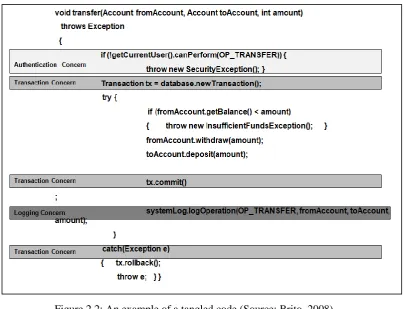
Figure 2 shows an example of tangled code. There are three concerns, Authentication, Transaction and Logging, which do not belong to this particular method according to the business logic of the method but they are yet present in the code.
2.4
Aspect-Orientation
[image:23.595.112.517.232.541.2]Software Engineering is an evolving field and it keeps on improving with the innovation and new ideas to improve modularity, reusability and extensibility of the systems. Kiczales (1997) suggested that contemporary approaches follow a dominant decomposition criterion which cannot capture all the existing concerns. The problem was named as tyranny of the dominant decomposition by Tarr et al (1999) who described that once a decomposition criterion is decided, all the concerns are captured according to that particular criterion
23
leaving other concerns scattered if they do not meet the criterion. History tells us that the majority of development techniques are introduced at the programming level and later are extended to the other phases of the development life cycle. For example, the most renowned technique, object-oriented programming, was introduced in a language named SIMULA-67 but today requirement analysis and design notations have also been developed for the object-oriented paradigm, such as Unified Modelling Language.
Aspect-Orientation was also introduced at the programming level. It started with the introduction of an extended C language named as Composition Filters by researchers at the University of Twente, Netherlands in 1992 (Bosch and Aksit, 1992), followed by Adaptive Programming (Lieberherr, 1996) and Aspect-Oriented Programming (Kiczales, 1997). With the passage of time, Requirements analysis and design strategies were also introduced for all these programming paradigms.
There are two different approaches to separation of concerns, Symmetric and Asymmetric (Harrison et al., 2002). Symmetric approaches employ a single type of construct for both crosscutting and non-crosscutting concerns, thus maintaining symmetry in the representation of both types of concerns, whereas Asymmetric approaches employ two (or more) different kinds of constructs (more detail is given in section 2.6).
2.5
Aspect-Oriented Programming
Object-Oriented programming (Meyer, 1988) is probably the most popular programming paradigm today. The reason behind this paradigm‟s popularity is its ability of encapsulation and separation of concerns in the form of objects to promote reusability. However, after enjoying two decades of popularity, object-oriented programming started to be questioned as well, just like functional programming and structured programming, on its inability to capture non-functional concerns in separate implementation units (in OO case, objects). As discussed in the earlier section, there are some concerns, such as security and persistence, which cannot be contained in single objects. Their scattered nature compels object-oriented programmers to write them redundantly in multiple places in the program.
24
constructs called aspects. This way these concerns are easily identified, implemented, documented and maintained and they are also easily reused and extended.
The following sections provide a detailed description of aspects and their key constituent elements, such as join points, pointcuts and advices. For the sake of consistency, the banking example will be followed to learn the concepts of an aspect and its key elements.
2.5.1 Aspects and Key Elements
As described earlier, a crosscutting concern is a functional or non-functional concern of the system whose implementation is spread over multiple system modules. Such concerns have a scattered nature and cause code tangling problems. Aspect-Oriented programming separates crosscutting concerns from the system and implements them as distinct modular constructs called aspects.
Aspects contain the implementation of the crosscutting concern in the form of advices.
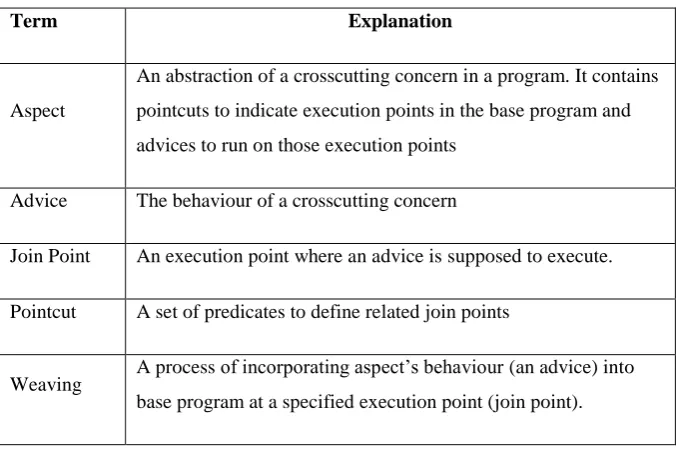
[image:25.595.143.482.471.699.2]Advices are just like methods and are executed at join points in the base system. A join point is a point where a particular aspect has to run its behaviour. Sometimes there are multiple join points where a particular advice of an aspect has to run so these join points are gathered in a set called a pointcut. Definitions of key terms of aspect are given in Table 1.
Table 2.1: Explanation of aspectual terms
Term Explanation
Aspect
An abstraction of a crosscutting concern in a program. It contains pointcuts to indicate execution points in the base program and advices to run on those execution points
Advice The behaviour of a crosscutting concern
Join Point An execution point where an advice is supposed to execute.
Pointcut A set of predicates to define related join points
25
2.6
Symmetric and Asymmetric Aspect-Orientation
Symmetric approaches treat all concerns of the system equally without dealing with any construct differently because of its nature. The asymmetric approaches, on the other hand, provide different techniques for specifying, designing and implementing aspect-oriented constructs (aspects) and non-aspect-oriented constructs (base elements). Such approaches additionally provide composition rules to compose both types of constructs together at the implementation level.
Symmetry is usually implemented on composable entities, join points and composition relationships (Harrison et al., 2002). The symmetry in designing composable entities entails component-component composition, where each entity is represented as a component. Each component is similar in nature, behaviour and associations. The examples of such components include subjects (Clarke et al., 1999) and Themes (Clarke and Baniassad, 2005). The asymmetric design, on the other hand, implements aspect-component composition, where aspects and components are designed using different methods. The composition of both the constructs is then modelled using composition rules. Aspect technology is a prime example of implementation of asymmetric entities. Join Point symmetry is only defined on the static composition of aspect-oriented constructs (when the composition is performed on lexical basis) (Bálik and Vranić, 2012), so existing AO approaches hardly apply it. The relationship asymmetry is implemented by an element if it defines within its body other elements that it is supposed to be composed with (as AspectJ has aspects that define composable elements in form of pointcuts). The symmetry in relationship is achieved when the information about relationship is kept outside the body of elements (Bálik and Vranić, 2012).
In the following subsections, we will discuss AO approaches that implement symmetric and asymmetric aspect-orientations.
2.6.1 Symmetric Aspect-Oriented Approaches
26
one controlled experiment mentioned by Rashid et al., (2010). Subject-Oriented programming is also a symmetric language.
Symmetry in aspect-orientation starts from the requirements engineering phase. Some of the oriented requirements engineering approaches that implement symmetric aspect-orientation are discussed below:
Concern-Oriented AORE Approach
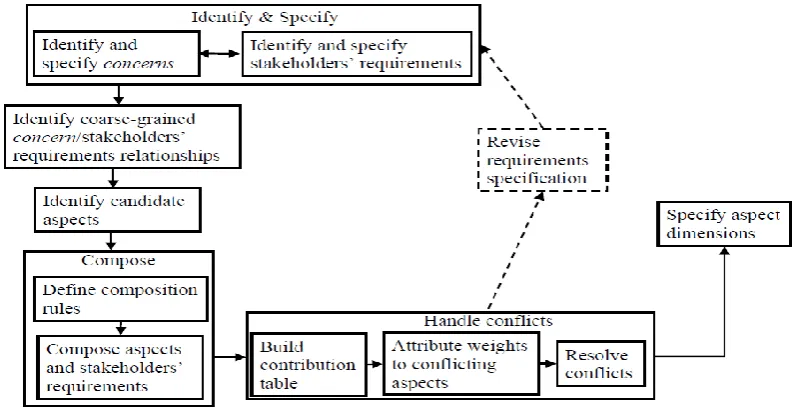
Concern Oriented approach was proposed by Moreira et al (2005a, 2005b) to address the so called tyranny of dominant decomposition. This approach views a system as a set of various concerns which are subsets of abstract concerns.
Figure 2.3: Concern-Oriented Requirements Engineering Process (Source: Moreira, 2005a)
27
2.6.2 Asymmetric Aspect-Oriented Approaches
PARC AOP ((Kiczales et al., 1997) and AspectJ are the prime examples of tools implementing asymmetry of constructs. AspectJ defines aspect-oriented constructs separately and composes them with base classes during the weaving process.
Grundy (1999) and Rashid et al. (2002, 2003) are considered to be some of the earliest approaches that introduction aspect-orientation in requirements engineering. Some of the other renowned requirements engineering approaches that implemented asymmetric aspect-orientation are discussed below:
Use Cases Based AORE Approach
Jacobson (2003) proposed that systems should be designed by breaking down use case diagrams into use case slices and use case modules as overlay on top of classes. These overlays can then be composed using any suitable aspect-oriented technology to form a complete system. Jacobson (2003) suggested that use cases are crosscutting concerns as their realization spans over multiple classes.
In (Jacobson and Ng, 2005) the authors have also presented a method for aspect-oriented software development with use cases. They have extended traditional use cases with two more elements, pointcuts and artefacts for use case slices and use case modules:
Pointcuts have been represented as sets of related join points which are represented by extension points (Jacobson, 2003)
28
Figure 2.4: A typical use case in AOSD with Use Cases Approach
(Source: Jacobson and Pan-Wei, 2005)
Figure 4 shows a typical description of a use case in this approach. The template <Perform Transaction> represents capturing of a non-functional requirement. A non-functional requirement is represented as an extension of a use case. The advantage of representing non-functional requirement in a template is that it helps in visualizing the context of a requirement and it also aids in identification of extension points.
AORE Using Theme/Doc
29
Figure 2.5: Theme/Doc Process (Adopted from: Chitchyan et al, 2005)
The Theme/Doc approach supports identification of aspects by capturing concerns with shared requirements at action view. It then verifies the design decision at the augmentation view. The approach provides good traceability as one can map requirements from Theme/Doc views to Theme/UML models.
AORE Component-Based Approach
In this approach, components are identified using any component based requirements analysis approach and then aspects are identified either by separating crosscutting features in the components or by using component specification and design information (Filman, 2005). The approach was introduced to identify aspects in reusable components. This is an asymmetric aspect-oriented approach as it only handles crosscutting concerns (Brito, 2008).
AORE with Arcade
30
2.7
Comparison of Aspect-Oriented Requirements Engineering
Approaches
There are weaknesses in almost all of the AORE approaches mentioned above. An overview of problems with each approach is given below:
The Aspect-Oriented Component Requirements Engineering Approach is only specific to component-based development and does not support other development paradigms. In addition, the approach does not help in identifying aspects from every component and it also lacks tool support.
AORE with Arcade is the most cited aspect-orientedrequirements engineering approach. It is a simple and straight forward approach that provides a multi-dimensional separation of concerns through the development lifecycle, which makes it more traceable compared to other AORE approaches.
AORE with Use Cases approach is similar to UML. It does not provide any mechanism to handle conflicts. Since this approach forms use case slices and use case modules for all the concerns of the system so it can be regarded as a symmetric approach.
Concern-Oriented AORE approach provides a multi-dimensional mechanism to separate concerns from requirements. As this technique is applied on all concerns so it can be regarded as a symmetric approach. It provides support to effectively manage early
trade-Figure 2.6: The process model for AORE with Arcade approach
[image:31.595.109.508.83.287.2]31
offs and negotiations among stakeholders. This approach is also equipped with a tool support.
Theme/Doc AORE approach is although a mature approach, it still lacks in providing support to specify and compose concerns in a systematic way despite being useful at the requirements analysis level. It also does not support traceability scalability as the technique becomes so complicated and cumbersome due to the size of Theme Views required for large systems.
2.8
Discussion
It is hard to say which approach is better, symmetric or asymmetric. If we look at the record of adoption of both the approaches, asymmetric approaches have received more recognition and have been adopted in industry more than symmetric approaches. The reason probably is the traditional Separation of Concerns concept. It is always more convenient and rather comprehensible to keep crosscutting and non-crosscutting concerns separate during the entire development life cycle until they are composed with each other dynamically. In one of the current research projects by Bálik and Vranić (2012), it has been argued that there are always concepts in the proclaimed asymmetric approaches that can be considered as symmetric. For example, peer uses case and features in the analysis and design techniques and traits (Scala), open classes (Ruby), or prototypes (JavaScript) in the programming languages. Similarly, inter-type declarations and advices can also be considered as symmetric concepts if everything is modelled using aspects and the base code is kept as thin as possible. In this case, intertype declarations can be used to define structure and initial method bodies. Advices can then implement the behaviour. This correlation suggests that asymmetric approaches can always be evolved to be symmetric if it is desired. It is also suggested that neither approach can be hailed to be better than the other; rather it is their functionality and efficacy that matters.
2.9
Chapter Summary
32
with examples. A banking example has been selected to demonstrate implementation of an aspect and its constituent elements.
33
Chapter 3:
Aspect-Oriented Design Approaches
Aspect-Oriented design has been perceived differently by different researchers. Some put modularity of the system as their first objective and some consider composition of aspects with base constructs as the most important factor. This chapter discusses some of the well-known aspect-oriented design approaches in the light of these different characteristics, and provides a detailed literature survey of this area of the research.
3.1
Software Design
One of the pioneering software design methodologists, J. Christopher Jones, commented in his book, Design Methods: Seeds of Human Futures (Jones, 1970), that design methodologies have been moving away from „drawings and patterns‟ in the notion of design. The same applies to contemporary design methodologies. Software Design methodologies started appearing in 1950s and 1960s and with time it became an established scientific field. Many researchers have described design in their own way. Lawson (1980) and Dasgupta (1989) described design projects as a combination of real or perceived needs where a need acts as a motivational starting factor for initiating a design project. Similar description has been provided by Willem (1990) who says that integral feature of a design is devising of a plan or prototype for the development of something new. Some design methodologists believe that software design is a symbolic representation of an artefact for implementation (Zhu, 2005) and some consider design as a simulation of a work that we want to do for a number of times until we develop the final product (Freeman, 1980). Simon (1973) explained design as the restructuring of a current product to develop a preferred product and Page (1966) described design as an „imaginative jump from present facts to future possibilities‟.
3.2
Aspect-Oriented Design
34
specification. Requirements are shaped into implementable elements, entities or functions in a software design. Due to the complexity of contemporary systems, software design must provide support for the abstraction of system elements and separation of concerns. Object-oriented programs are usually designed in the Unified Modelling Language (UML). UML provides both behavioural and structural representation of the system. For example, for behavioural representation interaction diagrams and state diagrams are used and for structural representation object and class diagrams. UML also allows designers to show the abstraction level of the classes of the system. If we evaluate the ability of UML for separation of concerns, we will have to evaluate object-oriented programming first since UML is an object-oriented modelling language. Object-orientation encapsulates the business logic of concerns within objects. Objects are the units of development in Object-Oriented Programming (OOP). There are some concerns of the system which are not fully handled in OOP, such as performance, persistence, fault-tolerance, etc. Such concerns affect or have connection with more than one object, thus, their representation and code is scattered over the system. Such scattered nature of code causes tangling problem of code. To counter these problems, aspect-oriented programming (AOP) has been proposed that implements such tangled and scattered elements as aspects.
To design aspects, a number of aspect-oriented design approaches have been introduced over the years. Aspect-oriented design (AOD) approaches allow designers to design aspects, their constituent elements, features and associations. They also provide mechanisms to connect aspects‟ behaviour (advices) to their corresponding join points in the base program. Some of the well-known AOD approaches are discussed in detail in the following sections.
3.3
Aspect-Oriented Design and Modelling Approaches
35
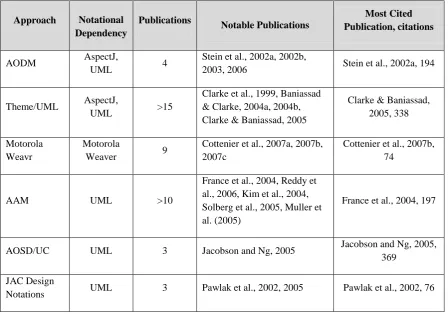
[image:36.595.85.534.445.759.2]The other common property among existing modelling approaches is extension of UML notations. Some of them have used UML profiles while some extended UML metamodels. There are only a few which are not based on UML, such as Sutton and Rouvellou, (2005) and Suvee´ et al. (2005). To the best of our knowledge, there are thirty UML-based approaches, namely; Grundy (2000), Ho et al. (2002), Zakaria et al. (2002), Stein et al. (2002a), Kande et al. (2003), Rausch et al. (2003), Von (2004), Ivers et al. (2004), Clarke and Baniassad (2005), Elrad et al. (2005), Pawlak et al. (2005), Reddy et al. (2006a), Coelho and Murphy (2006), Cottenier et al. (2007a), Fuentes et al. (2007), Jacobson and Ng (2005), Krechetov et al. (2006), Katara and Katz (2007), Klein et al. (2007), Lau et al. (2007), Paula and Batista (2007), Bustos and Eterovic (2007), Fuentes et al. (2007), Whittle et al. (2007), Albunni and Petridis (2008), Cui and Xu (2009), Li et al. (2010), Guessi et al. (2011), Gupta et al. (2011) and Evermann et al. (2011). We will only be discussing eight out of these thirty approaches. The reason behind the selection of these approaches is their maturity (number of publications and total citations), and similarity with AODL with respect to proposed notations. A brief summary of notational dependency and number of publications of these eight approaches has been provided in Table 3.1.
Table 3.1 - Graphic Nodes included in Join Point Identification Diagrams
Approach Notational Dependency
Publications
Notable Publications
Most Cited Publication, citations
AODM AspectJ,
UML 4
Stein et al., 2002a, 2002b,
2003, 2006 Stein et al., 2002a, 194
Theme/UML AspectJ,
UML >15
Clarke et al., 1999, Baniassad & Clarke, 2004a, 2004b, Clarke & Baniassad, 2005
Clarke & Baniassad, 2005, 338
Motorola Weavr
Motorola
Weaver 9
Cottenier et al., 2007a, 2007b, 2007c
Cottenier et al., 2007b, 74
AAM UML >10
France et al., 2004, Reddy et al., 2006, Kim et al., 2004, Solberg et al., 2005, Muller et al. (2005)
France et al., 2004, 197
AOSD/UC UML 3 Jacobson and Ng, 2005 Jacobson and Ng, 2005, 369
JAC Design
36
Klein‟s
Approach UML 9 Klein et al., 2005, 2006, 2007 Klein et al., 2006, 90
SUP MSC 5 Aldawud et al., 2003; Elrad et al., 2005
Aldawud et al., 2003, 132
There are a number of properties that an AOD approach must possess to be considered as an effective approach. A number of evaluation criteria for aspect-oriented modelling approaches have been proposed based on these properties, some of the noted ones are by Wimmer et al. (2011), Blair et al. (2005), Chitchyan et al. (2005), Op de beeck et al. (2006), and Reina et al. (2004). We have chosen some of the most important properties and have assessed the selected eight approaches against each property. AODL has also been evaluated against these properties (along with some additional general software design properties) in Chapter 6. These properties are as follows:
Language: There are some means adopted by AOD approaches to specify and design concerns. Some approaches adapt or extend a modelling language, such as UML, and some propose their own language or design methodology. The language contains artefacts, notations and diagrams to specify and model concerns, their behaviour and associations. The languages that adapt UML either utilize UML notations or extend some of the notations to specify constructs.
Design process: A design approach must follow a defined design process, containing a set of activities to design concerns from specification to composition. Some approaches offer a well-defined design process and some suggest an implicit way of designing concerns in the form of manuals and guidelines. This parameter has also been adopted by Op de beeck et al. (2006) and Wimmer et al (2011) to evaluate AOD approaches.
37
Modelling of Structural and Behavioural Crosscuttings: A design methodology offers support for both structural and behavioural modelling of concerns and their constituent elements. For instance, in UML, class diagram, component diagram and object diagram are used to depict structural associations and state machines, activity diagrams and interaction diagrams are used to show behavioural properties of the system. Similarly, an AOD language must also offer both types of representation for system concerns.
Concern Composition: Once crosscutting concerns are modelled as aspects, they are composed with base classes through predicates defined in their pointcuts. The composition is required to be modelled before implementation so that aspect interference and conflicts are identified and resolved.According to Kojarski and Lorenz (2006) there are two types of asymmetric compositions, pointcut-advice composition and static crosscutting composition and one type of symmetric composition usually known as compositor. The pointcut-advice composition provides a representation of internal compositions of an aspects and static crosscutting depicts the relationships between aspects and base classes. The compositor mechanism, on the other hand, contains identification of composable element, specification of match method and development of integration strategy describing how the matched elements will proceed after composition (Wimmer et al., 2011).
Conflict Resolution: Conflicts arise as a result of aspect composition. There could be a number of general, domain-related or application-related conflicts that can be encountered during aspect compositions but we will only talk about two of the most common conflicts. One is the shared join point problem, which occurs when two aspects try to impose their behaviour at a join point simultaneously. The second is aspect interference, which arises when an aspect changes or disturbs the definition of a join point or an aspect. The modelling approaches which propose composition strategies must also support conflict resolutions.
38
3.3.1 Aspect-Oriented Design Modelling (AODM)
The Aspect-Oriented Design Modelling (AODM) approach proposed by Stein at al., (2002a and 2002b) is an asymmetric design approach which was developed initially for the AspectJ programming language. It later evolved into a more generic approach by providing support for composition filters and adaptive programming besides AspectJ (Stein et al., 2002c, 2003, 2006).
Language
UML has been adopted as the basis for representation and specification of aspects. New notations and diagrams have been introduced which are extended versions of UML artefacts. Though there have been some efforts for turning the approach into a generic one, it still relies heavily on AspectJ platform.
Design Process
The design process is missing in AODM. There are no guidelines provided about the order of usage of the diagrams. The approach does address the majority of the design issues of aspect-oriented design, such as static crosscutting, dynamic crosscutting and composition, but it does not provide a step-wise set of activities to design these issues in order.
Concern Specification
AODM argues that an aspect is similar in structure to a UML class. It also considers pointcuts and advices similar to UML operations. Figure 3.1 shows these claimed similarities.
(a) Similarity between a pointcut and an operation (b). Similarity between ad advice and an operation
Aspects are contained in a class-like container and are represented with a
stereotype<<aspect>> to distinguish them from classes (as shown in Figure 3.2).
39
Modelling of Structural and Behavioural Crosscuttings
AODM supports both structural and behavioural types of crosscuttings. The structural crosscutting, which is also known as static crosscutting, involves the introduction of new data types or members of the base class. These additional base characteristics used to be known as “Introductions” in the earlier versions of AspectJ, but now they are known as Inter-type declarations. AODM uses UML parameterized template collaboration diagrams as containers to hold the depiction of structural crosscuttings, as shown in Figure 3.3. UML class diagrams and sequence diagrams are exploited to represent the crosscutting, and templates of the collaboration are used to hold information about the base types.
AODL represents behavioural crosscutting by specifying advices with a stereotype <<advice>>, as shown in Figure 3.2. As stated before, AODM considers advices similar to UML operations so they are represented like them. The problem is that they do not have a distinct identifier; they are represented with the signature of the pointcut they are related with. To counter this problem, AODM introduces pseudo identifiers.
[image:40.595.212.390.69.273.2]Figure 3.2: Representation of an aspect in AODM (Stein et al., 2002a)
40 Concern Composition
In AODM, composition is captured in a package that contains two types of diagrams (shown in Figure 3.4). The first diagram, which is shown at the left side of Figure 3.4, represents the structure of join points with the help of class diagrams where aspectual behaviour will be woven in. The right side of diagram depicts the behaviour of the join points with the help of sequence diagrams. The crosscutting is depicted in a class diagram with a “crosscutBy” property shown against the operation that contains the join point. The template of the package diagram contains the information about the aspect that is crosscutting the base classes. The join point is depicted with the help of sequence diagrams where the actual location of a join point is indicated with the help of stereotypes, for instance, in Figure 3.4, <<call>> of op1() has been depicted.
Figure 3.5 shows how a collaboration containing a join point is split into three sub-collaborations to show the insertion of advices at before, around and after a method call.
Figure 3.4: Join Point Indication Diagram (Stein et al., 2002c)
41 Conflict Resolution
There is no comprehensive conflict resolving mechanism provided by AODM. There is only support for resolving conflicts regarding priority of execution of aspects with the help of a stereotype <<dominates>> (Stein et al., 2002a). This stereotype points from an aspect whose priority is greater to the one with lesser priority.
Limitation and Weakness of AODM Approach
AODM treats aspects as UML classes which is a problematic comparison. The issue has been discussed in detail in (Iqbal and Allen, 2009). As discussed in this paper, classes are object-oriented elements. They are fundamentally encapsulating, inheritable and instantiable constructs. If we assess aspects based on these properties, we first of all find aspects contradicting the basic principle of encapsulation (or data-hiding). Aspects do have their own data but they also access other classes‟ private data to perform their functionality. For example, Security and Logging aspects need to access the private data of the interacting base classes, which is a clear violation of object-oriented encapsulation. Secondly, Inheritance can partially be implemented in aspects. Aspects can have child aspects but child aspects cannot override advices of the parent aspect because parent aspect‟s advices do not have unique signatures or identifiers. Finally, instantiation of aspects is not similar to that of classes either. Aspects are instantiated on need, not on demand like classes and objects. Their instantiation cannot be coded within the program; rather their instantiation depends on defined control points (join points) during the execution of the program. This dynamic nature of aspects‟ instantiation again contradicts the behaviour of classes and objects.