Changes in behaviour and salivary cortisol following targeted cognitive training in typical 12-month-old infants.
Sam V. Wass (1,2) (*), Clare Cook (3), Kaili Clackson (2)
1 – Department of Psychology, University of East London, UK 2 – Department of Psychology, University of Cambridge, UK
3 – Medical Research Council Cognition and Brain Sciences Unit, Cambridge, UK
* - Corresponding author
Correspondence address: University of East London, Stratford Campus, Water Lane, London E15 4LZ.
Email: [email protected]
Acknowledgements:
Title: Changes in behaviour and salivary cortisol following targeted cognitive training in typical 12-month-old infants.
Abstract: Previous research has suggested that early development may be an optimal period to implement cognitive training interventions, particularly those relating to attention control, a basic ability that is essential for the development of other cognitive skills. In the present study, we administered gaze-contingent training (95 minutes across 2 weeks) targeted at voluntary attention control to a cohort of typical 12-month-old children (N = 24) and sham training to a control group (N = 24). We assessed training effects on (a) tasks involving non-trained aspects of attention control: visual sustained attention, habituation speed, visual recognition memory, sequence learning and reversal learning; (b) general attentiveness (on-task behaviours during testing) and (c) salivary cortisol levels. Assessments were administered
immediately following the cessation of training and at a 6-week follow-up. On the immediate post-test infants showed significantly more sustained visual attention, faster habituation and improved sequence learning. Significant effects were also found for increased general attentiveness and decreased salivary cortisol. Some of these effects were still evident at the 6-week follow-up (significantly improved sequence learning and marginally improved […] sustained attention). These findings extend the emerging literature showing that attention training is possible in infancy.
Introduction
A number of authors in recent years have advocated the desirability of early interventions (Heckman, 2006; Shonkoff & Levitt, 2010; Sonuga-Barke, Koerting, Smith, McCann, & Thompson, 2011). The arguments that they present can be summarised in two strands. First, that development is an ongoing, dynamic, interactive process, and so targeting causal mechanisms early in disordered
development may be more effective than waiting until outcomes are established and then trying to reverse the pathogenic process (Karmiloff-Smith, 1998; see also Stipek & Valentino, 2015). Second, that convergent evidence from lesion studies (Spencer-Smith et al., 2005), computational modelling (Baughman & Thomas, 2008) and functional neuroimaging (Johnson, 2015) suggests that plasticity (i.e. the capacity to effect change) in brain and behaviour should be greater early in development (see Sonuga-Barke et al., 2011; Wass, 2014).
Consistent with this, a recent systematic review looked at the effects of cognitive training – i.e. training one cognitive domain to assess the degree to which
improvements are observed as a result of training to other, disparate cognitive domains (Wass, 2014). The review evaluated how the effects of cognitive training varied as a function of age (comparing children, young adults and older adults). It was found that studies targeting younger participants reported significantly more
Cognitive training studies with older children have tended to focus on the cognitive domains of attention control (e.g. Rueda, Checa, & Combita, 2012) and working memory (e.g. Klingberg et al., 2005). This is because these cognitive domains are
thought to play a special role as ‘domain-general’ skills that are involved in mediating subsequent learning across a variety of disparate cognitive domains (Johnson, 2012; Rose, Feldman, & Jankowski, 2012; Scerif, 2010). Recent research has suggested that this ‘domain-general’ role for attention control and working memory may be more important during early development. For example, Stipek and Valentino, using data from 6000 children who were assessed 5/6 times between the ages of 3 and 15, found that the relationship of working memory and attention with academic outcomes was strong and positive in early childhood, but declined in later years (Stipek & Valentino, 2015). This is consistent with evidence from other sources suggesting that early voluntary attention mediates learning in other domains (Cornish, Cole, Longhi, Karmiloff-Smith, & Scerif, 2012; Rose, Feldman, & Jankowski, 2012; Scerif, 2010; Wass, 2014).
inhibition, task switching and short-term memory for objects embedded in scenes. 95 minutes’ training was administered across four visits spread over 2 weeks.
Immediately after training, relative to an active control group, increased cognitive control and visual sustained attention as well as reduced attention disengagement latencies and saccadic reaction time latencies were observed: no changes in short-term memory were found (Wass et al., 2011). Similar training effects were found in studies by Ballieux and colleagues, in a small cohort of infants from low socio-economic status backgrounds (Ballieux et al., 2016). Forssman and colleagues
observed similar behavioural changes following training, and also assessed transfer to table-top assessments of naturalistic social attention (Mundy et al., 2003). They found that training led to significant changes in responding to social communication, but to no changes in infants’ initiating of social communication (Forssman, Wass, & Leppanen, (under review)).
The present study aimed to extend this work in three ways: First, by examining transfer of training to previously untested aspects of attention control; second, by examining the effect of training on salivary cortisol, a potential neurobiological correlate; third, by assessing the persistence of training effects over time.
(preferential looking to a novel, relative to a previously familiarised image) (Rose, Feldman, & Jankowski, 2012). Performance on several of these tasks during infancy has been shown to associate positively with long-term developmental outcomes: for example, infants’ rate of change of looks upon repeated presentations of a stimulus shows reliable long-term associations with IQ and other general cognitive measures (Colombo & Mitchell, 2009); and visual recognition memory during infancy
selectively associates with working memory, as assessed at 11 years (Rose, Feldman, Jankowski, & Van Rossem, 2012). We also included two measures used in previous studies, to assess whether previous training effects replicated in this, new sample. These were (4) visual sustained attention (infants’ peak look duration towards a novel, previously unseen object) (Wass et al., 2011) and (5) reversal learning (speed of unlearning a previously learnt rule) (Kovacs & Mehler, 2009). Finally, we included a more general behavioural measure, namely (6) attentiveness (looking behaviour towards the stimulus presentation area) during the administration of the entire testing battery. This measure can be compared to similar measures of on-task behaviours (general attentiveness during the experimental testing procedure) used in older children with Attention Deficit Hyperactivity Disorder (Green et al., 2012).
physiological reactivity by adopting self-regulation strategies in naturally occurring, stressful contexts (Aksan & Kochanska, 2004; Rothbart, Ellis, Rueda, & Posner, 2003; Sheese, Rothbart, Posner, White, & Fraundorf, 2008). These include presenting unfamiliar, aversive masks to infants (Sheese et al., 2008) – or simply attending a lab-based testing session, surrounded by unfamiliar people, places and equipment (Blair, 2010). Previous research has suggested that attention training may led to an increased use of social referencing during the exploration of novel objects (Wass et al., 2011), and to an increased likelihood of following social cues (Forssman et al., (under review)). This hypothesis would predict that training an infant’s attention control would lead, via altered self-regulation strategies in naturally occurring stressful contexts, to reduced levels of salivary cortisol. Of note, related forms of attention and training have been shown, in adults, to lead to reductions in resting salivary cortisol (Tang et al., 2009; Tang & Posner, 2009), but to our knowledge no previous work has explored these relationships in younger populations.
To address the third aim, the persistence of the effects of training, we tested not only immediately after the cessation of training, but conducted a follow-up assessment 6 weeks after the completion of the initial, two-week training phase. Comparable studies with older children have generally found that training effects, where detectable, tend to be maintained at intervals ranging from two months to a year (Dunning et al., 2013; Klingberg et al., 2005; Rueda, Rothbart, McCandliss,
As in the previous studies, five training sessions were administered over an average of two weeks. Half the participants completed a battery of gaze-contingent attention training tasks; the other half were controls, who attended the same number, duration and spacing of visits as the trained infants. Pre-post tests were administered at the beginning and end of the initial 2-week training phase, and at follow-up 6 weeks after the final training session.
Based on previous research (Ballieux et al., 2016; Forssman et al., (under review); Wass et al., 2011) we predicted that training would lead to changes in behaviour on all the behavioural measures of attention control. Of note, one previous study found that training led to no changes in working memory (Wass et al., 2011), but these were thought to be due to methodological problems with the assessment task used
Methods
Participants and Study Design
The study involved 48 typically developing infants who were each invited to visit the lab on six separate occasions. The sample size was selected using power analyses based on previous research that reported an effect size of 0.69 for the visual sustained attention measure (Wass et al., 2011). Based on this we calculated that a total of 48 participants (24 per group) was required, which allowing for 10% attrition would give 82% power for two-tailed significance of 0.05 using analysis of covariance with baseline-outcome correlation of 0.6.
Participants were recruited from the volunteer participant pool at XXX. The recruitment area for this study, XXX, is a wealthy university town and participants were predominantly Caucasian. No participating families reported any major psychiatric or other clinical conditions within the immediate family. Following recruitment, and prior to their first contact with the experimental team, they were randomly allocated to one of three groups: the trained group (N=24), control group 1 (N=12) and control group 2 (N=12) (see below for description of control groups). Participants’ mean (S.E.M.) age in days at visit 1 was: trained group - 360 (23), control group 1 - 363 (22), control group 2 - 358 (25) days. The gender split was 11/24 male for the trained group, 4/12 male for control group 1 and 5/12 male for control group 2.
immediately by a T/C session (which serves as a booster session for the intervention group). Visits 6 repeated the post-assessment battery. Visits 5 took place within mean 17 (sd 8) days of visit 1, and Visits 1-5 were evenly distributed throughout this period. Visit 6 took place within 67 (sd 14) days of visit 1.
Of 48 infants initially recruited 8 withdrew between visits 1 and 5 (4/2/3 for T/C1/C2), due either to the child or a member of their family falling ill during the initial two week-phase (N=4), meaning that they could not complete the sessions within the allocated time, or to infant fussiness (N=4). No further participants withdrew prior to visit 6.
Equipment and Protocols
All testing materials were presented using a Tobii TX300 eyetracker recording at 120Hz and Matlab, Psychtoolbox and the Matlab SDK. The monitor subtended c.30° of visual angle. All external sources of lighting were occluded during testing, and participants were lit with a single, diffuse light source above the tracker, at c.300 lux. Lighting was consistent for all participants. Participants were seated on their parent’s lap during testing. Parents were requested not to talk to their child during testing.
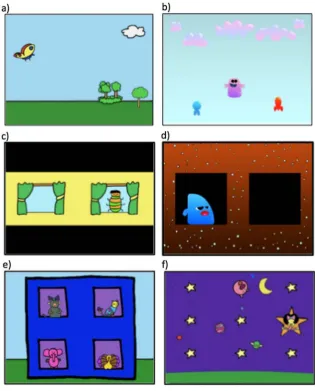
although occasionally sessions were curtailed earlier if the infant became irritable. Screenshots of the training stimuli are shown in Figure 1, and more in-depth descriptions are given in the Supplementary Materials.
Mean (S.E.M.) training time per task across all training sessions was 177 (13) seconds for the FlyMe game, 250 (14) for Puzzle Memory, 201(13) for Butterfly, 276(13) for Stars, 223(14) for Suspects and 262(12) for Windows.
INSERT FIGURE 1 HERE
Task 1 (Butterfly) – A target (a butterfly) was presented on the screen. When the child
fixated the target it moved from left to right and distractors scrolled in the opposite direction. When the child looked to any of the distractors, the display froze. The number and salience of the distractors changed adaptively contingent on performance. This task requires the child to maintain their fixation on one target (the butterfly), whilst suppressing the pre-potent response to look to moving distractors in the periphery. This task requires focused attention and inhibition.
Task 2 (FlyMe) – A target was presented on-screen. When the child fixated the target
it moved and distractors appeared. When the child looked to any of the distractors, they disappeared. The number and salience of the distractors changed adaptively contingent on performance. This task has similar cognitive demands to Task 1.
Task 3 (Windows) – When the infant fixated the target, it disappeared into one of
back to the cued window, s/he received an animation as a reward. The length of the delay, and the number of hiding locations, changed adaptively contingent on performance. This task requires visuospatial short-term memory.
Task 4 (Puzzle Memory) – When the infant fixated a character, an animation showed
it becoming occluded in one of several locations. After a delay, if the child looked back to the cued location and maintained their gaze there, a reward was triggered. Previously found targets remained on-screen as distractors in subsequent trials. The length of the delay, and the number of hiding locations, changed adaptively
contingent on performance. This task targeted visuospatial short-term memory and inhibitory control.
Task 5 (Suspects) - One of two possible targets (either an elephant or a chicken) was
presented with one or more distractors. When the infant ‘found’ the target within a time limit, they received an animation as a reward. The number of distractors varied adaptively with performance. Between blocks of 12 trials, the target changed. This task targets attention shifting and flexible search for changing targets, whilst ignoring distractors.
Task 6 (Stars) – One of five possible targets (cartoon characters in brightly coloured
Control protocol.
All control participants attended the same number of sessions, with the same equipment and testers as the trained infants. Control sessions had the same duration and spacing as the training sessions. This was ensured by pairing control participants individually with trained participants, to ensure that each control session had the same duration as that of a paired trained infant.
Control group 1 (N=12) watched non-contingent infant-appropriate animations and TV clips on the eyetracker, following the protocol used for the active control group in previous studies (Wass et al., 2011; Ballieux et al., 2016). A variety of clips were selected from YouTube and TV programs. No single clip lasted more than 2 minutes in duration. Control group 2 (N=12) viewed stimuli that were identical with the training stimuli except that they did not respond contingently to the child’s gaze. Instead of triggering responses based on the eyetracking data being recorded live, changes in the presentation were instead triggered from the pre-recorded gaze data for a matched participant from the trained group.
Control group 1 follows the control protocol used in previous studies with both infants (Ballieux et al., 2016; Wass et al., 2011) and children (Rueda, Rothbart, et al., 2005). Control group 2 follows what is recognised as the ‘gold-standard’ procedure for cognitive training research (e.g. Holmes, Gathercole, & Dunning, 2009; Klingberg et al., 2005) – insofar as participants are exposed to visually identical stimuli across the trained and control groups. We wished to examine whether any possible
Groups 1 and 2. A series of analyses were conducted using the same analytical strategy as used for the main results below, in order to examine whether any difference in performance could be observed between the two control groups. No significant differences were observed (all ps>.15), and so results have been pooled for the main analyses. (See Supplementary Materials for further details.)
Pre-post assessments
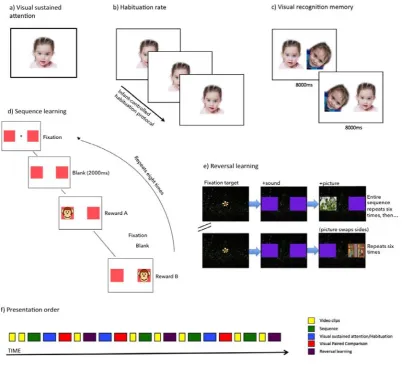
Figure 2 shows a schematic of the pre-post assessments administered. The battery lasted approximately 20 minutes and consisted of a series of experiments in which different blocks were presented inter-leaved. The order of block presentation (shown on Figure 2) was identical for all participants. All experimenters were blinded to expected study outcomes. All Matlab scripts used for stimulus presentation and data analysis have been supplied with this manuscript.
INSERT FIGURE 2 HERE
complete data were only available for 18 of the 48 participating infants, and so results from this experiment have been excluded.
Visual sustained attention/Habituation.
A still image was presented, subtending 7°, consisting of a child’s face against a white background (see Figure 2 for example). The image was presented in silence. An experimenter, watching a live video feed of the child from behind a curtain, coded whether they were looking at the screen using a key press. When the child had looked away for one second or more, this marked the end of the trial. The same image was then presented again. The same image was presented until the child had completed two consecutive looks at less than 50% of the longest look that trial (Colombo & Mitchell, 2009). If the child has not met the habituation criteria within 120 seconds of accumulated looking time or within 12 trials, the habituation protocol was aborted and the block was excluded. A refixation target was presented between trials, to ensure that the infant was looking at the screen at the start of each trial. The fidelity of the hand-coding was assessed by comparing the hand-coding with the eyetracker coding (the automatic detection of whether the child was looking at the screen), giving an acceptable reliability of .78. […] Three blocks of this experiment were presented, at different stages of the testing protocol (see Figure 2).
previous research, looks to criterion was found to be heavily positively skewed; this was corrected for by taking the reciprocal.
Visual recognition memory
This task was presented in three blocks, immediately following the visual sustained attention/habituation experiment. The previously familiarised image was presented concurrently with a novel image – each subtending 7°. The images were presented in one Left-Right order for 8000 ms, and then the order was swapped for the subsequent 8000 ms (Rose, Feldman, & Jankowski, 2012). Piloting work ensured that the pairs of stimuli used were of equal salience (i.e. attracted equal attention when both were unfamiliar). A refixation target was presented between trials, to ensure that the participant was looking to the screen at the start of each trial.
Binocular eyetracking data were averaged to monocular data, and smoothed using a continuous 150ms moving window. Proportion looking to the novel target was calculated as time spent viewing the unfamiliar target, divided by the time spent viewing both the familiar and the unfamiliar target combined.
Sequence learning
subtending 8°. After 2000ms a target (subtending 3°) appeared in one of two locations (following a LRLRLRLR sequence that was counterbalanced between blocks). As soon as the participant had looked to the target (or immediately if they had looked during the 2000ms anticipatory window), a reward lasting 2500ms was triggered in which the object became larger on screen (up to 8°) and an entertaining sound was played. The next trial started immediately, on completion of the previous trial.
Binocular eyetracking data were averaged to monocular data, and smoothed using a continuous 150ms moving window. Anticipatory looks were defined as a look in which the gaze entered the target location either during the 2000ms anticipatory window or within 300ms of the target appearing. Within-block learning was indexed by calculating the change in proportion of correct to incorrect anticipations between the second half and first half of each block.
Reversal learning
The duration between the start of the audio and the end of the trial (i.e. the end of the video) was 5000ms.
Binocular eyetracking data were averaged to monocular data and smoothed using a continuous 150ms moving window. Anticipatory looks were defined as a look in which the gaze entered the target location either during the 2000ms anticipatory window or within 300ms of the target appearing. Reversal learning was indexed by calculating the proportion of correct to incorrect anticipations after the reversal had taken place.
On-task behaviours
In order to provide a general index of each child’s attentiveness towards the stimulus presentation area during the administration of the complete pre- and post-testing battery, the average duration of all the periods during which the child attended to the screen during the entire session was calculated. In all infants, periods of general attention towards the tasks were interspersed with periods of fussiness, during which they refused to participate in testing and had their attention re-attracted to the screen before the start of the next trial. This measure can therefore be compared to other studies that measure the frequency of on-task behaviours (including the absence of behaviours such as fidgeting and getting up and moving) in older children with ADHD (Green et al., 2012).
with the eyetracker (Wass, Forssman, & Leppanen, 2014). The average duration of data segments obtained after interpolation was then calculated. The measure was found to be independent of between-individual variations in eyetracking data quality – such as flickeriness (a measure of the reliability of contact with the eyetracker)
(p=.18) (Wass et al., 2014).
Salivary cortisol
Cortisol was recorded twice at each pre-post test session: once immediately following the child’s arrival at the lab and once on the completion of the testing battery. Two measures were calculated based on these data: first, average cortisol levels, calculated as the average of the first and second readings; second, cortisol reactivity, calculated as the difference between the first and the second readings.
Parents were instructed to ensure that their child had not eaten or drunk within 30 minutes of their arrival at the lab, and experimenters verbally confirmed this on the child’s arrival. Samples were collected using a hydrocellulose microsponge
Due to a delay in obtaining ethical permission for the cortisol collection component of the study, cortisol collection was not attempted for the children enrolled early in the study. In addition a small number (<10%) of infants refused to provide a sample, or provided insufficient saliva for analysis (similar to as previously – see e.g. Goldberg et al., 2003). 32 (15 T/17 C) participants provided usable cortisol data at pre-test, 31 (15 T/16 C) at post-test, and 28 (13 T/15 C) at 6-week follow-up.
Consistent with previous research (Blair et al., 2011) we found a weak positive association in our pre-test data between the time of day of the sample collection and cortisol level (r=.18). In order to preclude the possibility that this factor might influence our results we ensured that, as far as possible, the time of day of each pre- and post-assessment was kept constant for each participant. Results showed a high degree of consistency: average visit time was 12:05 for the pre-assessment and 11:55 for the post-assessment for the trained group, and 11:55/11:30 for the pre-/post-assessments for the control group. In addition, the change in time of day between pre- and post-assessment has been calculated for each individual and included as a
Results
Performance at training tasks. In order to assess whether infants were improving with
repeated training, the performance levels for the six training tasks were collapsed in z-scores (separately for each task) and pooled into a single, composite measure to index how well that individual had performed at each training session. To examine change in performance over time a repeated measures ANOVA was conducted. This was conducted just on the data from training sessions 2, 3 and 4, as at visits 1 and 5 infants had already completed a 20-minute pre- and post-test assessment battery and so were already fatigued before the start of training. Sessions 2, 3 and 4 were, in contrast, dedicated training sessions, and so performance changes across these sessions could be directly compared. A RM ANOVA suggested that significant improvements in performance were observed across the training sessions (F(2,42)=9.19, p<.001).
INSERT FIGURE 3 HERE
Analytical strategy for pre-post tests.
To examine the effects of the training intervention on the different tasks, we conducted a set of ANOVAs with the factor Group (trained vs control), post-assessment scores as the dependent variable and pre-post-assessment scores as the
covariate (following Klingberg et al., 2005). Outliers were first excluded according to
effect sizes are given as partial η2, reflecting the proportion of explained variance in
the dependent measure.
Visual sustained attention
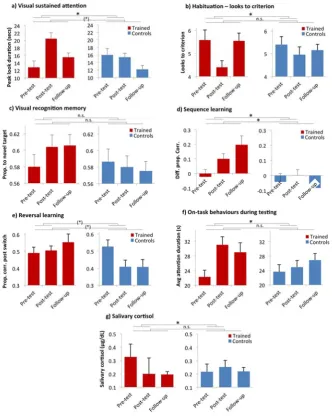
IQRs were inspected. No outliers were excluded at pre-test, one outlier (1T) was excluded at test and 2 (1T/1C) were excluded at the 6-week follow-up. At post-test a significant effect of Group was observed, suggesting an increase in visual sustained attention as a result of training: F(1,39)=6.67, p=.01, partial η2=.15. At
6-week follow-up a marginally significant effect of Group was observed: F(1,38)=4.03, p=.052, partial η2=.10.
Habituation (looks to criterion)
IQRs were inspected and no outliers were excluded. At post-test a significant effect of Group was observed, with training resulting in faster habituation (fewer looks to criterion): F(1,40)=4.60, p=.04, partial η2=.11. At 6-week follow-up no significant
effect of Group was observed: F(1,40)=1.67, p=.20, partial η2=.04.
Visual recognition memory
IQRs were inspected and one outlier was excluded (post-test, 1 T). At post-test no significant effect of Group was observed F(1,39)=1.45, p=.24, partial η2=.04. At
6-week follow-up no significant effect of Group was observed: F(1,40)=1.45, p=.24, partial η2=.04.
IQRs were inspected and one outlier was excluded (6-week assessment, 1 C). At post-test a significant effect of Group was observed, with training leading to faster
sequence learning: F(1,40)=4.60, p=.038, partial η2=.11. At 6-week follow-up a
significant effect of Group was observed: F(1,39)=10.7, p=.002, partial η2=.23.
Reversal learning
IQRs were inspected and no outliers were excluded. At post-test a marginally significant effect of Group was observed, with training leading to faster reversal learning: F(1,40)=3.00, p=.09, partial η2=.073. At 6-week follow-up a marginally
significant effect of Group was observed: F(1,40)=3.73, p=.061, partial η2=.089.
On-task behavior
IQRs were inspected and three outliers were excluded: pre-test: 0; post-test: 2 (1T, 1C); 6-week: 1 (1C). At post-test a significant effect of Group was observed, with training resulting in an increase in general attentiveness: F(1,38)=6.26, p=.017, partial η2=.15. At 6-week follow-up no significant effect of Group was observed:
F(1,39)=.68, p=.41, partial η2=.018.
Salivary cortisol
IQRs were inspected and the following outliers were excluded: pre-test: 1 (1T); 6-week: 1 (1T); 6-6-week: 3 (1T, 2C). At post-test a significant effect of Group was observed, suggesting a decrease in salivary cortisol as a result of training:
F(1,28)=4.25, p=.049, partial η2=.14. At 6-week follow-up no significant effect of
as the change in cortisol between the first and second recordings, showed no effect of Group: F(1,18)=.31, p=.59, partial η2=.019.
Discussion
We administered gaze-contingent training targeted at voluntary attention control to a cohort of typical 12-month-old children. Training-related changes were assessed, relative to an active control group, by administering a pre- and post-testing battery consisting of non-trained tasks assessing voluntary attention control. In addition we recorded the frequency of on-task behaviours during testing, and salivary cortisol. Post-assessments were administered immediately on the completion of the 2-week training phase, and 6 weeks after the completion of the initial training phase.
Our first aim for this study was to examine transfer of training to previously untested aspects of attention control. Here, we found that training led to a significantly faster habituation rate, to superior performance on a sequence learning task and to increased general attentiveness during testing (more on-task behaviours). In addition, we also replicated our previous findings that training led to significant changes in visual sustained attention and reversal learning – although in this case it should be noted that the reversal learning findings were only trend-level significance (Wass et al., 2011). Further, it should be noted that the change on the reversal learning measure was driven by a greater decrement in performance in the control group rather than an increase in performance in the trained group – a pattern that others have argued may lead to spurious training effects (Redick, 2015). This pattern was not observed on the other tasks.
orienting. In previous research we also found that the training led to faster saccadic reaction times (Wass et al., 2011). What is the most parsimonious explanation of these diverse changes in behaviour? One possibility is that all of the changes are mediated by increased voluntary (endogenous) control over eye movements (Johnson, 1990). Depending on context, this factor might lead in some situations to longer looking behaviour, in others to faster reaction times, and in others to more accurate orienting. Thus it is possible, for example, that sequence learning may have been improved after training, despite the fact that learning sequences was not directly a component of the training, because training led to an increase in the accuracy of endogenous anticipatory eye movements based on a previously learnt pattern
(Johnson, Posner, & Rothbart, 1991). Of note, the capacity to make endogenous eye movements is thought to be trace at this age, and to only start to emerge around the 12-month age boundary, and may therefore well be a factor limiting performance on the sequence learning task (Johnson et al., 1991, Colombo & Cheatham, 2006).
The findings of longer look durations towards novel objects (i.e. increased peak look
towards novel objects (Courage, Reynolds, & Richards, 2006). Thus, increased initial look duration and a faster subsequent fall-off of looks may both be effects of
increased endogenous (voluntary) control over orienting behaviours as a result of training.
The only task in the assessment battery not to show any changes immediately post training was the visual recognition memory task. This is consistent with previous findings, where no significant change was observed on a short-term memory task (Wass et al., 2011). This may be because, although closely related to attention control (Astle & Scerif, 2011) short-term memory is one of the hardest subcomponents of emergent executive function capacities, and the capacity for short-term memory storage is too weak at this age to show reliable training effects (although see Oakes, Baumgartner, Barrett, Messenger, & Luck, 2013). Of note, however, non-significant changes in the predicted direction were observed independently across all three
post-assessments for this task, as they had been in the previous study.
testing session, as well as in both recordings individually). We did not find that training led to changes in cortisol reactivity (the difference between the two
recordings taken at the beginning and end of the session) (cf Blair, Granger, & Razza, 2005; Haley, Weinberg, & Grunau, 2006). The mechanism underlying this change may be that increased attention skills induced by training may lead to better self-regulatory capacities that extend to the child’s interactions with the natural
environment (Rothbart et al., 2003). Consistent with this, previous research has found that training led to some increase in infants’ use of social referencing (Wass et al., 2011), as well as to greater responsiveness to social cues (Forssman et al., (under review)).
Although novel, and potentially exciting, there are several reasons why caution should be exercised with regard to the cortisol finding. First, the sample size for this analysis was lower than for the other measures, mainly due to technical delays in securing ethical approval. Second, due to random sampling differences between the groups, the trained group showed higher cortisol levels at pre-test than the trained group, raising the possibility that the training-related reduction in cortisol levels observed could simply be regression to the mean. However, the ANCOVA that we used controls for randomly occurring differences between groups at pre-test. Of note, and despite the consistent training-related reductions in cortisol that we identified, we also observed strong associations between pre- and post-test cortisol levels in the trained group (Pearson’s r=.65).
visit, training effects were detectable for visual sustained attention, looks to criterion, sequence learning, reversal learning (marginal), on-task behaviours during testing and resting salivary cortisol. At the follow-up assessment, changes were observed for the sequence learning task, and only marginal effects were observed for the reversal learning and visual sustained attention tasks. Thus, some dissipation of training effects was observed over the 6 weeks between the last training session and the follow-up appointment, as is consistently found in other studies. Of note, the total dose of training administered in the present study (95 minutes over 4 sessions) was substantially less than that administered in equivalent studies with older children (600 minutes over 20-25 sessions), and it may be that training regimes that administer a larger dose of training would find more long-lasting training effects. Future work should, therefore, investigate the effects of more long-term, continuous training regimes. Of note, recent research has investigated the effects of applying working memory training to children continuously, over an entire academic year, and noted training-related changes in reading and maths ability (Soderqvist & Nutley, 2015) that were not observed in equivalent studies that administered smaller doses of training (Dunning et al., 2013).
References
Aksan, N., & Kochanska, G. (2004). Links between systems of inhibition from infancy to preschool years. Child Development, 75(5), 1477-1490.
doi:10.1111/j.1467-8624.2004.00752.x
Astle, D. E., Barnes, J. J., Baker, K., Colclough, G. L., & Woolrich, M. W. (2015). Cognitive Training Enhances Intrinsic Brain Connectivity in Childhood. Journal of Neuroscience, 35(16), 6277-6283.
doi:10.1523/jneurosci.4517-14.2015
Astle, D. E., & Scerif, G. (2011). Interactions between attention and visual short-term memory (VSTM): What can be learnt from individual and developmental differences? Neuropsychologia, 49(6), 1435-1445.
doi:10.1016/j.neuropsychologia.2010.12.001
Ballieux, H., Wass, S. V., Tomalski, P., Kushnerenko, E., Karmiloff-Smith, A., Johnson, M. H., & Moore, D. G. (2016). Training attention control outside the lab: applying gaze-contingent training to infants from diverse SES
backgrounds. Journal of Applied Developmental Psychology, 43, 8-17. Baughman, F. D., & Thomas, M. S. C. (2008). Specific impairments in cognitive
development: a dynamical systems approach. Paper presented at the Cognitive
Science Society, Austin, Texas.
Blair, C. (2010). Stress and the Development of Self-Regulation in Context. Child Development Perspectives, 4(3), 181-188.
Blair, C., Granger, D. A., & Razza, R. A. (2005). Cortisol Reactivity Is Positively Related to Executive Function in Preschool Children Attending Head Start. Child Development, 76(3), 554-567.
Blair, C., Granger, D. A., Willoughby, M., Mills-Koonce, R., Cox, M., Greenberg, M. T., . . . Investigators, t. F. (2011). Salivary Cortisol Mediates Effects of
Poverty and Parenting on Executive Functions in Early Childhood. Child Development, 82(6), 1970-1984.
Colombo, J., & Cheatham, C. L. (2006). The emergence and basis of endogenous attention in infancy and early childhood. Advances in child development and behavior, 34, 283-322.
Colombo, J., & Mitchell, D. W. (2009). Infant visual habituation. Neurobiology of learning and memory, 92(2), 225-234. doi:10.1016/j.nlm.2008.06.002
Cornish, K., Cole, V., Longhi, E., Karmiloff-Smith, A., & Scerif, G. (2012). Does attention constrain developmental trajectories in fragile x syndrome? A 3-year prospective longitudinal study. American journal on intellectual and
developmental disabilities, 117(2), 103-120.
doi:10.1352/1944-7558-117.2.103
Courage, M. L., Reynolds, G. D., & Richards, J. E. (2006). Infants' attention to patterned stimuli: Developmental change from 3 to 12 months of age. Child Development, 77(3), 680-695.
Dilalla, L. F., Plomin, R., Fagan, J. F., Thompson, L. A., Phillips, K., Haith, M. M., . . . Fulker, D. W. (1990). Infant predictors of preschool and adult IQ - a study of infant twins and their parents. Developmental Psychology, 26(5), 759-769. doi:10.1037/0012-1649.26.5.759
Dunning, D. L., Holmes, J., & Gathercole, S. E. (2013). Does working memory training lead to generalized improvements in children with low working memory? A randomized controlled trial. Developmental Science, 16(6), 915-925. doi:10.1111/desc.12068
Forssman, L., Wass, S. V., & Leppanen, J. M. ((under review)). Training basic visual attention transfers to more complex cognitive and socio-cognitive skills in infancy. .
Green, C. T., Long, D. L., Green, D., Iosif, A.-M., Faye Dixon, J., Miller, M. R., . . . Schweitzer, J. B. (2012). Will Working Memory Training Generalize to Improve Off-Task Behavior in Children with Attention-Deficit/Hyperactivity Disorder? Neurotherapeutics, 9(3), 639-648.
Haley, D. W., Weinberg, J., & Grunau, R. E. (2006). Cortisol, contingency learning, and memory in preterm and full-term infants Psychoneuroendocrinology, 31(1), 108-117.
Heckman, J. J. (2006). Skill formation and the economics of investing in disadvantaged children. Science, 312(5782), 1900-1902.
doi:10.1126/science.1128898
Johnson, M. H. (1990). Cortical Maturation and the Development of Visual Attention in Early Infancy. Journal of Cognitive Neuroscience, 2(2), 81-95.
Johnson, M. H. (2012). Executive function and developmental disorders: the flip side of the coin. Trends in Cognitive Sciences, 16(9), 454-457.
Johnson, M. H. (2015). Developmental Cognitive Neuroscience, 4rd Ed. Oxford, UK: Wiley-Blackwell.
Johnson, M. H., Posner, M. I., & Rothbart, M. K. (1991). Components of visual orienting in early infancy - contingency learning, anticipatory looking, and disengaging. . Journal of Cognitive Neuroscience, 3(4), 335-344.
doi:10.1162/jocn.1991.3.4.335
Karbach, J., & Unger, K. (2014). Executive control training from middle childhood to adolescence. Frontiers in Psychology, 5, 390.
Karmiloff-Smith, A. (1998). Development itself is the key to understanding developmental disorders. Trends in Cognitive Sciences, 2(10), 389-398.
Klingberg, T. (2010). Training and plasticity of working memory. Trends in Cognitive Sciences, 14(7), 317-324. doi:10.1016/j.tics.2010.05.002
Klingberg, T., Fernell, E., Olesen, P. J., Johnson, M. H., Gustafsson, P., Dahlstrom, K., . . . Westerberg, H. (2005). Computerized training of working memory in children with ADHD - A randomized, controlled trial. Journal of the
American Academy of Child and Adolescent Psychiatry, 44(2), 177-186.
Kovacs, A. M., & Mehler, J. (2009). Cognitive gains in 7-month-old bilingual infants. Proceedings of the National Academy of Sciences of the United States of
Mundy, P., Delgado, C., Block, J., Venezia, M., Hogan, A., & Seibert, J. (2003). A Manual for the Abridged Early Social Communication Scales. University of
Miami.
Oakes, L. M., Baumgartner, H. A., Barrett, F. S., Messenger, I. M., & Luck, S. J. (2013). Developmental changes in visual short-term memory in infancy: evidence from eye-tracking. Frontiers in Psychology, 4.
doi:10.3389/fpsyg.2013.00697
Pilgrim, K., Ellenbogen, M. A., & Paquin, K. (2014). The impact of attentional training on the salivary cortisol and alpha amylase response to psychosocial stress: Importance of attentional control Psychoneuroendocrinology, 44, 88-99.
Redick, T. S. (2015). Working memory training and interpreting interactions in intelligence interventions. Intelligence, 50, 14-20.
doi:10.1016/j.intell.2015.01.014
Rose, S. A., Feldman, J. F., & Jankowski, J. J. (2012). Implications of infant cognition for executive functions at age 11. Psychological science, 23(11),
1345-1355. doi:10.1177/0956797612444902
Rose, S. A., Feldman, J. F., Jankowski, J. J., & Van Rossem, R. (2012). Basic information processing abilities at 11 years account for deficits in IQ associated with preterm birth. Intelligence, 39(4), 198-209.
doi:10.1016/j.intell.2011.03.003
Rueda, M. R., Checa, P., & Combita, L. M. (2012). Enhanced efficiency of the executive attention network after training in preschool children: immediate changes and effects after two months. Developmental Cognitive Neuroscience, 2 Suppl 1, S192-204. doi:10.1016/j.dcn.2011.09.004
Rueda, M. R., Posner, M. I., & Rothbart, M. K. (2005). The development of executive attention: Contributions to the emergence of self-regulation. Developmental Neuropsychology, 28(2), 573-594. doi:10.1207/s15326942dn2802_2
Rueda, M. R., Rothbart, M. K., McCandliss, B. D., Saccomanno, L., & Posner, M. I. (2005). Training, maturation, and genetic influences on the development of executive attention. Proceedings of the National Academy of Sciences of the United States of America, 102(41), 14931-14936.
doi:10.1073/pnas.0506897102
Scerif, G. (2010). Attention trajectories, mechanisms and outcomes: at the interface between developing cognition and environment. Developmental Science, 13(6), 805-812. doi:10.1111/j.1467-7687.2010.01013.x
Sheese, B. E., Rothbart, M. K., Posner, M. I., White, L. K., & Fraundorf, S. H. (2008). Executive attention and self-regulation in infancy. Infant Behavior & Development, 31(3), 501-510. doi:10.1016/j.infbeh.2008.02.001
Shonkoff, J. P., & Levitt, P. (2010). Neuroscience and the Future of Early Childhood Policy: Moving from Why to What and How. Neuron, 67(5), 689-691. doi:10.1016/j.neuron.2010.08.032
Soderqvist, S., & Nutley, S. B. (2015). Working Memory Training is Associated with Long Term Attainments in Math and Reading. Frontiers in Psychology, 6. doi:10.3389/fpsyg.2015.01711
Sonuga-Barke, E. J. S., Koerting, J., Smith, E., McCann, D. C., & Thompson, M. (2011). Early detection and intervention for attention-deficit/hyperactivity disorder. Expert Review of Neurotherapeutics, 11(4), 557-563.
doi:10.1586/ern.11.39
Spencer-Smith, M., Anderson, P., Jacobs, R., Coleman, L., Long, B., & Anderson, V. (2005). Does Timing of Brain Lesion Have an Impact on Children's Attention? Developmental Neuropsychology, 36(3), 353-366. doi:Pii 935854074
10.1080/87565641.2010.549983
Stipek, D., & Valentino, R. A. (2015). Early Childhood Memory and Attention as Predictors of Academic Growth Trajectories. Journal of Educational Psychology, 107(3), 771-788. doi:10.1037/edu0000004
Tang, Y. Y., Ma, Y. H., Fan, Y. X., Feng, H. B., Wang, J. H., Feng, S. G., . . . Fan, M. (2009). Central and autonomic nervous system interaction is altered by short-term meditation. Proceedings of the National Academy of Sciences of the United States of America, 106(22), 8865-8870. doi:10.1073/pnas.0904031106
Tang, Y. Y., & Posner, M. I. (2009). Attention training and attention state training. Trends in Cognitive Sciences, 13(5), 222-227. doi:10.1016/j.tics.2009.01.009 Wass, S. V. (2011). Gaze-contingent concentration training for infants. . Unpublished
PhD thesis, Birkbeck, University of London.
Wass, S. V. (2014). Applying cognitive training to target executive functions during early development. Child Neuropsychology. doi:DOI
Wass, S. V., Forssman, L., & Leppanen, J. (2014). Robustness and Precision: How Data Quality May Influence Key Dependent Variables in Infant Eye-Tracker Analyses. Infancy, 19(5), 427-460.
Wass, S. V., Porayska-Pomsta, K., & Johnson, M. H. (2011). Training attentional control in infancy. Current biology, 21(18), 1543-1547.
doi:10.1016/j.cub.2011.08.004
Figure 1: Screenshots of training tasks. A) Task 1 (Butterfly). The butterfly scrolled
left to right while the child looked directly at it, with moving distractors (trees and
clouds) scrolling from right to left presented in the child’s peripheral field. If the child
looked to the distractors, they disappeared and the scrolling stopped. b) Task 2
(FlyMe). The purple character (centre) scrolled upwards as long as the child looked
directly at it. Static and moving distractors appeared from the top and bottom of the
screen. If the child looked to the distractors, the character sank downwards and the
distractors disappeared. c) Task 3 (Windows). A target (the bug) was presented in one
location on screen. All windows then closed and fixation target (a red flower)
a look back to the cued window triggered a reward. d) Task 4 (Puzzle Memory). When
the child looked to the blue character, occluders covered the two locations, and then
a refixation target was presented. Looking back to the cued window triggered a
reward. Previously found targets remained on-screen, as distractors, for subsequent
trials. e) Task 5 (Suspects). A target (the elephant) was presented along with a range
of distractors. If the child looked to the target within a time window, they received a
reward. Once per block of 12 trials, the target changed. Targets from the previous
block (the chicken) were presented concurrently with the current target, as
distractors. f) Task 6 (Stars). A target (the orange star) was presented on-screen
along with a number of static and moving distractors. If the child looked to the target
within a time window, (s)he received a reward. Both target and distractors changed
Figure 2: schematics showing the pre-post assessment battery. a) Visual sustained
attention: a novel image was presented to a child, and the child’s peak look duration
was recorded; b) Habituation: the same image was presented repeatedly to the child,
and the change in look durations over time was recorded; c) Visual recognition
memory: a previously habituated image was presented together with a novel image
and the proportion of looking time to each picture was measured; d) Sequence
learning: an object appeared in an ABABABAB sequence; eye movements during the
anticipatory window were measured; e) Reversal learning: a reward appeared on one
side for six trials, before swapping and appearing on the other side for the subsequent
Tasks were presented in blocks of approximately 1-2 minutes in duration,
Figure 3: Raw results obtained for our pre-post measures. a) Visual sustained
attention; b) Habituation – looks to criterion; c) Visual recognition memory; d)
Sequence learning; e) Reversal learning; f) On-task behaviours during testing; g)
Salivary cortisol. Stars show the significance of the ANOVA analyses reported in the
main text. * indicates an ANOVA that was significant at p<.05; (*) indicates a