2017 2nd International Conference on Computer Science and Technology (CST 2017) ISBN: 978-1-60595-461-5
Quantum Teleportation Channel Capacity Coding
Dong-fen LI, Rui-jin WANG
a*,Hao LUO, Edward Baagyere,
Feng-li ZHANG, Xin-yun WANG and Xue-qin CHENG
School of Information and Software Engineering, University of Electronic Science and Technology of China, Chengdu, Sichuan 610054, China
*Corresponding author
Keywords: Quantum teleportation, Multiple degrees of freedom, Quantum capacity, Graph-state basis, Concatenated code.
Abstract. In this paper, we use the idea of quantum Graphic Cascade Coding, information security and quantum random coding to construct an immune noise channel, by using the normal state of pattern tree chart and forest chart, to make large diagonal matrices or blocks, in order to perform quantum coding operations under multiple degrees of freedom. Through calculation and analysis of different concatenated code channel capacity, we get the formula of different noise channels in multi-channel coherence information under the coder multiple degrees of freedom. By this, we can quickly calculate the coherence information of various concatenated codes in the channel, the approximation of the channel capacity and the noise margin of the channel transmission quantum, and analyze the different anti-noise performance of different cascaded codes in different parameter channels. And, thus, we can obtain the security regions where different noise channels can transmit quantum information.
Introduction
In recent years, we witnessed the eavesdropping scandal and user privacy disclosure event that exacerbated the information security concerns within the community of users of network services [1]. The "Prism door" and "Jindong Mall" incidents leaked a large number of sensitive information, events that point to the fact that more need to be done at China's national level in order to manage some of these information security crises [2]. However, the existing classical communication encryption method is not safe. These classical cryptographic algorithms are mostly constructed using large prime numbers couple with the use of huge amount of computing power in order to transmit secret information in a secure manner by protecting the privacy and integrity of sensitive information. Thus, this kind of security is depended on the computational complexity of the cryptographic algorithm used [3]. For example, the RSA algorithm, whose security is reduced to large integer factorization, is an NP problem. However, according to Moore's Law, the computing power of the processor is exponentially increasing, and thus, under the attack of malware and Trojan, it makes the cracking of such classical encryption algorithms easier, and which often lead to the leakage of sensitive information.
carry and efficient parallel processing capabilities, is therefore hard to crack the password using these technology, which is as strong as "spear".
Quantum teleportation (QT) is a technique of quantum entanglement distribution and quantum measurement. It transmits an unknown quantum state to a distant place, by realizing the spatial transfer of the quantum state without the transport of the physical carrier, it has the advantages of high reliability, low communication complexity and resource saving. Therefore, the QT solves traditional communication encryption algorithm problems of been easily cracked and that of monitoring of the information transmission process. These properties of the QT technique are the "shield" that guarantee the security of network information.
QT is an essential element of quantum information processing and also an important element of practical quantum technology. It plays an important role in large-scale quantum computing, long-range quantum communication and practical quantum computing networks. The core resource of QT is quantum entanglement, that is, when the quantum state superposition principle is reflected in the multi-particle or multi-degree of freedom system, there will be a unique phenomenon of quantum mechanics—quantum entanglement [5][6]. When the physical system and the noise environment are coupled to each other, it will accelerate the increase of quantum decoherence. At the same time, quantum entanglement will also occur leading to entanglement attenuation, and even entanglement sudden death problem [7] [8]. The channel capacity problem seriously affects the quality of quantum communication under noise environment and it is quantum teleportation under single degree of freedom. The reason is that in many applications, people often do not need to do more than the degree of freedom of quantum positioning, but only in a state to operate. How to improve low capacity communication under single degree of freedom is what these works seeks to address.
Related Work
In 2008, Winter et al. proposed the quantum capacity of symmetric quantum channels and private capacity, and gives the corresponding theorem and expression [9]. In the literature [10] the advantage of the asymmetric channel is used, but did not take into account the practical problems in the quantum channel which are the difficulties involve in maintaining a maximum entanglement state and the consuming of large entangled resources and other issues. In 2013, Kesting calculated the noise margins of different quantum codes under the Pauli environment, in the depolarized channel; they get the optimal encoding of different quantum concatenated codes [11]. In the same year, Chen et al. used information theory security and quantum random coding theory, secure capacity coding model based on noise channel to prove the message authentication capacity under strong security conditions [12]. From 2014 to 2015, Li et al. use the properties of hyper-entanglement state which is easy to prepare, easy to measure and easy to implement, to construct entangled exchange of quantum cryptography channel, and proposed a highly efficient ultra-dense coding method based on hyper-entanglement, effectively improving the channel utilization and capacity in quantum communication [13] [14] [15]. Afterwards, scholars spread and form the CSS construction theorem of quantum coding, it becomes an effective way of classical coding to construct quantum coding, and analyzes the quantum channel capacity in entanglement assistance, and which been widely used [16-17].
construct the unitary transformation matrix, purify the quantum channel with a certain probability to achieve dense coding and quantum error correction code. And thus, the receiver cannot completely distinguish the transmitted quantum state, the channel capacity also does not reach the theoretical value, and it cannot contain the needs of long-distance quantum teleportation.
The Design of Cascade Coding Schemes for Quantum State Under Multiple Degrees of Freedom
In this paper, we use the idea of quantum Graphic Cascade Coding, information theory security and quantum random coding theory to construct an immune noise channel by using the normal state of the pattern of tree chart and forest chart to make large diagonalzed matrices or blocks in order to performs quantum coding operations under multiple degrees of freedom. Through calculation and analysis of different concatenated code channel capacity, we can get the formula of different noise channel in multi-channel coherence information under the coder multiple degrees of freedom. We can then quickly calculate the coherence information of various concatenated codes in the channel, the approximation of the channel capacity and the noise margin of the channel transmission quantum, and analyzes the different anti-noise performance of different cascaded codes in different parameter channels, and obtains the security regions where different noise channels can transmit quantum information.
The coding properties are as follows:
Suppose N is the channel capacity, ρis input state, channel coherence information
is ( , )I ρ N =S N[ ( )]ρ −S I[ A⊗N(ψAP)], ψAP is the purified state ofρ , IA is the
identity operator that is acting on the auxiliary systemA, quantum single shot capacity
is Q N1( ) max ( , )I N ρ
ρ
= . Suppose ρn is the total input state of the input channel,
n
N⊗ is the function of n parallel channels N , the quantum coding capacity
is ( ) lim1 1( n)
n
Q N Q N
n ⊗
→∞
= . For quantum bit channels, suppose ρcis
n bit code quantum
state, the output state of quantum channel isσc = N⊗n(ρc). Supposeσc =N⊗n(ρc) is the purified state ofρc, then c n( AC AC)
A
I N
ρ = ⊗ ⊗ ψ ψ , the average information for
each channel is CN 1[ ( C) ( AC)]
I S S
n σ σ
= − .
Then cascade coding schemes for quantum state under multiple degrees of freedom can be designed as follows:
Step 1: If C
k k k k
G G
ρ =
π is Figure diagonal state of figure state basis, πk isthe probability of Gk , 0≤πk ≤1and k 1
k
π =
, k is a bit string of length n,then
1, ,...,2 n
k k k k
G = G . In the kraus operator summation representation,
, , , [0,1], 1
x y z x y z
p p p f∈ f = −p −p −p is channel fidelity, Single-channel pairs of
state is C C †
aEa Ea
σ
=
η
ρ
. If the channel combined output state isσAC, then it can be expressed as AC,sm tl
σ
, and according to orthogonal basis of chart state, we canget ( ), ( ) ( 1)a
k a
P AC
i i j a
a E Z K
i k j j k
σ π π η
∈
⊕ ⊕ =
− .Step 2: Suppose n1 is Internal Code of Tree diagram, n2 is outside code, the
concatenation code is n1×n2 , then the total input quantum state
is 1( 00...01 00...01)
2
C G G G G
ρ = + . The joint output state can be divided and the matrix can be constructed if divided, where e a
a
η =
η satisfy k e aE ∈Z K , and
0 a
a
η =
η satisfy k 0a
E ∈Z K . ηeand η0is eigenvalue of σAC, When the error operator
is Z Z1 2...Zi, then
1
11...100...0 i n i
k
−
= , and ηe =ai, η0=bi, if bit string x is unchanged, The
eigenvaluesηeand η0are invariant, when the error operator is
1 1 2... i n
Z Z Z Z , then degree
of simplicity is
1 1
i n
C − . Related information of tree diagram
is 1 1
1 1 1 0 ( , ) ( ) ( ) ( ) n n
C C AC i
n i
I
ρ
N Sσ
Sσ
C A B− ⊗
− =
= − =
− .Step 3: If
2
1 2 ... n
K =K ⊗K ⊗ ⊗K is stable subgroups of n1×n2Forest diagram, each
subgroup
2
j
K corresponds to j2 tree, accompany set isE=Z Kk , consists of n2 parts
of k
Z . In the tree diagram, it have li and si belongs to Z Z1 2...Zi type and
1 1 2... i n
Z Z Z Z type, it satisfy 2 1 2 0 ( ) n i i i
l s n
−
=
+ =
. The contribution value of the eigenvalue ofthe joint output state is 1
1
0
o o o o i i i i i i n
l l l s s s
i i i i
i
a b c d
−
− −
=
∏
. Then sum all the elementsK, and analyzethe forest diagram, output the eigenvalues of σc, and then get the corresponding degree
of degeneracy which is 2
1 1
!
2 ! ! 1
0
1 ( )i i n
l s i
n i i i
n C l s − + − =
Δ =
∏
and channel average coherenceinformation of 2 2 2
, 1 2
1 { [ 'log ( ') log ( ) log ( )]} CN
e e o o
l s
I
n n η η η η η η
=
− + + .
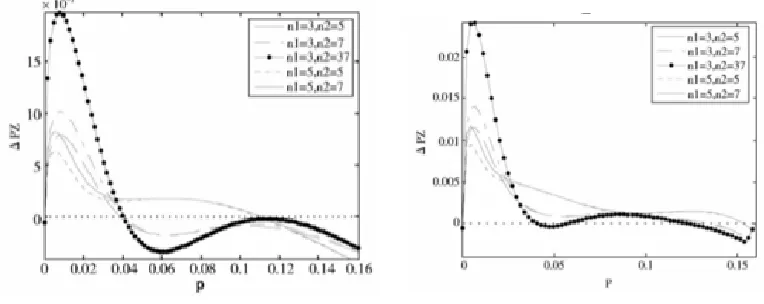
For different concatenated codes, when tan
θ
=Py /Px , take the two
Figure 1. tan
θ
=Py/Px,θ
=0. Figure 2. tanθ
=Py /Px,π
/ 4.Analysis and Summary
The two figures show that quantum teleportation channel capacity coding is a very effective method to analyze using the pattern base, and it can quickly calculate the coherent information of the various concatenated codes in the general bubble channel, by calculation and analysis of the noise margin of different concatenated codes in order to select the optimal encoding. Compared with the conventional method, it has been proven that the method of the scheme can significantly improve the calculation speed; the coding method of this paper is helpful to the research of quantum cryptography in the future.
Acknowledgement
This work is supported by Fundamental Research Funds for the Central Universities (ZYGX2014J051, ZYGX2014J066), Science and Technology projects in Sichuan Province (2015JY0178, 2016ZC2575, 2014GZ0109, 2015KZ002, 2015JY0030), National Natural Science Foundation of China (61472064).
References
[1] Huang, Chien-Cheng, and Kwo-Jean Farn. "A Study on E-Taiwan Promotion Information Security Governance Programs with E-government Implementation of Information Security Management Standardization." International Journal of Network Security 18.3 (2016): 565-578.
[2] Safa, Nader Sohrabi, Rossouw Von Solms, and Steven Furnell. "Information security policy compliance model in organizations." computers & security 56 (2016): 70-82.
[3] Pirandola, Stefano, Jens Eisert, Christian Weedbrook, Akira Furusawa, and Samuel L. Braunstein. "Advances in quantum teleportation." Nature Photonics 9, no. 10 (2015): 641-652.
[5] Zuppardo, Margherita, Tanjung Krisnanda, Tomasz Paterek, Somshubhro Bandyopadhyay, Anindita Banerjee, Prasenjit Deb, Saronath Halder, Kavan Modi, and Mauro Paternostro. "Excessive distribution of quantum entanglement." Physical Review A 93, no. 1 (2016): 012305.
[6] Obando, Paola C., Fagner M. Paula, and Marcelo S. Sarandy. "Trace-distance correlations for X states and the emergence of the pointer basis in Markovian and non-Markovian regimes." Physical Review A 92, no. 3 (2015): 032307.
[7] Špička, V., Th M. Nieuwenhuizen, and P. D. Keefe. "Physics at the FQMT'11 conference." Physica Scripta 2012, no. T151 (2012): 014001.
[8] Inoue, K. "Quantum noise in parametric amplification under phase-mismatched conditions." Optics Communications 366 (2016): 71-76.
[9] Smith, Graeme, John A. Smolin, and Andreas Winter. "The quantum capacity with symmetric side channels." Information Theory, IEEE Transactions on 54, no. 9 (2008): 4208-4217.
[10] Shadman, Zahra, Hermann Kampermann, Chiara Macchiavello, and Dagmar Bruss. "Optimal super dense coding over noisy quantum channels." New Journal of Physics 12, no. 7 (2010): 073042.
[11] Winter, Andreas. "Tight uniform continuity bounds for quantum entropies: conditional entropy, relative entropy distance and energy constraints." arXiv preprint arXiv:1507.07775 (2015).
[12] Dong-fen Li, Rui-jin Wang, Zhang F. Quantum information splitting of a two-qubit Bell state using a four-qubit entangled state. Chinese Physical C. 2015(4):26-30.
[13] Li, Dong-fen, Rui-jin Wang, and Feng-li Zhang. "Quantum information splitting of arbitrary three-qubit state by using four-qubit cluster state and GHZ-state." International Journal of Theoretical Physics 54.4 (2015): 1142-1153.
[14] Wang, Rui-jin, Dong-fen Li, and Zhi-guang Qin. An Immune Quantum Communication Model for Dephasing Noise Using Four-Qubit Cluster State.International Journal of Theoretical Physics 55.1 (2016): 609-616.
[15] Wang, Rui-jin, et al. "Two Ways of Robust Quantum Dialogue by Using Four-Qubit Cluster State." International Journal of Theoretical Physics (2015): 1-15. [16] Kesting, Frederik, Florian Fröwis, and Wolfgang Dür. "Effective noise channels for encoded quantum systems." Physical Review A 88, no. 4 (2013): 042305.