2017 3rd International Conference on Electronic Information Technology and Intellectualization (ICEITI 2017) ISBN: 978-1-60595-512-4
Study on Air-source Heat Pump Heating
System Based on Photovoltaic Generation
Complementary with Grid
Changwei Gao, Quangang He and Weiqiang Zheng
ABSTRACT
Air-source heat pump heating system based on photovoltaic generation complementary with grid is proposed in this paper. When solar radiation is sufficient, the photovoltaic array provides power to the load. Otherwise, grid smoothly switches into the system to replace the photovoltaic array. The scheme of the system for a heating room is put forward, and the actual system is set up. Comparing with traditional heating method, operation efficiency of the system is improved significantly. Experiment results show that when photovoltaic generation replaces the grid, the distortion rate of load’s current is small, and the system run smoothly.
KEYWORDS
Index Terms—Air-source Heat Pump, Energy Saving, Photovoltaic Generation, Power Distribution Network
INTRODUCTION
A new era of electric power system is raising, it takes new energy as the main ________________________
Changwei Gao, Quangang He, College of Electrical and Information Engineering, Liaoning Institute of Since and Technology, Benxi, China, 117004
logo and strives to achieve comprehensive complementary use of multi energy[1-3]. The United States and the European Union put forward that the proportion of their utilization of renewable energy will reach 20% of the total energy consumption in 2020. China put forwards that it will reach 15% in 2020 [4]. As a typical renewable energy, solar energy has many advantages. Utilization of solar energy has become one of world’s effective measures to deal with energy and environment problems [5-7]. In the process of the development of power system, photovoltaic power generation is changing from supplementary energy to alternative energy [8,9].
Air source heat pump is a new type of high efficiency and energy saving equipment. It is driven by electric energy and consumes a little high-grade energy (electricity). It absorbs the heat energy from external environment and transfers it into the heating room. It does not produce any emission and its average thermal efficiency as high as 300% above [10]. This paper proposed an air-source heat pump heating system based on photovoltaic generation complementary with grid. The heating system take photovoltaic array and grid as the power supply at the same time, when solar radiation is sufficient, photovoltaic array provide power to the loads, when solar radiation is insufficient, grid smooth cuts added.
STRUCTURE OF THE SYSTEM
The structure of the system is shown in Figure 1. Photovoltaic array and distribution network are the power supply of the air source heat pump heating system at the same time. The direct current produced by photovoltaic array and the direct current comes from the rectifier/filter input to two diodes respectively. Because of the unidirectional conductivity of the diode, the higher voltage is inverted into alternating current (ac), then the load gain power from the distribution box. Compressor makes loop heat medium flowing. In the evaporator, medium absorbs heat from the air. In the condenser, media releases heat and heats the water at the same time. Circulating pumps convey hot water to the tank and the hot water is stored in the water tank. Water conveying pump convey hot water to the fan coil in the heating room.
heat of the outdoor air
(75%)
power consumption
(25%)
air source heat pump units of the average
thermal efficiency is 400%
the heat provided by air source heat
pump
(100%)
~ distribution box inverter diode 1 grid transformer compressor circulat -ing pump water Conv-eying pump Rectifier /filter evaporator condenser storage tank expansion valve dryer fan coil Heat storage tank photovoltaic array DC booster diode 2
Figure 1. Structure of the system Figure 2. Energy balance of the air-source heat pump
ENERGY SAVING PRINCIPLE OF AIR SOURCE HEAT PUMP
Air source heat pump takes the low temperature heat energy that contained in the air as heat source, then achieves the goal of absorb heat from outdoor. It mainly includes compressor, evaporator, condenser, thermal expansion valve, filter, medium storage tank and other device, the structure is shown in Figure 1. In the air source heat pump, the temperature of the liquid medium is below -20°C. At work, medium continuously completes the working process of evaporation, compression, condensation and throttle. The work cycle continues; it realizes the purpose of transfer heat from outside environment to the water.
When heat pump is working, the medium absorbs the heat that contained in the external environment through the evaporator. At the same time, a part of electrical energy that consumed by the heat pump is converted into heat energy also. Thus, compared with traditional heat providing facilities, the energy conservation of air source heat pump is more remarkable. The energy balance of air source heat pump is shown in Figure 2.
CONTROL EFFECT OF POWER CONVERSION
[image:3.612.146.444.93.254.2]t (50ms / div)
I (
5A
/
di
v)
Ib Ic
Ia
Figure 3. Current waveform of the load during the power conversion.
ECONOMY ANALYSIS OF THE SYSTEM
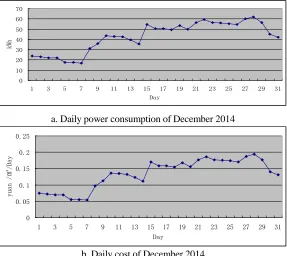
In December 2014, the temperature of the heating room is set to 18°C, electricity bills according to 0.5 yuan/kWh, daily power consumption of the system and daily heating cost for every square meter is shown in Figure 4. Winter heating period is 150 days, the charge standard of central heating is 28 yuan/m2, and the cost of traditional central heating system is 0.187 yuan / m2/day. As shown in Figure 4, the air source heat pump heating system’s economy is superior to traditional central heating system. December 1 to 7 are system’s test stage, system is not used to heating the room, so the power consumption of the system is small.
0 10 20 30 40 50 60 70
1 3 5 7 9 11 13 15 17 19 21 23 25 27 29 31
Day
kWh
a. Daily power consumption of December 2014
0 0.05 0.1 0.15 0.2 0.25
1 3 5 7 9 11 13 15 17 19 21 23 25 27 29 31
Day
yuan /㎡/Day
[image:4.612.154.441.409.665.2]b. Daily cost of December 2014
CONCLUSIONS
The paper proposed an air-source heat pump heating system based on photovoltaic generation complementary with grid. The system abolishes the battery energy storage link and reduces the cost of investment. The author put forward the scheme of the air-source heat pump heating system for an office building, and the actual system is set up. Experiment results show that when power supply is changed from photovoltaic to grid, the distortion of the load’s current is small, the system keeps running smoothly. Actual operation results show that the economic benefits of the system is superior to traditional central heating system.
ACKNOWLEDGMENTS
This study was supported by the Research Project of Liaoning Provincial Department of Education (Grant No. L2016lky04) and Youth Scientific Research Foundation of Liaoning Institute of Science and Technology (Grant No. qn201502).
REFERENCES
1. Arnau Gonzalez, Jordi-Roger Riba, Antoni Rius, Rita Puig. Sep. 2015. “Optimal sizing of a hybrid grid-connected photovoltaic and wind power system”, Applied Energy, vol.154, pp. 752-762.
2. A. Bonfiglio, M. Brignone, F. Delfino, R. Procopio. Jan. 2014. “Optimal Control and Operation of Grid-Connected Photovoltaic Production Units for Voltage Support in Medium-Voltage Networks”, IEEE Trans. Sustainable Energy, vol. 5, no. 1, pp. 254-263.
3. M. Bianchi, L. Branchini, C. Ferrari, F. Melino. Dec. 2014. “Optimal sizing of grid-independent hybrid photovoltaic–battery power systems for household sector”, Applied Energy, vol.136, pp. 805-816.
4. Qiang Xu, Haiyan Zhang, Zhen Qin, Yulei Guo. Feb. 2014. “Research on wind/solar hybrid generation and MPPT control system”, Electrical & Energy Management Technology. vol. 46, no. 3, pp. 52-56.
5. R. Shah, N. Mithulananthan, K. Y. Lee. Mar. 2014. “Large-Scale PV Plant With a Robust Controller Considering Power Oscillation Damping”, IEEE Trans. Energy Conversion, vol. 28, no. 1, pp. 106-116.
6. Wei He, Xiaoqiang Hong, Xudong Zhao, et al. May. 2015. “Operational performance of a novel heat pump assisted solar façade loop-heat-pipe water heating system”, Applied Energy, vol.146, pp. 371-382.
7. H. Kanchev, F. Colas, V. Lazarov, B. Francois. Oct. 2014. “Emission Reduction and Economical Optimization of an Urban Microgrid Operation Including Dispatched PV-Based Active Generators”, IEEE Transactions on Sustainable Energy, vol. 5, no.4, pp. 1397-1405.
8. A. Tani, M. B. Camara, B. Dakyo. Apr. 2015. “Energy Management in the Decentralized Generation Systems Based on Renewable Energy—Ultracapacitors and Battery to Compensate the Wind/Load Power Fluctuations”, IEEE Trans. Industry Applications, vol. 51, no. 2, pp. 1817-1827.
9. A. Bonfiglio, M. Brignone, F. Delfino. Mar. 2014. “Optimal Control and Operation of Grid-Connected Photovoltaic Production Units for Voltage Support in Medium-Voltage Networks”, IEEE Trans. Sustainable Energy, vol. 5, no. 1, pp. 254-263.
10. W. Wang, Y.C. Feng, J.H. Zhu, L.T. Li, et al. Dec. 2013. “Performances of air source heat pump