2017 2nd International Conference on Computational Modeling, Simulation and Applied Mathematics (CMSAM 2017) ISBN: 978-1-60595-499-8
Secure-Positioning-Protocol-Based Symmetric Cryptography
Qing-shui XUE
1,*,
Feng-ying LI
2,
Xiang-wei ZHENG
3, Ming-lei SHU
1,
Yun-xiang LIU
1, Zhi-yong SHAN
4and Wen-ju LI
11
School of Computer Science and Information Engineering, Shanghai Institute of Technology, Shanghai, China
2
School of Continuous Education, Shanghai Jiao Tong University, Shanghai, China
3
School of Information Science and Engineering, Shandong Normal University, Jinan, China
4
School of Information Science and Technology, Donghua University, Shanghai, China
*Corresponding author
Keywords: Positioning protocol, Symmetric cryptography, UC security, Model, Scheme.
Abstract. Position-based cryptography has attracted lots of researchers’ attention. In the mobile Internet, there are lots of position-based security applications. For the first time, one new conception, positioning-protocol-based symmetric cryptography is proposed. Based on one secure positioning protocol, one symmetric model is proposed. In the model, positioning protocols are bound to symmetric cryptography tightly, not loosely. Moreover, we propose one concrete positioning-protocol-based symmetric scheme, its correctness is proved. To our best knowledge, it is the first positioning-protocol-based symmetric scheme.
Introduction
In the setting of the mobile Internet, position services and position binding security applications become key requirements, especially the latter. Position services include position inquiring, secure positioning and so on. Position inquiring consists of inquiring your own position and positioning of other entities, which can be realized by TOA/AOA/RMS (radio/light or sound), Camera, Sensor and so forth [1-6]. The technology of inquiring your own position has GPS (Global Positioning System) and so on. The technology of positioning of other entities has Radar and so forth [2-6]. As we all know, the positioning of other entities is a more challenging one. There are many position binding security applications such as position-based encryption and position-based signature and authentication. For example, when one mobile user sends messages to one specified position which is one either physical or logical address (such as Internet Protocol address), it is desirable that only the user who is indeed at that address can receive it and decrypt messages. If the original receiver at that position because of some reasons leaves that address, it will not be able to receive or decrypt messages any more. In addition, if the original receiver at that place moves to another place, maybe he/she hopes he/she can receive messages at the new place. Take position-based signature and authentication, for example. One mobile or fixed user signs messages at one place and sends them to another mobile user. The receiver can receive the signed message and verify that received messages are really signed at the place by the sender. Even if the signer moves to another address, it will not influence the receiving and verification of signed messages. On March 8 of 2014, the missing Malaysian Airline MH370 can’t be found till now, as reminds us of the significance of positioning and related security applications.
will become far away from position-based cryptography. In other words, nowadays positioning protocols are bound loosely with relevant security applications, not tightly, and result in slow progresses of position-based cryptography and applications. Resorting to the thoughts, in the paper, our main contributions are as follows.
(1) We propose the definition and the model of positioning- protocol-based symmetric cryptography. First, positioning-protocol-based symmetric cryptography is a kind of symmetric one, but a novel one. The definition is given and its model is constructed. We define its security properties as well.
(2) To realize the kind of symmetric cryptography, one secure-positioning-protocol-based symmetric scheme is proposed and its security is analyzed in brief.
In the paper, we will organize the rest as follows. In Section 2, we will introduce the function of positioning protocols and one secure positioning protocol. In Section 3, one model and the definition of positioning-protocol-based symmetric cryptography are provided. We will propose one positioning-protocol-based symmetric cryptographic scheme in Section 4. Its correctness is proved in Section 5. The security of the proposed scheme will be briefly analyzed in Section 6. Finally, the conclusion is given.
Positioning Protocols
In the section, we will introduce the function of positioning protocols and one secure positioning protocol.
Function of Positioning Protocols
The goal of positioning protocol is to check whether one position claimer is really at the position claimed by it. Generally speaking, in the positioning protocol, there are at least two participants including position claimers and verifiers, where the verifiers may be regarded as position infrastructure. According to destination of the positioning, there are two kinds of positioning protocol, i.e., your own position positioning protocol and others’ position positioning protocol. As of now, lots of work on your own position positioning protocol have been done [2-6]. Nevertheless, research on others’ positions positioning protocol is far less and there are still many open questions to resolve. In our model and scheme, we will make full use of the two varieties of positioning protocol.
One Secure Positioning Protocol
Here, we will introduce one others’ positions positioning protocol. Compared with your own position positioning protocols, others’ positions positioning protocols are more complex.
In the section, we will review N. Chandran et al.’s secure positioning protocol in 3-dimension space [1], which can be used in the mobile Internet.
In the protocol, 4 verifiers denoted by V V1, 2,...,V4, which can output string Xi,are used. The prover
claims his/her position which is enclosed in the tetrahedron defined by the 4 verifiers. Let t1,...,t4 be the time taken for radio waves to arrive at the point P from verifier V V1, 2,...,V4 respectively. When we
say that V V1, 2,...,V4 broadcast messages such that they “meet” at P, we mean that they broadcast the
messages at time Tt T1, t T2, t3 and Tt4 respectively so that at time T all the messages are at position P in space. The protocol uses a pseudorandom generator namely an ε-secure
:{0,1}n {0,1}m {0,1}m
PRG . They select the parameters such that 2m is negligible in the security
parameters. Xi denotes a string chosen randomly from a reverse block entropy source. The protocol is
given as follows:
Step 1. V1,...,V3 and V4 pick keys K1,...,K3 and K4 selected randomly from {0,1}
m and broadcast
them through their private channel.
Step 2. For the purpose of enabling the device at P to calculate Ki for 1 i 4, the verifiers do as
'
2 ( 1, 1) 2
K PRG X K K . Similarly, at timeTt3 , V3 broadcasts
'
2 3 2 2 3
(X K, PRG X K( , )K) , and V4
broadcasts '
3 4 3 3 4
(X K, PRG X K( , )K ) at time Tt4.
Step 3. At time T, the prover at position P calculates messages '
1 ( , ) 1
i i i i
K PRG X K K for1 i 3.
Then it sends K4 to all verifiers.
Step 4. All verifiers check that the string K4 is received at time (Tti) and that it equals K4 that they pre-picked. If the verifications hold, the position claim of the prover is accepted and it is supposed to be indeed at position P. Otherwise, the position claim is invalid.
The Model
The Model
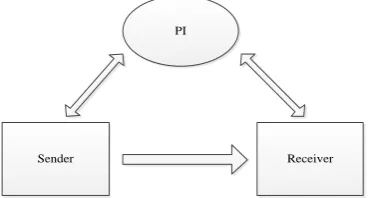
In the model, there are three parties including Sender, Receiver and Position Infrastructure (for simplicity, called PI). Sender takes responsibility of confirmation of positions of Receiver and encryption of messages sent to Receiver; it should be noted that only if Sender can make sure that Receiver’s position is valid before encrypting, he/she can proceed. That’s to say, before Sender encrypts messages, even if Receiver is not at that place, as long as the position is Receiver’s valid one, it will work. If hoping that Receiver has to be at that position before Sender encrypts, we can construct other models. Receiver is responsible for the confirmation of his or her own position by PI or other self-positioning systems and decryption of ciphertext; PI which is one trusted third party, is used to verify or provide Sender or Receiver’s valid positions. The model is depicted in Fig. 1.
Sender Receiver
[image:3.595.205.391.391.490.2]PI
Figure 1. Model of positioning-protocol-based symmetric cryptography.
Definition-Positioning-protocol-based Symmetric Cryptography
Simply speaking, the cryptography combines traditional symmetric cryptography and positioning protocols as one single scheme. It belongs to one-time cryptographic schemes. It is mainly composed of two primitives of sender encryption and receiver decryption. In the course of sender encryption, the sender first confirms the position of the receiver by running positioning protocols and gets the corresponding symmetric key (of course, the receiver also gets the symmetric key, but only during receiver decryption) . By using the symmetric key, the sender encrypts one message and then sends the ciphertext to the receiver. At the side of the receiver, or during the receiver decryption, the receiver first checks its own position by implementing positioning protocols with PI. If its position is valid or right, PI will send the symmetric key to the receiver and the receiver is capable of decrypting the ciphertext; otherwise, the receiver will not be able to gain the corresponding symmetric key to decrypt or reject decrypting the ciphertext.
Remark 1. During the course of sender encryption, if the sender doesn’t run the positioning
In formulation, the positioning-protocol-based symmetric cryptography consists of three primitives
(Initialization, PropEncryption, PropDecryption). Here h( ) is one secure hash function.
Initialization. PI takes as input secure parameter 1k
and outputs system master key mk and public
parameter pp, meanwhile, the system distributes user identity IDi for user i. In the model, the primitive or phase can be run only once when setting up the system.
PropEncryption. Sender generates one nonce nsender PI, , gets the identity IDreceiver and position
receiver
Pos of the receiver. Posreceiver is from PI and is Receiver’s valid position. Meanwhile, the sender
will receive another nonce nPI receiver, from PI, the sender will generate one-time session or symmetric
key by skh n( sender PI, ,nPI receiver, ). Sender encrypts message m by any symmetric cryptographic algorithm such as AES using session key sk, and c is the corresponding ciphertext. The ciphertext is (nsender PI, , )c and is sent to the receiver.
PropDecryption. After Receiver receives the ciphertext (nsender PI, , )c , he/she takes as input the identity IDreceiver and position Posreceiver of Receiver to run the positioning protocol with PI. If the receiver is indeed at the position, PI sends the nonce nPI receiver, which was used during the PropEncryption to the receiver. Otherwise, the receiver can’t get the nonce nPI receiver, . From the ciphertext (nsender PI, , )c from the sender and the nonce nPI receiver, , the receiver can recover the session key by skh n( sender PI, ,nPI receiver, ) . Then the receiver can decrypt the ciphertext (nsender PI, , )c and gets the plaintext m.
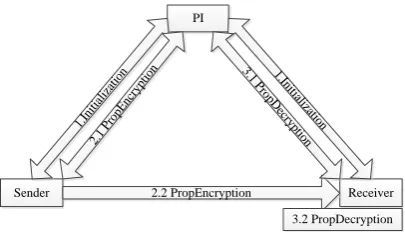
The formulation is illustrated Fig. 2.
Sender
PI
Receiver
1.In itial
izat
ion 1.In
itializ ation
2.2 PropEncryption 2.1
Pro pEnc
rypt ion
3.2 PropDecryption 3.1
P ro
pD ecry
[image:4.595.200.403.390.507.2]ption
Figure 2. Formulation of positioning-protocol-based symmetric cryptography.
Security Properties of Positioning-Protocol-Based Symmetric Cryptography
Positioning protocol binding. In the course of PropEncryption, the sender is requested to confirm the position of the receiver by communicating with PI. During the course of PropDecryption, the receiver has to confirm its own position by PI. That is to say, although the receiver is at the right position, if it does not confirm its position by PI, it will not be able to get the nonce which is generated by PI during the course of PropEncryption, as means that it can’t get the session key. Because the model is of one–time cryptography, after it receivers the ciphertext, if it moves from its original position to another one, its position confirmation by PI will not succeed, it is unable to get the session key to decrypt the ciphertext.
One Secure-Positioning-Protocol-Based Symmetric Scheme
As the above model does, there are mainly three participants: Sender, Receiver and PI. In addition, PI will play the role of system authority. In the scheme, there are three phases: Initialization phase, PropEncryption phase and PropDecryption phase. In the scheme, when confirming of other parties’ positions, the secure positioning protocol [1] mentioned above can be used. When verifying one participant’s own position, GPS or other technologies can be used. So, here the secure positioning protocol and GPS play the role of PI.
Initialization
PI takes as input secure parameter 1k and outputs system master key mk and public parameter pp,
meanwhile the system distributes user identity IDi for user i.
PropEncryption
Sender generates one nonce nsender PI, , gets the identity IDreceiver and position Posreceiver of the receiver.
receiver
Pos is from PI and is receiver’s valid position. Meanwhile, Sender receives one nonce nPI receiver,
from PI, then Sender generates one-time session key byskh n( sender PI, ,nPI receiver, ,Posreceiver,IDreceiver). Sender
encrypts the message m by any symmetric cryptographic algorithm using session key sk, and c is the
corresponding ciphertext. The ciphertext is (nsender PI, , )c and is sent to Receiver.
PropDecryption
Receiver takes as input the identity IDreceiver and position Posreceiver of its own to run the positioning
protocol with PI. If Receiver is indeed at the position, PI sends the nonce nPI receiver, which was used
during the PropEncryption to Receiver. Otherwise, the receiver can’t get the noncenPI receiver, . From the
ciphertext (nsender PI, , )c from the sender and the nonce nPI receiver, from PI, Receiver can recover the session key byskh n( sender PI, ,nPI receiver, ,Posreceiver,IDreceiver). Then the receiver can decrypt the ciphertext
,
(nsender PI, )c and get the plaintext m.
Correctness of the above Scheme
About the correctness of the above scheme, we have the following theorem.
Theorem 1: If the scheme correctly runs according to the above phases, Receiver can share the session key or symmetric key with Sender to decrypt the ciphertext.
Proof. In the course of PropEncryption, Sender generates the nonce nsender PI, , gets the identity
receiver
ID and position Posreceiver of Receiver, and receives the nonce nPI receiver, from PI, Sender can
produce one-time session key by skh n( sender PI, ,nPI receiver, ,Posreceiver,IDreceiver) . In the course of PropDecryption, from the ciphertext (nsender PI, , )c , the receiver can get nsender PI, . From PI, the receiver can get nPI receiver, , if and only if its position is confirmed to be truly Posreceiver. Because Receiver has the
knowledge of its identity and position, it can compute the session key
, ,
( sender PI, PI receiver, receiver, receiver)
skh n n Pos ID . Thus, Receiver and Sender can get and share the one-time
session key skh n( sender PI, ,nPI receiver, ,Posreceiver,IDreceiver). It is proved.
Conclusions
positioning-protocol-based asymmetric encryption and positioning-protocol-based signature. It is believed by us that the research on positioning-protocol-based cryptographic models or schemes in the mobile Internet will become one focus.
Acknowledgement
This research was financially supported by NSFC under Grant No. 61170227 and 61373149, NSSFC under Grant No. 16BGL003, Ministry of Education Fund under Grant No. 14YJA880033, SIT Collaborative Innovation Platform under Grant No. 3921NH166033, SIT Collaborative Innovation Fund under Grant No. 39120K178038, and SIT Foundation for Distinguished Scholars under Grant No. 39120K176049.
References
[1] N. Chandran, V. Goyal, R. Moriarty, R. Ostrovsky, Position based cryptography, in: S. Halevi (Eds.), CRYPTO 2009, Springer, Santa Barbara, CA, USA, 2009, pp. 391-407.
[2] N. Sastry, U. Shankar, D. Wagner, Secure verification of location claims, in: W.D. Maughan, A. Perrig (Eds.), ACM workshop on Wireless security 2003, San Diego, CA, USA, 2003, pp. 1-10.
[3] D. Singelee, B. Preneel, Location verification using secure distance bounding protocols, in: IEEE Conference on Mobile Adhoc and Sensor Systems Conference, 2005, pp. -840.
[4] L. Bussard, Trust establishment protocols for communicating devices, PhD thesis, Eurecom-ENST, 2004.
[5] S. Capkun, J. P. Hubaux, Secure positioning of wireless devices with application to sensor networks, in: IEEE INFOCOM, Miami, FL, USA, 2005, pp.1917-1928.
[6] S. Capkun, M. Cagalj, M. Srivastava, Secure localization with hidden and mobile base stations, in: IEEE INFOCOM, Barcelona, Catalunya, Spain, 2006.
[7] H. Buhrman, N. Chandran, S. Fehr, R. Gelles, V. Goyal, R. Ostrovsky, C. Schaffner, Position-based quantum cryptography: impossibility and constructions, in: CRYPTO 2011, Springer, Santa Barbara, California, USA, pp. 429-446.
[8] H. Buhrman, N. Chandran, S. Fehr, R. Gelles, V. Goyal, R. Ostrovsky, C. Schaffner, Position-based quantum cryptography: impossibility and constructions, CoRR abs/1009.2490, 2010.
[9] H. Buhrman, S. Fehr, C. Schaffner, F. Speelman, The Garden-hose game: a new model of computation, and application to position-based quantum cryptography, CoRR abs/1109.2563, 2011.