2017 2nd International Conference on Computer, Mechatronics and Electronic Engineering (CMEE 2017) ISBN: 978-1-60595-532-2
Assembly Process Optimization Method Based on Maximum
Entropy Theory
Zi-fu WANG, Zhi-jing ZHANG
*, Xin JIN, Zhao-li MA and Deng-yu ZHOU
Beijing Institute of Technology, 5 South Zhongguancun Street, Haidian District, Beijing, China
*Corresponding author
Keywords: Precision structure, Maximum entropy theory, Optimization method, Assembly
accuracy.
Abstract. The assembly accuracy of precision structures is significantly affected by the geometric error and thermal deformation of the mechanical components which can be represented by entropy. This paper provides an assembly process optimization method based on maximum entropy theory, optimizing multi-objective assembly process through the calculation of precision assembly system and entropy. This method can meet the requirements of high precision and high stability of precision mechanical system.
Introduction
In the precision mechanical system, the distribution of the shape errors and the assembly process parameters of the parts are different, which will result in different contact states between the mating surfaces of the parts. Under certain assembly force, the different contact states of the contact surface will lead to the deformation error of the parts which results in different geometric assembly errors. L Cheng has taken plane assembly joint surface as the research object, the problems of assembly joint
surface error modeling and tolerance optimization in the case of coupled tolerance are analyzed[1].
The influences of assembly error and bearing elasticity on the spur gear dynamic behavior are
analyzed by J Wang [2]. The influences of various assembly errors on the contact stress and contact
pattern were investigated and discussed by YC Chen [3]. Z Xiong have carried out a fundamental
analysis on the mounting and misalignment errors of transport mirror. An integrated simulated assembly station is proposed to align the mirror precisely, and the design of transport mirror unit is
optimized to satisfy the stringent specifications [4].
In addition, the non-uniform stress field caused by non-uniform contact will release energy as time, temperature and mechanical environment change, and the assembly accuracy will change as well. The research shows that for the mechanical system of low precision, the problem that shape error affecting the assembly accuracy is not significant. Otherwise, for the precision mechanical system, shape error will have a significant impact on the assembly accuracy. JB Kinney unify Maximum entropy estimation and Bayesian field theory by showing that every maximum entropy density estimate can be
recovered in the infinite smoothness limit of an appropriate Bayesian field theory[5]. M Lostaglio
discussed some features of thermodynamics in the presence of multiple conserved quantities [6].
The traditional shape error assessment method cannot reveal the influence of the shape error distribution on the assembly accuracy. For the precise mechanical system, the contact state and the contact stress distribution of the assembly surface will greatly influence on the assembly accuracy. In the traditional minimum surface based on assembly process optimization model, statistical calculation is used, but it does not consider the particularity of each component error in precision
mechanical system in small batch production [7-15].
Assembly Process Optimization Method Based on Maximum Entropy Theory
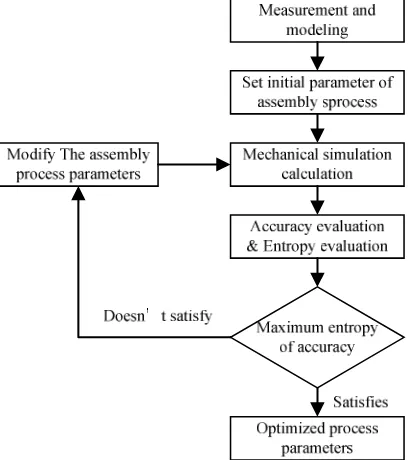
maximum entropy theory is put forward. 5 sections are involved in this method, including Measurement and modeling, setting assembly process parameters, Simulation calculation and accuracy & entropy evaluation, Determine whether the assembled parts meet the requirements of accuracy, Determine whether completely covers the boundary conditions. Fig. 1 shows the flow of the entire optimization process.
Figure 1. The flow of the entire optimization process.
Measurement and Modeling
The specific modeling process measurement is as follows. For the parts to be measured, a random point is taken as the origin point O, the direction perpendicular to the measured surface is taken as the Z axis, and the surface plane parallel to the measured surface is taken as the XOY surface, thereby a coordinate system of O-XYZ is established. The surface is measured by three coordinate measuring machine to get the measurement data. The 3D entity model established with the measurement data reflects the real morphology of the surface of the measured parts. The 3D model is finite element meshed. The measured 3D model is assembled.
Setting Assembly Process Parameters
The approach to set the initial assembly process parameters as follows. The initial assembly process parameters are selected and input the 3D solid assembly model within the range of the maximum and minimum assembly process parameters that the current assembly capacity can reach.
Simulation Calculation and Accuracy & Entropy Evaluation
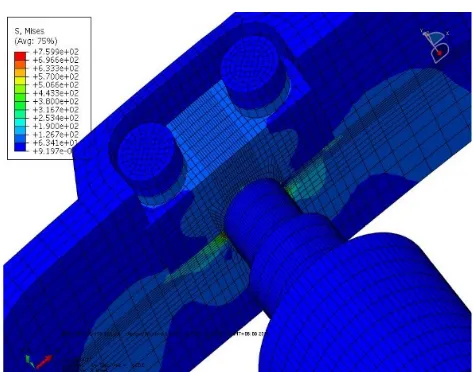
Figure 2. Stress nephogram of an example after simulation.
The accuracy of the assembly system is calculated, and the deviations between the actual position and the ideal position of the parts are calculated according to the coordinates of the parts of the nodes. The geometric assembly errors are calculated according to the assembly relationship and the accuracy requirements among the parts. Further, the geometric assembly error is get by the coupling of the geometric error of each part and the assembly stress deformation of each part. The node coordinate of mechanical parts calculated by simulation calculation can reveal the geometric assembly error effectively. For the specific accuracy requirements, such as flatness, perpendicularity, etc., they can be directly calculated by the node coordinates of the relevant surface of the parts after mechanical simulation.
The entropy value of the contact surface is calculated, and the entropy value of the contact surface is calculated according to the strain energy of the element. Further, the unit strain of the parts calculated by entropy can be calculated after mechanical simulation. The contact surface entropy of assembled parts represents the quality stability of the precision assembled parts. Accuracy stability is mainly affected by the distribution of the contact stress uniformity, and the stress distribution is more uniform, the assembled parts can resist longer against the environmental conditions (such as vibration and the temperature change etc.) influenced the accuracy.
Determine Whether the Assembled Parts Meet the Requirements of Accuracy
If the condition is not satisfied, the minimum change of assembly parameters that can be controlled under the current assembly capacity is taken as the initial step. The assembly process parameters are changed in the boundary conditions range, and return to simulation calculation in the mechanical simulation software iteratively.
If the assembled parts meet the requirements of accuracy, the assembly process parameters are kept in the assembly process parameters set which meet the requirements of accuracy.
Determine Whether Completely Covers the Boundary Conditions
If the parameters of assembly process parameters calculated does not completely cover the boundary conditions, the initial assembly process parameters are supposed to change in the boundary conditions range, and then return to simulation calculation in the mechanical simulation software iteratively.
If the condition is satisfied, the parameter with maximum entropy are taken as the optimal parameters for assembly process.
Conclusion
In this paper, an assembly process optimization method based on maximum entropy theory is proposed which can optimize the assembly process by optimizing the assembly accuracy and the entropy value of the parts iteratively.
Considering the specific shapes of the surfaces of different parts geometric error, the geometric assembly error is get by the coupling of the geometric error of each part and the assembly stress deformation of each part. Thus, it can be applied to optimize the assembly process in small batch production, and is suitable for requirements of high precision, high stability in precision mechanical system.
In this paper, the entropy value is used to evaluate the uniformity of stress, which is further used to describe the accuracy and stability of the assembled parts. Therefore, the assembly process optimization can be carried out according to the assembly accuracy and stability, which cannot be completed by other methods.
Reference
[1] Cheng L, Liu Z, Yandi A I, et al. Assembly Joint Surface Error Modeling and Tolerance Optimization in the Case of Coupled Tolerance[J]. Journal of Mechanical Engineering, 2015.
[2] Wang J, Lim T C. Influence of assembly error and bearing elasticity on the dynamics of spur gear pair [J]. ARCHIVE Proceedings of the Institution of Mechanical Engineers Part C Journal of Mechanical Engineering Science 1989-1996 (vols 203-210), 2015.
[3] Chen Y C, Wang Z G, Lo C C. Tooth contact analysis and assembly error analysis of a helical gear speed reducer with linear tip-relief[C]//International Conference on Artificial Intelligence and Robotics and the International Conference on Automation, Control and Robotics Engineering. ACM, 2016:21.
[4] Xiong Z, Wang H, Cao T, et al. Error analysis on assembly and alignment of laser optical unit[J]. Advances in Mechanical Engineering, 2015, 7(7): págs. 16-19.
[5] Kinney J B. Unification of field theory and maximum entropy methods for learning probability densities [J]. Physical Review E Statistical Nonlinear & Soft Matter Physics, 2015, 92(3):032107.
[6] Lostaglio M, Jennings D, Rudolph T. Thermodynamic resource theories, non-commutativity and maximum entropy principles [J]. 2015.
[7] Lin J, Yang L, Liu M, et al. Study on optimization model of matching parts assembly based on the process capability index [J]. Transactions of the Chinese Society for Agricultural Machinery, 2007.
[8] Du X, Zhang Y, Sun L. PCB assembly process optimization based on constraint model [J]. Research Journal of Applied Sciences Engineering & Technology, 2014, 7(1):105-110.
[9] Maeda S, Tanaka S, Mimotogi S. Optimization of directed self-assembly hole shrink process with simplified model [J]. Journal of Micro/ Nanolithography Mems & Moems, 2014, 13(3):031305.
[10] Application of the Constraint Model in Optimization of PCB Assembly Process [J]. Process Automation Instrumentation, 2013.
[11] Cui A, Zhang H P. Tolerance Allocation and Maintenance Optimal Design for Fixture in Multi-Station Panel Assembly Process [J]. Applied Mechanics & Materials, 2010, 34-35:1039-1045.
[13] Hussain T. Straight-Build Assembly Optimization: A Method to Minimize Stage-by-Stage Eccentricity Error in the Assembly of Axisymmetric Rigid Components (Two-Dimensional Case Study) [J]. Journal of Manufacturing Science & Engineering, 2011, 133(133):031014/1-9.