Canter, David V.
Canter, D. (2004). A partial order scalogram analysis of criminal network structures.
Behaviourmetrika. 31 (2), 1-21.
Original Citation
Canter, David V. Canter, D. (2004). A partial order scalogram analysis of criminal network
structures. Behaviourmetrika. 31 (2), 1-21. Behaviourmetrika.
This version is available at http://eprints.hud.ac.uk/8198/
The University Repository is a digital collection of the research output of the
University, available on Open Access. Copyright and Moral Rights for the items
on this site are retained by the individual author and/or other copyright owners.
Users may access full items free of charge; copies of full text items generally
can be reproduced, displayed or performed and given to third parties in any
format or medium for personal research or study, educational or not-for-profit
purposes without prior permission or charge, provided:
•
The authors, title and full bibliographic details is credited in any copy;
•
A hyperlink and/or URL is included for the original metadata page; and
•
The content is not changed in any way.
For more information, including our policy and submission procedure, please
contact the Repository Team at: [email protected].
A Partial Order Scalogram Analysis of Criminal Network Structures
David Canter
∗Two contrasting hypotheses about criminal organisations are that they will be ei-ther strongly hierarchical with recognisable differentiation between components of their organisational structure or that they will be loose networks of associates with no dis-cernable organisation. Six Indices of organisational morphology were therefore derived from Social Network Analysis measures to explore the different organisational structures of criminal groups and networks.
These were used to classify 12 drug-dealer networks, 11 property crime networks and six hooligan networks. Partial Order Scalogram analysis of these 29 groups across the six measures showed that there were a wide range of group structures, ranging from very loose networks without even central key figures through to highly structured networks that contained all six indicators of structure. Within this framework two dominant axes were identified, along which the degree of structure varied. One was proposed as a product of the size of the group, the other as a product of the centrality of leadership. This allowed three types of criminal organisation to be specified, A–ad hoc groups, B–oligarchies and, C–Organised Criminals. These different types tended to relate to group size with A as the smallest and C the largest with on average almost twice as many members. These different types of group carry different implications for group process and investigative interventions.
Although there was a tendency for the hooligan groups to be less structured and the drug networks to be the most structured, most forms of structure were found for all types of criminal activity. The study therefore raises a number of important questions about what gives rise to these variation in organisational morphology and the implica-tions the variaimplica-tions have for the conduct of the crimes, their investigation and methods for reducing the effectiveness of criminal networks.
1. Criminal Network Morphologies
Most crime is studied as the activity of individuals yet as Canter and Alison (2000) have shown in some detail, virtually all criminal activity is part of a social process. In-deed, many forms of criminality are only possible if a number of criminals are in contact with each other, passing products or people along a network of associates, or using the added power that comes from having a number of people involved (McAndrew, 2000). The question therefore arises as to how such networks may be organized. The answers to such questions will further our understanding of what makes criminal organizations possible and also offers up the possibility of law enforcement disrupting those networks in what Canter (2000) calls ‘Destructive organizational psychology’.
Key Words and Phrases:POSA, Criminal Networks, Social Network Analysis, Drugs, Property Crime, Hooligans
∗ Correspondence should be addressed to
The popular view, enshrined in fictional portrayals, is that criminal networks are strongly hierarchical with a ‘Mr Big’ in charge. However, some researchers, notably Sarnecki (2001) in his study of delinquent networks emphasise a loose pattern of asso-ciations that do not reflect any formal structure like that which would be expected in a legal organisation. There is the further possibility that different types of crime require, or encourage, different organisational morphologies with the hypothesis that the structure of criminal groups may be predicted from knowledge of their criminal activities. For exam-ple, it might be hypothesised that criminal activity that benefits from weight of numbers, such as a mass of hooligans involved in aggression, would not require the same degree of structure as a drug distribution network that must pass products from hand to hand and co-ordinate the collection of finances.
The little research that there has been into criminal networks certainly indicates that all criminal networks are not necessarily similar to each other (Passass & Nelken, 1993; van Duyne, 1996). They differ by the degree or type of organization, which may range from loosely connected networks to highly structured groups (Potter, 1994; Bourgois, 1985). However, very little is still known about the fundamental ways in which criminal patterns of communication vary from one network to another and how those variations may relate to the objectives and forms of criminality they support.
The underlying variation that can be drawn from the literature is degree of structure, from minimally structured groups to those that have a clear organisational shape with various degrees of differentiation. This quantitative variation from low to high degree of organisation can be reflected in a number of different aspects of the communication network and related features of group membership. It is an empirical question as to how these different aspects may relate to each other in various groups.
Six features of any network, which at it is productive to consider in order to estab-lish the variations in the ways in which any network may operate may be drawn from McAndrew’s extensive (2000) study of criminal networks. In summary the features are as follows:
1. Core groupof individuals that co-ordinate operations in a network 2. Key central figuresthat form the core group
3. Sub-groups that carry out different activities
4. Mid-level individuals that conduct daily operations, liaise with lower-level members and provide protection to the key figures
5. Isolated individualsthat provide information and resources and 6. Thesizeof the networks, i.e the number of individuals involved.
The presence of acore groupof individuals that co-ordinate network activities and are clearly differentiated from other members in the network is perhaps the most recognized structural feature (Dorn & South, 1990; Dorn, Murji, & South, 1992; Lewis 1994; Ruggiero & South, 1997; Johnston, 2000). For instance, although Lewis’ (1994) described heroin distribution in the UK from 1970 to 1990 as “. . . composed of complex, articulated, multi-faceted series of layered networks which individuals enter and exit according to means and circumstances” (p. 46), thereby showing that this distribution was far from a tidy single, hierarchical organization, nonetheless he indicated that there were distinctions to be made between a crucial group who lead trade (e.g., importers) and other more pe-ripheral members of the network (e.g., street dealers). Potter (1994) also pointed to clear differences between leaders and street-level workers in organized crime groups and that these differences were related to age and criminal experience. Hobbs (1997) supported the notion that there are clear differences between leaders and other members in property crime networks. For instance, he labeled core groups in criminal networks as “hubs” that were made up of entrepreneurs that were distinguished from other members of a network. Related to the notion of a core group, is the idea that there arekey central figuresthat form the core group (Block, 1978; Bourgois, 1995; Potter, 1994; Reuter & Haaga, 1986; Williams, 1993). In one of the earliest studies of the cocaine trade in New York during the 1910’s, Block (1978) reported that drug networks had a core group of people that gov-erned importing, wholesaling and retailing of cocaine. More recent research by Williams (1993) has also found that the small core group that run the upper levels of the wholesale distribution and retail side of the international heroin and cocaine industry consisted of key central figures that are bound by ethnic identity or familial ties. Although to a lesser extent, the existence of a core group has also been evident in stolen property networks. For example, Shover (1994) found that burglary networks were constantly changing in size, yet, a small core of two or three associates emerged when a burglary was required. Similarly, van Limbergen, Colaers and Walgrave (1989) observed a decline in the intensity of hooligan involvement, whereby the centre of the hooligan group consisted of a number of hard-core members that organize and plan violence.
Often found within a criminal network aresub-groupsof individuals that are responsible for conducting different activities (Block, 1989; Jenkins, 1992; Alder, 1992; Zhang & Gay-lord, 1996). Subgroups were evident in Jenkins’ (1992) study of the methamphetamine industry in Philadelphia. He found that the mafia group that controlled the acquisition of chemicals was made up of subgroups of powerful individuals or cliques. Jenkins reported that the subgroups interacted with various other networks within the industry. Subgroups were also found in property networks. A study by Maguire found that subgroups existed in burglary networks of highly professional thieves. He found that burglars dealt with survival by forming small cliques with a high level of secrecy, formed by small pools of mutually trusting members.
groups. For instance, Potter (1994) found this to be the case with high-risk activities associated with drug dealing. Mid-level intermediaries have also been used as liaisons with other networks. For instance, Jenkins’ (1992) noted that subgroups in networks were organized around powerful individuals that interacted with other networks in the drug in-dustry. Bourgois (1995) also demonstrated the similarity between the structure of a drug markets and legal enterprises, whereby mid-level individuals orpseudo-entrepreneurswere used to discipline the work force and manipulate the kinship networks to ensure loyalty. Shover (1973) reports that handlers acted as intermediaries between burglars and fences. The handlers often relayed to the burglars what was to be stolen, provided loans to the burglars and communicated with legitimate businessmen. More recently, Hobbs (1995) ethnographic study of professional criminals in London revealed that handlers continue to play an intermediary role in property crime networks by running storehouses for stolen goods. These mid-level intermediaries have been found to play significant roles in hooli-gan groups Van Limbergen, Colaers and Walgrave (1989). They called these individuals
stagiaries, who were younger and less delinquent individuals surrounding the hard core with the aim of becoming part of the core group. Similar to drug and property crimes, thestagiarieswere likely to protect the core group by being the first to participate in the violence.
The fifth aspect of criminal networks is isolated individuals. These individuals play a peripheral role by providing information and resources to a network (Sutherland, 1937; West, 1978). For example, Reuter and Hagga argued that cocaine shipping would be organized around a few members with peripheral contacts being utilized occasionally to dispose of the drugs as the opportunity arose. Similarly, Shover (1973) found that groups of burglars had external contacts, such as tipsters, fences and handlers that could be uti-lized to gain sources of information about potential jobs. Although peripheral members have been observed in hooligan networks, peripheral members are not so important for maintaining their structure. For example, Van Limbergen et al (1989) found that periph-eral members were ordinary adolescents who were motivated by the macho image and behaviour but did not get involved in the physical violence.
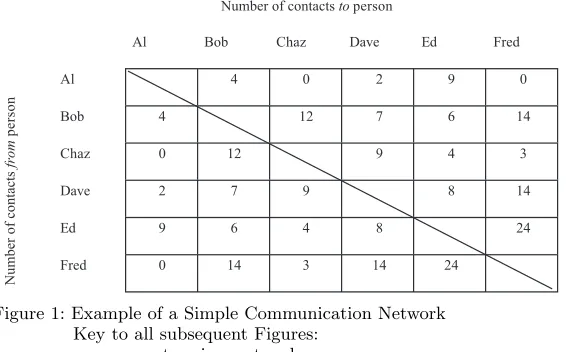
Figure 1: Example of a Simple Communication Network Key to all subsequent Figures:
p = property crime networks d = drug distribution networks h = hooligan networks.
Profiles with ellipses around them are ‘errors’ not in the same region as all other case with a similar score
1.1 Empirical Analysis of Criminal Network Structures: Social Network Analysis
The various features or network structure are open to precise definition using Social Network Analysis (SNA) (Sarnecki, 1986) which has been used to examine empirically the structures of criminal networks (McAndrew, 2000; Swanson, Chamelin, & Territo, 1992; Wassera & Faust,1994). SNA examines the associations between people in a network that have been obtained through observations of known contacts between members, for example from direct observation, telephone bills or, monitored telephone calls. Figure 1 shows an example of a simple communication matrix of observed links between members of the network that is required for SNA. For instance, if a member named Al is observed communicating four times with another member named Bob, a value of 4 is assigned to the Al-Bob cell in the matrix.
Borgatti et al (1992) was developed the UCINET software specifically to calculate a variety of quantitative measures of a network’s structure. These measures allow quan-tification of the features discussed above. The mathematical measures include Degree,
Betweeness, Closeness,Information,Clique, N-clique, K-core andCutpoints & Knots (cf Wasserman, Faust and Iacobucci, 1994 for a comprehensive account of the precise math-ematical calculations for this and subsequent measures). McAndrew (2000) used the first four measures to determine the relativecentralityof individuals in a network. Individuals in a network that have more links with other members are likely to be in an advantageous position that gives them the possibility of being key individuals and forming the core group. The greater number of links an individual has the more resources s/he can call upon to accomplish a goal.
the number of links that a member has with all other members in the network (Freeman, 1979). The more links an individual has then the more power they are considered to have. For example, if there are 9 members in a network, the highest degree that a member can achieve is 8. A member with a degree of 8 will have more opportunities for action and for co-operation with different members of the group, being less dependent on any one other member of the network. This provides a form of independence that is often associated with increased power.
Betweeness measures the extent to which an individual acts as an intermediary be-tween all other pairs of points. More specifically, bebe-tweeness measures how many times an individual falls on the shortest path between of all members in a network. For example, an individual in a network of 10 members can have a maximum betweeness measure of 36. Individuals that fall on the many of the shortest paths between other individuals in the network are considered to have some control over the flow of information or goods between those pairs, and act as an intermediary in the network (McAndrew, 2000; Bonacich, 1987).
Closeness measures how ‘easily’ a member can contact all other members with the least number of go-betweens. In other words, the sum of the shortest distance between any two individuals in a network, such that the individual with the smallest sum is considered to have a close relationship to all other individuals in the network. Power can emerge from being the centre of contact whose views can therefore be transmitted to a large number of members in the network.
Informationmeasures of how involved a member is in all possible paths in a network (Stephenson & Zelen, 1989). This measure takes account of the access the individual has to other individuals who are highly connected. It reflects the flexibility a person has in using routes through the network to gain information or to pass goods.
The three measures ofCliques,N-CliquesandK-Coremeasure whether sub-groups op-erate as part of the larger network, thus, indicating whether a hierarchy exists within a network. The more cliques exist the more structured the network and the more likely are there to be different levels of power within the network (McAndrew, 2000).
Clique measures the extent to which all individuals in a subgroup in a network are connected to all other members of that subgroup. A clique is thus a subset of individuals that are more closely tied to each other than are other members that are not part of that sub-group. A perfect clique would consist of all members being connected to one another.
N-Cliqueis a more lenient measure that does not require all individuals in a network to be connected with one another. In contrast to a perfect clique (1-clique), a 2-clique would be all individuals connected through an intermediary.
K-Core: consists of a sub-group of individuals that are connected to each other a little more than they are to others within the network as a whole. All individuals have an equal number of contacts between one another and one more than others in the network do with them (Seidman, 1983).
1.2 Derivation of Network Features from SNA Measures.
pre-cisely from the various quantitative SNA indices. However, the data in the present case, as with most data derived from police sources, is likely to have some degree of unreliability. All the main variables were therefore treated as dichotomies to increase their robustness and reliability.
The variable of Sizewas determined for the present sample by regarding groups of 15 or more members as large. Those with less than 15 members were defined as small.
The Key Central Figures that indicate the prominence of apparent leaders can be de-termined from the SNA centrality Scores. For example, an individual with considerably higher scores than the rest of the group would be a key central figure. The actual value that is used as the cut-off is dependent on the size of the group. The range of values of the centrality scores that occur for each group were therefore examined and if any individual had a distinctly higher score than anyone else in the group that was taken as an indication that the group had a key central figure.
The presence of aCore Groupindicates that one central group is present in the overall communication network. This was determined by looking at the size of the various mea-sures of clique-ness. When some, or all, of the people in a network, had high clique scores together with the highest centrality measures, this was taken as indicating that there was cohesive subgroup at the core of the network.
Mid-Level Members exists when individuals are found whose centrality scores, whilst being clearly lower than thekey central figuresare nonetheless distinctly higher than the rest of the group. Further examination of their position in the network also supports their role as intermediaries.
Whether a network had Subgroups or not was determined by the presence of cliques and n-cliques. These consisted of one or more groups distinct from the main network but having a connection with the rest of network.
Isolated individuals exist when there are one or more members who are connected to the network through only one individual. These members are located at the periphery of a network as they only have one connection to any other person within the network.
One further measure was to establish if there were anySubgroups as Chain. This was defined as a number of individuals connected to one core member, having few connections within other members of the group. Subgroups exist when members are connected in a chain-like configuration, rather than clusters, or cliques of highly connected members. This is distinct from the Subgroups variable because sub-groups as chains imply a more structured, hierarchical organisation than having Subgroups as coherent cliques.
1.3 A Partial Order of Criminal Network Structures?
all these indices and others that are high on them all. If so, some indication of what gives rise to these variations would be of value, in particular whether it relates in any way to the nature of the criminal activity. The further possibility arises of there being qualitative differences in the morphologies that reflect different styles of organisation. This combina-tion of an overall quantified index, based on a number of measures that have a common order, together with the possibility of qualitative variation in the combination of measures gives rise to what is known as a ‘Partially Ordered Scale’ (Shye, 1978). The focus of the present study is therefore to establish the empirical nature of this partially ordered scale derived from the seven measures across a varied sample of criminal networks.
2. Method
2.1 Samples
A sample of 12 drug, 11 property crime and 6 hooligan networks were extracted from two secondary sources (Johnston, 1994; McAndrew, 1998), giving 29 different groups of offenders ranging in size from 7 to 45 members. McAndrew originally collected both the drug and property networks from UK police intelligence files (e.g., phone bills, surveil-lance records, financial transactions). Generally, the drug networks ranged in size from 8 to 30 individuals, and were involved in importation, distribution and street level dealing of heroin, artificially manufactured drugs such as ecstasy and cocaine. The property crime networks ranged in size from 8 to 45 individuals, and were involved in burglary, ramraiding (a form of hit-and-run burglary carried out by teams), and handling of stolen goods.
Johnston collected data on hooligan groups from the UK National Criminal Intelligence Service Football Unit (NCISF) who keep records of known violent football hooligans and observations of their contacts with each other. The hooligan groups ranged in size from 9 to 32 individual. In total there were 140 male football hooligans aged between 19 and 44 years.
2.2 Procedure
SNA calculations were performed on each of the 29 groups using UCINET (Borgatti et al, 1992) and these were examined to determine the presence or absence of each of the six indices described above. Whether the group was large or not was determined, as mentioned, by whether it had 15 or more members. The resulting matrix of presence or absence of each feature for all seven measures across the 29 groups was the basis of the subsequent calculations.
2.2.1 Partial Order Scalogram Analysis
is 1111111, indicating that there are no organising features to the network, through to 2222222, which shows a highly organised set of contacts between the members. The var-ious combinations of 1’s and 2’s can exist between these two extremes. Some them will be distinctly greater or less than each other across all the features, e.g. 1221112 is clearly less on each feature than 1222212. These can therefore be ordered directly in relation to each other from lowest to highest. Other structuples may be qualitatively different, e.g. 1221112 has the same ‘total score’ of 10 as 2112112, but in some cases the features are higher and in some cases lower. These two structuples are therefore qualitatively differ-ent. In other words, where there are profiles of features that are quantitatively similar but qualitatively different the system of profiles can only be partially ordered. The empir-ical nature of this partial order provides some insight into the different forms that these criminal groups take.
A partially ordered system can be calculated by hand if the number of structuples is limited. But in the present case there are 27= 128 possible structuples so that
determin-ing the system they comprise would be extremely difficult by hand. Furthermore, such a system is potentially multi-dimensional, which could make interpretation extremely dif-ficult. Use was therefore made of the algorithms developed by Shye (1978). This uses base co-ordinates in order to determine the most efficient two-dimensional representation that represents the relationships of order and quality between the structuples. Because this form of partial order analysis relies on base co-ordinates it is known as Partial Order Scalogram Analysis with Base Co-ordinates (POSAC).
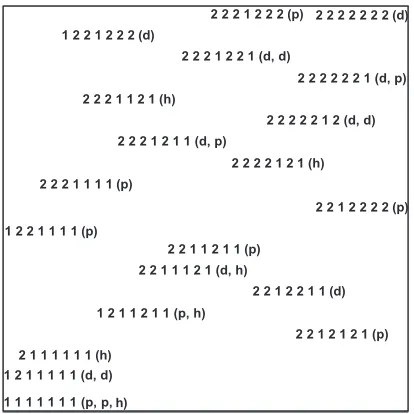
POSAC represents the profiles as points in a geometric space, where the location of the points reflect the partial order among the profiles. Figure 2 provides the results of the POSAC of the 29 criminal groups across the seven features. It depicts a geometric space where increasing criminal structure (i.e., degree of structure) running from the lower left (i.e., 1111111) to the upper-right (i.e., 2222222). This dominant quantitative axis is known as the ‘Joint Axis’ because it is determined by the total value of the all the features, i.e. their joint combination. Profiles with the same structuple are represented in space by the same point as the analysis is carried out on the unique profiles not on the raw data. In the present case there were 20 unique profiles across the 29 different criminal groups.
Since qualitatively different profiles can occupy one of several positions along the lat-eral axis, while still preserving an order of increasing structure, POSAC determines the location of profiles through an iterative process whereby profiles with similar score on a one variable are positioned closer together in the configuration than profiles with different scores on that variable. For example, networks with the profiles 2221121, 2212121 and 1121222 would all be located in the same position on the Joint Axis because they have a total sum of eleven. However, the profiles 2221121 and 2212121 would be located closest together because they have the same score on 5 of the variables and profiles 2221121 and 1121222 would be located furthest apart because they only share the same score on one variable.
Figure 2: A partial order scalogram analysis with co-ordinates (POSAC) of 20 profiles derived from the 29 networks showing Structuples for each group
of the space. If such regionality is identified it can be used to create a framework for categorising the various networks
3. Results
Figure 2 is the two-dimensional solution derived from the POSAC. It has a coefficient of correct representation of 0.83, indicating that 83% “of structuple pairs, weighted by their observed frequencies, are correctly represented” (Borg & Shye, 1995, page 113). An examination of the partially ordered structure revealed a substantial amount of qualitative and quantitative variation in criminal network structures, as shown by the even spatial distribution of profiles in the solution space. The interpretation of the underlying system that gives rise to these variations provides insight into the ways in which criminal network morphologies operate.
The interpretation of the underlying structure relies upon determining how each of the variables (features) partition the overall POSAC space. This is facilitated by examining the partitioning loading coefficients for each variable, given as a note to each figure. These coefficients are calculated for all possible ways in which the space can logically be divided (Cf Shye, 1985).
The X-axis: Size/Mid-Level Individuals
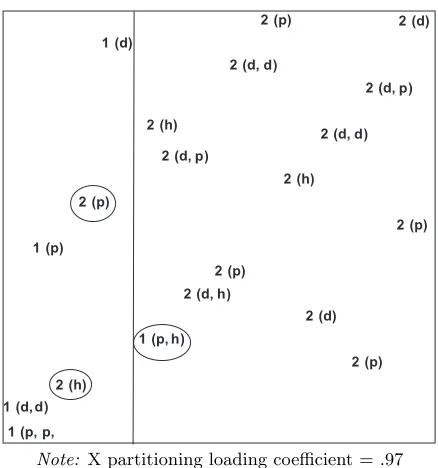
Note: X partitioning loading coefficient = .97
Figure 3a: Partitioned Item Diagram for Variable “Size of Network”: Polar (X) Role
POSAC algorithm operates. In the present results, shown in Figure 3a, the X-axis can be seen to be created by the difference in group size. As mentioned, this is widely recognised as an important attribute of all organisations. In the present case it contributes directly to one of the main ways in which criminal organisations vary.
Figure 3b shows that all the networks that have mid-level individuals are larger than 15 members because the partitioning for the mid-level individuals is parallel to the size partitioning and sits within the region of the larger groups. This has two important im-plications. One is that any group that can be shown to have mid-level individuals can also be expected to be of a reasonable size. It also implies that as a criminal network grows so the emergence of mid-level individuals is likely to happen. This suggests that size is not so much a component of a strong sub-grouping of participants that might be expected to form cliques that may be open to potential competition with each other, but rather that increases in the size of criminal networks gives rise to individuals who may be thought of as ‘lieutenants’. These are people who operate between the ‘rank and file’ and the ‘leadership’. One direct implication of this for police investigations is that if they are aware that a criminal network is large and they identify individuals who play an impor-tant role they must be careful to determine if those identified individuals are the central figures or merely mid-level acting in part to protect those central figures. For smaller networks, however, it is more reasonable to assume that any significant figures are central as mid-levels of the communication network may not have emerged.
The Y-axis: Key Central Figures/Core Group
Note: X partitioning loading coefficient = 1.00
Figure 3b: Partitioned Item Diagram for Variable “Mid-Level Individuals”: Polar (X) Role
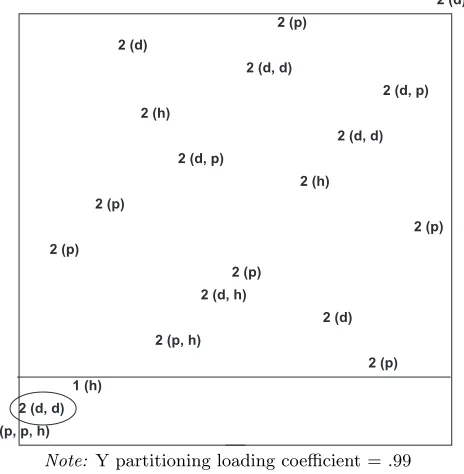
Note: Y partitioning loading coefficient = .99
Figure 3c: Partitioned Item Diagram for Variable “Key Central Figures”: Polar (Y) Role
[image:13.516.145.377.347.584.2]Note: Y partitioning loading coefficient = 1.00
Figure 3d: Partitioned Item Diagram for Variable “Core Group”: Polar (Y) Role
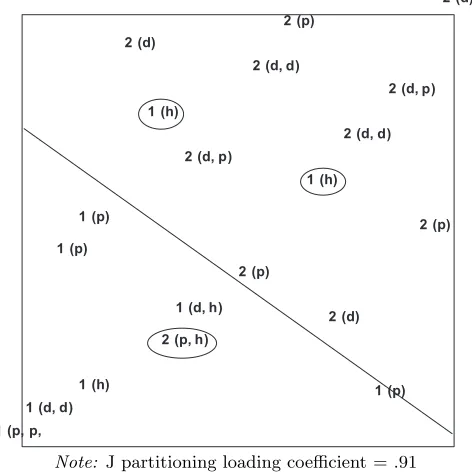
Note: J partitioning loading coefficient = .91
Figure 3e: Partitioned Item Diagram for Variable “Subgroups”: (J) Role
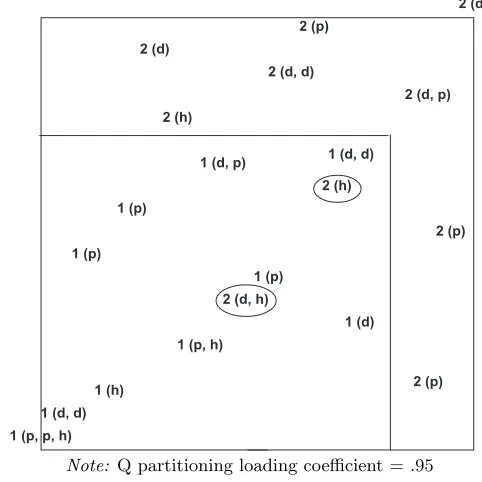
[image:14.516.141.377.354.590.2]Note: Q partitioning loading coefficient = .95
Figure 3f: Partitioned Item Diagram for Variable “Isolated individuals”: Accentuating (Q) Role
would be counter-intuitive because it would be expected that larger groups require more ‘management’ than smaller groups. However, close comparison of the partitionings of size and key central figures shows that all of the larger groups do in fact have key central fig-ures. Further, the four groups that do not have key central figures are all smaller groups. This leads to the identification of a small subset in the sample as a whole of groups that are small without key central figures.
The existence of core groups would seem to be dependent on the presence of key central figures. This makes sense in part because the determination of a core group relies upon establishing if there is a clique of individuals who are in direct contact with people central to the network. The independence of this variable from that of mid-level individuals, though, serves to clarify the difference between the processes set in motion by size and those that derive from the power of significant individuals. This vertical axis seems to be a product of key individuals generating around them a core of people who themselves have contact with each other and create an interconnected group. In contrast the x-axis seems to be more a function of the demands placed on communication networks by the number of people involved. Size versus leadership may thus be seen as the two dominant axes that underlie the variations on network morphologies.
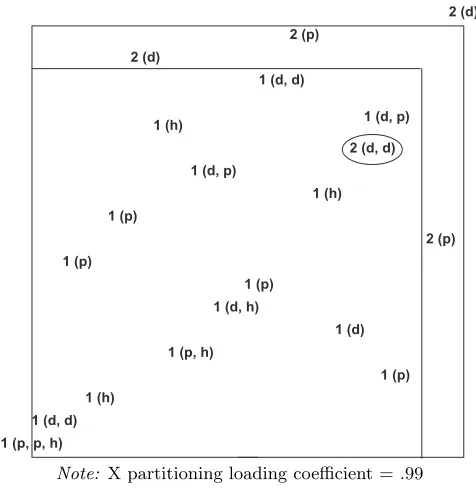
Note: X partitioning loading coefficient = .99
Figure 3g: Partitioned Item Diagram for Variable “Subgroups as Chains”: Accentuating (Q) Role
extreme of the X axis so for present purposes it is more parsimonious to consider this as an extreme of the Y axis. In other words, those networks that have both key central figures and core groups may also at more extreme levels of differentiation give rise to isolated individuals. This would be a recognised group dynamic process whereby the very existence of cliques helps to put some members in more isolated roles.
Such groups on the extreme of the vertical axis can be seen to be highly differenti-ated with central figures, cores cliques and spilling off from them individuals who have relatively tenuous links with the group as a whole.
The Joint Axis-Subgroups
The combination of the size variable, that gives rise to mid-level individuals, and the leadership variable, that is essential for a core group, is the creation of sub-groups, shown in Figure 3e. This divides the plot above and below a diagonal running from top left to bottom right, in other words cutting across the dominant quantitative, or ‘joint’ axis. This supports the view that the major development in organisational complexity of criminal networks is the emergence of sub-groups of individuals who have more contact with each other than with the group as a whole, often known as cliques.
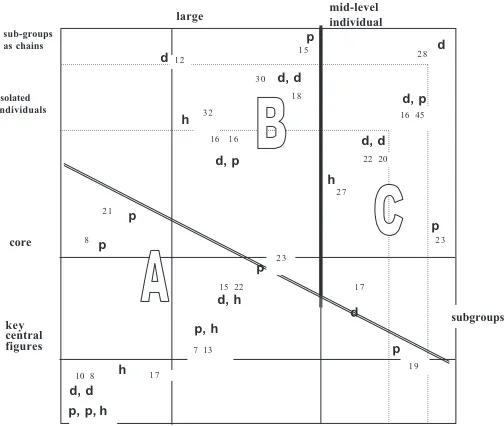
Note: The solid lines relate to the X and Y partitions. The dot-ted lines relate to the accentuating and attenuating partitions. The numbers are the size of the groups.
Figure 4: A partial order scalogram analysis with co-ordinates (POSAC) of 20 profiles derived from the 29 criminal networks with superposition of the seven partition lines.
showing further the way the process of creating levels in an organisation is also prone to generate conditions in which individuals are left with limited contact with that network. The final variable of sub-groups as chains serves to emphasise the extremities of the configuration, contributing to the most extreme levels of the other variables. As such it is also a clear attenuator, producing a Q partitioning, somewhat similar to the isolated individuals, but at an even more extreme level. This variable can only come into play when high levels of all the other variables exist. This therefore shows the most extreme form of structure that occurs in criminal groups, when individuals who are not necessarily key central figures do themselves have a sub-network in contact with them. This would seem to be the basis for another, possibly at some time competitive, sub-group to emerge that could be distinct from the overall network.
Overall Variations in Degree of Structure and Crime Type
This gives rise to three broad types of group.
Type A as indicated in Figure 4,ad hoc groups. They do not have sub-groups, but may have either core members or are greater than 15 people whilst not having any other dif-ferentiating characteristics (with just one exception that although consisting of 19 people has no central figures, but isolated individuals) would seem to be the least structured of the networks.
Those that do have subgroups may either as in Type B, having isolated individuals, implying a relatively loose network of people with some coherent groups but no strong hierarchy. This may be though of as anoligarchy that has a number of faction leaders with little strong indication of levels in a chain of command.
In contrast the most strongly structured groups, Type B, are closest to beingCriminal Organisations. They have lieutenants, in their mid-level individuals, as well as the nascent alternative groups in their sub-groups as chains.
When considering the different types of crime in which the criminal networks are in-volved it is clear that all types do exist in all three general regions. However if the main distinction is taken across the partitioning created by the existence of subgroups, regarding those without subgroups as less structured than those with, then some suggestive patterns can be discerned. Of the six hooligan groups four are in the less organised region. For the property networks seven are in the less organised and four in the more organised region. By contrast the drug networks tend to fall in the organised region with nine out the twelve in that region. This pattern fits the idea that the hooligan networks are really loose groups of associated individuals.
Although three of the drug networks are in the less organised region the great majority appear to have much greater structure. This may be partly a function of their larger size, but as can be seen from the sizes of the groups as indicated in Figure 4, there is a drug groups of 15 members that has little organisational structure and another of 12 members that has every component except mid-level individuals. In general, although the average group size for Type A is 13 individuals, for Type B, 20 people and for Type C 25, there is a considerable range of sizes across all three groups. Thus the tendency for the larger organisations to be the most structured, whilst present is certainly not a rigidly strong relationship in this sample.
4. Conclusions—Three Types of Group
Partial Order Scalogram Analysis of measures derived from Social Network analysis was applied to data derived from known contacts between members of criminal groups and networks. This led to the identification of two key ways in which criminal network structures can vary. One relates to the increasing size of the group and with that size the emergence of individuals who act as links between the key central individuals and the rest of the group. Groups that have all these components may also have isolated individuals who only have contact with the group through one person.
core groups that form a sort of ‘aristocracy’ around these figures then on to the emer-gence of sub-groups linked in as chains to significant figures in the group. At their most differentiated these groups are also likely to have isolated individuals.
These two dimensions assisted in the identification of three broad types of group. The most definitive aspect of the networks appeared as the presence of sub-groups. The less differentiated organisational structures had no-subgroups (Type A). Those that had sub-groups could be either high on the axis of group structure (Type B) or high on both axes (Type C).
Type A groups that are low on both dimensions, operated as if they were an ad hoc
group with relatively little structure, sometimes with just the presence of key central figures. These groups, identified as Type A in Figure 4 they tended to be the smallest groups, ranging in size from 8 to 22 with an mean of 13 members. In the present sample they have a preponderance of hooligan groups and property criminals, but they do also contain some of the smaller drug networks.
Type B groups were labelled ‘oligarchies’ because their communication networks appear to be controlled by a small group of people. These tend to be larger than Type A groups, ranging in size from 12 to 32 members with an average of 20 members. They consisted mainly of drug networks but also contained property criminals and the largest hooligan group in the sample of 32 members.
Type C groups were the closest to being an illegal organisation with most forms of dif-ferentiation, indicating a management hierarchy. They contained the largest network in the sample of 45 property criminals, with the smallest group being 16 drug dealers. Their average size of 25 members indicates that Type C typically contains the largest number of people in any group.
These findings indicate that, as has been found in so many studies of organisational size, the number of people involved in any group carries implications for how hierarchical and structured a group needs to be to survive. Apparently once a criminal network gets beyond about ten members it starts to differentiate in various ways. Beyond about 20 members this differentiation becomes more pronounced.
activities, some closer to the opportunistic actions of hooligans and others closer to the planned management of large drug cartels.
5. Discussion
These findings contribute in three quite distinct ways. From a social psychological perspective, they indicate some of the structural components inherent in criminal social networks. Secondly they offer further illustrations of methodologies of general relevance to the study of social networks. From the perspective of investigative psychology they help to develop an understanding of the structure and operation of organised crime groups with the view to more effectively investigating and disrupting them.
Despite the inherent logic of the current results and their potential value some caveats are necessary. The data on which the analyses are based, like most information derived from police records, as discussed in detail by Canter and Alison (2003), has many pos-sible flaws. In the present sample we can never be certain if the full network has been identified or if the observational data the police have collected is complete. Furthermore, the information available is very limited. In telephone surveillance no account is taken of the nature of the communications involved only who is in contact with whom. Where people are observed together the substance of their meeting is not recorded merely that they have been seen together. All of the above results therefore only relate the structure of the communication networks, and that in a limited number of groups. Certain infer-ences have been made about the significance of these structures. The implications of these inferences are such that future research to test them with other forms of data would be very worthwhile.
The main finding is that POSAC examination of measures derived from SNA reveals some intriguing variations in the structure of criminal networks. These variations are likely to have some relationship to the size of the network and the nature of the crimes in which it is engaged, but other aspects of the networks could be relevant and are open to empirical test if the data was available. For instance, the longevity of the network may be important, the older networks being hypothesised to be more highly structured. The personality, age or experience of the main players could also be significant, with some individuals being more dominant than others, shaping the network around their own char-acter. Issues such as ethnic mix and family relationships would also be expected to play a part with processes of social identification bringing some sub-sets of individuals more into contact with each other than with those they regarded as less socially relevant.
From an investigative point of view the findings offer many indications for ‘destructive organisational psychology’ (Canter 2000). The fact that most groups contain key central figures does, for example, suggest that it will be profitable for law enforcement agencies to identify who these individuals are. If they cannot be identified it may be because the network or febrile and not very stable, being more readily destroyed by police pressure.
they may be more likely to become informants, being less integrated into the group as a whole. The analysis also shows that for any informant an attempt should be made to determine the structure of the network as a whole and where that informant is placed within that structure.
If the structure turns out to be an oligarchy (Type B) then the core group need to be clearly identified. In such a group arresting one or two key central figures may have little impact in destroying the activity of the network as a whole because other core group members can readily take over. In a Type C organised criminal network the presence of mid-level individuals needs to be carefully assessed. They may be the ‘heirs apparent’ or implicitly in competition with the central group and so may be the most useful to draw upon for information or to use in other ways to disrupt the network.
This exploration of a diversity of 29 criminal groups and networks has demonstrated that potentially fruitful application of POSAC to measures derived from SNA. It has shown that the sorts of information collected by the police is amenable to such analyses and that, despite their inherent complexity, results of interest and possible significance have been derived. Development of this approach with other criminal groups and networks and with further information about those groups and their membership could therefore of great value in moving our understanding of criminal organisations.
R
EFERENCESBarker, R.G. & Gump.P.V. (eds.).Big School, Small School: High School Size and Student Be-havior, Stanford: Syanford University Press.
Borgatti, S.P., Everett, M.G., & Freeman, L.C. (1992). UCINET IV Version 1.62., Columbia: Analytic Technologies.
Canter, D. (2000). Destructive Organisational Psycholgy. In D.Canter & L. Alison (Eds.), The Social Psychology of Crime: Groups, Teams and Networks, Aldershot: Ashgate, pp.321– 334.
Canter, D. & Alison, L. (2000). The Social Psychology of Crime. In D.Canter & L. Alison (Eds.), The Social Psychology of Crime: Groups, Teams and Networks, Aldershot: Ashgate, pp.1– 20.
Canter, D & Alison L. (2003). Converting Evidence Into Data: The Use Of Law Enforcement Archives As Unobtrusive Measurement.The Qualitative Report, 8(2), June
http://www.nova.edu/ssss/QR/QR8-2/index.html.
Dorn, N., Murji, K., & South, N. (1992).Traffickers: Drug markets and law enforcement, London: Routledge.
Dorn, N. & South, N. (1990). “Drug Markets and Law Enforcement.”British Journal of Crimi-nology, 30(2), pp.171–188.
Duyne, van, P. (1996). “The Phantom and threat of Organised Crime.”Crime, Law and Social Change, 24: pp.341–77.
Duyne, van, P. (1997). “Mobsters are People Too.” In D.V. Canter & L.J. Alison (Eds.), Inves-tigative Psychology Volume 3: Criminal Networks, Aldershot: Dartmouth.
Freeman, L.C. (1979). “Centrality in Social Networks: Conceptual clarifications.” Social Net-works, 1: pp.215–39.
Johnston, L. (2000). The social structure of football hooliganism. In D. Canter & L.J. Alision (Eds.),The Social Psychology of Crime, Aldershot, Dartmouth, pp.153–188.
McAndrew, D. (1998). The Structure of Criminal Networks, University of Liverpool, Unpublished PhD. Thesis.
McAndrew, D. (2000). The structure of criminal networks. In D. Canter & L.J. Alision (Eds.),
The Social Psychology of Crime.Aldershot, Dartmouth, pp.51–94.
Moreno, J.L. (1934).Who Shall Survive? Washington, D.C.: Nervous and Mental Disease Pub-lishing Company.
Reiss, A.J. (1986). “Co-offending Influences on Criminal Careers.” In A. Blumstein (Ed.), Crim-inal Careers and Career CrimCrim-inals, Washington, D.C.: National Academy Press.
Reiss, A.J. & Farrington, D.P. (1991). “Advancing Knowledge about Co-offending: Results from a prospective longitudinal survey of London males.”Journal of Criminal Law and Crimi-nology82: pp.360–95.
Reuter, P. & Haaga, J. (1986).The Organisation of High-Level Drug Markets: An Exploratory Study, Santa Monica: RAND.
Ruggiero, V. & South, N. (1995).Eurodrugs: Drug use, markets and trafficking in Europe, Lon-don: UCL Press.
Sabbagh, C., Cohen, E.H., & Levy, S. (2003). Styles of Social Justice Judgements as Portrayed by Partial-Order Scalogram Analysis.Acta Sociologica, 46(4), pp.323–338.
Sarnecki, J. (1986).Delinquent Networks, Stockholm: Liber forlag.
Sarnecki, J. (2001).Delinquent Networks: Youth Co-Offending in Stockholm, Cambridge: Cam-bridge University Press.
Schneider, S.R. (1997). “The Criminal Intelligence Function: Toward a comprehensive and nor-mative model.”IALEIA Journal, 9(2), pp.1–34.
Scott, J.P. (1991).Social Network Analysis: A handbook, London: Sage.
Seed, P. (1987).Applied Social Network Analysis: A set of tools for social services research and practice, Tunbridge Wells, UK: Costello.
Shaw, B. & Cummings, L.L. (Eds.), (1990).Research in Organisational Behaviour12, Greenwich: JIA Press.
Shye, S. (1978). Partial order scalogram analysis. In S. Shye (Ed.),Theory construction and data analysis in behavioural sciences, San Francisco: Jossey Bass.
Shye, S. & Elizur, D. (1994).An Introduction to Facet Theory, Newbury Park, CA: Sage. Sparrow, M.K. (1991). “The Application of Network Analysis to Criminal Intelligence: An
as-sessment of the prospects.”Social Networks, 13: pp.251–74.
Stephenson, K. & Zelen, M. (1989). “Rethinking Centrality: Methods and applications.”Social Networks, 11: pp.1–37.
Strang, J. & Gossop, M. (Eds.), (1994).Heroin Addiction and Drug Policy: The British system, Oxford: Oxford University Press.
Van Limbergen, K., Colaers, C., & Walgrave, L. (1989). The societal and psycho-sociological background of football hooliganism.Current Psychology Research and Reviews, 8, 4–14. Wasserman, S. & Faust, K. (1994).Social Network Analysis: Methods and applications,
Cam-bridge: Cambridge University Press.
Wiegand, B. (1994). “Black Money in Belize: The ethnicity and social structure of black-market crime.”Social Forces, 73(1), 135–54.
Williams, P. (1993). “The International Drug Trade: An industry analysis.”Low Intensity Con-flict and Law Enforcement, 2(3), pp.397–423.
Warr, M. (1996). Organization and instigation in delinquent groups.Criminology, 34, 11–37.