THE LONDON SCHOOL OF ECONOMICS AND POLITICAL SCIENCE
LOCAL ECONOMIC DEVELOPMENT IN MEXICO
THE CONTRIBUTION OF THE BOTTOM-UP APPROACH
Eduardo Iván Palavicini Corona
A thesis submitted to the Department of Geography and Environment of the London School of
Economics and Political Science for the degree of Doctor of Philosophy
Declaration
I certify that the thesis I have presented for examination for the PhD degree of the London School of Economics and Political Science is solely my own work other than where I have clearly indicated that it is the work of others.
The copyright of this thesis rests with the author. Quotation from it is permitted, provided that full acknowledgement is made. This thesis may not be reproduced without my prior written consent.
I warrant that this authorisation does not, to the best of my belief, infringe the rights of any third party.
Abstract
This thesis examines the contribution of the bottom-up approach towards local economic development (LED) in Mexico. It applies a combination of methodologies to assess if the growing importance of this approach in the public policy arena is supported by a more focused and systematic analysis. In doing so, the aim is to offer a broader and deeper understanding of the key elements of the bottom-up perspective and their specific impact on the economic and social development of places, by considering a large sample of Mexican municipalities; and to better comprehend the effects of local actions and interactions on the shape and effectiveness of those key elements by focusing on two municipalities, which have adopted different strategies.
The first part of the empirical analysis uses a quantitative methodology and presents – to the best of our knowledge – the first nationwide quantitative assessment of the impact of the constituents of the bottom-up approach on the development fortunes of local jurisdictions. The analysis relies on a purpose-built database of 898 municipalities in Mexico and on heteroscedasticity-consistent ordinary least square (OLS) regression methods to evaluate whether the implementation of six different components of the bottom-up development strategies – development plan, sustainability, entrepreneurship, capacity building, participation mechanisms, and development links – has delivered greater human development across Mexican municipalities. The results of the analysis indicate that municipalities engaging in LED have witnessed improvements in human development, relative to those which have overlooked it. The increase in human development has been greatest for those local authorities which have pursued capacity building, the establishment of development links and which have drafted a development plan based on a local diagnosis.
Acknowledgements
This research was mostly funded by the Mexican Council of Science and Technology (CONACYT).
It has been a privilege to be supervised by Andrés Rodríguez Pose. I am especially grateful for his invaluable guidance, encouragement, continuous support and friendship.
I take this opportunity to express my gratitude to all the academics who made possible the construction of the LED database for Mexican municipalities and all the participants in the case studies. In particular, I thank to scholars at El Colegio de Tlaxcala, A.C.
I am grateful to the Environment and Geography Department and to the LSE for their financial support at some point during my studies. I thank the helpful comments of professors and classmates within the department. I am grateful to my review supervisor Riccardo Crescenzi and my friends Guilherme Resende and Tulio Cravo for their interest in my work and feedback.
I express my gratefulness to Dr. Simona Iammarino and Dr. Antonio Vázquez Barquero, who were the examiners of this thesis, for contributing to strengthen its contents with their detailed observations.
I thank my flatmates at Sidney Webb House and Braemar Road for their friendship and allowing me to share my PhD experience. From all my friends, Guan and his wife Jingyi deserve a special mention. I cannot express in words my gratitude for their help during difficult times.
Table of Contents
CHAPTER 1: Introduction... 9
CHAPTER 2: An introduction to the bottom-up approach towards the development of places..... 14
1. Introduction... 14
2. The bottom-up approach: conceptual background and the links between practice and theory... 14
3. LED definitions and their main elements... 22
4. What has been wrong with the top-down approach?... 25
5. Words of caution and criticisms to the bottom-up approach... 30
6. Final considerations and remarks... 32
CHAPTER 3: The bottom-up perspective to economic development: key features and policies... 36
1. Introduction... 36
2. The fundamental elements of the bottom-up approach...
.
... 363. The rationale for the application of bottom-up strategies in Latin America and Mexico... 47
4. Considerations for studying the bottom-up approach in Mexico... 55
5. Final remarks and conclusions... 61
CHAPTER 4: The contribution of the bottom-up approach towards economic development: a quantitative approach to analyse Mexican municipalities... 64
1. Introduction... 64
2. Human development: a development index for Mexican municipalities... 65
3. Municipal development indexes in Mexico in 1990 and 2005... 72
4. The concept of human development and the LED approach... 82
5. The proposed model... 88
6. Concluding remarks... 95
ANNEX 1: Map 1. Regional Division of Mexico... 97
ANNEX 2: LED database: Questionnaire... 98
CHAPTER 5: Quantitative assessment of the bottom-up approach in Mexican municipalities: findings, conclusions and further research... 100
1. Introduction... 100
2. LED database and model diagnostics... 101
3. Findings... 108
4. Conclusions and final remarks... 116
ANNEX: Tables and figures of correlations and multicollinearity tests... 120
CHAPTER 6: Qualitative analysis of the bottom-up approach in Mexico: selection and background of case studies... 123
1. Introduction... 123
2. Institutional context... 125
3. The bottom-up approach in Tlaxcala... 131
4. Tlaxcala‟s main physical, population and economic features... 133
5. Selection criteria based on the number of LED constituents, differences on the MDI and employment indicators... 141
6. The development context in Apizaco and Chiautempan... 143
CHAPTER 7: A closer examination of the impact of the bottom-up approach in
Mexican municipalities: Apizaco and Chiautempan 1990-2010... 155
1. Introduction... 155
2. Existence of development plans and sustainability... 160
3. Empowerment, capacity building and governmental competence... 163
4. Entrepreneurial attitudes and aptitudes... 166
5. Participation attitudes and mechanisms... 168
6. Collaborative links and networks within and outside the locality... 175
7. The impact of the bottom-up approach in the development of Apizaco and Chiautempan... 179
8. Other aspects influencing the development of Apizaco and Chiautempan... 186
9. Final remarks... 188
ANNEX: Table 1: In-depth interviews by municipality... 191
CHAPTER 8: Thesis summary and conclusions... 192
Index of Tables, Figures and Pictures
CHAPTER 2
Table 1: LED definitions... 22
CHAPTER 3 Table 1: Latin American challenges for the success of the bottom-up strategies... 52
Figure 1: Pattern of territorial economic development in Europe... 56
CHAPTER 4 Table 1: MDI, 1990: bottom and top 20 municipalities... 74
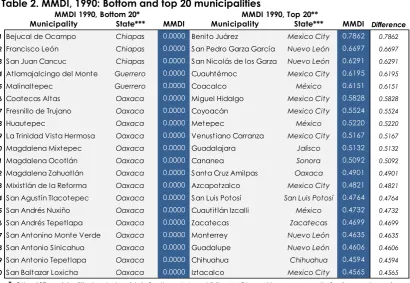
Table 2: MMDI, 1990: bottom and top 20 municipalities... 75
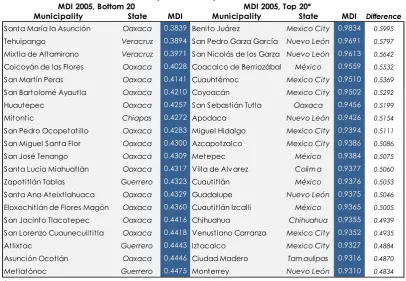
Table 3: MDI, 2005: bottom and top 20 municipalities... 77
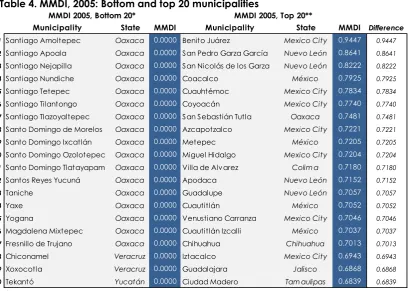
Table 4: MMDI, 2005: bottom and top 20 municipalities... 78
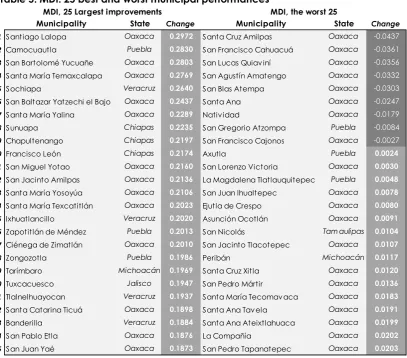
Table 5: MDI: 25 best and worst municipal performances... 81
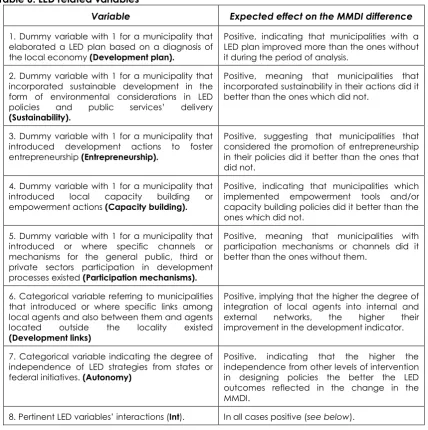
Table 6: LED related variables... 92
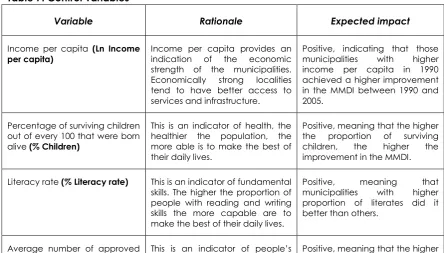
Table 7: Control variables... 93
Figure 1: Components of the development index for Mexican Municipalities (MDI)... 70
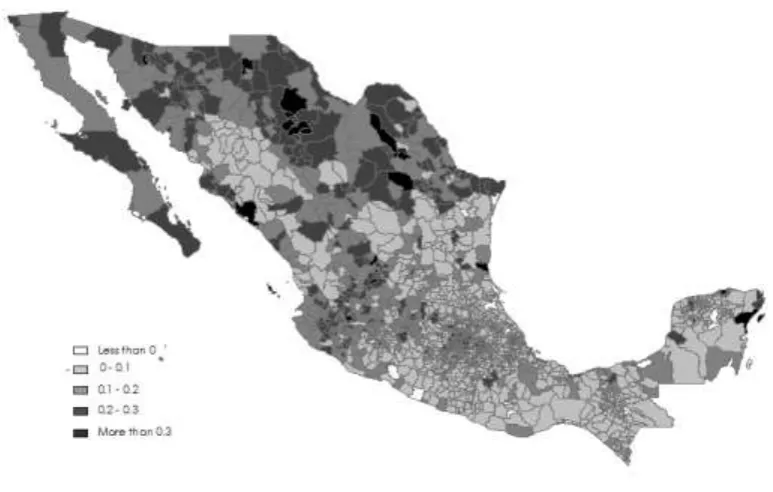
Figure 2: Map of the MMDI variation 1990-2005... 82
ANNEX 1: Map 1. Regional Division of Mexico... 97
CHAPTER 5 Table 1: Number of municipalities incorporating each LED criterion 1990-2005... 104
Table 2: Model with the number of LED criteria... 110
Table 3: Model with the LED variables... 113
Table 4: Model with interactions... 114
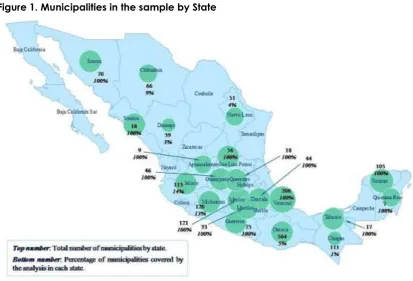
Figure 1: Municipalities in the sample by State... 103
ANNEX: Tables and figures of correlations and multicollinearity tests... 120
CHAPTER 6 Table 1: Number of municipalities in Tlaxcala incorporating the LED criteria... 132
Table 2: Tlaxcala‟s population density... 135
Table 3: Tlaxcala‟s population by gender... 135
Table 4: Tlaxcala‟s population growth... 136
Table 5: Main urban municipalities in Tlaxcala... 136
Table 6: Tlaxcala‟s indigenous population... 137
Table 7: Tlaxcala‟s contribution to the national GDP by sector... 138
Table 8: Sector‟s contribution to the GDP of Tlaxcala... 139
Table 9: Tlaxcala‟s GDP composition by main economic activities... 139
Table 10: Number of firms and people employed by firm size in services and manufactures, 2003... 140
Tlaxcala... 142
Table 13: Population annual growth rates... 144
Table 14: Population density in Apizaco and Chiautempan... 144
Table 15: Indigenous population in Apizaco and Chiautempan (%)... 144
Table 16: Economic composition 1990 and 2000: Apizaco and Chiautempan... 146
Table 17: Value of the main agricultural produce and meat production in Apizaco and Chiautempan as a percentage of state‟s values... 149
Table 18: Municipal Development Index figures: Apizaco and Chiautempan... 150
Table 19: Community presidencies in Apizaco and Chiautempan... 152
Figure 1: Municipal division of the state of Tlaxcala... 134
Figure 2: MMDI components in Apizaco and Chiautempan... 151
CHAPTER 7 Table 1: MMDI improvements in Apizaco and Chiautempan considering different periods of time... 170
Table 2: Factors perceived as influencing Apizaco‟s and Chiautempan‟s development outcomes... 180
Picture 1: Steam locomotive in Apizaco‟s main roundabout... 165
Picture 2: A commercial street in Chiautempan... 167
CHAPTER 1 Introduction
In Small is Beautiful: a Study of Economics as if People Mattered, Schumacher (1973) suggested the importance of territories within countries to tackle issues of poverty, mass migration, unemployment, and income inequalities, among others. He criticised the focus of national policies on gross domestic product growth which neglects other aspects of people‟s quality of life and the concrete circumstances of the places where individuals live and interact. Later, Stöhr and Taylor (1981) observed that bottom-up development strategies had not been implemented on a regular basis and for a long period of time. After long periods of top-down predominance in public policy and the continued presence of the problems pointed by Schumacher, policy strategies closer to local (sub-national) realities started growing in importance as recent as the outset of the last decade of the 20th century (Pike et al. 2006).
The popularity of local economic development (LED) approaches to economic and social development has risen significantly over the last two decades, fundamentally as a result of what has been perceived as a failure of top-down development strategies (Boisier, 1999; Puga, 2002; Crescenzi and Rodríguez-Pose, 2008). In short, numerous national approaches to development have been unsuccessful to satisfy local needs as well as to tackle local economic difficulties and challenges, and, thus, have failed to improve people‟s quality of life in a context of increasing globalisation (Greffe, 1989; Potter et al., 1999; Swinburn, 2006).
Parallel processes of globalisation and decentralisation have not only granted localities greater autonomy to design and implement their own development strategies, but have also promoted capacity building and the empowerment of local actors, leading to a greater emphasis on the participation of local stakeholders and on the sustainability of development processes (Pike et al., 2006). In addition, in the specific case of Latin America, democratisation has also favoured decentralisation efforts and contributed to the transfer of greater responsibilities and resources to sub-national governments (Enriquez-Villacorta, 2006).
In this context, the literature is awash with a number of successful LED cases showing that bottom-up strategies provide viable development alternatives in a more integrated world. However, despite the success cases documented by academics and practitioners, the impact of LED strategies remains insufficiently assessed (Crescenzi and Rodríguez-Pose, 2011; Gordon and Low, 1998; Markusen and Schrock 2006). A large percentage of the literature dealing with LED has tended to concentrate on a handful of cases such as Silicon Valley in California, the Third Italy, Baden-Württemberg, Jutland in Denmark, Bangalore in India, Wenzhou in China, and Rafaela in Argentina. But the constant tendency in the literature to examine and evaluate successful cases has resulted in an overwhelming dominance of single-case inductive approaches to the study of LED strategies, which have resulted in an impossibility to determine whether LED strategies, beyond the well-documented cases, really work (Barberia and Biderman, 2010; Crescenzi and Rodríguez-Pose, 2011). It may well be the case that the evaluation of local and regional development has been constrained to the lushest trees, disregarding the multitude of small and generally poorly documented attempts to try to implement the bottom-up approach across the world.
Meyer-Stamer (2005) maintains that although there are some „good practice‟ experiences described in the literature, it is not easy to clearly distinguish the effects of LED strategies on development outcomes even in the best known and documented success stories. In this sense, there are no studies that have put together the key elements of strategies which main feature is their local origin and focus, and analysed their specific effects on the development fortunes of the places where they have been contemplated.
the International Labour Organisation (ILO), among others. Besides, the Europe 2020 strategy contemplates a regional policy based on the „strengths of each territory‟
(European Commission Website1). LED strategies have been seen as complements, if not
as outright alternatives, to traditional top-down development programmes (Pike et al., 2006; Potter et al., 1999; Stöhr, 1990; Tödtling, 2011; Vázquez Barquero, 1999 and 2011). The need to examine the concrete effect of the key elements of this approach grows in importance given that the role of sub-national territories in development has not escaped criticism within the literature (Lovering, 1999; Mohan, 2011; Newton, 1978).
As bottom-up strategies towards economic and social development have been pursued within developing and developed countries, and successful cases have been increasingly documented along the years since the outset of the 1990s, it is now possible to build an analytical framework to examine their specific contribution to the development performance of territories (Pérez-Sánchez, 2010; Vargas, 2006).
In order to perform such analysis, in this dissertation we select the case of Mexico. It is interesting and relevant to examine the effects of the key constituents of the bottom-up approach in this Latin American country for two reasons. First, it is one of the countries in the world where the pursuit of LED strategies by regional and local authorities has been prominent since the 1990s as documented by numerous studies (Albuquerque, et al. 2002; Bair and Gereffi, 2003; Helmsing, 2001b; Iammarino et al., 2008; Mazza and Parga, 1999; Mitchell Group Inc., 2003; Pike, et al. 2006; Pérez-Sánchez, 2010; Rabellotti and Schmitz, 1999; Ruiz-Durán, 2000a and 2000b; Vargas, 2006). Second, Mexico‟s formal institutional setting allows sub-national levels of government to engage in social and economic development. Democratisation and decentralisation efforts since the end of the 1980s have contributed to transfer greater responsibilities and resources to sub-national authorities, among other aspects favouring their active role in promoting development (Cabrero, 2003b; Ruiz Durán, 2005; Vargas 2006).
To sum up, the relevance of this research is rooted in two different aspects. First, the need to clearly specify what the bottom-up perspective involves in a context of external influences and different scales of policy intervention (Martin and Sunley, 2008). On these grounds, this research offers a detailed discussion on the bottom-up approach towards economic development which leads to clearly distinguish its fundamental features and policy actions. Second, it is necessary to propose and use different analytical tools to examine the concrete impact of each of those key elements on the development of
places. To that end, we propose a quantitative methodology to test such impact, followed by a qualitative analysis intended to provide some knowledge on the specific shape and characteristics of the effects discovered during the quantitative study. Such a combination of methods is being proposed in the European Union to evaluate its regional policy 2014-2020, with the advantage that the European Commission will not only be able to evaluate individual strategies in particular regions, but the information gathered would also be useful for including a large number of them in further analyses
(European Commission Website2).
Our research hypothesis is that the fundamental elements of the bottom-up approach have played a significant role in the development of the Mexican localities where these elements were present between 1990 and 2005. More specifically, we hypothesise that if, as believed by the literature on local and regional development, LED strategies are expected to have a positive impact on economic development, then the presence of any of the specific LED features and policy actions – development plans, sustainability, empowerment and capacity building, entrepreneurship, development linkages, as well as participation mechanisms – in the strategies followed by Mexican municipalities resulted in better development outcomes. This dissertation is organised as follows.
Chapter 2 introduces the bottom-up approach and sets the foundation that contributes to build the conceptual basis for the analysis of its impact on the development of Mexican municipalities. Towards this end, a discussion of the logic behind the idea of localities as the main source of development initiatives is presented as well as a comparison between the top-down and bottom-up approaches. Additionally, an analysis of different LED definitions identifies the fundamental features of this approach.
Chapter 3 completes the theoretical ideas and background that represent the foundation for the analysis of the impact of bottom-up strategies on the development of places by explaining and illustrating their key features and policy instruments, as well as discussing the rationale for their implementation in Latin American countries, in general, and Mexico, in particular. This chapter also provides detailed insights on the pertinence of the selected scale of analysis.
Chapter 4 elaborates on the methodology to quantitatively test if the LED constituents have had a significant effect on the development of Mexican municipalities. This
chapter introduces and explains the model specification, the LED explanatory and control variables, as well as informs on the selection of the response variable.
Chapter 5 carries out the quantitative analysis using a database specifically-tailored for the purpose of this project – as there were no prior datasets on LED strategies at the municipal level in Mexico. Chapter 5 unveils the model results and comments them in light of the analytical framework developed in chapters 2 and 3.
Two municipalities in the state of Tlaxcala are selected for further analysis: Apizaco and Chiautempan. Chapter 6 informs on the design of the qualitative analysis and on the criteria for the consideration of these municipalities as our case studies. Chapter 6 also explains their development context which includes their institutional setting, their attributes relative to the LED database, and their main geographical, economic, and social features.
CHAPTER 2
An introduction to the bottom-up approach towards the development of places
1. Introduction
Local economic development (LED) can be affected by both national governments‟ interventions and by sub-national ones. Since the start of the 1990s local and regional development strategies have been increasingly adopted with governments no longer acting as the sole or predominant actors in the development process (Albuquerque, 2005; Glasmeier, 2001; Vázquez-Barquero, 2002). This chapter elaborates on the background behind the growing importance of bottom-up strategies all over the world, and presents their main conceptual underpinnings.
The chapter‟s aim is to introduce the bottom-up approach to economic development and set the conceptual foundation that will contribute to build the basis for the analysis of the impact of bottom-up strategies in Mexico.
We start discussing the general background of this approach by going through basic considerations of the concept of the word development and some of the most common uses of this word in the development practice. The clarification of what is understood here by the development of places is followed by a discussion of the logic behind the idea of localities or sub-national regions as the main source of development initiatives. This is followed by a review and analysis of different definitions of LED in order to identify its key elements. Next, a comparison between top-down and bottom-up approaches sheds further light on the rationale of the latter towards effectively promoting economic development. The main criticisms to this approach are discussed before offering some concluding remarks.
2. The bottom-up approach: conceptual background and the links between practice and theory
scholars but also by policy makers, non-governmental organisations (NGOs), and international organisations such as the Organisation for Economic Cooperation and Development (OECD) and the World Bank. Finally, the logic behind the idea of regions or localities as the main source of economic development policies is examined.
2.1 The focus of economic development on economic growth
Acknowledging the importance given by O‟Neill (2011) to the use of language in the development practice and literature, we start by looking at the meanings of the word development. It has a variety of connotations that depend on the context people use it3. The idea of a process of growth has predominated in the literature on economic development (Boisier, 1999; Pearce, 2001). The use of language that closely relates the
ideas of growth and development may stem from the definitions of „growth’ in different
languages which include the following: „the process of growing and progressive
development‟. For the word „development’, a common definition is the „act, process,
or result of developing‟, where „develop(ing)’ refers to „increase, augment, improve and perfect‟.
As a consequence of the focus on economic growth, the nations and regions that are economically classified as developed are the ones that have reached certain high economic standards in terms of gross domestic product (GDP) and level of industrialisation. The developing countries are the nations going through the process of catching up with developed countries‟ GDP figures and economic composition (Pearce, 2001). By the same token, among the developing ones, the so called emerging market economies or newly industrialising countries have been the ones with the highest GDP growth rates. This pervasive idea known as „developmentalism‟ prevailed during the second half of the 20th century (Pike et al. 2006) and, arguably, is still in the mind of many policy makers around the world. The LED strategies are part of a more comprehensive approach as it will be explained in the remaining paragraphs of this chapter.
2.2 Social and human development
According to the United Nations Research Institute for Social Development (UNRISD), the strategy towards social development entails the promotion of universal social
protection and equity in a context of economic globalisation. This social perspective is incorporated to the policy agenda by means of public policies and institutions that aim to protect citizens from social contingencies and poverty. In addition, social policy should contribute to improve people‟s involvement in the formulation of development policies and public services, as well as help individuals to satisfy their needs and pursue their aspirations. Government accountability through participatory mechanisms is another fundamental element of this approach (Douglas and Geller, 2007). In short, social development involves the promotion of participatory democracy, human rights protection including gender equality, and poverty eradication, among other aspects
(Smetana et al, 2008; UNRISD Website4).
The concept became popular during the 1990s as a result of social policy reactions to macroeconomic adjustments. In the 1970s the development strategy of most developing countries was still import-substitution industrialisation led by the state. The consequence of trying to produce some intermediate inputs and any kind of final goods within each country, predominantly by state managed firms (public firms), was the prevalence of inefficiencies and non-competitive markets. In Mexico, this in combination with a huge budget deficit, high external debt, and low oil prices; led to a severe economic downturn during the 1980s (Aspe, 1993; Urquidi, 1996). In the middle of economic crises, the structural economic adjustments began consisting in privatisation of public firms, debt re-structuring, downsizing of public deficits, and
openness to trade5.This emphasis on market liberalisation did not consider the possible
social impact of the structural changes. For example, the privatisation of public firms and controls on public expenditure ended an era of direct governmental intervention in the labour market which secured jobs that otherwise would not survive as a result of low productivity and other inefficiencies in the use of resources (Aspe, 1993; Urquidi, 1996).6
Some national governments started to design policies under the label of „social development‟ in order to ameliorate the situation of the unemployed and the population living in poverty. In the case of Mexico a new ministry was created in the administration of Salinas de Gortari (1988-1994) called Social Development. Some years after its creation, the administration of President Ernesto Zedillo implemented the poverty alleviation programme called Progresa (now Oportunidades) which has been
4http://www.unrisd.org/
5 In Mexico the openness to trade dates from 1986 with its accession to the General Agreement on Tariffs and Trade (GATT).
internationally recognised as successful in terms of the results evaluated within samples of beneficiaries (IFPRI, 2002; Levy, 2006; Schultz, 2001; World Bank, 2004b).7
International organisations were also aware of the impact of macroeconomic policies on vulnerable population sectors within developing countries. As a result, the United
Nations Development Programme (UNDP) proposed to put an emphasis on human
development, while the United Nations International Children's Emergency Fund
(UNICEF) with its study called Adjustment with a Human Face initiated an international
debate on how to protect vulnerable groups from the negative effects of the economic adjustments and reforms taken to fix poor countries‟ economies. The pursuit of human development has included not only the satisfaction of people‟s basic needs but also their empowerment and improving their capacities for a better participation in their social and economic life. Improving human capital or people‟s education has been seen as beneficial in monetary and non-monetary terms for both individuals considered alone and as a group (Silva, 2008). Thereby, investment in human development or human capital has become one of the fundamental actions of development strategies around the world since the outset of the 1990s.
To sum up, the concepts of social and human development, and related policies had its momentum as a reaction to counterbalance the perceived negative socioeconomic effects of economic restructuring in different countries. Economic development is further discussed below alongside with its relation to the notion of sustainability.
2.3 Economic and sustainable development
In line with one aspect of the definition of the word „development‟ presented above, economics literature on the topic bases the study of the economic development of countries mainly in the determinants of gross domestic product (GDP) growth (Meier and Rauch, 2000). Traditional growth theoreticians such as Solow (1956, 1957, 1964) and Lucas (1988, 1993) concentrated on the contribution of physical and human capital as well as technical progress and knowledge accumulation on economic growth. Deeper understandings have added other aspects such as social capital to their equations. For example, Rodrik, et al. (2004) argue that there are three sets of explanations that should be considered when studying economic growth: international trade related, geographical and institutional. For them, the interaction between these three factors
7 You can find a complete description of this programme in Spanish in the following electronic address:
„determines which societies will innovate and accumulate, and therefore develop, and which will not‟ (Rodrik, et al., p. 133). Therefore, the literature on economic development has seen it merely as economic growth by focusing on the process of increasing countries‟ potential (i.e productivity) towards higher levels of GDP and,
consequently, employment.8
In 1987 the United Nations (UN) General Assembly in its 96th plenary meeting welcomed the report of the World Commission on Environment and Development which emphasised the need for a new approach to economic development consisting in a change of direction towards sustainable development (Bruhn-Tysk and Eklund, 2002). For the UN this concept implied „meeting the needs of the present without compromising the ability of future generations to meet their own needs‟, and „should become a central guiding principle of the United Nations, governments and private
institutions, organizations and enterprises‟9. Since then, the concept has been
increasingly incorporated in the agendas of governments, multilateral organisations and some NGOs.
The concept goes further than the ecological aspect when sustainability in economic development also considers the participation of local people in the development process, the effects of economic activities on communities and their localities, the protection of landscapes and natural resources, and the benefits for present and future generations (Forsyth, 1996). Precisely, this more complete idea of development, which also shares the ideals of human and social development, than the mere emphasis on economic growth is promoted by the proponents of LED strategies as it will be shown below.
2.4 The development of places and the bottom-up approach
The development of places has mainly been related to the economic sphere as job creation, productivity increases and income growth goals predominated in the development agendas during the 20th century (Geddes and Newman, 1999). Policies affecting the economic performance of regions and localities were mainly designed at a national level following the dominant economic theories at the time. However, the intensification of the globalisation of the world economy, the transition from close to
8 After Solow's (1956, 1957) neo-classical economic growth analytical framework, the vast literature on economic growth has incorporated other different aspects to the analysis of economic growth such as external economies, labour migration, savings rates, foreign direct investment, and geographical variables, among others (Boserup, 2007; Meier and Rauch, 2000; Pike et al. 2006).
9 United Nations Department of Economic and Social Affairs (DESA) electronic posting:
open economies, the necessary reduction of public deficits in some countries, the number and geography of people living under 1 dollar per day, in combination with the perceived low effectiveness of top-down policies; facilitated a change of focus towards a more bottom-up and comprehensive notion of development (Martin and Sunley, 2008a; Tödtling, 2011). To this we can add the emergence of other concerns such as increasing sub-national disparities and the awareness of the presence of sustainability problems (Ruiz-Durán, 2005; Martin and Sunley, 2008a; Tödtling, 2011).
The main development concepts in practice were briefly reviewed in the previous sub-sections to better understand the background of bottom-up strategies towards economic development. The awareness of the main aspects that development experts and practitioners around the world have been considering towards improving the life conditions in a particular society contributes to clarify the aims and elements that need to be covered in a development strategy for a territory. In other words, the human, social and sustainable development ideals promote the enhancement of individuals‟ capacity (individually and as a group) to face the challenges and make the best of opportunities in their social and productive lives in a context of economic transformations (Max-Neef et al. 1993). Thus, the development of places goes beyond the goal of economic growth as it incorporates the notions of „improving‟ and „perfecting‟ embedded in the definitions of the words „development‟ and „develop‟ presented in the introduction of this section (Corro and Palavicini-Corona, 2008; Local Government Commission, 1997).
Multilateral organisations such as the OECD and the United Nations (UN) by means of different endeavours such as the UN Development and Environment programmes and the OECD‟s Centre for Local Development have emphasised dimensions and perspectives of development other than the economic dimension and the top-down perspective. At the ideological level, post-development views argue that the capitalism structures imposed by Western countries reinforce inequalities among rich areas and places lagging behind. To fix this structural aspect of a capitalist society those views propose to promote local and regional own forms of development according to places‟ particular circumstances and desires (Leyshon et al. 2003). At the same time, the emergence of social actors have been filling gaps in poverty reduction, social inclusion and environmental issues, among others (Amin et al. 2002).
spheres other than only pursuing economic growth. On these grounds, bottom-up strategies have been carried out and different key elements for their success can be identified (CAF, 2010). This allows the LED approach to gain importance and be recommended by academics and development experts as a development alternative without disregarding the possibility of benefiting from national and supra-national development actions (Stöhr and Taylor, 1981; Giordano et al. 2005; Rodríguez-Pose and Crescenzi, 2011).
According to Peet (1998), and Gordon and Low (1998), the idea of a particular space as an active element in the economic and social outcomes of places has been present in the geography literature since Doreen Massey‟s (1978, 1984) and Philip Cooke (1986, 1989) contributions in which social processes are seen as place specific and as essential elements in shaping the economic trends of localities. The same academics attribute the notion of local influence over localities‟ economic own destiny in a globalised context to the same authors. In a similar line of ideas, Teitz (1994) traces back the change in emphasis on LED strategies from mainly attracting outside investment to enhancing the local ability to generate employment from within to the beginning of the 1980s.
The bottom-up perspective towards the development of places concentrates on a specific context and takes into account its geographic, economic, as well as formal and informal institutional framework to propose potentially successful economic development strategies (Vázquez-Barquero, 2009). Why is place specificity important? One of the main reasons is that the proximity to people‟s needs and wishes at the local level (for example, the smallest administrative unit in a country) is seen by bottom-up proponents as the foundation of the development process (Hugonnier, 1999; Stöhr, 1990; Vázquez Barquero, 1988 and 1999). This suggests that the benefits of the bottom-up approach towards economic development may not only entail the delivery of services or policies more efficiently (i.e. maximising the total surplus for the local society) but also the possibility of a better accountability of its processes due to the mentioned proximity (Martínez-Vázquez and Mcnab 2003).
different localised agents such as firms, research and technology centres, and governmental offices, among others.
In this line of ideas, Gordon (2006) suggests that when talking about the protagonism of localities or places, researchers should not reify them. In other words, researchers and practitioners should avoid the vagueness of talking about a locality as something acting by itself because the relevance and richness of analysing localities lies on the concrete institutions, circumstances and people living there. Taking this into account, we refer to what happens in a locality in terms of the different interests, characteristics, actions and interactions of local actors acting individually or as a group in a particular physical, social and economic context.
The fundamental idea behind the bottom-up approach is to harness the development potential of a particular geographical area to improve the well-being of its residents (Cheshire and Gordon, 1996). Therefore, although the economic aspect of development is of core importance, the process of local economic development is determined by different local characteristics including the prevailing local bonds of different nature (economic, social, linguistic, socio-political, and cultural, among
others)10. This territorial dimension implies the participation in the development process
of local agents from the public, private and social sectors (Stöhr, 1990). This is thought to generate development policies which are more coherent and effective than central or national government interventions (Hugonnier, 1999; Pike, et al. 2006; Ruiz-Durán, 2005).
Thereby, the proposition supported by mainstream theories of public finance, fiscal federalism and public choice (Azfar et al, 1999; Oates, 1999; Tiebout, 1956) in relation to a better allocation of resources at sub-national levels of government than at the federal or central level is considered in the bottom-up approach with a strong emphasis on local circumstances and the constant interaction among local agents. At the same time, this interaction supposes a greater extent of accountability and increases the chances of the development process continuity when political vicissitudes occur (Azfar et al, 1999; Cabrero, 2003b; Hugonnier, 1999; Díaz-Malásquez, 2009; Martínez-Vázquez and Mcnab, 2003).
In short, the bottom-up approach towards the development of places is a process that focuses on identifying and putting to work local resources of diverse nature to improve people‟s quality of life. As we explain below with more detail, LED considers individuals primarily as ends and not only as means of development processes. Therefore, this
development perspective places special attention to the synergy and local embeddedness of sustainability, social, human and economic development goals.
Once the logic behind the leading role of localities in the development of places has been clarified, the following section offers further details on the bottom-up approach towards LED.
3. LED definitions and their main elements
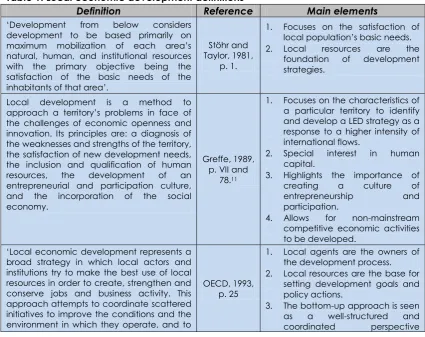
[image:22.595.111.537.376.713.2]This section goes through definitions of the bottom-up perspective towards economic development given in the course of the last thirty years. The aim is to clearly distinguish some of the key aspects of this approach. In chapter 3, these aspects will be revised and complemented when studying some experiences of LED around the world in order to define its key elements and set the base for the analysis of Mexican localities. Table 1 presents different definitions and their main elements.
Table 1. Local economic development definitions
Definition Reference Main elements
„Development from below considers development to be based primarily on maximum mobilization of each area‟s natural, human, and institutional resources with the primary objective being the satisfaction of the basic needs of the inhabitants of that area‟.
Stöhr and Taylor, 1981,
p. 1.
1. Focuses on the satisfaction of local population‟s basic needs. 2. Local resources are the
foundation of development strategies.
Local development is a method to approach a territory‟s problems in face of the challenges of economic openness and innovation. Its principles are: a diagnosis of the weaknesses and strengths of the territory, the satisfaction of new development needs, the inclusion and qualification of human resources, the development of an entrepreneurial and participation culture, and the incorporation of the social economy.
Greffe, 1989, p. VII and
78.11
1. Focuses on the characteristics of a particular territory to identify and develop a LED strategy as a response to a higher intensity of international flows.
2. Special interest in human capital.
3. Highlights the importance of creating a culture of entrepreneurship and participation.
4. Allows for non-mainstream competitive economic activities to be developed.
„Local economic development represents a broad strategy in which local actors and institutions try to make the best use of local resources in order to create, strengthen and conserve jobs and business activity. This approach attempts to coordinate scattered initiatives to improve the conditions and the environment in which they operate, and to
OECD, 1993, p. 25
1. Local agents are the owners of the development process. 2. Local resources are the base for
setting development goals and policy actions.
3. The bottom-up approach is seen as a well-structured and coordinated perspective
place them within a framework of coherent
local policy.‟ towards LED.
„Local development is a wide ranging concept that can best be seen as a process through which a certain number of institutions and/or local people mobilise themselves in a given locality in order to create, reinforce and stabilise activities using as best as possible the resources of the territory. It can be seen as a bottom-up attempt by local actors to improve incomes, employment opportunities and quality of life in their localities in response to the failure of markets and national government policies to provide what is required, particularly in underdeveloped areas and areas undergoing structural adjustment.‟
Potter et al. (1999, p. 97)
1. Includes economic and non-economic goals.
2. Local actors are seen as the protagonists of the development process.
3. Focuses on development policies based on the particular circumstances of a territory as an alternative to fix market and government failures.
„It is a local economy and society activation process based on the endogenous resources of a particular place with the goals of promoting economic growth, employment, and the local community well-being.‟
Pérez and Carrillo (2000, p.48)
1. It is not only an economic but also a social process.
2. The goals are economic and social.
3. The foundation of development actions are the local resources. „Local economic development may be
defined as a process in which partnerships between local governments, community-based groups and the private sector are established to manage existing resources, to create jobs and stimulate the economy of a well defined territory. It emphasises local control, using the potentials of local human, institutional and physical capabilities. Local economic development initiatives mobilise actors, organisations and resources, develop new institutions and local systems through dialogue and strategic actions.‟
Helmsing, 2001b, p. 3.
1. Emphasises the participation of private and social sectors in the development process alongside with the public sector.
2. Stresses the local origin and
management of the
development process.
3. Considers the creation of new mechanisms for the interactions
between development
participants.
„In our conception, Local Development appears as a new way to look at and act from the territory in this new globalization context. From that point of view, the challenge for local societies is presented in terms of their insertion in the global context in a competitive way, capitalizing their local and regional capacities through local actors‟ strategies.‟
CLAEH-ALOP, 2002,
p. 7.
1. Emphasises the local content of the approach as policies consider local circumstances in a context of higher international economic competition.
2. The insertion of local societies in the global context recognises the favourable role of local, national and international networking and interactions. „The purpose of local economic
development is to build up the economic capacity of a local area to improve its economic future and the quality of life for all. It is a process by which public, business and non-governmental sector partners work collectively to create better conditions for economic growth and employment generation. The ability of communities to improve the quality of life, create new economic opportunities and fight poverty depends upon them being able to participate effectively in the LED process, and act strategically in the changing and increasingly competitive market economy.‟
Swinburn, 2006, p. 1.
1. Includes economic and non-economic goals.
2. The role of local capabilities is once more highlighted.
3. Considers a strategic vision of local development.
4. Stresses again the participation of citizens, business and social sectors in the development process.
From the basic-needs satisfaction goal of the definition of development from below offered by Stöhr and Taylor (1981) to the more ambitious notion of Swinburn (2006), the importance attributed to the endogenous nature of the approach is notorious in all definitions. To summarise table 1, the main aspects of this perspective highlighted since the first experiences were documented and definitions given are:
1. The bottom-up approach is seen as a process fed by a strategic vision of development where economic goals are the main but not the sole concern.
2. The focus is on the characteristics and circumstances of a particular territory
but also considering the outside world to identify and develop a feasible LED strategy.
3. Local agents are seen as the protagonists of the development process where
the participation of members of the public, private and social sectors is indispensable.
4. There is recognition of the relevant role of new and innovative ideas, attitudes
and skills in the development process in terms of development goals and the means to determine and achieve them.
The definitions suggest that the bottom-up approach is a comprehensive strategy which not only has to do with identifying and taking into account the local economic strengths, weaknesses, opportunities and threats in a globalised world to set particular medium and long run goals; but also with the development process itself that demands considering -in addition to economic and physical features- the social, cultural and legal characteristics of places (Boisier, 1999; North, 1990; Pike, et al. 2006). In other words, a significant implication of the four elements of the bottom-up approach identified here is the need to strengthen local capabilities or the local context in diverse aspects to make the best of the physical and economic conditions.
prospects of the territory; aptitudes to identify and successfully run an innovative business; and capabilities to provide high-quality public services, among others. Therefore, the development of places through LED is a long term process that involves actions to meet both present needs of diverse nature, and future development visions.
To complete the background and rationale of the bottom-up approach, in the following section we dig deeper on the causes of its growing appeal since the beginning of the 1990s by comparing it with the top-down perspective.
4. What has been wrong with the top-down approach?
The aim of the following paragraphs is to highlight that, as far as the development goals of places are concerned (e.g. employment generation, higher standards of living), some academics have found that top-down approaches have had fundamental limitations while bottom-up approaches implemented under particular conditions can improve the economic outcomes of both core and peripheral territories (Tödtling, 2011; Vázquez-Barquero, 2011).
It is argued that localities or jurisdictions within a specific country have an essential role in stimulating local economic development in their territory while national or central governments have a crucial role in other matters. However, as sub-national entities are part of a whole country, to better achieve local, regional and national goals coordination is necessary (Camejo, and Gallicchio, 2004; Giordano et al. 2005;
Helmsing 2001b; Uphoff and Esman, 197412).
We start looking at the role of governments in the economy of places by recalling their main economic functions. We relate those economic functions to different levels of government before discussing the features that have deteriorated the top-down interventions‟ appeal to stimulate economic development with impact on sub-national jurisdictions.
The main function of governments is to establish and enforce laws, norms and rules (Stiglitz, 1986). Economically speaking, the state determines the legal framework that regulates property rights‟ establishment and the market interactions between economic agents (e.g. consumers, producers, workers). For example, the property rights over a start-up assure its owner rights and obligations in the market place, and a
buyer of a house can have certainty of her ownership after the transaction is done. The legal recognition of patents are incentives for continuing the research and development endeavours that let economic agents achieve higher efficiency and, therefore, produce the same with fewer resources or produce more with less or the same amount of them. As these fundamental regulations need to have a national (i.e. within a whole country), and sometimes, international (i.e. among countries) recognition, the national government is the foundational level of the rule of law with important practical contributions at sub-national levels.
Externalities are present in different ways in markets. Externalities refer to the cost or benefit imposed to others by the actions of economic agents (Stiglitz, 1986). The correction of negative externalities could be the function of local, regional and national authorities alone or in coordination. For example, if a firm producing fertilizers is polluting a local lake, the local authority would be the most suitable to correct the cost that this may impose on fishermen, tourism or the local population that may enjoy swimming there. An interesting example is the case of air pollutants that go beyond local and even national jurisdictions (Mason, 2001) and, as a consequence, other levels of government might need to intervene (e.g. setting air quality standards and signing pollution reduction compromises with other countries such as the Kyoto Protocol).
In the case of foreign direct investment and firms buying supplies in other countries such as wood for furniture production, different levels of government in different countries might also have to intervene to correct the possible negative effects of their activities (Klooster, 2006; Nadvi, 2008). The concept of environmental governance refers to the institutional setting by which economic activities are regulated to protect natural resources in order to achieve sustainable development. The contemporary nature of environmental governance is based on the recognition of the fact that economic activities can have a larger impact on the natural environment than solely on the
particular place where they are performed (Mason, 2001; Nadvi, 2008).13
The provision of public goods is intended to create positive externalities or, in other words, to provide the goods and services demanded by the population that private agents do not have incentives to supply (Stiglitz, 1986). All levels of government can produce them considering the costs of delivery and the reach of their benefits when provided. However, in small and/or impoverished municipalities or states, the managing
and delivery capacity of public goods by local civil servants might be poor, thereby, the role of the central or national government becomes essential implying that the extent of local intervention need to be lower, at least at the beginning of the development process, than in better-off places (Courchene, et al., 2000).
A public garden in a town is enjoyed generally by locals and the cost of its maintenance should be lower for the local authorities. In the case of roads or highways connecting different regions of a country, a central government lead is fundamental (Courchene, et al., 2000). Although most of the time the capital investment for its construction comes from national funding, the maintenance and operation could be the responsibility of sub-national authorities (Cabrero and Martínez-Vázquez, 2000). A hospital with the capacity to provide different specialised medical services in a particular state or province for the benefit of residents living in different municipalities is likely to be efficiently managed by the provincial instead of the municipal authority where it is located, and the financing of its construction and equipment might have national origin (Cabrero and Martínez-Vázquez, 2000).
In the case of imperfect markets such as monopolies and oligopolies, the economics literature highlights the fact that the farther to the theoretical ideal of perfect competition, the lower the total surplus enjoyed for the society as a whole (Fisher et al., 1990; Mankiw and Taylor, 2006; Parkin, 2007; Stiglitz and Heertje, 1989). In other words, prices become higher and the quantity available of products or services is lower in imperfect markets than in competitive settings. Traditionally, actions against monopolies or oligopolies have been designed and implemented at a national level, although regional or local monopolies or oligopolies may exist.
The existence of information asymmetries or incomplete information is another market failure that demands government intervention (Greenwald and Stiglitz, 1986). Oftentimes, all levels of government need to intervene. For example, in Mexico, the harmful effects of smoking written down in cigarettes‟ packs to inform the consumers on the risks of this activity is a national level regulation, while the prohibition of smoking in public places is regulated locally (this action is also part of correcting a negative externality).
and regional inequalities is a national concern as the former refers to aggregate economic variables such as inflation, exchange and interest rates, and the latter to disparities within a country (Prud‟homme, 1995). Programmes to combat poverty such as „Oportunidades‟ in Mexico and „Bolsa Familia‟ in Brazil are examples of national government efforts to redistribute income among the citizens of these countries where income per capita disparities are large. The provision of incentives to attract direct investment is an example of policy actions that can be implemented at any level of government to stimulate employment, contributing to strengthen the economy in stable periods or to reactivate it when downturns happen.
In short, both national and sub-national governments have an important role in solving market failures and setting and enforcing the rules that allow the functioning of markets. Pursuing the economic development of places is a significant task of governments and it is influenced by what is happening in their own jurisdictions and elsewhere. The nature and complexity of the task suggests the need of cooperation among levels of government and implies the identification of concrete actions that could be performed more efficiently by each of them, and generate synergies. As noted, the proximity to the concrete circumstances that people experience in their everyday life makes the local level the key scale for defining and pursuing development goals.
From the detailed account given about the bottom-up approach in previous sections and the brief discussion on the economic functions of governments just presented, the significant role that factors not directly related with the economic functions of governments have in the LED process stands out (Storper, 1997). This is because not only the collaboration between governmental levels is needed but also the participation of other local agents; considering both, the interactions among them and with external actors. This is explicitly taken into account in the bottom-up in contrast to the top-down approach (Rodríguez-Pose, 2010). Having this in mind, in the last part of this section the main drawbacks that scholars have identified in the top-down approach are exposed.
was left out of the equation during great part of the second half of the XX century (Stöhr and Taylor, 1981).
Second, there are many studies that have presented evidence in the direction of null or negative impacts of top-down or centre-down approaches to economic development in countries, regions or localities lagging behind (Boisier, 1999; Rodríguez-Pose and Crescenzi, 2008; Gramlich, 1994; Puga, 2002). Examples range from the large amount of transfers from rich regions to impoverished ones in countries as different as Italy and Mexico, to sectoral approaches within the import-substitution strategy in Latin American countries (Corro and Palavicini-Corona, 2008; Loddo, 2004; Pike et al. 2006).
Thirdly, the role of central or national governments has been changing as a result of the adjustments to face the challenges and opportunities of the globalisation process (Cooke, 1989; Martin and Sunley, 2008b). Devolution efforts around the world have given more responsibilities and/or resources to sub-national governments. In this context, local authorities have been seen by many as main actors in local economic development processes (Finot, 2001)14. As noted before, the public choice and fiscal federalism theories support this trend by suggesting that devolution can improve the well-being of local people by increasing the efficiency in resources allocation towards satisfying their needs and wishes according to their preferences and circumstances (Gil, Pascual, and Rapún, 2004; Rodríguez-Pose et al. 2007).
Pike et al. (2006) believe that the reasons for the lack of success of top-down policies could be identified from their own design. According to them, the nature of the bottom-up approach could reduce the chances to incur in the shortcomings observed in the top-down policies. For example, the authors underline that most of top-down policies were not designed as part of a comprehensive strategy and, then, only tried to solve immediate problems that were evidently hindering economic development. The case of transport infrastructure illustrates this point (Pike et al., 2006, p.15):
„Heavy investment in infrastructure, with little or no emphasis on other development factors such as the support of local firms, the improvement of local human resources, or the diffusion and assimilation of technology, has often created only imperfect accessibility to markets.‟
To give another example, connecting cities or towns might increase competition to local firms as it facilitates the entry of final and intermediate products from elsewhere into the local markets at lower costs. In places relying on tourism, if infrastructure improvements reduce substantially the travel time to them, some local firms such as restaurants and hotels might be affected because one day trips could be encouraged (Ottaviano, 2008).
Another alleged problem of top-down approaches is the tendency to misuse policies which have been successful elsewhere regardless of the specificities of each territory (Pike, et al. 2006; Vargas, J. 2006). As we will see even with greater detail, pursuing LED entails the embeddedness of the approach through the participation of local agents, and a diagnosis of the resources and characteristics of the territory; in combination with a strategic perspective to tackle the identified weaknesses, profit from the opportunities and strengths, and face the identified challenges.
To sum up, the changes in economic development processes implied by the bottom-up approach entail a greater emphasis of national or central governments on certain traditional functions such as redistribution schemes among jurisdictions and macroeconomic stabilisation, both suggested by decentralisation and public finance theories; and lower in others such as planning and implementing local economic development as suggested by the bottom-up approach to LED and also the public finance theories. Governmental functions demand a coordination effort among different levels of government. Top-down approaches have showed a lack of cooperation and coordination among levels of government and, consequently, have failed in correcting local market failures and in satisfying local development needs (Boisier, 1999; Potter et al., 1999).
5. Words of caution and criticisms to the bottom-up approach
The above involves changes in managing local economic development processes that will vary according to the specific characteristics of places (i.e. weaknesses and strengths of local governments and other local agents). For Storper (1995) the prevailing market and non-market factors (i.e. social, relational and other informal institutions that may affect economic behaviour) are particularities that affect the places‟ potential of economic success. In this sense, Bardhan (2002) and Bardhan and Dilip (2000) argue that governance failure in development policy and public services delivery could occur not only among actors located at different scales but also at the local level alone. Lack of cooperation could prevent setting and achieving LED goals. This means that the bottom-up approach might also entail establishing the conditions which would allow success to take place, such as modifying existing structures of participation and power within localities. This might prove to be difficult as some of the experiences presented in the following chapter will illustrate. This, again, puts regions or localities at the centre of their development fortunes.
Puga (2002, p.374) affirms that the possible existence of „a cumulative causation process‟ may increase regional disparities. For example, in prosperous places workers and firms benefit from being close to each other and to large markets, where higher welfare and consumption options are enjoyed by the former and higher efficiency in inputs‟ markets and distribution channels by the latter. This attracts even more firms, entrepreneurs and jobseekers from non-prosperous areas (Morgan, 1997; Rodríguez-Pose and Crescenzi, 2008).
Rodríguez-Pose and Gill (2004) warn that devolution processes might increase regional disparities within countries as a result of greater political and economic power of the already most dynamic localities; while Lovering (1999), in his critique to the „regional euphoria‟, argues that national economic performance cannot be seen as the sum of sub-national outcomes. All these phenomena could be reasons why policies either top-down or bottom-up have stronger possibilities of success in some places than in others.
off or core regions the capacity to offer incentives is usually higher, and; by achieving their goal, reinforce territorial inequalities.
However, this might not represent a significant trouble as territorial competition can also take the form of efficiency improvements of local governments‟ public services and policies delivery (Rodríguez-Pose et al. 2007). Moreover, the possibility of raising territorial inequalities might not really be a problem if bottom-up strategies are successfully designed and implemented in peripheral areas. LED strategies are more about enhancing the local ability to generate wealth and a better quality of life from within than only about attracting outside investment (CAF, 2010; Teitz 1994). In addition, the strengthened „centrifugal forces‟ (e.g. pollution, congestion, high housing prices, among others) in core areas eventually cause some firms and workers to migrate (Krugman, 1998).
Those warnings instead of weakening the case for the bottom-up approach discussed here suggest the need of a clear identification of the specific roles, as well as the required coordination between the national, regional, and local levels; depending on the particular circumstances and development threshold of each locality
(Vázquez-Barquero, 2011). Precisely,the chances of success of a LED strategy could be higher in
the bottom-up than the top-down approach because of its more informed, integrated and coordinated perspective; and because its foundations lie on specific local characteristics including the participation of, ideally, all local sectors in the development process, as well as the consideration of the local external context (Rodríguez-Pose, 2010; Vázquez-Barquero, 2009).
6. Final considerations and remarks