ICT-driven interactions: On the
Dynamics of mediated control
Kofi Agyenim Boateng
Information Systems and Innovation Group
Department of Management
The London School of Economics and Political Science,
United Kingdom
Dissertation submitted to the LSE in fulfilment of the
requirements for the award of the Degree of Doctor of
Philosophy in Information Systems
2
Abstract
Interactions driven by Information Communications Technologies (ICT) have gained significant acceptance and momentum in contemporary organisational settings, this is illustrated by their massive adoption and varied deployment across the various levels of an organisation’s hierarchy. ICTs such as mobile telephones, Personal Digital Assistants (PDA), videoconferencing, BlackBerries and other forms of portable and immovable computing technologies provide enduring bases for mediated interactions in human activities.
This thesis looks into the dynamics of ICT-driven interactions and, distinctively, focuses on the manifestations and implications of mediated control in a collaborative environment. The study draws on the concept of administrative behaviour which leads to the observation that the nature of mediated control is not static, but evolutionarily dynamic that springs from highly unpredictable contexts of work. Thus, interactions driven by ICTs influence and change the dynamics of mediated control against the background of the rhythm, structure and direction of an organisation’s purposeful undertakings.
3
4 To my family,
5
Acknowledgements
This dissertation is the zenith of an extended period of determined and sacrificial
academic discipline motivated by an unflinching desire for learning and knowledge. This
has meant climbing the academic ladder from early years at Asem Boys Primary School,
through St. Pauli Preparatory, T.I. Ahmadiyya Secondary School, Kwame Nkrumah
University of Science and Technology to the London School of Economics and Political
Science. The kind of challenges – financial, social and psychological – that, at some
point, conspired to nearly quell my academic ambitions have strengthened my belief in
Luke 1:37 that: ‘For nothing will be impossible with God’. It is on this basis that I
express my utmost gratitude to the Almighty God, for His bounteous mercies provided
me with the needed logistics of grace – so instrumental and vital – that have seen me
through this academic journey.
To my parents, Mr. Emmanuel Kwame Asamoah and Mary Ama Konadu, is my
everlasting indebtedness for their monumental effort and sacrifice that have undoubtedly
pushed me up to this point of my academic engagement.
I have always considered the Information Systems and Innovation Group in the
Department of Management at the LSE a fascinating and inspiring environment for
scholarship as graduate, research student and graduate teaching assistant. Dr. Carsten
Sorensen is one distinguished personality in the Group that I am perpetually grateful to
for his wisdom, mentorship and superlative supervisory qualities that have turned my
inchoate ideas at the start of the research into something more concrete. Carsten, accept
my unqualified appreciation for your warmth, encouragement and support meshed with a
strong sense of candor and firmness inspired by the spirit of rigour and relevance in the
entire duration of this research.
I remain thankful to my assessors, Prof. Ian Angell and Dr. Jonathan Liebenau as well as
my research tutor, Prof. Jannis Kallinikos, for their insightful remarks and invaluable
comments during the initial stages of this research.
Many heartfelt thanks go to a special friend, Dr. Gamel Okoampa Wiredu, for providing
very useful comments and fruitful feedback on the content of this thesis in the earlier
6
I also thank Mushtaque Ahmed and Ozgur Camkiran for not only granting me
uninhibited access to their organisation but also provided opportunities and the right
atmosphere for gathering the relevant data for this research. To this end, I wish to thank
all the people who allowed me to interview them for this work. I also owe a deep sense of
gratitude to the Nobel Laureate, Herbert A Simon on whose concept of Administrative
Behaviour I relied on to develop this dissertation.
I can hardly leave out my colleague PhD students; Ioanna Chini, Spyridon Samonas,
Noora Alghatam, Patrik Karrberg, Maryam Ali, Savita Bailur, Jonathan Wang and
Alexander Grous (now Dr. Alexander Grous), who have been helpful one way or another.
A special gratitude also goes to friends who have proved thoughtful in several ways
during the period of my academic experience. These include, Mr. Kwaku Brogya
Boateng, Mrs. Regina Nuako, Mohammad Ibrahim Abubakar, Bright B. Simons, Vera
Amankwa, Terry Egan, Florence Asumanu, Kwaku Ohemeng-Agyei, Salomey Donkor,
Collins Agyei-Yeboah, Mrs. Akosua Wiredu, Linda Boateng, Ansah Robert, Michael
Wiafe, Sarah Osei, Dr. Daniel Osei-Joehene, Christian Tanoh, Beatrice Adwoa
Kyei-Baffour, Kwasi Appiah and others who time and space will not permit me to mention.
Their encouraging support in diverse formats has been heart-warming in the course of my
academic career.
My family offers a crucial foundation for everything that I do. Besides, my dear wife,
Abrafi, and son, Nhyira, have played an indispensable part in assisting me discover the
innovative space necessary to develop and work on my dissertation. They supply a loving
7
Table of contents
ABSTRACT ... 2
ACKNOWLEDGEMENTS ... 5
TABLE OF CONTENTS ... 7
LIST OF FIGURES ... 10
LIST OF TABLES ... 11
CHAPTER ONE: RESEARCH ISSUES, FOCUS AND MOTIVATION ... 12
1.1PRELIMINARY MATTERS...12
1.2MOTIVATIONAL RELEVANCE ...17
1.3ICT-DRIVEN INTERACTION: RESEARCH DOMAIN AND QUESTION ...19
1.3.1 Empirical investigation ...23
1.4OBJECTIVES AND ANTICIPATORY CONTRIBUTIONS OF THE STUDY ...25
1.4.1 Expected Theoretical contribution ...26
1.4.2 Expected Practical contribution ...27
1.4.3 Anticipatory Methodological contribution ...27
1.5OUTLINE OF DISSERTATION STRUCTURE ...27
1.6CHAPTER IN REVIEW ...29
CHAPTER TWO – TECHNOLOGY MEDIATED INTERACTION AND CONTROL: A CRITICAL REVIEW ... 30
2.1INTRODUCTION ...30
2.2INTERACTION EXPLAINED ...31
2.2.1 Perspectives on interaction ...33
2.2.2 Direction of current interaction studies ...38
2.3THE CONCEPT OF MEDIATION ...42
2.4THEORIES OF MEDIATED INTERACTION ...44
2.4.1 Social presence theory ...45
2.4.2 Media richness theory ...45
2.5ICTS AND THE DAWN OF MEDIATED INTERACTION ...47
2.5.1. Regulating mediated interaction ...49
2.6THE ADVENT OF CALL-CENTRES ...51
2.6.1 Call-centre management and administration ...51
2.7CONTROL: HISTORICAL RENDITION AND CURRENT CONSIDERATIONS ...53
2.7.1 The control conundrum ...57
2.8CONTROL AND THE DESIGN OF ORGANISATIONS ...57
2.8.1 Behaviour-driven control ...60
2.8.2 Outcome-driven control ...62
2.9CHAPTER SUMMARY ...65
CHAPTER THREE – RESEARCH METHODOLOGY ... 66
3.1RESEARCH PHILOSOPHY AND ORIENTATION ...67
3.1.1 Positivist research tradition ...69
3.1.2 Interpretivist research orientation ...70
3.2CHOOSING INTERPRETIVE RESEARCH IN IS...71
3.3RESEARCH DESIGN STRATEGY ...75
8
3.4UNIT OF ANALYSIS ...79
3.5DATA COLLECTION TECHNIQUE ...79
3.5.1 Direct Observation ...80
3.5.2 Interviews ...82
3.5.3 Miscellaneous data ...90
3.6MECHANICS OF DATA INTERPRETATION ...90
3.6.1 Analysing and interpreting evidence ...92
3.7CHAPTER IN REVIEW ...94
CHAPTER FOUR – THEORETICAL FOUNDATION... 95
4.1PHILOSOPHICAL UNDERPINNINGS AND FOUNDATIONS OF THE THEORY OF ADMINISTRATIVE BEHAVIOUR ...97
4.1.1 John Dewey ...101
4.1.2 William James ...102
4.1.3 Alfred Jules Ayer ...103
4.2MECHANICS OF ORGANISATIONAL CONTROL ...104
4.2.1 Expressing authority in organisations ...105
4.2.2 The structural components of authority ...109
4.3TRAINING AS A TOOL FOR ORGANISATIONAL INFLUENCE ...113
4.4THE PSYCHOLOGY OF ADMINISTRATIVE BEHAVIOUR ...115
4.4.1 Rationality ...116
4.4.2 Organisational loyalty ...118
4.5CHAPTER IN REVIEW ...121
CHAPTER FIVE: RESULTS ... 123
MOVABLE AND IMMOVABLE ICTS IN TECHNOLOGY-DRIVEN INTERACTION – A MEDIATED CONTROL AND SERVICE PERSPECTIVE 123 5.1EFSL– HISTORICAL ACCOUNT AND OPERATIONAL OVERVIEW ...123
5.1.1 The Rhythmic pattern of work at EFSL. ...127
5.1.2 Movable and stationary ICTs as instruments of control through interaction ...134
5.1.3 ICT use and service delivery as an organisational strategy ...134
5.2FOUNDATION FOR DEVELOPING MEDIATED CONTROL RELATIONSHIP ...135
5.2.1 Training – a tool for managing emotional outburst in mediated interactions ...140
5.2.2 Building effective rapport with customers through service ...142
5.2.3 ICTs and work transformation ...145
5.3MEDIATED INTERACTION:MONITORING AND BUILDING A CASE FOR EVIDENCE ...149
5.3.1 Modes and motives of ICT-driven interaction as environment for mediated control ...153
5.3.2 Heterogeneous modalities and motivations of information exchange...153
5.4DISCRETION AND THE CONDITIONS FOR ITS APPLICATION ...159
5.5SUBSTANTIVE FINDINGS...163
5.5.1 Absolute trust in the wisdom of systems ...164
5.5.2 Mediated Control induces the use of discretion ...165
5.5.3 ICT interaction reinforces or mars social relationships ...166
5.6CHAPTER IN REVIEW ...168
CHAPTER SIX: ANALYSIS ... 169
ORGANISATIONAL CONTROL IN MEDIATED INTERACTION – MOTIVATIONS, INSTRUMENTALITIES AND RAMIFICATIONS ... 169
6.1STANDARDISATION:MANIFESTATIONS OF CONTROL AND REPERCUSSIONS OF MEDIATED INTERACTION ...170
6.1.1 Communication through control ...173
6.1.2 Mediated control: Iron cage or electronic chain? ...179
9
6.2.1 Managing relationship through mediated interaction ...184
6.2.2 Emotional repercussions of mediated interaction ...186
6.3MAKING SENSE OF ICT-DRIVEN INTERACTION ...188
6.3.1 The economics (cost) of interaction ...189
6.3.2 Social presence vs. bodily absence ...191
6.3.3 Enriching information or mediating interaction? ...193
6.3.4 Miscellaneous accounts ...195
6.4CHAPTER IN REVIEW ...196
CHAPTER SEVEN: DISCUSSION ... 199
MANIFESTATIONS, CHALLENGES AND UNDERLYING RATIONALITIES OF ICT-DRIVEN INTERACTION AND MEDIATED CONTROL ... 199
7.1EXPRESSIONS OF ICT INDUCED ORGANISATIONAL CONTROL ...199
7.1.1 The manifest character of control – a sales perspective ...200
7.1.2 The manifest character of control – a distribution standpoint ...201
7.2THE CONTROL-DISCRETION TENSIONS IN ICT USE ...203
7.2.1 Flexible diversity in ICT-driven organisational mediated control ...206
7.3MANAGING EMPLOYEE RELATIONSHIP VIA THE DYNAMICS OF ICT-DRIVEN INTERACTION ...208
7.3.1 Managing employee relationship ...209
7.4MEDIATED INTERACTION PROVIDES AMBIVALENCE OF SITUATED RATIONALITIES. ...211
7.4.1 Objective rationality in organisational discourse ...212
7.4.2 Subjective rationality in ICT-driven interaction ...214
7.5CHAPTER IN REVIEW ...216
CHAPTER EIGHT – CONCLUDING OBSERVATION... 217
8.1DISSERTATION OVERVIEW ...217
8.2RESEARCH CONTRIBUTIONS ...220
8.2.1 Contributions to theory and practice ...220
8.2.2 Methodological contribution ...221
8.3LIMITATIONS AND FUTURE RESEARCH DIRECTIONS...222
8.4FINAL REMARKS ...223
10
List of Figures
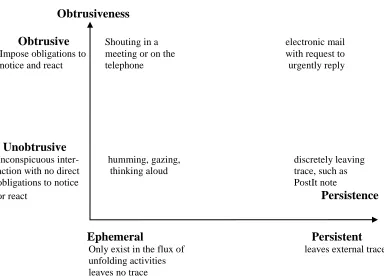
FIGURE 1:INTERACTION MODALITY: UNOBTRUSIVE VERSUS OBTRUSIVE, AND EPHEMERAL VERSUS
PERSISTENT INTERACTION ...50 FIGURE 2:THE STRUCTURE OF AUTHORITY BASED ON CHESTER BARNARD’S (1938) ANALYSIS OF THE
CONCEPT. ...113 FIGURE 3:ORGANISATION CHART OF EFSL ...126
FIGURE 4: A REPRESENTATIVE VARIETY OF FOOD ITEMS THAT EFSL SELLS TO ITS CUSTOMERS ...128
FIGURE 5: TELESALES REPS TAKING AND PROCESSING CUSTOMERS’ ORDERS ON THE TELEPHONE IN THE CALL CENTRE HALL ...128
FIGURE 6: MAPS INDICATING THE DETAILS OF A CUSTOMER’S ORDER AND THE DELIVERY POINTS FOR A
PARTICULAR DELIVERY AREA DURING ROUTE PLANNING ...129 FIGURE 7:SHIPMENT BUILDING ACTIVITIES AT EFSL’S WAREHOUSE SHOWING CERTAIN ASPECTS OF
11
LIST OF TABLES
TABLE 1:TYPES OF INTERACTION ...37 TABLE 2:ILLUSTRATION MEDIA RICHNESS BASED ON DAFT AND LENGEL’S 1986ORGANIZATIONAL
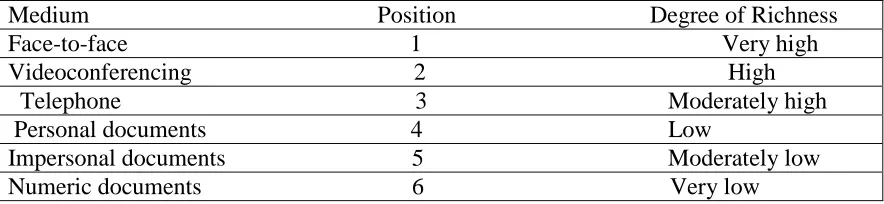
INFORMATION REQUIREMENTS,MEDIA RICHNESS AND STRUCTURAL DESIGN. ...46 TABLE 3:RECONSTRUCTION OF THE MEDIA RICHNESS TABLE, BASED ON RICE’S (1992) EXPOSITION ON
12
CHAPTER ONE:RESEARCH ISSUES, FOCUS AND MOTIVATION
If we knew what it was we were doing, it would not be called research, would it?
– Albert Einstein (1879-1955)
1.1 Preliminary matters
The advent of Information Communication Technologies (ICT) and the
techniques of interaction and processing of information have expanded the possibilities of
their application in controlling organisational and business processes (Beniger, 1986). As
contemporary organisations continue to survive on information, innovative methods of
control are required to cope with the challenges that characterise the dynamics of
information processing. Indeed, control and information are rapidly turning to allies
(Ibid); hence the ability of individuals to exercise influence in orchestrating behavioural
changes may demand an equal measure in information processing and interaction. The
rising differentiation and specialisation massively characterising modern-day
organisations call for an effective coordination function which, could in turn, necessitate
augmented information communication abilities that can be provided in the realm of ICT
(Beniger, 1986, cf. Weber, 1978).
Information Systems are fundamental to mediated control (Ciborra and
Associates, 2000) and technology mediated interaction1 between formal organisational
configurations and activities and are, by extension, significant for the harmonisation of
contemporary work practices (Earl and Feeny, 1994, Nutt et al., 2000). Information
Communication Technology driven interaction has gained significant acceptance and
momentum as is evidenced in their massive adoption and varied deployment and
application in many organisations (Morgan, 1997, Pfeffer, 1992). Indeed, to date, almost
‘three quarters of all employees use computer or ICT in the workplace’ (Nathan et al.,
2003). Relying on ICTs to mediate interaction between working colleagues in different
1 It should be pointed out that at some point, ‘technology mediated interaction’ would be used
13
sections and locations within, and sometimes outside, the layout of an organisation
demands an appreciable degree of control and collaboration from the entire
organisational machinery. It should be stated ahead of time that control in this work
draws on the notion of
a co-ordinating mechanism based on asymmetric relations of power and domination in which conflicting instrumental interests and demands are the overriding contextual considerations (Reed, 2001, p. 201).
In other words, the study sees control from laid-down structural guidelines, policies,
procedures, rules and set out by the top organisational hierarchy in context-specific
situations to achieve stated organisational goals. To this end, control emphasises the
unequal balance of power that reinforces the relationship between superiors and
subordinates which characterise their day-to-day legitimate organisational rapport and
undertaking. Undoubtedly, the advances in technology have had unusual and insightful
effects on widening the scale and utility of computing in technology mediated interaction
in collaborative work. Technological artefacts have been drawn into the worldwide
technological innovation resulting in multifaceted technology mediated interaction
activities that could have been imagined only in course books. Technology mediated
interaction continues to significantly gain popularity in organisations and among the
professionals within them resulting in their mass and wide adoption and utilisation and
consequently mounting academic attention from Information Systems (IS) researchers
(Hinds and Kiesler, 1995, Belanger et al., 2001, Walther, 1997, Green, 2002,
Ngwenyama and Lee, 1997).
A key component of technology mediated interaction is the flexibility and the
dynamism particularly associated with the many modes of its expression. Part of their
flexible nature is demonstrated by their capacity of establishing interaction and exchange
relations with others not collocated; what can conveniently be described as ‘virtual
collaboration’(Olson and Olson, 2000 p.141). Secondly, these technologies continue to
influence, shape and inform the manner groups and individuals have come to initiate
control strategies to regulate their technology mediated interaction in their everyday
working practices. Therefore Dahlbom and Ljungberg (1998 p.228) are right when they
14
A rapidly increasing use of electronic mail, more adequate telephone services like voice mail and mobile phones quickly change the conditions of work. You are no longer tied to your office and, with increasing communicative interaction, the pace of work increases. There is a shift from bureaucratic document management to the bustle of the market of its many meetings. The old factories for office work, education, research and health care may very well be disintegrated and be replaced by meeting places for mobile services exchange.
The pressure to go global, the demand to reduce operational costs, the growing
need for adaptability and prompt response to the ever-changing, unstable world of
commerce and business (Kim and Mauborgne, 2005) have phenomenally activated the
quest for flexible organisational configurations (Smithson, 1994). Consequently,
organisations continue to adopt innovative practices, including varying the modalities of
their technology mediated interactions, in an attempt to offer high degree of customer
service (Mowshowitz, 1997, Snow et al., 1996) as a means of sharpening their
competitive edge (Porter and Millar, 1985). ICT-driven interaction continues to
spearhead and influence the way we interact in the workplace, home or any other place
that may occasion an appropriate setting for interaction to be consummated. The many
complex technology mediated devices that make it possible for non face-to-face
encounters or communication to be consummated conveniently illustrate this view.
Of the many possible factors that have activated the ‘interaction society’ (Wiberg,
2005b) are such technological mobile architecture as videoconferencing, teleworking,
BlackBerries (mobile email devices) and internet-activated mobile phones (Kakihara et
al., 2005). Again the supporting infrastructure such as the internet and mobile telecommunication network (Hanseth, 2000) laptops, Bluetooth technology, application,
and its bourgeoning critical mass have equally been instrumental in spearheading the
interaction society. The culminating effect has been the transformation and modification
of our behaviour and work culture. In a similar vein, human behaviour has, in turn,
impacted and informed the design, architecture and functionalities of these technologies.
This mutual effect between technology and human agency is observed elsewhere with the
claim that ‘whatever effect technology may have on social forms is heavily shaped by the
social, cultural and institutional relations in which the technology is embedded’
15
moulded and shaped our pattern and mechanics of mediated interaction in diverse work
activities, both at the individual and group levels.
Emphasis is speedily being shifted away from purely centralised to moderately
decentralised business processes (Malone et al., 1987). To a greater extent work
arrangements are being organised from locations other than where the centre of activity is
(Shapiro, 1999). Control in ICT-driven interaction is crucially necessary for organisations
whose operations are not only concentrated in the organisation but also sometimes
transcend their immediate geographic boundaries. An idea clearly brought out is the fact
that the pattern of work in such organisations is particularly rife in inadequacy of local
knowledge, differences in idiosyncratic experiences, situational priorities, threatening
deadlines, risks, disparities in cultural orientations, values and norms (Lane, 1998).
Technology mediated interaction is getting increasingly popular in response to the
challenges posed by the concept of ‘disembedded front’(Giddens, 1990). In this sense
social systems and work arrangements in contemporary times are taken from the local
context and distributed across space and time. Advanced technological artefacts have
then become vital for pumping life and vitality into the emerging organisational work
arrangements for information generation and sharing, communication, coordination
collaboration and control. Today, ICTs have not only expanded the scope by which they
are implicated in mediating interaction and influencing organisational configuration, but
they have also formed and transformed the circumstances and conditions in which
interaction is mediated across an entire organisation.
It is widely claimed that technology-driven information systems are profoundly
involved in the practices that incorporate, redesign, reconfigure and restructure
organisations (Orlikowski, 1996, Markus and Benjamin, 1997, Scott Morton, 1991); the
same information systems institutionalise work, work relationships and work life (Berger
and Luckmann, 1966). Indeed, technology mediated interaction can scatter the
controlling influence of the top hierarchy that could be instrumental for mutual
information exchange, knowledge sharing and work collaboration. The reason for this
claim is premised on the presupposition that distance, implied in technology mediated
interaction, introduces many challenges such as unfamiliarity of local experience that
16
(O'Leary et al., 2002). In other words, mediated interaction, in a way, pushes the centre of
organisational authority to be more reliant on the members distributed across both
defined settings and emerging contexts. Such members have their behavioural patterns
unpredictable and contingent which may not be under direct managerial scrutiny and
observation.
Legitimately, one wonders how the organisational top hierarchy initiates moves to
control both individual and group tasks and activities to bring about a coordinated, joint
and collaborative action within the organisational set-up. Part of the answer to this query
may be found in Courpasson’s (2000) notion of soft bureaucracy which emphasises a
situation where ‘flexibility and decentralization co-exist with more rigid constraints and
structures of domination’ (p.157). Control in this study is not restricted to the
‘informating’ power of Information Technology (IT) alone in which Zuboff (1988 pp.
9-10) recounts that apart from its automating power, ICT
… simultaneously generates information about the underlying productive and administrative processes through which an organization accomplishes its work. It provides a deeper level of transparency to activities that had been either partially or completely opaque….Activities, events and objects are translated into and made visible by information when a technology informates.
The path-breaking work associated with the above quotation and many others in that
category provide us with a significant collective overview on the application of
Information Systems (IS) in contexts where the controller is commissioned and entrusted
with the authority over the controlled. However, these studies specifically fail to account
for a situation where the controller uses assortments of mediated technological artefacts
to control both the individuals and groups on one hand and the activities they are
involved in on the other (Kirsch, 2004).
Arguably, control continues to be a central part of, and essential challenge to,
organisational sociology and management philosophy (Simons, 1995). Control is needed
to monitor, set targets, regulate and even motivate people to channel their disparate group
or individual activities in the interest of the stated objectives of the organisation (Beniger,
1986, Courpasson, 2000). Again, control in technology mediated interaction is vital in
17
channelled in a synergistic fashion for the total benefit of the organisation. The purpose
of this study, therefore, is to appreciate control – driven by different means both
technology and human – from diverse organisational perspectives. The study is also set to
understand the extent to which control, through mediated interaction, informs
organisational loyalty.
1.2 Motivational relevance
The recent past has witnessed a burgeoning number of research interests and
activities in computer mediated interaction in the IS community. The lingering challenge
that technology mediated interaction poses has informed and inspired the birth of various
forms of tools with varying degrees of complex, embodied intentionality to make
technology mediated interaction as real-time as practicable. The reason, obviously, is to
permit interaction beyond spatial, contextual, shifting, transitory frontiers and limitations.
Consequently, manoeuvrable technology artefacts like Personal Digital Assistants PDAs,
mobile phones, laptops, computers etc., have regimented functionalities that allow for
Instant Messaging (IM), videoconferencing among others to provide flexible, dynamic
and pragmatic support for distributed collaboration and mediated interaction.
Studying mediated control from the standpoint of technology driven interactions
in a collaborative setting could prove a fascinating endeavour as it could provide some
useful insights into the dynamisms and mechanisms involved in mediated control. Such
dynamics and mechanisms could range from how much control, for instance, is taken
away from the organisational top hierarchy in technology mediated interactions? Does
any other factor like trust replace mediated control or does top management lose some
degree of their administrative control in the process of mediating the interactions of
subordinates from the fringes of the organisation. Besides, technology mediated
interaction could be essentially crucial, as its very essence may be characterised by
unpredictable complexities, nascent and situational predicaments that sometimes
challenge the very foundations on which mediated control is erected.
The drive to study ICT-driven interaction vis-à-vis mediated control stems from
18
and research. For, it reveals the various stakeholders, such as top management,
middle-level management and those at the lower echelons of the organisation, with varying and
incessantly shifting degrees of interests, individual motivations, personal preferences and
preoccupation in technology use. Further contemporary work is becoming increasingly
characterised by distribution instead of centralisation, flexibility rather than rigidity and a
higher degree of independence and interdependence rather than hierarchical control.
It is necessary that a study devoted to ICT-driven interaction incorporates
mediated control as well, especially when the activities involved occur in a collaborative,
interdependent environment. This view reflects a ‘coordinative arrangement’ (Kallinikos,
2007 p. 274) which reinforces the idea of functional interdependence in spite of the
presence of a centralised authority appropriately described by Kallinikos as ‘coordination
centres’. The key role of the coordinative centres is to maintain an awareness of the
activities within a network of disparate entities. The following statement epitomises a
fundamental function undertaken by the central administration to oversee the assortment
of operations that take place among other entities with a shared operational interest.
To accomplish their task, coordination centres must remain both dissociated and detached from local engagements and seek to obtain a bird’s-eye view of the actors and operations they coordinate, a task that is substantially aided by the control and management of information processes (Ibid. p. 283).
This simple yet seductive statement seems to suggest, by extension, that there is more to
control than that which is usually assumed and subsequently taken for granted as is
expressed by the phrase ‘…management of information processes. In this sense, control
in its various dimensions such as codified rules, regulatory norms and procedural
guidelines, is vital as technology mediated interaction could be occasioned by shared
context, joint interpretive cognition of social norms, interdependence, common
experiences and trust. Even the sophistication that accompanies the functionalities in
current, distance-bridging communication mediation tools, such as computers,
Blackberries, PDAs, laptops, mobile phones, among others can hardly make up for the
significant role that distance plays in technology mediated interaction. Naturally, control
19
professionals in contemporary rising flexible work settings characterised by varied types
of organisational structures.
1.3 ICT-driven interaction: research domain and question
Interaction mediated by technology continues to demand significantly more than
advanced technological objects or artefacts could possibly offer. ICT-driven interaction
in this study identifies the decisive role and crucial involvement of technology artefacts
in undertaking common and personalised organisational activities; not merely as ‘maps
but remarkably as scripts (Schmidt, 1997). ICT-driven interaction requires social mores
and conventions, norms, folklore, organisational structure and institutional arrangements
to be mutually fulfilling, from the standpoint of the social agents and the organisation
concerned. For ICT-driven interaction to achieve a greater measure of being mutually
beneficial and fruitfully effective,
there have to be signs, objects of some sort that are about some thing, objects whose function is reference rather than presence (Borgmann, 1999 p.17).
In light of the foregoing, money, for instance, was once upon a time employed as a token,
or a ‘boundary object’ for transmitting aims and intentions across heterogeneous working
social entities (Bowker and Star, 1999, Star and Griesemer, 1989, Star, 1995) to mediate
interaction. Put differently, objects were used as ‘immutable mobiles’ so that the
transportation of such objects across distance and space simultaneously preserved their
cognitive content and intended significance (Latour, 1990) to convey ideas, messages, or
information from one interaction partner to another.
History reminds us that coins were influential in mediating interaction of people
from distant geographical locales (King and Frost, 2002). The aesthetic features on the
coin illustrated by, for instance, the emperor’s face on it and the ease of handling the coin
(money) served as a commanding state-supported device for disambiguating decisive
facets of the interaction process. In this vein such objects served as interaction mediation
tools for carrying out the wishes and desires of authorities at a distance.
Research on technology mediated interaction has, for a considerable amount of
20
particular emphasis on engineering, computer science and design of mobile devices and
equipment that mediate human interaction in diverse organisational engagements and
application (Jacko and Sears, 2003, Schmidt et al., 1999). The other end of the continuum
goes as far as exploring the patterned emotional instabilities associated with mediated
communication encounters or interaction in its minutiae form (Goffman, 1983a, Walther,
1994, Heath and Luff, 2000). Continua like these present a dichotomous situation that
sometimes translates into a dilemma.
The reason stems from the observation that attention, in this connection, is
divided between the technical elements of mobile artefacts and the widely assumed social
implications spawned by such technology such as their harmful and green house effects
on society at large (Arnold, 2003). However, and surprisingly, least attention, if any, is
given to mediated control in these research works; given the fact that mediated control
plays a pivotal role in constituting the processes needed for the elicitation and
maintenance of shared and collective action (Layder, 1997). Broadly speaking, control
has not only caught the attention of researchers but the subject has equally occupied them
for decades now. Yet we know little of studies that pin their focus on and direct their
attention on the dynamics of mediated control in an environment where interaction is
largely driven by ICTs.
It should however be made clear that several studies treat control from divergent
epistemological and ontological perspectives. For instance Ouchi (1979b) provides a
conceptual framework for understanding the plan and aim of organisational control
mechanisms. Vivid description is given as to how organisations manage the contentious
issues of evaluation and control. Eisenhardt (1985) on her part adopts the agency theory
to explore different control variables like reward schemes and job features to deepen our
knowledge in organisational design and its implications for reward structures and
compensation packages in 54 United States (US) retail stores. Writing on corporate
control structures, Walsh and Seward (1990) maintain the importance of coupling internal
organisational control-oriented structures with external market informed control
mechanisms to operate side by side with varied aspirations of both shareholders and
managers. Last, but by no means least, Davis and Thompson (1994) devote their attention
21
movement to elucidate the drifting capacities of shareholders and managers. Quite
recently, and still on control, Kohli and Kettinger (2004) relate and set out to probe how
illegitimate principals enforce behavioural conformance on agents. These academic
endeavours seem disjointed so far as mediated control of technology-driven interaction is
concerned.
It would be fair, at this point, however, to recall the work of Yates (1989) in
which she details and highlights the distribution and dissemination of information by
managers to control and coordinate institutional activities. A comprehensive account is
given of innovative managerial skills in the use of various mediated interaction
techniques in the propagation of information both within and outside the organisational
setting. Mention is made, specifically, of letters, telegraphs, memoranda and copying as
some of the instances of managerial communication regarding interaction within and
outside the organisation. A space can also be reserved for Yates and Orlikowski’s (2002)
account of ‘Team Room’, a platform that enabled the scheduling of different patterns of
group collaborative habitually arranged interaction. Six distinct underlying incentives of
‘purpose – why, contents – what, participants – who, form – how, time – when and place
– where’ (Ibid. p.32) characterised this particular interaction activity, though no special
place was retained for the element of control in any conceivable form. However, the sort
of general perspectives that motivated the use of certain technology (in this case email)
establishes some kind of link with this particular study.
Admittedly, it has to be revealed that Yates’ work has a certain amount of
relevance for this study; though it even predates the discovery and the subsequent
introduction of the Internet Explorer in 1995 by Microsoft® (Castells, 2001). As
expected, Yates’ work least anticipated the variance in the modes of technology mediated
interactions. This variance includes electronic mail (Email), videoconferencing, among
others that depend heavily on the architectural foundations of the Internet which are
significant in today’s organisational and interorganisational exchanges. This
notwithstanding, there is a dearth of research endeavours that holistically look at
ICT-driven interaction from mediated control perspective. Indeed very little is known of
academic works that genuinely and consciously look and integrate mediated control in
22
This compendium intends to take up this challenge and move the work in this
research area further forward. This academic enterprise is worth pursuing on at least two
counts. Firstly, it would seek to bring out the issues pertaining to the controlling
capabilities of people and technology in their respective areas of strengths and limitations
in ICT-driven interaction. Secondly, such a study could help mould our
reconceptualisation of ICT-driven interaction and its practical application to diverse
situational contingencies, such as the administration of mediated control in organisational
behaviour.
Control – as a concept – has been studied from multiple perspectives due to
different motivations and interests researchers have reposed in the subject. Indeed,
research on control has occupied intellectuals for years now, except that its application in
the domain of information systems is still, relatively speaking, at the bourgeoning stage.
And academic interest in such studies continues to gather investigative storm, except to
say that empirical, real-life endeavour is, on many counts, lacking in detailed existential
undertaking. In this connection, it would be fair to suggest that until quite recently, there
is a disproportionate study of the various manifestations of control in the use of ICTs.
This notwithstanding their massive implication in enterprise-wide and interorganisational
practices as exemplified in our everyday work experiences. The aim of this study as
delineated earlier, among other things, is to get insights into mediated control in
ICT-driven interaction. The achievement of this ambition requires a reorientation to the entire
realm of technology mediated interaction, drawing heavily on an empirically informed
research undertaking. Both the contextual and pragmatic use of movable and immovable
ICTs are then highlighted under mobile and stationary working environments.
In the exercise of mediated control in technology-driven interaction in a
collaborative work, there are likely to be moments of apparent tension, conundrum and
even a dilemma. For when do human control strategies and tactics begin and when does
technology take over control responsibilities from humans in such ICT-driven
interactions? A query like this provides us with a launching pad for, and subsequently
sensitises us to, the dominant research question of this study. How does mediated control
manifest and how is it ensured in ICT-driven interaction in an organisation’s
23
the research to seek captivating responses to the following matters as well. What
mechanisms constitute control in technology mediated interaction? To what extent can
we better understand the rationalities and motivations that drive technology mediated
interaction in collaborative environment? How adequate are control structures (both
human and technology) instituted by the organisational top hierarchy to bring about the
expected form of behaviour in ICT-driven interaction?
One disclaimer would suffice for now before this study goes any further. This
study looks at ICT-driven interaction from a multi-dimensional, all-inclusive approach, in
which different types of technology mediated objects or tools for diverse modes and
forms of interaction are considered. This is a step further than what has generally been
discussed in the growing body of literature on ICT-driven interaction. The reason stems
from the fact that such research efforts have concentrated, and in the process limited their
focus on, only fixed personal computers (PC) to the exclusion of other mediating tools
like mobile phones, fixed telephone, Personal Digital Assistants (PDAs), laptops and
others, see for example (Walther, 1995, Walther, 1996a, Vrasidas and Zembylas, 2003,
Alavi and Leidner, 2001). The list is not exhaustive, but at least it provides a relation to,
and a sense of direction of, the context under consideration and the claim being put
forward to justify the need for this study.
The apparent limitation to these tools of interaction, for example the PC, is its
reduced social presence; it is generally text-oriented and particularly asynchronous in its
mechanics (Sproull and Kiesler, 1986, Wellman et al., 1996). The current reconstruction
of ICT-driven interaction in organising collaborative work equally requires a crucial
reconsideration of the fundamental characteristics of the strategies that proved successful
in mediated interaction and social as well as commercial exchanges in ancient times.
1.3.1 Empirical investigation
The empirical body of this study sets itself to investigating the application of both
24
Food Services Ltd,2 hereafter referred to as EFSL, sells semi-prepared food and food
related items to small and medium-size fast food shops and restaurants in and around
London. The food logistics industry in London is highly competitive and customers are
very sensitive not only to price but also, crucially, to the way and manner their
unpredictably capricious demands are met and satisfied. The least error – however
inadvertently – human or technology, on the part of the organisation could trigger a
significant shift of their customers to their competitors. EFSL has recently, through the
use of technology, automated greater proportion of the processes involved in commercial
exchanges with its customers from order processing to delivery. Automation has, as a
result, meant that greater aspects of control and decision-making abilities have been
structured and assigned to technology, with people having little room for the use of
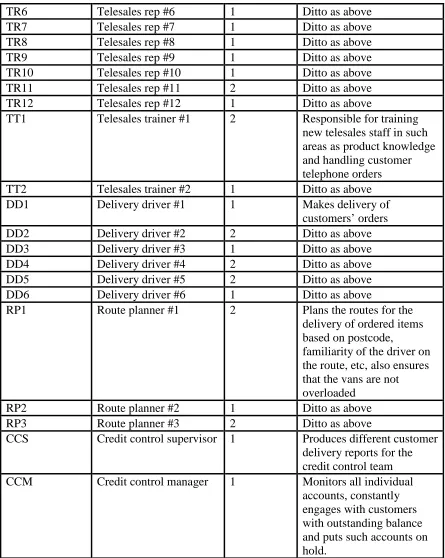
discretion. Two distinctive services are provided: order processing by telesales
representatives (hereafter referred to telesales reps) and order delivery by delivery
drivers. The telesales reps are made up of about 12 different teams of roughly 5, headed
by a team leader each, while delivery is carried out by a fleet of approximately 200
vehicles.
For an organisation like EFSL, the aspiration to satisfy customers with an
appreciable degree of efficiency and effectiveness is a daunting challenge. This implies
telesales reps have to demonstrate professional alertness and alacrity together with
unwavering proficiency in processing customers’ orders, while delivery drivers have to
be smart and attentive to the details of computer generated invoices. Demonstrating the
appropriate telephone conduct, which involves tempering large dose of restraint with an
equal measure in respect of pleasant disposition, is required of every telesales rep. This
behavioural expectation, on the backdrop of mediated interaction, is intended to
encourage and enhance both employee and customer loyalty.
The research is contextualised around order processing and delivery activities
which prominently feature telesales reps and delivery drivers in their use of portable,
mobile and stationary ICTs in carrying out their respective duties. The telesales reps and
2
25
delivery drivers have been especially selected because both represent the organisation to
the outside world in two differing but complementary ways. The telesales perform what
can be described as back-end activities while the delivery drivers undertake front-end
functions. The back-end activities refer to the series of functions that characterise the
duties of the telesales reps in the form of taking customers’ orders on the phone and its
allied activities in the office prior to loading. Front-end functions identify all the
processes that involve transporting packaged orders from the company’s site to the
delivery addresses of the customers with the aid of mobile phone. The delivery drivers
are supposed to use the mobile phone in different emerging situations to mediate their
interaction with the head office in the course of delivering customers’ orders.
The choice of telesales reps and delivery drivers as the scope around which this
thesis explores and probes is partly due to their particular use, and heavy reliance on ICTs
to drive interaction in all its stripes. Secondly, the resolve to concentrate on ICT-driven
interaction takes into due consideration the issues of administrative behaviour, control,
discretion and emotional repercussions that are significant in demarcating the context of
this study. Consequent upon these key issues, the writer decided to adopt a case study
research as a means of gathering the relevant data which provides the foundation for
critical analysis. The underlying motivation is to ‘observe the …process in real time as it
unfolds in the field of setting. This approach maximises the probability of discovering
short-lived factors and changes that exert an important influence’ (Van De Ven, 2007 p.
208 ).
1.4 Objectives and anticipatory contributions of the study
In pursuance of convincing answers to the searching, key research question just
delineated above, this study hopes to achieve the following set of objectives:
• To do an extensive explication of the concept of mediated control within
collaborative work environments;
• To understand not only why control and other regulatory practices are laid out but
26
• To intensely explore the possible substitutes and or ancillaries of control, if any,
in ICT-driven interaction;
• To develop a theoretical template that would better shape our appreciation of
ICT-driven interaction from the standpoint of mediated control in contemporary
organising; and
• To form a common, integrated and practical outlook on the establishment of
mediated control in collaborative activities.
Given this set of objectives, this research anticipates to make particular contributions in
respect of the following areas.
1.4.1 Expected Theoretical contribution
As indicated earlier, the concept of control is not new, especially, in the field of
administrative behaviour. However, discussions on the concept hardly ever treat it from a
mediated standpoint. One of the primary aims of this dissertation, therefore, is to make a
contribution to the ongoing debate about control by theorising the means by which ICTs
can shape control in new and often unexpected ways. Also, the study seeks to make
meaningful contribution to concepts like organisational loyalty and discretion against the
background of mediated control in administrative behaviour. The lessons drawn from the
application of these theories, with respect to introspection, of their shortcomings could be
instrumental in facilitating how these concepts conceive reality.
The study, additionally, aims to provide organisational researchers the
opportunity to cultivate a more meaningful and enhanced conceptualisation of the
implications of technology-driven interaction on mediated control in diverse work
environments. The research aspires to foment some level of understanding of the
relationships between administrative behaviour and how it informs and impacts mediated
control. In the process, the study intends to make conclusions, however incipient and
tentative they may seem, about the influential role of ICTs in controlling the behaviour of
social agents in organisations. By this, the study anticipates to make a legitimate
27 1.4.2 Expected Practical contribution
Given the focus of this study, the final product is expected to deepen and broaden
the understanding of mediated control in interactions largely inspired by ICTs for
professionals, particularly those in the logistics industry. This work also wishes to alert
professionals to the importance of shedding their rooted and taken-for granted
assumptions they may have on the traditional notions of control. To this end, the study
hopes to sensitise practitioners to the reality that it is about time they recognised the need
for pragmatic approach in their administrative relationship with people whose situation
they can hardly or fully anticipate and appreciate but with whom they should interact for
their mutual and corporate benefit. Since this study focuses on an organisation that
supplies food logistics, it can possibly contribute towards discussions on the future of the
industry, however impermanent it may seem.
1.4.3 Anticipatory Methodological contribution
By studying an organisation that uses a combination of portable, mobile and
stationary ICTs in its daily enterprise-wide operations, creative methods are used,
through which penetrating examination and consideration promise to convey a
methodological contribution. To this end, the particular use of faith as an addendum to
methodological research inquiry marks a productive contribution.
1.5 Outline of Dissertation Structure
Chapter 1: This chapter sets up the research agenda, demarcates the research
boundaries of the study and points out the various components that are constitutive of the
research. It anticipates the strings of issues that fall within the purview of mediated
control in ICT-driven interaction in the organisation and administration of collaborative
work. Subsequently, the chapter rounds-up with the significance of this whole academic
endeavour by summarising three specific areas of contributions that the study hopes to
28
Chapter 2: This part of the study looks backward into general interaction studies,
mark out the trajectory of technology mediated interaction with an illustration on the
paradigmatic nature of mediated interaction as a dispensational innovation, contingent on
the dynamics of the time. The chapter invariably witnesses the exercise of independent
critical judgement to provide a focused, analytical and balanced outline of issues that
have much relevance to mediated control in technology driven interaction, especially
within a collaborative environment. The distinctive ‘selling point’ of this work is made
abundantly clear at this stage.
Chapter 3: The methodological appropriateness of the study receives the
highlights in this section of the work. The different divergent routes that lead to the
elicitation and solicitation of the data are emphasised and discussed. In the end, an
explanation is provided to support how the different approaches befit the overall purpose
and integrity of the study.
Chapter 4: An outline of the theoretical underpinning of the research takes the
centre stage in this chapter. It is against this background that administrative behaviour as
a lens is applied to understand the various dimensions of mediated control within the
confines of technology driven interaction in an organisation. Again, the key features,
underlying principles of the theory of administrative behaviour are noted, and their
implications for mediated control in technology driven interaction explored to enrich our
appreciation of the concept of control in both theorising and application in the field of
practice.
Chapter 5: This chapter introduces the context of the case study, with an
introductory background to the key highlights of the main activities that pertain to the
fundamental mission of the organisation under study. The chapter captures the vital
segments of the many activities of mediated control and interaction inspired by
technology in a collaborative environment.
Chapter 6: The data gathered from both personal observation and the series of
interviews is subjected to detail analysis to signpost the thematic directions against the
background of the aims and significance of this study. Multi-dimensional approaches are
applied to layout the major blocks of issues that come to the fore in the consideration of
29
collaborative work. In addition the paradoxes, conundrums and dilemmas involved in
mediating control in technology mediated interactions get the attention in this portion of
the study in the light of the research aspirations.
Chapter 7: This chapter seeks to bring out the simmering tensions and
repercussions of mediated control with detailed discussions that reflect the consequences
of the use of technology to facilitate interaction. The chapter endeavours to link the
emerging themes in chapters 2, 3, 4, 5 and 6 together by invariably, drawing on
philosophical hermeneutics. The aim is to bring out a personal appreciation of matters
pertaining to both the observed and conceptual facets of the research in order to arrive at
some wide-ranging reflections and specific propositions.
Chapter 8: Ultimately, this aspect of the study summarises the entire work by
presenting the significance of the study in view of the key ideas and arguments advanced
in the whole research exercise. It then pinpoints the limitations of the study, highlights its
unique contributions and presents the way forward in terms of future research directions
in a related study.
1.6 Chapter in review
The section has so far outlined the agenda for this study by teasing out
contemporary work within which the study is posited. The motivational factors driving
the study, together with the specific objectives and the general significance have been
highlighted to mark out the research question that provides the guiding trajectory for the
whole exercise. A summary of each chapter has also been delineated to indicate the
30
CHAPTER TWO – TECHNOLOGY MEDIATED INTERACTION AND CONTROL: A CRITICAL REVIEW
2.1 Introduction
Section I
Patterns of contemporary societal interaction have taken on a new dimension,
marking a dramatic departure from what used to pertain in the past, succinctly described
as arm’s length or close, proximal interaction or better still, face-to-face interaction
(Goffman, 1974). Reflecting this thought might have influenced Wiberg (2005a) to label
today’s world as The Interaction Society. A description that well captures Collins’
observation that ‘a lifetime is, strictly speaking, a chain of interaction situations’ (Collins,
1981 p.998). Interaction Society should not be construed in any way to imply that
interaction, regardless of how we understand it today, did not occur in the past. Indeed,
interaction society illustrates the technological component and dimension that have
become the very fabric of today’s multivariate interaction activities with its continuously
transforming manifestations, either at the individual, group or organisational level.
Contemporary interaction in commercial milieus and private environments are
characterised by mediated gadgets, even in circumstances which otherwise would have
occasioned face-to-face encounters. Nowadays, the use of mobile telephones, PDAs,
videoconferencing facilities, BlackBerries and other forms of portable and immovable
computing technologies to interact with working colleagues, either in close range or long
distance situations, is on an unparalleled ascendancy.
This chapter takes an epistemological look into general interaction studies. The
specific focus is on technology driven interaction, highlighting the paradigmatic character
of interaction as hinging on pragmatic exigencies, business imperatives, organisational
strategising and demands of the moment. The chapter customarily witnesses the
application of independent critical judgement to provide a focused, analytical and
balanced outline of issues that have much relevance to technology mediated interaction
with regard to control, especially within a collaborative environment. The distinctive
31
To achieve this, I draw heavily on the mainstream interaction literature and zero
in on technology mediated interaction with a view to bringing to light the connections
between these concepts and their practical relevance to the study. Essentially, the review
process consciously separates technology mediated interaction from control in two
different sections. Therefore while the first body of the literature review largely occupies
technology driven interaction and its current dimensions and sociological implications,
the domain of the second section indicates the implication of control in current
ICT-enabled organisational activities.
The initial section on 2.2 seeks to explicate the concept of interaction while the
subsequent subsections trace the historical patterns of interaction to its present expression
and structure. The concept of mediation finds space in section 2.3 while the subsections
discuss the theories of mediated interaction and rationale behind their implication in
organisational communication. Emphasis is placed on social presence and media richness
theories in explaining the role played by both transportable and immovable ICTs such as
mobile phones, PCs, and other handheld devices in the adoption of mediated interaction
at different spatial contexts. The purpose is to reveal how the dawn of ICT-driven
interaction continues to inform the pattern and mechanics of individual and group
communication in various organisational regimes.
The latter part of the review, mainly, 2.6, would delve into control as it pertained
in earlier organisational dispensations and how it is implicated in contemporary work
practices. Here, control is positioned within social and sometimes psychological contexts.
The purpose is to demarcate human-base control regulations in organisational strategising
from control devices inspired and monitored by non-human elements.
2.2 Interaction explained
It is appropriate to build and develop a systematic understanding of interaction
that aligns itself with the objectives of this study and addresses the particular issues raised
in the research question. To this end, we need to embark on a careful endeavour to set the
parameters for the clarification of the term ‘interaction’ so that the concept is limned as
32
not easy to chance upon a generally acceptable referent for interaction in the conventional
literature. Some authors who approach the subject from both theoretical and practical
dimensions (Nasrallah et al., 2003, Zack and McKenney, 1995, Clair et al., 2005, Perlow
et al., 2004) do little to offer a definition for interaction. In fact such studies only go as
far as providing detailed descriptions and general features of the notion of interaction. An
exception can however be provided in terms of the pioneering works on interaction by
Goffman (1974, 1983b) and, later, Collins (2004) who offer analytical explanation of
interaction from the standpoint of its ritual activities in the form of chains. For instance,
drawing on Goffman and Durkheim, Collins presents a specific meaning of interaction as
‘a mechanism of mutually focused emotion and attention producing a momentarily
shared reality, which thereby generates solidarity and symbols of group membership’
(Ibid. p. 7).
To be sure, Goffman (1981) and Collins (2004) have had occasions to describe
interaction as one dimensional human activity, what can be illustrated, appropriately, as
micro interaction. In this sense, interaction is understood to be a private individual engagement such as can be expressed when a person is thinking aloud or talking to
himself or herself. Interaction then becomes personalised conversations and expressions
that ‘do not mark a flooding of emotion outward, but a flooding of relevance in’
(Goffman, 1981 p. 121). Interaction considered in this narrow form tends to overlook
many crucial elements, by means of ‘mutual accreditation’ (Gregory, 1994 p. 497), that
finds expression in the sphere of the mechanics of information exchange, sharing, storage
and interactivity for widening the scale of our understanding on the concept.
It could be right to suppose that at the time of Goffman, interaction had not
assumed such a diversified form as is evidenced in the revolutionary manner in which
ICTs have transformed the phenomenon. This notwithstanding, we find a glimmer of
hope in the definition ventured by Simpson and Galbo (1986 p. 38) that views interaction
as:
33
Due to its essential elements of reciprocity and mutuality, the following has been
purposefully chosen as a definition that holds much promise and significance for the
integrity of this research exercise. Conceptualising interaction in its reciprocal fashion
restricts any possibility to attribute to it a unidirectional perspective as sometimes obtains
in communication. Interaction therefore seeks to identify ‘reciprocal events that require at
least two objects and two actions. Interaction occur when these objects and events
mutually influence one another’ (Wagner, 1994 p. 8). It is the interactive character of
interaction as exemplified in the just quote that provides the frame for parties to
interconnect in a meaningful number of ways to engage in an all-inclusive
communicative behaviour.
The definition lays down the foundation for understanding the many possibilities
in which interaction can be consummated and expressed between and among people.
These possibilities include communication, collaboration, co-operation and coordination.
Interaction then, enables the establishment of networks for reaching out to contacts
without necessarily their body presence (Peters, 1999) by means of the mediating
capabilities of ICTs. The application and use of mediation tools in getting in touch with
one’s interaction partner broadens the meaning and scope of interaction, which can be
appropriately referred to as macro interaction; interaction activities that extend beyond
the identity of an individual. It is thus characterised by ‘continuous reciprocity of
expressive acts…’ (Berger and Luckmann, 1966 p. 29).
Interaction, then, implies reciprocity (Vrasidas, 2001) and mutuality of action or
‘meta communication’ between or among actors in their determination to commit
themselves to a technological or sociological intercourse for a determined purpose. An
activity that leads to ‘mutual tuning-in relationship’ (Schutz, 1971) because it is
predicated on shared dependency, common identity, mutual experience and joint context
that is captured in a collective purpose directed toward common objectives (Schmidt and
Bannon, 1992).
34
Undoubtedly, interaction is the engine that keeps the wheels of society running.
Indeed, in Boden’s (1994) opinion, interaction could be construed as an adhesive that
binds modern organisations. Though this description falls short of providing any
indication on how interaction fastens organisations and societies, it nevertheless makes
allusion to the instrumentality of interaction in bringing communities together.
Interaction reflects the very embodiment of human life in any society. Luckmann (2005
p. 4) recognises this position with the assertion that ‘the traditions of life by which human
societies are organised are the cumulative result of long chains of interaction’. In this
vein, Luckmann soundly but forcefully argues that, irrespective of its situational stride
and application mode, interaction is not a one-off event; since it sets the tone for the
possibilities of future engagements.
The crucial significance of interaction cannot therefore be overemphasised in any
society be it organised or otherwise. Much credence is given to this view by Hughes
(1958) who stresses the point that interaction lies right at the core of an organisation’s
life. This view suggests that interaction leads people to initiate strategic moves, develop
routines, cultivate practices and procedures that give birth to organisations and provide
the means for their vital sustenance (Hughes, 1971). By way of amplification, interaction
is the life of an organisation; a life that should not be seen as a detached component of
human activity but as an integrated, continuous, ongoing process. In line with the
symbolic interactionist (Blumer, 1969), the ongoing and recurring nature of interaction
does not only exist in a context but it also configures the context. This reflexivity then
implies that interaction is inextricably linked with the context of its occurrence which
generates a relationship that precludes any attempt to keep the two experientially apart.
It is interesting to note that the series of activities undertaken by the
instrumentality of interaction do not take place in a vacuum or come about automatically.
In fact they happen as a result of cognitive, thoughtful, and experiential processes of
individual, group or organisational action. It is least surprising then that Kakihara and
Sørensen (2002a) mainly link the building process of the phenomenon of knowledge with
the notion of interaction. The reason for this, they assert, is that the emergence of
knowledge draws its origin from interaction. And this interaction constitutes the very
35
Goffman (1967) divides interaction into two main categorical pillars: focused and
unfocused interaction. Focused interaction illustrates the agreement people come to, to
continue their concentration on a particular cognitive and ocular awareness as it pertains
to conversation. Unfocused interaction on the other hand reflects the situation where an
individual, qua interactant, within an auricular distance is less obligated to connect to a
joint focus of attention. Social gatherings, individuals waiting their turn on a queue to
check-in at the airport and an ordinary man walking on the street are appropriate
instances of unfocused interaction. Put simply, unfocused interaction, according to
Goffman, involves ‘decorous individual noninterferingly going about his proper business’
(Ibid p. 133). In short, while focused interaction demonstrates intentionality and
preparedness on the part of the interaction parties to commit themselves to a shared sense
of purpose; unfocused interaction expresses lack of obligation and involvement to
commit to a mutual engagement. Focused interaction invites the parties to adjust their
personal deportment under the presumption that they are under each other’s scrutiny.
While these categories provide the sense by which we can appreciate interaction, there is
barely nothing in its mechanics to inform us of the necessity of the ‘durability,
intelligibility and portability of the information’ (Sproull and Keisler, 1991 p. 3)
exchanged between the parties.
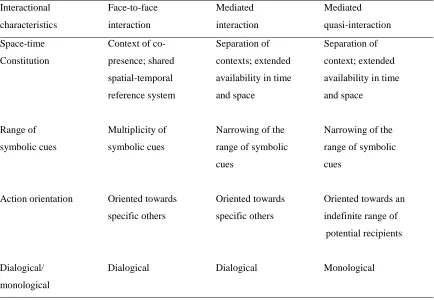
In a dramatic point of departure, Thompson (1995) provides three categories of
interaction that reflect not only many of the circumstances which such exchanges become
feasible but also the tools that make the conduct of interaction meaningfully rich.
Face-to-face interaction, mediated interaction and mediated quasi-interaction constitute the
structure of Thompson’s categorisation of interaction. In the face-to-face mode,
participants are in the immediate presence of each other with a shared spatial-transitory
reference scheme. Hence participants take deictic elements as ‘here’, ‘that’, ‘now’, ‘that’,
among others for granted with the presumption that they would be comprehended
automatically. In this sense the speaker could clear any ambiguities when the referent is
clumsy by pointing to the object under discussion. Face-to-face interaction is then
dialogical in orientation as recipients can respond (in theory) and get feedback to