108
Globalisation, education policy and the Bologna Process:
Interlocking and dependency discourses
MAGDALINI KOLOKITHA
Cass School of Education University of East London UK [email protected]
ABSTRACT
This article traces the interconnection of the Bologna Process (BP) and the globalisation discourses which introduce a generic policy ensemble in European Higher Education (EHE). The two discourses appear as imbricated within an ideological understanding of the policy discourse. I explore similarities and controversies between the two discourses focusing particularly on knowledge economy driven policies and trends in higher education. Finally, I suggest that the high level of intertextuality between the globalisation and the discourses in their discursive construction permits us to consider them as interlocking and dependency discourses.
KEYWORDS
Bologna Process, globalisation, policy ensemble, higher education, discourse
RÉSUME
Cet article retrace l’interdépendance du Bologna Process (BP) et les discours de la globalisation qui introduisent une structure de politique générique dans l’Enseignement Supérieur Européen (EHE). Les deux discours s’apparaissent comme imbriqués dans une compréhension idéologique du discours politique. J’explore les controverses et les similitudes entre les deux discours mettant l’accent en particulier sur l’économie du savoir, axée sur les politiques et les tendances dans l’enseignement supérieur. Enfin, je suggère que le niveau élevé de l’intertextualité entre la globalisation et les discours dans leur construction discursive nous permet de les considérer comme des discours d’enclenchement et de dépendance.
MOTS-CLÉS
Bologna Process, globalisation, ensemble politique, enseignement supérieur, discours
THE BOLOGNA PROCESS AS A POLICY DISCOURSE
2010 was the benchmark year for the most significant set of guidelines in higher education in the European context, the Bologna Process (BP). The BP crystallises the on-going attempt for the creation of a common European Higher Education Area (EHEA). The BD was initially signed by 29 European ministers of education in 1999 and expressed the following targets:
109
Adoption of a system essentially based on two main cycles, undergraduate and postgraduate;
Establishment of a system of credits – ECTS ;
Promotion of mobility;
Promotion of European co-operation over quality assurance with a view to developing comparable criteria and methodologies;
Promotion of the necessary European frameworks in HE, particularly with regards to curriculum development, inter-institutional co-operation, mobility schemes and integrated programmes of study, training and research (Bologna Declaration, 1999).
The need for convergence in the EHEA was based on the notion of ‘challenges’ coming from ‘abroad’ to EHE, referring to HE global competition. According to the Sorbonne Declaration signed in 19971. These ‘challenges’ could be overcome by the creation of a common
educational market that would establish and promote the autonomy of European universities. These ‘challenges’ crystallised the education policy discourse around the globe at the beginning of 2000. As Porter and Vidovich (2000, p. 456) observe “it is possible to see a number of common themes internationally in the reactions of higher education policy to globalisation and its impact on changes at the institutional level”. In relation to EHEA these common features include the state budget reduction when HEIs expand in the areas of initial and life-long learning, the increase of private sector funding, the commodification of knowledge, performativity, quality, managerialism, and a preoccupation of education policy discussions with higher education finance issues and the role of universities within this context. Their practical expression discussed in the BP official documents is concerned with the structure (in terms of years and time limits) of HE and a compatible credit accumulation system for the evaluation of degrees, which would help mobility in relation to quality assurance. The lack of a quality assurance system to evaluate degrees from different institutions in different countries was seen as one of the major reasons for the low level of student mobility within EHEIs.
The BP significance lies on the one hand in its distinguishing features in relation to education policy and research and on the other in its implicit connotations for the European region and particularly the EU. Regarding education policy and research, the BP is an idiomorphic expression of national education ministers’ initiatives towards regional convergence in European higher education as it represents European, regional response to external, global, market-related competition threats. The process demonstrates particular peculiarities. The first lies within the nature of the BP itself. It is largely perceived as an initiative of the European education ministers. The Bologna Declaration is located outside the EU legal framework of policy making. For this reason non-EU member states are Bologna signatory countries. However, the EU’s influence on the BP, at the levels of its administration, its move towards institutionalisation and also the decision-making processes, is such that one cannot but to draw a direct connection between the Process and the EU framework, even if it is located at its margins. The dilemma concerning the nature of the BP as EU-driven or established through the cooperation of European countries, is theoretically and analytically overcome by discussing the Europeanisation of HE policy beyond and around the BP. However, I support that the significance of such a policy process does not lie in its educational implications but, most importantly, in its discursive practices as the means for the transformation of the ideational signifier in HE policy from the national to the regional.The
1The four countries represented by their Ministers of education came from France (Claude Allègre, Minister of
National Education, Research and Technology), Great Britain (Tessa Blackstone, Minister of Higher Education), Germany (Jürgen Ruettgers, Minister of Education, Science, Research and Technology) and Italy (Luigi
110
second peculiarity of the BP is the absence of a legal framework, which constructs a condition of non–obligatory and voluntary participation on the part of the signatory countries. Thus, participation in the process appears as a ‘free choice’ made by countries concerning their Higher Education Institutions (HEIs) as part of an adaptation to global and regional HE trends. Specifically the BP appears as a set of common guidelines for national HE policies, the realisation of which differ in progression and extent within each member-state. Thirdly, the realisation of BP initiatives was bound to time limitations with a deadline set for 2010.
Theoretically and methodologically this paper draws from the merging of three approaches towards research, policy and discourse. Firstly, I adopt a ‘discourse-based approach’ to research according to which “you have to suspend your belief in the innocence of words and the transparency of language as a window on an objectively graspable reality” (MacLure, 2003, p. 12 emphasis in the original). Scondly, for the analysis of the official documents related to the BP I utilised the Ball’s (1993) notion of the ‘policy cycle’ which suggests that policy documents are both ‘text’ and ‘discourse’. The policy cycle consists of an amalgamation of different perspectives, aiming at the creation of a methodological toolbox, which can be broken down, rearranged and merged with other analytical and theoretical concepts for the specific needs of individual policy analysis. Finally, I adopt Codd ‘s (1988, p. 244) definition policy documents “as ideological texts that have been constructed within particular historical and political context”. These features support my attempt to explore the BP as a generic ‘policy ensemble’ (Ball, 1993) in the European HE.
EDUCATION POLICY, GLOBALISATION, AND NON-STATE ACTORS
The concept of globalisation entails complexity as the concept is “used with increasing frequency but often with different meaning by different commentators who may be focusing on different dimensions” (Porter & Vidovich, 2000, p. 449). My approach to the concept draws upon the idea that globalisation is a ‘discourse’. It is something that lies within the abstract level of understanding but has the ability to arrange and rearrange, form and reform, position and identify whomsoever or whatever exists within its field. In addition, my understanding and usage of the term follows a definition outlined in Rizvi and Lingard (2000) and Burbules and Torres (2000) which places its origins in the 1970s, when the passage from Fordism as an economic model to post-Fordism occurred. That period is characterised by the beginnings of ‘transnational economic transitions’ and ‘economic restructuring’ in parallel with attempts aiming at ‘the implementation of neo-liberal policies in many nations’ (Burbules & Torres 2000, p. 5). It was also the time in which transnational organisations such as the Asia Pacific Economic Cooperation (APEC), the North America Free Trade Agreement (NAFTA) and the European Economic Community (EEC) - now European Union (EU) - , came into being.
111
the current dominant discourse in education policy constructs the new student and citizen subjectivities.
The alteration at the mode of state control over education, and particularly higher education, is the point at which globalisation and neo-liberal Ideology influence education. Whereas, neo-liberalism is perceived as a form of governmentality which works at different levels such as the political, as a political philosophy [‘constitutes a mentality of government’ (Rose, 1992, p. 145)] and perspective, aiming at the empowerment of the subject through the development of its sense of autonomy and responsibility; the institutional, based on the marketisation of the previously public welfare state provisions such as education, health and pensions; and finally, on the ethical level, by constructing new values as it introduces new principles that rule the conduct of the subjects. As the dominant discourse is changing on all levels of the social sphere, economic, political and cultural, educational discourse is repositioned. The state has less control over discursive change as it is also positioned by it. As Rizvi and Lingard (2000, p. 423) suggest, “while talk of the end of the state is misleading, it is certainly the case that globalisation has given rise to a new spectrum of policy processes that are filtered through multiple regional and global political networks”. The European Union is the expression of this idea, as a regional and global political network based on the need to face the challenges arising from globalisation and the market. Within this context, markets, as a force working at a global and regional level, come to fill in the gap which is created by the state’s withdrawal from the educational space.
The marketisation of education is very clear within recent HE reforms, particularly those that took place in Australian HE (Lingard & Rizvi, 1998; Henry, Lingard, Rizvi & Taylor, 2001; Vidovich, 2004) in the US and New Zealand and finally, in European education reform. The main ideas on which these reforms rely are HEI competitiveness, quality in relation to evaluation and assessment, creation of a highly qualified labour force and attraction of new educational consumers, such as students and private sector research funding, thus, shifting part of the cost of HE funding from the state to consumers.
The interaction between the education market and globalisation may go a long way in explaining current education policies. For example, the ‘BP’, which is an EU higher education policy, is presented as a reaction to globalisation, and justified as the means by which the EU will respond to economic competition from the US and the Far East. Another feature of the way in which globalisation affects education policies is the effect that supranational organisations have upon the later. Yelland (2000) presents reports from the OECD in which the organisation frames global higher education policy in the context of internationalisation. Yelland considers the relevance of several national higher education policies to the proposed OECD guidelines but concludes that national policies are still very much concerned with and focused on ‘domestic demands’. Also, he re-focuses the question of relevance as “how relevant are national policies in a context of globalisation” (Yelland, 2000, p. 301), focusing on the role of the nation-states, which need to answer and reorganise HE in response to global requirements. Rizvi and Lingard (2000, p. 423) explain, that “globalisation is redefining the role of the nation-state as an effective manager of the national economy, public policy and national cultural development”. Whilst, these two points of ‘domestic demand’ on the one hand and ‘the state as national policy manager’ on the other, may appear on the first instance as contradictory, a closer appreciation shows that they are not. The focus on domestic demand that Yelland describes is clearly evident, however lately in that nation states appear to face the same challenges deriving from globalisation. In that sense, every national policy focuses on domestic issues, but these issues appear as a common place of challenge for every state. The ‘domestic’ is defined in terms of globalisation as a local or national problem.
112
‘knowledge economy’ discourse aims to consider and explore the effects of globalisation on a regional higher education policy and consequently on national higher education policies. My focus on the ‘knowledge economy’ (KE) discourse emerges as it appears as a global educational factor of immense importance. To explore the KE discourse I shall focus on the role of three distinctive multilateral organisations.
The World Bank
The World Bank’s appreciation of the KE becomes clear while focusing on the role of the HEIs in the attempt to realise the former. The role of HEIs is described as critical “in supporting knowledge-driven economic growth strategies and the construction of democratic, ‘socially’ cohesive societies. (Word Bank, 2002, p. 23). The way in which HEIs are called upon to fulfil this role is located in their need “to respond effectively to changing education and training needs, adapt to a rapidly shifting tertiary education landscape and, adopt more flexible modes of organisation and operation” (Ibid). The World Bank proposes that a significant part of the economic development of a country – developing or developed – relies on its educational output within the spectrum and limits of the KE. HEIs are expected to host, mobilise and realise the changes in education with the support of the state. The World Bank suggests that this should take place under the umbrella of a National Innovation System (NIS)2. In such systems, efficiency ensures the greatest educational outcomes with low cost
investments and effectiveness provides for the accomplishment of the targets set within a regulated and specified time framework and the desirable quality.
The aim of a NIS is, on one hand, human capital formation and, on the other, the establishment and/or improvement of democracy and social cohesion. The crucial factor for both is investment in HE. Considering the former, the Bank promotes widening participation in HE, provision for lifelong learning and the establishment or consideration of the international recognition of the qualifications that HEIs provide. The latter aspect of the NIS regarding a knowledge-based society is that HE will inflate to their students’ values that will form them into responsible citizens and aims to create greater social cohesion3 as a result of
education.
Within this understanding, universities are seen as facilitators of the KE as global institutions that should be responding rapidly, efficiently and effectively to the emerging international market in higher education. The efficiency and the effectiveness of universities within the global HE market should be regulated and measured for the benefit and assistance of both students/clients and business/clients. What is therefore needed, according to the World Bank view is Quality Assurance mechanisms for the evaluation and accreditation of HEIs’ programmes, and new modes of organisation, operation and management of the form and character of these institutions.
The Organisation for Economic Cooperation and Development
A similar approach to that of the World Bank can also be traced within OECD (1996 a, b and c) documents. OECD analysis is increasingly directed to understanding the dynamics of the knowledge-based economy and its relationship to traditional economics, as reflected in ‘new growth theory’. The growing codification of knowledge and its transmission through
2 An NIS is a web made up of the following elements: a) knowledge-producing organisations in the education
and training system, b) the appropriate macroeconomic and regulatory framework, including trade policies that affect technology diffusion, c) innovative firms and networks of enterprises, d) adequate communication infrastructures, and e) other factors such as access to the global knowledge base and certain market conditions that favour innovation (World Bank, 2002).
3 For a critical discussion on the relationship between social cohesion and education utilising data from
113
communication and computer networks has led to the emerging of ‘information society’. The need for workers to acquire a range of skills and continuously adapt these skills underlies the ‘learning economy’. The importance of knowledge and technology diffusion requires better understanding of knowledge networks and ‘national innovation systems’ (OECD, 1997).
The OECD is clearly one of the most influential global actors in the promotion of the KE discourse and furthermore in the development of education policy and particularly that in HE. However, research shows that the OECD’s influence on national HE policy varies in different countries. The work of Henry et al. (2001)4, for example, is an apparent example of
strong OECD influence in the national HE policy field but its influence, albeit to lesser extent, can also be traced in the UK, New Zealand and the European region (Peters, 2001).
OECD ideas embedded in the KE discourse are structured around the promotion of lifelong learning, educational indicators and outcomes, widening participation, the introduction of education and specifically HE in a global economy and a globally competitive market. They aim to promote equity, justice and social cohesion through the individual choices of a responsible and educated population. Undoubtedly, the focus of the OECD has always been upon education and it is not surprising that the KE discourse has been developed as one of, if not the most, powerful strains of rhetoric.
The major concern regarding the above lies in the implicit ideological and political presuppositions according to which the organisation produces reports, policies and research and under which umbrella they are operating. It has been argued (Henry et al., 2001; Lauder, Brawn, Dillabough & Halsey, 2006; Rizvi & Lingard, 2006; Lingard, Rawolle & Taylor, 2007) that even though the OECD has a far more indirect influence upon national education policies than the World Bank and the WTO, it still effectively promotes a neo-liberal account of economic globalisation.
The World Trade Organisation
The WTO is promoting at a global level the liberalisation of trade and aiming at the liberalisation of markets and is significantly entering the area of HE. Its interest in higher education policy becomes clear through the commercialisation or marketisation of HE due to and through the introduction of the General Agreement on Trade in Services (GATS). GATS aims to expand global trade agreements within and between higher education and private providers. This is beginning to have an immense impact on HE funding, autonomy and research orientation. Oosterlinck (2002) claims that the wisest decision for higher education policy would be to accept the reality of GATS and start discussions toward its implementation so as to avoid polarization.
Robertson (2003, p. 16) suggests that ‘the WTO can be regarded as a means of constituting neo-liberalism, making it potentially more powerful than any other international organisation or organ of global governance’ and Rikowski (2004, p. 572) also states that GATS ‘seek[s] to transform educational services into internationally tradable commodities’. The arguments of the WTO, and also the World Bank and the OECD, and the promotion of a neo-liberal account of educational services is of significant importance in this research and will be discussed later in this chapter. Nevertheless, the Trade Ministers responsible for the WTO decisions represent their states’ interests. And Robertson, Bonal & Dale (2006, p. 242) explains in her research that “many states – though not all in the same way and not all for the same reasons – are at least willing if not eager players in the WTO processes, as they seek to advance their own national interests in the global knowledge economy”.
114
EDUCATION POLICY, KNOWLEDGE ECONOMY AND HEIS
The exploration of the global education policy field cannot be extracted from the ideological foundations or perspectives of the multilateral organisations that inform it. Even though it cannot be claimed that the multilateral global agencies discussed above fully coincide, what is widely suggested is that, in broad terms, they all work towards the production and/or influence of higher education policies relying and utilising in most cases the same or similar conceptual frameworks. In the case of the ‘knowledge economy’ the multilateral organisations also share a similar economic framework, often referred to as the Washington Consensus. The term signifies ‘neo-liberal or market-fundamentalist policies (Ibid.). The importance of Washington Consensus in the global higher education field is that it promotes what Peters calls ‘the “neo-liberal project of globalisation” modelled by the world policy agencies such as the IMF and the World Bank’ and which ‘predominates in world policy forums at the expense of alternative accounts of globalisation’ (Peters, 2003, p. 362).
Within the logic of economic globalisation education is perceived not only as the means for economic development – at the state, regional or global level – but also is asserted to be part of a global liberal trade market as a service that individuals need to utilise for their own development and profit. Education is not anymore a public service offered to the citizens of a state but rather it is the citizens’ responsibility to be educated for the economic development of the state. This appreciation of education fostered by economic globalisation and the Washington Consensus is implanted in the current higher education policy trends, as expressed through the notion of and call for a knowledge economy. The basis for educational innovation towards the knowledge economy ‘involves a fundamental rethinking of the traditional relationships between education, learning and work, focusing on the need for a new coalition between education and industry’ (Peters, 2003, p. 364), as expressed in the multilateral organisations’ policy documents.
The link between education and national economic development and national competitiveness can be seen as a born-again version of human capital theory. Additionally, as Guile suggests, this link has been given a new twist in recent UK and EU educational policies. In both cases the concept of the knowledge economy has been deployed in two senses: ‘as a vision of future economic activity and as a rationale for lifelong learning policies’ (Guile, 2006, p. 364).
Concluding I suggest that multilateral organisations such as the World Bank, the OECD and the WTO increasingly have significant discursive power to frame the global higher education policy field at the level of policy trends and policy formation. However, within the processes of the policy cycle, states and their national higher education policies are not totally dominated, although undoubtedly, ‘it is through the nation state that globalising practices seep into economies’ (Currie at al., 2003, p. 7), most of the time it is state ministers or state representatives that participate in the multilateral organisations’ decision-making groups.
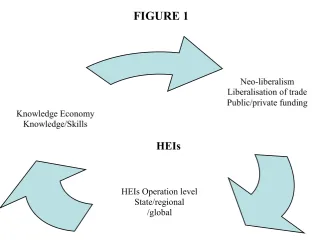
115 FIGURE 1
HEIs Discursive Position
The scheme changes the discursive position of the HEIs when the variables alter from knowledge to skills, from the state to the regional or the global operational level of the HEIs, from public funding to private. In an industrial, Fordist society, the three interrelated variables of the cycle were stable. HEIs aimed at the production and transition of knowledge to a labour force that will serve the state they are located in and thus, they were primarily publicly funded institutions. However, this relationship is altered within the knowledge society. HEIs are called upon to operate not only on a national but also on a regional and global level. They recruit, train and educate students who will be part of a global labour force. Finally, their relationship with the state is weakened, as the latter is not perceived as their sole or major funding body. A further part of the KE discourse calls upon HEIs to construct a closer relationship with industry both at the level of the skills that are demanded in the market but also at the level of financial provision. The growing complexity of the relationship between the three variables introduces uncertainty and move towards competitiveness, excellence and performativity in the way that HEIs operate. Finally, the cycle of the KE discourse has implication for HE institutional governance.
INTERLOCKING AND DEPENDENCY DISCOURSES
Earlier, I discussed the impact of globalisation on national education policy and presented the argument that the latest trends in national education policy and especially higher education to a great extent exhibit similarities. In my research the BP is treated as a common European policy in higher education. Hence, I will try to bring together these two issues by focusing on the similarities and controversies of the two discourses, that is, the globalisation discourse and the BP discourse, always in respect to education policy.
Tracing the influences of globalisation on education policy may be plausible following Lingard and Rizvi’s (1998) suggestion that globalisation is both a ‘process’ and an ‘ideological discourse’. It is in the acceptance of globalisation as an ideological discourse and not only a process that the similarities and divergences of different current national education
Neo-liberalism Liberalisation of trade Public/private funding
HEIs Operation level State/regional
/global Knowledge Economy
Knowledge/Skills
116
policies can be understood even though they are all presented as reactions to globalisation by national governments and the policies they introduce. To that point Green’s (1999) work comparing education policies in Europe offers a similar argument. As Vidovich (2004) frames it: “He (Green 1999) found a relatively consistent ideology in education policy across different countries and regions, even those with different historical and cultural backgrounds, which might suggest that the ideological component of globalisation is transcending ‘traditional’ ideological differences between countries and perhaps accounting for the accelerating rate of policy transfer around ‘the globe’. However, Green also found strong evidence of differentiated structures and processes that were related to different national and regional contexts. Thus, both policy convergence and divergence were occurring simultaneously” (Vidovich, p. 353).
The BP is a policy making process and as such is embedded in the discourse that creates/constructs it. In other words, the BP is embedded in the ideological discourse of globalisation as much as it is constructed with a view to respond to it. Moreover, the EU, which is the organisation that supports the BP as a policy making process, is a supranational organisation, the discourse of which is expressed through institutions that are not tied or bound to any national boundaries within its specified geographical space, It works within the context of globalisation and constructs, promotes and influences the discourse of its member states’ education policy. The relationship and dynamics of globalisation in relation to the EU as a supranational organisation can be seen in parallel to what Henry et al. (2001) write concerning the dynamics of the OECD in relation to globalisation: the OECD “is both a globalising agent as well as being shaped in its turn by globalisation” (Henry et al., 2001, p. 59).
I shall now present the similarities and controversies of the two discourses, mainly through the way they appear in BP related documents and in EU approaches to education through the European Commission (EC). Novoa (2000) has conducted interesting research into the discourses and rhetoric that arose within the official EC documents on education and specifically HE. Although his research stops prior to the BP era his description of the rhetoric on EHEIs is valid. He identifies three main discourses: a) the economic logic, b) the rhetoric of citizenship and c) the discourse about quality.
Specifically, in relation to the economic logic, Novoa describes the political context of neoliberal orientation according to which “educational policies are being reconstructed around ideas of ‘choice’, ‘standards’, ‘competencies’, ‘European values’ and ‘real knowledge’ as a way to legitimise the growing pressure to make the perceived needs of business and industry into the primary goals of the school” (Novoa, 2000, p. 41). The above presents an EU economic approach following the exact line set by economic globalisation. Within the idea of ‘European values’ and ‘competency’ arises the rhetoric of citizenship. European citizenship is embedded in discourses of responsibility and trust towards the EU by its citizens and in the adoption of an EU identity that would be based on labour flexibility and consequently, life-long learning, competitiveness, continuous evaluation, mobility and, above all, an EU with public social characteristics. Bringing into the discussion the results of the French and Netherlands referenda on the EU constitution5, a first appreciation would be that people do respond exactly that way. The French and Dutch denial of the EU constitution was merely an
5 Czech Republic – Cancelled; Denmark, Poland, Portugal, United Kingdom – Postponed; Ireland, Sweeden –
117
expression of disappointment and lack of trust because of the reduced level of social characteristics in EU policies and the expansion of marketisation, not only in education but also in most spheres of social life.
Coming back to Novoa’s appreciation, the discourse about quality has recently been dominating European education policy. The discourse on quality starts with the discourse of competitiveness in a global educational market. Quite interesting in this respect is the EC’s reports “Realising the European Higher Education Area – Achieving the Goals”, which was produced as a contribution to the BP ministerial meeting in Bergen 2005. With this report, the EC alerts the European Ministers to the fact that “our systems, our Universities face bigger challenges and stronger competition than ever before” (2005, p. 3). Three main areas of under-performance are identified: a) Tertiary education attainment – 21% lower than the US (38%), Canada (43%), Japan (36%_ and South Korea (26%), b) Access to higher education - “the EU 52% is slightly ahead of Japan 49%, behind Canada 59% and far behind the US 81% and South Korea 82% - and c) research performance - “we have about 5.5 researchers per 1,000 employees, marginally less than Canada or South Korea, but way below the US 9.0 or Japan 9.7” (Ibid. p. 3). In order for the EU to be able to successfully tackle such challenges, it should focus on the development and restructuring of its HE system through the national education policies of EU member states that would follow EU education policy guidelines. These guidelines are expressed and specified in the BD.
O’Mahony (2002) presents the six action areas identified by the BP policy discourse. Those are;
Freedom with responsibility: empowering universities
Employability on the European labour market
Mobility in the higher education area
Compatibility: a common but flexible qualifications framework
Quality assurance and certification (accreditation)
Competitiveness at home and in the world
And as he explains “these areas of policy convergence were identified in the Bologna Declaration and they fit around wider issues of higher education development” (O’Mahony, 2002, p. 45).
From the above ‘six action areas’ or policy arenas, I shall primarily focus on the discourse concerning quality. The prioritisation of quality discourse comes naturally as the remaining five features of the policy are related to it either as a presupposition or as a result of quality. For example, the first feature of ‘freedom with responsibility’ for the empowerment of the universities is vital for the desegregation of state HE state systems and enforcement of competitive attitudes within HEI which have to “be free to make strategic choices, to concentrate on their core areas, to choose their partners, and to position themselves to compete to deliver quality education research and service” (O’Mahony, 2002, p. 48). ‘Competitiveness at home and in the world’ on the other hand is bound to the established and acknowledged quality of an HEI. Or in other words “Quality is the basic underlying condition for trust, relevance, mobility, compatibility and attractiveness in the European Higher Education Area” (2002, p. 21, emphasis in the original)6. Moreover, the quality discourse
within the BP guidelines has two points of focus. One can be described as internal as it is focused on the establishment of national and regional quality for HEIs. The other can be described as external as it is focused on quality for international competition. During the
6 “Compendium of basic documents in the BP” Compiled by the Directorate General IV: Education, Culture and
118
ministerial meetings and the follow-up group meetings within the BP, there is an explicit reinforcement and monitoring of the Bologna signatory members’ steps to adapt to both points of focus in quality. In relation to internal national quality, the BP has established the state of national reports, in which each signatory member has to present the steps taken by the nation towards the establishment of the ‘six action areas’ and consequently of quality. And, at that level, the realisation of the policy guidelines can be said to be on the right track, as most of the countries have created national quality assurance agencies (for example, Greece) or have developed their pre-existing agencies (for example, the UK) . However, in relation to the external international quality features, it has been noted that there are still issues to be overcome. As O’Mahony suggests, “To compete more on the global level European higher education needs to have grown used to competition within the continent, and even at national level. Being competitive requires a certain culture and behaviour and not just rhetoric” (O’Mahony, 2002, p. 62).
The quality discourse within the BP emerges as extended not only to national and regional levels but also to the global level. In addition, the quality discourse cannot be left to take its course. The need for quality within the discourse appears to be urgent. Thus, HEI institutions and their participants appear not to have the time to be constructed silently and slowly by the processes of the discourse. Instead they are compelled to willingly accept, adapt and realise the discourse, by subjecting themselves to it. These issues of the multilevel spread of quality discourse in the demand for quality appear in paragraphs 3 and 4 of the preamble of the EUA Glasgow declaration:
3. Europe needs strong and creative universities as key actors in shaping the European knowledge society through their commitment to wide participation and lifelong learning, and their promotion of quality and excellence in teaching, learning, research and innovation activities.
4. This will be achieved by self-confident institutions able to determine their own development and to contribute to social, cultural and economic well-being at a regional, national, European and Global level (EUA, Brussels, 15 April 2005, p. 1).
As mentioned earlier, the quality discourse is interrelated with issues of competitiveness and attractiveness, within the context of global educational markets. From this perspective, Professor A. Oosterlinck, the Vice-Chancellor of K. U. Leuven and an EUA Board Member suggests the implementation of GATS on HE. “One could even argue that GATS could be considered as an extension of the Bologna system, which we are currently implementing throughout Europe. ...It is obvious that Bologna will increase competition among education providers, but it will (p. 5) also improve the overall quality of European education… …GATS is a reality, even though much still needs to be filled in. It would be unwise of the world of education to try to ignore this reality” (Washington, May 23rd, 2002, p. 6).
119
On the other end of the above conceptualisations, can be found the national HE policies of the BP signatory countries, which are guided towards initiatives promoting the widening of access and participation in HE. Interestingly, the widening access and participation in HE are promoted and perceived, to a greater extent, within a context and political discourse of equity and opportunity. However, their purposive introduction underlying these initiatives aims primarily to assist the EHEA to overcome the low percentages of HE attainment, access to HE and research performance in the global HE competitive market. Equity in HE becomes a significant factor at the point that it is regarded as participation within HE. And widening participation is, foremost, economically meaningful as it serves the ideal of a KE by supporting the labour market with a highly educated population committed to lifelong learning, by bringing income to HEIs through fees, by reaching the global numerical standards and re-establishes HE performance and quality and finally, by reinforcing the attractiveness and competitiveness of the HE system, e.g. the EHEA.
In any case, what comes as a unifying aspect within the globalisation and BP discourse regarding their mutual characteristics is the unquestioned prioritisation of quality within HE (Morley, 2003, 2004). In the previous paragraph I tried to draw connections between HE systems’ auditing and the understanding of quality. Now I will try to move forward into the connections between ‘quality’ and the notions of workforce flexibility, competitiveness, managerialism and self-organisation. These are recognised as the underlying issues within the six areas of action identified in Salamanca and presented by O’Mahony (2002). As I mentioned earlier, quality in relation to them appears both as a prerequisite and as a consequence. In that sense, quality and the related features construct a new generic policy ensemble based on the ideas of neo-liberalism. In this new policy regime the constructive discourse is that of self-organisation, self-responsibility and autonomy – applied both to HEIs and their participants – and the policy technologies for its sustainability is the reformation of the self in order to adapt to the new ‘quality culture’ and the rewarding of managerial ideologies. It is a regime that bases its governance not only in its acceptance by the largest part of the population - 45 signatory countries of the BP – but by excluding discursively the subjectivities that lie outside the policy discourse.
Concluding I would suggest that there are analogous and relationships between the discourses of globalisation and the BP. The ideological features of the globalisation discourse have been embodied in that of Bologna, as an education policy response to the global context. Because of the similarities of the two discourses, it could be claimed on one hand that the discourse is just moving levels, from the global to the national, as its main features, that is, competitiveness, flexibility and quality, remain unchanged. On the other hand, the continuous reference to social and cultural issues in the BP discourse could suggest that the adoption of the globalisation discourse is not blindfold and silent, but is a process of constant discursive recontextualisation. Finally, it seems, that the two discourses are neither similar to nor parallel to each other. But it appears that the BP policy discourse only makes sense, only has a need to exist in the terms, demands and patterns set by the globalisation discourse. Moreover, they stand with ideologically parallel features but these appear with different strength and force in their construction as discourses.
REFERENCES
120
Burbules, N. C., & Torres, C. A. (2000). Education and globalization: an introduction. In N. C. Burbules & C. A. Torres (Eds), Education and globalization: critical perspectives (pp. 1 - 26). New York: Routledge.
Carnoy, M. (2000). Globalization and Educational Reform, Globalisation and Education: Integration and Contestation across Cultures. Maryland: Rowman & Littlefield Publishers. Codd, J. (1988). The construction and deconstruction of educational policy documents. Journal of Education Policy, 3(3), 235-247.
Currie, J., DeAngelis, R., De Boer, H., Huisman, J., & Lacotte, C. (2003). Globalizing practices and University responses: European and Anglo-American differences. USA: Praeger.
Green, A. (1999). Education and globalisation in Europe and East Asia: covergent and divergent trends. Journal of Education Policy, 14, 55-71.
Green, A., Preston, J., & Germen, J. (2006). Education, equality and social cohesion: a comparative analysis. Basingstoke: Palgrave Macmillan
Guile, D. (2006). What is distinctive about the knowledge economy? Implications for Education. In H. Lauder, P. Brown, J.-A. Dillabough & A. H. Halsey (Eds), Education, Globalization and Social Change (pp. 355-366). Oxford: Oxford University Press
Henry, M., Lingard, B., Rizvi, F., & Taylor, S. (2001). The OECD, Globalisation and Education Policy. Oxford: Pergamon.
Lauder, H., Brown, P., Dillabough, J.-A., & Halsey, A. H. (2006). Introduction: The prospects for Education: individualisation, globalisation and social change. In H. Lauder, P. Brown, J.-A. Dillabough & J.-A. H. Halsey (Eds), Education, Globalisation and Social Change (pp. 1-70). Oxford: Oxford University Press.
Lingard, R., & Rizvi, F. (1998). Globalisation, the OECD and Australian Higher Education. In J. Currie & J. Newson (Ed.), Universities and Globalisation: critical perspectives (pp. 257-273). London: Thousands Oaks: SAGE.
Lingard, B., Rawolle, S., & Taylor, S. (2007). Globalizing policy sociology in education: working with Bourdieu. Journal of Education Policy, 20, 759-777.
MacLure, M. (2003). Discourse in educational and social research. Buckingham: Open University Press.
Morley, L. (2003). Quality and power in Higher Education. Berkshire: SRHE and Open University Press.
Morley, L. (2004). Theorising quality in Higher Education. London: Institute of Education. Novoa, A. (2000). The restructuring of the European Educational Space: changing relationships among states, citizens, and educational communities. In T. Popkewitz (Ed.),
Educational knowledge: changing relationships between the state, civil cociety and the educational community (pp. 31-57). Albany: State University of New York Press.
OECD (1996a). The Knowledge-based Economy. Paris: OECD.
OECD (1996b). Measuring what people know: human capital accounting for the Knowledge Economy. Paris: OECD.
OECD (1996c). Employment and Growth in the Knowledge-based Economy. Paris: OECD. OECD (1997). National Innovation Systems. Paris: OECD
O'Mahony, M. (2002). Universities and the Bologna Process. THEMA, 1, 45-64
121
Peters, M. (2001). National education policy constructions of the ‘Knowledge Economy’: towards a critique. Journal of Educational Enquiry, 2, 1-22.
Peters, M. A. (2003). Education Policy in the age of Knowledge Capitalism. Policy Futures in Education, 1, 361-380.
Porter, P., & Vidovich, L. (2000). Globalisation and Higher Education. Educational Theory, 50, 449-465.
Rikowski, G. (2004). Marx and the education of the future. Policy Futures in Education, 2, 565-577.
Rizvi, F., & Lingard, B. (2000). Globalisation and education: complexities and contigencies.
Educational Theory, 50, 419-426.
Rizvi, F., & Lingard, B. (2006). Globalisation and the changing nature of the OECD’s educational work. In H. Lauder, P. Brown, J.-A. Dillabough & A. H. Halsey (Eds),
Education, Globalization and Social Change (pp. 247-260). Oxford: Oxford University Press. Robertson, S. L. (2003). WTO/GATS and the Global Education Services Industry.
Globalisation, Societies and Education, 1(3), 259-266.
Robertson, S., Bonal, X., & Dale, R. (2006). GATS and the Education Services Industry: The politics of scale and global reterritorialization. In H. Lauder, P. Brown, J.-A. Dillabough & A. H. Halsey (Eds), Education, Globalisation and Social Change (pp. 228-246). Oxford: Oxford University Press.
Rose, N. (1992). Governing the enterprising self. In P. Heelas & P. Morris (Eds), The values of the enterpise culture: a moral debabte (pp. 141-164). London: Routledge.
Whitty, G., Power, S., & Halpin, D. (2003). Making sense of Education Policy. London: Paul Chapman Publishing.
World Bank. (2002). Constructing Knowledge Societies: New Challenges for Tertiary Education. Washington, DC: The World Bank.
Vidovich, L. (2004). Global-National-Local dynamics in policy processes: a space of 'quality' policy in higher education. British Journal of Sociology of Education, 25, 341-354.
Yelland, R. (2000). Supranational organisations and transnational education. Higher Education in Europe, 25, 297-303.
BOLOGNA RELATED DOCUMENTS
Bergen Communiqué (2005). The European Higher Education Area – Achieving the Goals. Communiqué of the Conference of European Ministers responsible for Higher Education, Retrieved from http://ec.europa.eu/education/policies/educ/bologna/bergen.pdf.
Bologna Declaration (1999). The European Higher Education Area. University of Bologna, Italy. Retrieved from http://ec.europa.eu/education/policies/educ/bologna/bologna.pdf.
Bologna beyond 2010 (2009). Report on the development of the European Higher Education Area Background paper for the Bologna Follow-up Group prepared by the Benelux Bologna Secretariat, Leuven/Louvain-la-Neuve Ministerial Conference April 2009. Retrieved from http://www.ond.vlaanderen.be/hogeronderwijs/bologna/conference/documents/Beyond_2010 _report_FINAL.pdf.
Glasgow declaration (2005). EUA, Brussels, 15 April 2005, p. 13. Retrieved from http://www.eua.be/eua/jsp/en/upload/Glasgow_Declaration.1114612714258.pdf.
122
Ministers responsible for Higher Education, Leuven, 28-29 April 2009. Retrieved from http://www.ond.vlaanderen.be/hogeronderwijs/bologna/conference/documents/leuven_louvai n-la-neuve_communiqu%C3%A9_april_2009.pdf.