University of Huddersfield Repository
Cerutti, Federico, Giacomin, Massimiliano, Vallati, Mauro and Zanella, Marina
A SCC Recursive MetaAlgorithm for Computing Preferred Labellings in Abstract Argumentation
Original Citation
Cerutti, Federico, Giacomin, Massimiliano, Vallati, Mauro and Zanella, Marina (2014) A SCC
Recursive MetaAlgorithm for Computing Preferred Labellings in Abstract Argumentation. In: 14th
International Conference on Principles of Knowledge Representation and Reasoning (KR), 20th
24th July 2014, Vienna, Austria.
This version is available at http://eprints.hud.ac.uk/id/eprint/19946/
The University Repository is a digital collection of the research output of the
University, available on Open Access. Copyright and Moral Rights for the items
on this site are retained by the individual author and/or other copyright owners.
Users may access full items free of charge; copies of full text items generally
can be reproduced, displayed or performed and given to third parties in any
format or medium for personal research or study, educational or notforprofit
purposes without prior permission or charge, provided:
•
The authors, title and full bibliographic details is credited in any copy;
•
A hyperlink and/or URL is included for the original metadata page; and
•
The content is not changed in any way.
For more information, including our policy and submission procedure, please
contact the Repository Team at: [email protected].
A SCC Recursive Meta-Algorithm for Computing Preferred Labellings in
Abstract Argumentation
Federico Cerutti
School of Natural and Computing Science King’s College
University of Aberdeen AB24 3UE, Aberdeen, United Kingdom
e-mail: [email protected]
Massimiliano Giacomin
Department of Information EngineeringUniversity of Brescia via Branze, 38 25123, Brescia, Italy
e-mail: [email protected]
Mauro Vallati
School of Computing and Engineering University of Huddersfield Huddersfield, HD1 3DH, United Kingdom
e-mail: [email protected]
Marina Zanella
Department of Information Engineering University of Brescia
via Branze, 38 25123, Brescia, Italy e-mail: [email protected]
Abstract
This paper presents a meta-algorithm for the computation of preferred labellings, based on the general recursive schema for argumentation semantics called SCC-Recursiveness. The idea is to recursively decompose a framework so as to com-pute semantics labellings on restricted sub-frameworks, in or-der to reduce the computational effort. The meta-algorithm can be instantiated with a specific “base algorithm”, applied to the base case of the recursion, which can be obtained by generalizing existing algorithms in order to compute la-bellings in restricted sub-frameworks. We devise for this pur-pose a generalization of a SAT-based algorithm, and pro-vide an empirical investigation to show the significant im-provement of performances obtained by exploiting the SCC-recursive schema.
Introduction
Dung’s theory of abstract argumentation (Dung 1995) is a unifying framework able to encompass a large variety of specific formalisms in the areas of nonmonotonic reason-ing, logic programming and computational argumentation. It is based on the notion of argumentation framework (AF),
consisting of a set of arguments and an attackrelation be-tween them. Differentargumentation semanticsintroduce in a declarative way the criteria to determine which arguments emerge as justified from the conflict, by identifying a num-ber of extensions, i.e. sets of arguments that can “survive the conflict together”. In (Dung 1995) four “traditional” se-mantics were introduced, namelycomplete,grounded, sta-ble, andpreferredsemantics. For an introduction on alterna-tive semantics, see (Baroni, Caminada, and Giacomin 2011). The main computational problems in abstract argumen-tation includedecisionandconstructionproblems, and turn
Copyright c2014, Association for the Advancement of Artificial Intelligence (www.aaai.org). All rights reserved.
out to be computationally intractable for most of argumenta-tion semantics (Dunne and Wooldridge 2009). In this paper we focus on the extension enumerationproblem, i.e. con-structingallextensions prescribed for a givenAF: its
solu-tion provides complete informasolu-tion concerning the justifica-tion status of arguments and subsumes the solujustifica-tions to the other problems.
On the practical side, few results are available on the de-velopment of efficient algorithms for abstract argumentation and their empirical assessment. In particular, in (Cerutti et al. 2013; 2014) a SAT-based approach has been proposed to solve the extension enumeration problem for preferred se-mantics. Preferred semantics represents the main contribu-tion in Dung’s theory, as it allows multiple extensions (dif-ferently from grounded semantics), the existence of exten-sions is always guaranteed (differently from stable seman-tics), and no extension is a proper subset of another exten-sion (differently from complete semantics). The proposed approach basically performs a search in the space of com-plete extensions to enumerate the maximal ones, exploit-ing a SAT solver to identify the relevant search states. In (Cerutti et al. 2014) it has been shown to be competitive w.r.t. other state-of-the-art systems including ASPARTIX (Egly, Alice Gaggl, and Woltran 2010), ASPARTIX-META (Dvoˇr´ak et al. 2011) and the system presented in (Nofal, Dunne, and Atkinson 2012). A limitation of this approach is that it is always applied to the AF as a whole, without
dividing the enumeration problem into a number of simpler sub-problems.
sub-frameworks identified by the strongly connected com-ponents. It is worth to mention that the focus of this paper is on preferred semantics, but the devised meta-algorithm can be instantiated with various specific “base algorithms” and applied to a variety of semantics.
The paper is organised as follows. After recallling some necessary background in the first section, the SCC-recursive schema is reviewed in the next one. Then the parametric meta-algorithm is presented, and the generalization of the SAT-based algorithm of (Cerutti et al. 2014) is described. Next section describes the test setting and comments the experimental results, while the last section provides a final discussion and concludes the paper. Proofs are omitted or sketched due to space limitations.
Background
An argumentation framework (Dung 1995) consists of a set of arguments1and a binary attack relation between them.
Definition 1. Anargumentation framework(AF) is a pair
Γ =hA,RiwhereAis a set of arguments andR ⊆ A × A. We say thatbattacksaiffhb,ai ∈ R, also denoted asb→a. The set of attackers of an argument a will be denoted as
a− ,{b :b →a}, the set of arguments attacked byawill be denoted asa+ , {b : a → b}. We also extend these notations to sets of arguments, i.e. givenE⊆ A,E− ,{b| ∃a∈E,b→a}andE+
,{b| ∃a∈E,a→b}.
An argumentawithout attackers, i.e. such thata− = ∅, is saidinitial. Moreover, each argumentation framework has an associated directed graph where the vertices are the argu-ments, and the edges are the attacks.
The basic properties of conflict–freeness, acceptability, and admissibility of a set of arguments are fundamental for the definition of argumentation semantics.
Definition 2. Given anAFΓ =hA,Ri:
• a setS ⊆ Ais aconflict–freeset ofΓif@a,b ∈ Ss.t.
a→b;
• an argument a ∈ A isacceptable with respect to a set
S⊆ AofΓif∀b∈ As.t.b→a,∃c∈Ss.t.c→b; • a setS⊆ Ais anadmissible setofΓifSis a conflict–free
set ofΓand every element ofSis acceptable with respect toSofΓ.
An argumentation semanticsσprescribes for anyAFΓa set ofextensions, denoted asEσ(Γ), namely a set of sets of
arguments satisfying the conditions dictated byσ. Here we
need to recall the definitions of complete (denoted asCO), grounded (denoted asGR) and preferred (denoted asPR) semantics only.
Definition 3. Given anAFΓ =hA,Ri:
• a set S ⊆ A is a complete extension of Γ, i.e. S ∈ ECO(Γ), iffS is admissible and∀a ∈ As.t.ais accept-able w.r.t.S,a∈S;
1In this paper we consider only finitesets of arguments: see
(Baroni et al. 2013) for a discussion on infinite sets of arguments.
• a set S ⊆ A is thegrounded extension of Γ, i.e. S ∈ EGR(Γ), iffSis the minimal (w.r.t. set inclusion) complete extension of Γ. Its existence and uniqueness have been proved in (Dung, Mancarella, and Toni 2006);
• a set S ⊆ A is a preferred extension of Γ, i.e. S ∈ EPR(Γ), iffSis a maximal (w.r.t. set inclusion) complete extension ofΓ.
It can be noted that each extension S implicitly defines
a three-valuedlabellingof arguments: an argumentais la-belled in iff a ∈ S; is labelled out iff ∃ b ∈ S s.t.
b → a; is labelled undec if neither of the above
con-ditions holds. In the light of this correspondence, argu-mentation semantics can be equivalently defined in terms of labellings rather than of extensions (Caminada 2006; Baroni, Caminada, and Giacomin 2011). For technical rea-sons, we introduce the notion of labelling both for argumen-tation frameworks and for arbitrary sets of arguments. Definition 4. Given a set of argumentsS, alabellingofS
is a total functionLab : S −→ {in,out,undec}. The set of alllabellingsofS is denoted asLS. Given anAF Γ =
hA,Ri, alabellingofΓis a labelling ofA. The set of all labellingsofΓis denoted asL(Γ).
In particular, complete labellings can be defined as fol-lows.
Definition 5. LetΓ =hA,Ribe an argumentation frame-work. A labellingLab ∈L(Γ)is acomplete labellingofΓ
iff it satisfies the following conditions for anya∈ A: • Lab(a) =in⇔ ∀b∈a−Lab(b) =out;
• Lab(a) =out⇔ ∃b∈a−:Lab(b) =in;
The grounded and preferred labelling can then be defined on the basis of complete labellings.
Definition 6. LetΓ =hA,Ribe an argumentation frame-work. A labellingLab ∈ L(Γ)isthe grounded labellingof
Γif it is the complete labelling ofΓminimizing the set of ar-guments labelledin, and it is apreferred labellingofΓif it is a complete labelling ofΓmaximizing the set of arguments labelledin.
In order to show the connection between extensions and labellings, let us recall the definition of the func-tion Ext2Lab, returning the labelling corresponding to a
conflict–free set of argumentsS.
Definition 7. Given an AF Γ = hA,Riand a conflict– free setS ⊆ A, the corresponding labellingExt2Lab(S)is defined asExt2Lab(S)≡ Lab, where
• Lab(a) =in⇔a∈S
• Lab(a) =out⇔ ∃b∈Ss.t.b→a
• Lab(a) =undec⇔a∈/S∧@b∈Ss.t.b→a
(Caminada 2006) shows that there is a bijective corre-spondence between the complete, grounded, preferred ex-tensions and the complete, grounded, preferred labellings, respectively.
Proposition 1. Given an an AF Γ = hA,Ri, Lab is a complete (grounded, preferred) labelling ofΓif and only if there is a complete (grounded, preferred) extensionS ofΓ
The set of complete labellings ofΓis denoted asLCO(Γ), the set of preferred labellings asLPR(Γ), while LGR(Γ) denotes the set including the grounded labelling.
SCC-Recursiveness Revisited
In (Baroni and Giacomin 2004) it has been recognised that each argumentation framework can be partitioned into a set of sub-frameworks in such a way that most common argumentation semantics (originally defined at the global level) can be equivalently defined at the level of these sub-frameworks. In particular, an extension-based semantics def-inition schema has been introduced, called SCC (strongly connected component)-recursiveness, based on the graph-theoretical notion of SCCs i.e. the equivalence classes in-duced by the path equivalence (i.e. mutual reachability) re-lation between the nodes of the associated graph of an argu-mentation framework (given the direct correspondence be-tween eachAF and its associated graph, in the following
we will equivalently refer to both of them asAF).
Definition 8. Given anAFΓ =hA,Ri, the binary relation ofpath-equivalencebetween nodes, denoted asPEΓ⊆ A× A, is defined as follows:
• ∀a∈ A,ha,ai ∈PEΓ;
• ∀a,b∈ A,a6=b,ha,bi ∈PEΓiff there is a path froma toband vice versa.
Two main features of the SCC-recursive schema are worth remarking.
First, the SCC-recursive schema exploits the partial or-der of SCCs induced by the attack relation and can be re-garded as a constructive procedure to incrementally build ex-tensions following such partial order. At the beginning, the extensions of the frameworks restricted to theinitialSCCs (i.e. those not receiving attacks from others) are computed and combined together. Then each SCC which is attacked only from initial SCCs is considered, and for each extension
Ealready obtained, the extensions of such a SCC are locally
computed and merged withE. The process is then applied
to all SCCs following their partial order, until no remaining SCCs are left to process.
A second feature is that the schema, as the name suggests, is recursive. In particular, for every SCC considered in the above procedure, the local computation is performed as fol-lows. First, all arguments attacked by the extension selected in the previous SCCs are suppressed. Then, the procedure is recursively applied to the remaining part of the SCC. The base of the recursion is reached when there is one SCC only: in this case, a base functionBF is called. Such a function receives as input an argumentation frameworkΓ =hA,Ri
and a setC⊆ A:Γis a sub-framework of the originalAF
Γ0 = hA0,R0i, andC contains the arguments that are “ex-ternally accepted” (i.e. their attackers inA0
\ Aare attacked by the part of the extension constructed so far).
The following definitions introduce the SCC-recursive schema in its original extension-based form (Baroni, Gia-comin, and Guida 2005).
First, let us recall the definition ofrestrictionof anAFΓ
to a set of argumentsI, in symbolΓ↓I.
Definition 9. Given an argumentation framework Γ =
hA,Riand a setI ⊆ A, the restriction ofΓtoIis defined asΓ↓I ≡(A ∩I,R ∩(I×I)).
Then, Definition 10 introduces the function GF(Γ, C)
which recursively computes the semantics extensions on the basis of the SCCs ofΓ. Let us denote as SCCΓ the set
in-cluding the SCCs of an argumentation frameworkΓ.
Definition 10. A given argumentation semanticsσis SCC-recursive if for any argumentation frameworkΓ =hA,Ri, Eσ(Γ) =GF(Γ,A)⊆2A. For anyΓ =hA,Riand for any
setC⊆ A,E∈ GF(Γ, C)if and only if • E∈ BFσ(Γ, C)if |SCCΓ|= 1
• ∀S ∈SCCΓ(E∩S)∈ GF(Γ↓S\(E\S)+, UΓ(S, E)∩C) otherwise
where
• BFσ(Γ, C)is a function, calledbase function, that, given
an argumentation framework Γ = hA,Ri such that |SCCΓ|= 1and a setC⊆ A, gives a subset of2A • UΓ(S, E) ={a∈S\(E\S)+| ∀b∈(a−\S), b∈E+}
As shown below, this schema is based on the notions of admissible set, complete, grounded, preferred extension of anAF in a set of arguments.
Definition 11. Given anAF Γ =hA,Riand a setC⊆ A, a setE⊆ Ais:
• anadmissible set ofΓinCif and only ifEis an admissi-ble set ofΓandE⊆C
• acomplete extension ofΓinCif and only ifEis an ad-missible set ofΓinC, and every argumentα∈Cwhich is acceptable with respect toEbelongs toE
• thegrounded extension ofΓ inC if and only if it is the least (with respect to set inclusion) complete extension of
ΓinC
• apreferred extension ofΓinCif and only if it is a max-imal (with respect to set inclusion) complete extension of
ΓinC.
The existence and uniqueness of the grounded exten-sion in C, as well as the existence of at least a preferred
extension in C, have been proved in (Baroni, Giacomin,
and Guida 2005). The set of admissible sets in C is
de-noted as EAD(Γ, C), the set of complete extensions in
C as ECO(Γ, C), the set of preferred extensions in C as EPR(Γ, C), whileEGR(Γ, C)denotes the set including the grounded extension inC.
(Baroni, Giacomin, and Guida 2005) proves that GF(Γ, C), as defined in Def. 10, returns Eσ(Γ, C) (with
σ∈ {CO,GR,PR}), provided thatBFσ(Γ, C)returns the
complete, grounded, and preferred extensions inC,
respec-tively. The correctness of the schema then follows from the fact that, according to Definition 11,Eσ(Γ,A) =Eσ(Γ).
A Parametric Meta-Algorithm to Enumerate
Preferred Labellings
Algorithm 1Enumerating the preferred labellings of anAF
PREF(Γ)
1: Input:Γ =hA,Ri
2: Output:Ep∈2L(Γ)
3: return R-PREF(Γ,A)
BFPR, without committing on the way B-PR performs its computation.
The meta-algorithm consists of Algorithms 1 and 2. It represents an implementation of the SCC-recursive schema with two main improvements. First, the schema has been adapted to the labelling-based approach: the following defi-nition introduces the labelling-based counterpart of the com-plete, grounded and preferred extension inC.
Definition 12. Given anAFΓ =hA,Riand a setC⊆ A, a labellingLab∈L(Γ)is acomplete (grounded, preferred) labelling of Γ inC if there is a complete (grounded, pre-ferred) extensionSofΓinCsuch thatLab=Ext2Lab(S). The set of complete and preferred labellings ofΓinCare denoted as LCO(Γ, C) and LPR(Γ, C), respectively, and the set including the grounded labelling ofΓinCis denoted asLGR(Γ, C).
Finally, a pre-processing step computing the grounded la-bellingLab∗inCis performed. The labellings of the whole
argumentation framework can then be obtained by extending Lab∗, on the basis to the following result.
Proposition 2. Let hA,Ri be an argumentation frame-work and letC ⊆ Aa set of arguments. Considering the grounded labellingLab∗ofΓinCand the setU including the undec-labelled arguments according toLab∗, it holds thatLPR(Γ, C) ={Lab∗∪E |E∈ LPR(Γ↓U, C∩U)}.
Sketch of proof. This extends the known result (Baroni, Caminada, and Giacomin 2011) that the grounded extension is a subset of the intersections of preferred extensions.
Let us turn to the description of the meta-algorithm. The function PREF (Algorithm 1) receives as input an argumen-tation frameworkΓ = hA,Ri and returns the set of
pre-ferred labellings of Γ. This is simply achieved by invok-ing (at line3) R-PREF(Γ,A), where the function R-PREF
(GF in Def. 10) receives as input an argumentation frame-workΓ = hA,Riand a setC ⊆ A, and computes the set LPR(Γ, C), i.e. the set of preferred labellings ofΓinC.
Algorithm 2 implements the function R-PREF. First, a pre-processing step which computes the grounded labelling inCis executed at line3by means of the call(Lab, U) =
GROUNDED(Γ, C).
The procedure GROUNDED (Alg. 3) receives as input an argumentation frameworkΓ =hA,Riand a setC⊆ A,
and returnsLabandU:Labis the restriction of the grounded
labelling to the arguments that areinorout-labelled;U is
the set including the remaining (undec-labelled) arguments.
The GROUNDED procedure iteratively labelsineach
argu-menta ∈Cwhich either is initial, or receives attacks from
arguments labelledout, and then labelsouteach argument
attacked bya.
Algorithm 2Enumerating the preferred labellings in a setC
of anAF
R-PREF(Γ, C)
1: Input:Γ =hA,Ri,C⊆ A
2: Output:Ep∈2L(Γ)
3: (Lab, U) =GROUNDED(Γ, C) 4: Ep := {Lab}
5: Γ = Γ↓U
6: (S1, . . . , Sn) :=SCCSSEQ(Γ)
7: fori∈ {1, . . . , n}do
8: E0p := ∅ 9: forLab∈Epdo
10: (O, I) := BOUNDCOND(Γ, Si,Lab)
11: ifI=∅then
12: Lab=Lab∪{(a,out)|a∈O}∪{(a,undec)|
a∈Si\O}
13: E0p=Ep0 ∪ {Lab}
14: else
15: ifO=∅then
16: E∗=B-PR(Γ↓Si, I∩C)
17: else
18: Lab=Lab∪ {(a,out)|a∈O}
19: E∗=R-PREF(Γ↓Si\O, I∩C) 20: end if
21: E0p=Ep0 ∪(Lab⊗E∗)
22: end if
23: end for
24: Ep := Ep0
25: end for
26: returnEp
After the computation of Lab and U, Alg. 2 initialises
the variableEp to{Lab}at line 4.Ep stores the set of
la-bellings that are incrementally constructed. Then the com-putation proceeds by considering the argumentation frame-workΓ↓U (line5).
At line 6 the strongly connected components of the ar-gumentation framework are identified. We assume that an algorithm is available, denoted as SCCSSEQ, which re-ceives as input an argumentation framework Γand returns as output a sequence (S1, . . . , Sn) including the strongly
connected components of Γ in a topological order, i.e. if ∃a ∈ Si,b ∈ Sj such that a → b theni ≤ j. This can
be done in linear time under the number of attacks (Cormen et al. 2009, p. 617).
The incremental construction of the preferred labellings is performed by the outer loop (lines 7-25), which iter-atively selects the i-th SCC. At the beginning of the
it-eration, Ep includes the partial labellings constructed for
S1∪. . .∪Si−1.Then the inner loop is entered, which
ex-tends any labelling Lab ∈ Ep to Si (lines 9-23) storing
the labellings thus obtained inE0
p (initialised at line8). At
line 10 variable O is set to include arguments of Si that
are attacked by “outside”in-labelled arguments according
to Lab, and variable I is set to include arguments of Si
that are only attacked by “outside”out-labelled arguments.
Algorithm 3Determining the grounded labelling of anAF
in a setC
GROUNDED(Γ, C)
1: Input:Γ =hA,Ri,C⊆ A
2: Output:(Lab, U) :U ⊆ A,Lab∈LA\U
3: Lab := ∅
4: U := A 5: repeat
6: initialf ound := ⊥
7: for a∈Cdo
8: if{b∈U |b→a}=∅then
9: initialf ound := > 10: Lab := Lab∪ {(a,in)}
11: U := U\a
12: C := C\a
13: for b∈(U∩a+)do
14: Lab := Lab∪ {(b,out)}
15: U := U\b
16: C := C\b
17: end for
18: end if
19: end for
20: until(initialf ound)
21: return(Lab, U)
O = {a ∈ Si | ∃b ∈ S ∩a− : Lab(b) = in} and
I = {a ∈ Si | ∀ b ∈ S ∩a−,Lab(b) = out}, with
S≡S1∪. . .∪Si−1.
IfI = ∅then no argument ofSi can be labelled in, in
particular each argument inO is labelledoutand each
ar-guments in Si\O is labelledundec. Accordingly,Lab is
extended with such a labelling (line12) and included inEp0
(line13). Then a new iteration of the loop is entered to
pro-cess a new labellingLab∈Ep(if any).
Otherwise, two cases are considered. IfO =∅then there are no arguments to suppress fromSi, thus the base case of
the recursion applies. This is a small improvement w.r.t. Def. 10 which allows to avoid an unnecessary recursive step. In the base case, the preferred labellings ofΓ↓Si inSi∩Care
computed by means of the algorithm B-PR, and assigned to
E∗(line16). IfO 6=∅then each argument inOis labelled
out, and the R-PREF procedure is recursively invoked on
Γ↓Si\O andI∩C (line19). In both cases, line21extends
the labellingLab to cover the whole componentSi — by
combining it with all labelling ofE∗— and updateE0p.
In-deed,Lab⊗E∗denotes the set{Lab∪ Lab∗| Lab∗∈E∗}. After the inner loop is exited, i.e. when all labellings ofEp
have been considered, the obtained labellingsE0pare those
coveringS1, . . . , Si, thusEpis set toEp0 at line24. After the
outer loop is exited all strongly connected components have been processed, thusEp is returned as the set of preferred
labellings inC(line26).
The following theorem shows that Algorithm 2 (and thus Algorithm 1) is correct
Theorem 1. Given anAF Γ = hA,Riand a setC ⊆ A, Algorithm 1 returnsEp=LPR(Γ, C).
A SAT-Based Approach for the Base Case
R-PREF (Alg. 2) relies on an external algorithm (B-PR) for enumerating the preferred labellings ofΓ in a set of argu-mentsC. In order to empirically prove the improvementsob-tained using Alg. 2, in this section we discuss a specific im-plementation of B-PR generalizing the approach of (Cerutti et al. 2014).
The proposed algorithm performs a search in the space of complete extensions inC, in order to maximise the set of inarguments (cf. Definitions 12 and 11). Each step of the
search process requires to encode in a propositional formula the constraints corresponding to complete labellings of an
AF inC, with opportune modifications due to the search
process. Then, a SAT solver checks whether the formula is satisfiable, i.e. there exists a truth assignment of the variables such that the formula evaluates to>, and if this is the case returns such an assignment.
As a first step to identify the encoding, here we provide the definition ofcomplete labelling ofΓinCin a more
al-gorithmic way than Definition 12.
Definition 13. LethA,Ribe an argumentation framework and C ⊆ Abe a set of arguments. A total functionLab :
A 7→ {in,out,undec}is acomplete labelling ofΓinCiff it satisfies the following conditions for anya∈C:
L1
C:Lab(a) =in⇔ ∀b∈a−Lab(b) =out;
L2
C:Lab(a) =out⇔ ∃b∈(a−∩C) :Lab(b) =in;
L3
C:Lab(a) = undec ⇔ ∀b ∈ (a− ∩C),Lab(b) 6=
in∧ ∃c∈a−:Lab(c) =undec;
and the following conditions for anya∈(A \C):
L1
A\C:Lab(a) =out⇔ ∃b∈(a−∩C) :Lab(b) =in;
L2
A\C:Lab(a) = undec ⇔ ∀b ∈ (a
−
∩C),Lab(b)6=
in.
The following proposition shows that Definition 13 actu-ally identifies the complete labellings inCas introduced in
Definition 12.
Proposition 3. Given an an AF Γ = hA,Ri and a set
C ⊆ A,Labsatisfies the conditions of Definition 13 if and only if there is a complete extensionS ofΓinC such that Lab=Ext2Lab(S).
Sketch of proof. The proof generalizes (Cerutti et al. 2014, Proposition 2), to take into account the parameterC.
The Complete Labelling Formula of
Γ
in
C
Given anAF Γ =hA,Riand a setC ⊆ A, we are
inter-ested in identifying a boolean formula in conjunctive nor-mal form (as required by the SAT solver), calledcomplete labelling formula ofΓinCand denoted asΠΓ,C, such that
the satisfying assignments of the formula are in one-to-one correspondence with the complete labellings ofΓinC.
To this purpose, we have to introduce some notation. Let
φbe a bijectionφ:{1, . . . ,|A|} 7→ A(the inverse map will
be denoted asφ−1):φis an indexing ofA. Argumentφ(i)
will be sometimes referred to as argumentifor brevity. For
andUi, with the intended meaning thatIi is>when
argu-mentiis labelledin,⊥otherwise (and analogouslyOiand
Ui correspond to labelsout andundec). Formally, given
Γ =hA,Riwe define the corresponding set of variables as V(Γ),∪i∈φ−1(A){Ii, Oi, Ui}.
The following definition expresses the constraints of Def-inition 5 in terms of the variablesV(Γ).
Definition 14. Given anAF Γ =hA,Riwith|A|=kand a setC⊆ A, letφ:{1, . . . , k} 7→ Abe an indexing ofA. TheEN Callencodingdefined on the variables inV(Γ)is given by the conjunction of the formulae listed below:
^
i∈φ−1(C)
(Ii∨Oi∨Ui)∧(¬Ii∨ ¬Oi)∧
(¬Ii∨ ¬Ui)∧(¬Oi∨ ¬Ui)
(1)
^
i∈φ−1(C)
Ii∨
_
{j|φ(j)→φ(i)}
(¬Oj)
(2)
^
i∈φ−1(C)
^
{j|φ(j)→φ(i)}
¬Ii∨Oj
(3)
^
i∈φ−1(C)
^
{j∈φ−1(C)|φ(j)→φ(i)}
¬Ij∨Oi
(4)
^
i∈φ−1(C)
¬Oi∨
_
{j∈φ−1(C)|φ(j)→φ(i)} Ij (5) ^
i∈φ−1(C)
^
{k|φ(k)→φ(i)}
Ui∨ ¬Uk∨
_
{j∈φ−1(C)|φ(j)→φ(i)} Ij
(6)
^
i∈φ−1(C)
^
{j∈φ−1(C)|φ(j)→φ(i)}
(¬Ui∨ ¬Ij)
∧
¬Ui∨
_
{k|φ(k)→φ(i)}
Uk
(7)
^
i∈φ−1(A\C)
¬Ii∧(Oi∨Ui)∧(¬Oi∨ ¬Ui)
(8)
^
i∈φ−1(A\C)
^
{j∈φ−1(C)|φ(j)→φ(i)}
¬Ij∨Oi
(9)
^
i∈φ−1(A\C)
¬Oi∨
_
{j∈φ−1(C)|φ(j)→φ(i)} Ij (10) ^
i∈φ−1(A\C)
Ui∨
_
{j∈φ−1(C)|φ(j)→φ(i)} Ij (11) ^
i∈φ−1(A\C)
^
{j∈φ−1(C)|φ(j)→φ(i)}
¬Ui∨ ¬Ij
(12)
Formulas (1) and (8) encode the fact that Labis a total
function. The other formulas are in direct correspondence with the conditions of Definition 13:
• formulas (2) and (3) encodeL1
C;
• formulas (4) and (5) encodeL2
C;
• formulas (6) and (7) encodeL3
C;
• formulas (9) and (10) encodeL1 A\C;
• formulas (11) and (12) encodeL2 A\C.
The following proposition shows thatEN Call is a
com-plete labelling formula of Γ inC, i.e. every satisfying
as-signment of the EN Call encoding corresponds to a
com-plete extension inC, and vice versa. For ease of notation, if
a variable is not assigned to>then it is⊥.
Proposition 4. LethA,Ribe an argumentation framework andC ⊆ Abe a set of arguments. IfLabis a complete la-belling ofΓinC, then the assignmentΦV(Γ) ≡ {(Ii,>) |
Lab(φ(i)) = in} ∪ {(Oi,>) | Lab(φ(i)) = out} ∪
{(Ui,>) | Lab(φ(i)) = undec}satisfies theEN Call
en-coding of Definition 14. Conversely, if ΦV(Γ) is a satisfy-ing assignment of theEN Callencoding, then the labelling Lab≡ {(a,in)|Iφ−1(a)∈ΦV(Γ)} ∪ {(b,out)|Oφ−1(b)∈
ΦV(Γ)} ∪ {(c,undec) | Uφ−1(c) ∈ ΦV(Γ)} is a complete labelling ofΓinC.
Sketch of proof. The result derives from Proposition 3 by transforming logical implications in AND/OR.
Several syntactically different encodings can be devised which, while being logically equivalent, can significantly affect the performance of the overall process (Cerutti et al. 2014). The following proposition shows the 20non
re-dundant encodings (i.e. it is not possible to drop out some clauses so as to obtain a simpler logically equivalent encod-ing) equivalent toEN Call.
Proposition 5. LethA,Ribe an argumentation framework andC⊆ Abe a set of arguments. Referring to the formulae listed in Definition 14, let us define the following formulae (for the arguments inC):
Ca
1 : (1)∧(2)∧(3)∧(4)∧(5)
Cb
1: (1)∧(4)∧(5)∧(6)∧(7)
C2: (1)∧(3)∧(5)∧(7)
C3: (1)∧(2)∧(4)∧(6)
as well as the following ones (for the arguments inA \C):
N Ca
1 : (8)∧(9)∧(10)
N Cb
1 : (8)∧(11)∧(12)
N C2: (8)∧(10)∧(12)
N C3: (8)∧(9)∧(11)
Any encoding of the form C ∧ N C, where
C ∈ {Ca
1, C1b, C1c, C2, C3} and N C ∈ {N Ca
1, N C1b, N C2, N C3}, is equivalent to EN Call,
i.e. it has the same satisfying assignments of the variables inV(Γ).
Sketch of proof. The proof exploits the fact thatLabis a
to-tal function and shows that the conditions inC∧N C entail
those included inEN Call.
Corollary 1. LethA,Ribe an argumentation framework andC⊆ Abe a set of arguments. Any encoding of the form
C∧N C (see Proposition 5) is a complete labelling formula ofΓinC.
The SAT basepref Algorithm
We are now able to describe the proposed procedure to im-plement B-PR. The procedure, called SAT basepref, resorts to five external functions:SS, I-ARGS, O-ARGS, U-ARGS
and LAB.SS is a SAT solver able to prove unsatisfiability
too: it accepts as input a CNF formula and returns a variable assignment satisfying the formula if it exists, εotherwise.
All the other functions accept as input a variable assign-ment concerning V(Γ): I-ARGS returns the corresponding set of arguments labelled as in, O-ARGS returns the
cor-responding set of arguments labelled asout, U-ARGS
re-turns the corresponding set of arguments labelled asundec,
while LAB returns the labelling corresponding to the input variable assignment. Moreover, IN CC denotes the clause
W
i∈φ−1(C)Ii.
The SAT basepref procedure (Alg. 4) initialises, at line3,
the variableEp which stores the generated labellings. Then
cnfis initialized toΠΓ,C ∧IN CC:ΠΓ,C is a complete
la-belling formula of Γ in C, e.g. one of the equivalent
en-codings shown in Proposition 5, whileIN CC restricts the
search process to a non empty labelling (this is non restric-tive due to the check of line34). The search process is car-ried out by two nestedrepeat-untilloops. Roughly, the in-ner loop (lines 8–24) resembles a depth-first search which, starting from a non-empty complete labelling inC, produces
a sequence of complete labellings inC strictly ordered by
set inclusion. When the sequence can no more be extended, its last element corresponds to a complete labelling in C
maximizing the set ofin-labelled arguments, namely to a
preferred labelling. The outer loop (lines 5–33) drives the search: it ensures, through proper settings of the variables, that the inner loop is entered with different initial conditions, so that all preferred labellings inCare found.
The following theorem shows that Algorithm 4 is correct. Theorem 2. Given anAF Γ = hA,Riand a setC ⊆ A, Algorithm 4 returnsLPR(Γ, C).
Algorithm 4Enumerating the preferred labellings in a setC
of aAF
SAT basepref(Γ, C)
1: Input:Γ =hA,Ri,C⊆ A
2: Output:Ep∈2L(Γ)
3: Ep := ∅
4: cnf := ΠΓ,C∧IN CC
5: repeat
6: pref cand := ∅ 7: cnf df := cnf
8: repeat
9: lastcompf ound := SS(cnf df) 10: iflastcompf ound! = εthen
11: pref cand := lastcompf ound
12: for a∈I-ARGS(lastcompf ound)do
13: cnf df := cnf df∧Iφ−1(a)
14: end for
15: for a∈O-ARGS(lastcompf ound)do
16: cnf df := cnf df∧Oφ−1(a)
17: end for
18: remaining := ⊥
19: for a∈C∩U-ARGS(lastcompf ound)do
20: remaining := remaining∨Iφ−1(a)
21: end for
22: cnf df := cnf df∧remaining
23: end if
24: until(lastcompf ound! = ε)
25: ifpref cand! = ∅then
26: Ep := Ep∪ {LAB(pref cand)}
27: oppsolution := ⊥
28: for a∈C\I-ARGS(pref cand)do
29: oppsolution := oppsolution∨Iφ−1(a)
30: end for
31: cnf := cnf∧oppsolution
32: end if
33: until(pref cand! = ∅)
34: ifEp=∅then
35: Ep={(a,undec)|a∈ A}
36: end if
37: returnEp
The Empirical Analysis
In this section, we present the results of a large experimen-tal study examining the reduction of computational effort in enumerating preferred extensions due to the application of the proposed meta-algorithm (Alg. 1) instantiated with Alg. 4 as B-PR.
Experimental Setup
also borrowed from the planning community, which is de-fined as follows. For eachAF, each system gets a score of
1/(1 + log10(T /T∗)), whereTis its execution time andT∗ the best execution time among the compared systems, or a score of 0 if it fails in that case. Runtimes below 0.01 sec get by default the maximal score of 1.
In order to evaluate PREF, we compared it with the imple-mentation of the approach discussed in (Cerutti et al. 2014), which has been proved to be competitive w.r.t other state-of-the-art systems. In the following we refer to SCC-P as the prototype implementing the algorithm PREF with C2 and N C2, and SAT-P as the current version (rev. 128) of the
soft-ware presented in (Cerutti et al. 2014) with C2. We chose
to compare SCC-P not with the implementation of Alg. 4 called as PREF(Γ,A), but with SAT-P in order to give
addi-tional strength to this empirical evaluation. Both SCC-P and SAT-P are implemented in C++ and both adopt Glucose (Au-demard and Simon 2009; 2012) as integrated SAT solver.
We designed three experiments aimed at addressing the following hypotheses:
I1: on Γ s.t. |SCCΓ| = 1, SCC-P performs worse than
SAT-P;
I2: there exists a valueχsuch that onΓwhere|SCCΓ|> χ, SCC-P performs better that SAT-P;
I3: onΓs.t.|SCCΓ|> χ, the greater|EPR(Γ)|, the more SAT-P performs worse than SCC-P.
To check the first hypothesis, we conducted an experiment on 790 randomly generatedAFs (Γ), s.t.|SCCΓ|= 1,
vary-ingAbetween 25 and 250 with a step of 25.
Coming to the second hypothesis, we randomly generated 720AFs varying|SCCΓ|between 5 and 45 with a step of 5.
The size of the SCCs is determined by normal distributions with means between 20 and 40 with a step of 5, and with a fixed standard deviation of 5. We similarly varied the proba-bility of having attacks between arguments among SCCs.
Finally, we addressed the third hypothesis conducting an experiment on 2800 AFs randomly generated as before,
such that50≤ |SCCΓ| ≤80with a step of 5.
In the following we rely on the Wilcoxon Signed-Rank Test (WSRT) in order to identify significant subset of data.
Experiments on
Γ
s.t.
|
SCC
Γ|
= 1
Figure 1 depicts the significant (p <0.05) IPC values
(nor-malised to 100) for SCC-P and SAT-P when |SCCΓ| = 1
varying|A|and|EPR(Γ)|. From this, we can observe that there is a significant statistical evidence supporting hypoth-esisI1. It is worth to mention that when|SCCΓ|= 1, PREF
(i) identifies the presence of a single SCC, (ii) calls the B-PR on the single computed SCC. Since B-PR is a variation (cf. Alg. 4) of the algorithm SAT-P, the great difference of per-formance shown in Fig. 1 suggests that refining the proto-typical implementation we used in these experiments would lead to better results.
Experiments on
Γ
s.t.
5
≤ |
SCC
Γ| ≤
45
Figure 2 summarises the results obtained in the experiment aimed at proving hypothesis I2, about the existence of a
40 50 60 70 80 90 100
0 50 100 150 200 250
|Γ|
IPC value (normalised) for SCC-P and SAT-P when|SCCΓ|= 1, varying|Γ|
[image:9.612.338.545.68.212.2]SCC-P SAT-P
Figure 1: Significant (p <0.05) IPC values (normalised) for SCC-P and SAT-P when|SCCΓ|= 1varying|A|.
numberχsuch that onΓwith|SCCΓ|> χ, SCC-P performs
better than SAT-P.
40 50 60 70 80 90 100
0 10 20 30 40 50
|SCCΓ|
IPC value (normalised) for SCC-P and SAT-P when5≤ |SCCΓ| ≤45
[image:9.612.337.545.308.455.2]SCC-P SAT-P
Figure 2: Significant (p <0.05) IPC values (normalised) for SCC-P and SAT-P when5≤ |SCCΓ| ≤45varying|SCCΓ|.
In particular, it turns out that:
• for|SCCΓ| = 30,M d(SCC-P) = 6.43,M d(SAT-P) = 5.63,z=−2.87,p <0.01;
• for|SCCΓ| = 35,M d(SCC-P) = 8.81,M d(SAT-P) = 8.53,z=−0.35,p= 0.73;
• for|SCCΓ| = 40,M d(SCC-P) = 10.49,M d(SAT-P) = 12.53,z=−3.56,p <0.01;
whereM d(·)indicates the median of execution times. In other terms, when|SCCΓ| = 35, the performances of
SCC-P and SAT-P are statistically indistinguishable (p = 0.73>0.05). However, for|SCCΓ|>35, Fig. 2 shows that SCC-P performs significantly (p <0.05) better than SAT-P.
Experiments on
Γ
s.t.
50
≤ |
SCC
Γ| ≤
80
0 100 200 300 400 500 600 700 800 900
0 50 100 150 200 250 300
s
|EPR(Γ)|
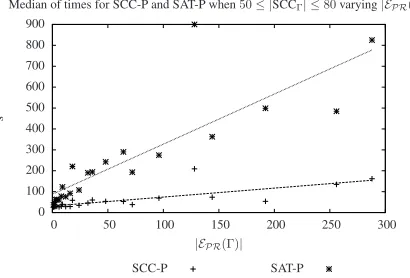
Median of times for SCC-P and SAT-P when50≤ |SCCΓ| ≤80varying|EPR(Γ)|
[image:10.612.65.270.61.200.2]SCC-P SAT-P
Figure 3: Significant median values for SCC-P and SAT-P when50 ≤ |SCCΓ| ≤ 80varying|EPR(Γ)|, and their re-gression to the functionf(x) =a x+b: SCC-P,a= 0.43,
b= 31.33; SAT-P,a= 2.40,b= 87.53.
on the number of computed preferred labellings. Given the linear regression of these data, it turns out that the execution times of SAT-P grows≈2· |EPR(Γ)|, while SCC-P grows ≈ 1
2· |EPR(Γ)|, thus supporting hypothesisI3.
Moreover, the third experiment provides additional statis-tically significant (p <0.05) evidence in support of hypoth-esis I2, as Figure 3 summarises. Roughly speaking,
com-puting the increment of performance as the average of the difference of execution times normalised on the maximum time between SCC-P and SAT-P, we can conclude that there is a significant increment of performances up to 56%.
Conclusions
In this paper we devised and evaluated a general parametric algorithm in order to decompose the preferred extensions enumeration problem into restricted subframeworks. To this purpose, several research challenges have been tackled.
First, an efficient algorithmic implementation of the SCC-recursive schema, originally introduced in a declarative form, has been developed, also leading to a labelling-based formulation. Let us notice that, recently, an approach has been proposed in (Liao, Lei, and Dai 2013) which partially exploits the SCC-recursive schema. In particular, while it borrows from (Baroni, Giacomin, and Guida 2005) the idea of decomposing the argumentation framework into its SCCs, it does not exploit the recursion step to achieve a deeper de-composition of theAF. Other “splitting” techniques have
been proposed in literature. In particular, in the context of argumentation dynamics (Baumann et al. 2012) introduces a decomposition of an argumentation framework into two parts, while (Dvoˇr´ak, Pichler, and Woltran 2012) exploits a tree-based decomposition. A general study of decompos-ability properties w.r.t. arbitrary partitions of an argumen-tation framework is also presented in (Baroni et al. 2012). Comparing different approaches for dividing anAF in
sub-frameworks represents an interesting future work.
A second contribution of the present paper is the general-ization of the approach in (Cerutti et al. 2014) to the
com-putation of labellings in a restricted sub-framework, which is mandatory for applying the SCC-recursive schema. As acknowledged in (Cerutti et al. 2014), the relationship be-tween argumentation semantics and the satisability problem has been already considered in the literature, e.g. in (Besnard and Doutre 2004; Dvoˇr´ak et al. 2012; Arieli and Caminada 2013), where different encodings for labellings of an AF
according to several semantics have been introduced. Gen-eralizing these proposals in order to integrate them into the SCC-recursive schema is another challenge for future work. Finally, an empirical investigation has been carried out to show a statistical evidence in favour of the reduction of com-putational effort by the exploitation of the SCC-recursive schema. In particular, as shown in the previous section, de-spite the fact that the current prototypical implementation needs further refinements (cf. the results of experiments on
Γs.t.|SCCΓ| = 1), forΓwith|SCCΓ| > χ = 35there is
a statistical evidence showing how implementing the SCC-recursive schema reduces the computational effort of enu-merating the preferred labellings. Moreover, as depicted in Fig. 3, the execution time of the SCC-recursive implementa-tion is less sensible to the number of labellings, i.e. its execu-tion time grows less than the non SCC-recursive implemen-tation when the number of computed preferred labellings in-creases. This suggests to explore an hybrid approach where, at each recursion step, a choice is made on whether com-puting the preferred labellings with a direct call to B-PR or applying the SCC-recursive schema. Such choice can be based on an heuristic to estimate the number of SCCs and la-bellings, and can be easily implemented with an additional step after line5of Alg. 2.
Several other future works are envisaged. First, we want to strengthen the statistical evidence in favour of the SCC-recursive schema by exploiting and comparing different en-codings of complete labellings derived from EN Call,
cluding the redundant ones. Moreover, Alg. 2 can be in-stantiated with a different B-PR algorithm, e.g. generalizing the algorithms presented in (Egly, Alice Gaggl, and Woltran 2010; Nofal, Atkinson, and Dunne 2014; Dvoˇr´ak et al. 2014) for computing labellings in sub-frameworks.
Finally, we intend to apply the devised meta-algorithm to stable and CF2 semantics, which directly fit the SCC-recursive schema (Baroni, Giacomin, and Guida 2005), as well as to semi-stable and ideal semantics by exploiting the relationship with preferred semantics.
Acknowledgements
The authors would like to acknowledge the use of the Uni-versity of Huddersfield Queensgate Grid in carrying out this work. The authors also thank the anonymous reviewers for their helpful comments.
References
Arieli, O., and Caminada, M. W. 2013. A QBF-based for-malization of abstract argumentation semantics. Journal of Applied Logic11(2):229–252.
of the 21st International Joint Conference on Artifical Intel-ligence (IJCAI 2009), 399–404.
Audemard, G., and Simon, L. 2012. GLUCOSE 2.1.http:
//www.labri.fr/perso/lsimon/glucose/.
Baroni, P., and Giacomin, M. 2004. A General Recursive Schema for Argumentation Semantics. InProceedings of the 14th European Conference on Artificial Intelligence (ECAI 2004), 783–787.
Baroni, P.; Boella, G.; Cerutti, F.; Giacomin, M.; van der Torre, L.; and Villata, S. 2012. On Input/Output Argu-mentation Frameworks. InProceedings of the 4th Interna-tional Conference on ComputaInterna-tional Models of Arguments (COMMA 2012), 358–365.
Baroni, P.; Cerutti, F.; Dunne, P. E.; and Giacomin, M. 2013. Automata for Infinite Argumentation Structures. Artificial Intelligence203(0):104–150.
Baroni, P.; Caminada, M.; and Giacomin, M. 2011. An introduction to argumentation semantics. Knowledge Engi-neering Review26(4):365–410.
Baroni, P.; Giacomin, M.; and Guida, G. 2005. SCC-recursiveness: a general schema for argumentation seman-tics. Artificial Intelligence168(1-2):165–210.
Baumann, R.; Brewka, G.; Dvoˇr´ak, W.; and Woltran, S. 2012. Parameterized Splitting: A Simple Modification-Based Approach. In Erdem, E.; Lee, J.; Lierler, Y.; and Pearce, D., eds.,Correct Reasoning, volume 7265 of Lec-ture Notes in Computer Science. Springer Berlin Heidelberg. 57–71.
Besnard, P., and Doutre, S. 2004. Checking the acceptabil-ity of a set of arguments. InProceedings of the 10th In-ternational Workshop on Non-Monotonic Reasoning (NMR 2004), 59–64.
Caminada, M. 2006. On the Issue of Reinstatement in Argu-mentation. InProceedings of the 10th European Conference on Logics in Artificial Intelligence (JELIA 2006), 111–123. Cerutti, F.; Dunne, P. E.; Giacomin, M.; and Vallati, M. 2013. A SAT-based Approach for Computing Extensions in Abstract Argumentation. InSecond International Work-shop on Theory and Applications of Formal Argumentation (TAFA-13).
Cerutti, F.; Dunne, P. E.; Giacomin, M.; and Vallati, M. 2014. Computing Preferred Extensions in Abstract Argu-mentation: A SAT-Based Approach. In Black, E.; Modgil, S.; and Oren, N., eds.,TAFA 2013, volume 8306 ofLecture Notes in Computer Science. Springer-Verlag Berlin Heidel-berg. 176–193.
Cormen, T. H.; Leiserson, C. E.; Rivest, R. L.; and Stein, C. 2009.Introduction to Algorithms. MIT Press.
Dung, P. M.; Mancarella, P.; and Toni, F. 2006. A dialectic procedure for sceptical, assumption-based argumentation. In Prooceedings of the 1st International Conference on Com-putational Models of Arguments (COMMA 2006), 145–156. Dung, P. M. 1995. On the Acceptability of Arguments and Its Fundamental Role in Nonmonotonic Reasoning, Logic Programming, and n-Person Games. Artificial Intelligence 77(2):321–357.
Dunne, P. E., and Wooldridge, M. 2009. Complexity of abstract argumentation. In Rahwan, I., and Simari, G., eds., Argumentation in AI. Springer-Verlag. chapter 5, 85–104. Dvoˇr´ak, W.; Gaggl, S. A.; Wallner, J.; and Woltran, S. 2011. Making Use of Advances in Answer-Set Program-ming for Abstract Argumentation Systems. In Proceed-ings of the 19th International Conference on Applications of Declarative Programming and Knowledge Management (INAP 2011).
Dvoˇr´ak, W.; J¨arvisalo, M.; Wallner, J. P.; and Woltran, S. 2012. Complexity-Sensitive Decision Procedures for Ab-stract Argumentation. InProceedings of 13th International Conference on Principles of Knowledge Representation and Reasoning (KR 2012), 54–64.
Dvoˇr´ak, W.; J¨arvisalo, M.; Wallner, J. P.; and Woltran, S. 2014. Complexity-sensitive decision procedures for abstract argumentation.Artificial Intelligence206:53–78.
Dvoˇr´ak, W.; Pichler, R.; and Woltran, S. 2012. Towards fixed-parameter tractable algorithms for abstract argumen-tation.Artificial Intelligence186:1–37.
Egly, U.; Alice Gaggl, S.; and Woltran, S. 2010. Answer-set programming encodings for argumentation frameworks. Argument & Computation1(2):147–177.
Jim´enez, S.; de la Rosa, T.; Fern´andez, S.; Fern´andez, F.; and Borrajo, D. 2012. A review of machine learning for auto-mated planning.Knowledge Engineering Review27(4):433– 467.
Liao, B.; Lei, L.; and Dai, J. 2013. Computing Preferred La-bellings by Exploiting SCCs and Most Sceptically Rejected Arguments. InSecond International Workshop on Theory and Applications of Formal Argumentation (TAFA-13). Nofal, S.; Atkinson, K.; and Dunne, P. E. 2014. Algorithms for decision problems in argument systems under preferred semantics.Artificial Intelligence207:23–51.