C A S E R E P O R T
Open Access
Application of the ICD-11 classification of
personality disorders
Bo Bach
1*and Michael B First
2Abstract
Background:The ICD-11 classification of Personality Disorders focuses on core personality dysfunction, while allowing the practitioner to classify three levels of severity (Mild Personality Disorder, Moderate Personality Disorder, and Severe Personality Disorder) and the option of specifying one or more prominent trait domain qualifiers (Negative Affectivity, Detachment, Disinhibition, Dissociality, and Anankastia). Additionally, the practitioner is also allowed to specify a Borderline Pattern qualifier. This article presents how the ICD-11 Personality Disorder classification may be applied in clinical practice using five brief cases.
Case presentation:(1) a 29-year-old woman with Severe Personality Disorder, Borderline Pattern, and prominent traits of Negative Affectivity, Disinhibition, and Dissociality; (2) a 36-year-old man with Mild Personality Disorder, and
prominent traits of Negative Affectivity and Detachment; (3) a 26-year-old man with Severe Personality Disorder, and prominent traits of Dissociality, Disinhibition, and Detachment; (4) a 19-year-old woman with Personality Difficulty, and prominent traits of Negative Affectivity and Anankastia; (5) a 53-year-old man with Moderate Personality Disorder, and prominent traits of Anankastia and Dissociality.
Conclusions:The ICD-11 Personality Disorder classification was applicable to five clinical cases, which were classified according to Personaity Disorder severity and trait domain qualifiers. We propose that the classification of severity may help inform clinical prognosis and intensity of treatment, whereas the coding of trait qualifiers may help inform the focus and style of treatment. Empirical investigation of such important aspects of clinical utility are warranted.
Keywords:ICD-11, Classification, Personality disorder, Severity, Trait
Background
Personality Disorder is important to all health care practi-tioners because it is a prevalent condition that applies to approximately 12% of the general community [1], 25% of primary care patients [2], and at least 50% of psychiatric outpatients [3]. This potentially complicates the relation-ship between patients and health care professionals, increases the risk of premature mortality, and results in a huge cost to society [4]. However, research highlights sig-nificant problems with the ICD-10 and DSM-IV/DSM-5 categorical approaches to Personality Disorder diagnos-tics, including arbitrary diagnostic thresholds, extensive overlap among categories, lack of evidence for 10 distinct categories, and insufficient clinical utility [4–6]. In
comparison to the assessment of other mental disorders, assessment of Personality Disorders is more difficult in routine clinical practice. Reviewing the 79 DSM criteria for 10 disorders (plus 15 criteria of conduct disorder) is cumbersome and requires specialized training. In response to these shortcomings, the 11th edition of the Inter-national Classification of Diseases (ICD-11) adopts a di-mensional approach to the classification of Personality Disorders that focuses on global level of severety and five trait qualifiers [7]. The present article aims to introduce and illustrate how the ICD-11 Personality Disorder classi-fication may be applied in clinical practice using five brief cases with different diagnostic features.
Rationale of the ICD-11 classification of personality disorders
The ICD-11 nomenclature for Personality Disorders [8]
focuses on the impairment of self and interpersonal person-ality functioning, which may be classified according to * Correspondence:[email protected];[email protected]
1Center of Excellence on Personality Disorder, Psychiatric Research Unit,
Region Zealand, Slagelse Psychiatric Hospital, Fælledvej 6, Bygning 3, 4200 Slagelse, Denmark
Full list of author information is available at the end of the article
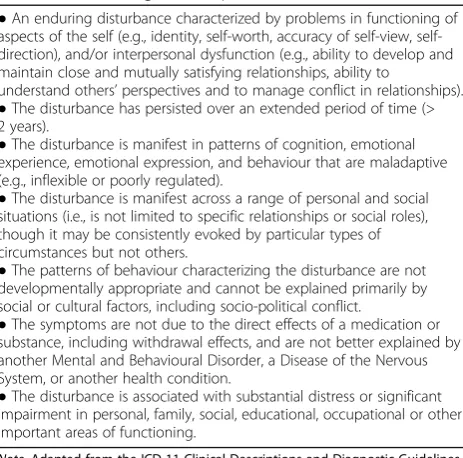
degree of severity (“Personality Difficulty”,“Mild Personality Disorder”, “Moderate Personality Disorder”, and “Severe Personality Disorder”). Furthermore, the diagnosis may also be specified with one or more prominent trait qualifiers (Negative Affectivity, Detachment, Dissociality, Disinhib-ition, and Anankastia), which contribute to the impairment in personality functioning. Unlike the polythetic ICD-10 criteria for Personality Disorders (e.g., five out of nine cri-teria) which set the disorder/non-disorder threshold based on the number of criteria that are met, the ICD-11 diagnos-tic requirements for Personality Disorders base the diagno-sis on a global evaluation of personality functioning. Given that personality functioning might be impaired in various ways, the trait qualifiers are available to describe the specific pattern of traits that contribute to the global personality dysfunction. The general diagnostic requirements for Per-sonality Disorder are presented in Table 1, the guidelines for determination of the level of severity are presented in Tables 2, 3 and4 and the five trait domain qualifiers are elucidated in Table5. In addition to specifying Personality Disorder severity and stylistic trait qualifiers, the user is also allowed to code substhreshold Personality Difficulty and a Borderline Pattern qualifier (see Table6).
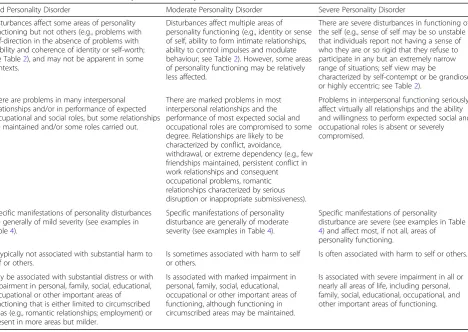
As shown in Table 2 and 3, the classification of
se-verity aligns with the psychodynamic tradition of per-sonality organization [9, 10] as well as scientifically valid models of core Personality Disorder features [11–15]. Importantly, research shows that much of the predictive and prognostic value in Personality Dis-order assessment can be derived from such a core di-mension [13,16]. A classification according to severity
also provides information for guiding intensity of clin-ical management and treatment [10,17,18].
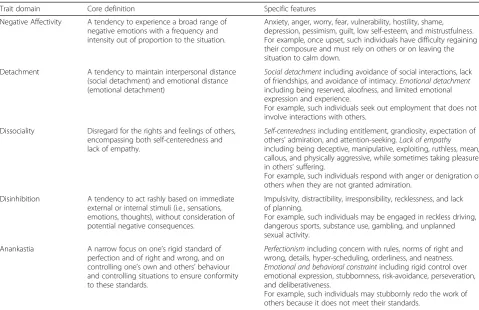
Finally, as shown in Table5, the deliniation of five trait domain qualifiers aligns with other empirically-derived dimensional schemes, including the cross-culturally repli-cated Five-Factor Model [19–21] and the DSM-5 Alterna-tive Model of Personality Disorders [22–24]. The ICD-11 trait domain qualifiers not only provide scientifically sound and homogenous building blocks of personality psychopathology but also clinical information for selecting type and focus of treatment [25–28].
Application of the ICD-11 model in clinical practice
[image:2.595.303.538.103.490.2]At a basic level, the ICD-11 classification allows the clinician the option of rapid assessment of personality functioning. As such, a practitioner should be able first Table 1General diagnostic requirements
●An enduring disturbance characterized by problems in functioning of aspects of the self (e.g., identity, worth, accuracy of view, self-direction), and/or interpersonal dysfunction (e.g., ability to develop and maintain close and mutually satisfying relationships, ability to
understand others’perspectives and to manage conflict in relationships).
●The disturbance has persisted over an extended period of time (> 2 years).
●The disturbance is manifest in patterns of cognition, emotional experience, emotional expression, and behaviour that are maladaptive (e.g., inflexible or poorly regulated).
●The disturbance is manifest across a range of personal and social situations (i.e., is not limited to specific relationships or social roles), though it may be consistently evoked by particular types of circumstances but not others.
●The patterns of behaviour characterizing the disturbance are not developmentally appropriate and cannot be explained primarily by social or cultural factors, including socio-political conflict.
●The symptoms are not due to the direct effects of a medication or substance, including withdrawal effects, and are not better explained by another Mental and Behavioural Disorder, a Disease of the Nervous System, or another health condition.
●The disturbance is associated with substantial distress or significant impairment in personal, family, social, educational, occupational or other important areas of functioning.
Note. Adapted from the ICD-11 Clinical Descriptions and Diagnostic Guidelines for Personality Disorder.
Table 2Aspects of personality functioning that contribute to severity determination in Personality Disorder
Degree and pervasiveness of disturbances in functioning of aspects of the self:
●Stability and coherence of one’s sense of identity (e.g., extent to which identity or sense of self is variable and inconsistent or overly rigid and fixed).
●Ability to maintain an overall positive and stable sense of self-worth.
●Accuracy of one’s view of one’s characteristics, strengths, limitations.
●Capacity for self-direction (ability to plan, choose, and implement ap-propriate goals).
Degree and pervasiveness of interpersonal dysfunction across various contexts and relationships (e.g., romantic relationships, school/work, parent-child, family, friendships, peer contexts):
●Interest in engaging in relationships with others.
●Ability to understand and appreciate others’perspectives.
●Ability to develop and maintain close and mutually satisfying relationships.
●Ability to manage conflict in relationships.
Pervasiveness, severity, and chronicity of emotional, cognitive, and behavioral manifestations of the personality dysfunction: Emotional manifestations
○Range and appropriateness of emotional experience and expression.
○Tendency to be emotionally over- or underreactive.
○Ability to recognize and acknowledge unwanted emotions (e.g., anger, sadness).
Cognitive manifestations
○Accuracy of situational and interpersonal appraisals, especially under stress.
○Ability to make appropriate decisions in situations of uncertainty.
○Appropriate stability and flexibility of belief systems. Behavioural manifestations
○Flexibility in controlling impulses and modulating behaviour based on the situation and consideration of the consequences.
○Appropriateness of behavioural responses to intense emotions and stressful circumstances (e.g., propensity to self-harm or violence).
The extent to which the dysfunctions in the above areas are associated with distress or impairment in personal, family, social, educational, occupational or other important areas of functioning.
[image:2.595.58.290.491.720.2]to identify the presence or absence of Personality Dis-order, then its severity, and, if appropriate, one or more prominent trait qualifiers that contribute to the expression of personality dysfunction. Accordingly, the procedure for classification of ICD-11 Personality Disorder is fairly simi-lar to the procedure of diagnosing ICD-10 F32 Depressive episode which has three levels of severity (mild,moderate, and severe), and which may, if appropriate, be further qualified by additional codes for individual features. For example, F32.11 Moderate depressive episode with som-atic syndrome or F32.3 Severe depressive episode with psychotic symptoms.
Classification of personality disorder severity replaces comorbidity
Because the ten different types of categorical Personality Disorder diagnoses no longer exist in the ICD-11 classifica-tion, the practitioner has no choice but to assess Personality Disorder itself rather than focussing the assessment on overlapping and heterogenous polythetic categories (see Tables1and2) [4]. Accordingly, instead of the classification into ten types, the ICD-11 can be said to involve a subclas-sification into three categories of severity, which cannot
co-exist with one another (i.e., a patient cannot have a Mild Personality Disorder while also having a Severe Personality Disorder). Thus, the ICD-11 classification eradicates the ex-cessive comorbidity characterizing the different ICD-10 Personality Disorder categories. However, the clinician still has the option of indicating the presence of a Personality Disorder without specifying its severity (i.e., “severity un-specified”). The specified severity threshold for yielding a Personality Disorder diagnosis (at least “mild” severity) is explained in Table3 and exemplied in Table 4. Thus, the definition of “mild” severity may also be employed as a screener for presence or absence of Personality Disorder.
[image:3.595.66.535.96.428.2]The option of coding subthreshold personality difficulty In addition to the Personality Disorder diagnosis (in the chapter on Mental and behavioral disorders), clinicians have the option of indicating the presence of Personality Diffi-culty. Personality Difficulty is not considered to be a mental disorder per se, but is availble for clinical use and is located in the section of the ICD-11 classification for non-disease entities that constitute factors influencing health status and encounters with health services. Personality Difficulty is somewhat akin to the ICD-10 non-disorder category Z73.1 Table 3Essential features of Personality Disorder severity
Mild Personality Disorder Moderate Personality Disorder Severe Personality Disorder
Disturbances affect some areas of personality functioning but not others (e.g., problems with self-direction in the absence of problems with stability and coherence of identity or self-worth; see Table2), and may not be apparent in some contexts.
Disturbances affect multiple areas of personality functioning (e.g., identity or sense of self, ability to form intimate relationships, ability to control impulses and modulate behaviour; see Table2). However, some areas of personality functioning may be relatively less affected.
There are severe disturbances in functioning of the self (e.g., sense of self may be so unstable that individuals report not having a sense of who they are or so rigid that they refuse to participate in any but an extremely narrow range of situations; self view may be
characterized by self-contempt or be grandiose or highly eccentric; see Table2).
There are problems in many interpersonal relationships and/or in performance of expected occupational and social roles, but some relationships are maintained and/or some roles carried out.
There are marked problems in most interpersonal relationships and the performance of most expected social and occupational roles are compromised to some degree. Relationships are likely to be characterized by conflict, avoidance, withdrawal, or extreme dependency (e.g., few friendships maintained, persistent conflict in work relationships and consequent occupational problems, romantic relationships characterized by serious disruption or inappropriate submissiveness).
Problems in interpersonal functioning seriously affect virtually all relationships and the ability and willingness to perform expected social and occupational roles is absent or severely compromised.
Specific manifestations of personality disturbances are generally of mild severity (see examples in Table4).
Specific manifestations of personality disturbance are generally of moderate severity (see examples in Table4).
Specific manifestations of personality disturbance are severe (see examples in Table 4) and affect most, if not all, areas of personality functioning.
Is typically not associated with substantial harm to self or others.
Is sometimes associated with harm to self or others.
Is often associated with harm to self or others.
May be associated with substantial distress or with impairment in personal, family, social, educational, occupational or other important areas of functioning that is either limited to circumscribed areas (e.g., romantic relationships; employment) or present in more areas but milder.
Is associated with marked impairment in personal, family, social, educational, occupational or other important areas of functioning, although functioning in circumscribed areas may be maintained.
Is associated with severe impairment in all or nearly all areas of life, including personal, family, social, educational, occupational, and other important areas of functioning.
“accentuation of personality traits”which is a subcategory of the Z73 “Problems Related to Life-Management Difficulty” in the chapter“Factors Influencing Health Status and Con-tact with Health Services”.
Like a Personality Disorder diagnosis, Personality Dif-ficulty is characterized by relatively stable difficulties (e.g., at least 2 years). Such difficulties are associated with some problems in functioning which are insuffi-ciently severe to cause notable disruption in social, occu-pational, and interpersonal relationships and that may be limited to specific relationships or situations. Prob-lems with emotions, cognitions, and behaviors are only expressed intermittently (e.g., during times of stress) or at low intensity. In contrast to Mild Personality Disorder, the individual with Personality Difficulty only has some intermittent or low intensity personality-related prob-lems (e.g., in circumscribed risk situations), but not to the extent that it compromises the individual’s ability to
keep a job, initiate and maintain friendships, and have somewhat satisfactory intimate relationships.
For example, a patient with eating disorder may have personality difficulities of rigid perfectionism (i.e., Ana-nkastia) while maintaining a strong social network and making slow but steady progress towards finishing an education. Another patient with resistant anxiety symp-toms may have difficulties of anxiousness (i.e., Negative Affectivity) but otherwise be viewed as a treasured friend and collegue. In both cases, the specified patterns of Per-sonality Difficulty reveal specific vulnerabilities. Taken together, when most appropriate a code of Personality Difficulty may be applied to the patient with noteworthy but not prominent personality problems.
Personality trait qualifiers
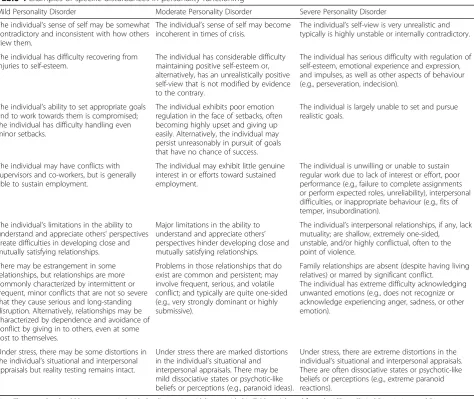
[image:4.595.60.535.94.493.2]One or more stylistic trait qualifiers may be coded if they are prominent in the personality makeup of the Table 4Examples of specific disturbances in personality functioning
Mild Personality Disorder Moderate Personality Disorder Severe Personality Disorder
The individual’s sense of self may be somewhat contradictory and inconsistent with how others view them.
The individual’s sense of self may become incoherent in times of crisis.
The individual’s self-view is very unrealistic and typically is highly unstable or internally contradictory.
The individual has difficulty recovering from injuries to self-esteem.
The individual has considerable difficulty maintaining positive self-esteem or, alternatively, has an unrealistically positive self-view that is not modified by evidence to the contrary.
The individual has serious difficulty with regulation of self-esteem, emotional experience and expression, and impulses, as well as other aspects of behaviour (e.g., perseveration, indecision).
The individual’s ability to set appropriate goals and to work towards them is compromised; the individual has difficulty handling even minor setbacks.
The individual exhibits poor emotion regulation in the face of setbacks, often becoming highly upset and giving up easily. Alternatively, the individual may persist unreasonably in pursuit of goals that have no chance of success.
The individual is largely unable to set and pursue realistic goals.
The individual may have conflicts with supervisors and co-workers, but is generally able to sustain employment.
The individual may exhibit little genuine interest in or efforts toward sustained employment.
The individual is unwilling or unable to sustain regular work due to lack of interest or effort, poor performance (e.g., failure to complete assignments or perform expected roles, unreliability), interpersonal difficulties, or inappropriate behaviour (e.g., fits of temper, insubordination).
The individual’s limitations in the ability to understand and appreciate others’perspectives create difficulties in developing close and mutually satisfying relationships.
Major limitations in the ability to understand and appreciate others’ perspectives hinder developing close and mutually satisfying relationships.
The individual’s interpersonal relationships, if any, lack mutuality; are shallow, extremely one-sided, unstable, and/or highly conflictual, often to the point of violence.
There may be estrangement in some relationships, but relationships are more commonly characterized by intermittent or frequent, minor conflicts that are not so severe that they cause serious and long-standing disruption. Alternatively, relationships may be characterized by dependence and avoidance of conflict by giving in to others, even at some cost to themselves.
Problems in those relationships that do exist are common and persistent; may involve frequent, serious, and volatile conflict; and typically are quite one-sided (e.g., very strongly dominant or highly submissive).
Family relationships are absent (despite having living relatives) or marred by significant conflict.
The individual has extreme difficulty acknowledging unwanted emotions (e.g., does not recognize or acknowledge experiencing anger, sadness, or other emotion).
Under stress, there may be some distortions in the individual’s situational and interpersonal appraisals but reality testing remains intact.
Under stress there are marked distortions in the individual’s situational and interpersonal appraisals. There may be mild dissociative states or psychotic-like beliefs or perceptions (e.g., paranoid ideas).
Under stress, there are extreme distortions in the individual’s situational and interpersonal appraisals. There are often dissociative states or psychotic-like beliefs or perceptions (e.g., extreme paranoid reactions).
individual diagnosed with Personality Disorder or Per-sonality Difficulty. Yet, it is important to recognize that the trait qualifiers are not like categories or syndromal diagnoses, but instead denote stylistic dimensions that con-tribute to the expression of the personality dysfunction. However, for the purpose of coding, the prominent trait qualifiers can only be indicated as present or absent even though they exist on a continuum. Essentially, the overall severity of personality dysfunction (i.e.,mild,moderate, and severe) reflects the degree to which the prominent traits have an impact on the patient’s self- and interpersonal func-tioning [29], which is illustrated in a figure for each of the five cases. Thus, Severe Personality Disorder is likely to be associated with several trait domain qualifiers, whereas Mild Personality Disorder may be associated with the pres-ence of only one trait qualifier. In other words, complexity of trait domain qualifiers may often reflect the severity of the Personality Disorder. However, in some cases an indi-vidual may have a Severe Personality Disorder and manifest only one prominent trait qualifier (e.g., Dissociality causing severe danger towards others).
Borderline pattern qualifier
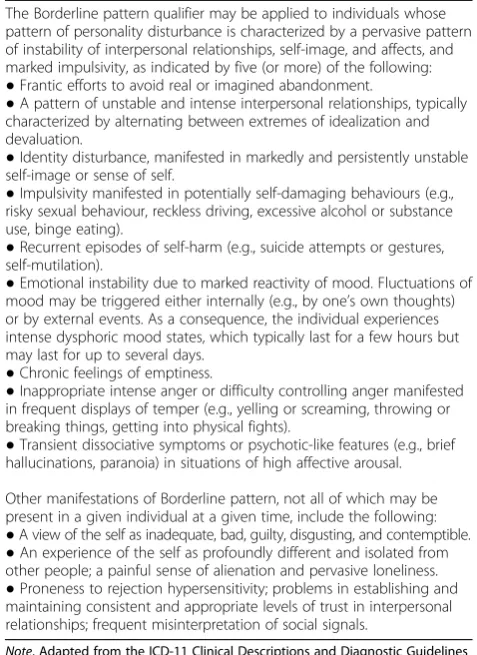
As presented in Table6, the ICD-11 classification of Per-sonality Disorders also includes the option of specifying
a Borderline Pattern Qualifier. Like the trait qualifiers, the Borderline Pattern qualifier is considered optional and can be used in combination with the trait qualifiers (e.g.,Moderate Personality Disorder, with Borderline Pat-tern, with Negative Affectiviy, Disinhibition, and Dissoci-ality). Unlike the trait qualifiers, the Borderline Pattern Qualifier is operationalized as requiring at least 5 out of 9 polythetic features adapted from the DSM-5 criteria for Borderline Personality Disorder. It has been sug-gested that this qualifier may serve as a familiar indica-tor for choosing psychotherapeutic treatment consistent with established theory and treatment manuals.
Onset and stability of personality disorder
[image:5.595.57.537.97.407.2]As presented in Table1, the personality disturbance must have persisted over an extended period of time (> 2 years). Elements of Personality Disorder tend to first appear in childhood or adolescence and continue to be manifest into adulthood. However, while ICD-10 states that Personality Disorders tend to be stable over time, the ICD-11 guideline explicitly states that Personality Disorders are only “ rela-tively”stable after young adulthood, and may change such that a person who had a Personality Disorder during young adulthood no longer has one by middle age. In some cases, a person who earlier did not have a diagnosable Personality Table 5Trait domain qualifiers that contribute to the expression of personality dysfunction
Trait domain Core definition Specific features
Negative Affectivity A tendency to experience a broad range of negative emotions with a frequency and intensity out of proportion to the situation.
Anxiety, anger, worry, fear, vulnerability, hostility, shame, depression, pessimism, guilt, low self-esteem, and mistrustfulness. For example, once upset, such individuals have difficulty regaining their composure and must rely on others or on leaving the situation to calm down.
Detachment A tendency to maintain interpersonal distance
(social detachment) and emotional distance (emotional detachment)
Social detachmentincluding avoidance of social interactions, lack of friendships, and avoidance of intimacy.Emotional detachment
including being reserved, aloofness, and limited emotional expression and experience.
For example, such individuals seek out employment that does not involve interactions with others.
Dissociality Disregard for the rights and feelings of others, encompassing both self-centeredness and lack of empathy.
Self-centerednessincluding entitlement, grandiosity, expectation of others’admiration, and attention-seeking.Lack of empathy
including being deceptive, manipulative, exploiting, ruthless, mean, callous, and physically aggressive, while sometimes taking pleasure in others’suffering.
For example, such individuals respond with anger or denigration of others when they are not granted admiration.
Disinhibition A tendency to act rashly based on immediate external or internal stimuli (i.e., sensations, emotions, thoughts), without consideration of potential negative consequences.
Impulsivity, distractibility, irresponsibility, recklessness, and lack of planning.
For example, such individuals may be engaged in reckless driving, dangerous sports, substance use, gambling, and unplanned sexual activity.
Anankastia A narrow focus on one’s rigid standard of perfection and of right and wrong, and on controlling one’s own and others’behaviour and controlling situations to ensure conformity to these standards.
Perfectionismincluding concern with rules, norms of right and wrong, details, hyper-scheduling, orderliness, and neatness.
Emotional and behavioral constraintincluding rigid control over emotional expression, stubbornness, risk-avoidance, perseveration, and deliberativeness.
For example, such individuals may stubbornly redo the work of others because it does not meet their standards.
Disorder, may develop one later in life. Sometimes, emer-gence of Personality Disorder in older adults may be related to the loss of social supports that had previously helped to compensate for personality disturbance.
Features of psychoticism and level of severity
In contrast to the DSM-5 Section II and Section III ap-proaches, the ICD-11 classification does not provide any code for Schizotypal Personality Disorder or Psychoticism because such features are coded within Schizophrenia and other primary psychotic disorders. However, as shown in Tables 3 and 4, the ICD-11 classification of Personality Disorder severity may be based on whether the patient expe-riences“dissociative states or psychotic-like beliefs or percep-tions” and/or is “highly eccentric”, which may resemble certain features of Schizotypal Personality Disorder. This is consistent with the traditional structural approach to classifi-cation of personality organization (e.g., high, middle, and low borderline levels) [9, 10], in which the lowest and most severe level may involve transient psychotic states. In other words, the ICD-11 approach classifies the capacity for reality testing (i.e., accuracy of situational and interpersonal ap-praisals) according to level of Personality Disorder severity and not as a distinct type or trait domain. However, as shown
in Table 6, the Borderline Pattern qualifier also involves
“Transient dissociative symptoms or psychotic-like features (e.g., brief hallucinations, paranoia) in situations of high affective arousal,” which is consistent with the established DSM-IV/5 construct of Borderline Personality Disorder.
How to operationalize the ICD-11 personality disorder diagnosis?
After having ensured that the general diagnostic require-ments for Personality Disorder are met (Table1), the user may select one of three different diagnostic codes according to Personality Disorder severity (Table 3), followed by the option of coding one or more prominent trait qualifiers (Table5). Additionally, the Borderline Pattern qualifier may also be applied if the clinical description matches this pat-tern (Table6). As in the ICD-10, the relevant information may be gathered from clinical interviews and observations, review of clinical records, and/or informant reports.
[image:6.595.54.293.99.427.2]Assessment tools are curently being developed to assist clinicians and researchers in the assessment of Personality Disorder diagnosis according to ICD-11. In the meantime, diagnostic information obtained from assessment tools de-veloped for the DSM-5 AMPD model can be used for making an ICD-11 dimensional Personality Disorder diag-nosis. For example, the Structured Clinical Interview for the DSM-5 Alternative Model of Personality Disorders (SCID-AMPD) operationalizes personality functioning ac-cording to the DSM-5 Level of Personality Functioning Scale (LPFS) along with the 25 DSM-5 trait facets [30]. The LPFS score along with the 25-facet personality profile can be converted into an ICD-11 Personality Disorder diagnosis using a “cross walk” as described in Table 7.
Table 7ICD-11“Cross Walk”for DSM-5 Alternative Model of Personality Disorders
ICD-11 Severity of Personality Dysfunction
DSM-5 Criterion A: Level of Personality Functioning
None 0) No impairment (Healthy Functioning)
Personality Difficulty 1) Some impairment
Mild Personality Disorder 2) Moderate impairment
Moderate Personality Disorder 3) Severe impairment
Severe Personality Disorder 4) Extreme impairment
ICD-11 Trait Domain Qualifiers DSM-5 Criterion B: Trait Domains
Negative Affectivity Negative Affectivity
Detachment Detachment
Disinhibition Disinhibition
Dissociality Antagonism
Anankastia [Rigid Perfectionism and Perseveration]a
Note. The threshold for a Personality Disorder diagnosis is a t least Mild Personality Disorder (ICD-11) or Moderate impairment of personality functioning (DSM-5)
a
These are facets from the domains of (low) Disinhibition and (high) Negative Affectivity, respectively
Table 6Borderline pattern qualifier
The Borderline pattern qualifier may be applied to individuals whose pattern of personality disturbance is characterized by a pervasive pattern of instability of interpersonal relationships, self-image, and affects, and marked impulsivity, as indicated by five (or more) of the following:
●Frantic efforts to avoid real or imagined abandonment.
●A pattern of unstable and intense interpersonal relationships, typically characterized by alternating between extremes of idealization and devaluation.
●Identity disturbance, manifested in markedly and persistently unstable self-image or sense of self.
●Impulsivity manifested in potentially self-damaging behaviours (e.g., risky sexual behaviour, reckless driving, excessive alcohol or substance use, binge eating).
●Recurrent episodes of self-harm (e.g., suicide attempts or gestures, self-mutilation).
●Emotional instability due to marked reactivity of mood. Fluctuations of mood may be triggered either internally (e.g., by one’s own thoughts) or by external events. As a consequence, the individual experiences intense dysphoric mood states, which typically last for a few hours but may last for up to several days.
●Chronic feelings of emptiness.
●Inappropriate intense anger or difficulty controlling anger manifested in frequent displays of temper (e.g., yelling or screaming, throwing or breaking things, getting into physical fights).
●Transient dissociative symptoms or psychotic-like features (e.g., brief hallucinations, paranoia) in situations of high affective arousal.
Other manifestations of Borderline pattern, not all of which may be present in a given individual at a given time, include the following:
●A view of the self as inadequate, bad, guilty, disgusting, and contemptible.
●An experience of the self as profoundly different and isolated from other people; a painful sense of alienation and pervasive loneliness.
●Proneness to rejection hypersensitivity; problems in establishing and maintaining consistent and appropriate levels of trust in interpersonal relationships; frequent misinterpretation of social signals.
[image:6.595.306.539.506.697.2]Accordingly, SCID-AMPD Module I evaluates three levels of Personality Disorder impairment (the two lower levels comprise subthreshold for diagnosis and healthy functioning, respectively) [31], which translate into the ICD-11 clas-sification of Mild Personality Disorder, Moderate Per-sonality Disorder, and Severe PerPer-sonality Disorder as
illustrated in Table7. Likewise, the SCID-AMPD
Mod-ule II evaluates DSM-5 trait facets and domains [30],
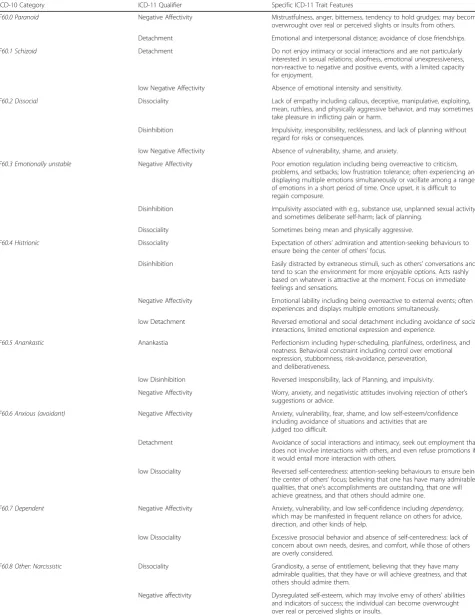
which may be translated into ICD-11 trait domain qual-ifiers directly (see Table7) or deliniated by means of an algorithm for trait facets measured with the Personality Inventory for DSM-5 (PID-5)1[32]. Finally, the ICD-11 trait domain qualifiers may also be derived from avail-able ICD-10 categorical Personality Disorder informa-tion using the“cross walk”presented in Table8[22].
For clinical screening and research purposes, self-report measures have been developed to deliniate severity of per-sonality dysfunction and prominent trait qualifiers. For ex-ample, the Level of Personality Functioning Scale–Brief Form 2.0 (LPFS-BF) [33, 34] efficiently measures impair-ment of self- and interpersonal functioning consistent with the ICD-11 diagnostic guidelines. The Personality In-ventory for ICD-11 (PiCD) is a 60-item self-report or informant-report instrument, which describes the five ICD-11 domains [19]. Finally, as previously asserted, the ICD-11 domains may also be deliniated using an empiric-ally established algorithm for using the ratings on the Per-sonality Inventory for DSM-5 (PID-5) to determine the ICD-11 trait domain qualifiers [32].
Case presentation
The following five cases demonstrate how the ICD-11 Personality Disorder classification may be applied to indi-viduals with varying severity of personality dysfunction and configuations of trait qualifiers. All five cases meet the general diagnostic requirements for Personality Disorder, except for Case 4 (Fig. 4) whose clinical presentation is only characterized by subthreshold Personality Difficulty.
Case 1 (Fig.1) is a 29-year-old women, who has a his-tory of numerous serious suicide attempts resulting in re-peated hospitalizations, multiple treatment providers, and medication trials typically with little to no benefit. She has been diagnosed with ICD-10 F60.3 Emotionally unstable Personality Disorder, but her clinical presentation is also complicated by substance abuse (i.e., cannabis and am-phetamine), eating disorder, panic attacks, aggressive/im-pulsive behaviors leading to a total loss of reliable friends, and severe self-harm that has endangered her life. During her childhood she was verbally and physically abused by her mother, and sexually abused by two of her mother’s male acquantances; she never knew her dad. Under stress she suffers from trauma-related dissociative states includ-ing symptoms of depersonalization and psychotic-like voices telling her to punish herself or vanish from the
present reality, though, she is mostly aware that the voices only exist in her mind. When experiencing minor defeats or perceived rejection, she responds with feelings of self-loathing or anger. Due to excessive mistrust of other people, her ability to form intimate relationships and cap-acity for empathy is severily compromised, and she has no idea what to do with her life or what she has to offer. Apart from experiencing mistrust, emptiness, and anger, she occasionally uses ingratiation and charm in her at-tempts to have her need for warmth and approval met. As displayed in the figure, Case 1’s (Fig.1) clinical presenta-tion is classified as Severe Personality Disorder (e.g., ser-ious difficulty with regulation of emotional experience, self-esteem, and impulses with a past history and future expectation of severe harm to self, psychotic-like percep-tions, and she lacks reliable friends) with prominent trait qualifiers ofNegative Affectivity(e.g., experiences negative emotions that are out of proportion to the situation in-cluding shame, mistrustfulness, and anger), Disinhibition (e.g., tendency to act impulsively in response to immediate
stimuli in a harmful manner), and Dissociality (e.g.,
mistrust-related aggression and tendency to manipulate or
seduce others). In this case Moderate Personality
Dis-order does not apply because Case 1 (Fig. 1) is not even able to maintain a few friendships or a regular job, and her self-injuries have caused long-term damage and en-dangered her life. Additionally, Case 1’s (Fig.1) diagnosis may be further elucidated using the Borderline Pattern qualifier as indicated by nearly all of the features presented in Table6.
Table 8Tentative ICD-10“Cross Walk”for ICD-11 Trait Domain Qualifiers
ICD-10 Category ICD-11 Qualifier Specific ICD-11 Trait Features
F60.0 Paranoid Negative Affectivity Mistrustfulness, anger, bitterness, tendency to hold grudges; may become overwrought over real or perceived slights or insults from others.
Detachment Emotional and interpersonal distance; avoidance of close friendships.
F60.1 Schizoid Detachment Do not enjoy intimacy or social interactions and are not particularly interested in sexual relations; aloofness, emotional unexpressiveness, non-reactive to negative and positive events, with a limited capacity for enjoyment.
low Negative Affectivity Absence of emotional intensity and sensitivity.
F60.2 Dissocial Dissociality Lack of empathy including callous, deceptive, manipulative, exploiting, mean, ruthless, and physically aggressive behavior, and may sometimes take pleasure in inflicting pain or harm.
Disinhibition Impulsivity, irresponsibility, recklessness, and lack of planning without regard for risks or consequences.
low Negative Affectivity Absence of vulnerability, shame, and anxiety.
F60.3 Emotionally unstable Negative Affectivity Poor emotion regulation including being overreactive to criticism, problems, and setbacks; low frustration tolerance; often experiencing and displaying multiple emotions simultaneously or vacillate among a range of emotions in a short period of time. Once upset, it is difficult to regain composure.
Disinhibition Impulsivity associated with e.g., substance use, unplanned sexual activity, and sometimes deliberate self-harm; lack of planning.
Dissociality Sometimes being mean and physically aggressive.
F60.4 Histrionic Dissociality Expectation of others’admiration and attention-seeking behaviours to ensure being the center of others’focus.
Disinhibition Easily distracted by extraneous stimuli, such as others’conversations and tend to scan the environment for more enjoyable options. Acts rashly based on whatever is attractive at the moment. Focus on immediate feelings and sensations.
Negative Affectivity Emotional lability including being overreactive to external events; often experiences and displays multiple emotions simultaneously.
low Detachment Reversed emotional and social detachment including avoidance of social interactions, limited emotional expression and experience.
F60.5 Anankastic Anankastia Perfectionism including hyper-scheduling, planfulness, orderliness, and neatness. Behavioral constraint including control over emotional expression, stubbornness, risk-avoidance, perseveration, and deliberativeness.
low Disinhibition Reversed irresponsibility, lack of Planning, and impulsivity.
Negative Affectivity Worry, anxiety, and negativistic attitudes involving rejection of other’s suggestions or advice.
F60.6 Anxious (avoidant) Negative Affectivity Anxiety, vulnerability, fear, shame, and low self-esteem/confidence including avoidance of situations and activities that are judged too difficult.
Detachment Avoidance of social interactions and intimacy, seek out employment that does not involve interactions with others, and even refuse promotions if it would entail more interaction with others.
low Dissociality Reversed self-centeredness: attention-seeking behaviours to ensure being the center of others’focus; believing that one has have many admirable qualities, that one’s accomplishments are outstanding, that one will achieve greatness, and that others should admire one.
F60.7 Dependent Negative Affectivity Anxiety, vulnerability, and low self-confidence includingdependency, which may be manifested in frequent reliance on others for advice, direction, and other kinds of help.
low Dissociality Excessive prosocial behavior and absence of self-centeredness: lack of concern about own needs, desires, and comfort, while those of others are overly considered.
F60.8 Other: Narcissistic Dissociality Grandiosity, a sense of entitlement, believing that they have many admirable qualities, that they have or will achieve greatness, and that others should admire them.
self-esteem, is highly submissive in relationships but at least some healthy relationships and occupational roles are maintained) with prominent features of Negative Affectivity (e.g., anxiety, shame, low self-esteem, vulnerability, and depression depressivity) and Detachment (e.g., avoidance of social
interac-tions). Notably, when Case 2 (Fig. 2) was younger, he
would probably have been classified as Moderate
Per-sonality Disorder because he virtually had no friends; but he has improved since then as he now maintains a stable job and at least a couple of relationships.
Case 3 (Fig.3) is a 26-year-old man incarcerated for bru-tal violence (e.g., purposely injured a shop owner with a blunt instrument just to get his money). Although he claimed to feel no suffering from any symptoms or dysfunc-tion, he sought rehabilitation for his dependency on cocaine which had caused him certain problems while imprisoned including withdrawal symptoms and symptoms of intoxica-tion (e.g., tremor and dry mouth). A psychiatric evaluaintoxica-tion concluded that his personality features met ICD-10 criteria for F60.2 Dissocial Personality Disorder including some characteristic psychopathic (e.g., callousness and exploita-tiveness) and narcissistic (e.g., entitlement) features as well as recklessness without concern for others’safety. Case 3 (Fig. 3) did not recall much from his childhood and ap-peared aloof and emotionally detached while mentioning that his father was extremely physically abusive towards him and his mother. He did not experience anything
positive from friendships, unless they could provide him with certain favors. Moreover, he was not ashamed of ad-mitting that he did not care about harming others, but was rather proud of it, and he generally never felt any emotional or physical pain nor remorse. Case 3’s (Fig.3) clinical pres-entation is classified as Severe Personality Disorder (e.g., past history and future expectation of severe harm to others, friendships have no genuine value to him, and self-view is characterized by entitlement) with prominent features of Dissociality (e.g., callousness, exploitation of others, and entitlement), Disinhibition (e.g., recklessness with no regard for others’safety), and some Detachment (e.g., aloofness). In this caseModerate Personality Disorder would not apply because Case 3 (Fig.3) is not even inter-ested in maintaining a single friendship and the risk of
dangerous harm to others is not just “sometimes” but
“often”taking place.
Case 4 (Fig.4) is a 19-year-old highschool student, who was referred for treatment of ICD-10 F41.2 mixed anxiety and depressive disorder along with symptoms of anorexia nervosa, which she had previously been treated for in a private adolescent psychiatric clinic. Case 4 (Fig.4) is from a relatively stable familiy, where the father works as phys-ician and the mother as dentist. She has always been good at school and at finishing her duties in the home. Even though her parents have been busy with their own careers, they have persistently encouraged her to play the piano at different occasions and excel at horse riding competitions
Fig. 1Severe Personality Disorder with Borderline Pattern and prominent traits of Negative Affectivity, Dissociality, and Disinhibition
[image:9.595.57.539.88.209.2] [image:9.595.59.540.594.713.2]because they knew and expected that she was good at that. For that reason, her father never responded posi-tively when she performed very well, whereas he showed disaoppointment if she did not get an A at her exams. While she was 13 her world fell apart as she dis-covered her father having an affair with another woman from his workplace, and she started overperforming in school and in sport while gradually developing eating disorder symptoms (restricting food leading to abnor-mally low weight) and even more unrelenting stan-dards. However, she managed to maintain satisfying relationships with her friends as well as her mother and siblings. Case 4’s (Fig.4) clinical presentation is
primar-ily classified as Anorexia Nervosa in the context of
Personality Difficulty (i.e., some long-standing difficul-ties in her way of thinking about the self and the world, including unrelenting standards, which are insuffi-ciently severe to cause notable disruption in school and
most relationships) with prominent features ofNegative
Affectivity (e.g., depressivity, shame, and anxiety) and Anankastia (e.g., perfectionism, concern with meeting obligations, perseveration, deliberatetiveness, and tight
control of own emotional expression). In this caseMild
Personality Disorder would not apply because Case 4’s (Fig. 4) habitual personality issues are not leading to any notable psychosocial impairment, whereas her problems are mainly attributable to other current mental problems.
Case 5 (Fig. 5) is a 53-year-old highly skilled and
well-groomed accountant who has worked for several companies during his carreer. At his current job, Case 5 (Fig. 5) was referred to a psychologist at the company’s HR department. Overall his personality characteristics were consistent with the ICD-10 Personality Disorder diagnoses F60.5 Anankastic Personality Disorder and F60.8 Other: Narcissistic Personality Disorder. Since adolescence, Case 5 (Fig. 5) has been more or less pre-occupied with order, details, rules, and organization, in-cluding excessive pedantry and stubbornness. He always
knew the “right” solution to most problems, and felt
more capable of solving complicated things than nearly anyone else. Furthermore, he felt more important and entitled than most other people, and turned hostile when this was not recognized by others. Therefore, at work he has been reluctant to collaborate with others or to delegate “important” tasks to others, unless they sub-mit to exactly his way of doing it. Colleagues and other people who know him well describes him as officious,
supercilious, high-handed, unimaginative, intrusive,
petty-minded, meddlesome, and nosy. An ex-wife has called Case 5 (Fig.5)“a narcissist”, whereas he refers to her as“too vulnerable and unintelligent”. For those rea-sons he has not been able to maintain his occupational positions due to conflicts with superiors and emotional abuse of co-workers who he perceives as less efficient than himself. According to his account of things, it was
Fig. 3Severe Personality Disorder with prominent traits of Dissociality and Disinhibition
[image:10.595.58.540.87.210.2] [image:10.595.58.539.594.714.2]his decision to leave the different companies during his career simply because they were not professional enough. According to ICD-11 guidelines, Case 5’s (Fig.
5) clinical presentation may be classified as Moderate
Personality Disorder(e.g., a compromized capacity for un-derstanding and appreciating others’ perspectives, work relationships are disrupted, and persistent conflicts result in emotional harm to others) with prominent traits of Anankastia (e.g., stubbornness, orderliness, and perfec-tionism) and Dissociality (e.g., entitlement, grandiosity, lack of empathy, meanness, and hostility). In this case, Se-vere Personality Disorder does not apply because while Case 5’s (Fig. 5) intimate and occupational relationships have been disrupted by frequent conflicts, he is still able to maintain work productivity and at least some relation-ships for a certain period of time. Likewise,Mild Personal-ity Disorder does not apply because he is virtually incapable of or unwilling to sustain employment due to interpersonal issues, and he does not have any positive/ healthy relationships not even with family members.
Discussion
The ICD-11 approach changes the structure and process of diagnosing a Personality Disorder by focusing attention on the universal features of personality dysfunction in-cluding a classification of severity. Such a classification system has the advantage of simplifying the process of identifying a Personality Disorder. For example, the practi-tioner does not have to rule out the presence of a Person-ality Disorder by determining that none of the nine ICD-10 categories are present. Moreover, the ICD-11 clas-sification is likely to have greater clinical utility because placing severity of personality functioning at the center of the diagnostic process can help service providers to distin-guish those patients who have the greatest level of disturb-ance from those who do not, and thereby help services to target their interventions more effectively [13,18].
The parsimoniousness of the ICD-11 classification may also frustrate some clinicians who desire a more detailed conceptualization of the patient’s personality stucture. Ac-cordingly, in comparison to the nine categories in ICD-10
or the 25 facets in the DSM-5 AMPD model, the ICD-11’s five trait domains may be viewed as insufficiently detailed for describing all the subtle nuances of the patient’s per-sonality. Yet, when all trait qualifier combinations are taken into account, the number of diagnostic constella-tions provides information for a more detailed clinical conceptualization. For example, when describing features of the ICD-10 diagnosisAvoidant Personality Disorder, the
clinician may use the ICD-11 codeMild Personality
Dis-order with prominent features of Negative Affectivity (i.e.,
anxiousness and poor self-esteem) and Detachment (i.e.,
social withdrawal and intimacy avoidance). However, the ICD-11 classification does not accommodate a coding of the specific subfeatures or facets as in the DSM-5 AMPD
model where Avoidant Personality Disorder may be
de-scribed in terms ofanxiousness,withdrawal, andintimacy avoidance. In any case, preliminary research suggests that the five ICD-11 trait domains explain a substantial amount of variance in all Personality Disorder categories [22, 35–38]. From this empirical perspective, little infor-mation (i.e. variance) seems lost in the transition from the 10 familiar Personality Disorder types to 5 trait domain qualifiers. However, this empirical reality may not neces-sarily be noticed by practitioners when using this new ap-proach for the first time, and communication remains a central purpose of a diagnostic system.
The ICD-11 classification allows the clinician to apply as many trait domain qualifiers as necessary to portray the clinical reality and dynamics of personality functioning, which offers more unique diagnostic profiles in various combinations. For example, the trait domain qualifier ofNegative Affectivityapplies to both Case 1 and Case 2 (Figs1and2) but with a substantially distinct“flavour”in each case due to the influence of co-occuring trait quali-fiers. This is acknowledged in the ICD-11 guidelines, which indicates that the manifestation of one prominent trait is largely dependent on the presence of other traits. Accordingly, Case 1 (Fig.1) is likely to experience“ exter-nalizing” features of Negative Affectivity (e.g., anger and contempt) due to her co-occuring Dissociality, whereas Case 2 (Fig. 2) is likely to experience “internalizing”
[image:11.595.57.540.87.211.2]features of Negative Affectivity (e.g., depression, anxiety, guilt) due to his co-occuring Detachment.
Application of severity and traits in clinical treatment In contrast to the ICD-10 Personality Disorder categories, the ICD-11 classification separates common features of per-sonality dysfunction (e.g, capacity for self-direction and ability to understand others’perspectives) from specific fea-tures of personality traits (e.g., impulsivity and attention seeking). This is consistent with research suggesting that se-verity of Personality Disorder tends to change or fluctuate while personality trait patterns tend to be relatively stable [6,13,16,17]. From a treatment-perspective, traits tend to be resistant to change, whereas the severity of impairment related to the trait is less resistant to change. In other words, patients (and people in general) tend to stay essen-tially who they are, even if successful treatment helps them adapt who they are to their environment more effectively. Therefore, treatment should target what the Personality Disorder does to the patient (i.e., severity), as we cannot really change what it is (i.e., traits). For example, we esti-mated that Case 2’s (Fig.2) disorder previously would have been classified asModerate Personality Disorder with prom-inent features of Negative Affectivity and Detachment be-cause he virtually had no friends beforehand. Due to his improvement he now maintains a stable job and at least a couple of relationships, and for that reason his disorder is now only classified as Mild Personality Disorder but still with the pattern of Negative Affectivity and Detachment. Likewise, an urgent goal of treating Case 1 (Fig.1) would involve helping her regulate emotions in a less destructive
manner so that her diagnosis may be changed fromSevere
Personality DisordertoModerate Personality Disorder with-out getting rid of her basic style ofNegative Affectivity, Dis-sociality, and Disinhibition. Similarly, a major goal of treating Case 3 (Fig. 3) would involve providing him with skills that may prevent him from being dangerous to others, and thereby changing his level of impairment fromSevere Personality Disorder to Moderate Personality Disorder, while his dissocial core traits basically remain the same.
Level of severitytells the clinician important information about level of risk, prognosis, and treatment intensity, and it provides a variable for the assessment of change common to all individuals with a Personality Disorder
diagnosis [13, 17]. Accordingly, the more severe a
patient’s personality pathology, the greater the risk there is for extreme or problematic behavior (e.g., harm to self or others, treatment dropout, criminal issues, and psychotic-like symptoms) and the less optimistic the clinician can be for a smooth treatment with rapid and enduring gains [17]. Individuals with Severe Personality Disorder may need more intense treatments, such as hospitalization or multimodal approaches (e.g., com-bined group and individual). For example, Case 1 (Fig.1)
(Severe Personality Disorder with prominent features of Negative Affectivity, Disinhibition, and Dissociality; Bor-derline Pattern qualifier) would need a more intensive treatment program than Case 2 (Fig.2) (Mild Personality Disorder with prominent features of Negative Affectivity and Detachment).
Trait domain qualifiers can be said to contribute to the more individual expression of personality dysfunc-tion. For example, one patient may show impairment of the capacity for interpersonal functioning. Yet, it makes a great difference whether this impairment is related to being very dominant (e.g., Dissociality) or being overly submissive (e.g., Negative Affectivity and Detachment). Those two different trait expressions inform different treament foci and style. Moreover, knowing the patient’s prominent traits is useful for establishing a favorable treatment alliance, providing psychoeducation, increas-ing the patient’s self-knowledge, planning realistic
treat-ment goals, and matching therapy to the patient’s
personality (e.g., group therapy or individual therapy) [26]. Importantly, traits may also mirror habitual defen-sive- or coping responses (e.g., Detachment as a defense against shame or fears of being hurt by others) [28, 39,
40]. Therefore, traits may play an important role for
improving the patient’s personality functioning.
Conclusion
In this article we illustrated the application of the ICD-11 classification using five different cases in which we took all aspects of the diagnostic guidelines into account. The ICD-11 Personality Disorder classification was found applicable to the five clinical cases, which were classified according to Personaity Disorder severity and trait domain qualifiers. We propose that the classifi-cation of severity may help inform clinical prognosis and intensity of treatment, whereas the classification of trait qualifiers may help inform the focus and style of treat-ment. Empirical research is warranted to investigate such important aspects of clinical utility. Moreover, future empirical research should evaluate perceived ease of use, utility for communication with patients and pro-fessionals, and inter-rater reliability. Finally, it seems vital to investigate whether practitioners across all WHO member countries can use the classification in a reliable manner despite substantial diversity in culture and professional resources.
Endnotes
1
Additional file
Additional file 1:Essential features and examples of ICD-11 levels of personality disturbance, including“None”and“Personality Difficulty”. (PDF 114 kb)
Abbreviations
AMPD:Alternative Model of Personality Disorders; DSM: Diagnostic and Statistical Manual of Mental Disorders; ICD: International Classification of Diseases; LPFS: Level of Personality Functioning Scale; LPFS-BF 2.0: Level of Personality Functioning Scale–Brief Form 2.0; PiCD: Personality Inventory for ICD-11; PID-5: Personality Inventory for DSM-5; SCID-AMPD: Structured Clinical Interview for DSM-5 Alternative Model of Personality Disorders
Acknowledgements
We owe thanks to Geoffrey M. Reed and the ICD-11 Personality Disorder Work Group for paving the way for this work.
Funding
Grants have been received from the Health Scientific Research Fund of Region Zealand.
Authors’contributions
BB drafted the manuscript and MF provided substantial contributions and critical feedback. Both authors read and approved the final manuscript.
Ethics approval and consent to participate
Not applicable.
Consent for publication
Demographic and other patient specific information has been de-identified for each case.
Written informed consent was obtained from the patient for publication of this case report. A copy of the written consent is available for review by the editor of this journal.
Competing interests
The authors are involved in developing a structured interview to assess the ICD-11 classification of Personality Disorder.
Author Bo Bach is currently acting as an Associate Editor for BMC Psychiatry.
Publisher’s Note
Springer Nature remains neutral with regard to jurisdictional claims in published maps and institutional affiliations.
Author details
1
Center of Excellence on Personality Disorder, Psychiatric Research Unit, Region Zealand, Slagelse Psychiatric Hospital, Fælledvej 6, Bygning 3, 4200 Slagelse, Denmark.2Department of Psychiatry, New York State Psychiatric Institute, Columbia University, New York, NY, USA.
Received: 10 July 2018 Accepted: 24 September 2018
References
1. Torgersen S. Epidimiology. In: Widiger TA, editor. The Oxford handbook of personality disorders. 1st edition. Oxford University press; 2013. p. 186. 2. Moran P, Jenkins R, Tylee A, Blizard R, Mann A. The prevalence of
personality disorder among UK primary care attenders. Acta Psychiatr Scand. 2000;102:52–7.
3. Beckwith H, Moran PF, Reilly J. Personality disorder prevalence in psychiatric outpatients: a systematic literature review. Personal Ment Health. 2014;8:91–101.
4. Tyrer P, Reed GM, Crawford MJ. Classification, assessment, prevalence, and effect of personality disorder. Lancet. 2015;385:717–26.
5. Widiger TA, Trull TJ. Plate tectonics in the classification of personality disorder. Am Psychol. 2007;62:71–83.
6. Clark LA. Assessment and diagnosis of personality disorder: perennial issues and an emerging reconceptualization. Annu Rev Psychol. 2007;58:227–57.
7. Reed GM. Progress in developing a classification of personality disorders for ICD-11. World Psychiatry. 2018;17:227–8.
8. WHO. ICD-11 Clinical Descriptions and Diagnostic Guidelines for Mental and Behavioural Disorders. 2018. https://gcp.network/en/private/icd-11-guidelines/disorders.
9. Doering S, Burgmer M, Heuft G, Menke D, Bäumer B, Lübking M, et al. Reliability and validity of the German version of the structured interview of personality organization (STIPO). BMC Psychiatry. 2013;13:210.
10. Caligor E, Kernberg OF, Clarkin JF, Yeomans FE. Psychodynamic therapy for personality pathology: treating self and interpersonal functioning. Arlington: American Psychiatric Publishing; 2018.
11. Sharp C, Wright AGC, Fowler JC, Frueh BC, Allen JG, Oldham J, et al. The structure of personality pathology: both general (‘g’) and specific (‘s’) factors? J Abnorm Psychol. 2015;124:387–98.
12. Morey LC, Bender DS, Skodol AE. Validating the proposed diagnostic and statistical manual of mental disorders, 5th edition, severity indicator for personality disorder. J Nerv Ment Dis. 2013;201:729–35.
13. Clark LA, Nuzum H, Ro E. Manifestations of personality impairment severity: comorbidity, course/prognosis, psychosocial dysfunction, and‘borderline’ personality features. Curr Opin Psychol. 2018;21:117–21.
14. Williams TF, Scalco MD, Simms LJ. The construct validity of general and specific dimensions of personality pathology. Psychol Med. 2018;48:834–48. 15. Hopwood CJ, Malone JC, Ansell EB, CA S, Grilo CM, McGlashan TH, et al.
Personality assessment in DSM-5: empirical support for rating severity, style, and traits. J Personal Disord. 2011;25:305–20.
16. Wright AGC, Hopwood CJ, Skodol AE, Morey LC. Longitudinal validation of general and specific structural features of personality pathology. J Abnorm Psychol. 2016;125:1120–34.
17. Crawford MJ, Koldobsky N, Mulder R, Tyrer P. Classifying personality disorder according to severity. J Personal Disord. 2011;25:321–30.
18. Bach B. Treating comorbid depression and personality disorders in DSM-5 and ICD-11. Lancet Psychiatry. in press. https://doi.org/S2215-0366(18)30351-1. 19. Oltmanns JR, Widiger TA. A self-report measure for the ICD-11 dimensional trait model proposal: the personality inventory for ICD-11. Psychol Assess. 2017;30(2):154–69.
20. Widiger TA, Simonsen E. Alternative dimensional models of personality disorder: finding a common ground. J Personal Disord. 2005;19:110–30. 21. Mulder RT, Newton-Howes G, Crawford MJ, Tyrer PJ. The central domains of
personality pathology in psychiatric patients. J Personal Disord. 2011;25:364–77. 22. Bach B, Sellbom M, Skjernov M, Simonsen E. ICD-11 and DSM-5 personality
trait domains capture categorical personality disorders: finding a common ground. Aust New Zeal J Psychiatry. 2018;52:425–34.
23. American Psychiatric Association. Diagnostic and statistical manual of mental disorders 5th edition (DSM-5). Arlington: American Psychiatric Publishing, Inc.; 2013.
24. Lotfi M, Bach B, Amini M, Simonsen E. Structure of DSM-5 and ICD-11 personality domains in Iranian community sample. Personal Ment Health. 2018;95:86–95.
25. Bagby RM, Gralnick TM, Al-Dajani N, Uliaszek AA. The role of the five-factor model in personality assessment and treatment planning. Clin Psychol Sci Pract. 2016;23:365–81.
26. Bach B, Presnall-Shvorin J. Using DSM-5 and ICD-11 personality traits in clinical treatment. In: Gratz KL, Lejuez C, editors. Cambridge: Cambridge Handbook of Personality Disorders: Cambridge University Press; in press. 27. Bach B, Kongerslev MT. Personality dynamics in Schema therapy and the forthcoming ICD-11 classification of personality disorder. Eur J Pers.https:// doi.org/10.1002/per.2174.
28. Bach B, Bernstein DP. Schema therapy conceptualization of personality functioning and traits in ICD-11 and DSM-5. Curr Opin Psychiatry.https:// doi.org/10.1097/YCO.0000000000000464.
29. Olajide K, Munjiza J, Moran P, O’Connell L, Newton-Howes G, Bassett P, et al. Development and psychometric properties of the standardized assessment of severity of personality disorder (SASPD). J Personal Disord. 2018;32:44–56. 30. Skodol AE, First MB, Bender DS, Oldham JM, Module II. Structured clinical
interview for personality traits. In: First MB, Skodol AE, Bender DS, Oldham JM, editors. Structured clinical interview for the DSM-5 alternative model for personality disorders (SCID-AMPD). Arlington: American Psychiatric Association; 2018.
alternative model for personality disorders (SCID-AMPD). Arlington: American Psychiatric Association; 2018.
32. Bach B, Sellbom M, Kongerslev M, Simonsen E, Krueger RF, Mulder R. Deriving ICD-11 personality disorder domains from dsm-5 traits: initial attempt to harmonize two diagnostic systems. Acta Psychiatr Scand. 2017; 136:108–17.
33. Bach B, Hutsebaut J. Level of personality functioning scale–brief form 2.0: utility in capturing personality problems in psychiatric outpatients and incarcerated addicts. J Pers Assess.https://doi.org/10.1080/00223891.2018. 1428984.
34. Bach B, Anderson JL. Patient-reported ICD-11 personality disorder severity and DSM-5 level of personality functioning. J Personal Disord. 2018.https:// doi.org/10.1521/pedi_2018_32_393.
35. Fossati A, Krueger RF, Markon KE, Borroni S, Maffei C. Reliability and validity of the personality inventory for DSM-5 (PID-5): predicting DSM-IV personality disorders and psychopathy in community-dwelling Italian adults. Assessment. 2013;20:689–708.
36. Morey LC, Benson KT, Skodol AE. Relating DSM-5 section III personality traits to section II personality disorder diagnoses. Psychol Med. 2016;46:647–55. 37. Hopwood CJ, Thomas KM, Markon KE, Wright AGC, Krueger RF. DSM-5
personality traits and DSM-IV personality disorders. J Abnorm Psychol. 2012; 121:424–32.
38. Sellbom M, Sansone RA, Songer DA, Anderson JL. Convergence between DSM-5 section II and section III diagnostic criteria for borderline personality disorder. Aust N Z J Psychiatry. 2014;48:325–32.
39. Huprich SK. Moving beyond categories and dimensions in personality pathology assessment and diagnosis. Br J Psychiatry.https://doi.org/10. 1192/bjp.2018.149.