2016 International Conference on Artificial Intelligence: Techniques and Applications (AITA 2016) ISBN: 978-1-60595-389-2
Research on the Generation of the Disassembly Sequence of Small-size
Waste Household Appliances Based on Modularization
Xu-wu SU
*and Fan ZUO
School of Mechanical Engineering, Hubei University of Technology, Wuhan Hubei 430068,China
*Corresponding author
Keywords: Waste household appliances, Disassembly sequence, Interference matrix,
Modularization, Evaluation.
Abstract. To study the process of the generation and evaluation of the disassembly sequence of waste electric rice cookers of a certain type first of all, the structure of electric rice cookers of this type is analyzed, and the existing domestic and international research methods are reevaluated. Secondly, basing on modularization, the model is firstly simplified, and then the interference matrix is applied to modeling, followed by Analytic Hierarchy Process of this structure to generalize this model to the disassembly of more complex assemblies. Finally, through the evaluation of the disassembly sequence generated by the model, the optimal disassembly sequence is selected and the method of how to generate the disassembly sequence is summarized.
Introduction
In recent years, owing to continuous improvement of the standard of living and faster replacement of household appliances , the life cycle of household appliances is turning shorter and the quantity of waste ones is increasing. However, the waste household appliances can not discompose in the nature. If they are discarded carelessly, they will cause environment pollution thus threatening people's health and waste recyclable resources[1]. At the background of Industry4.0, the best way we can do is to scrap waste appliances reasonably, which is helpful to reach the goals of both saving the resources and protecting the environment. Meanwhile, it accords with the demand of sustainable development. To this end, we should analyse the categories of the parts to be dismantled line the procedure of disassembly parts up in some certain rules ,then it will generate disassembly sequences that need some criteria to evaluate the feasibility. The disassembly sequences have been studied by the domestic and overseas scholars. Li discussed the Classified Directed Constraint Graph Model (CDCGM) application in the generation of the disassembly sequences. Wang combined the strengths of GAs and Tabu search and presented the detailed flow chart of the hybrid approach for optimize the disassembly sequence. Hong[2] reported a neural network algorithm to generate optimized robotic assembly sequences for an assembly product. These studies focused on studying the disassembly sequences of large waste appliances and assembly[3], such as refrigerator, air-conditioner, television. However, few scholars discuss the sequences of small waste appliances, such as electric rice cooker. Although the number of parts that must be or may be recycled (such as control elements and fasteners, respectively) of small waste appliances is less than that of large appliances, we should not neglect the recycle of small waste appliances for the huge amount of them. The disassembly sequence generation procedure of a typical small waste appliance–electric rice cooker is studied in order to find the most appropriate generation method in this paper.
Introduction to the Rice Cookers Model
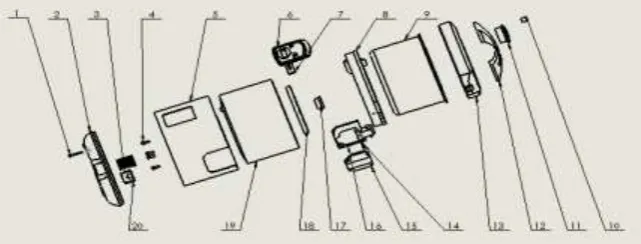
17-Electromagnetic switch, 18-Electro-magnetic disk, 19-The inner pot, 20-Plug wire place.In addition, the gap between the bottom of the pot and the inner pot,also placed a large number of electrical parts, such as temperature controller, thermal protector, binding post, connecting line,etc.
Figure 1. Explosion diagram of electric rice cooker.
Analysis of Advantages and Disadvantages of Common Modeling Patterns
In the research of disassembling and recycling of waste products, the establishment of disassembly model and the generation of disassembly sequence is equally important than the study of the intelligent disassembling equipment. At present, the most commonly used models for disassembling and recycling are undirected graph, directed graph, AND/ OR graph, Petri nets, etc. Undirected graph is a diagram of each edge is no direction, although it is very simple to show the connection information between the various parts, but it can not clearly describe removing orders of the parts without directions. Relative to undirected graph, the directed graph inclueds directions of every edge of a graph, although it can clearly describe the constraint between the various parts and indicate the order of disassambly, it is only applicable to the case of less parts. When the number of parts is large, the number of generated disassembly sequence is huge, this makes its modeling effect trival and the process of selecting the optimal solution is more complicated. AND/OR diagram is a structure diagram composed of "and" nodes and "or" nodes, the nodes of this model are less, and can show all the disassembly sequences that can be formed, but when the number of parts is increased, it is also easy to cause the combination explosion because of the relatively large number of cut-sets (because the individual parts may have a variety of disassembly sequence, the main set is the union-set). Petri net can express concurrent events, for each target of disassembly can be clearly expressed, but its model is easy to become very large and the algorithm is complicated[4].
As shown in figure 1, contains multiple parts, it is not appropriate to model rice cooker just by several kinds of commonly used graphics, new ways are required to solve the problem of modeling.
Establishment of Model
Introducing Modularized Disassembly Methods
Disassembly on the one hand is to recycle the valuable recyclable parts, on the other hand is to recycle parts which may cause pollution. From the figure of the example electric rice cooker, although composed of 20 parts, target parts that really need to be disassembled (target parts mainly comprises fasteners, parts that is harmful to the environment, and parts with the value of recycling) are the fastening parts and electrical parts, that is to remove no. 1, 2, 3, 4, 20 (the plug wire place joined with the bottom of the pot) parts, other parts can then be classified according to their material (such as plastic, metal), so that the number of parts can be reduced. This is an application of modularation[5]. The modularation process is shown in Figure 2:
modules of the K affiliated parts on a single set aside. And so on, each to the next layer, it can be combined into the module is less and less, to get closer to the assembly of a single module and single target parts, and will greatly reduced parts number at this time. However, in the n-1 layer, the accessory parts number P can be 0, the target parts must exist, otherwise only module 1, equivalent to the assembly is the module, so it is no meaning to the division of the module.
Figure 2. Modular implementation process.
Modular disassembly method can integrate more parts into a module, then regards the module as one of the parts, according to the disassembled target parts to study the relevant parts and modules, which greatly reduces the risk of combinatorial explosion phenomenon, at the same time improves the efficiency of disassembly.
Establish the Interference Matrix Model
In order to disassemble the target parts, the first is to determine its disassembly direction, which is to express clearly the spatial relationship between the parts in the assembly, it is need to consider the constraint relation between these parts. Here to choose the matrix interference, because its compared to the above several diagrams can better reflect its geometrical precedence relation.
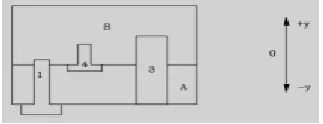
Decomposes the entire electric rice cooker into no. 1, 3, 4 parts and A (2 and 20), B (residual parts) module, when disassembles the bottom of the pot 2, the electrical parts can be directly removed, is not counted as part of the serial number. Erected in figure 1, get the simplified model diagram shown in figure 3.
Figure 3. Simplified entity of electric rice cooker.
Definition[6]: when the part J fixed, the part I moving along the K(±X,±Y,±Z) direction, if i and
j occur collision interference, it is recorded as Fij(k)=1. If there is no interference, it is recorded as
Fij(k)=0. The figure shows that because of fasteners, the entity can only be disassembled along the
direction of +Y and -Y. So we can get the following two matrices:
1 A 3 4 B 1 A 3 4 B
0 0 0 0 0 1 0 0 0 0 1 0 0 0 0 1 1 1 0 0 1 0 0 1 0 = Y +
F(ij )
[image:3.595.217.379.493.555.2]Analysis the matrices, found disassembled along the + Y direction, the module B is first removed, at this time the part 3 and part 4 non-interference in each other, they can be casually dismantled. Followed by the module A and part 1 have been removed successively. When disassembled along the -Y direction, the part 1 is dismantled first, followed by the module A. Similarly, parts 3 and 4 are not ordered to be dismantled, and the last is the module B. Therefore, 4 disassembly sequences are obtained:
(1) B, 3, 4, A, 1; (2) B, 4, 3, A, 1; (3) 1, A, 3, 4, B; (4) 1, A, 4, 3, B.
By the matrices show that when the elements of a certain line are all 0, it means that there is no collision interference in the direction of the line, can be directly dismantled. When the elements of some lines appear in the matrix are all 0, indicates that these lines represent the parts in this direction in the process of dismantling have no orders. When any one line in a matrix of the elements are not complete to 0, it is indicated that there are no detachable parts in the assembly.
Analytic Hierarchy Structure
In this case, although there is no target parts needed to be disassembled in the A module, by analogy, if there are some target parts in some other module which need to be disassmbled, then you need to disassemble the module again, decomposing them into other parts or modules. This is equivalent to a layer by layer down until the target parts are dismantled. The top layer of the analytic hierarchy structure is the assembly which need to be demolished, and then it is decomposed into parts, modules or sub assemblies of the next layer by releasing the constraint relations between parts, so it's easy to analysis the constraint relation of each part.
Filter Disassembly Sequence
The disassembly direction has two in the above-mentioned, thus there were two interference matrices, but these two matrices which must have a more optimized than another. However, one of them could be more optimized. Generally speaking, Evaluation of indexes for the optimum alternatives are disassembly time, quantity of the disassembly parts, times of redirect, disassembled tools, cost of disassembly, etc. It has been studied in detail in References [2] and [5], which used mathematical expression for calculation[7]. By comparing the results, to determine the optimal disassembly sequence. The formula is as follows.
(1) formula for calculating disassembly time:
Tk: operation time of disassembly part k, Tk’: preparation time of disassembly part k, n: quantity of
the parts in the assembly.
(2) formula for calculating the quantity of the parts:
Nk: the part k, n: total quantity of the assembly.
When the part k appears in the disassembly sequence, the Nk=1; if not, then Nk=0.
(3) formula for calculating the times of redirect:
Ck: the redirect value.
In one disassembly sequence, if the part K needs to be redirected, then Ck=1; if not, then Ck=0.
ε: the corresponding weight,
According to the above several formulas to calculate, compares the results of each sequence calculation, which weight is less, that is the optimal disassembly sequence.
However, this method is more complicated, actually we can also through the analysis of the coupling characteristics of small-size home appliance to obtain the disassembly sequences. The direction of the disassembly is from outside to inside or from top to bottom or from bottom to top. Meanwhile, because of the all fasteners are arranged in the same direction, based on the principle that the fasteners must be removed before the other connected parts then other parts can be disassembled[8], so it's easy to get rid of some other unreasonable disassembly sequences. For example,it would be the only sequence of 1,A,4,3,B left according to the 4 principles mentioned above.
In addition, it's hard to disassemble the small-size household appliances for rust and distortion of the parts. If we want to get the most out of recycling parts,we should use some machine tools for People’s work efficiency low and security risks, such as manipulator. In order to disassembly parts from used products successfully, usually clamping and fixation are needed. According to the direction of the clamping clip can also effectively delete the sequence of collision caused by demolition.
Summary
This paper discusses the disassembly sequence generation procedure of one type of waste electric rice cooker, the disassembly sequence generation process in general is presented. Firstly, we should understand the information of the assembly which will be dismantled, such as the geometry and physical properties, volume and quality, material, model, etc. Secondly, all the feasible disassembly sequences of the entire assembly is generated by modeling. As the object is a assembly, the disassembly sequences must exist, and at least one disassembly sequence is feasible. Then, the disassembly sequences are searched one by one and the target part is identified, if the same disassembly sequences are encountered, one of them can be eliminated. Finally, according to the guidelines for screening, the optimal disassembly sequence is determined. This method isalso suitable for the generation process of the disassembly sequences of other small-size household appliances. The disassembly sequences generation can be stored in a database, which provides a reliable liabrary for the subsequent study of disassembly sequence of other models in the future.
References
[1] G.F. Liu, Zh.F. Liu, J.G Lin, H.B. Zhu, J.B. Jiang. Recycling and Reusing of Appliances and Key Problems[J]. China Resources Comprehensive Utilization, 2001,10:9-13.
[2] Hong DS, Cho HS, A neural-network-based computational scheme for generating optimized robotic assembly sequences[J]. Engineering applications of artificial intelligence 1995,8(2):129-145.
[3] B.Ch. Zeng, Disassembly and Recycling Design Technology of Appliances [D]. Soochow University, 2010.
[4] J.F. Li, J. Chen, F.Y. Li, Y.L. Wang, Disassembly-recycling model and generation of disassembLy sequences of electromechanical products[J]. Journal of Shandong University (Engineering Science),2004,05:9-13.
[6] B. Wang, N.Sh. Wang, Optimizing Algorithm for Disassembly Sequence Based on Tabu Search and Genetic Algorithms [J]. Journal of Chongqing University (Natural Science Edition), 2006,03:23-27.
[7] N.W. Liu, Q.Ch. Zh, J.J.Guo, Research on evaluation of disassembling based on AHP[J]. Journal of Tianjin University of Technology, 2009,01:22-25.