2016 International Conference on Computer, Mechatronics and Electronic Engineering (CMEE 2016) ISBN: 978-1-60595-406-6
WSN Layer-cluster Sensor Deployment for Frozen Soil Data Acquisition
Zhi-wei WANG
1, Zi-ming LI
1, Hong-yi LIU
2and Xu LIU
3,*1
State Grid Heilongjiang Electric Power Company Limited, China
2State Grid Heilongjiang Electric Power Company Limited Harbin Power Supply Company, China
3
Beijing Jiaotong University, China
*Corresponding author
Keywords: Node deployment, Regular hexagon, Layer-cluster, Hybrid hop, Frozen soil.
Abstract. In the large-scale system of frozen soil data acquisition, the problem of sensors deployment is still widely researched. Although various methods of sensors deployment have been proposed, which are based on wireless sensor networks (WSN), sensors deployment utilization and energy utilization need to be improved in WSN. Therefore, a method for large multi-node deployment of hybrid layer-cluster topology in WSN is proposed in this paper. The experimental results in Mohe show that the layer cluster hybrid topology model based on hexagon partition can reach the coverage rate of 100% and the energy utilization rate increasing by 5.4% and 8.6% on the condition of relatively less deployed sensor nodes. The method is an effective solution to the problem of node deployment for frozen soil data acquisition of large-scale and multi-node in WSN.
Introduction
[image:1.595.219.377.601.774.2]Heilongjiang Province is located in the northern part of the eastern monsoon region, has nearly 150 thousand square kilometers of frozen soil[1]. With the influence of strong Siberia and Mongolia high pressure, it shapes the freezing continental climate, creating the right conditions for the formation and development of frozen soil. Different types of frozen soil and frozen soil characteristics are shaped under a wide variety of climate types[2]. Due to the special engineering properties of low temperature, easy change and high sensitivity, the roadbed subsidence, sag, frost heaving and frost boiling, pavement cracking and other diseases are easily produced when roads and railways are built in the frozen soil region which seriously threatens the traffic safety[3]. The frozen soil is an unstable soil that is very sensitive to climate and temperature. With the external influence of climate change and human factors, the temperature field is redistributed after the thermal disturbance in frozen soil and it may cause the transmission line's tower base in frozen soil field occur serious deformation, even collapse[4]. So it is very necessary to study the distribution of the frozen soil and take measures to prevent it.The maximum depth of seasonal frozen soil distribution in Heilongjiang province is shown in Figure 1[5].
The main methods used in the exploration of frozen soil are geological exploration, long term observation of site, geophysical exploration and so on. Generally speaking, geological exploration has some disadvantages such as high cost, long time, and influence on urban traffic and noise[6-7]. As it is closely related to the performance and lifetime of the system, how to deploy the nodes in a fixed area[8-10], such as Heilongjiang Province, is an important issue, and the reasonable network topology model can greatly improve the accuracy of the network monitoring results[11].
This paper proposes to use layer cluster type sensor deployment method to research network coverage level and power consumption. A hexagon divide layer cluster network topology model is proposed on the basis of star and mesh topology model. The regular hexagon deployment strategy is adopted by the outer sensor nodes, and the common nodes and cluster head nodes are connected by star structure. The cluster head nodes in the inner layer are classified according to the circle domain, and the cluster head nodes of each grade are connected by a network structure, and the mixed hop routing method based on the critical distance is used by the communication between cluster head node and the base station using. Through the simulation in Mohe County experiment area, quadrilateral partition network is compared with the random deployment in the same distance transmission, results show that it can reduce energy consumption, reduce the node end-to-end delay, improve the perception efficiency of the network, save cost, and can effectively solve the distribution problem of frozen soil in Heilongjiang.
Layer-Cluster Network Monitoring Model
Due to the coverage area of frozen soil in Heilongjiang is larger, the distribution of frozen soil in different frozen soil region is also different. In order to realize the large-scale collection of frozen soil data, a layer cluster type network monitoring model is proposed in this paper. Wireless sensor network hierarchical model can be abstracted as: network can be seen as an undirected graph
( , )
G V E , V represents the set of all the nodes in sensor networks, E represents the set of
connected network communication link between two nodes.
Definition 1: The network layer depth is M, the sensor node is a set V , Pi represents a set of the
nodes in ith layer, so V
P P1, 2,...,PM
, obviously 1M i i
V P
.Definition 2: The set of the nodes in ith layer is Pi
x x1, 2,...,xN
, the set of nodes for the ithcluster is Qi
x xi1, i2,...,xij
, xij represents each cluster member node, so 1i i
i
P Q
.
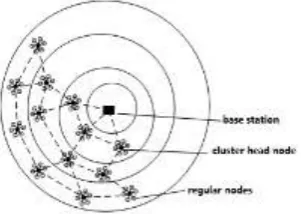
[image:2.595.223.374.657.764.2]According to the different energy and function, the network is composed of common nodes, cluster head nodes and base stations. Base station is the first layer, cluster head node is the second layer, the rest of the common sensor nodes are the third layer. Assuming that the node position is fixed, the base station is located in the center of the disc and the energy of the base station is unlimited. The layer cluster hybrid topology structure proposed in this paper is shown in Figure 2 and the monitoring area can be abstracted into a disc.
The cluster head transmits the data to the base station, if the single hop communication is taken, nodes far away to the cluster head node can consume huge energy because of the long distance transmission; if taking multi-hop communication, nodes near to the cluster head node may lead to the premature failure due to excessive energy consumption for forwarding data packets and affect the monitoring performance of the whole network, so the sensing data transmission needs to be further studied. In this paper, the star-structure connection is adopt between ordinary nodes and cluster head nodes and single hop mode is used for data transmission, the mesh-structure topology connection is adopt between the cluster head nodes and data transmission is in use of single hop or multi-hop mode, so it can be more conducive to large-scale collection of frozen soil data in Heilongjiang Province.
Node Deployment Strategy Based on the Hexagonal Partitioning
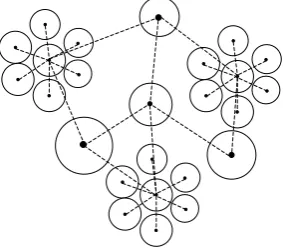
[image:3.595.227.369.302.426.2]The two-layers hybrid structure topology network based on star topology structure and mesh-structure is used in this paper. The ordinary node layer adopts star- structure topology, while the mesh-structure topology is used in the inner layer of cluster head nodes. The two-layers hybrid topology model is shown in Figure 3:
Figure 3. The star-mesh hybrid topology structure.
Cluster nodes in wireless sensor network not only sense data and collect the information of the other cluster member nodes but also communicate with the other cluster nodes and forward the collected data and information, so the energy consumption is the largest. In order to reduce the energy consumption in the process of data transmission, the sensor node using the hexagon deployment model as shown in Figure 3. Each sensor node is located in the vertex position of the hexagon, the cluster head nodes is in the geometric center of the hexagonal. Ordinary nodes and cluster head nodes are connected by star-structure topology and data transmission is in use of single hop mode, so deployment like this can ensure distance between each ordinary node to the cluster head node equal. The uneven communication distance leads to the uniform energy consumption so that some nodes may die prematurely, which affect the performance of network monitoring.
As the frozen soil area in Heilongjiang Province is large, diverse climates also led to a variety of different characteristics of the frozen soil. Proposed node deployment strategy based on the division of the hexagonal can implement the data collection of frozen soil and obtain the distribution characteristics of frozen soil more efficiently with the analysis of the coverage level and energy consumption.
Critical Distance-Based Hybrid Hop Routing Analysis
station to the outermost layer of the cluster head node is d , according to the circular domain classification, the distance can be divided into a number of jumps. The analysis based on the linear model is shown in Figure 4:
Figure 4. A linear mathematical model of data transmission.
Simulation Analysis of Experimental Area in Mohe
Mohe in Heilongjiang Province is located in the northernmost China, which belongs to hilly area with an average elevation of 550m and the highest elevation of 1397m. Vegetation coverage rate is as high as 90% and water resources very rich. Mohe County has continental monsoon climate. With the alternating influence of the inland and offshore high pressure and monsoon, the overall performance is the long and dry cold winter, short and hot summer. The average temperature of summer is 18.2℃, the average temperature in January is -31.8℃, the historical minimum temperature in the history is -52.3℃(1969), and the temperature difference between day and night is large. The average annual rainfall is 460.8 mm, and the average ice period is 7 months. It is in the southeast edge of the Eurasian Continental permafrost region, with the annual average temperature of -4. 2℃ and the annual average ground temperature of -4~0℃, there are continuous permafrost exists, with the thickness of 50~100m[13].
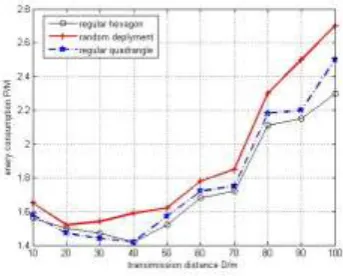
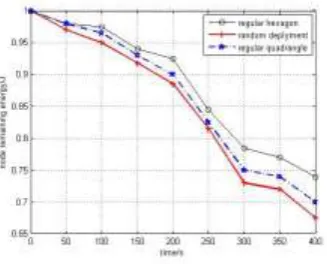
In order to verify the performance of the hexagon partition model proposed in this paper, we draw a comparison with the quadrilateral partition and random deployment partition, and with a rectangular area in Mohe County of Heilongjiang Province for the experimental area. As the development and formation of frozen soil are influenced by temperature, water content, soil thickness, soil lithology, soil density and other factors, so temperature, humidity, thickness, lithology and density can be the monitoring targets of the frozen soil. Choose HX15 temperature sensor whose measuring range is -40~180°C, HL-TR03 humidity sensor, LK-G5000 thickness sensor, lithology sensor and density sensor. The algorithm simulation experiment was carried on in the platform MATLAB7.1 and energy consumption, average delay, average packet delivery ratio were mainly analyzed and compared by the simulation, and the three groups of dates are drawn respectively below in Figure 5, Figure 6 and Figure 7.
[image:4.595.209.381.629.767.2]
Figure 6. Remaining energy curve of the nodes. Figure 7. The average end to end time delay.
Based on the experimental analysis above, the distance of 40m between the nodes of the hexagonal
partition is the most appropriate, the critical distance of single hop and multi-hop is dmax160m.
Layer cluster hybrid topological structure based on hexagonal partition proposed in this paper can optimize the performance of large networks with the advantages of reducing the energy consumption of the network, saving the cost, achieving a given area coverage with minimum nodes and faster operating efficiency, which proves the scientific validity of the topology optimization model to the large scale sensor networks in experimental area of Mohe County. This research was financially supported by the National Science Foundation.
Summary
It is proved that the method of WSN layer-cluster sensor deployment is an effective method to study the distribution of frozen soil in Heilongjiang province. On the analysis of the coverage rate and the power consumption of the sensor network and the basis of the star and mesh topology model, a kind of layer-cluster network topology model based on regular hexagon partition is put forward in this paper. The hexagon deployment strategy is utilized in the outer layer of the sensor nodes and the star structure connection is adopt between ordinary nodes and cluster head nodes; the layer classification of the inside cluster head nodes is based on circular domain and the cluster head node of each level is connected by mesh-structure, the hybrid hop routing method is used by cluster head nodes to communicate with base station based on critical distance. By comparing the experimental simulation of the random deployment and quadrilateral partition, the results show that this method can reduce energy consumption and the end to end delay for the same distance on the transmission network, along with improving the perception of the network efficiency and saving cost. Therefore, the distribution of frozen soil in Heilongjiang Province can be effectively studied by the same sensor nodes deployment method.
References
[1] Zhai Weifeng, et al. Sustainable development of Heilongjiang province and strategy analysis of geological disaster reduction in 21 Century [J]. Disaster, 2004,19: (4). (in Chinese with English abstract)
[2] Zhao Qiguo, Gong Haoqing, Gu Guoan. Frozen soil of China [J]. Acta Pedologica Sinica.1993.30(4) :341-354. (in Chinese with English abstract)
[3] Zhang Jianguo, Guo Wei, Xu Jinfu. How to deal with the damage of frozen soil to Highway Engineering [J]. Beifang Jiaotong, 2012(11):26-27(in Chinese with English abstract).
[4] Wan Yinong. Design of power transmission line tower foundation in permafrost regions of Qinghai Tibet Plateau [J]. Electric Railway, 2008(06):9-12. (in Chinese with English abstract).
[6] Yu Qihao, Cheng Guodong. Application of geophysical prospecting technology in the survey of permafrost in China [J]. Journal of Glaciology and Geocryology, 2002. 24 (1):102-108. (in Chinese with English abstract)
[7] Chang Xiaoli, Jin Huijun, He Ruixia, et al. Development of permafrost monitoring in the northern
part of Greater Khingan Range [J]. Journal of Glaciology and Geocryology,2013,35(1):93-100.
(in Chinese with English abstract)
[8] Shah R C, Rabaey J M. Energy aware routing for low energy ad hoc sensor networks[C]. Proc. Of the 3rd IEEE Wireless Communications and Networking Conf. (WCNC), Orlando, 2013:151-165.
[9] Lindgren A, Doria A, Schelen O. Probabilistic routing in intermittently connected networks[J]. Mobile Computing and Communications Review, 2012,7(3):19-20.
[10] Sinan I, Mehmet Y D. Cross layer load balanced forwarding schemes for video sensor networks[J]. Ad Hoc Networks, 2011, 19(3):265-284.
[11] Duan Shumin, Mu Junchen. Algorithm. Research of the deployment of mobile ad hoc network service nodes of evolutionary computation[J]. Computer Simulation, 2014, 31(4):307-309. (in Chinese with English abstract)
[12] Shi Zhenxing, Fan Xiujuan, Jiang Ying, et a1. Research on energy balanced hierarchical clustering of single hop and multi hop routing algorithm for mixed WSN[J]. Manufacturing automation, 2013,(15):53-56. (in Chinese with English abstract)