2016 International Conference on Wireless Communication and Network Engineering (WCNE 2016) ISBN: 978-1-60595-403-5
Design and Implementation of the Management System of House Lease
Wei LI
1and Jian-feng XIONG
21College of Computer, Wuhan Vocational College of Software and Engineering, Wuhan Hubei
430205, China
2The first secondary vocational school in Zhuhai, Guang Dong, 519000, China
Keywords: House rental management system, B / S, SSH, JSP.
Abstract. This paper presents the design and implementation of the housing rental management system. The system uses the Struts/Spring/Hibernate framework that implements the separation layer and the logical layer, can complete the rental information browsing, query, input, modify, management and other functions, the system improves the efficiency of housing rental.
Introduction
With the continuous development of database technology and the rapid increase of computer hardware speed, information management technology more and more aroused people's attention[1]. Information management system not only can effectively manage all kinds of data, but also improve the efficiency and quality of information management, so that the standardization of management[2]. Housing rental management system which was designed to help the users to understand the rental and publish rental information, complete the information browsing, query, entry, modification, management and other modules to meet user requirements. To facilitate the exchange of housing tenants and housing tenants, so that both sides can understand each other's needs after the transaction, so as to achieve the accurate use of housing information.
System Development Technical Description
Development of Technology Options
This system is based on B/S (Browser / server) structure design of the system[3]. It takes Java Struts2, Hibernate3, Spring2.5 three framework as the main technology to complete the interactive work page and database data, in which the main work were input and output, modify, storage and query; it prospects for the use of jQuery + HTML5 + CSS3 + Ajax asynchronous communication. The server side uses MYSQL as the database, Tomcat is the WEB server. The operating environment of the system is XP SP2 Window or more, other operating systems, such as Linux are also supported.
Development Tools
The main development tools used in this system are:
1) The development tool of JAVA and JSP is MyEcpliese8.6, which integrates a lot of plug-ins, but also the support integration of the three frameworks of SSH, can greatly accelerate the development of efficiency[4];
2) AptanaStudio,Dreamweaver and WebStorm are the development tools for JAVASCRIPT and HTML,which were the first choice for the development of the language and the advantage was the income;
3) image processing using the Photoshop
4) SQLYOG, the database assistant tools, can be easy to operate on the database, and do not have to write a command line every time;
System Requirement
The system mainly has the following several major modules: login registration module, housing rental information release module, the user's personal center management module, news bulletin module. Ordinary users can browse the web page after entering the rental of the latest information, if you want to pass the system release of rental housing, Qiuzu information must be registered as a member of the site users, after the release of the information can be directly displayed on the page, you can update or delete management on the other, users can browse to you the release of information, thus greatly improve the housing rental rates.
Ordinary users can browse the web page after entering the rental of the latest information, if someone want to pass the system release of rental housing .Rent information must be registered as a member of the site users, after the release, the information can be directly displayed on the page, you can update or delete management that the other users can browse the information which you released, thus greatly improve the housing rental rates.
System Use Case Analysis
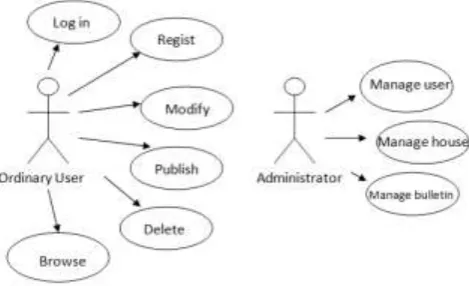
[image:2.595.186.421.366.509.2]House rental management system allows users to have two identities: ordinary users and administrators, each kind of identity are very convenient to operate, fast. Any user can browse, view rental information, if you want to publish personal information, it must be registered, log and then use. The basic information of these users has their unified management of the administrator. System site use case diagram shown in Figure 1.
Figure 1. System use case diagram.
User Detailed Requirements
According to the previous analysis of the house rental management system, it can be divided into two parts: ordinary user module and administrator module.
1) The ordinary user module:
a) non registered users module: browse, search housing information, browse the website news bulletin.
b) registered user module: browse, search, publish, modify and delete house information, browse the website news bulletin, modify personal password information, but also can edit their personal information.
2) Administrator module:
a) house management: to view the released details of the house information, and can delete, modify, etc.
b) user information management: view the website system registered members, and can be made to delete, modify, etc.
Database Design
The database is the central part of the information system, the careful and strict consideration is necessary in the database design. After the demand analysis, the analysis and design of the database is needed. Relational database is one of the widely used database types[5]. The design of relational database is the process of organizing and structuring the data. The design of the relational model is the key problem. For small database size, it can be relatively easy to deal with the table structure in the database. However, with the growing scale of the project, the corresponding database has become more complex, the relationship model of table structure is more complex. Due to the unreasonable definition of the table structure will lead to update the data caused by the incomplete data. Therefore, it is necessary to standardize the database design, reduce redundant data, improve the efficiency of the database storage, data integrity and scalability[6].
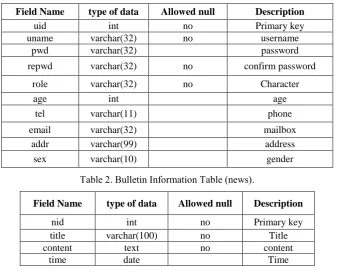
The part of data table structure of the system is given below.
Table 1. User information table (user).
Field Name type of data Allowed null Description
uid int no Primary key
uname varchar(32) no username
pwd varchar(32) password
repwd varchar(32) no confirm password
role varchar(32) no Character
age int age
tel varchar(11) phone
email varchar(32) mailbox
addr varchar(99) address
[image:3.595.130.470.263.535.2]sex varchar(10) gender
Table 2. Bulletin Information Table (news).
Field Name type of data Allowed null Description
nid int no Primary key
title varchar(100) no Title
content text no content
time date Time
System Implementation
Implementation of System Login Module
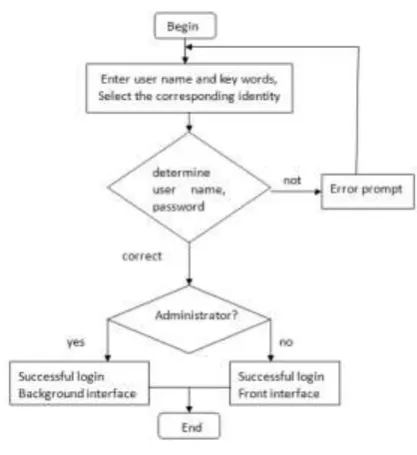
If the user wants to release the housing information, it is necessary to login successfully after login, users can browse personal information, modify personal password information, search, publish, modify and delete individual housing information, on-line message and other functions.
Figure 2. Login flow chart.
If the user's information is correct, it shows that the user is legitimate users, can successfully login to the system front interface; if it is a system administrator, then go to the background work management interface.
Part of System Code
The following is part the logic code of the query function in the business. //Advanced query
public List findByProperty(String propertyName, Object value) { try {
String queryString = "from House as model where model."+ propertyName + " like ?"; Query queryObject = getSession().createQuery(queryString);
queryObject.setParameter(0, "%"+value+"%"); return queryObject.list();
} catch (RuntimeException re) { }
}
public List findAll() { try {
String queryString = "from House";
Query queryObject = getSession().createQuery(queryString); return queryObject.list();
} catch (RuntimeException re) { }
} }
Summary
References
[1] A. Zewge, Y. Dittrich and R. Bekele, "Adapting participatory design to design information system with rural Ethiopian community," AFRICON, 2015, Addis Ababa, 2015, pp. 1-5.
[2] L. Deng and S. Ye, "Vehicle information system design based on Beidou Navigation Satellite System," Information and Automation, 2015 IEEE International Conference on, Lijiang, 2015, pp. 867-870.
[3] J. Liu, F. Sun and F. Wang, "A design of urban open spatial information system on the basis of spatial information technology," 2013 21st International Conference on Geoinformatics, Kaifeng, 2013, pp. 1-7.
[4] P. Křemen and Z. Kouba, "Ontology-Driven Information System Design," in IEEE Transactions on Systems, Man, and Cybernetics, Part C (Applications and Reviews), vol. 42, no. 3, pp. 334-344, May 2012.
[5] W. Q. Luo and Z. H. Hu, "Information system design based on Petri net," Proceedings of 2011 IEEE International Conference on Grey Systems and Intelligent Services, Nanjing, 2011, pp. 654-658.
[6] C. Liyu, "Based on Research about Intelligent Financial Information System Design," Intelligence Science and Information Engineering (ISIE), 2011 International Conference on, Wuhan, 2011, pp. 193-195.