Open Access
Research article
Quetiapine augmentation of SRIs in treatment refractory
obsessive-compulsive disorder: a double-blind, randomised,
placebo-controlled study [ISRCTN83050762]
Paul D Carey*
1, Bavanisha Vythilingum
1, Soraya Seedat
1,
Jacqueline E Muller
1, Michael van Ameringen
2and Dan J Stein
1Address: 1MRC Research Unit on Anxiety Disorders, University of Stellenbosch, Cape Town, South Africa and 2Department of Psychiatry and
Behavioral Neurosciences, McMaster University, Hamilton, Ontario, Canada
Email: Paul D Carey* - [email protected]; Bavanisha Vythilingum - [email protected]; Soraya Seedat - [email protected]; Jacqueline E Muller - [email protected]; Michael van Ameringen - [email protected]; Dan J Stein - [email protected] * Corresponding author
Abstract
Background: Although serotonin reuptake inhibitors are effective in the treatment of OCD, many patients fail to respond to these agents. Growing evidence from open-label and placebo-controlled trials suggests a role for augmentation of SRIs with atypical antipsychotics in OCD. Quetiapine is generally well tolerated and previous open-label data has produced mixed results in OCD and additional controlled data is needed.
Methods: We undertook a double-blind, randomised, parallel-group, flexible-dose, placebo-controlled study of quetiapine augmentation in subjects who had responded inadequately to open-label treatment with an SRI for 12 weeks. Following informed consent and screening, forty-two subjects were randomised to either placebo or quetiapine for six weeks.
Results: There was significant improvement from baseline to endpoint on the Yale-Brown Obsessive-Compulsive Scale in both the quetiapine and placebo groups (quetiapine, n = 20, p < 0.0001; placebo, n = 21, p = 0.001) with 40% (n = 8) of quetiapine and 47.6% (n = 10) of placebo treated subjects being classified as responders. Quetiapine did not demonstrate a significant benefit over placebo at the end of the six-week treatment period (p = .636). Similarly quetiapine failed to separate from placebo in the subgroup of subjects (n = 10) with co-morbid tics. Quetiapine was generally well tolerated.
Conclusions: In this study, quetiapine augmentation was no more effective than placebo augmentation of SRIs. A number of limitations in study design make comparisons with previous studies in this area difficult and probably contributed to our negative findings. Future work in this important clinical area should address these limitations.
Published: 24 January 2005
BMC Psychiatry 2005, 5:5 doi:10.1186/1471-244X-5-5
Received: 12 October 2004 Accepted: 24 January 2005
This article is available from: http://www.biomedcentral.com/1471-244X/5/5
© 2005 Carey et al; licensee BioMed Central Ltd.
Background
Obsessive-compulsive disorder (OCD) is a prevalent, chronic and disabling disorder [1]. Controlled pharmaco-therapy studies have established superiority of serotonin re-uptake inhibitors (SRI's) over noradrenaline reuptake inhibitors and over placebo in OCD and these currently form the cornerstone of pharmacotherapy management [2]. Despite the considerable advances made with the introduction of the SRI's into clinical practice, 40–60% of subjects still fail to respond adequately to initial therapy [3,4].
From this it is clear that a need exists to pursue more effec-tive treatments for those with OCD who fail to respond or respond inadequately to SRI's. To this end, preliminary evidence supports a role for the addition of atypical antip-sychotics to SRIs in OCD. These agents combine serot-onin-dopamine antagonism with the advantage of being well tolerated including a low potential for inducing motor side-effects.
To date a number of open-label studies have suggested that augmenting SRI's with atypical antipsychotics is an effective strategy for treatment-refractory OCD. These include support for risperidone [5-7], olanzapine [8-13], and more recently amisulpride [14] and quetiapine [15-18]. A single open-label study using quetiapine as aug-mentation showed lack of effect in a small sample using low doses [19].
The outcome of the first controlled study in this area with the antipsychotic haloperidol demonstrated preferential benefit for refractory OCD subjects with co-morbid tic dis-order [20]. In two subsequent studies the efficacy of risp-eridone in SRI refractory OCD has also been reported [21,22]. Interestingly the former study [21], did not repli-cate the particular advantage for subjects with co-morbid tic disorder. Efficacy has also been shown for quetiapine [23] and olanzapine [24] using similar designs, but the effects on co-morbid tic disorders were not reported. In contrast a recent controlled study using olanzapine failed to demonstrate efficacy over placebo in a six week study [25].
Despite some mixed evidence in this area, in general the available literature appears to support the use of relatively short trials with low doses of antipsychotic agents as aug-mentation to SRIs. Quetiapine has a particularly interest-ing profile in that it is the only available antipsychotic with significant 5-HT1D effects and this serotonin recep-tor subtype has been implicated in OCD [26,27].
Our objective was to examine the effects of quetiapine augmentation in subjects with OCD who had failed to respond adequately to a 12 week trial of an SRI,
employ-ing a double-blind, placebo-controlled, six week study design.
Methods
PatientsForty two subjects aged 18–65 years inclusive were recruited in our multi-centre study comprising five sites in South Africa and one in Canada. Recruitment took place between May 2002 and November 2003. Prior to com-mencement, all sites in the study received approval from their relevant Research Ethics committees/Institutional review boards and regulatory authorities. All subjects pro-vided written informed consent prior to the commence-ment of any study-related procedures. Diagnosis was confirmed using the MINI Neuropsychiatric Interview (Version 5.00, 1998) [28] to ensure compatibility with the Diagnostic and Statistical Manual for Mental Disorders, Fourth Edition (DSM-IVTR)[29] criteria for OCD. Sub-jects with any co-existing Axis I disorder were excluded unless the co-morbid condition was deemed to be second-ary to the OCD. Female subjects of childbearing potential were required to use adequate contraception and were not permitted to breastfeed while on the study. Subjects were excluded if they suffered from unstable medical condi-tions including renal or hepatic insufficiency, epilepsy or had suffered previous brain injury or undergone brain sur-gery. Taking medication that was deemed likely to interact with quetiapine or any other psychoactive substance was grounds for exclusion.
Study Design
All subjects were treated and monitored by investigators for the minimum twelve week duration of SRI-alone treat-ment phase before inclusion into this study. This was to ensure that patients met criteria for duration of SRI treat-ment which included at least 6 weeks on the maximum tolerated dose of the relevant SRI. Sample size calcula-tions were based conservatively on similar work in this area [20,21]. Accordingly, for the primary outcome varia-ble (YBOCS), clinically meaningful differences between treatment groups of 6.67 with a standard deviation (SD) of 6 would be detected with a power of 80% at a 5% sig-nificance level with a sample size of 14 in each of the treat-ment groups. The larger sample recruited reflects the anticipation of a 33% drop-out rate in the double-blind treatment phase.
Obsessive-compulsive score following twelve weeks of treatment. Inadequate response, as defined above, to at least one SRI administered for a minimum of 12 weeks of which 6 weeks was either at the maximum tolerated dose or alternatively the manufacturer's recommended maxi-mum daily dose. SRI doses were maintained at the same level throughout the double-blind treatment phase. For assignment to either quetiapine or placebo groups, we used a computer generated randomization schedule sup-plied by the sponsoring pharmaceutical company which also packaged the medication. This procedure ensured blinded, balanced allocation to each treatment group across all the study sites. All investigators remained blind to this schedule until closure of the study. No incidents requiring investigators to break the blind occurred through the course of the study.
Treatment
At baseline participants were randomly allocated to receive treatment with either quetiapine or placebo using a computer generated schedule and numbered dispensing wallets. A flexible dosing schedule was initiated at 25 mg per day for one week and then doubled weekly to the start of week 4. Based on Clinical Global Impression of Improvement (CGI-I) scores of minimally improved or worse, clinicians were permitted to increase the dose to a maximum of 300 mg per day for the final two weeks of the study. In addition to clinical measures of improvement, clinicians also considered patient tolerability in their deci-sion to adjust doses. Following completion of the treat-ment phase, subjects were withdrawn from study medication while continuing their SRIs. All subjects were then followed up for any adverse effects.
Ratings
Patients were assessed by clinicians at baseline and on completion of weeks 2, 4 and 6. Telephonic assessments were performed on completion of weeks 1 and 3. Symp-toms of obsessive-compulsive disorder were measured by the same clinician where possible at all study visits using the Yale Brown Obsessive Compulsive Scale YBOCS)
[30,31]. A global assessment of severity and improvement was made by clinicians at all assessment points using the Clinical Global Impressions scale of Severity (CGI-S) and Improvement (CGI-I) [32]. Depression was rated using the 10-item Montgomery-Asberg Depression rating scale (MADRS) [33]. For a measure of patient-rated disability we used the Sheehan Disability scale (SDS) [34]. For sub-jects with tics, frequency and severity were rated using the Yale Global Tic Severity Scale (YGTSS) [35].
Our primary outcome measures for OCD symptoms were (1) the change in YBOCS score from baseline to endpoint and (2) the clinical global impression of improvement (CGI-I) at endpoint. In the final analysis, treatment response was defined as a 25% or greater reduction in YBOCS score and a CGI-I of 1 (very much improved) or 2 (much improved) from baseline to endpoint. Secondary outcome measures included the MADRS, SDS and YGTSS (in subjects with co-morbid tics).
Statistical analysis
[image:3.612.53.560.100.193.2]Thirty-nine of the forty-two randomised subjects success-fully completed the six-week treatment phase. Two sub-jects withdrew from the study prematurely (Week 1 and Week 4) due to severe levels of sedation. In both of these cases at least one week of study medication had been taken and at least one post-baseline clinical assessment was completed. Both of these subjects were included in the final analysis using data from the last observation car-ried forward (LOCF). The single subject not included in the efficacy analysis completed the study, but was found not to have correctly fulfilled the study definition of treat-ment refractoriness and was excluded. Twenty subjects were allocated to the quetiapine arm and twenty-one to the placebo arm. Student's t-tests were used to determine any baseline differences in the groups for age, gender, number of previous trials of SSRI's, severity of symptoms in relation to OCD, depressive symptoms, and CGI-S. Analysis of variance was undertaken with group and tics as factors. All tests were two-tailed with p-values of less than 0.05 considered significant.
Table 1: SRI's used by subjects for failed treatment trial prior to inclusion in the study.
Drug N Mean maximum tolerated dose (mg/day) Median daily dose (mg/day) Range
Fluoxetine 13 60 60 60
Citalopram 10 61 60 10
Paroxetine 4 65 60 20
Fluvoxamine 10 290 300 100
Sertraline 1 200 200 0
Results
Study sample characteristics
For the final analysis, our sample comprised 19 men and 22 women. Baseline characteristics of two treatment groups did not differ with respect to age (years) (quetiap-ine group 33.8(SD 9.66), placebo group 31.81 (SD 12.14); p = 0.57), gender (p = 0.29), number of previous adequate SRI trials (quetiapine 1.55 (SD 1), placebo 1.62 (SD 1.02) (p = 0.83), baseline severity of OCD (CGI-severity, p = 0.47; YBOCS, p = 0.33), depressive symptoms (p = 0.91), patient-rated disability (p = 0.28) or the pres-ence (n = 11, p = 0.66 and severity (p = 0.87) of co-morbid tics.
Treatment outcomes
For the primary outcome measure of severity (YBOCS), quetiapine (p < 0.0001) and placebo (p = 0.001) augmen-tation of an SRI significantly improved symptoms of OCD. However quetiapine did not demonstrate signifi-cant benefit over placebo at the end of the six-week treat-ment period (F = .19; p = .636) (Figure 1). The mean reduction in YBOCS scores for the combined group was 7.15 points (quetiapine = 7.10; placebo 7.19). Forty
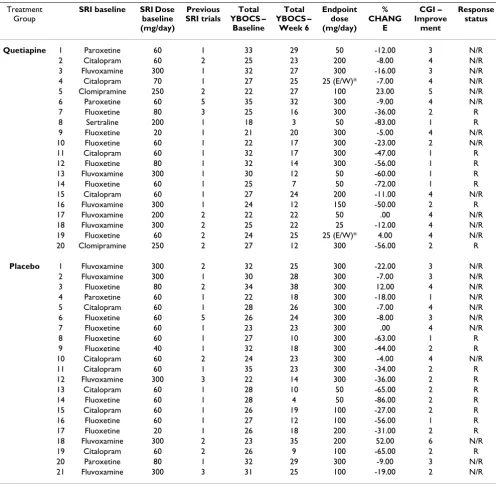
per-cent (n = 8/20) of subjects on quetiapine were classified as responders (YBOCS reduction of >25% from baseline and CGI-improvement score of 1 or 2) while 47.6% (n = 10/ 21) of subjects on placebo were classified as responders. A higher number of previous SRI trials for the each treat-ment group did not correlate with the degree of change on the YBOCS or the response status. Table 2 provides details of individual subject SRI doses, baseline clinical severity ratings and response status. Table 3 provides a summary of baseline and change scores for each of the primary and secondary outcome variables.
Of the 11 subjects with co-morbid tics, six were ran-domised to quetiapine. Endpoint data was missing for one subject on quetiapine. Of the remaining 10 subjects, 3 (quetiapine n = 2 (33%); placebo n = 1(20%)) were clas-sified as YBOCS responders. The reduction in the YGTSS did not differ significantly between treatment groups with tics (quetiapine -4.5, placebo -9.4; F = 2.8, p = .46).
Severity ratings for depressive symptoms (MADRS) were low at baseline (mean 10.6, SD 4.8), showed little change over the study period, and at week 6 remained similar for
YBOCS change for treatment groups Figure 1
YBOCS change for treatment groups Quetiapine and placebo groups improved significantly, without significant between group differences (F = 0.19; p = 0.636)
17
20
23
26
29
Placebo
Quetiapine
:HHN
:HHN
:HHN
:HHN
both groups (quetiapine = 8.2, SD 4.8; placebo = 7.7, SD 6.1).
The mean daily dose at week 6 for the quetiapine group was 168.75 mg (SD 120.82) compared to 228.57 mg (SD 99.46) per day for those on placebo. Quetiapine respond-ers (187.5 mg, SD 124.6) did not differ significantly from quetiapine non-responders (156.25 mg, SD 122.1) in their mean daily dose at Week 6 (p = .585). Furthermore,
[image:5.612.57.553.99.586.2]within the quetiapine group, participants receiving ≥ 200 mg/day (10/20 at week 6 demonstrated non-significant differences (F = 6.837, p = .988) and a marginally lower percentage reduction in YBOCS at endpoint (26.7%, SD 20.34) compared to those receiving a dose ≤ 200 mg/day (26.9%, SD 36.24) at endpoint.
Table 2: Baseline characteristics of treatment groups
Treatment Group
SRI baseline SRI Dose baseline (mg/day)
Previous SRI trials
Total YBOCS –
Baseline
Total YBOCS –
Week 6
Endpoint dose (mg/day)
% CHANG
E
CGI – Improve
ment
Response status Quetiapine 1 Paroxetine 60 1 33 29 50 -12.00 3 N/R
2 Citalopram 60 2 25 23 200 -8.00 4 N/R
3 Fluvoxamine 300 1 32 27 300 -16.00 3 N/R
4 Citalopram 70 1 27 25 25 (E/W)* -7.00 4 N/R
5 Clomipramine 250 2 22 27 100 23.00 5 N/R
6 Paroxetine 60 5 35 32 300 -9.00 4 N/R
7 Fluoxetine 80 3 25 16 300 -36.00 2 R
8 Sertraline 200 1 18 3 50 -83.00 1 R
9 Fluoxetine 20 1 21 20 300 -5.00 4 N/R
10 Fluoxetine 60 1 22 17 300 -23.00 2 N/R
11 Citalopram 60 1 32 17 300 -47.00 1 R
12 Fluoxetine 80 1 32 14 300 -56.00 1 R
13 Fluvoxamine 300 1 30 12 50 -60.00 1 R
14 Fluoxetine 60 1 25 7 50 -72.00 1 R
15 Citalopram 60 1 27 24 200 -11.00 4 N/R
16 Fluvoxamine 300 1 24 12 150 -50.00 2 R
17 Fluvoxamine 200 2 22 22 50 .00 4 N/R
18 Fluvoxamine 300 2 25 22 25 -12.00 4 N/R
19 Fluoxetine 60 2 24 25 25 (E/W)* 4.00 4 N/R
20 Clomipramine 250 2 27 12 300 -56.00 2 R
Placebo 1 Fluvoxamine 300 2 32 25 300 -22.00 3 N/R
2 Fluvoxamine 300 1 30 28 300 -7.00 3 N/R
3 Fluoxetine 80 2 34 38 300 12.00 4 N/R
4 Paroxetine 60 1 22 18 300 -18.00 1 N/R
5 Citalopram 60 1 28 26 300 -7.00 4 N/R
6 Fluoxetine 60 5 26 24 300 -8.00 3 N/R
7 Fluoxetine 60 1 23 23 300 .00 4 N/R
8 Fluoxetine 60 1 27 10 300 -63.00 1 R
9 Fluoxetine 40 1 32 18 300 -44.00 2 R
10 Citalopram 60 2 24 23 300 -4.00 4 N/R
11 Citalopram 60 1 35 23 300 -34.00 2 R
12 Fluvoxamine 300 3 22 14 300 -36.00 2 R
13 Citalopram 60 1 28 10 50 -65.00 2 R
14 Fluoxetine 60 1 28 4 50 -86.00 2 R
15 Citalopram 60 1 26 19 100 -27.00 2 R
16 Fluoxetine 60 1 27 12 100 -56.00 1 R
17 Fluoxetine 20 1 26 18 200 -31.00 2 R
18 Fluvoxamine 300 2 23 35 200 52.00 6 N/R
19 Citalopram 60 2 26 9 100 -65.00 2 R
20 Paroxetine 80 1 32 29 300 -9.00 3 N/R
21 Fluvoxamine 300 3 31 25 100 -19.00 2 N/R
Tolerability
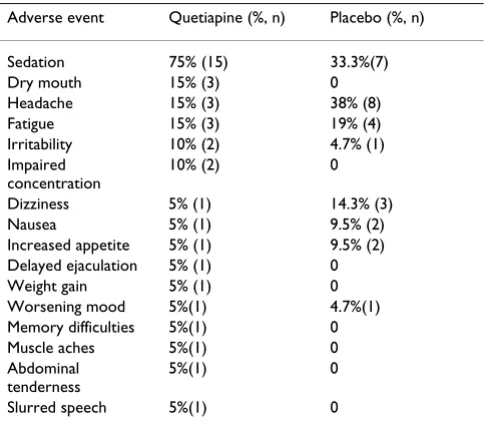
Quetiapine was generally well tolerated and no serious adverse events (SAE's) were reported through the course of the study period. Two patients on quetiapine withdrew from the study due to severe sedation (Week 1 and Week 4) that was judged to be drug related. Otherwise adverse events were in the mild to moderate range and were mostly self-limiting. No subjects on placebo withdrew from the study. Table 4 provides a list of the adverse events and their frequencies in the respective study groups.
Discussion
Our findings indicate that both quetiapine and placebo significantly reduced symptoms in subjects with OCD who had failed to respond adequately to 12 weeks of an SSRI and, that the difference between groups was not sig-nificant. Similarly in the subgroup with co-morbid tics, no preferential benefit was noted for quetiapine. Interest-ingly, the high placebo response was similar to that seen in a recent failed controlled trial of olanzapine [25], but stands in contrast to the positive studies in this area in which low placebo response rates were seen when demon-strating efficacy of quetiapine [23], risperidone [21], and olanzapine [24]. It is likely that features of study design or specific study population characteristics may have con-tributed to this finding and these are discussed below.
[image:6.612.54.555.99.297.2]First, the duration of a therapeutic trial of an SRI prior to augmentation with an antipsychotic should be of ade-quate dose and duration. In our study the majority of par-ticipants had failed only the single trial of an SRI on which they continued during the study (63.4% mean 1.59). Notably only six weeks of this treatment was required at the maximum tolerated dose. Despite the notion that an optimum trial of pharmacotherapy in OCD is 12 weeks, it may be argued that higher and ultimately effective doses of an SRI had not been maintained for an optimum duration prior to randomization. Given that therapeutic doses of SRIs in OCD are usually on the upper end of the dose range, it seems feasible that the high placebo response rate may reflect a response to SRI's once they had been administered at these higher doses for the additional six weeks of the study. It seems possible that the recent study by Shapira et al [25] may have been impacted by similar factors.
Table 3: Summary scores (baseline) and change scores for primary and secondary outcome variables.
Quetiapine Placebo
YBOCS (baseline) 26.4 (SD4.6) 27.7(SD3.9)
YBOCS (change at week 6) -7.1(SD7.2) -7.2(SD8.4)
YBOCS % change -26.9% -26%
CGI-Severity (baseline) 5.2 (SD0.8) 5.3 (SD0.8)
CGI-Severity (week 6) 4.1 (SD1.4) 4.1(SD1.5)
MADRS (baseline) 10.6 (SD 4.8) 10.71 (SD 9.8)
MADRS (change at week 6) -2.6 (SD 6.5) -3 (SD 8.3)
SDS (baseline) 17.9 (SD 5.3) 19.6(SD4.7)
SDS (change at week 6) -5.3(SD5.6) -6.1 (SD4.8)
YGTSS (baseline) 24.7 (SD 19.3) 22.6(SD 22.3)
YGTSS (change at week 6) -4.5(SD 5.1) -9.4 (SD 14.6)
YGTSS % change -18.2% -41.6%
Table 4: Percentage of subjects for each treatment group reporting adverse events
Adverse event Quetiapine (%, n) Placebo (%, n)
Sedation 75% (15) 33.3%(7)
Dry mouth 15% (3) 0
Headache 15% (3) 38% (8) Fatigue 15% (3) 19% (4) Irritability 10% (2) 4.7% (1) Impaired
concentration
10% (2) 0
Dizziness 5% (1) 14.3% (3)
Nausea 5% (1) 9.5% (2)
Increased appetite 5% (1) 9.5% (2) Delayed ejaculation 5% (1) 0 Weight gain 5% (1) 0 Worsening mood 5%(1) 4.7%(1) Memory difficulties 5%(1) 0 Muscle aches 5%(1) 0 Abdominal
tenderness
5%(1) 0
[image:6.612.55.297.357.570.2]In a second and related point; the number of previous SRI trials in the subgroup receiving quetiapine did not predict a poorer response to treatment. This effect is probably related to the lack of statistical power to detect these dif-ferences in a group in which the low number of previous SRI trials was a distinguishing characteristic. Certainly, previous positive studies in this area have used relatively more refractory groups based on the number of previously failed SRI trials. Taken together with the first point above, we suggest that future work in this area should consider longer periods at maximum tolerated doses of SRI's prior to categorisation of subjects as treatment refractory.
Third, the use of a slow up-titration resulted in a relatively low mean daily dose being administered for the majority of the study. For instance, a mean daily (week 6) dose of 168 mg/day in the quetiapine group (median 175 mg) had only been achieved for the final two weeks of the study. These doses are comparably low to those used in the negative single-blind study using low dose quetiapine by Sevincok et al [19]. In contrast the positive study using quetiapine by Denys et al [23] employed a more rapid up-titration and a fixed-dose design. This meant that subjects were exposed to 200 mg daily doses that were generally well tolerated, from the start of week 3. The authors of this study were able to show significant YBOCS differences between groups from the end of week 4. Similarly Mc Dougle et al [21], using risperidone, began treatment on 1 mg per day for one week and permitted weekly 1 mg incre-mental increases for 6 weeks. They found that by the beginning of week 2, most subjects were on or around the mean daily dose for treatment responders (2.2 mg). Despite the significant improvement in the quetiapine group demonstrated in our study, the apparent lack of benefit of doses higher than 200 mg per day may seem surprising, however, we cannot rule out the possibility that administering these higher doses for an adequate duration would have changed the outcome. In addition it must be noted that in our study the quetiapine group reported high rates of sedation (n = 15, 75%) and a 10% (n = 2) rate of premature withdrawal was experienced. As such it seems likely that a more aggressive up-titration schedule might have resulted in even higher rates of with-drawal. By comparison, rates of sedation were equally high, but did not appear to restrict use of the more rapid up-titration in the study by Denys et al [23]. Certainly evi-dence of efficacy using lower doses has been demon-strated in studies of 6 and 8 weeks duration [21,23,24], and it seems that therapeutically adequate doses should probably be reached earlier than week 4 in a 6 week study.
Fourth, the impact of repeated clinical assessments and rating of relatively small changes in clinical severity com-bined with regular dose increases, may conceivably have increased the placebo response rates resulting from
increased optimism, a tendency to over-report improve-ments and belief that higher doses are more likely to be more effective than lower doses. This may be particularly true for the placebo-treated group that were considerably less likely to report sedation as an adverse event and as such were more likely to have their treatment dose increased at each visit. Our results differ, with respect to placebo response, from a considerable literature that sug-gests a consistently lower placebo response rate in treat-ment trials in OCD than in other mood and anxiety disorders. While we believe that the reasons (1–3) dis-cussed above probably provide the main reasons for our finding, the impact of repeated assessments and the potential effect thereof cannot be entirely discounted.
Conclusions
Despite significant improvement in each of the study groups, response to quetiapine augmentation in SRI non-responders, failed to separate from placebo treated sub-jects at the end of the six week treatment phase. A number of limitations in study design make comparisons with pre-vious studies in this area difficult and probably contrib-uted to our negative findings. Future work in this important clinical area should address these limitations.
Competing interests
Dr. Stein has received research grants and/or consultancy honoraria from Astrazeneca, Eli-Lilly, GlaxoSmithKline, Lundbeck, Orion, Pfizer, Pharmacia, Roche, Servier, Solvay, Sumitomo, and Wyeth.
Authors' contributions
PDC drafted manuscript and analysed data, BV protocol design, SS protocol design, JEM drafting of manuscript, statistical design, data acquisition, MVM protocol design, DJS principal investigator, protocol design, drafting of manuscript.
Acknowledgements
This study was funded by Astra ZenecaThe authors wish to acknowledge the contribution of the participating investigators: Dr's, Maud, Mohr, Nel, Potgieter, Russouw and Verster
References
1. Murray CJL LAD: Global burden of disease: a comprehensive assessment of mortality from diseases injuries and risk factors in 1990 and projected to 2020 Harvard: WHO; 1996.
2. Greist JH, Bandelow B, Hollander E, Marazziti D, Montgomery SA, Nutt DJ, Okasha A, Swinson RP, Zohar J: WCA recommenda-tions for the long-term treatment of obsessive-compulsive disorder in adults. CNS Spectr 2003, 8:7-16.
3. Greist JH, Jefferson JW: Pharmacotherapy for obsessive-com-pulsive disorder. Br J Psychiatry Suppl 1998:64-70.
4. Pigott TA, Seay SM: A review of the efficacy of selective serot-onin reuptake inhibitors in obsessive-compulsive disorder. J Clin Psychiatry 1999, 60:101-106.
Publish with BioMed Central and every scientist can read your work free of charge "BioMed Central will be the most significant development for disseminating the results of biomedical researc h in our lifetime."
Sir Paul Nurse, Cancer Research UK
Your research papers will be:
available free of charge to the entire biomedical community
peer reviewed and published immediately upon acceptance
cited in PubMed and archived on PubMed Central
yours — you keep the copyright
Submit your manuscript here:
http://www.biomedcentral.com/info/publishing_adv.asp
BioMedcentral 6. Stein DJ, Bouwer C, Hawkridge S, Emsley RA: Risperidone
aug-mentation of serotonin reuptake inhibitors in obsessive-compulsive and related disorders. J Clin Psychiatry 1997,
58:119-122.
7. Pfanner C, Marazziti D, Dell'Osso L, Presta S, Gemignani A, Milan-franchi A, Cassano GB: Risperidone augmentation in refractory obsessive-compulsive disorder: an open-label study 1. Int Clin Psychopharmacol 2000, 15:297-301.
8. Weiss EL, Potenza MN, McDougle CJ, Epperson CN: Olanzapine addition in obsessive-compulsive disorder refractory to selective serotonin reuptake inhibitors: an open-label case series. J Clin Psychiatry 1999, 60:524-527.
9. Koran LM, Ringold AL, Elliott MA: Olanzapine augmentation for treatment-resistant obsessive-compulsive disorder. J Clin Psychiatry 2000, 61:514-517.
10. Francobandiera G: Olanzapine augmentation of serotonin uptake inhibitors in obsessive-compulsive disorder: an open study. Can J Psychiatry 2001, 46:356-358.
11. Crocq MA, Leclercq P, Guillon MS, Bailey PE: Open-label olanzap-ine in obsessive-compulsive disorder refractory to antide-pressant treatment. Eur Psychiatry 2002, 17:296-297.
12. D'Amico G, Cedro C, Muscatello MR, Pandolfo G, Di Rosa AE, Zoc-cali R, La Torre D, D'Arrigo C, Spina E: Olanzapine augmentation of paroxetine-refractory obsessive-compulsive disorder. Prog Neuropsychopharmacol Biol Psychiatry 2003, 27:619-623.
13. Bogetto F, Bellino S, Vaschetto P, Ziero S: Olanzapine augmenta-tion of fluvoxamine-refractory obsessive-compulsive disor-der (OCD): a 12-week open trial. Psychiatry Res 2000, 96:91-98. 14. Osmen M, Kemal Y, Senel T: Amisulpride augmentation in
treatment-resistant obsessive-compulsive disorder. An open trial. Hum Psychopharmacol 2003, 18:463-467.
15. Atmaca M, Kuloglu M, Tezcan E, Gecici O: Quetiapine augmenta-tion in patients with treatment resistant obsessive-compul-sive disorder: a single-blind, placebo-controlled study. Int Clin Psychopharmacol 2002, 17:115-119.
16. Denys D, van Megen H, Westenberg H: Quetiapine addition to serotonin reputake inhibitor treatment in patients with treatment-refractory obsessive-compulsive disorder: an open-label study. J Clin Psychiatry 2002, 63:700-703.
17. Francobandiera G: Quetiapine augmentation of sertraline in obsessive-compulsive disorder. J Clin Psychiatry 2002,
63:1046-1047.
18. Mohr N, Vythilingum B, Emsley RA, Stein DJ: Quetiapine augmen-tation of serotonin reuptake inhibitors in obsessive-compul-sive disorder. Int Clin Psychopharmacol 2002, 17:37-40.
19. Sevincok L, Topuz A: Lack of efficacy of low doses of quetiapine addition in refractory obsessive-compulsive disorder.J Clin Psychopharmacol 2003, 23:448-450.
20. McDougle CJ, Goodman WK, Leckman JF, Lee NC, Heninger GR, Price LH: Haloperidol addition in fluvoxamine-refractory obsessive-compulsive disorder. A double-blind, placebo-con-trolled study in patients with and without tics. Arch Gen Psychiatry 1994, 51:302-308.
21. McDougle CJ, Epperson CN, Pelton GH, Wasylink S, Price LH: A double-blind, placebo-controlled study of risperidone addi-tion in serotonin reuptake inhibitor-refractory obsessive-compulsive disorder. Arch Gen Psychiatry 2000, 57:794-801. 22. Hollander E, Rossi NB, Sood E, Pallanti S: Risperidone
augmenta-tion in treatment-resistant obsessive-compulsive disorder: a
double-blind, placebo-controlled study. Int J
Neuropsychopharmacol 2003, 6:397-401.
23. Denys D, de Geus F, van Megen H, Westenberg H: A double-blind, randomized, placebo-controlled trial of quetiapine addition in patients with obsessive-compulsive disorder refractory to serotonin reuptake inhibitors.Journal of Clinical Psychiatry 2004,
65:1040-1048.
24. Bystritsky A, Ackerman DL, Rosen RM, Vapnik T, Gorbis E, Maidment KM, Saxena S: Augmentation of serotonin reuptake inhibitors in refractory obsessive-compulsive disorder using adjunctive olanzapine: a placebo-controlled trial. J Clin Psychiatry 2004,
65:565-568.
25. Shapira NA, Ward HE, Mandoki M, Murphy TK, Yang MC, Blier P, Goodman WK: A double-blind, placebo-controlled trial of olanzapine addition in fluoxetine-refractory obsessive-com-pulsive disorder. Biol Psychiatry 2004, 55:553-555.
26. Mundo E, Richter MA, Zai G, Sam F, McBride J, Macciardi F, Kennedy JL: 5HT1Dbeta Receptor gene implicated in the pathogenesis of Obsessive-Compulsive Disorder: further evidence from a family-based association study. Mol Psychiatry 2002, 7:805-809. 27. Mundo E, Richter MA, Sam F, Macciardi F, Kennedy JL: Is the
5-HT(1Dbeta) receptor gene implicated in the pathogenesis of obsessive-compulsive disorder? Am J Psychiatry 2000,
157:1160-1161.
28. Sheehan DV, Lecrubier Y, Sheehan KH, Amorim P, Janavs J, Weiller E, Hergueta T, Baker R, Dunbar, G.C.: The Mini-International Neuropsychiatric Interview (M.I.N.I.): the development and validation of a structures diagnostic psychiatric interview for DSM-IV and ICD-10. J Clin Psychiatry 1998, 59:22-33.
29. Diagnostic and Statistical Manual for Mental Disorders Fourth Edition TR: Washington, D.C., American Psychiatric Association; 2002. 30. Goodman WK, Price LH, Rasmussen SA, Mazure C, Delgado P,
Heninger GR, Charney DS: The Yale-Brown Obsessive Compul-sive Scale. II. Validity. Arch Gen Psychiatry 1989, 46:1012-1016. 31. Goodman WK, Price LH, Rasmussen SA, Mazure C, Fleischmann RL,
Hill CL, Heninger GR, Charney DS: The Yale-Brown Obsessive Compulsive Scale. I. Development, use, and reliability.Arch Gen Psychiatry 1989, 46:1006-1011.
32. Guy W: ECDU Assessment Manual for Psychopharmacology National Institute of Mental Health, Research Branch; 1976:313-331. 33. Montgomery SA, Asberg M: A new depression scale designed to
be sensitive to change. Br J Psychiatry 1979, 134:382-389. 34. Sheehan DV: The Anxiety Disease Edited by: University of SouthFlorida
DPBM. New York, Scribners; 1983.
35. Leckman JF, Riddle MA, Hardin MT, Ort SI, Swartz KL, Stevenson J, Cohen DJ: The Yale Global Tic Severity Scale: initial testing of a clinician-rated scale of tic severity. J Am Acad Child Adolesc Psychiatry 1989, 28:566-573.
Pre-publication history
The pre-publication history for this paper can be accessed here: