IOP Conference Series: Materials Science and Engineering
PAPER • OPEN ACCESS
Compatibility improvement method of empty fruit
bunch fibre as a replacement material in cement
bonded boards: A review
To cite this article: Hayana Dullah et al 2017 IOP Conf. Ser.: Mater. Sci. Eng. 271 012076
View the article online for updates and enhancements.
Related content
Resistivity of carbon from oil palm bunches: percolation theory
M Deraman
-Mechanical properties of unidirectional oil palm empty fruit bunch (OPEFB) fiber reinforced epoxy composite
C S Hassan, C W Yeo, B Sahari et al.
-The effect of alkaline treatments soaking time on oil palm empty fruit bunch (OPEFB) fibre structure
M K Faizi, A B Shahriman, M S Abdul Majid et al.
-Recent citations
Response of coir fibre reinforced cement composites to water repellent chemical additive and microwave accelerated curing
Banjo A. Akinyemi et al
1234567890
GCoMSE2017 IOP Publishing
IOP Conf. Series: Materials Science and Engineering 271 (2017) 012076 doi:10.1088/1757-899X/271/1/012076
Compatibility improvement method of empty fruit bunch
fibre as a replacement material in cement bonded boards: A
review
Hayana Dullah1, Zainal Abidin Akasah1*, Nik Mohd Zaini Nik Soh1, Sajjad Ali Mangi1
1
Faculty of Civil and Environmental Engineering, UTHM Malaysia *Corresponding author: [email protected]
Abstract. The utilization of oil palm empty fruit bunch (OPEFB) fibre on bio-composite product has been introduced to replace current material mainly wood fibre. OPEFB is widely available as palm oil is one of the major agricultural crops in Malaysia. EFB fibre are lignocellulosic materials that could replace other natural fibre product especially cement bonded board. However, the contains of residual oil and sugar in EFB fibre has been detected to be the reason for incompatibility issue between EFB fibre and cement mixtures. Regarding on the issue, a study has been conducted widely on finding the suitable pre-treatment method for EFB fibre to remove carbohydrate contained in the said fibre that are known to inhibit cement hydration. Aside from that, cement accelerator was introduced to enhance the hydration of cement when it was mixed with natural fibre. Hence, this paper will summaries the previous findings and in-depth study on the use of EFB fibre as a replacement material in cement bonded fibre boards.
1.Introduction
The potential use of natural fibre as bio-composites has been accepted globally, because it is cheap, sustainable, biodegradable and reduces the carbon dioxide (CO2) emissions [1]. The use of wood fibre has been increased rapidly as a natural composite in cement based products i.e. cement bonded board [2]. However, the utilization of wood fibre will lead to the increase demand of forest sources. Ultimately, the use of wood fibre as a bio-composites material will increase the rate of deforestation [3]. The growth in the use of palm oil production caused the environmental issue and created solid waste in terms of abundance quantity of empty fruit bunch (EFB) from oil palm mills [4]. Oil palm empty fruit bunch fibre (OPEFB) is the most important fibre that is readily available within Malaysia. subsequently, the attention is required on the production of OPEFB-cement products and study on the incompatibility of cement and OPEFB fibre. The issue of compatibility between natural fibre and cement has been highlighted in many previous studies on application of bio-composites. Based on research by Yi, et al. [5], there is compatibility issue between cement and fibre due to the existing of hemi-cellulose, starch, sugar, tannins and lignin which appear to inhibit significantly the setting of cement hydration.
2
1234567890
GCoMSE2017 IOP Publishing
IOP Conf. Series: Materials Science and Engineering 271 (2017) 012076 doi:10.1088/1757-899X/271/1/012076
fibre board (CBFB) used by previous researchers. It is expected that this information will provide an idea to utilize OPEFB as a main material for cement bonded composites.
2.Previous research work
This paper summarises the previous findings on the factors that affect compatibility, improving compatibility, pre-treatment and the use of chemical additive as cement accelerator by utilizing EFB fibre.
2.1.Factors affecting compatibility
The compatibility affecting of EFB fibre on cement is consisted by a number of factors. One of the factors is of EFB fibre's wide range of carbohydrates such as hemi-cellulose, starch, sugar, tannins and lignin that are known to inhibit normal setting and delayed the setting time of the cement matrix [8]. The natural fibre cannot be used directly on cement matrix due to the existence of residual oil that interrupts the penetration of binding agent and thus affecting the properties of the final EFB-products [9, 10].
2.2.Method of compatibility improvement
Many researchers carried a series of tests to improve the compatibility of fibre and cement by using some modification of fibre method mainly physical, chemical and thermal pre-treatments (extraction or soaking of wood particles in some solutions such as hot water and sodium hydroxide before its mixing with cement) [11, 12]. Natural fibre needs to be modified before being utilized on cement bonded board, thus reducing carbohydrate contained in EFB fibre is essential to improve the bonding between EFB fibre and cement.
1234567890
GCoMSE2017 IOP Publishing
[image:4.595.83.514.113.602.2]IOP Conf. Series: Materials Science and Engineering 271 (2017) 012076 doi:10.1088/1757-899X/271/1/012076
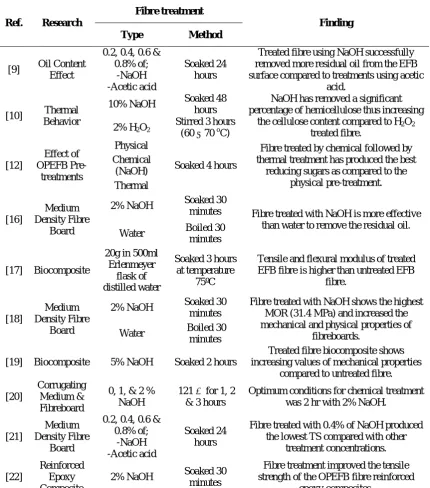
Table 1: Previous study on EFB pre-treatment method.
Ref. Research
Fibre treatment
Finding
Type Method
[9] Oil Content Effect
0.2, 0.4, 0.6 & 0.8% of;
-NaOH -Acetic acid
Soaked 24 hours
Treated fibre using NaOH successfully removed more residual oil from the EFB surface compared to treatments using acetic
acid.
[10] Thermal
Behavior
10% NaOH Soaked 48
hours
NaOH has removed a significant percentage of hemicellulose thus increasing
the cellulose content compared to H2O2
treated fibre. 2% H2O2 Stirred 3 hours
(60 – 70 oC)
[12]
Effect of OPEFB
Pre-treatments
Physical
Soaked 4 hours
Fibre treated by chemical followed by thermal treatment has produced the best
reducing sugars as compared to the physical pre-treatment. Chemical (NaOH) Thermal [16] Medium Density Fibre Board
2% NaOH Soaked 30
minutes Fibre treated with NaOH is more effective than water to remove the residual oil.
Water Boiled 30
minutes
[17] Biocomposite
20g in 500ml Erlenmeyer
flask of distilled water
Soaked 3 hours at temperature
75ºC
Tensile and flexural modulus of treated EFB fibre is higher than untreated EFB
fibre.
[18]
Medium Density Fibre
Board
2% NaOH Soaked 30
minutes
Fibre treated with NaOH shows the highest MOR (31.4 MPa) and increased the mechanical and physical properties of
fibreboards.
Water Boiled 30
minutes
[19] Biocomposite 5% NaOH Soaked 2 hours
Treated fibre biocomposite shows increasing values of mechanical properties
compared to untreated fibre.
[20]
Corrugating Medium & Fibreboard
0, 1, & 2 % NaOH
121 ℃ for 1, 2 & 3 hours
Optimum conditions for chemical treatment was 2 hr with 2% NaOH.
[21]
Medium Density Fibre
Board
0.2, 0.4, 0.6 & 0.8% of;
-NaOH -Acetic acid
Soaked 24 hours
Fibre treated with 0.4% of NaOH produced the lowest TS compared with other
treatment concentrations.
[22]
Reinforced Epoxy Composite
2% NaOH Soaked 30
minutes
Fibre treatment improved the tensile strength of the OPEFB fibre reinforced
epoxy composites.
Sodium hydroxide (NaOH) is reportedly could modify the surface of EFB fibre and disrupts the crystalline region in the cellulose, thus undergo complete de-crystallization and weaken the energy bonding of cellulose [13, 14]. Furthermore, oil and impurities of EFB fibre could be removed by using chemical pre-treatment method. It was noted by Ndazi et al. [24] that the sodium hydroxide (NaOH) have good ability to break hydrogen bonding in network structure of fibre cellulose which can increase fibre surface roughness. From Table 1, Sodium hydroxide (NaOH) is the reagent that is widely used for EFB fibre pre-treatments, which can be conducted over a wide range of operating condition such as different concentration of NaOH and soak period of EFB fibre.
4
1234567890
GCoMSE2017 IOP Publishing
IOP Conf. Series: Materials Science and Engineering 271 (2017) 012076 doi:10.1088/1757-899X/271/1/012076
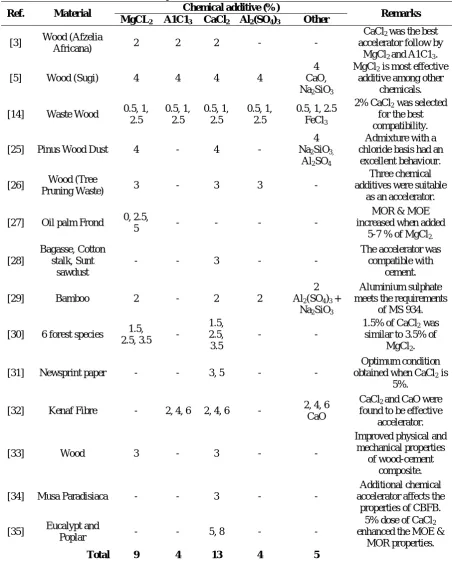
[image:5.595.70.523.174.736.2]compatibility of fibre-cement water mixtures are summarized in Table 2. Normally the percentage of chemical additive that have been used in range between 0.5 – 5% depending on the type of chemical. Based on the table, the favourable type of chemical used as cement accelerator is calcium chloride (CaCl2) followed by magnesium chloride (MgCL2).
Table 2: Previous study of chemical additive used as cement accelerator.
Ref. Material Chemical additive (%) Remarks
MgCL2 A1C13 CaCl2 Al2(SO4)3 Other
[3] Wood (Afzelia
Africana) 2 2 2 - -
CaCl2 was the best
accelerator follow by MgCl2 and A1C13.
[5] Wood (Sugi) 4 4 4 4
4 CaO, Na2SiO3
MgCl2 is most effective
additive among other chemicals.
[14] Waste Wood 0.5, 1,
2.5 0.5, 1, 2.5 0.5, 1, 2.5 0.5, 1, 2.5
0.5, 1, 2.5 FeCl3
2% CaCl2 was selected
for the best compatibility.
[25] Pinus Wood Dust 4 - 4 -
4 Na2SiO3,
Al2SO4
Admixture with a chloride basis had an
excellent behaviour.
[26] Wood (Tree
Pruning Waste) 3 - 3 3 -
Three chemical additives were suitable
as an accelerator.
[27] Oil palm Frond 0, 2.5,
5 - - - -
MOR & MOE increased when added
5-7 % of MgCl2.
[28]
Bagasse, Cotton stalk, Sunt
sawdust
- - 3 - -
The accelerator was compatible with
cement.
[29] Bamboo 2 - 2 2
2 Al2(SO4)3 +
Na2SiO3
Aluminium sulphate meets the requirements
of MS 934.
[30] 6 forest species 1.5,
2.5, 3.5 -
1.5, 2.5, 3.5
- -
1.5% of CaCl2 was
similar to 3.5% of MgCl2.
[31] Newsprint paper - - 3, 5 - -
Optimum condition obtained when CaCl2 is
5%.
[32] Kenaf Fibre - 2, 4, 6 2, 4, 6 - 2, 4, 6
CaO
CaCl2 and CaO were
found to be effective accelerator.
[33] Wood 3 - 3 - -
Improved physical and mechanical properties
of wood-cement composite.
[34] Musa Paradisiaca - - 3 - -
Additional chemical accelerator affects the
properties of CBFB.
[35] Eucalypt and
Poplar - - 5, 8 - -
5% dose of CaCl2
enhanced the MOE & MOR properties.
1234567890
GCoMSE2017 IOP Publishing
IOP Conf. Series: Materials Science and Engineering 271 (2017) 012076 doi:10.1088/1757-899X/271/1/012076
It was observed that additional chemical additive can modify the setting time of cement hydration for utilization of natural fibre into cement bonded fibre board products. Early study on utilization of oil palm fibre was conducted by Hermawan et al. [27] to cement bonded fibre board product which was reported to enhance the mechanical performance with addition of 5-7 % of MgCl2. However, the additional of other accelerator need to be emphasized based on previous studies that applied several types of chemical accelerator on different type of natural fibre which have same structural composition with EFB fibre. Therefore, other types of chemical additive should also need to be considered to accelerate the setting time of EFB fibre-cement mixture.
3.Conclusion
Based on the extensive literature review as suggested by the several researchers, the following conclusions have been drawn;
(a) EFB fibre can be utilized as replacement of other natural fibre i.e. wood fibre by improvement method of chemical treatment with sodium hydroxide (NaOH) which could remove the part of hemicellulose and lignin contains present in EFB fibre.
(b) Amount of silica body removed in EFB fibre is depend to the concentration of Sodium Hydroxide (NaOH) and soaking period.
(c) It was perceived from the previous studies that the cement accelerator could affect the hydration setting and compressive strength of cement-bonded fibre boards.
(d) Chemical additive by using CaCl2 and MgCl2 seems to be a good potential as they increased the setting time of cement matrix.
As per conclusions above, it is recommended to modify the structure of EFB fibre by using Sodium Hydroxide (NaOH) as a pre-treament agent and additional of cement-curing accelerator i.e. calcium chloride (CaCl2) and magnesium chloride (MgCl2) to improve the compatibility between EFB fibre and cement for the cement bonded board product. However, it is essential to study on the different concentration of the chemicals to observe the optimum percentage for application of EFB fibre since there are very limited and rare to found published research finding about the effect of EFB fibre as a main material for the cement bonded board product.
4. References
[1] Brandt A M 2008 Fibre reinforced cement-based (FRC) composites after over 40 years of development in building and civil engineering Compos. Struct.86 (1–3) 3–9
[2] Kochova K, Schollbach K and Brouwers H J H 2015 Use of alternative fibres in wood wool cement boards and their influence on cement hydration 19th International Conference on Building Materials (London:ICABMMA 2017) pp 1375–1382
[3] Sotannde O A, Oluwadare A O, Ogedoh O and Adeogun P F 2012 Evaluation of cement-bonded particle board produced from Afzelia africana wood residues J. Engineering Sci. Technolology7 (6) 732–743
[4] Sumathi S, Chai S P and Mohamed A R 2008 Utilization of oil palm as a source of renewable energy in Malaysia,” Renew. Sustain. Energy Rev.12 (9) 2404–2421
[5] Yi M W, Tomita B, Hiramatsu Y, Miyatake A and Fujii T 2002 Study of hydration behaviors of wood-cement mixtures: Compatibility of cement mixed with wood fiber strand obtained by the water-vapor explosion process J. Wood Sci.48 (5) 365–373
[6] Bin N, Zhiqiang W, Haiqin W and Xiaoning L 2014 Wood-cement compatibility review Wood Research 59 (5) 813–826
[7] Karade S R 2010 Cement-bonded composites from lignocellulosic wastes Constr. Build. Mater.
24 (8) 1323–1330
6
1234567890
GCoMSE2017 IOP Publishing
IOP Conf. Series: Materials Science and Engineering 271 (2017) 012076 doi:10.1088/1757-899X/271/1/012076
[9] Ibrahim Z, Abdul Aziz A and Ramli R 2015 Effect of treatment on the oil content and surface morphology of oil palm (Elaeis guineensis) empty fruit bunches ( EFB ) fibres Wood Research60 (1) 157–166
[10] Hassan N S and Badri K 2016 Thermal behaviors of oil palm empty fruit bunch fiber upon exposure to acid-base aqueous solutions Malaysian J. Anal. Sci.20 (5) 1095–1103
[11] Aanifah F J M, Yee P L, Wasoh H and Abd-Aziz S 2014 Effect of different alkaline treatment on the release of ferulic acid from oil palm empty fruit bunch fibres J. Oil Palm Res.26 (4) 321–331
[12] Ariffin H, Hassan M A, Md Shah U K, Abdullah N and Shirai Y 2008 Effect of physical, chemical and thermal pretreatments on the enzymatic hydrolysis of oil palm empty fruit bunch (OPEFB) (Kesan prarawatan fizikal, kimia dan termal terhadap hidrolisis enzimitik tandan kosong kelapa sawit) J. Trop. Agric. and Fd. Sc. 36 (2) 1–10
[13] Frybort S, Mauritz R., Teischinger A and Müller U 2008 Cement bonded composites - A mechanical review BioResources3 (2) 602–626
[14] Wang L, Chen S S, Tsang D C W, Chi S P and Kaimin S 2016 Value-added recycling of construction waste wood into noise and thermal insulating cement-bonded particleboards
Constr. Build. Mater. 125 316–325
[15] Nazerian M and Sadeghiipanah V 2013 Cement-bonded particleboard with a mixture of wheat straw and poplar wood J. For. Res.24 (2) 381–390
[16] Ramli R, Shaler S and Jamaludin M A 2002 Properties of Medium density fibreboard from oil palm empty fruit bunch J. oil palm Res. 14 (2) 34–40
[17] Suradi S S, Yunus R M, Beg M D H and Yusof Z A M 2009 Influence pre-treatment on the properties of lignocellulose based biocomposite National Conference on Postgraduate Research (NCON-PGR) 2009 67–78
[18] Norul Izani M A, Paridah M T, Mohd Nor M Y and Anwar U M K 2013 Properties of medium-density fibreboard (MDF) made from treated empty fruit bunch of oil palm J. Trop. For. Sci. 25 (2) 175–183
[19] Senawi R, Mohd Alauddin S, Mohd Saleh R and Shueb M I 2013 Polylactic acid/empty fruit bunch fiber biocomposite: Influence of alkaline and silane treatment on the mechanical properties Int. J. Biosci. Biochem. Bioinforma3 (1) 59–61
[20] Mulyantara H L T, Rizaluddin A T, Nakagawa I A and Ohi H 2015 Properties of fibers prepared from oil palm empty fruit bunch for use as corrugating medium and fiberboard J―STAGE
Adv.1148 1349–1159
[21] Ibrahim Z, Ahmad M, Aziz A A, Ramli R, Jamaludin M A, Muhammed S and Alias A H 2016 Dimensional Stability Properties of Medium Density Fibreboard (MDF) from Treated Oil Palm (Elaeis guineensis) Empty Fruit Bunches (EFB) Fibres, Open J. Compos. Mater., 6 (4) 91–99
[22] Hassan S, Chellaiah N R, Sahari B, Salit M S and Abdul Aziz N 2016 Effect of chemical treatment on oil palm empty fruit bunch (OPEFB) fiber on water absorption and tensile properties of OPEFB fiber reinforced epoxy composite Key Engineering Materials701 295– 299.
[23] Mat Soom R, Wan Hassan W H, Md Top A G and Hassan K 2006 Thermal properties of oil palm fibre J. Palm Oil Res.18 272–277
[24] Ndazi B S, Karlsson S, Tesha J V and Nyahumwa C W 2007 Chemical and physical
modifications of rice husks for use as composite panels Compos. Part A Appl. Sci. Manuf.38 (3) 925–935
[25] Matoski A, Hara M M, Iwakiri S and Casali J M 2013 Influence of accelerating admixtures in wood-cement panels: Characteristics and properties Acta Sci. Technology35 (4) 655–660 [26] Nasser R A, Salem M Z M, Al-Mefarrej H A and Aref I M 2016 Use of tree pruning wastes for
manufacturing of wood reinforced cement composites Cem. Concr. Compos.72 246–256 [27] Hermawan D, Hata T, Kawai S, Nagadomi W and Kuroki Y 2002 Manufacturing oil palm
fronds cement-bonded board cured by gaseous or supercritical carbon dioxide J. Wood Sci.
1234567890
GCoMSE2017 IOP Publishing
IOP Conf. Series: Materials Science and Engineering 271 (2017) 012076 doi:10.1088/1757-899X/271/1/012076
[28] Mohamed T E 2004 Effects of mixing some wood and non-wood lignocellulosic materials on the properties of cement and resin- bonded particleboard University of Khartoum Ph.D Thesis [29] Sudin R and Swamy N 2006 Bamboo and wood fibre cement composites for sustainable
infrastructure regeneration Journal of Materials Science, 41 (21) 6917–6924 [30] Noor Azrieda A R, Razali A K, Izran K, Rahim S and Adbul Aziz M 2009 Hydration
permormance of cement-bonded wood composites: Compatibility assessment of six pioneer forest species Borneo Sci.25 47–58
[31] Ashori A, Tabarsa T and Valizadeh I 2011 Fiber reinforced cement boards made from recycled newsprint paper Mater. Sci. Engineering A528 (25–26) 7801–7804
[32] Amel B A, Paridah M T, Rahim S, Osman Z, Zakiah A and Ahmed S H 2014 Effects of kenaf bast fibres on hydration behaviour of cement J. Trop. For. Sci. 26 (3) 340–346
[33] de Castro V G, Braz R L, Azambuja R R, Loiola P L, Iwakiri S and Matos J L M 2015 Wood-cement boards of Eucalyptus saligna with different chemical additives and methods of formation Floresta45 (2) 349–360
[34] Ogunsile B O and Adepegba J A 2015 Cement bonded particle board from Musa paradisiaca stalk Pacific J. Sci. Technol. 16 (1) 12–20
[35] Ashori A, Tabarsa T, Azizi K and Mirzabeygi R 2011 Wood-wool cement board using mixture of eucalypt and poplar Ind. Crops Prod. 34 (1) 1146–1149
Acknowledgments