Journal of Chemical and Pharmaceutical Research, 2016, 8(4):749-756
Research Article
CODEN(USA) : JCPRC5
ISSN : 0975-7384
Optimizing coagulation process by using sludge produced in the water
treatment plant
M. Farhaoui
1and M. Derraz
21
National Office of Electricity and Drinking Water, Meknes, Morocco
2Biology Department, University of My Ismail, Meknes, Morocco
_____________________________________________________________________________________________
ABSTRACT
In the water treatment processes, the coagulation and flocculation processes produce sludge according to the level of the water turbidity. The aluminum sulfate is the most common coagulant used in water treatment plants of Morocco as well as many countries. It is difficult to manage Sludge produced by the treatment plant. However, it can be used in the process to improve the quality of the treated water and reduce the aluminum sulfate dose. In this study, the effectiveness of sludge was evaluated at different turbidity levels (low, medium and high turbidity) and coagulant dosage to find optimal operational conditions. The influence of settling time was also studied. A set of jar test experiments was conducted to find the sludge and aluminum sulfate dosages in order to improve the produced water quality for different turbidity levels. Results demonstrated that using sludge produced by the treatment plant can improve the quality of the produced water and reduce the aluminum sulfate using. The aluminum sulfate dosage can be reduced from 40 to 50% according to the turbidity level (10, 20 and 40 NTU). Results show that sludge can be used in order to reduce the aluminum sulfate dosage and improve the quality of treated water. The highest turbidity removal efficiency is observed within 6 mg/l of aluminum sulfate and 35 mg/l of sludge in low turbidity, 20 mg/l of aluminum sulfate and 50 mg/l of sludge in medium turbidity and 20 mg/l of aluminum sulfate and 60 mg/l of sludge in high turbidity. The turbidity removal efficiency is 97.56%, 98.96% and 99.47% respectively for low, medium and high turbidity levels.
Key words: Coagulation process, sludge, Turbidity removal, aluminum sulfate, coagulant dose.
_____________________________________________________________________________________________
INTRODUCTION
The demand on water supply is increasing over the last century due to improved lifestyle, industrial development and population growth. This increased demand is facing a paradox to produce treated water with high quality at lower cost. In order to reduce the water cost, it is very important to optimize the operating expenses in the water treatment plant (power, chemicals, operator’s expenses…) and many measures should be taken in this vision.
to treat different levels of turbidity (75, 150 and 300 NTU). Eman [3] tried MoringaOleifera seed in the coagulation process to treat low turbid water in Malaysia. However, Aho [4] highly recommended the use of this natural coagulant in the domestic turbid water purification in Nigeria. Other natural coagulants are proposed as an important alternative in the water treatment plant. The coagulants are from plant origin such as nirmali seed and maize [5], cassia angustifolia seed [6], mesquite bean and cactus latifaria [7], chestnut and acorn [8], Cocciniaindica fruit mucilage [9] and from different leguminous species [10]. Also, the Bhindi seed, Methi, Beheda , Guar seeds and Drum stick can be used as coagulant in 100 to 1200 NTU turbid water range with remarkable percentage removal from 70 to 93% [11]. In the other hand, Cocciniaindica, Strychnospotatorum and Cactus opuntia were used as natural coagulant and improved the quality of the filtered water [12]. Those natural products have coagulating activity in the treatment of turbid water and can be used as coagulant or as coagulant aid with other synthetic and industrial coagulants (aluminum sulfate…) in order to reduce the coagulant consumption in the water treatment plant.
This paper addresses the problem of optimizing of the aluminum sulfate consumption in the water treatment plant and the possibility to substitute it by another natural coagulant in order to reduce the cost of the operating. This paper is organized as fellows. After an introduction of the objective of this study, the experimental section is described in section II, also,the methodology used to assess the effectiveness of the sludge as coagulant in the coagulation-flocculation-filtration process is explained. In section III, the results are presented and discussed.
EXPERIMENTAL SECTION
a/ Water treatment operation
This study was developed in a water treatment plant located in Meknes in the middle of Moroccan Kingdom, whose source is two big springs Bittit (630 l/s) and Ribaa (400l/s). The quality of water produced by the springs changes according to the rainfall in the region. Sometimes, it can be affected by the snow in the Atlas Mountain. The treatment water plant, as part of other water resources, water to more than 700.000 inhabiatnts of Meknes city, Morocco and has a nominal capacity of 600 l/s of treated water. Figure 1 presents a schematic overview of the various operations necessary to treat the water.
Figure 1: simplified synopsis of the water treatment plant.
Many measurements of variables such as: turbidity level, PH, conductivity, temperature is needed to carry out the jars test in order to determine the optimal dose of the aluminum sulfate. The raw water variables used in this study present the following variation intervals:
Table1: statistical summary of raw water conditions from 01/01/2013 to 31/12/2014 (ONEE, 2015)
Variables Min Max Turbidity: Bittit (NTU) 1.7 850 Turbidity: Ribaa (NTU) 1.62 960 Raw Water
(Bittit & Ribaa Springs)
Coagulation
Floculation Settling Filtration Tank
Treated water Storage
Coagulation and Preliminarydisinfection
Final
Disinfection
Parameters :
- PH
- Temperature
- Conductivity - Turbidity
Parameters :
- PH
- Temperature
PH 6.80 7.74 Temperature: (°C) 14 24.70 Conductivity micro s/cm 509 624
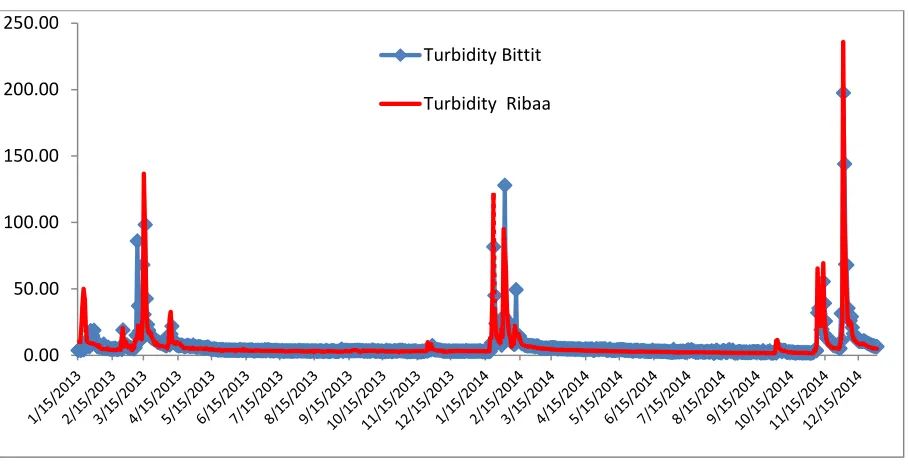
[image:3.595.80.534.139.371.2]In the rainfall period, the turbidity of raw water changes from time to time as shown in the graph below, the turbidity of the raw water can increase to reach levels more than 900 NTU:
Figure 2: statistical data of turbidity level of the spring’s water from 01/01/2013 to 31/12/2014 (ONEE, 2015).
However, the turbidity level is less than 10 NTU this two last years (2013 and 2014) for more than 80% of the year and more than 60% of the year (1321 /2191days); the turbidity is less than 10 NTU for the five last years as shown by the table below.
Number of days Year/ Turbidity Turbidity less or
equal than 5 NTU
Turbidity more than 5and less or equal
than 10 NTU
Turbidity more than 10 and less or equal than 20 NTU
Turbidity more than 20 and less or equal than 40 NTU
Turbidity more than 40
NTU
Total
2009 147 60 101 34 23 365
2010 0 0 113 148 104 365
2011 0 132 144 59 30 365
2012 301 38 17 5 5 366
2013 260 74 23 8 0 365
2014 247 62 32 20 4 365
Total 955 366 430 274 166 2191
955 1321 1751 2025 2191
Pourcentage 44% 17% 20% 13% 8%
Pourcentage of Aggregated data
[image:3.595.67.547.444.591.2]44% 60% 80% 92% 100%
Table 2: Turbidity levels distribution from 2009 to 2014 (Number of days per turbidity level).
Year : 2013
BittitSpring RibaaSpring Month min max min max January 3,70 18,95 10,00 50,00 February 4,50 19,00 3,95 20,65 March 4,95 98,40 4,50 136,66 April 6,40 21,95 4,90 32,77 May 3,93 6,30 3,80 5,30 June 3,72 4,40 3,34 4,89 July 3,30 4,33 2,92 3,62 August 3,00 3,80 2,70 3,46 September 3,10 4,64 2,68 4,15 October 2,90 3,99 2,46 3,62 November 2,70 7,44 2,90 10,00 December 3,07 4,23 2,60 3,95
0.00 50.00 100.00 150.00 200.00 250.00
Turbidity Bittit
Table 3: statistical data of turbidity (min and max) measured in 2013 and 2014 per month (ONEE, 2015)
Year : 2014
BittitSpring RibaaSpring Month min max min max January 3,06 81,69 3,00 120,66 February 6,48 128,00 5,93 78,90 March 4,86 6,91 3,90 5,65 April 4,30 4,90 3,30 4,19 May 3,17 4,77 2,48 3,37 June 3,00 3,86 2,60 2,87 July 2,36 4,50 2,16 2,49 August 1,74 4,20 1,88 2,28 September 1,80 3,50 1,64 1,90 October 1,89 4,20 1,67 11,64 November 1,80 55,50 1,68 69,29 December 6,57 197,50 5,06 235,89
EXPERIMENTAL SECTION
b.1 Preparation of synthetic turbid water:
The turbid water is prepared by adding different weights of sludge in mg into 1 liter of raw water from the spring for the medium (20 NTU) and high (40 NTU) turbidity levels. However, the low turbidity (10 NTU) water is obtained directly from the spring.
b.2 Preparation of Aluminum solution:
The Aluminum solution was prepared by dissolving 1 g of aluminum sulfate (Al2(SO4)3) in distilled water (PH = 7 ± 0.1) and the solution volume is increased to 1 liter. Each 1 ml of prepared stock solution is equal to 10 mg/l when it is added to 1 liter of turbid water to be tested.
b.3 Preparation of sludge solution:
The sludge produced in the settling step of the treatment process is used to prepare the sludge solution. A certain volume of raw water is added to the blend and stirred for 5 minutes at 300 rpm using magnetic stirrer. The volume of obtained suspension is increased to 1 liter and the gravity filtered through a 1um filter paper to separate residual particles from the prepared solution. The filtrate solution is referred to a sludge coagulant in this study.
b.4Research methodology:
A standard jar test apparatus equipped with six paddles rotating in a set of six beakers is used to simulate coagulation, flocculation and sedimentation processes.At the first, Control experiments for coagulation tests are performed in order to determine the optimal dose of the aluminum sulfate in normal conditions. The selected level of turbid water ( 1L) is filled into the beakers and various doses in the range from 10 to 100 mg/l of sludge and the aluminum sulfate according to the results of the first jar test determining the optimal dose of the inorganic coagulant in normal conditions are separately added in the beakers and mixed rapidly (300 rpm) for one minute. The mixing speed was then reduced to 40 rpm for 20 minutes. Then thestirrer is turned off and the suspensions are allowed to settle for different periods of time ranging from 30 to 120 minutes under quiescent conditions.After each period of settling time, supernatant samples of each beaker in the jar test is withdrawn from located 10 cm below the water level and residual turbidity is measured.
RESULTS AND DISCUSSION
III.1. Investigation of the optimum coagulant dose:
Standard Jar test experiments were performed within three levels of turbidity (10, 20 and 40 NTU) using the aluminum sulfate as coagulant. The objective of this experiment is to determine the optimal dose of aluminum sulfate to apply in the process of coagulation for different levels of turbidity.
The table below shows the results:
Table 4: Optimal dose of Aluminum sulfate for water turbidity levels.
Turbidity level Optimal dose of SA (mg/l) 10 NTU 10
[image:4.595.224.388.713.754.2]A set of experiments were performed using jar test to investigate the optimal dose of sludge to add in order to improve the quality of water.
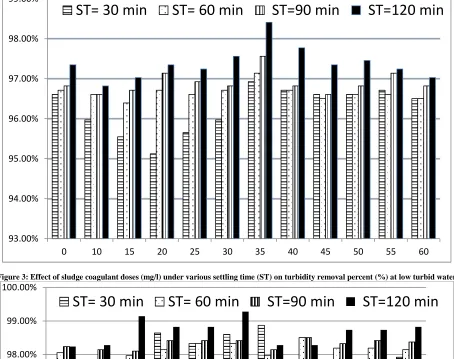
[image:5.595.78.532.117.476.2]Figure 3: Effect of sludge coagulant doses (mg/l) under various settling time (ST) on turbidity removal percent (%) at low turbid water.
Figure 4: Effect of sludge coagulant doses (mg/l) under various settling time (ST) on turbidity removal percent (%) at Medium turbid water.
93.00% 94.00% 95.00% 96.00% 97.00% 98.00% 99.00%
0 10 15 20 25 30 35 40 45 50 55 60
ST= 30 min
ST= 60 min
ST=90 min
ST=120 min
93.00% 94.00% 95.00% 96.00% 97.00% 98.00% 99.00% 100.00%
0 10 20 30 40 50 60 70 80 90 100
Figure 5: Effect of sludge coagulant doses (mg/l) under various settling time (ST) on turbidity removal percent (%) at high turbid water.
Figures 3 to 5 clearly show that certain dosages of sludge produced by the treatment plant used with the aluminum sulfate improve the turbidity removal percentage and achieve good removal efficiencies. Then, the best results of turbidity removal percentage were observed at the settling time of 120 minutes.
The maximum values of turbidity removal at low, medium and high turbidity are 98.41, 99.28 and 99.42% corresponding to the optimum dose of sludge of 35, 50 and 60 mg/l respectively.
[image:6.595.70.527.479.704.2]A set of experiments is performed using the optimal sludge doses obtained from the experiments below (35, 50 and 60 mg/l) while the aluminum sulfate was changed from 0 to 10 mg/l , from 4 to 15mg/l and from 6 to 20 mg/l respectively for low, medium and high turbidity.
Figure 6: Effect of Aluminum sulfate doses (mg/l) and sludge dose (35 mg/l) under various settling time (ST) on turbidity removal percent (%) at low turbid water.
96.00% 96.50% 97.00% 97.50% 98.00% 98.50% 99.00% 99.50% 100.00%
0 10 20 30 40 50 60 70 80 90 100
ST= 30 min
ST= 60 min
ST=90 min
ST=120 min
94.00% 94.50% 95.00% 95.50% 96.00% 96.50% 97.00% 97.50% 98.00%
2 4 6 8 10
Figure 7: Effect of Aluminum sulfate doses (mg/l) and sludge dose (50 mg/l) under various settling time (ST) on turbidity removal percent (%) at medium turbid water.
Figure 8: Effect of Aluminum sulfate doses (mg/l) and sludge dose (60 mg/l) under various settling time (ST) on turbidity removal percent (%) at high turbid water.
The table below shows the results of turbidity removal percentage using aluminum sulfate only, optimal dose of AS and sludge and the optimal dose of sludge and the proposed dose of AS :
Table 5: Turbidity removal percentage for different levels of turbidity using AS and sludge at settling time of 60 minutes.
Low Turbidity Medium turbidity High turbidity
Initial turbidity 9.34 21 39.4
Optimal dose of Aluminum sulfate (mg/l) (1) 10 20 20 Optimal dose of sludge (mg/l) used within AS (2) 35 50 60 Dose of AS (mg/l) proposed to be used with optimal dose of sludge (3). 6 10 12 Turbidity removal percentage using only AS (1) 96.71% 98.05% 98.98% Turbidity removal percentage using AS and sludge as coagulant aid (1)+(2) 97.14% 98.33% 99.34% Turbidity removal percentage using optimal dose of sludge and AS (2)+(3) 97.56% 98.96% 99.47%
96.50% 97.00% 97.50% 98.00% 98.50% 99.00% 99.50%
4 6 8 10 13 15
ST=30 min
ST=60 min
98.20% 98.40% 98.60% 98.80% 99.00% 99.20% 99.40% 99.60%
6 8 10 12 15 20
The results show that the sludge used as coagulant aid with the aluminum sulfate improve not only the water quality produced by the treatment plant (turbidity removal percentage from 96.71 to 97.56%, from 98.05 to 98.96% and from 98.98 to 99.47% for low, medium and high turbid water respectively) but also it can be used to reduce the aluminum sulfate dose in the coagulation process (from 10 to 6 mg/l, from 20 to 10 mg/l and from 20 to 12 mg/l for low, medium and high turbid water respectively) .
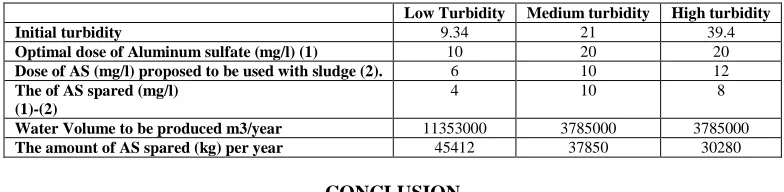
Table 6: Advantages of using sludge as coagulant aid and its economic benefits in the water treatment plant.
Low Turbidity Medium turbidity High turbidity
Initial turbidity 9.34 21 39.4
Optimal dose of Aluminum sulfate (mg/l) (1) 10 20 20 Dose of AS (mg/l) proposed to be used with sludge (2). 6 10 12 The of AS spared (mg/l)
(1)-(2)
4 10 8
Water Volume to be produced m3/year 11353000 3785000 3785000 The amount of AS spared (kg) per year 45412 37850 30280
CONCLUSION
This paper has presented some results concerning the use of sludge as coagulant aid with the aluminum sulfate in the water treatment plant. The sludge improves the quality of the produced water by increasing the coagulation efficiency and the aluminum sulfate dosage is decreased. The sludge volume is reduced and subsequently sludge management costs. The coagulation process is optimizing and this approach offers several significant economics and operational benefits such as it minimized the aluminum dose required to 40% for low and high turbidity levels and to 50% for medium turbidity level, reduced the sludge volume produced by the treatment plant and decreased the residual turbidity of the water. These advantages are very important not only for process economy through reducing the cost of treatment but also in the management of the sludge volume. Therefore, it is reasonable to consider this approach to be applied in the treatment plant for water with similar turbidity level.
REFERENCES
[1] Shen, Y.H., J. Chem. Technol. Biot., 2005,80: 581-586.
[2] Mukheled A. Journal of Water Resource and Protection, 2012,4, 79-92
[3] N. A. Eman, A. M. Suleyman, M. S. Hamzah, Md. A. Zahangir and M. R. M. Salleh, Journal of Water Resource
and Protection, Vol. 2, 2010,No. 3, pp. 259- 266.
[4] Aho, I. M. and Lagasi, J.E., Americain Journal of Scietific and Industrial Research, 3 (6), pp. 487-492. doi:10.5251/ajsir.2012.3.6.487.492.
[5] P. K. Raghuwanshi, M. Mandloi, A. J. Sharma, H. S. Malviya and S. Chaudhari, (2002) Water Quality Research, Vol. 37, 2012,No. 4, pp. 745-756.
[6] R. Sanghi, B. Bhatttacharya and V. Singh, Cassia Green Chemistry, Vol. 4, 2002,No. 3, pp. 252-254.
[7] A. Diaz, N. Rincon, A. Escorihuela, N. Fernandez, E. Chacin and C. F. Forster, A Preliminary Evaluation of Turbidity Removal by Natural Coagulants Indigenous to Venezuela,” Process Biochemistry, Vol. 35, 1999,No. 3-4, pp. 391-395.
[8] M. Šciban, M. Klašnja, M. Antov and B. Škrbic, BioresourceTechnol-ogy, Vol. 100, 2009,No. 24, pp. 6639-6643.
[9] V. Patale and P. Parikh, Journal of Pure and Applied Sciences,Vol. 18, 2010, pp. 27-30.
[10] M. Šciban, M. Klašnja and J. Stojimirovic, ActaPeriodica Tech-nologica, Vol. 36, 2005, pp. 81-87.
[11] Amitkumar A. Ghanmode, Farooq I. C. International Journal of Civil and Structural Engineering, Vol. 3,
2015,Issue 1, pp: (368-375)