RELIABILITY ANALYSIS OF DISTRIBUTION NETWORK
ROYSTONE ANTHONY
A project report submitted in
fullfillment of the requirement for the award of the Degree of Master of Electrical Engineering
Faculty of Electrical and Electronic Engineering Universiti Tun Hussein Onn Malaysia
Abstract
The knowledge of the reliability of distribution networks and systems is important consideration in the system planning and operations for development and improvements of power distribution systems. To achieve the target as minimum interruptions as possible to customers, utilities must strive to improve the reliability but at the same time reduce cost. It is a known fact that most of customer interruptions are caused by the failure in distribution system. However, valid data are not easy to collect and the reliability performance statistic not easy to obtain. There is always uncertainty associated with the distribution network reliability. For evaluation and analysis of reliability, it is necessary to have data on the number and range of the examined piece of equipment. It’s important to have database for failure rates, repair
time and unavailability for each component in distribution network. These studies present the analysis of distribution networks and systems by using analytical methods in SESB’s distribution substations and network systems. These studies use analytical
Abstrak
TABLE OF CONTENTS
ACKNOWLEDGMENT iii
ABSTRACT ABSTRAK
iv v
LIST OF TABLES ix
LIST OF FIGURES xi
LIST OF SYMBOLS AND ABBREVIATIONS
xiii
LIST OF APPENDICES xiv
CHAPTER 1 INTRODUCTION 1
1.1 Project Background 1
1.2 Problem Statements 2
1.3 Project Objectives 4
1.4 Project Scopes 4
1.5 Thesis Outline 5
CHAPTER 2 LITERATURE REVIEW 6
2.1 Introduction 6
2.2
2.3 2.4 2.5
Reliability
2.2.1 Reliability Evaluation 2.2.2 Reliability Indices
Power Quality and Availability Network Equivalent Technique Description of Previous Methods 2.5.1 Reliability Evaluation of Distribution Networks Using Fuzzy Logic
2.5.2 The Reliability Analysis of
7 7 8 9 10 10
Distribution System Based on Dynamic Bayesian Network
2.5.3 Case Study of Distribution Network Reliability Analysis Based on Probabilistic Method.
2.5.4 Summary of Previous Methods
11
12 14
CHAPTER 3 METHODOLOGY 16
3.1 Project Methodology 3.1.1 Overview
3.1.2 Feasible Study on Reliability Analysis
3.1.3 Markov Modelling 3.1.4 Network Modelling
16 16
18 18 20 3.2 Overview and Analysis of the Existing
Distribution Network
24
3.3 Reliability Indices of the Existing Distribution Network
24
3.4 Interruptions Causes 26
CHAPTER 4 RESULT AND ANALYSIS 28
4.1 Failure Mode and Effect Analysis (FMEA), Network Modelling And Assumptions
30
4.2 Reliability Parameter 31
4.3 Case 1: Effects of Parallel Mode Operations of 66/11kV Transformers
32
4.4 Case 2: Effects of Independent Mode Operations of 66/11kV Transformers
38
4.5 Case 3: Effects of Double 11kV Busbar
43
4.6 Case 4: Effects of Parallel 11kV Feeders
49
CHAPTER 5 CONCLUSION AND
5.1 Conclusion 57 5.2 Recommendations
5.2.1 Outage Mitigation Technique 5.2.2 Maintenance Strategy
5.2.3 Tree Trimming Strategy
58 59 59 61
REFERENCES 63
LIST OF TABLES
Table 2.1 Summary of previous method for reliability analysis 14 Table 3.1 Component data for system in Figure 3.6 23 Table 3.2 Load Point reliability indices for the system of Figure 3.6 23 Table 3.3 SESB’s Interruption causes for year 2012 and 2013 (Overall) 26
Table 4.1 Reliability Parameter 32
Table 4.2 Analysis of failure for circuit breaker and feeder cable 34 (Overhead line, OHL and Underground line (UG)) for load point 1 – load
point 4 using FMEA method for Case 1.
Table 4.3 Analysis of failure for circuit breaker and feeder cable 35 (Overhead line, OHL and Underground line (UG)) for load point 5 –
load point 8 using FMEA method for Case 1.
Table 4.4 Analysis of failure for circuit breaker and feeder cable 36 (Overhead line, OHL and Underground line (UG)) for load point 9 – load
point 10 using FMEA method for Case 1.
Table 4.5 11kV Distribution load point average current, average power 37 and estimate number of customer.
Table 4.6 Reliability Indices for Distribution feeder (11kV) for Case 1. 37 Table 4.7 Analysis of failure for load point 1 – load point 4 using FMEA 40 method for Case 2.
Table 4.8 Analysis of failure for load point 5 – load point 8 using FMEA 41 method for Case 2.
Table 4.9 Analysis of failure for load point 9 – load point 10 using FMEA 42 method for Case 2.
Table 4.10 Reliability Indices for Distribution feeder (11kV) for Case 2. 42 Table 4.11 Reliability parameter for double busbar configuration. 44 Table 4.12 Analysis of failure for load point 1 – load point 4 using FMEA 46 method for Case 3.
Table 4.14 Analysis of failure for load point 9 – load point 10 using FMEA 48 method for Case 3.
Table 4.15 Reliability Indices for Distribution feeder (11kV) for Case 3. 48 Table 4.16 Effects on the distribution reliability indices for parallel 51 configuration of feeder (overhead line cable)
Table 4.17 Effects on the distribution reliability indices for parallel 52 configuration of feeder (Underground cable)
LIST OF FIGURES
Figure 2.1 System Reliability Subdivision 6 Figure 2.2 The simple sketch map of Single Bayesian Network 12 (SBN) and Double Bayesian Network (DBN)
Figure 2.3 Probabilistic Reliability Assessment Flowchart 13
Figure 2.4 A Weibull Markov model. 14
Figure 3.1 The planning approach for the Reliability Analysis 17 of Distribution network.
Figure 3.2 Example of simple distribution system. 18 Figure 3.3 (a) Primary Markov model (b) Secondary Markov 20 Model (c) Tertiary Markov Model
Figure 3.4 Series Structure 21
Figure 3.5 Parallel Structure 21
Figure 3.6 Simple 3-load point radial system 23 Figure 3.7 Overall SAIDI Sabah from year 2006 to year 2013. 25 Figure 4.1 Single Line Diagram of Tuaran 66/11kV Substation. 29 Figure 4.2 Parallel operations of 66/11kV transformers. 33 Figure 4.3 Independent mode of operation for Transformer 1 – 39 Transformer 3 for 66/11kV Tuaran substation. The 11kV bus
section assumes to be open to enable the independent mode operation.
Figure 4.4 Double bus configurations for 11kV bus system 44
Figure 4.5 Double bus configuration 45
Figure 4.6 Series and parallel modelling for 11kV feeder. 49 Figure 4.7 Summary of result of Reliability Indices (Underground 54 cable)
Figure 4.8 Summary of result of Reliability Indices (Overhead line 54 cable)
Figure 5.1 Three step procedure for developing of a Reliability 58 Improvement Strategy
LIST OF SYMBOLS AND ABBREVIATIONS
SAIDI – System Average Interruption Duration Index SAIFI – System Average Interruption Duration Index CAIDI – Customer Average Interruption Duration Index ASAI – Average Service Availability Index
ASUI – Average Service Unavailability Index
ENS – load- and energy-orientated indices such as Energy Not Supplied
AENS – Average Energy Not Supplied
ACCI – Average Customer Curtailment Index SESB – Sabah Electricity Sendirian Berhad kV – kilo volt
U – Average unavailability r – Average repair rate λ – Average failure rate
LIST OF APPENDICES
APPENDIX TITLE PAGE
A SAIDI & SAIFI Data from Sabah Electricity Sdn. Bhd. (SESB) Year 2011 – 2013
64
A1 SAIDI YTD 2011 (SECTOR 1 & 2) 64 A2 SAIDI Sector 2 Year 2011 for Distribution,
Transmission and Generation
65
A3 SAIDI Sector 2 Year 2011 for Distribution, Transmission and Generation
66
A4 SAIDI YTD 2012 (SECTOR 1 & 2) 67 A5 SAIDI Sector 2 Year 2012 for Distribution,
Transmission and Generation
68
A6 SAIDI Sector 2 Year 2012 for Distribution, Transmission and Generation
69
A7 SAIDI YTD 2013 (SECTOR 1 & 2) 70 A8 SAIDI Sector 2 Year 2013 for Distribution,
Transmission and Generation
71
A9 SAIDI Sector 2 Year 2013 for Distribution, Transmission and Generation
72
A10 SESB SAIFI and CAIDI data for Year 2011 to 2013 73
B Sabah Grid Network 74
C DETAIL SINGLE LINE DIAGRAM 75
C1 Single Line Diagram (SLD) for Tuaran 66/11kV & 66/33 kV
75
CHAPTER 1
INTRODUCTION
1.1 Project Background
Power distribution network system established mainly to provide adequate electricity supply to customers as economically as possible with reasonable assurance of reliability. Nowadays, the power distribution networks have grown exponentially in term of size and technology over the past few years. As a result, utility company must strive to ensure that the customer’s reliability requirements are met with
optimum strategic planning and lowest possible cost. The ability of the system to provide adequate supply of electricity energy determine by the term reliability. Reliability analysis of distribution network is not a new topic in electric power industries, a lot of studies and research have been carried out due to the increasing cost of blackouts and fault outages.
Over the past, distribution network system have received less attention devoted to reliability studies compared to generation and transmission system [1]. The reasons being is the generation and transmission systems are capital intensive and the inadequacy can have widespread consequences for both society and environment. However, a distribution system is slightly cheaper compare to the other two because its effects are localized. Analysis of the customer failure statistics of most utilities shows that distribution system makes the greatest individual contribution to the unavailability of electrical supply to customer.
predictive methods are normally used to evaluate the reliability of a distribution network. Most utilities focus more on historical assessment rather than predictive methods. Predictive methods are categorized into analytical and simulation methods. Reliability assessment method for distribution system fall into two classes: simulation and analytical [2]. Simulation is the most flexible method but require extensive time in computational and also uncertainty in precision. Analytical method can be further divided into network modeling and Markov modeling. Network modeling has been the most popular technique for distribution system reliability analysis due to the simplicity of the method and natural similarities between network model and the distribution topology. The difference between simulation and analytical method is the way in which the system reliability indices are evaluated. By applying both analytical and simulation method, the reliability indices for distribution systems will be determined such as System Average Interruption Frequency Index (SAIFI) and System Average Interruption Duration Index (SAIDI). The probability distribution of SAIFI and SAIDI which give information about the variability of the indices also need to obtain in order to improve in decision making.
1.2 Problem Statements
There are many factors that contribute to the failure of distribution network system. Reliability is very important issue in dealing with planning and operation of the networks. In distribution system planning, reliability aspects are an important part of the decision base. Thus, to be able to assess and evaluate, reliability is needed in the planning process. The data obtained from Sabah Electricity Sdn Bhd (SESB) showed that the distribution network contribute the highest SAIDI and SAIFI for three years from 2011 to 2013.
contribute to the measurement of how far the system meet the performance criteria, to help quantify comparison between various options, and to help in term of economic decision [3]. Besides that, reliability analysis result will determine the failure rate and mean failure duration for particular equipment or group of equipments, thus with more detail in databases, the information gained may be important for utilities operators, such as the most frequent cause of failures, areas of greatest amount of undelivered energy [4] or the most weakness area of protection system which contribute to interruptions and fault.
In this project, the most challenging and difficult aspect will be on the analytical part where details concentration are required to acquire input data from utilities and industries and calculation to obtained useful reliability indices which will be used for comparison with the historical assessment. Incorrect input data will of course lead to false result [6]. Furthermore, the difficulties for completing this project are to apply the analytical methods for analysis of the existing distribution network and systems. The advantages and disadvantages associates with both analytical and simulation techniques are as follows:
(a) The analytical model always gives the same numerical result for the same system, same model and same set of input data, whereas the result from a simulation method is dependent on the random number generator used and the number of simulations.
(b) The model used in the analytical approach is usually a simplification of the system. The simulation approach, however, can incorporate and simulate any system characteristic that can be recognized. Thus it gives a better description of practical system behavior.
(c) The solution time for analytical techniques is relatively short, as compared to that for simulation techniques which is usually extensive. This disadvantage has been partially overcome by the development of modern computational facilities. However, the solution time still remains high in applications that demand several reliability assessments.
1.3 Project Objectives
The major objective of this project is to evaluate the reliability of distribution networks in Sector 2 of Sabah Grid network and to determine the system reliability indices by using analytical method. The reliability indices are System Average Interruption Frequency Index (SAIFI) and System Average Interruption Duration Index (SAIDI). Result from these approaches and some changes in philosophy study are analyze and compared. The following issues shall be discussed:
a) To assess and evaluate the existing reliability indices of distribution network system of Sector 2 area in Sabah grid network.
b) To determine the reliability indices System Average Interruption Frequency Index (SAIFI) and System Average Interruption Duration Index (SAIDI) using predictive (analytical) methods.
c) To compare the results for further recommendation and improvement in decision making of planning and design based on predictive methods and some changes in the operating philosophy.
1.4 Project Scopes
This study will focus on the analysis of 33kV and 11kV distribution network in Sector 2 of Sabah Grid network. The parameter used to determine the reliability indices are failure rate, repair rate and unavailability. The scopes of this project are: a) Implementation of predictive analysis methods for the existing distribution
network 33kV and 11kV system.
b) Analysis of SAIDI and SAIFI for distribution level. Compare both method and further evaluate to obtain optimum reliability indices.
c) The operating philosophy and system configuration which includes protection, control, monitoring and equipment used.
databases such as SAIDI and SAIFI acquired from Sabah Electricity Sendirian Berhad (SESB), from System Operation Division.
The past or historical data will be used as benchmarking and reference for comparison with predictive analysis results. Two methods in analytical technique which has been used extensively by researchers and as a bench mark system: Network Modelling Markov chain modelling.
The result of analytical methods depends on the quality of input data or the data available with the company and user. Therefore, it is very important for the utilities to maintain and update the data recording systems for future use. This would enhance to improve the system studies in future and the overall reliability in the system.
1.5 Project Outline
CHAPTER 2
LITERATURE REVIEW
2.1 Introduction
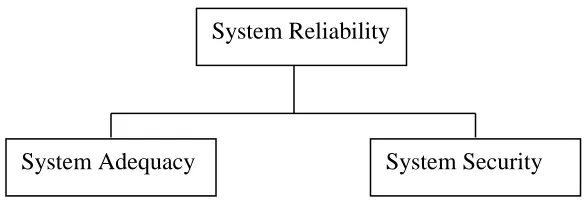
[image:18.595.177.469.630.734.2]Electrical power are vital important to our modern society nowadays in line with the challenges to provide the most efficient and cost effective way of supplying electricity from industrial area up until residential consumers. The availability of a reliable power supply at reasonable cost is crucial for the economic growth and development of a country [5]. Power Utilities Company nowadays try to enhance and develop their own strategies based on experience, trending, research and studies to meet customer demands as economically as possible at reasonable service of reliability. An analysis throughout the word shows that around 90% of all customer reliability problems are due to the problem in distribution system. Thus, improving distribution reliability is the key to improving customer reliability [6]. The concept of power-reliability is extremely broad and covers all aspects of the ability of the system to satisfy the customer requirements. There is a reasonable subdivision of the concern designated as system reliability which is shown in Figure 2.1.
Figure 2.1: System Reliability Subdivision. System Reliability
Figure 2.1 represents two basic aspects of a power system: system adequacy and security. Adequacy relates to the existence of sufficient facilities within the system to satisfy the consumer load demand. These include the facilities necessary to generate sufficient energy and the associated transmission and distribution facilities required to transport the energy to the actual consumer load points. Security relates to the ability of the system to respond to disturbances arising within that system. Security is therefore associated with the response of the system to whatever perturbations it is subject to [3].
2.2 Reliability
2.2.1 Reliability Evaluation
The ultimate goal of reliability analysis is to help answer questions like “is the system reliable enough?”, “which scheme will fail less?” and “where can the next
dollar be best spent to improve the system?”. As discuss before, reliability in power system can be divided into two basic aspects which is System Adequacy and System Security. Since distribution system are seldom loaded near their limits, reliability emphasis in system security compared to system adequacy. Reliability evaluation of distribution systems consist of two main approaches Simulation and Analytical methods.
(a) Simulation methods based on drawings from statistical distributions (Monte Carlo).
(b) Analytical methods based on solution of mathematical models.
2.2.2 Reliability Indices
The basic load-point reliability indices used to predict the reliability of a distribution system are the average load point failure rate (λs), the average load point outage
duration (rs), and the average annual load point time or unavailability (Us) [7]. A
wide range of system indices can be calculated with these three parameters. The system reliability indices may be customer-orientated such as SAIFI, SAIDI, Customer Average Interruption Frequency Index (CAIFI), Customer Average Interruption Duration Index (CAIDI), Average Service Availability Index (ASAI), Average Service Unavailability Index (ASUI) or load- and energy-orientated indices such as Energy Not Supplied (ENS), Average Energy Not Supplied (AENS) and (ACCI).
Quantitative reliability evaluation of a distribution system can be divided into two basic segments; measuring of the past performance and predicting the future performance [8]. Below are some of the basic indices that have been used to assess the past performance;
• System Average Interruption Frequency Index (SAIFI). It is designed to give
information about the average frequency of sustained interruption per customer over predefined area.
i i i N N SAIFI SERVED CUSTOMER OF NUMBER TOTAL ONS INTERRUPTI CUSTOMER OF NUMBER TOTAL• System Average Interruption Duration Index (SAIDI). It is commonly referred to as
customer minutes of interruption or customer hours, and is designed to provide information about the average time that the customers are interrupted.
i i i N N U SAIFI SERVED CUSTOMER OF NUMBER TOTAL DURATIONS ON INTERRUPTI CUSTOMER OF SUMsystem based on system topology and failure data of the components. Due to stochastic nature of failure occurrence and outage duration, it is generally based on probabilistic models. The basic indices associated with system load points are; failure rate, average outage duration and annual unavailability.
2.3 Power Quality and Availability
Perfect power quality is characterized by a perfect sinusoidal voltage source without waveform distortion, variation in amplitude or variation in frequency. To attain near perfect quality, a utility could spend vast amounts of money and accommodate equipment with higher power quality needs. On the other hand a utility could spend little and require customer s to compensate for the resulting power quality problems. Neither of extreme is desirable, utilities must find a balance between cost and power quality provided to the customer. Power quality concerns are becoming more frequent with the proliferation of sensitive electronic equipment and automated process. Power quality problems are basically divided into many categories such as interruptions, sags, swells, transients, noise, flicker, harmonic distortion and frequency variations [9].
2.4 Network Equivalent Technique
The analytical techniques required for distribution system reliability evaluation are highly developed. Many of the published concepts and techniques are presented and summarized in [1]. Conventional techniques for distribution system reliability evaluation are generally based on failure mode and effect analysis (FMEA) [10]. This is an inductive approach that systematically details, on a component-by-component basis, all possible failure modes and identifies their resulting effects on the system. Possible failure events or malfunctions of each component in the distribution system are identified and analysed to determine the effect on surrounding load points. A final list of failure events is formed to evaluate the basic load point
indices. The FMEA technique has been used to evaluate a wide range of radial distribution systems. In systems with complicated configurations and a wide variety of components and element operating modes, the list of basic failure events can become quite lengthy and can include thousands of basic failure events. This requires considerable analysis when the FMEA technique is used. It is therefore difficult to directly use FMEA to evaluate a complex radial distribution system. A reliability network equivalent approach is use to simplify the analytical process. The main principle in this approach is using an equivalent element to replace a portion of the distribution network and therefore decompose a large distribution system into a series of simpler distribution systems. This approach provides a repetitive and sequential process to evaluate the individual load point reliability indices.
2.5 Description of Previous Methods
2.5.1 Reliability Evaluation of Distribution Networks Using Fuzzy Logic
The fuzzy logic method was used to predict the reliability as there was no mathematic function describing the relationship between subsystems and the network reliability. The advantage of fuzzy logic method is its enabling the possibility of adding new fuzzy systems to the existing model, in order to account for factors that were not included in the model. These new fuzzy level can be added into fuzzy level 1 or 2. The reason is that all subsystems are assumed to be independent to each other. Furthermore, fuzzy logic is more flexible thus it allow for its application to simplify complex models. Due the simplification, the computation time is reduced and larger model could be easily evaluated with minimal computation time.
2.5.2 The Reliability Analysis of Distribution System Based on Dynamic Bayesian Network
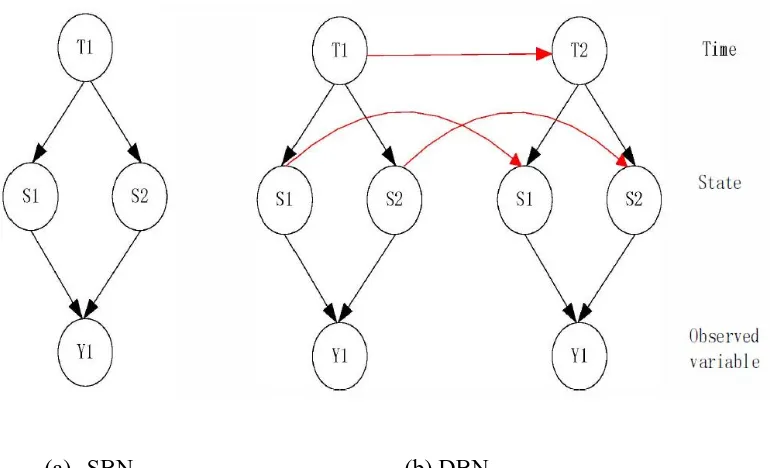
Dynamic Bayesian network is a time extension of the static Bayesian network, which consists of the initial network and transfer network. Based on Dynamic Bayesian networks, the actual value of the component failure rates and repair rates can be accurately reflected and failure frequency and duration of distribution system can be calculated. Bayesian network method permits not only computing the reliability indices of a distribution system but also presenting the effect of each component or some components on the system reliability.
(a) SBN (b) DBN
Figure 2.2: The simple sketch map of Single Bayesian Network (SBN) and Double Bayesian Network (DBN)
2.5.3 Case Study of Distribution Network Reliability Analysis Based on Probabilistic Method.
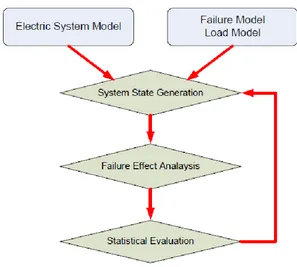
Figure 2.3: Probabilistic Reliability Assessment Flowchart
The failure model describe that the system component will fail, how it fail and how long the repair time required. The load models may consist of only a few possible load demands, or based on precise load forecast and growth scenarios. The combination of one or more simultaneous faults and a specific load condition is called a system state. The system state production module will use failure and load models to build a list of relevant system states. Each of this system states may have one or more faults.
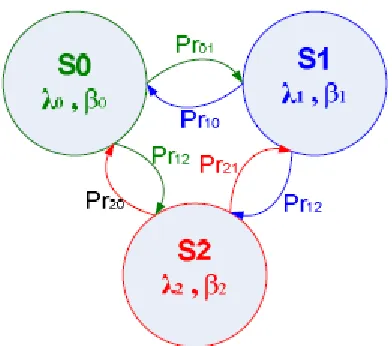
reliability assessment functions are based on “Weibull-Markov” model (W-M model). This model illustrated in Figure 2.4.
Figure 2.4: A Weibull Markov model.
Refer to above Figure 2.4, each behaviour represent different state which is: S0 states with 100% capacity, S1 describe a state with limited capacity and S2 describe the repair state. It can be concludes that positive effects on final results and initial capital before implementation and construction of network [14].
2.5.4 Summary of Previous Methods
The summary of the previous research and study on reliability analysis for distribution network is shown in Table 2.1.
Table 2.1: Summary of previous method for reliability analysis
Year Author Model Advantages 2010 M.R Emjedi,
K.Awodele, S.Chowdhury, S.P
Chowdhury
Fuzzy Logic Fuzzy logic used to examine the influence of the various sub-system that comprise in distribution network in term of reliability.
Enabling the possibility of adding new
[image:26.595.107.528.613.762.2]consider factor that not included in the original model.
The flexibility of fuzzy model allows
for its application to simplify complex concept to easy concept.
2012 Aoxue Su, Mingtian FAN, Zhonglai LI
Dynamic Bayesian Network
Construct the topological relationship of
distribution system on influence of each component on the systems.
This method not considers the impact of
time factor to the variables, but reflect the probabilistic dependencies between variables and time varying of variables.
Able to describe the dynamic evolution
process of distribution system due to disconnect switches and protection devices.
2011 Yong Tang Artificial Neural Network
Used Radial Basic Function (RBF)
Neural network classifier to distinguish the high reliability and low reliability of load point.
This method not applicable to ring
CHAPTER 3
METHODOLOGY
3.1 Project Methodology
3.1.1 Overview
This research is adopting methods involving analysis and evaluation of reliability of the distribution network in sector 2 of Sabah grid network to see how reliability could be improved in the distribution system by incorporating reliability analysis in the systematic planning approach so that optimum reliability is achieved. The reliability indices of the present system shall be evaluated, assessed and compared and sees how risk of failure could be mitigated. The reliability indices for the year 2011 to 2013 are being considered as base year for the case study.
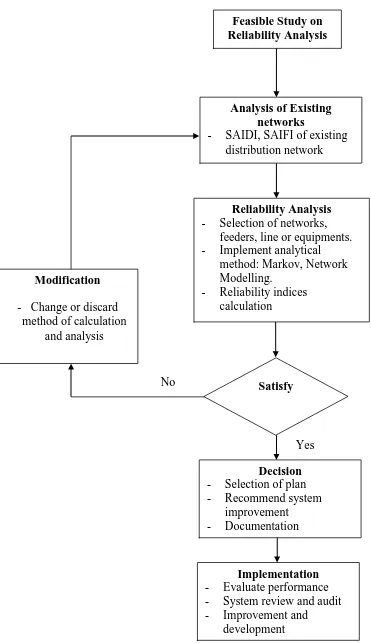
Reliability indices such as SAIFI, SAIDI and CAIDI can be calculated using equation given in 2.2.2 [3]. These indices provide a relative measure for a group of load points or for the entire system. Analysis will be carried out at distribution network substation Tuaran 66/11kV system. But the selection of distribution substation depends on the availability of data and information required for calculation and analysis. Result from these approaches will be compare with the actual value of reliability indices obtain from year 2011 to 2013. In this project, we will apply two analytical methods to determine the reliability indices which are Markov model and Network modelling. The project’s Gantt chart is given in Appendix A. The research is conducting in phase’s basis as shown in flowchart in
Figure 3.1: The planning approach for the Reliability Analysis of Distribution network.
Analysis of Existing networks
- SAIDI, SAIFI of existing distribution network
Reliability Analysis - Selection of networks,
feeders, line or equipments. - Implement analytical
method: Markov, Network Modelling.
- Reliability indices calculation
Satisfy
Decision - Selection of plan - Recommend system
improvement - Documentation Modification
- Change or discard method of calculation
and analysis
No
Yes Feasible Study on Reliability Analysis
Implementation - Evaluate performance - System review and audit - Improvement and
3.1.2 Feasible Study on Reliability Analysis
The feasible study on reliability analysis concentrates on the previous methods used for reliability evaluation and assessment. The existing system network will be bench mark and compare with the previous study and research so that the methods that need to be apply is suitable with the current systems. In order to achieve this, details study and research is required to be conduct by referring to SESB distribution system operation and design.
The technique required to analyze a distribution system depend on the type of system being considered and depth of analysis needed. Firstly, we need to know the basic evaluation technique then extend to more complex system inclusive of more refined modeling aspects. This project will be base on two methods which are Network modeling including basic evaluation technique for distribution system and Markov chain model. More concentration on the basic evaluation technique as the existing distribution network system is more compatible with this technique.
3.1.3 Markov Modelling
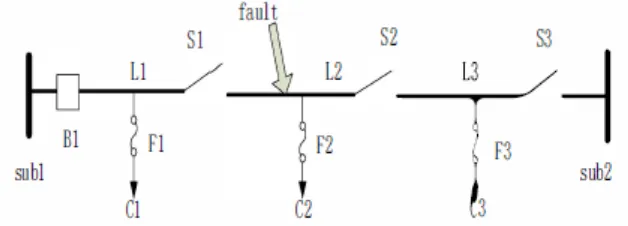
[image:30.595.162.476.570.683.2]In this project, the technique term Hierarchical Markov Modelling (HMM) will be used to determine the reliability indices. The HMM decompose the reliability problem into three levels according to system topology, integrated protection system behaviour and individual protection devices behaviour [13]. To illustrate HMM, the example distribution system in Figure 3.2 will be used.
Figure 3.2: Example of simple distribution system.
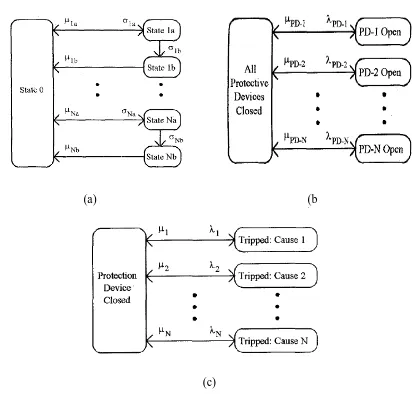
This system is normally fed from a substation and can be back fed from a second substation if needed. HMM begins by creating primary model based on system topology. Primary model has a normal operating state (S0) and additional states corresponding to various switching actions. Parameter such as repair rates and switching rates will be required. In the primary model, states are determined exclusively by sectionalizing switch positions and not by the status of protection devices. The sectionalizing switches determine the system topology while the protection system determines how the system will respond to contingencies while in a certain topology.
Secondary Markov models will be created to model the protection system behavior of each primary model state. These model have a base state of all protective devices in a close position. The secondary model protection devices can either be open or closed, and are characterized by a failure rate and repair rate.
Figure 3.3: (a) Primary Markov model (b) Secondary Markov Model (c) Tertiary Markov Model
Figure 3.3 illustrate the three models in HMM. In Figure 3.3 (a), µ represent repair rates, and σ represent switching rates, in (b) λ represent failure rates and µ represent repair rates. To implement HMM, a software application is required and further study and research will be conduct to find suitable software for HMM.
3.1.4 Network Modelling
Network modelling is the use of series-parallel combinations to reduce the network. It determines the load point indices and aggregates them to get the system wide indices. A radial system basically consists of set of series components like; breakers, lines, switches, transformers and at the end a “Customers”. In the series structure
(a) (b
)
both components must be intact for the system to function, "a chain is no stronger than its part" while in the parallel structure both must fail for the system to stop functioning. In this case, all the components are connected in series as shown in Figure 3.4 and the equations needed to evaluate the basic indices are as follows;
Figure 3.4: Series Structure
(a) Average Failure rate of the system:
2 1 2 1 s i i (3.1)
(b) Average outage time of the system:
s s
i i
ir U
r r r r
2 1 2 1 2 1 2 2 1 1 sr (3.2)
If λ1 λ2 r1 r2 << λ1 r1 or λ2 r1 r2
(c) Average Annual Outage time of the system:
s s s
s r r
f
s
U (3.3)
Where λi the failure rate at node i, ri is the outage time at node i. In parallel
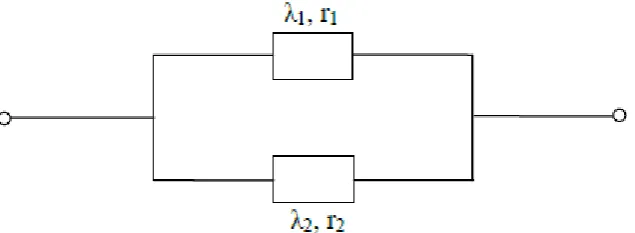
system, the failure modes of the load point involve overlapping outages, i.e. two or more components must be on outage at the same time in order to interrupt a load point as shown in Figure 3.5. It is assumed that the failures are independent and that restoration involves repair or replacement, the equations used to evaluate the indices of the overlapping outage are as shown below.
[image:33.595.163.481.624.740.2](d) Average Failure rate of the system: ) ( 1 ) ( 2 1 2 1 2 2 2 1 1 2 1 2 1
p r r
r r r r
(3.4)
Where λ1 r1 and λ2 r2 usually << 1
(e) Average outage time of the system:
2 1 2 1 p r r r r r
(3.5)
(f) Average Annual Outage time of the system:
p pr
p
U (3.6)
These are adequate for simple radial systems and more extended indices have to be used for general distribution systems (mixed radial and meshed systems). In this master project, the following alternatives which may improves reliability in the system shall be considered:
i) Assessment of the existing network ii) Change in the network configuration iii) Use of additional sectionalizing switches
iv) Automation and control facilities via control centre monitoring and supervision.
In this project, we will assume that the distribution system are design and construct as single radial and parallel systems:
i) Single radial system
11kV feeder supply direct to customer
33kV feeder for interconnection between substation
ii) Parallel System
33kV transformer (incomer) connected to two bus bar system (reserve
and main) to supply 11kV feeder connected to customer. Three basic reliability parameters requires for analysis:
i i s : rate failureAverage (3.7)
i i i s r U : time outage annualAverage (3.8)
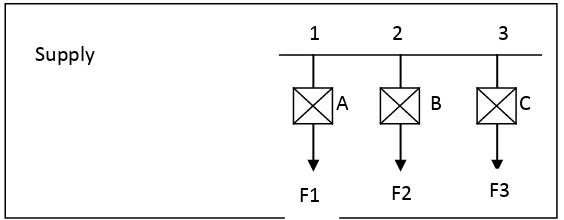
i i i i i s s s r U r : time outageFigure 3.6: Simple 3-load point radial system
[image:35.595.105.536.426.677.2]A radial system consist of a set of series components, including lines, cables, disconnects (or isolator), bus bar, breaker, earth switch and etc [15]. A customer or substation connected to any load point of such system requires all components between himself and the supply point to be operating. A simple radial system shown in Figure 3.8. The assume failure rates and repair times of each line A, B and C are shown in Table 3.1 and the load point reliability indices are shown in Table 3.2. Data shown is the typical and general feature of radial system. The assumption made is perfect isolation of faults on line element A, B and C by the circuit breaker.
Table 3.1 Component data for system in Figure 3.6
Line λ (f/yr) r (hours)
A 0.2 6.0
B 0.10 5.0
C 0.15 8.0
Table 3.2 Load Point reliability indices for the system of Figure 3.6 Load Point λ (f/yr) r (hours) UL(hours/yr) Number of
customer
Average Load Demand (kW)
F1 0.2 6.0 1.2 200 1000kW
F2 0.10 5.0 1.7 150 700kW
F3 0.15 8.0 2.9 100 400kW
The customer and load oriented indices can now be evaluated as belows:
Supply
F1 F2 F3
A B C
on interrupti omer hours/cust 02 . 6 SAIFI SAIDI CAIDI year omer hours/cust 1.74 450 ) 100 9 . 2 ( ) 150 7 . 1 ( (1.2X200) SAIDI on/year interrupti 289 . 0 100 150 200 ) 100 45 . 0 ( ) 150 3 . 0 ( (0.2X200) X X X X SAIFI
The above illustration is the basic evaluation technique for basic radial system. For the purpose of this study, further operating philosophy will be apply such as additional of isolation (disconnects), additional protection and automation, transferrable load and others system configuration that might affect the reliability indices. It shall be observe that, when the additional features applied on the evaluation, there will be changes and improvement in the reliability indices.
3.2 Overview and Analysis of the Existing Distribution Network.
Appendix D1 shows the detail single line diagram of Tuaran 66/11kV and 66/33 kV system. For the purposed of the study, we will consider the distribution feeder for supply direct to customer or feeder that interconnect between substation such as Tuaran 11kV, Mengaris 132/33kV interconnect to Kota Marudu 33/11kV. Here we will also look at the future performance of the distribution system reliability when there are changes in the configuration, operation condition and or protection schemes, and expansion in the network. In this project, the predictive reliability analysis shall be carried out in 33kV and 11kV feeder and a number of alternatives shall be evaluated. Further evaluation and study on the existing network will be conducted to determined type of network configuration either radial, parallel or mesh.
3.3 Reliability Indices of the Existing Distribution Network
REFERENCES
1 Roy Billinton, Ronald N. Allan, Reliability Evaluation of Power System, Second Edition, 2008.
2 Hongyun Zhang, Pengxiang Bi, “Development and Application of Reliability Analysis System for Medium and High Voltage Distribution Networks”,
DRPT2008 6-9, China, 2008.
3 M.R Emjedi, K.Awodele, S.Chowdhury, S.P.Chowdhury, Reliability Evaluation of Distribution Networks Using Fuzzy Logic, IEEE 2010.
4 Radomir Gono, Stanislav Rusek, Michal Kratky, Reliability Analysis of Distribution Networks, 9th International Conference, Electrical Power Quality and Utilization, Barcelona 2007.
5 Tempa Dorji, Reliability Assessment of Distribution Systems, Norweigan University of Science and Technology (NTNU), 2009.
6 Richard E. Brown, Electric Power Distribution Reliability, Second Edition. 7 R. Billinton and W. Li, Reliability Assessment of Electric Power
Systems Using Monte Carlo Methods, New York, Plenum Press, 1994.
8 M.G. Da Silva, A. B. Rodrigues, C. L.C. de Castro, A.C. Neto, E.A. Moutinho, N.S.A. Neto, A.B. Cavalcante. Reliability Assessment of Distribution Networks in Brazil’s Northeast, 8th International Conference on
Probabilistic Methods Applied to Power Systems, Iowa State University, September 12-16, 2004.
9 Edited by Angelo Baggini, Handbook of Power Quality, John Wiley and Sons, Ltd.
10 Henley EJ, Hiromitsu K (1981) Reliability Engineering and Risk Assessment, Prentice-Hall, Englewood Cliffs, NJ.
12 HUO Limin, ZHU YongLi, Zhang Liguo, Bayesian Network Time Sequence Simulation Inference Algorithm for Reliability Assessment of Power Systems [J], TRANSACTIONS OF CHINA ELECTROTECHNICAL SOCIETY, 2008, 23(6):S9-95.
13 A.Coelho, A.B.Rodrigues, M.G.Dasilva, “Distribution Network Reconfiguration Reliability Constraints”, IEEE, 2004.
14 Aoxue SU, Mingtian FAN, Zhonglai LI, The Reliability Analysis of Distribution System Based on Bayesian Network, China International Conference on Electricity Distribution (CICED 2012), Shanghai China, 5-6 September 2012.
15 Lokesh Prakash Manohar, Reliability Assessment of a Power Grid With Customer Operated CHP Systems using Monte Carlo Simulation, University of Massachusetts Amherst, 2009.
16 Tim Taylor, Mike Markshall and Eric Neumann, Developing a Reliability ImprovementStrategy for Utility Distribution Systems, IEEE, page 444-449. 17 M.G. Da Silva, A. B. Rodrigues, C. L.C. de Castro, A.C. Neto, E.A.
Moutinho, N.S.A. Neto, A.B. Cavalcante, Reliability Assessment of Distribution Networks in Brazil’s Northeast, 8th International Conference on