QUALITY ASSESSMENT ON MEDICAL IMAGE DENOISING ALGORITHM: DIFFUSION AND WAVELET TRANSFORM FILTERS
ZAID QAYS ABDULLAH
A thesis submitted in
fulfillment of the requirements for the award of the Degree of Master of Computer Science (Software Engineering)
The Department of Software Engineering
Faculty of Computer Science and Information Technology Universiti Tun Hussein Onn Malaysia
v
ABSTRACT
ABSTRAK
vii
CONTENTS
TITLE i
DECLARATION ii
DEDICATION iii
ACKNOWLEDGEMENT iv
ABSTRACT v
ABSTRAK vi
CONTENTS vii
LIST OF TABLES x
LIST OF FIGURES xi
LIST OF SYMBOLS AND ABBREVIATIONS xiii
LIST OF APPENDICES xiv
CHAPTER 1 INTRODUCTION 1
1.1 Background 1
1.2 Problem Statement 2
1.3 Motivation 2
1.4 Objectives of the Research 3
1.5 Scope of the Research 4
1.6 Significant of the Research 4
1.7 Outline of the Research 4
CHAPTER 2 LITERATURE REVIEW 6
2.1 Medical Image 6
2.2 Medical Image Processing 6
2.3 The Noise 7
2.3.1 The White Noise 8
2.3.2 Poison Noise 8
2.3.3 Speckle Noise 8
2.4.1 Grey Level Slicing 9
2.4.2 Median Filter 10
2.5 Image Denoising Techniques 11
2.5.1 Diffusion Filter Technique 11
2.5.1.1 Nonlinear Diffusion Filtering Algorithm 11
2.5.2 Wavelet Transform Technique 13
2.5.2.1 Discrete Wavelet Transform Algorithm (DWT) 13
2.6 Image Quality Assessment Methods 15
2.6.1 Signal-to-Noise Ratio (SNR) 16
2.6.2 Mean Square Error (MSE) 17
2.6.3 Peak Signal to Noise Ratio (PSNR) 17 2.6.4 Structural Similarity Index Metric (SSIM) 18
2.7 Previous Related Work 19
2.7.1 Medical Image Denoising Methods 19 2.7.2 Image Quality Assessment Methods 23
2.8 Summary of the Chapter 24
CHAPTER 3 METHODOLOGY 26
3.1 Introduction 26
3.2 Flow Chart of the Proposed Methods 26
3.3 Data Collection of Medical Image 28
3.4 Image Enhancement 28
3.4.1 Grey Level Slicing 28
3.4.2 Median Filter 29
3.5 Diffusion Filter 29
3.6 Wavelet Transform 30
3.7 Image Quality Assessment Methods 31
3.7.1 Signal-to-Noise Ratio (SNR) 33
3.7.2 Mean Square Error (MSE) 34
3.7.3 Peak Signal-to-Noise Ratio (PSNR) 34 3.7.4 The Structural Similarity Index Metric (SSIM) 35
3.8 Summary of the Chapter 37
CHAPTER 4 RESULTS AND DISCUSSION 38
4.1 Introduction 38
ix
4.3 Data Collection 39
4.4 Image Enhancement Techniques 40
4.5 Image Denoising 40
4.6 Performance Measure 41
4.7 Summary of the Chapter 61
CHAPTER 5 CONCLUSION AND FUTURE WORK 62
5.1 Conclusion 62
5.2 Future Work 63
REFERENCES 64
APPENDICES 68
LIST OF TABLES
4.1 SNR, RMSE, PSNR and SSIM values of Diffusion and Wavelet Transform Filters for Original Image 1
44
4.2 SNR, RMSE, PSNR and SSIM values of Diffusion and Wavelet Transform Filters for Original Image 2
47
4.3 SNR, RMSE, PSNR and SSIM values of Diffusion and Wavelet Transform Filters for Original Image 3
50
4.4 SNR, RMSE, PSNR and SSIM values of Diffusion and Wavelet Transform Filters for Original Image 4
53
4.5 SNR, RMSE, PSNR and SSIM values of Diffusion and Wavelet Transform Filters for Original Image 5
56
4.6 SNR, RMSE, PSNR and SSIM values of Diffusion and Wavelet Transform Filters for Original Image 6
59
4.7 SNR, RMSE, PSNR and SSIM values of Diffusion and Wavelet Transform Filters for all Original Image
xi
LIST OF FIGURES
2.1 Median Filter Representation 10
3.1 Flow Chart of Proposed Methods 27
3.2 Grey Level Slicing of Medical Image (a) Original Image. (b) Grey level Output.
28
3.3 Medical Image Enhancement by Median Filter (a) Original Image with Impulse Noise. (b) Median Filter Output.
29
3.4 (a) Original Image with Noise. (b) Image Divided Using PDE
30
3.5 The Original Image Filtered into Four Sub-bands 31
3.6 Model of the Proposed Algorithm 32
3.7 Evaluation Parameters of Image Quality 32
3.8 Represent Original Image and Denoised Image for the Signal Level
33
3.9 Structural Similarity Index Metric (SSIM) Measurement System
35
3.10 Image of size (LxL) with sliding window of size (BxB) 36 4.1 The Graphical User Interface for Medical Image Denoising
System
39
4.2 Original Image 1 Used for Testing Algorithm 39 4.3 Original Image 1 Enhancement Using Median Filter 40 4.4 Addition of Gaussian Noise to Original Image 1 41 4.5 Original Image 1 Denoised by Diffusion Filter 42 4.6 Original Image 1 Denoised by Wavelet Transform Filter 43 4.7 Performance Analysis of Diffusion and Wavelet Transform
Filters for Original Image 1
4.8 (a) Input Original Image 2. (b) Enhance Original Image 2. (c) Addition of Gaussian Noise to Original Image 2
45
4.9 Original Image 2 Denoised by Diffusion Filter 46 4.10 Original Image 2 Denoised by Wavelet Transform Filter 46 4.11 Performance Analysis of Diffusion and Wavelet Transform
Filters for Original Image 2
47
4.12 (a) Input Original Image 3. (b) Enhance Original Image 3. (c) Addition of Gaussian Noise to Original Image 3
48
4.13 Original Image 3 Denoised by Diffusion Filter 48 4.14 Original Image 3 Denoised by Wavelet Transform Filter 49 4.15 Performance Analysis of Diffusion and Wavelet Filters for
Original Image 3
50
4.16 (a) Input Original Image 4. (b) Enhance Original Image 4. (c) Addition of Gaussian Noise to Original Image 4.
51
4.17 Original Image 4 Denoised by Diffusion Filter 51 4.18 Original Image 4 Denoised by Wavelet Transform Filter 52 4.19 Performance Analysis of Diffusion and Wavelet Filters for
Original Image 4
53
4.20 (a) Input Original Image 5. (b) Enhance Original Image 5. (c) Addition of Gaussian Noise to Original Image 5.
54
4.21 Original Image 5 Denoised by Diffusion Filter 54 4.22 Original Image 5 Denoised by Wavelet Transform Filter 55 4.23 Performance Analysis of Diffusion and Wavelet Filters for
Original Image 5
56
4.24 (a) Input Original Image 6. (b) Enhance Original Image 6. (c) Addition of Gaussian Noise to Original Image 6.
57
4.25 Original Image 6 Denoised by Diffusion Filter 57 4.26 Original Image 6 Denoised by Wavelet Transform Filter 58 4.27 Performance Analysis of Diffusion and Wavelet Filters for
Original Image 6
xiii
LIST OF SYMBOLS AND ABBREVIATIONS
𝜇 – Edge Estimate
𝛾 – Threshold
⨂ – The Convolution Operation
𝐴𝑗 – The Low Frequency
𝑊𝑗 – The High Frequency
𝜎 – Variance
𝑑𝐵 – Decibel
k – Edge Magnitude Parameter
IT – Information Technology
CT – Computed Tomography
MRI – Magnetic Resonance Imaging
US – Ultrasound
SPECT – Single Photon Emission Computed Tomography
PET – Positron Emission Tomography SNR – Signal-to-Noise Ratio
MSE – Mean Square Error
PSNR – Peak-Signal-to-Noise Ratio
SSIM – Structural Similarity Index Metric
PDF – Probability Density Function
AWGN – Additive White Gaussian Noise
LIST OF APPENDICES
APPENDIX TITLE PAGE
A Code of Login Page for Medical Image Denoising System
68
B Code of Interface Page for Medical Image Denoising System
73
CHAPTER 1
INTRODUCTION
1.1 Background
Medical information composing of clinical data, images, and other physiological signals, has become an essential part of a patient’s care, whether during the
screening, diagnostic stage or treatment phase. Over the past three decades, rapid developments in Information Technology (IT) and medical instrumentation have facilitated the development of digital medical imaging. This development has mainly concerned Computed Tomography (CT), Magnetic Resonance Imaging (MRI), different digital radiological processes of vascular, cardiovascular and contrast imaging, mammography, diagnostic ultrasound imaging, nuclear medical imaging with Single Photon Emission Computed Tomography (SPECT), and Positron Emission Tomography (PET) (Prudhvi & Venkateswarlu, 2012). All these processes have produced ever-increasing quantities of images. These images are different from typical photographic images, primarily because they reveal internal anatomy as opposed to an image of the surface. Specificities of medical images in natural monochromatic or colour images, the pixel intensity of the image corresponds to the reflection coefficient of natural light.
noise while preserving important features. There have been several denoising techniques like Wiener filter, Median filter, Average filter, and Wavelet Thresholding; Principle Component Analysis (PCA), Independent Component Analysis (ICA) and Topographic ICA. Each technique has its assumptions, merits, and demerits. The prime focus of this project is to perform comparative studies of diffusion filter and wavelet transform and to evaluate their performance in denoising data. The main advantages of wavelet transform over other existing signal processing techniques are its space-frequency localization and multi-scale view of the components of a signal, also to identify spatial structure in transect data. Furthermore, there must be a suitable representation of the data in order to facilitate any analysis procedures. By using transformation or decomposition techniques, it can achieve and reach the maximum goal of the signals set of basic functions prior to processing in the transform domain. Digital images are subject to a wide variety of distortions during acquisition, processing, storage, transmission, and reproduction, which may result in a degradation of visual quality. So, measurement of image quality is very important to numerous image processing applications.
1.2 Problem Statement
In any images denoising algorithm, it is important that the denoising process has no bluffing, distortion effect and interference with the signal or image. Medical images carry important information that is needed for diagnosis. Medical images are exposed to white Gaussian noise during its acquisition and transmission, where its power is uniformly dispersed over the spectral and spatial places, and this makes it hard for the doctor to diagnose the disease (Rani et al., 2012). Some filters have been designed to remove noise and keep the important information of the image unaffected. However, performance evaluations of these filters are still needed to evaluate the filter in removing noise from medical image.
1.3 Motivation
3
is needed for the diagnosis of patients. Designing a filter or building up an algorithm that will remove the noise and enhance the contrast of the medical image is very important. Image denoising with wavelet transform become an interesting area of research in the recent years since it has the property of multi-resolution. Furthermore, the properties of wavelet transform make it very sufficient to denoising the images with less degradation compared to other digital filters. Different images with a different scale can be obtained through wavelet transform even though there is some of the high-frequency information hidden in a high-frequency sub-images of the wavelet transform. Therefore, to enhance a medical image efficiently, more images should be obtained with high frequency information. On other ways, diffusion filter has received much deliberation and experienced important developments with promising results and applications in various specific domains. This technique can improve the image by lessening density inside unwanted objects in the image without losing much information and reinforce contrast of the edges of the image (Wang et al., 2010). As a result, it is proposed for denoising medical images that will result in
high quality. Some filter results in blurring effect or in reducing the data of the images while these data are one of the interests. Therefore, image quality assessment is needed to evaluate the filtering algorithm. The goal of image quality assessment is to measure the strength of the perceptual similarity between denoised images and reference images.
1.4 Objectives of the Research
Based on research background and the related issues, the objectives of this research have been formulated as follows:
(i) To denoise medical images using diffusion filter and wavelet transform techniques.
(ii) To evaluate the performance of diffusion and wavelet filtering in removing noise from medical images by measuring Signal-to-Noise Ratio (SNR), Mean Square Error (MSE), Peak-Signal-to-Noise Ratio (PSNR) and the Structural Similarity Index Metric (SSIM) to further validate their performance on removing noise of medical images.
1.5 Scope of the Research
The research will be started using medical images from MedPix (MedPix, 2000), followed by pertaining filtering algorithm by diffusion filter and wavelet transform, performing quality evaluation of the two filters on the denoised images, and finally, validation of which filtering algorithm work better.
1.6 Significant of the Research
The significant of this research are formulated as follows: (i) Medical images are used for diagnosis purpose.
(ii) Medication is done based on the result shown in the imaging system as a result is needed to improve its quality.
1.7 Outline of the Research
In this project, the work is divided into five chapters, starting from introduction and ending with the conclusion.
Chapter 1 introduces general information about the project and discusses some of the advantages and significance of the proposed project. General introduction to image quality measured are discussed and some image quality assessment measured are proposed in this project for the evaluation of the design algorithms. The problem statement is defined properly and the proposed solutions to the existing problems are suggested, but details will be discussed in Chapter 3.
Chapter 2 introduces several imaging modalities, types of noise, image denoising techniques, and several image quality assessments are measured. Many algorithms are discussed in this chapter and several works have been reviewed and used in this chapter as literature review for the whole project. Furthermore, limitations of the previous methods were introduced and based on that; two algorithms are proposed in this project.
5
structural similarity index metric is one of the best measures of image quality and it is used for the evaluation of the proposed algorithms in denoising medical images.
Chapter 4, discuss the obtained results from the proposed filters and shows the analysis of both algorithms in the denoised images. This chapter also knowledge any of the filters proposed works best at removing Gaussian noise from medical image through the results obtained by several image quality assessments.
CHAPTER 2
LITERATURE REVIEW
This chapter introduces medical imaging, image quality assessment methods and image denoising techniques. In this chapter, general overview and background studies are introduced, followed by discussion on the literatures related to the field, and finally, summary of the importance of the proposed algorithms for solving the drawback by previous methods.
2.1 Medical Image
Medical images obtained from Magnetic Resonance Imaging (MRI), Computed Tomography (CT) and Ultrasound imaging (US) are the most common tools for diagnosis. These images are often subjected to random noise that occur during the process of obtaining images. The attendance of noise not only produces unwanted visual quality, but also lowers the visibility of low-contrast objects. Thus, the medical imaging analysis considered image denoising as one of the basic tasks (Ke Lu et al., 2012).
2.2 Medical Image Processing
7
processing, the area of interest is being raised. It comprises an extensive range of methods and techniques, initiating with the acquisition of images by exploiting specialized devices, image enhancement and analysis, to 3D model reconstruction from 2D images captured by the device (Sudha et al., 2009). The captured or digitized image will undergo the process of segmentation and extraction of important information before further processed in medical imaging for diagnosis.
Medical images are usually of low contrast and due to various acquisitions, as well as display devices because of application of diverse types of quantization or reconstruction and enhancement algorithms. Image processing techniques have made it feasible to extract meaningful information from medical images with less degradation.
The main objective of medical imaging is to acquire a high resolution image with as much detail as possible for the sake of diagnosis, analysis of disease, and other applications used for. To achieve the finest possible diagnoses, it is necessary that medical images be clear and free of noise and artifacts. Noise removal is one of the major challenges in the study of medical imaging (Buades et al., 2005). Consequently, they could mask and blur important but delicate features in the images, which reflect that the noise in medical images creates a problem. Therefore, medical image processing and analyzing focuses on the structural and functional.
2.3 The Noise
Whatever the noise type and characteristics is, it is considered as undesired contents in a desired pattern or image. The categorization of noise relies mainly on the characterizing probabilistic provision. Usually, the noise hides some information about the images and it makes it difficult for the doctors to diagnose. Image diagnosis is always done after applying image enhancement and denoising techniques to the original images.
This present the essential description of the most commonly present types of noise that corrupts the images during its acquisition or transmission process.
2.3.1 The White Noise
The white or Gaussian noise is the most common type of noise where its power is uniformly dispersed over the spectral and spatial spaces and its mean is zero (Rani et al., 2012). This type of noise has a probability density function (PDF) of the normal
distribution (also known as Gaussian distribution). It most commonly presents as additive noise to be called additive white Gaussian noise (AWGN) as described by previous researchers. Gaussian noise generates a series of noise having a Gaussian normal distribution function according to the probability density function equation.
2.3.2 Poison Noise
The nonlinear response of the image detectors and recorders generate poison noise. This noise is image data dependent. This expression arises because detection and recording processes include random electron emission having a Poisson distribution with a mean response value. Since the mean and variance of a Poisson distribution are equal, the image dependent term has a standard deviation if it is assumed that the noise has a unity variance (Kaur & Kaur, 2013).
2.3.3 Speckle Noise
9
2.4 Image Enhancement
Image enhancement is basically improving the interpretability or perception of information in images for human viewers and providing better input for other automated image processing techniques. The principal objective of image enhancement is to modify attributes of an image to make it more suitable for a given task and a specific observer. One or more attributes of the image are modified during this process. The choice of attributes and the way they are modified are specific to a given task. Furthermore, observer-specific factors such as the human visual system and the observer's experience or talent will introduce a great deal of subjectivity into the choice of image enhancement methods. Many existing techniques enhance a digital image without spoiling it. Image enhancement methods can broadly be divided into the following two categories (Maini & Aggarwal, 2010):
(i) Spatial Domain Methods: the spatial domain techniques deal with the image pixels. The pixel values are manipulated to achieve desired enhancement. (ii) Frequency Domain Methods: the image is first transferred into frequency
domain in this category. It means that the Fourier Transform of the image is computed first. All the enhancement operations are performed on the Fourier transform of the image, and then, the Inverse Fourier transform is performed to get the resultant image. These enhancement operations are performed in order to modify the image brightness, contrast or the distribution of the gray levels. As a consequence, the pixel value (intensities) of the output image will be modified according to the transformation function applied to the input values.
Image enhancement is applied in every field where images are ought to be understood and analyzed.
2.4.1 Grey Level Slicing
s = T(r) (2.1)
where T is a transformation that maps a pixel value r into a pixel value s.
However, the results of this transformation are mapped into the grey scale range of digital images. Therefore, the results are mapped back into the range of [0, L-1], where L=2k, k being the number of bits in the image considered. For instance, for an 8-bit image, the range of pixel values will be [0, 255]. A digital gray image can have pixel values in the range of 0 to 255 (Maini & Aggarwal, 2010).
2.4.2 Median Filter
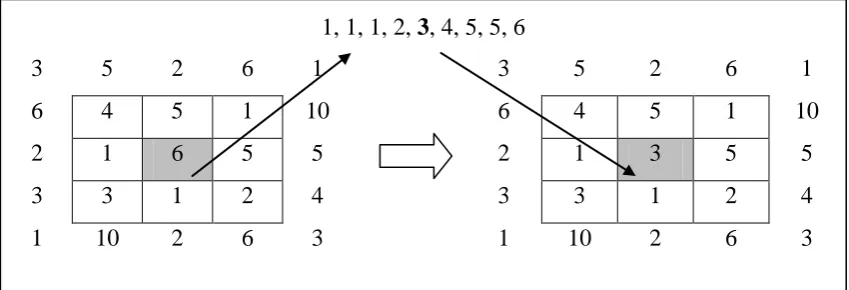
Median filtering is similar to the mean or averaging filter since they produce pixel, this is set to an "average" of the pixel values in the surrounding region of the corresponding input pixel. In median filtering, the importance of an output pixel is determined by the median of the surrounding region of pixels rather than the mean. Among the advantages of median filter is that the median is much less sensitive than the mean to critical values. Furthermore, median filtering is able to remove these outliers without decreasing the amount of sharpness of the image (Arastehfar et al., 2013). In median filter, the size of the neighbourhood used for filtering is 3-by-3 as shown in Figure 2.1.
1, 1, 1, 2, 3, 4, 5, 5, 6
3 5 2 6 1 3 5 2 6 1
6 4 5 1 10 6 4 5 1 10
2 1 6 5 5 2 1 3 5 5
3 3 1 2 4 3 3 1 2 4
[image:21.595.107.532.520.665.2]1 10 2 6 3 1 10 2 6 3
11
2.5 Image Denoising Techniques
Image denoising is done by filtering or designing tools to remove the noise. Filtering divide in broad categories depends on its operation or efficiency. Denoising of images in medical science is still a challenging problem up to today. There are so many techniques and algorithms published, where each has their own assumptions limitations and advantages. Common methods of image denoising are spatial domain and transform domain. The linear filter such as Weiner and non- linear threshold filtering, wavelet coefficient model, non-orthogonal wavelet transform, wavelet shrinkage, anisotropic filtering and trilateral filtering are used in denoising. Examples of spatial filtering are mean filtering and Gaussian filtering. The results obtained by linear filters are not good because they destroy the fine details and lines and blur the sharp edges of the images. Bilateral filter is used recently to denoise the images since it work effectively with high frequency areas, but it fails to work at low frequency. In fact, it fails to remove salt and pepper noise and gives low performance to remove speckle noise. It can be concluded that each technique or filter or algorithm has its own advantages and limitations or drawbacks. Up to now, there are so many filters for medical image denoising but medical image denoising is still a challenging problem (Kaur & Sharma, 2013).
2.5.1 Diffusion Filter Technique
Diffusion filter is a new proposed filter, hence rarely used in image processing. The elegant property of the technique is that it can enhance images by reducing unwanted intensity variability within the objects in the image without losing much information and enhance the contrast of the edges (Wang et al., 2010).
2.5.1.1 Nonlinear Diffusion Filtering Algorithm
The nonlinear diffusion filtering operation is governed by the following nonlinear partial differential equation (PDE):
where 𝑓𝑡 𝑥, 𝑦 is the initial noisy image at time t and the solution of the above PDE iteratively yields a filtered version which can be considered as the denoised image (Boguslaw et al., 2012). In equation 2.2, 𝑐 𝑥, 𝑦 is the diffusion coefficient, controlling the diffusion amount and is typically described by a diffusivity function:
𝑐 𝑥, 𝑦 = 𝑔 |𝜇 𝑥, 𝑦 | = 1
1+ 𝜇 𝑥 ,𝑦
𝛾
2 (2.3)
where | 𝜇 𝑥, 𝑦 | is the edge estimate at pixel (x, y), usually approximated by a gradient magnitude operator, and 𝛾 is the edge threshold parameter. The diffusivity function 𝑔 |𝜇| is a nonnegative monotonically decreasing function and depending
upon the value of the edge threshold, 𝛾, encourages homogenous regions with reduced noise while preserving the edges (Gottschlich & Scho, 2012). The nonlinear diffusion of PDE can be expanded to:
𝜕
𝜕𝑡 𝑓𝑡 𝑥, 𝑦 = 𝜕
𝜕𝑥 𝑐 𝑥, 𝑦 . 𝜕
𝜕𝑥𝑓𝑡 𝑥, 𝑦 + 𝜕
𝜕𝑦 𝑐 𝑥, 𝑦 . 𝜕
𝜕𝑦 𝑓𝑡 𝑥, 𝑦 (2.4)
Substituting the time-derivative of 𝑓𝑡 𝑥, 𝑦 by its forward difference and discrediting:
𝑓𝑡+∆𝑡 𝑥,𝑦 −𝑓𝑡 𝑥,𝑦
∆𝑡 =
𝜕
𝜕𝑥 𝑐 𝑥, 𝑦 . 𝜕
𝜕𝑥𝑓𝑡 𝑥, 𝑦 + 𝜕
𝜕𝑦 𝑐 𝑥, 𝑦 . 𝜕
𝜕𝑦 𝑓𝑡 𝑥, 𝑦 (2.5)
Let ∆𝑡 = 1 and replacing𝑐 𝑥, 𝑦 , as defined above with1 − 𝑝 𝑥, 𝑦 , it obtains:
𝑓𝑡+1 𝑥, 𝑦 = 𝑓𝑡 𝑥, 𝑦 +
𝑑2
𝑑𝑥2𝑓𝑡 𝑥, 𝑦 +
𝑑2
𝑑𝑦2𝑓𝑡 𝑥, 𝑦 −
𝜕
𝜕𝑥 𝑝 𝑥, 𝑦 . 𝜕
𝜕𝑥𝑓𝑡 𝑥, 𝑦 − 𝜕
𝜕𝑦 𝑝 𝑥, 𝑦 . 𝜕
𝜕𝑦𝑓𝑡 𝑥, 𝑦 (2.6)
13
2.5.2 Wavelet Transform Technique
One of the most basic problems in signal processing is to discover a suitable representation of the data that will facilitate an analysis process. One way to achieve this aim is by decomposition of the signal on a set of fundamental functions prior to processing in the transform domain (Bao & Zhang, 2003). Transform theory has played a key role in image processing for a number of years; it continues to be a topic of interest in theoretical as well as applied work in this field. Image transforms are used widely in many image processing fields, including image enhancement, restoration, encoding, and description.
2.5.2.1 Discrete Wavelet Transform Algorithm (DWT)
Overviews of the fast implementation of the discrete wavelet transform (DWT) as given by a literature review. The forward wavelet transform (FDWT) operation (termed also as decomposition or analysis) is given by the following equation:
𝐴𝑗 𝑥, 𝑦 = 𝑓 𝑥, 𝑦 ⨂ 𝐻 𝑦 ⨂ 𝐻 𝑥
𝑊𝑗𝐻 𝑥, 𝑦 = 𝑓 𝑥, 𝑦 ⨂ 𝐻 𝑦 ⨂ 𝐺 𝑥 (2.7) 𝑊𝑗𝑉 𝑥, 𝑦 = 𝑓 𝑥, 𝑦 ⨂ 𝐺 𝑦 ⨂ 𝐻 𝑥
𝑊𝑗𝐷 𝑥, 𝑦 = 𝑓 𝑥, 𝑦 ⨂ 𝐺 𝑦 ⨂ 𝐺 𝑥
where 𝑓 𝑥, 𝑦 is the given image, ⨂ denotes the convolution operation, and H and G
are one dimensional low pass and high pass decomposition filters, respectively. The image is decomposed into four sub-bands; 𝐴𝑗 denotes the low frequency approximation sub-band, 𝑊𝑗𝑖, 𝑖 ∈ 𝐻, 𝑉, 𝐷 denotes the high frequency sub-band at scale j, and i being one of the horizontal (H), vertical (V), or diagonal (D) orientations. The original image can be reconstructed through the inverse wavelet transform (IDWT) operation (termed also as reconstruction or synthesis):
𝑓 𝑥, 𝑦 = 𝐴𝑗 𝑥, 𝑦 ⨂𝐻 𝑥 ⨂𝐻 𝑦 + 𝑊𝑗𝐻 𝑥, 𝑦 ⨂𝐻 𝑦 ⨂𝐺 𝑥 +
where 𝐻and 𝐺 are one dimension allow pass and high pass reconstruction filters derived as conjugate or dual of the decomposition filters H and G, which depend on whether the filters are orthogonal or bi-orthogonal, respectively. Assuming that the original image 𝑓 𝑥, 𝑦 is part of the scale-space such that the wavelet coefficients can
be manipulated after decomposition, the original image and the reconstructed image can be considered as 𝑓𝑡 𝑥, 𝑦 , 𝑓𝑡+1 𝑥, 𝑦 , respectively. Using this convention, writing
the analysis and synthesis operations in joint form will give us the following formulation:
𝑓𝑡+1 𝑥, 𝑦 =
𝑓𝑡 𝑥, 𝑦 ⨂HH x, y ⨂𝐻𝐻 𝑥, 𝑦 + 𝑓𝑡 𝑥, 𝑦 ⨂GH x, y ⨂𝐺𝐻 𝑥, 𝑦 + 𝑓𝑡 𝑥, 𝑦 ⨂HG x, y ⨂𝐻𝐺 𝑥, 𝑦 + 𝑓𝑡 𝑥, 𝑦 ⨂GG x, y ⨂𝐺𝐺 𝑥, 𝑦 (2.9)
where 𝑓 𝑥, 𝑦 ⨂ 𝐺𝐻 𝑥, 𝑦 is the separable convolution of 𝑓 𝑥, 𝑦 with 𝐺 𝑥 and 𝐻 𝑦 (Yang et al., 2010).
Transforming the above equation into Fourier domain produces the following mathematical expressions:
𝑓 𝑡+1 𝑤𝑥, 𝑤𝑦 =
𝑓 𝑡 𝑤𝑥, 𝑤𝑦 . 𝐻𝐻 𝑤𝑥, 𝑤𝑦 . 𝐻𝐻 𝑤𝑥, 𝑤𝑦 +
𝑓 𝑡 𝑤𝑥, 𝑤𝑦 . 𝐺𝐻 𝑤𝑥, 𝑤𝑦 . 𝐺𝐻 𝑤𝑥, 𝑤𝑦 + 𝑓 𝑡 𝑤𝑥, 𝑤𝑦 . 𝐻𝐺 𝑤𝑥, 𝑤𝑦 . 𝐻𝐺 𝑤𝑥, 𝑤𝑦 +
𝑓 𝑡 𝑤𝑥, 𝑤𝑦 . 𝐺𝐺 𝑤𝑥, 𝑤𝑦 . 𝐺𝐺 𝑤𝑥, 𝑤𝑦 (2.10)
𝑓 𝑡+1 𝑤𝑥, 𝑤𝑦 =
𝑓 𝑡 𝑤𝑥, 𝑤𝑦 . {[𝐻𝐻 𝑤𝑥, 𝑤𝑦 . 𝐻𝐻 𝑤𝑥, 𝑤𝑦 ] + [𝐺𝐻 𝑤𝑥, 𝑤𝑦 . 𝐺𝐻 𝑤𝑥, 𝑤𝑦 ] + [𝐻𝐺 𝑤𝑥, 𝑤𝑦 . 𝐻𝐺 𝑤𝑥, 𝑤𝑦 ] + [𝐺𝐺 𝑤𝑥, 𝑤𝑦 . 𝐺𝐺 𝑤𝑥, 𝑤𝑦 ] (2.11)
15
𝐻𝐻 . 𝐻𝐻 + 𝐺𝐻 . 𝐺𝐻 + 𝐻𝐺 . 𝐻𝐺 + 𝐺𝐺 . 𝐺𝐺 = 1 (2.12)
This is the case of conventionally used orthogonal and bi-orthogonal wavelet transform.
2.6 Image Quality Assessment Methods
Measurement of image quality is crucial in many image processing systems. Due to inherent physical limitations and economic reasons, the quality of images, audios, and videos could visibly degrade right from the point when they are captured to the point when they are viewed by a human observer. Finding the image quality measures that have high sensitivity to these distortions would help systematic design of coding communication and imaging systems and improving or optimizing the image quality for a desired quality of service at a minimum cost.
Measurement of image quality is very important to numerous image processing applications. Human being is highly visual creatures, which mean it can recognize each other from appearance. The main function of the human eye is to extract structural information from the viewing field, and the human visual system (HVS) is highly adapted for this purpose. Therefore, for the applications, in which images are ultimately to be viewed by human beings, the only accurate method of quantifying visual image quality is through subjective evaluation or assessment. However, subjective evaluation is usually too inconvenient because it is time-consuming and expensive. As a result, a lot of efforts have been made to develop objective image quality metrics that correlate with perceived quality (Abdul Rehman & Wang, 2012).
The goal of image quality assessment research is to design a method to measure the strength of the perceptual similarity between the test and the reference images. Many approaches have been taken in account by researchers to measure the quality of an image or for the assessment of images.
sensitivities, which are usually determined by psychophysical measurement. The short coming from this approach is that larger visible differences may not necessarily imply lower perceptual quality.
In the second approach, the observation process efficiently extracts and makes the use of information represented in the natural scene, whose statistical properties are believed to play a fundamental role in the development of the HVS. A clear example of the second approach is the structural similarity based image quality assessment method. This method is based on observation that natural images are highly structured, meaning that the signal samples have strong dependencies among themselves. These dependencies carry important information about the structure of the objects in the visual scene (Brunet et al., 2011).
The most commonly used objective image quality measures are; Signal-to-Noise Ratio (SNR), Mean Square Error (MSE), Peak Signal-to-Signal-to-Noise Ratio (PSNR) and Structural Similarity Index Metric (SSIM).
2.6.1 Signal-to-Noise Ratio (SNR)
Signal-to-noise ratio is also called as SNR or S/N; defined as the ratio of signal power to the noise power corrupting the signal. The Signal-to-Noise Ratio (SNR) is a defining factor when it comes to quality of measurement. A high SNR guarantees clear acquisitions with low distortions and artifacts caused by noise. The better your SNR, the better the signal stands out, the better the quality of your signals, and the better your ability to get the results you desire. SNR measurement is commonly used in the field of science and engineering fields. A ratio higher than 1:1 indicates more signal than noise. While SNR is commonly quoted for electrical signals, it can be applied to any form of signal (Naomi, 2009).The SNR is given by the following formula:
(𝑆𝑁𝑅)𝑑𝐵 =𝑣𝑎𝑟 (𝑎𝑣𝑔 𝐼𝑑𝑒𝑛𝑜𝑖𝑠𝑒𝑑 )
17
2.6.2 Mean Square Error (MSE)
This metric is frequently used in signal processing. The goal of a signal fidelity measure is to compare two signals by providing a quantitative score that describes the degree of similarity and the level of error or distortion between them. Typically, it is assumed that one of the signals is a pristine original, while the other is distorted or contaminated by errors as some noise (Baluja et al., 2013). The MSE is defined as follows:
𝑀𝑆𝐸 = 1
𝑁𝑀 𝑁
𝑖=1 𝐼𝑜𝑟𝑖𝑔𝑖𝑛𝑎𝑙 𝑖, 𝑗 − 𝐼𝑑𝑒𝑛𝑜𝑖𝑠𝑒𝑑 𝑖, 𝑗 2 𝑀
𝑗 =1 (2.14)
where
N, M: give the size of the image.
𝐼𝑜𝑟𝑖𝑔𝑖𝑛𝑎𝑙 𝑖, 𝑗 : is the pixel values at location (i, j) of the original image before
the denoising process.
𝐼𝑑𝑒𝑛𝑜𝑖𝑠𝑒𝑑 𝑖, 𝑗 : is the pixel values at location (i, j) of the image after denoising algorithm.
2.6.3 Peak Signal to Noise Ratio (PSNR)
PSNR stands for the peak signal-to-noise ratio. It is an engineering term used to calculate the ratio between the maximum possible power of a signal and the power of corrupting noise that affects the fidelity of its representation. Because many signals have a very wide dynamic range, PSNR is usually expressed in terms of the logarithmic decibel scale (Goyal & Sekhon, 2011). The PSNR computes as:
𝑃𝑆𝑁𝑅 = 20𝑙𝑜𝑔10 255
𝑅𝑀𝑆𝐸 (2.15)
2.6.4 Structural Similarity Index Metric (SSIM)
The structural similarity index (SSIM) method is a recently proposed approach to image quality assessment. It is widely believed that the statistical properties of the natural visual environment play a fundamental role in the evolution, development, and adaptation of the human visual system (HVS). An important observation about natural image signal samples is that they are highly structured. Structuring signal means that the signal sample exhibit strong dependencies amongst themselves, especially when they are spatially proximate. These dependencies carry important information about the structure of the objects in the visual scene. The principal hypothesis of structural similarity based image quality assessment is that the human visual system is highly adapted to extract structured information in the visual field, and therefore, a measurement of structure similarity or distortion should provide a good approximation to perceived image quality. The SSIM index is a method to measure the similarity or the differences between two sets of images. SSIM index is a full reference metric, in other words, the measure event of image quality is based on an initial uncompressed or distortion free image as reference (Napoleon & Praneesh, 2013). The SSIM is computes as:
𝑆𝑆𝐼𝑀 𝑥, 𝑦 = 2×𝑥𝑦+𝐶1 2×𝜎𝑥𝑦+𝐶2
(𝜎𝑥2+𝜎𝑦2+𝐶2)×( 𝑥 2+ 𝑦 2
+𝐶1) (2.16)
where
𝑥: is the average of x.
𝑥 = 1
𝑁 𝑥𝑖
𝑁
𝑖=1 (2.17)
𝑦: is the average of y.
𝑦 = 1
𝑁 𝑦𝑖
𝑁
𝑖=1 (2.18)
19
𝜎𝑥2 = 1
𝑁−1 (𝑥𝑖 − 𝑥)
2 𝑁
𝑖=1 (2.19)
𝜎𝑦2: is variance of y.
𝜎𝑦2 = 1
𝑁−1 (𝑦𝑖 − 𝑦)
2 𝑁
𝑖=1 (2.20)
σxy: represents the standard deviation of x and y.
𝜎𝑥𝑦 = 1
𝑁−1 (𝑥𝑖
𝑁
𝑖=1 − 𝑥 ) ( 𝑦𝑖 − 𝑦) (2.21)
C1 = (k1L)2, C2 = (k2L)2;two variables to stabilize the division with weak
denominator, L represents the dynamic range of the pixel values, and k1 = 0.01 and k2 = 0.03 by default (Napoleon & Praneesh, 2013).
2.7 Previous Related Work
2.7.1 Medical Image Denoising Methods
Liao et al. (2010) proposed image denoising technique based on bilateral filter. Bilateral filter (BF) is a famous filter in preserving details while smoothing the image and increases its luminance and contrast. However, its performance in image denoising is unsatisfied because the bilateral filter uses gray levels of pixels directly, which causes the propagation of noise. In context bilateral filter (CBF), the range of filter is not defined on the gray levels directly but it is defined in the context; therefore, it can be suppressed greatly.
Palhano (2010) presented a method for real-time denoising of ultrasound images. A developed version of the Non-Local-means method is presented that incorporates an ultrasound dedicated noise model as well as a graphic processor unit (GPU) implementation of the algorithm. The work was based on average and the results demonstrated that the proposed method is very efficient in terms of denoising quality and is real-time.
used to adjust the amount of denoising strength of the filter. The information is obtained automatically from the images by using new local noise estimation. Proposed new noise-adaptive method was demonstrated to outperform the standard filter when spatially varying noise is present in the images.
Ruikar & Doye (2011) proposed wavelet based image denoising methods. Wavelet algorithms are useful tool for signal processing such as image compression and denoising. However, this technique is computationally faster and gives better results. Results based on different noise such as Gaussian, Poisson’s, salt and pepper,
and Speckle was performed in this paper by using used signal-to-noise ratio as a measure of the quality of denoising. Some aspects that were analyzed in this paper may be useful for other denoising schemes, objective criteria for evaluating noise suppression performance of different significance measures. Some function gives better edge perseverance, background information, and contrast stretching in spatial domain.
Satheesh & Prasad (2011) proposed a medical image denoising algorithm using contourlet transform. It used thresholding technique for the purpose of segmentation and enhancement. Image preprocessing was used for the purpose of removing white Gaussian noise and enhancement. The proposed algorithm maintains edges while removing the noise from the images. Numerical results show that the proposed algorithm can obtain a higher peak signal-to-noise ratio (PSNR) than wavelet based denoising algorithms using MR Images in the presence of AWGN.
Bhardwaj & Singh (2012) proposed a novel approach of medical image enhancement based on Wavelet transform. Wavelet transform based denoising techniques are of greater interest because of their performance over Fourier and other spatial domain techniques. First, a medical image was decomposed with Haar transform. Then again, high-frequency sub-images were decomposed. Secondly, noise in the frequency field was reduced by the soft-threshold method. Then, high frequency coefficients are enhanced by different weight values in different sub images. Then, the enhanced image was obtained through the inverse Haar transform. Lastly, the image’s contrast is adjusted by nonlinear contrast enhancement
21
Luo & Zhu (2012) proposed a technique based on a reconstruction-average mechanism. At first, different parts of the original complete spectrum are chosen from each of which a signal is reconstructed using a singularity function analysis model. Denoising achieved by averaging these reconstructed signals is by the fact that each of them is the sum of the same noise-free signal and an additive noise of varying magnitude. The experimental results on both simulated and real monochrome images show that the proposed denoising method allows efficient denoising while maintaining image quality and presents significant advantages over conventional denoising methods.
Rani et al. (2012) proposed an image denoising techniques as comparative study. In their paper, a comparison has been made in suitability methods of image denoising to remove noise using different techniques. Visual information transmitted in the form of image is naturally corrupted by Gaussian noise, which is a classical problem in image processing. Therefore, wavelet denoising technique is used because of the ability to capture the energy of a signal with few energy transform values. However, the wavelet transform has drawbacks in extracting the information from the edges, curves of the image. Wavelet transforms works well for the salt and pepper noise. To overcome this drawback of wavelet transform, the curvelet transform has been proposed. The curvelet transform best suited for extracting the information at the edges and curves of an image. The curvelet transform works well to extract features of an image and has been proven to be the best for denoising of an image, but for the salt and pepper noise, the curvelet transform does not work well. Hence, comparison of the image denoising performance is shown in terms of PSNR and visual performance. The result showed that curvelet transform gave a better PSNR and visual performance than wavelet transform and other methods.
Tran et al. (2012) proposed a model which decomposes a 3D image into two components: the first one containing the geometrical structure of the image and the second one containing the noise. The algorithm of wavelet transform was used to filter out the noise from the image where several decomposition levels were used. The wavelet shrinkage property was used for enhancement purpose. The numerical implementation was described in the paper and some experiments for denoising a 3D MRI image were successfully performed.
filter is a nonlinear and local technique that preserves the features while smoothing the images at the same time. It removes the additive white Gaussian noise effectively but its performance is poor in removing salt and pepper noise.
Ke Lu et al. (2012) investigate an adaptive denoising scheme based on the patch Nonlocal- means (NL-means) algorithm for medical imaging denoising. Compared with the traditional means algorithm, the proposed adaptive NL-means denoising scheme has three unique features. It restricted local neighborhood, where the true intensity of each noisy pixel is estimated from a set of selected neighboring pixels to perform the denoising process. It calculates the weights to the similarity between the patch to denoise and the other patches candidates. It applies the steering kernel to preserve the details of the images. The proposed method has been compared with similar state-of-art methods over synthetic and real clinical medical images showing an improved performance in all cases analyzed.
Tsiotsios & Petrou (2012) proposed on the choice of the parameters for anisotropic diffusion (AD) in image processing. AD filtering is highly dependent on some crucial parameters such as conductance function, gradient threshold parameter, and stopping time of the iterative process. Various alternative options at each stage of the algorithm are examined and evaluated and the best choice is selected. The scheme is evaluated with the help of real and simulated images and compared with other state of the art schemes using objective criteria. They carefully studied all steps of the anisotropic diffusion algorithm and came up with the best choice among the various options at each step, describing a complete image- adapted denoising tool. Despite a stopping criterion, the level of the removed noise and the quality of the preserved edges are also considered. The scheme was evaluated using several images with different levels of noise. The most difficult images to improve with AD are those with many details and texture. This is not surprising as highly textured image shave significant levels of energy in the high frequencies too, where noise is supposed to dominate. It is expected that any noise suppression scheme will have difficulty with such images.
23
2.7.2 Image Quality Assessment Methods
Sampat et al. (2009) introduced a new measure of image similarity called the complex wavelet structural similarity (CW-SSIM) index, and showed its applicability as a general purpose for image similarity index. The idea behind CW-SSIM is that certain image distortions lead to consistent phase changes in the local wavelet coefficients and that a consistent phase shift of the coefficients does not change the structural content of the image. Four case studies were conducted and they demonstrated the superiority of the CW-SSIM index against other indices such as Dice which commonly used for assessing the similarity of a given pair of images. Furthermore, it shows that the CW-SSIM index has a number of advantages compared to others. It is robust to small rotations and translations as property of wavelets. It provides useful comparisons even without a preprocessing image registration step, which is essential for other indices and it is computationally less expensive.
Abdul Rehman & Wang (2010) showed that the structural similarity (SSIM) index as a good perceptual image quality predictor. However, in many real world applications, such as network visual communications, SSIM is not applicable because its computation requires full access to the original image. This paper proposed a reduced-reference approach that estimates SSIM with only partial information about the original image. It extracts statistical features from a multi-scale and multi-orientation divisive normalization transforms and develops a distortion measure by following the philosophy analogous to that in the construction of SSIM method. An interesting linear relationship between reduced-reference SSIM estimate and full-reference SSIM was seen when the image distortion type is fixed not varied. A regression-by discretization method is then applied to normalize the measure between image distortion types. Live database was used to test the proposed distortion measure where it shows strong correlations with both SSIM and subjective evaluations. It also demonstrates how the reduced-reference features employed to partially repair a distorted image.
theoretical principles and reliable computational models. When viewing natural images, the optimal perceptual weights for pooling should be proportional to the local information content that can be estimated in units of bit using advanced statistical models of natural images. Extensive studies based upon six publicly-available subject- rated image databases concluded with three useful findings as follows:
(i) Information content weighting leads to consistent improvement in the performance of image quality assessment algorithms.
(ii) Surprisingly, with information content weighting even the widely criticized peak signal-to-noise-ratio can be converted to a competitive perceptual quality measure when compared with state-of-the-art algorithms.
(iii) The best overall performance is achieved by combining information content weighting with multi-scale structural similarity measures.
Brunet et al. (2011) proposed a class of metrics for signals and images deriving mathematically was considered as elements of reduce noise based upon the SSIM index. The important feature of this construction is that it considers the two terms of the SSIM index, which are normally multiplied together to produce a scalar as components of an ordered pair. However, each of these terms is then used to produce a normalized metric, in which one operates by the means of the signals while the other operates on their zero-mean components. This algorithm shows that a suitable norm of an ordered pair of metrics defines a metric in the RN.
2.8 Summary of the Chapter
64
REFERENCES
Abdul Rehman & Wang, Z. (2010). Reduced-Reference SSIM Estimation. The International Conference on Image Processing (ICIP), pp. 289 – 292.
Abdul Rehman & Wang, Z. (2012). Reduced-Reference Image Quality Assessment by Structural Similarity Estimation. IEEE Transactions on Image Processing, 21(8), pp. 3378 – 3389.
Arastehfar, S., Pouyan, A. A. & Jalalian, A. (2013). An enhanced median filter for removing noise from MR images. Journal of AI and Data Mining (JADM), 1(1), pp.13-17.
Baluja, Y., Mishra, S., Saini, T. S. & Pati, M.V. (2013). Frequency Domain Based Data Hiding Technique for Audio Signal. International Journal of Innovative Research in Science, Engineering and Technology, 2(5), pp.
1564 – 1569.
Bao, P. & Zhang, L. (2003). Noise Reduction for Magnetic Resonance Images via Adaptive Multiscale Products Thresholding. IEEE Trans. Med. Image., 22(9), pp. 1089 – 1099.
Bhardwaj, A. & Singh, M. K. (2012). A Novel approach of medical image enhancement based on Wavelet transform. International Journal of Engineering Research and Applications (IJERA), 2(3), pp. 2356 – 2360.
Bhonsle, D., Chandra, V. & Sinha, G. R. (2012). Medical Image Denoising Using Bilateral Filter. I.J. Image, Graphics and Signal Processing, 6, pp. 36 – 43. Boguslaw O., Mark F. & Vicente G. (2012). Coherence Enhancing Diffusion Filtering Based On The Phase Congruency Tensor. IEEE International Symposium on Biomedical Imaging (ISBI), 20, pp. 202 – 205.
Brunet, D., Vrscay, E. R. & Wang, Z. (2011). A Class of Image Metrics Based on the Structural Similarity Quality Index. International Conference on Image Analysis and Recognition (ICIAR11), Burnaby, BC, Canada, 1, pp. 100 –
Buades, A., Coll, B. & Morel, J. M. (2005). A Review of Image Denoising Algorithms, With a New One. Multiscale Modeling & Simulation, 4(2), pp. 490 – 530.
Chen, Y., Yin, R., Flynn, P. & Broschat, S. (2003). Aggressive region growing for speckle reduction in ultrasound images. www.computerScienceWeb.com. 24, pp. 677 – 691.
Gottschlich, C. & Scho C. B. (2012). Oriented Diffusion Filtering for Enhancing Low-Quality Fingerprint Images. IET Biometrics, 1(2), pp. 105 – 113. Goyal, M. & Sekhon, G. S. (2011). Hybrid Threshold Technique for Speckle Noise
Reduction using wavelets for Grey scale images. International Journal of Image, Graphics and Signal Processing (IJIGSP), 2(2), pp. 620 – 625.
Kaur, M. & Sharma, R. (2013). RESTORATION OF MEDICAL IMAGES USING DENOISING. International Journal for Science and Emerging Technologies with Latest Trends, 5(1), pp. 35 – 38.
Kaur, R. & Kaur, R. (2013). Survey of De-noising Methods Using Filters and Fast Wavelet Transform. International Journal of Advanced Research in Computer Science and Software Engineering, 3(2), pp. 133 – 136.
Ke Lu, Ning He, & Liang Li. (2012). Nonlocal Means-Based Denoising for Medical Images. Computational and Mathematical Methods in Medicine, 2012, pp. 7.
Liao, Z., Hu, S., Yu, Z. & Sun, D. (2010). Medical Image Blind Denoising Using Context Bilateral Filter. International Conference on Medical Image Analysis and Clinical Applications (MIACA), pp. 12 – 17.
Luo, J. & Zhu, Y. (2012). Denoising of medical images using a reconstruction-average mechanism. Digital Signal Processing, 22, pp. 337 – 347.
Maini, R. & Aggarwal, H. (2010). A Comprehensive Review of Image Enhancement Techniques. Journal of Computing, 2(3), pp. 8 – 13.
Manjón, J. V., Coupé, P., Martí-Bonmatí, L., Collins, D. L. & Robles, M. (2010). Adaptive Non-Local Means Denoising of MR Images with Spatially Varying Noise Levels. Journal of Magnetic Resonance Imaging, 31(1), pp.192 – 203.
66
Napoleon, D. & Praneesh, M. (2013). Detection Of Brain Tumor Using Kernel Induced Possiblistic C-Means Clustering. International Journal of Computer & Organization Trends, 3(9), pp. 436 – 438.
Palhano, F. (2010). Real time ultrasound image denoising. Journal of Real-Time Image Processing, 6, pp. 1 – 14.
Prudhvi, V. N. & Venkateswarlu, T. (2012). Denoising of Medical Images using Total Variational Method. An International Journal (SIPIJ), 3(2), pp. 131 – 142.
Radiology Teaching Files, Peer Reviewed Proven Cases MedPix. (2000). Medical Image Database, http://rad.usuhs.mil/medpix/parent. pp. 1- 66.
Rangaraju, K. S., Kumar, K. & Renumadhavi, C. H. (2012). Quantitative Image Quality Assessment – Medical Ultrasound Images. International Journal of Engineering Research & Technology (IJERT), 1(4), pp. 1 – 6.
Rani, U., NARULA, C. & Pardeep. (2012). Image Denoising Techniques A Comparative Study. International Journal of Electronics, Communication & Instrumentation Engineering Research and Development (IJECIERD),
2(3), pp. 64 – 74.
Rathor, G. P., Kaushik, A. R., & Gupta, V. (2012). Medical Images Denoising Techniques Review. International Journal of Electronics Communication and Microelectronics Designing, 1(1), pp. 33 – 36.
Ruikar, S. D. & Doye, D. D. (2011). Wavelet Based Image Denoising Technique. International Journal of Advanced Computer Science and Applications
(IJACSA), 2(3), pp. 49 – 53.
Sampat, M. P., Wang, Z., Gupta, S., Bovik, A. C. & Markey, M. K. (2009). Complex Wavelet Structural Similarity: A New Image Similarity Index. IEEE Transactions on Image Processing, 18(11), pp. 2385 – 2401.
Satheesh, S. & Prasad, K. (2011). Medical Image Denoising Using Adaptive Threshold Based on Contourlet Transform. Advanced Computing: An International Journal (ACIJ), 2(2), pp. 52 – 58.
Sudha, S., Suresh, G. R. & Suknesh, R. (2009). Speckle Noise Reduction in Ultrasound Images by Wavelet Thresholding based on Weighted Variance. International Journal of Computer Theory and Engineering, 1(1), pp. 1793
Tran, MP., Peteri, R. & Bergounioux, M. (2012). Denoising 3D medical images using a second order variational model and wavelet shrinkage. Image Analysis and Recognition Lecture Notes in Computer Science, 7325, pp.
138 – 145.
Tsiotsios, C. & Petrou, M. (2012). On the choice of the parameters for anisotropic diffusion in image processing. Pattern Recognition, 46, pp. 1369 – 1381. Wang, Y., Niu, R. & Yu, X. (2010). Anisotropic Diffusion for Hyperspectral
Imagery Enhancement. IEEE Sensors Journal, 10(3), pp. 469 - 477.
Wang, Z. & Li, Q. (2011). Information Content Weighting for Perceptual Image Quality Assessment. IEEE Transactions on Image Processing, 20(5), pp. 1185 – 1198.
Wang, Z., Bovik, A. C., Sheikh, H. R. & Simoncelli, E. P. (2004). Image Quality Assessment: From Error Visibility to Structural Similarity. IEEE Transactions on Image Processing, 13(4), pp.1 – 14.
Webster, A. A., Jones, C. T., Pinson, M. H., Voran, S. D., & Wolf, S. (1993). An Objective Video Quality Assessment System Based on Human Perception. SPIE, 1913, pp. 15 – 26.