prediction in notched woven laminates under
quasi-static loading
H. Ahmad*
1, A. D. Crocombe
2and P. A. Smith
2The present paper is concerned with modelling damage and fracture in notched woven fabric
composites. Previous experimental work has shown that, under tensile loading, damage at a
notch in a variety of glass fibre reinforced plastic (GFRP) and carbon fibre reinforced plastic
(CFRP) composites based on woven fabric reinforcement comprises matrix damage and fibre tow
fracture along the plane of maximum stress. It is these experimental observations that inform the
failure modelling developed here, in which a cohesive zone approach is used within a
two-dimensional extended finite element method framework. The traction–separation parameters
used in the extended finite element method implementation are based on previously reported
experimental measurements for the strength and toughness of the woven fabric materials under
investigation. The approach is shown to provide predictions of notched strength that are in very
good agreement with experimental results from the literature for a range of glass fibre reinforced
plastic and carbon fibre reinforced plastic woven fabric systems and also agree well with results
obtained from closed form analytical models, which require calibration.
Keywords:Circular hole, Notched plate, Strength prediction, Stress, Woven composite, XFEM
Introduction
Woven fabric based composite materials are an attrac-tive option for a range of engineering applications. Although the mechanical properties are not as good as those of their non-woven counterparts, they still offer reasonable specific stiffness and strength with particu-larly good impact and energy absorption characteristics. Moreover, they offer some economies and greater flexibility in processing options. A particular problem with woven composites (as with other composites) is their sensitivity to the presence of stress concentrations, such as those provided by an open hole and bolted joint. Unlike many structural metallic materials, composite materials in general lack the capability to deform plastically in the macroscopic sense and this means that failure at a stress raiser in a composite occurs in a relatively brittle fashion. Notwithstanding this, compo-site materials have the capability to sustain damage before fracture; this means that the notched strength is greater than would be expected simply on the basis of the elastic stress concentration factor. The damage mechanisms in notched woven composite plates differ
from those in notched non-woven composite plate and this has implications for the modelling approach.
The failure of composite materials from a stress raiser, particularly an open hole, has been researched exten-sively over the years. Early closed form models (of which the most well known are perhaps the point and average stress criteria of Whitney and Nuismer1) have been followed by finite element (FE) based approaches of varying degrees of complexity. Some of the latter models treat the composite as a homogeneous material for the purpose of the stress analysis and then use laminate theory and two-dimensional in-plane failure models to simulate progressive damage at the ply level, followed by a degradation of the elastic properties to account for the stress redistribution before ultimate failure, e.g. Chang and Chang.2Other models use a quasi-two-dimensional approach,3 or a full three-dimensional analysis, e.g. Hallett et al.4 These approaches represent the observed damage more realistically – in particular, they incorpo-rate through thickness damage (delamination) in addi-tion to in-plane damage. Kortschot et al.3 proposed a model for notched strength prediction which represents the effect of intraply damage (local unidirectional ply splitting) and interply (associated delamination) crack-ing on the stress distribution near the notch tip in the longitudinal plies of notched cross-ply laminates and uses a statistical Weibull based failure criterion in two-dimensional (2D) model to predict the failure of the 0u plies and hence the notched strength. Hallett et al.4 modelled damage within an FE framework and used the
1Department of Structures and Materials Engineering, Faculty of Civil and
Environmental Engineering, Universiti Tun Hussein Onn Malaysia, 86400 Parit Raja, Batu Pahat, Johor Darul Tak’zim, Malaysia
2Division of Mechanical, Medical and Aerospace Engineering, Faculty of
Engineering and Physical Sciences, University of Surrey, Guildford, Surrey GU2 7XH, UK
approach to investigate the effect of a number of parameters (hole diameter, ply thickness and laminate thickness) on the strength of notched quasi-isotropic carbon fibre reinforced plastic (CFRP) laminates sub-jected to tensile stress. Another class of failure model (discussed further below) is based on modelling macro-scopic through thickness crack growth from the notch, an approach which is perhaps not consistent with the observed failure mechanism in laminates based on unidirectional layers of reinforcement such as discussed above.
Many of the more widely used approaches to predict notched strength are semiempirical in nature and this limits their general applicability. In particular, the subcritical damage that develops at notches (and which needs to be represented in some way within any model) varies according to the details of the composite under investigation. Hence, it is only through the use of physically based models that there is the possibility of a failure theory being applicable to more than one class of problem without extensive recalibration of the model. In a notched woven fabric glass fibre reinforced plastic (GFRP) composite subjected to tension, it has been shown experimentally using a model (transparent) GFRP system that before failure, an intense zone of damage develops in the region of maximum tensile stress.5 Damage within that zone comprises matrix cracking and splitting, but also fibre tow fracture. In that sense, the damage resembles stable self-similar crack growth, suggesting that a fracture mechanics based model is a physically reasonable one to use. A similar study was carried by Belmonteet al.6on woven quasi-isotropic and cross-ply CFRP. Although the opaque nature of the CFRP means that direct observa-tions of damage are less straightforward, there was evidence of tow failure before specimen failure. Other valuable data concerning notched tensile strength of woven composites had been presented previously by Kim et al.7 More recent work by Zahari et al.8 has considered the notched compressive behaviour of woven GFRP.
The previous paragraph suggests that an appropriate failure model for notched woven fabric composites under tensile loading would consider the damage growth from the notch explicitly. There are a number of essentially similar techniques that treat the problem in this way. A particular stress–displacement relation is assumed within the damage zone and the energy absorbed in separating the crack faces corresponds to the material toughness Gc. One of the first models to
adopt this method was that of Eriksson and Aronsson9 who assumed a constant cohesive stress–displacement relationship within the damage zone. An approximate analytical version of this approach, a ‘critical damage growth’ (CDG) model, was presented by Hitchen et al.,10 building on earlier work by Soutis and Fleck,11 and this was applied subsequently to woven composites.5,6 Afaghi-Khatibi et al.12 presented an ‘equivalent crack growth model’ (ECGM) which assumed a linear decrease in cohesive stress with displacement in the damage zone, which they applied successfully to the data of Kimet al.7
The present work explores further the applicability of this type of approach, which in the present paper is incorporated within an extended finite element model
(XFEM) formulation. A limitation of the previous studies is that the material parameters within the models have generally been calibrated against experimental data rather than determined independently. Here we use independent measurements of unnotched strength and toughness, where available, to develop numerical models for the experimental studies on woven fabric systems conducted by Kim et al. using GFRP7 and Belmonte et al. using GFRP5 and CFRP.6 In the next section, details of the numerical procedure are provided. Extended finite element model predictions are compared with experiment and other closed form solutions in subsequent sections.
Finite element modelling
Notched plate geometry and material properties
The three experimental studies from the literature were modelled within a two-dimensional FE framework using ABAQUS CAE Version 6.9.1.13For all the models, the plate symmetry means that only half of the coupon needed to be modelled (Fig. 1), reducing computational cost and time during the processing stage. The first data set is taken from the extensive experimental work conducted by Kim et al.7 using three types of woven fabric composite systems with various combinations of notch sizes, laminate width and volume fraction. All plates have a lengthLof 200 mm with varying widthsW and a circular hole of diameter d of 5 mm. Table 1 shows the geometry and material properties for all the woven fabric systems investigated experimentally by Kimet al.7that are being modelled in current paper. The elastic properties are required for the stress analysis while to implement the damage model, the unnotched strengthsoand the fracture energyGcare also required.
Independently measured values for the latter were not reported by Kimet al.7Instead, they derived their values from an analysis of the notched strength experimental data and this is the origin of the notch size dependent data (strength and fracture energy) seen in Table 1, apparent in the glass–epoxy in particular. In the absence of independently measured properties, these fracture energy values are used in the current work as it enables comparison not only with the experimental data from Ref. 7 but also with the ECGM approach, which has been applied to the same data set.12
The second and third data sets were taken from the work of Belmonte et al. for woven GFRP laminates5 and woven CFRP laminates6 respectively. The plates had 130 mm gauge length (GFRP) or 150 mm gauge length (CFRP) and a constant width of 25 mm with notch sizes (hole diameters) dof 2?5, 5?0 and 10?0 mm giving d/W ratios of 0?1, 0?2 and 0?4 respectively. Belmonte also included an additional series of larger CFRP specimens from the thickest plates that had gauge length 380 mm, width 120 mm and a 20 mm diameter 1 Geometry of notched composite plate model, used for
hole corresponding to d/W50?17. Belmonte et al.5,6 carried out experiments on two different types of woven composite systems, i.e. GFRP and CFRP. The material properties are shown in Tables 2 and 3. The GFRP systems comprised two stacking sequences of a four-layer quasi-isotropic composite (Table 2). The woven CFRP systems investigated had two types (a plain weave and a five harness satin weave), two different lay-ups (cross-ply and quasi-isotropic) and three different plate thickness for each giving 12 systems in total (Table 3). In contrast with Kim et al.,7 Belmonte et al.5,6 reported values of fracture energy that were measured indepen-dently for each lay-up using single edge notch fracture mechanics specimens in accordance with ASTM E399-90.
Implementation of constitutive law in FE
modelling
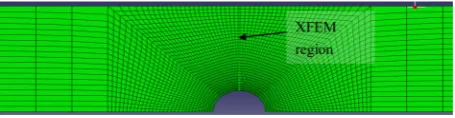
A typical plane stress mesh used in the FE modelling is shown in Fig. 2. The meshes are refined in the vicinity of notch edge, while away from the notch, the mesh can be made coarser. Mesh refinement was investigated and is discussed in a later section on ‘Woven composite systems tested by Kimet al.7’. As indicated earlier, in the
notched plate under increasing tensile load, damage is
assumed to grow in a self-similar manner along the plane of net tension (reduced area). Hence, only crack opening (mode 1) needs to be considered. In this work, two methods for modelling the damage have been used, namely XFEM and cohesive zone modelling (CZM). All of the data were modelled using XFEM and some of Belmonteet al.’s5,6data were also modelled using CZM. Both methods use the same traction–separation damage model, illustrated schematically in Fig. 3. This material model behaves in a linear manner until the traction reaches a critical value (strength parameter) and then unloads with increasing displacement dissipating the fracture energy Gc in the process. The strength
parameter has been taken as the unnotched strengthso
of the laminate. The values of strength parameter (unnotched strength so) and fracture toughness Gc
are obtained from literature12 and independently from experimental work5,6and are shown in Tables 1–3. Both damage models have been embedded within a mesh of 2D continuum elements having a linear elastic plane stress response. Both damage models are discussed briefly below.
[image:3.595.64.542.358.478.2]In conventional FE modeling, a discontinuity such as crack requires accurate modelling and hence mesh refinement. Furthermore, crack propagation usually
Table 2 Material properties of woven GFRP from Belmonteet al.5
Stacking sequence t/mm Ex/GPa Ey/GPa vxy Gxy/GPa so/MPa Gc/kJ m
22
(0u/90u/¡45u)s 1.25 15.9 15.9 0.3 6.10 291 20.3
(90u/0u/¡45u)s 1.25 16.0 16.0 0.3 6.10 291 20.3
*The unnotched strength and toughness values for the (90u/0u/¡45u)sstacking sequence were assumed to be the same as for the
[image:3.595.64.542.530.573.2](90u/0u/¡45u)sstacking sequence.
Table 1 Material properties of woven fabric system conducted by Kimet al.7*
Materials type
Thicknesst/
mm vf/%
Exx/
GPa
Eyy/
GPa Gxy vxy
Width/ mm
Unnotched strengthso/MPa
Fracture energy
Gc/kJ m22
Glass–epoxy 2.0 62 23.6 23.6 4.0 0.11 10 351 12.6
20 319 21.2
40 275 33.1
Glass–polyester 2.3 60 21.6 21.6 3.9 0.16 10 309 14.9
30 296 17.5
2.3 44.5 14.7 14.7 2.7 0.17 10 218 7.50
30 198 8.00
Carbon–epoxy 1.2 60 56.7 56.7 8.7 0.22 10 596 30.5
20 581 45.0
*vf5fibre volume fraction; Exx5longitudinal Young’s modulus; Eyy5transverse Young’s modulus;vxy5Poisson’s ratio; t5laminate
thickness.
Table 3 Material properties of all woven CFRP from Belmonteet al.6
Series Laminate code t/mm Ex/GPa Ey/GPa vxy Gxy/GPa so/MPa Gc/kJ m22
Plain weave cross-ply (PX) PX2 0.51 50.4 50.4 0.103 4.42 481 26.0
PX4 1.03 51.4 51.4 0.092 4.42 527 27.7
PX8 2.03 53.1 53.1 0.083 4.42 538 22.7
Plain weave quasi-isotropic (PQ) PQ4 1.02 37.2 37.2 0.353 13.8 390 21.6
PQ8 2.03 36.8 36.8 0.328 13.9 428 17.9
PQ12 3.17 35.2 35.2 0.297 13.6 372 18.3
Five harness satin cross-ply (5X) 5X2 0.81 45.1 45.1 0.077 3.78 419 28.8
5X4 1.60 47.0 47.0 0.062 3.78 535 20.0
5X8 3.15 47.4 47.4 0.053 3.78 456 17.6
Plain weave quasi-isotropic (5Q) 5Q4 1.53 34.1 34.1 0.296 13.2 375 19.2
5Q8 3.17 33.5 33.5 0.320 12.7 347 16.8
[image:3.595.65.542.627.766.2]requires a predefined crack path allowing the propaga-tion of cracks along element boundaries. Extended finite element model, which is an extension to conventional FE methods, is based on an enrichment function that allows a displacement jump between crack faces to occur during crack propagation. Crack path and crack location are not required to be specifieda prioriand the elements effectively split to allow arbitrary crack propagation. The response at this split is defined by the traction–separation response discussed above.
Damage initiation and propagation are simulated at regions experiencing principal stresses greater than corresponding values specified in traction–separation law and always take place orthogonally to the maximum principal stresses. Damage initiation is triggered when the maximum principal stress reaches the critical traction. Damage evolution is controlled by a damage parameter D which is determined from the current separation and the release separation (determined from Gcandso). Fracture makes the structural response
non-linear and numerical methods can experience difficulty converging to a solution. Viscous regularisation (a form of damping) has been used to facilitate convergence and a parametric study was undertaken to determine the optimum value (small enough not to influence the solution values but large enough to allow convergence to be obtained). The XFEM region (i.e. the region capable of sustaining damage) was assigned to a band of the model beside the notch edge (seeFig. 2). Four noded 2D plane stress elements (CPS4) were used as the current implementation of XFEM only worked in conjunction with the first order elements.
Unlike XFEM, CZM requires that the failure path is specified beforehand and seeded with cohesive elements.14 As already discussed, the method of modelling the damage in the CZM is the same as in the XFEM approach (a traction–separation response). The cohesive zone elements were located along the net section plane. The elements are required to be thin (0?01 mm was used in the current work) and were assigned a high initial stiffness. Cohesive elements (COH2D4) were used within cohesive zone region and eight noded quadratic plane stress elements (CPS8) were used in uncracked region. Along common interfaces, the elements were connected using a tie constraint.
Comparison of strength prediction with
experimental data and other models
Woven composite systems tested by Kim
et al.
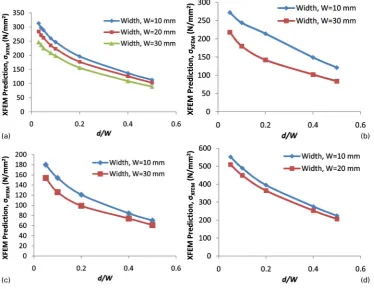
7Comparison between XFEM results and experimental data for the notched woven laminates reported by Kim et al.7 are shown in Fig. 4. In general, the agreement is good with discrepancies no more than 20% (and generally much less than this) for any system/notch size. In all cases apart from the 30 mm wide glass–polyester samples, the XFEM approach underestimates the experimental
strength. A slightly larger error overall is observed for the glass–polyester composites than the other systems, but no particular significance is attached to this, especially given the uncertainty regarding the toughness values. Figure 5 compares the XFEM results to ECGM approach adopted by Afaghi-Khatibi et al.12 The agreement between the ECGM results and XFEM is very good, not unexpectedly as both represent fracture mechanics formulations of the problem, and this provides validation for the XFEM formulation used here.
Typical load–displacement plots from the XFEM are shown in Fig. 6, giving results from 10 mm wide glass/ epoxy lay-up plates with hole diameter of 0?4 mm and close-up view damage plots at specific locations in the graph were illustrated in Fig. 7. Owing to large stress concentration at the vicinity of hole as tension load is applied, the onset of damage will be initiated at the hole edge as expected. After initiation, the crack was still able to carry increased load until it reached about one hole diameter in length at which point ultimate failure occurred. It would appear that the length of the process zone is critical in determining ultimate failure. This process continued until the plate separated completely associated with catastrophic failure after maximum load had been achieved. Two types of parametric studies were carried out to determine the sensitivity of the strength prediction to key model parameters (10 mm wide glass/ epoxy with 0?4 mm hole diameter was chosen for this purpose). The first study was to determine an acceptable viscous regularisation value to use to ensure that the strength prediction results were independent from the viscosity constant. It was found that it was difficult to obtain converged solutions if the viscosity was too small; however, as can be seen, large viscosity values gave excessive and non-physical results. From Fig. 8, a viscosity of 0?0001 is sufficient as lower values produce similar results. The second study assessed mesh sensi-tivity and the results are shown in Fig. 9. The number of elements refers to the region surrounding the hole, and the mesh surrounding the hole was refined in a radial direction. It can be seen that there is no significant mesh sensitivity; indeed one of the basic features of XFEM formulation is that a high level of mesh refinement at the crack tip is not required.13
Quasi-isotropic woven GFRP tested by Belmonte
et al.
5 [image:4.595.58.286.50.109.2]As expected, all of the models showed failure along the net tension plane, which is within the enriched XFEM region specified in the model. The XFEM predicted notched strengths are compared with experimental data, CZM predictions and various analytical approaches5in Fig. 10. Typical load–displacement plot is given in 2 Mesh of model implemented
Fig. 11, with associated enclosed view at crack initiation and propagation point displayed in Fig. 12. Similar fashion of XFEM results of load–displacement plot was observed as shown in earlier case (Fig. 6). The XFEM gives very reasonable agreement with experimental data, to within,6% and with the CZM. Minor discrepancies
between the XFEM and CZM are most likely due to the different element types (the elements used in CZM were quadratic while in XFEM only a linear elements could be used as suggested in the relevant ABAQUS man-ual13). For the (0u90u/z45u/245u)slay-up, the Whitney–
Nuismer point and average stress criterion (PSC and
aglass–epoxy;bglass–polyester (V1f560%);cglass–polyester (V1f544?5%);dcarbon–epoxy 4 Comparison of experimental notched strength with XFEM modelling of Kimet al.’s work7
a glass–epoxy (W510 mm); b glass–polyester (W530 mm; vf560%); c glass–polyester (W530 mm; vf544?5%); d carbon–
epoxy (W510 mm)
ASC), give excellent agreement as expected (these semiempirical models are calibrated at one of the notched strength results). The CDG model also gives good agreement. The strength predictions for the (90u/0u/
z45u/245u)sare reasonable. Note that for this stacking
sequence, the same strength and toughness values were assigned as for the other stacking sequence. The results perhaps suggest that this stacking sequence has a lower strength and/or toughness – a lower toughness would be consistent with the surface 90ulayers restricting the extent of 0uply splitting, which seems plausible.
Cross-ply and quasi-isotropic woven CFRP
tested by Belmonte
et al.
6The results for the cross-ply and quasi-isotropic woven CFRP composite systems with different notch sizes are presented in a similar way in Fig. 13. Both CZM and XFEM of failure initiation and propagation in woven CFRP exhibited similar trends as shown in woven GFRP. Overall agreement is very good, within 10% for most systems (the range of error is 0?09–19?41%). Similar size errors were found in large width (40 mm) and small width (25 mm) specimens. In almost all cases, the XFEM tends to underestimate the experimental strength, with a higher discrepancy for the cross-ply systems than the quasi-isotropic systems. The under-estimation may be a result of the simplifying assump-tions within the constitutive law. For instance, the tow fractures tend to follow the crimp regions and this means that the assumption of self-similar crack growth is not entirely realistic.
As with the GFRP results, the PSC and ASC (the Whitney–Nuismer failure criteria) give the best predic-tions compared with other approaches for the hole sizes
of 10 mm or less, over which range they were calibrated against the experimental data. As a result, the PSC and ASC predictions are less good for the larger hole size of 20 mm where the same characteristic distance values were used. Overall the numerical results obtained here using XFEM show better prediction than the CDG model implemented by Belmonte et al.,6 especially for the cross-ply systems. The CDG model was formulated based on an isotropic analysis, which could only be corrected partially for the orthotropic cross-ply systems and so the discrepancies are perhaps not surprising.
Concluding remarks
Two-dimensional modelling of notched woven GFRP and CFRP composite plates has been implemented within an FE framework. The XFEM and CZM 6 Typical load–displacement plots resulting from
imple-menting XFEM approach for laminate reported by Kim
et al.7
7 Damage plot of crack initiation and crack propagation using XFEM as labelled in Fig. 5 for glass/epoxy (W510 mm;
d52 mm)
8 Notched specimen failure load as function of damage stabilisation coefficient for woven glass–epoxy system (10 mm wide and hole diameter of 0?4 mm) following Kimet al.7
9 Notched specimen failure load as function of number of elements for woven glass–epoxy system (10 mm wide and hole diameter of 0?4 mm) following Kim
approaches gave very reasonable agreement with the experimental data for all the systems investigated. There was also good agreement with a range of other
modelling approaches. The advantages of the XFEM/ CZM approach used in the present work are that, unlike the other approaches, it is physically based (and 10 Comparison of woven GFRP notched strength
predic-tion using XFEM (present work) with experimental data
11 Typical load–displacement curve from CZM (woven GFRP (0u/90u/¡45u)s
12 Damage plot for cohesive damage modelling using CZM as labelled in Fig. 9 for GFRP plate (d510 mm). Note that failure in cohesive zones is denoted as SDEG51 and given as red colour (D, E) and blue colour (F)
aPX series;b PQ series;c5X series;d 5Q series
consistent with experimental observations of damage and fracture) and that it may be implemented using independently measured material properties. In turn this offers the prospect that the approach may be applicable to failure in other classes of problem (e.g. net tension failure at a bolted joint) without extensive recalibration of the model.
References
1. J. M. Whitney and R. J. Nuismer: ‘Stress fracture criteria for laminated composites containing stress concentrations’,J. Compos. Mater., 1974,8, 253–265.
2. F. K. Chang and K. Y. Chang: ‘A progressive damage model for laminated composites containing stress concentrations’,J. Compos. Mater., 1987,21, (3), 834–855.
3. M. T. Kortschot, P. W. R. Beaumont and M. F. Ashby: ‘Damage mechanics of composite materials: III – Prediction of damage growth and notched strength’,Compos. Sci. Technol., 1991,40, 147–165.
4. S. R. Hallett, B. G. Green, W. G. Jiang and M. R. Wisnom: ‘An experimental and numerical investigation into the damage mechan-isms in notched composites’,Composite Part A, 2009,40A, 613– 624.
5. H. M. S. Belmonte, C. I. C. Manger, S. L. Ogin, P. A. Smith and R. Lewin: ‘Characterisation and modeling of the notched tensile fracture of woven quasi-isotropic GFRP laminates’,Compos. Sci. Technol., 2001,61, 585–597.
6. H. M. S. Belmonte, S. L. Ogin, P. A. Smith and R. Lewin: ‘A physically-based model for the notched strength of woven quasi-isotropic CFRP laminates’,Composites Part A, 2004,35A, 763– 778.
7. J. K. Kim, D. S. Kim and N. Takeda: ‘Notched strength and fracture criterion in fabric composite plates containing a circular hole’,J. Compos. Mater., 1995,29, (Part 7), 982–998.
8. R. Zahari, A. H. Azmee, F. Mustapha, M. S. Salit, R. Varatharajoo and A. Shakrine: ‘Prediction of progressive failure in woven glass/epoxy composite laminated panels’, J. Mekan., 2008,25, 80–91.
9. I. Eriksson and C. G. Aronsson: ‘Strength of tensile loaded graphite/epoxy laminates containg crack, open and filled holes’,J. Compos. Mater., 1990,24, 456–482.
10. S. A. Hitchen, S. L. Ogin, P. A. Smith and C. Soutis: ‘The effect of fibre length on fracture toughness and notchness and notched strength of short carbon fibre/epoxy composites’, Composites, 1994,6, 407–413.
11. C. Soutis and N. A. Fleck: ‘Static compression failure of carbon fibre T800/924C composite plate with a single hole’, J. Compos. Mater., 1990,24, 536–558.
12. A. Afaghi-Khatibi, L. Ye and Y. W. Ma: ‘An effective crack growth model for residual strength evaluation of composite laminates with circular holes’,J. Compos. Mater., 1996,30, 142–163.
13. ABAQUS V. ‘User’s manual and theory manual’, Hibbitt, Karlsson and Sorensen, Inc., Providence, RI, USA, 2009. 14. H. Ahmad, A. D. Crocombe and P. A. Smith: ‘Strength prediction of