EFFECT OF GAP LENGHTS OF SPHERE-SPHERE ELECTRODES ON AIR
BREAKDOWN LEVEL UNDER LIGHTNING IMPULSE
AHMAD AZLAN BIN HAMZAH
A project report submitted in partial
fulfillment of the requirement for the award of the
Degree of Master of Electric Power
Faculty of Electrical and Electronics Engineering
Universiti Tun Hussein Onn Malaysia
ABSTRACT
Rapid growth of high voltage technology gives the opportunity to engineer to do a study
on the environmental protection. Production high voltage power is due to natural
conditions that could harm and damage the ecosystem of the human condition. In
electrical power system, HV power equipment are mainly subjected with spark over
voltage. These over voltage which may causes by the lighting strokes, switching action,
Normally, the standard sphere gaps are widely used for protective device in such
electrical power equipment. The sphere gaps are commonly used for measurements of
peak values of high voltages and have been adopted any designing in HV equipment.
This project is study about the effect of gap length of sphere-sphere electrodes on air
breakdown level under lightning impulse. This project is started by experimental setup
and producing standard impulse voltage. The lightning impulse produce should be meets
the specifications required by BS EN 60060-1:2010. The standard characteristic of
impulse voltage T1/T2 where T1 is the front time while T2is time to half value also discussed. The procedure of the lab which implement also referred from Terco High
Voltage Experiments. The method that will use in this project is Up and Down Method
to obtain U50. From this method, we can examine the average value of breakdown of an
impulse lightning voltage is applied to the electrodes. The project also discusses about
the electric field density while the impulse voltage is loaded into the sphere to sphere
electrode and separated it at desire air gap by using the FEMM software. The
characteristic either uniform or non-uniform results also present in this project. Level of
insulations at desire gaps between the sphere’s gap also obtain after complete this
ABSTRAK
Kepesatan teknologi voltan tinggi memberi peluang kepada jurutera untuk melakukan
kajian dalam sektor pelindungan persekitaran. Penghasilan voltan tinggi daripada alam
semulajadi mendatangkan bahaya dan kerosakan kepada ekosistem kehidupan manusia.
Dalam sistem kuasa elektrik, HV peralatan kuasa tertakluk kepada voltan percikan.
Voltan percikan tersebut boleh disebabkan oleh kilat dan petir,aksi pensuisan, Pada
kebiasaannye, jurang antara sfera dalam rekabentuk perkakasan elektrik digunakan
secara meluas untuk perlindungan kepada perkakasan elektrik. Projek yang dijalankan
adalah mengkaji kesan perubahan jarak antara sfera dalam persekitaran udara biasa di
bawah tekanan voltan impulse. Projek ini dimulakan dengan penghasilan voltan
impulse.Voltan impulse yang diperolehi sepatutnya mengikut spesifikasi BS EN
60060-1:2010. Voltan impulse yang diperolehi mempunyai T1/T2 di mana T1 adalah masa
hadapan manakala T2 adalah masa ketika separuh. Prosedur makmal yang dilaksanakan
berdasarkan Eksperimen Terco High Voltage. Semasa di makmal, langkah Naik dan
Langkah Turun dijalankan untuk mendapatkan nilai voltan U50. Projek juga
membincangkan tentang kekuatan medan voltan apabila sfera sfera diberikan voltan
impulse dan dijarakkan pada jarak yang hendak dikaji menggunakan perisian FEMM.
Hasil dapatan data kemudian diproses kemudiannya ditentukan ciriannya samada
CONTENTS
TITLE……….…...i
DECLARATION………..ii
ACKNOWLEDGEMENT iii
ABSTRACT iv
ABSTRAK v
CONTENT………vi
LIST OF TABLES………. ..ix
LIST OF FIGURES……… x
1 PROJECT OVERVIEW ... 1
1.1 Introduction 1 1.2 Problem Statement 1 1.3 Objective 2 2 LITERATURE REVIEW... 3
2.1 Breakdown voltage 3
2.3 Spark over voltage 4
2.3.1 Townsend theory 5
2.3.2 Paschen's Law 6
2.4 Marx Generator 7
2.5 Lightning in Malaysia 10
3 METHODOLOGY ...11
3.1 Impulse Voltage 16
3.1.1 Tolerances 17
3.2 Test Setup U50 17
3.2.1 Up and down method. 22
3.3 Drawing the electrode using FEMM software 24
4 RESULT ANALYSIS AND DISCUSSION ...26
4.1 Result for 1cm’s gap 27
4.1.1 Voltage Density for 1cm’s gap 29
4.1.2 Electric field intensity |E| for 1cm’s gap 30
4.2 Result for gap 1.5cm 31
4.2.1 Voltage Density for 1.5cm’s gap 33
4.2.2 Electric field intensity |E| for 1.5cm’s gap 34
4.3 Result for gap 2cm 35
4.3.2 Electric field intensity |E| for 2 cm’s gap 38
4.4 Result for gap 2.5cm 39
4.4.1 Voltage Density for 2.5 cm’s gap 41
4.4.2 Electric field intensity |E| for 2.5 cm’s gap 42
4.5 Result for gap 3cm 43
4.5.1 Voltage Density for 3 cm’s gap 45
4.5.2 Electric field intensity |E| for 3 cm’s gap 46
4.6 Overall result 48
4.6.1 Analysis about U50 versus gap 48
4.6.2 Analysis about Emax versus gap 49
4.6.3 Analysis about Field Utilization (FUF) Factorversus Gap 50
4.6.4 Analysis about U50 versus Field Utilization Factor (FUF) 51
4.6.5 Analysis about Emax versus Field Utilization Factor (FUF) 52
5 CONCLUSION AND RECOMMENDATION ...53
5.1 Conclusion 53
5.2 Recommendation 55
LIST OF TABLES
3.1 Table of list equipment 12
4.1 Up and down method for 1cm’s gap 28
4.2 Up and down method for 1.5cm’s gap 32
4.3 Up and down method for 2 cm’s gap 36
4.4 Up and down method for 2.5 cm’s gap 40
4.5 Up and down method for 3 cm’s gap 44
LIST OF FIGURES
2.1 Electrode configuration for flashover [6]. 4
2.2 Spark over voltage occurred [7]. 5
2.3 Visualation of a Townsend Avalanche [8]. 6
2.4 Paschen Law Curve Characteristic [10]. 7
2.5 Marx Generator connection during charging and discharge [12]. 9
2.6 Marx Generator [14]. 9
2.7 World Isokeraunic Map [15]. 10
3.1 Impulse Voltage Generator test setup 11
3.2 Block Diagram 13
3.3 Single Stage Test Set-Up 13
3.4 Silicon Rectifier 14
3.5 Charging Rectifier 14
3.6 Control Desk 15
3.7 Sphere gap 16
3.8 Switching impulse voltage [18]. 17
3.9 Grounding the component using earthing rod 18
3.10 Gap measuring 19
3.12 Sphere to sphere cant touched each other 21
3.13 Measuring gap between sphere to produce Impulse Voltage 21
3.14 Flow Chart Up and Down Method 23
3.15 Diameter of sphere’s electrode 24
3.16 Using actual diameter sphere to simulate 25
4.1 Impulse voltage applied during the U50 test. 27
4.2 Breakdown and non-breakdown for 1cm’s gap 27
4.3 Voltage Density for 1cm’s gap 29
4.4 Graph for voltage density for point a to b 1cm sphere gap
configuration 29
4.5 Field Intensity for 1cm’s gap 30
4.6 Graph for electric field intensity |E| at point a to b for 1cm
sphere gap electrodes 31
4.7 Breakdown and non-breakdown for 1.5 cm’s gap 31
4.8 Voltage Density for 1.5cm’s gap 33
4.9 Graph for voltage density for point a to b 1.5cm sphere gap
configuration 33
4.10 Field Intensity for 1.5 cm’s gap 34
4.11 Graph for electric field intensity |E| at point a to b for 1.5cm
sphere gap electrodes 35
4.12 Breakdown and non-breakdown for 2 cm’s gap 35
4.13 Voltage Density for 2cm’s gap 37
4.14 Graph for voltage density for point a to b 2cm sphere gap
configuration 38
4.16 Graph for electric field intensity |E| at point a to b for 2cm
sphere gap electrodes 39
4.17 Breakdown and non-breakdown for 2.5 cm’s gap 39
4.18 Voltage Density for 2.5cm’s gap 41
4.19 Graph for voltage density for point a to b 2.5 cm
sphere gap configuration 42
4.20 Field Intensity for 2.5 cm’s gap 42
4.21 Graph for electric field intensity |E| at point a to b for 2.5 cm
sphere gap electrodes 43
4.22 Breakdown and non-breakdown for 3 cm’s gap 43
4.23 Voltage Density for 3cm’s gap 45
4.24 Graph for voltage density for point a to b 3 cm sphere gap
configuration 46
4.25 Field Intensity for 3 cm’s gap 47
4.26 Graph for electric field intensity |E| at point a to b for 3cm
sphere gap electrodes 48
4.27 U50 versus gap 49
4.28 Emax versus gap 50
4.29 Field Utilization Factor versus gap 51
4.30 U50 versus FUF 51
CHAPTER 1
1 PROJECT OVERVIEW
1.1 Introduction
Nowadays, the study of high voltage rapidly expanding in tandem with technology.
Various studies and new findings about the high voltage that can offer security to users
has attracted a lot more to learn about the science of high voltage. When discussing
about the high voltage, the impression is the danger of high voltage electric shock that
enables including fatal accidents, spark causing injury to humans and can also cause
damage to electrical equipment. This project is discusses one of the important
phenomenon in high voltage is breakdown voltage.
Breakdown voltage, sometimes also called dielectric strength or striking voltage,
is the quantity of electrical force required to transform the electrical properties of an
object. Most commonly, it is used with respect to insulators[1]. Many researches work
has been done to understand the fundamental characteristics of the electrical breakdown.
Breakdown voltage is a phenomenon where the quantity of an electrical force is required
to transform the electrical properties of an object.
1.2 Problem Statement
In electrical power system, high voltage (HV) power equipment are mainly subjected
switching action, determine the safe clearance required for proper insulation level. In
order to avoid these problems in high voltage power equipment, sphere-sphere
electrodes on air breakdown level under lightning impulse is study and will present in
this report. The characteristic of the breakdown voltage obtained from the study is used
as an improvement in the design of any electrical equipment. For example in designing
of transmission line, height is analyze accurately and to avoid voltage breakdown.
1.3 Objective
The main objective of the project is:
1. To study about the performance characteristic of impulse voltage.
2. To setup impulse voltage circuit.
3. To arrange sphere to sphere electrodes in breakdown voltage test.
4. To get U50 value using the Up and Down Method.
5. To simulate and analysis the air breakdown voltage for different gap between
sphere to sphere using FEMM software
6. To analyze the effect of voltage applied and gap size against a field intensity
CHAPTER 2
2 LITERATURE REVIEW
2.1 Breakdown voltage
Electrical breakdown or dielectric breakdown refers to a rapid reduction in
the resistance of an electrical insulator when the voltage applied across it exceeds
the breakdown voltage[2]. This results in a portion of the insulator becoming electrically
conductive. Electrical breakdown may be a momentary event (as in an electrostatic
discharge), or may lead to a continuous arc discharge if protective devices fail to
interrupt the current in a high power circuit[3].
Under sufficient electrical stress, electrical breakdown can occur within solids,
liquids, gases or vacuum. However, the specific breakdown mechanisms are
significantly different for each, particularly in different kinds of dielectric medium[4].
2.2 Flashover
Flashover occurs due to the insulation resistance between the two rods is decreasing
while the voltage between the two rods is increasing, causing the insulation is turned
Figure 2.1: Electrode configuration for flashover [6].
2.3 Spark over voltage
A spark gap consists of an arrangement of two conducting electrodes separated by a gap
usually filled with a gas such as air, designed to allow an electric spark to pass between
the conductors as shown at Figure 2.2. When the voltage difference between the
conductors exceeds the gap's breakdown voltage, a spark forms, ionizing the gas and
drastically reducing its electrical resistance[6]. This usually happens when
the voltage drops, but in some cases occurs when the heated gas rises, stretching out and
then breaking the filament of ionized gas. Usually, the action of ionizing the gas is
violent and disruptive, often leading to sound (ranging from a snap for a spark
Figure 2.2: Spark over voltage occurred [7].
2.3.1 Townsend theory
Consider a simple electrode arrangement as shown in the Figure 2.1, having two parallel
plate electrodes separated by a distance d and immersed in a gas at pressure p. A
uniform E is applied between two electrodes. Due to any external radiation (ultra violet
illumination) free electrons are liberated at the cathode. When an electron, e is placed in
an E it will be accelerated with a force eE towards the anode.
This electron collides with the other gas molecules while it is traveling towards
the anode. If the energy of the electron is sufficiently large (about 12.2 eV for N2 or 15.5
eV for O2), on collision it will cause a break-up of the atom or molecule into positive ion
and electron, so the new electrons and positive ions are created. Thus created electrons
form a group or an avalanche and reach the anode. This is the electric current and if it is
sufficiently large it results in the formation of a conducting path between the electrodes
Figure 2.3: Visualation of a Townsend Avalanche [8].
2.3.2 Paschen's Law
Paschen's Law is an equation that gives the breakdown voltage, that is the voltage
necessary to start a discharge or electric arc, between two electrodes in a gas as a
function of pressure and gap length. It is named after Friedrich Paschen who discovered
it empirically in 1889[9].
Paschen studied the breakdown voltage of various gases between parallel metal
plates as the gas pressure and gap were varied. The voltage necessary to arc across the
gap decreased as the pressure was reduced and then increased gradually, exceeding its
original value. He also found that at normal pressure, the voltage needed to cause an arc
reduced as the gap size was reduced but only to a point. As the gap was reduced further,
the voltage required to cause an arc began to rise and again exceeded its original value.
For a given gas, the voltage is a function only of the product of the pressure and gap
length. The curve he found of voltage versus the pressure-gap length product is called Original ionization event
Paschen's curve. He found an equation that fitted these curves, which is now called
Paschen's law.
At higher pressures and gap lengths, the breakdown voltage is approximately
proportional to the product of pressure and gap length, and the term Paschen's law is
sometimes used to refer to this simpler relation[10]. However this is only roughly true,
[image:17.612.124.517.199.521.2]over a limited range of the curve as shown at Figure 2.4.
Figure 2.4 : Paschen Law Curve Characteristic [10].
2.4 Marx Generator
A Marx generator is an electrical circuit first described by Erwin Otto Marx in 1924. Its
purpose is to generate a high-voltage pulse. Marx generators are used in high energy
physics experiments, as well as to simulate the effects of lightning on power line gear
and aviation equipment. A bank of 36 Marx generators is used by Sandia National
pulse by charging a number of capacitors in parallel, then suddenly connecting them in
series[11]. See the circuit at Figure 2.5, at first, n capacitors (C) are charged in parallel
to a voltage V by a high voltage DC power supply through the resistors (RC). The spark
gaps used as switches have the voltage V across them, but the gaps have a breakdown
voltage greater than V, so they all behave as open circuits while the capacitors charge.
The last gap isolates the output of the generator from the load; without that gap, the load
would prevent the capacitors from charging. To create the output pulse, the first spark
gap is caused to break down (triggered); the breakdown effectively shorts the gap,
placing the first two capacitors in series, applying a voltage of about 2V across the
second spark gap. Consequently, the second gap breaks down to add the third capacitor
to the "stack", and the process continues to sequentially break down all of the gaps. The
last gap connects the output of the series "stack" of capacitors to the load. Ideally, the
output voltage will be nV, the number of capacitors times the charging voltage, but in
practice the value is less. Note that none of the charging resistors Rc are subjected to
more than the charging voltage even when the capacitors have been erected[12]. The
charge available is limited to the charge on the capacitors, so the output is a brief pulse
as the capacitors discharge through the load (and charging resistors). At some point, the
spark gaps stop conducting and the high voltage supply begins charging the capacitors
again.
The principle of multiplying voltage by charging capacitors in parallel and
discharging them in series is also used in the voltage multiplier circuit, used to produce
high voltages for laser printers and cathode ray tube televisions, which has similarities to
this circuit[13]. The difference is that the voltage multiplier is powered with alternating
current, and produces a steady DC output voltage, while the Marx generator produces a
Figure 2.5 : Marx Generator connection during charging and discharge [12].
[image:19.612.221.433.409.696.2]2.5 Lightning in Malaysia
Lightning strike comes about every day in the world. The lightning strike towards the
surface on earth has been estimated at 100 times every second[15]. United State
National Lightning Safety Institution reported that Malaysia has highest lightning
activities in the world while the average thunder day level for Malaysia’s capital Kuala
Lumpur within 180 - 260 days per annum Isokeraunic level is approximately 200
thunderstorm days a year. The lightning ground flash density is about 15-20 strike per
[image:20.612.145.504.258.484.2]km per year[15].
Figure 2.7 : World Isokeraunic Map [15].
Lightning has an extremely high current, high voltage and transient electric
discharge. It is transient discharge of static electricity that serves to re-establish
electrostatic equilibrium within a storm environment Malaysia lies near the equator and
therefore it is categorized as prone to high lightning and thunderstorm activities[16].
Observations performed by the Malaysian Meteorological Services indicate that
thunders occur 200 days a year in Malaysia. Thunderstorms have been suspected to have
caused between 50% and 60 % of the transient tripping in the transmission and
distribution networks for Tenaga Nasional Berhad (TNB), Malaysia’s electric power
CHAPTER 3
3 METHODOLOGY
This chapter discusses about the method have been done to develop this research. Before
we discuss about the methodology of air breakdown voltage’s experiment, the Impulse
Voltage Generator test setup is shown in Figure 3.1. The main supply of the voltage
generator is AC supply then convert into the DC supply which will used as input voltage
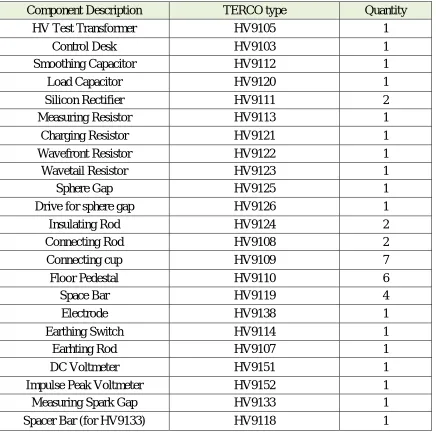
of Impulse Voltage Generator. Table 3.1 shows the equipment used in the Impulse
Voltage Generator test setup. Figure 3.2 also is present about the block diagram on
[image:21.612.119.535.454.691.2]operation the Impulse Voltage is produced.
Table 3.1: Table of list equipment
Component Description TERCO type Quantity
HV Test Transformer HV9105 1
Control Desk HV9103 1
Smoothing Capacitor HV9112 1
Load Capacitor HV9120 1
Silicon Rectifier HV9111 2
Measuring Resistor HV9113 1
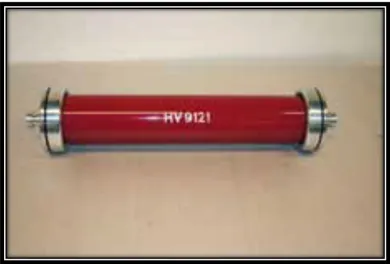
Charging Resistor HV9121 1
Wavefront Resistor HV9122 1
Wavetail Resistor HV9123 1
Sphere Gap HV9125 1
Drive for sphere gap HV9126 1
Insulating Rod HV9124 2
Connecting Rod HV9108 2
Connecting cup HV9109 7
Floor Pedestal HV9110 6
Space Bar HV9119 4
Electrode HV9138 1
Earthing Switch HV9114 1
Earhting Rod HV9107 1
DC Voltmeter HV9151 1
Impulse Peak Voltmeter HV9152 1
Measuring Spark Gap HV9133 1
Figure 3.2 : Block Diagram [14]
In our test, we used the Single Stage Test Set Up as shown at Figure 3.3, which
contain Silicon Rectifier as Figure 3.4 and Charging Rectifier as Figure 3.5. Silicon
Rectifier used to convert the AC input from the transformer into DC output to produce
the Impulse Voltage.
[image:23.612.131.521.391.655.2]Figure 3.4: Silicon Rectifier
[image:24.612.132.522.411.675.2]Figure 3.6: Control Desk
The Control Desk is used to control and operate high voltage AC/DC Impulse
test equipment. The desk contains operating and signal elements for the control circuit of
the test equipment for warning and safety. The control desk is made to house the
measuring instruments (Peak, Impulse and DC Voltmeters) and also the Trigger Device.
The electrode as shown in Figure 3.7 is sphere to sphere which used in this
research. The sphere to sphere is separated at desired gap and gaps will be measured
Figure 3.7: Sphere gap
3.1 Impulse Voltage
The impulse voltage produced then were measured and compared it’s characteristic to
the theoretical impulse voltage as shown in Figure 3.8. The value of the test voltage is
the maximum voltage that was sketched in the graph also the total value of the test
voltage on the circuit switching impulse[18]. Time to peak is the time needed from the
true origin voltage to the maximum voltage value of the switching impulse voltage. The
standard lightning-impulse voltage is a smooth full lightning-impulse voltage having a
front time of 1.2 μs and a time to half-value of 50μs and described as a 1.2/50 impulse.
The important terms that we should know about the lighting impulse characteristic is the
front time, which label as a virtual parameter defined as the time interval between the
Figure 3.8 : Switching impulse voltage [18].
3.1.1 Tolerances
When we are getting the impulse voltage during our test, we need to consider about the
tolerance. Tolerance is the value that we are accepted from the test voltage curve
compare to the calculated value from the test curve. The test voltage value is accepted if
±3 % from test voltage, front time accepted ±30 %, and time to half value ±20 % vary
from standard curve.
3.2 Test Setup U50
This section discusses the procedures carried out in these experiments in the High
experiment to avoid any untoward incidents happen. The measures carried out are set
out below.
1. Make sure all switches are in the off state. This is important to make sure to start the test.
2. Entering the cage, grounding the component as transformer, capacitor, silicon rectifier, sphere gap and other components by using the earthing rod as shown in
Figure 3.9. This is important to make sure that the power is totally discharged
[image:28.612.126.541.97.508.2]before starts a new test.
Figure 3.9: Grounding the component using earthing rod
3. The electrodes sphere to sphere is installed at the desired gap. The minimum is set up at the initial lab then, continued to increase the gap between the electrodes.
[image:28.612.153.533.246.395.2]Figure 3.10 : Gap measuring
4. After than that, the cage is locked. We are only able to start the test after the cage is properly locked.
5. First of all, the control desktop is ON by the key. The main switch is now can ON till the green is light indicated.
6. The voltage regulator knob is reduced at minimum value to confirm that the input of the rectifier is zero. Figure 3.11 shows the interface on the control
Figure 3.11 : Control Desktop interface
7. Sphere gap is observed to make sure that the sphere didn’t touched each other. Figure 3.12 is show the sphere gap is not touch each other while figure 3-13
shows the measuring gap between the spheres. If the spheres connected, the
impulse voltage can’t to produce to for our test. The gap can be controlled
Figure 3.12 : Sphere to sphere cant touched each other
Figure 3.13: Measuring gap between sphere to produce Impulse Voltage
8. The button primary and secondary is ON. The voltage now can be increased till the impulse voltage occurred. The impulse voltage’s waveform is captured by the
[image:31.612.174.476.376.605.2]9. The voltage now is increased and decreased by using the up and down method at the minimum gap till 20 times to get the U50 value.
10. The up and down method also repeated after increased the gap between the electrode.
3.2.1 Up and down method.
The technique we used in this research is the up-and-down method. The up-and-down
method the voltage level is increased by an amount U if no disruptive discharge
occurs in a group of n voltage applications, otherwise the voltage level is decreased by
the same amount after there is a breakdown is occur. In the discharge procedure, the
voltage level is increased by Uif one by the same amount. In all cases the voltage
interval between levels Ushould be approximately from 1.5 % to 3 % of the estimated
value of u50
Up and down method is used to get the U50 from our test. By referring the Figure
3.14 shows the flow on doing our test. The test per gap is repeated for 20 times by
averaging the value of voltage. This step is applied at the 1cm, 1.5cm, 2cm, 2.5cm and
3.3 Drawing the electrode using FEMM software.
At this stage, we are using FEMM software to simulate the Field Intensity Voltage at
desired gap. When draw the sphere to sphere in this software, we are using the actual
diameter sphere electrode that we use in the lab. The sphere electrodes that used in this
[image:34.612.191.463.208.559.2]test was 5cm diameter as shown in Figure 3.15.
Figure 3.15 : Diameter of sphere’s electrode
Regarding to the Figure 3.16, the actual diameter is using to our simulation using
FEMM software. While draw the sphere is set to axisymmetric so that only need draw
REFERENCES
1. Naidu, M.S. and V. Kamaraju, High voltage engineering2013: Tata
McGraw-Hill Education.
2. Meek, J.M. and J.D. Craggs, Electrical breakdown of gases. 1978.
3. Brown, R.E., Electric power distribution reliability2008: CRC press.
4. Dissado, L.A. and J.C. Fothergill, Electrical degradation and breakdown in
polymers1992: IET.
5. Forrest, J., The characteristics and performance in service of high-voltage
porcelain insulators. Journal of the Institution of Electrical Engineers-Part II:
Power Engineering, 1942. 89(7): p. 60-80.
6. Hagenguth, J., Short-time spark-over of gaps. Electrical Engineering, 1937.
56(1): p. 67-76.
7. Seargent, D.A., Lightning’s Gleaming Rod, in Weird Weather2012, Springer. p.
149-213.
8. Roe, R.M., J.R. Busemeyer, and J.T. Townsend, Multialternative decision field
theory: A dynamic connectionst model of decision making. Psychological review,
2001. 108(2): p. 370.
9. Howell, A.H., Breakdown studies in compressed gases. Electrical Engineering,
1939. 58(5): p. 193-206.
10. Go, D.B. and D.A. Pohlman, A mathematical model of the modified Paschen’s
curve for breakdown in microscale gaps. Journal of Applied Physics, 2010.
107(10): p. 103303.
11. Zaccarian, L., et al. A control theory approach on the design of a Marx generator
network. in Pulsed Power Conference, 2009. PPC'09. IEEE. 2009. IEEE.
12. Kuffel, J., E. Kuffel, and W.S. Zaengl, High voltage engineering
13. Fitch, R.A. and W.F. Crewson, MARX GENERATOR AND TRIGGERING
CIRCUITRY THEREFOR, 1973, US Patent 3,746,881.
14. Baek, J.W., et al., Solid state Marx generator using series-connected IGBTs.
Plasma Science, IEEE Transactions on, 2005. 33(4): p. 1198-1204.
15. Abidin, H.Z. and R. Ibrahim. Thunderstorm day and ground flash density in
Malaysia. in Power Engineering Conference, 2003. PECon 2003. Proceedings.
National. 2003. IEEE.
16. Abdullah, N., M.P. Yahaya, and N.S. Hudi. Implementation and use of lightning
detection network in Malaysia. in Power and Energy Conference, 2008. PECon
2008. IEEE 2nd International. 2008. IEEE.
17. Khan, N., et al., Laser-triggered lightning discharge. New Journal of Physics,
2002. 4(1): p. 61.
18. Rizk, F.A., A model for switching impulse leader inception and breakdown of
![Figure 2.1: Electrode configuration for flashover [6].](https://thumb-us.123doks.com/thumbv2/123dok_us/8767692.897309/14.612.190.462.92.319/figure-electrode-configuration-for-flashover.webp)
![Figure 2.2: Spark over voltage occurred [7].](https://thumb-us.123doks.com/thumbv2/123dok_us/8767692.897309/15.612.190.461.72.277/figure-spark-over-voltage-occurred.webp)
![Figure 2.3: Visualation of a Townsend Avalanche [8].](https://thumb-us.123doks.com/thumbv2/123dok_us/8767692.897309/16.612.139.515.125.361/figure-visualation-townsend-avalanche.webp)
![Figure 2.4 : Paschen Law Curve Characteristic [10].](https://thumb-us.123doks.com/thumbv2/123dok_us/8767692.897309/17.612.124.517.199.521/figure-paschen-law-curve-characteristic.webp)
![Figure 2.5 : Marx Generator connection during charging and discharge [12].](https://thumb-us.123doks.com/thumbv2/123dok_us/8767692.897309/19.612.221.433.409.696/figure-marx-generator-connection-during-charging-and-discharge.webp)
![Figure 2.7 : World Isokeraunic Map [15].](https://thumb-us.123doks.com/thumbv2/123dok_us/8767692.897309/20.612.145.504.258.484/figure-world-isokeraunic-map.webp)
![Figure 3.1: Impulse Voltage Generator test setup [14]](https://thumb-us.123doks.com/thumbv2/123dok_us/8767692.897309/21.612.119.535.454.691/figure-impulse-voltage-generator-test-setup.webp)