Journal of Chemical and Pharmaceutical Research, 2014, 6(5):
418-422
Research Article
CODEN(USA) : JCPRC5
ISSN : 0975-7384
Game problems and Countermeasures of harmonious urban-rural economic
development -- Taking the perspective of the energy scarcity
Hongshan Ai
1, Xie Li
2and Hai-shu Qiao
31
College of economics & trade in Hunnan University
2
College of economics & trade in Hunnan University
3
College of Finance and Statistics in Hunnan University
_____________________________________________________________________________________________
ABSTRACT
The harmonious urban-rural economic development cannot do without energy. This paper, taking the perspective of the energy scarcity, analyses the relationship between scarcity and the harmonious urban-rural economic development, explores the game relationship between the two, studies the energy problem of harmonious urban-rural economic development, puts forward some countermeasures to alleviate the problem.
Key words:Harmonious urban-rural economic development; game; energy; scarcity
_____________________________________________________________________________________________
INTRODUCTION
Energy is the lifeblood of economic development, but the energy problem is serious in China, which will affect the economic development. The coordinated development of urban and rural areas has become a hot topic, but also an important strategy of economic development in the future. In the reality of energy scarcity, the town’s development steadily needs the abundant energy resources while the rural also need to have abundant energy resources to shorten the gap between urban and rural areas and developed rapidly. Therefore, the harmonious urban-rural economic development haves some game relationships in the perspective of the energy scarcity.
energy problem of the harmonious urban-rural economic development, the paper explores the game relationships based on the coordinated development of urban and rural areas using the game theory.
THE SCARCITY OF ENERGY IN CHINA AND THE ANALYSIS OF RELEVANCE BETWEEN ENERGY AND URBAN AND RURAL DEVELOPMENT
2.1 Analysis of the scarcity of energy in China
The scarcity of energy is that the energy cannot meet consumer demand. This mainly displays in two aspects. The one is the Number cant not meet consumer demand that is in short supply; energy production yield is much lower than the consumption demand. The two is that the energy quality does not meet. The matter should not demand market supply products are not real consumer demand products; there was a significant gap between the quality or consumer demand relative to the current supply of products. In short, the short supply is the quantity; the short quality should be the quality problem. The quantity of energy scarcity is the resource endowment problem or the scale of investment and production problems. The short supply of energy is the quality of industrial technology and investment direction. Concrete analysis is as follows:
[image:2.595.195.439.442.580.2]First, the short supply. Figure 1 is the gap trend graph in China. From the picture we can see that the gap of energy in our country exist for a long time, showing an overall upward trend. From 1992 to 2012 the energy gap trend presents numerous ups and downs, through which the law of economic development can be found in the energy gap. From 1993 to 1995 is Chinese economic stable period, and the energy gap significantly decreased. From 1996 to 2000 is China's economy stable development period, and the energy gap is widening. From 2001 to 2007 years is a period of rapid economic development, energy gap also rose rapidly change. From the above three energy trend can be seen that the economic development is always accompanied by the change of energy gap. This shows that the energy supply requires more than economic development, which also shows a serious shortage of energy industry growth rate in China. Since 2008, China's economy is developing steadily stage, energy consumption has declined. From the above analysis we can see that our energy to maintain a steady pace of development, but because demand economic development has led to uneven development, and the development of this demand and supply mismatch exists, the supply cannot respond promptly to the needs and challenges. Compared to other industries, the energy industry of the initial investment is large. Once the investment merits of its future are more stable, then we do not put on output in the short term, and therefore the energy industry changes as the market changes and are subject to change. This time the energy industry needs to predict future economic and market demand for investment in production.
Fig. 1:The proportion of China's energy gap trend from 1992 to 2012
Note: Data from the "China Statistical Yearbook 2013", after I finishing derived. Energy gap = (year consumption - year supply) * 100% / year supply.
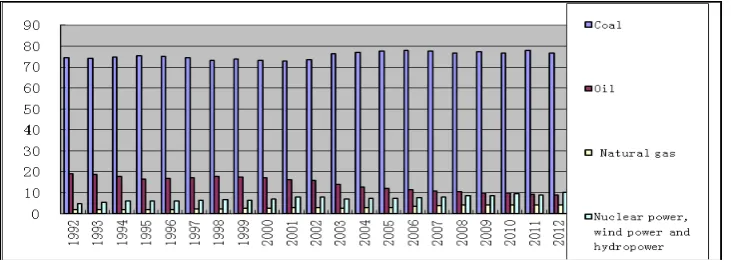
Secondly, quality should not short. The quality of China's energy is mainly in the energy mix. Since the irrational energy structure results in a lot of problems, chief among them is the environmental problem. The current level of the urban environment is harsh lesson. Environmental issues in Beijing, Shanghai, Wuhan, Shenzhen and many other developed cities have become the focus of attention, and have a serious impact on people's lives and survival. Figure 2 shows the trend of China's energy structure. As can be seen from the figure, there is not much change in the energy mix in China's 20 years, which shows there are serious problems in the industrial development of China's energy. In 20 years, more than 70 percent of China's energy still relies mainly on coal supply; changes in crude oil and natural gas are not big; and the water, wind and nuclear power and other new energy sources only have a slow upward trend. As we all know, the environmental impacts of utilization of raw coal and higher emissions are great. While the impact on the environment of the new high energy and low emissions are very small. However, due to serious environmental problems caused by the long-term dependence on coal, this description should not seek our quality clean green renewable energy development, a serious shortage of pace to keep up with the demands of
0% 2% 4% 6% 8% 10% 12% 14% 16%
economic and social development, and a serious shortage of renewable energy development mainly in the direction of investment and technology issues. So our energy policies need to reflect. There is also the problem of the use of traditional energy technologies, which is an important reason for the impact of low utilization of traditional energy sources such as coal
Fig. 2: Chinese energy structure trends from 1992 to 2012
Note: the datas are from “the Chinese statistical yearbook 2013".
2.2 Correlation analysis with harmonious urban-rural economic development and scarcity of energy
Firstly, the number of association analysis of scarcity and urban and rural development. Characteristics of the energy industry, as well as the short of energy give the scarcity of coordinated urban and rural development great obstacles. Relationship between the two is mainly manifested in two aspects.(1)the energy gap is difficult to balance urban and rural development issues. Currently in town to promote the economic development of China's energy gap is already very large, and this gap persists. Although the current strategy of gradual implementation of the coordinated development of urban and rural areas, but the current development of the town is not stagnant, its consumption of energy is not stagnant. It is to say, even if not to improve rural energy consumption in the development process, the town's energy consumption will still be increasing, although supplies are also under development, but the gap is not a short time away. According to ease past the speed of China's energy gap, if not adjust the energy strategy, then it needs at least 10 years to be able to balance. And, in fact, promote the integrated development of the rural economy and rural development, rural economic development cannot be divorced energy support. Also said that with the development of rural economy, rural demand for energy will rapidly increase, and then in accordance with the current energy supply growth, China's energy gap will grow. (2) Because of this gap exists, the energy gap may be a key factor affecting the development of the rural economy, it said has become a key element affecting the coordinated development of urban and rural areas. Energy imports are not a simple question. From the mid-2000s -1990s, the Chinese government had taken a lot of energy exports to solve the wrong problem, which is an important strategy is to import large quantities of energy. But even if there are insufficient consumption of imports,in the early 21st century, our country has undergone several energy demand, vehicle queues appear Arranging purchase of oil. Due to insufficient generating capacity, China's annual consumption will occur locally restricted phenomenon, and limit the scope of the countryside as a major power. If the integration of urban and rural development, the greater the economic loss arising rural brownouts, more affecting rural economic development, which is to accelerate rural development strategy to achieve integration of urban and rural development is contrary.
is to develop sophisticated scientific way.
ENERGY GAME OF THE HARMONIOUS URBAN-RURAL ECONOMIC DEVELOPMENT
Energy scarcity mainly is in short of supply and quality. Based on the above analysis, both urban and rural development has great relevance. In fact, the energy in the quantity and quality of supply exists in game urban and rural areas, and the government has the game options in. Specific analysis is as follows:
The number game of urban and rural supply. Energy supply cannot meet the needs of economic development of the urban and rural economic development, which is the basis of the number of games. Then there are only two option: one needs to maintain adequate supply of urban economic development in the town, but the coordinated development of urban and rural areas cannot be achieved ; second is sufficient supply in rural areas, it will affect the development of the town.
Quality game of supply between urban and rural. The quality game mainly is because new energy production is limited, which accounts for 10% of China's current supply of new green energy throughout the total energy consumption. Assuming 10% of all use in urban areas, then the environment is certainly beneficial to the town, but this time the energy and production in rural areas must rely entirely on coal to solve, will inevitably bring a lot of pollution and toxic substances. That is sacrificed to maintain the rural urban environment. Assuming 10% of all use in rural areas, so a lot of the inevitable deterioration of the urban environment, but the environment in rural areas will not be destroyed. Reality is often not so extreme, but there is certainly biased. So this time there are two options for the game.
Based on the above analysis, construct the game of Figure 3. 1 indicates bias, 2 indicates deviation. The selections of different quality and quantity result in A, B, C and D, four possibilities. Selects of towns and rural areas have a variety of combinations,① A and D, ② D and A, ③ B and C, ④ C and B. If you select ①, then the town will get in terms of quality and quantity of bias, while rural in terms of quality and quantity deviation, then the favorable conservation and economic development of urban environment of Chen Zhen, obviously for rural economic development adversely. If you choose ②, the situation reversed. If you choose ③, towns tend to get quality, but the quantity of deviation, then the environment is conducive to the protection of the town, but detrimental to their economic development. It is beneficial for rural economic development in rural areas, but is not conducive to protecting the rural environment. Select ④, so the situation is similar.
Quantit y1 Quality
1
Energy supply
Quality 2
Quantit y2 Quantit
y1 Quantit
y2
Figure3 the game figure Of energy supply A
D C B
CONCLUSION AND COUNTERMEASURES
Acknowledgement
This paper was supported by The National Soft Science of China (Research on innovation and Countermeasures of scientific and technological achievements transformation mechanism, 2013GXQ4D172) and The National Natural Science Foundation of China(The Mechanism and Empirical Analysis on Inclusive Growth of Trade in China, 71173069)
REFERENCE
[1]Lafang Wang. The impacts of energy price changes on energy consumption of urban and rural residents [J].Journal of Hunan University (SOCIAL SCIENCE EDITION), 2010,05:57-62.
[2] Rongzhi Liu. China Agricultural Science Bulletin, 2007,08:577-580.
[3] Lina Zhang. The rural energy supply and demand in Chongqing city analysis research and policy [D].Chongqing University, 2006.
[4] Bin Tang. Construction of rural energy [D].of new countryside under the framework of Shandong Agricultural University, 2008.