A Need Analysis Study: Do Students Really Want to
Share Their Desks with Technology?
Gökhan Demirdöken
Department of Foreign Languages, Turkish Air Force Academy, National Defense University, İstanbul, Turkey
Received September 26, 2019; Revised October 21, 2019; Accepted November 1, 2019
Copyright©2019 by authors, all rights reserved. Authors agree that this article remains permanently open access under the terms of the Creative Commons Attribution License 4.0 International License
Abstract
Technology has already been one of the most important aspects of classrooms. The purpose of this study is to examine the perception of learners on technology integration in English Language teaching classroom through online applications and tools. This is a quantitative study and survey design was preferred due to nature of our study. The questionnaire was taken from another research and adapted accordingly. It was conducted on 124 preparatory class students in a state university in Turkey. Students were asked to state their opinion on each item of the questionnaire based on a five-degree Likert scale. To analyze data, descriptive analysis was used by calculating frequency, mean and standard deviation of each item with the help of SPSS 23. With regard to technology, findings indicated that students favor the integration of technology into language learning environments through online tools. It was also important for them to be a part of computer-assisted activities. Overall, the findings demonstrated that students were already willing to welcome online applications and tools with open arms and their attitude towards frequent use of technology in EFL classrooms might well be related to their professional affiliation. Necessary suggestions were put forward at the end of the study.Keywords
EFL, Technology, Web 2.0, Learners’ Perspective, Needs Analysis, Attitude1. Introduction
The latest developments in information and communication technologies (ICT) have affected in-class activities to a great extent and many different implementations have emerged consequently. Various technology tools that can be used in education have been and are still developed and introduced for an advanced teaching process, which, in return, is expected to help
English as foreign language (EFL) students go through a smoother learning process, and even some of the students will get their feet wet in a more productive classroom environment. However, achieving it is likely to be a quite difficult journey, and there are some necessary steps to be taken which consist of two phases: the first step is to successfully integrate ICT into national education policies and systems. Balogun and Yusuf (2011) state such an integration is mostly dependent on the competence and on the attitude of teachers towards the role of modern technologies in teaching and learning. The second step is to identify students’ needs and expectations clearly. Therefore, "integration of technological devices such as computers, interactive whiteboards, etc. into language classroom on the one hand and students as the user of these tools on the other hand put great emphasis on exploring the students' attitude towards technology and its merits and demerits on language learning process" (Izadpanah & Alavi, 2016). The focus of this study is to highlight the second step more vividly so that policy makers, teachers, and teacher-trainers will benefit from it.
2. Literature Review
are important to them and to their studies, and which technologies they would like to see used more often" in 15 different countries with 213 institutions. All of these studies investigated students in different learning environments and they all set sight on something which is crucial in language studies: attitude. These studies shed light on the fact that no matter what the consequence is for a language learner or no matter where the learner is, the common-constant variable for all learners is their attitude toward integration and use of ICT in language learning environments. Furthermore, it has been one of the most popular non-linguistic variables in language learning environments (Boser, Palmer, & Daugherty, 1998; Ertmer, Paul, Molly, Eva, & Denise, 1999; Bhattacherjee & Premkumar, 2004; Ardies, De Maeyer, Gijbels & van Keulen, 2014).
What’s more, getting to know students’ expectations is crucial in two ways: first behaviors are influenced by attitudes (Kaballa & Crowley, 1985). "Second there is a positive relationship between affective characteristics and foreign language achievement" (Saracaloglu, 2000). Therefore, we should, first of all, offer a clear-cut definition of attitude, and then we can move on with its relation to language learning in tech-rich environments. Gardner (1985, pp. 91-93) defines attitude as “an evaluative reaction to some referent or object, inferred on the basis of the individual’s beliefs or opinions about the referent”. Bain (1927) describes attitude as ‘’ the relatively stable overt behavior of a person’’. Both Gardner and Bain center their definition upon the fact that the result of an action in someone’s life relies on that person’s attitude toward actualizing it. In this respect, we can further develop our discussion to the point that language learning is highly dependent on the learner’s attitude toward achieving the competency in the target language which is English in our case. The importance of attitude in language learning has been subject to many studies so far. Jalali and Dousti (2014) read up on ‘’students’ attitudes about CALL integration after the actual use of computers in their classes’’. The data from young EFL learners made a great contribution to their findings which suggest that the majority of participants are positive toward CALL integration and learners’ attitudes are highly affected by teachers’ perceptions toward technology. As part of her master thesis study Onsoy (2004) examined ‘’how students and teachers perceive use of computer technology resources in language learning and teaching by investigating the attitudes of students and teachers towards computers’’. Onsoy (2004) states students and educators for the most part have uplifting mentalities towards utilization of computer technology both in their everyday lives and in language guidance. It is also provided in the same study that the greater part of the understudies (62%) trust that the CALL program is advantageous in enhancing perusing abilities and an extraordinary larger part of the educators (95%) support the idea that it is compelling in
enhancing perusing aptitudes (Onsoy, 2004). We can deduce the conclusion from her study that attitude definitely shapes expectations of teachers and students from technology. Similarly, Wiebe and Kabata (2010) examined how technology affects the attitude of teachers and students. In total 183 students and 7 teachers participated in their study and the participants all provided precious data which suggests that ‘’instructors' encouragement affects the number of times students log into or visit the course website’’ (Wiebe & Kabata, 2010). Their finding presents us the fact that teachers’ attitude toward the use of technology in language learning environments can trigger the learner in a positive way. Contrastively, Ozturk’s study (2012) suggests that in spite of the fact that the understudies don't have uplifting frames of mind towards computers and don't care for utilizing computers, they consider the innovation of computer as a learning apparatus and as a decent instrument to help language learning. Additionally, they believe that there is a requirement for a preparation to utilize computers in learning a language even though they don't assume that they themselves need such preparing. This also supports the idea that, whether in a positive or negative way, attitude plays a crucial role in language learning. Within the Turkish EFL context Mathews-Aydinli and Elaziz (2010) explored "the attitudes of students and teachers toward the use of interactive whiteboards (IWBs) in a foreign language teaching and learning context". The data collected from a great number of participants from various institutions in Turkey indicated that the overall positive attitude of Turkish EFL students and teachers seem to affect their expectations from tech-rich learning and teaching environments. Additionally, as Mathews-Aydinli and Elaziz (2010) suggested students enjoy it and feel themselves comfortable using it, and they also believe it is a beneficial teaching tool. In short, as we referred to earlier, we can come to the conclusion that practices are affected by demeanors, and affective characteristics and foreign language achievement are highly interrelated (Saracaloglu, 2000), which is also supported by the findings of the previous studies in the field. In the light of the information provided above, the current study was designed to serve for the purpose of filling in a gap in the field by exploring the how preparatory class EFL students regard the implementation of technology tools in the foreign language classrooms and what they expect from technology with regard to language learning as part of their professional affiliation, which is expected by the researcher to map out a route towards more effective use of technology in Turkish EFL context. Herewith, the current study seeks answer to the following research questions:
1. What are the attitudes of Turkish EFL students towards the use of technology in the classroom? 2. Are the Turkish EFL students ready to be a part of a
3. Research Method
3.1. Participants
The current study was carried out at a state university in Istanbul, Turkey. A total of 325 students were enrolled in preparatory class program for 2017-2018 academic year. However, students were informed before conducting the questionnaire and some students were excluded from the study as they did not match the criterion stated below. There were two reasons for choosing the participants: First, in terms of social factors, students’ social background features, such as gender, age, and education level were left aside because the researchers wanted to collect data from as many students from various social backgrounds as possible. Second, the participants were selected by using criterion sampling, which is a part of purposeful sampling method (Patton, 2014) and they were required to meet a certain criterion which was having not used technology tools such as Quizlet, Quizizz, Padlet, Educaplay, and Edpuzzle before. The reason for that was to clearly analyze and learn more about the attitude of a sociologically diverse population towards integration of technology tools in language learning classrooms based on their first-hand experiences in such learning environments. As a result, only 116 students were finally chosen to take part in the study.
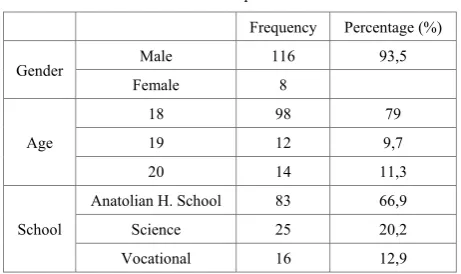
Table 1. Participants Profile
Frequency Percentage (%)
Gender Male 116 93,5
Female 8
Age
18 98 79
19 12 9,7
20 14 11,3
School
Anatolian H. School 83 66,9
Science 25 20,2
Vocational 16 12,9
As seen in Table 1, 116 of all participants were male (93,5 %) and 8 were female (6,5 %). Most of the participants (79 %) were 18 years old and they had just
graduated from high school. Rest of the participants (21 %) was 19 and 20 years old and they had graduated from high school one year earlier than the others. The vast majority of participants (66,9 %) was of Anatolian High School graduates.
3.2. Data Collection
The current study is quantitative and survey design was preferred due to nature of our study. To examine the attitudes of learners towards educational and technological application in language learning, “Attitudes towards Computer-Assisted Language Learning (A-CALL) questionnaire’’ (Jalali & Ardebili, 2013) was taken and adapted accordingly. It originally consisted of 20 items but before administering it, two experts reviewed it and two items were taken out to ensure validity and reliability. It was conducted on 124 preparatory class students studying at a state university in Turkey. Students were asked to state their opinions on each item in the questionnaire based on a five-degree Likert scale (Strongly disagree, disagree, neutral, agree, and strongly agree). The Cronbach’s Alpha of the A-CALL questionnaire was calculated to be 0.81.
3.3. Data Analysis
The SPSS (Statistical Package for Social Sciences) software version 23 was utilized to analyze the obtained data. To examine the participants’ attitudes towards technology use, frequency, mean score and standard deviation for each item in the questionnaire was calculated. Learners were informed about the purpose of the questionnaire and they participated voluntarily. They were ensured that all the information would be used for scientific purposes and no real name would be used in the study.
4. Findings
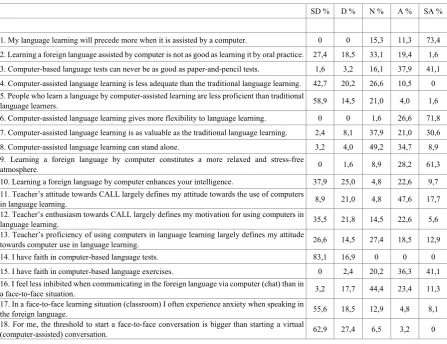
[image:3.595.59.290.423.560.2]Table 2. Attitudes of Turkish EFL students towards use of technology
SD % D % N % A % SA %
1. My language learning will precede more when it is assisted by a computer. 0 0 15,3 11,3 73,4 2. Learning a foreign language assisted by computer is not as good as learning it by oral practice. 27,4 18,5 33,1 19,4 1,6 3. Computer-based language tests can never be as good as paper-and-pencil tests. 1,6 3,2 16,1 37,9 41,1 4. Computer-assisted language learning is less adequate than the traditional language learning. 42,7 20,2 26,6 10,5 0 5. People who learn a language by computer-assisted learning are less proficient than traditional
language learners. 58,9 14,5 21,0 4,0 1,6
6. Computer-assisted language learning gives more flexibility to language learning. 0 0 1,6 26,6 71,8 7. Computer-assisted language learning is as valuable as the traditional language learning. 2,4 8,1 37,9 21,0 30,6 8. Computer-assisted language learning can stand alone. 3,2 4,0 49,2 34,7 8,9 9. Learning a foreign language by computer constitutes a more relaxed and stress-free
atmosphere. 0 1,6 8,9 28,2 61,3
10. Learning a foreign language by computer enhances your intelligence. 37,9 25,0 4,8 22,6 9,7 11. Teacher’s attitude towards CALL largely defines my attitude towards the use of computers
in language learning. 8,9 21,0 4,8 47,6 17,7
12. Teacher’s enthusiasm towards CALL largely defines my motivation for using computers in
language learning. 35,5 21,8 14,5 22,6 5,6
13. Teacher’s proficiency of using computers in language learning largely defines my attitude
towards computer use in language learning. 26,6 14,5 27,4 18,5 12,9
14. I have faith in computer-based language tests. 83,1 16,9 0 0 0
15. I have faith in computer-based language exercises. 0 2,4 20,2 36,3 41,1
16. I feel less inhibited when communicating in the foreign language via computer (chat) than in
a face-to-face situation. 3,2 17,7 44,4 23,4 11,3
17. In a face-to-face learning situation (classroom) I often experience anxiety when speaking in
the foreign language. 55,6 18,5 12,9 4,8 8,1
18. For me, the threshold to start a face-to-face conversation is bigger than starting a virtual
(computer-assisted) conversation. 62,9 27,4 6,5 3,2 0
Note. SD=Strongly disagree, D=disagree, N=neutral, A=agree, SA=Strongly agree.
The responses to the first item indicate that majority of students (73,4 %) strongly agree with the idea that computer-assisted language learning will boost the learning process. Moreover, it is obvious that students believe in technology’s potential to assist them throughout the learning process as a total of 84,7 percent of students stated positive attitude to the first item. However, it is quite surprising that the same students seem to be unsure when it comes to comparing the computer-assisted language learning with language learning by oral experience, which is the main concern of second item in the questionnaire. When the relevant data is analyzed, most of the students (33,1 %) stated a neutral attitude towards the effectiveness of computer-assisted language learning when compared to learning a language by oral experience. Additionally, 27,4 percent of students showed strong opposition to the same item. Another issue raised by the questionnaire is the assessment of language competency level of students (Item 3), which aims at finding out students’ attitude towards the use of both paper-and-pencil tests and computer-based language tests. The relevant data present the fact that 79,0 percent of students favored the idea that assessing the language competency via computer-based tests are as good as paper-and-pencil tests. The majority of students (58,9 %) are also in the opinion that those who learn a language in a computer-assisted learning environment are not worse than
those who learn a language in traditional learning environments (Item 5), which is also another indicator of students’ positive attitudes towards the use and integration of technology. What should also be noted down is that the flexibility of tech-assisted language learning (Item 6) is highly appreciated by students (71,8 %). The most controversial issue in the questionnaire was whether computers enhance students’ intelligence when learning a foreign language or not (Item 10). The responses indicate a strong opposition to the argument with a total of 62,9 percent negative response whereas 32,3 percent of students seem to favor the effect of technology in enhancing their intelligence. Moreover, teachers’ attitude towards technology (Item 11) highly shapes students’ own attitude towards the use of technology in language learning as 47,6 percent of participants stated that they ‘’agree’’ with the argument, and 17,7 percent of participants stated that they "strongly agree".
5. Conclusions
[image:4.595.76.524.89.433.2]such as Quizlet, Quizizz, Padlet, Educaplay, and Edpuzzle. The findings of our study have great value in that they can guide policymakers, educators, and researchers to develop a better understanding of how to design their education policies at tertiary level with respect to latest developments in technology, and varying attitudes and expectations of students.
"The term attitude, today, has shaped the landscape of education" (Inal, Evin & Saracaloglu, 2000) and as the first research question intends, when it comes to finding out the students’ attitudes towards the use of technology in the classroom, the contribution of the term attitude to the field of language education is priceless. Within this context, when participants’ responses to the first and fifth items in the questionnaire are scrutinized, it can be deduced that those who strongly agreed that their "language learning will proceed when it is assisted by a computer" (Item 1) did not agree with the argument that "people who learn a language by computer-assisted learning are less proficient than traditional language learners" (Item 5). As stated by
Keleş (2013) Web 2.0 apparatuses have a constructive outcome on the ELT understudies' English learning aptitudes and that they also trusted the Web 2.0 advancements had an impact in improving their English learning. What’s more, Shishkovskaya and Sokolova (2015) brought up the effect of Web 2.0 advances, which contain diverse sorts of materials in the improvement of understudies' information and language relational abilities. The findings of current study and previous studies in the field resemble to each other in that EFL students seem to be of the opinion that rather than just learning the target language, technology will foster their learning processes. That’s why it can be inferred from the findings of our study that tertiary level Turkish EFL students who made use of Web 2.0 tools in high school should be supported with similar tools in the succeeding learning levels which differs this study from other studies. Moreover, it can be researched in a separate study that the effect of exposure to Web 2.0 tools in high school on Turkish EFL students learning outcomes when they are also supported with similar tools at tertiary level.
In a previous study, Mathews-Aydinli and Elaziz (2010) puts forward that students enjoy using Web 2.0 tools and they also feel comfortable when these tools are utilized in the classroom. Similarly, Aşıksoy (2018) states that most of the students in her study were aware of the existence of Web 2.0 tools and they believe these instruments help them in learning English. However, it can be concluded from the findings of our study that although students are affected by the use of Web 2.0 tools as part of language learning processes, teachers’ competency in using the so-called tools does not influence students’ language learning. That’s why the contradiction between students’ attitude towards and teachers’ competency in Web 2.0 tools may be further examined.
In summary, it is acknowledged by everyone that
technology is and will be an inseparable part of language learning process. It is also evident that Turkish EFL students are ready to embrace technology with open arms so it should be the foremost responsibility of educators to find a way to make use of various Web 2.0 tools based on their students’ needs on specific language skills and to engage them in more interactive activities to promote their language learning experience. Furthermore, policy makers should take into consideration the fact that students’ awareness of Web 2.0 tools and their previous experience with these tools can be the significant tools which have the potential to lead to significant increase in language competency.
REFERENCES
Ardies, J., De Maeyer, S., Gijbels, D., & van Keulen, H. [1]
(2014). Students’ attitudes towards technology. International Journal of Technology and Design Education.
Aşıksoy, G. (2018). ELT Students’ Attitudes and Awareness [2]
Towards the Use of Web 2.0 Technologies for Language Learning. Journal of Language and Linguistic Studies, 14(2), 240-251.
Bain, R. (1927). An Attitude on Attitude Research. [3]
American Journal of Sociology, 33, 940-957.
Bhattacherjee, A., & Premkumar, G. (2004). Understanding [4]
Changes in Belief and Attitude toward Information Technology Usage: A Theoretical Model and Longitudinal Test. MIS Quarterly, 28(2), 229.
Boser, R. A., & Daugherty, M. K. (1998). Students Attitudes [5]
toward Technology in Selected Technology Education Programs. Journal of Technology Education, 10(1). Dahlstrom, E., & Bichsel, J. (2014) ECAR Study of [6]
Undergraduate Students and Information Technology, 2014. Research report. Louisville, CO: ECAR, October 2014. Gardner, R. C. (1985). Social psychology and second [7]
language learning: the role of attitudes and motivation. London: Edward Arnold.
Inal, S., Evin, I., & Saracaloğlu, A. S. (2000). The Relation [8]
between Students’ Attitudes toward Foreign Language and Foreign Language Achievement. Dil Dergisi.
Izadpanah, S., & Alavi, M. (2016). Student-engaged [9]
Viewpoint on Technology in Learning English in Zanjan Public High Schools. Theory and Practice in Language Studies, 6(4), 854.
Jalali, S., & Ardebili, M. (2013). The perceptions of Iranian [10]
EFL learners toward computer-assisted language learning. Paper presented at the International Conference on Current Trends in ELT, 20-22 May, Urmia, Iran.
Jalali, S., & Dousti, M. (2014). Attitudes of Iranian EFL [11]
Keleş, U. (2013). The perceptions of ELT students about the [12]
use of Web 2.0 tools, particularly Wikis in their future language classrooms (Doctoral dissertation), Bilkent University, Ankara.
Koballa Jr, T. R., & Crawley, F. E. (1985). The influence of [13]
attitude on science teaching and learning. School Science and mathematics, 85(3), 222-232.
Macleod, H., & Paterson, J. (2012). A survey of [14]
undergraduate technology use and attitudes. Marc [Dataset]. University of Edinburgh. Retrieved from http://dx.doi.org/ 10.7488/ds/97.
Mathews-Aydinli, J. & Elaziz, F. (2010). Turkish Students' [15]
and Teachers' Attitudes toward the Use of Interactive Whiteboards in EFL Classrooms. Computer Assisted Language Learning, 23(3), 235-252
Onsoy, S. (2004). Students’ and Teachers’ Attitudes towards [16]
the Use of Computer-assisted Language Learning at the Preparatory School of Celal Bayar University. Retrieved from http://www.thesis.bilkent.edu.tr/0002566.pdf Ozturk, K. (2012). Students’ Perceptions of CALL at Dokuz [17]
Eylül University School of Foreign Languages. ELT Research Journal. 1(4), 216-229.
Patton, M. Q. (2014). Qualitative evaluation and research [18]
methods. (4th Edition). London: SAGE Publications. Saracaloglu, A. (2000). The Relation between Trainee [19]
Teachers’ Attitudes to Foreign Languages and their Academic Success. Eğitim ve Bilim Dergisi, 254(115). Sarac, H. (2018). Use of Instructional Technologies by [20]
Teachers in the Educational Process: Metaphor Analysis Study. European Journal of Educational Research, 7 (2), 189-202. Retrieved from http://dergipark.gov.tr/eujer/issue /36436/412683.
Shishkovskaya, J. V., & Sokolova, E. Y. (2015). Integration [21]
of Web 2.0 Technologies into the Process of Students’ Self-Directed English Learning. Mediterranean Journal of Social Sciences, 6(2), 541-545.
Wiebe, G., & Kabata, K. (2010). Students' and Instructors' [22]
Attitudes toward the Use of CALL in Foreign Language Teaching and Learning. Computer Assisted Language Learning, 23(3), 221-234.
Yusuf, M. O., & Balogun, M. R. (2011). Student-teachers' [23]