Journal of Chemical and Pharmaceutical Research, 2014, 6(5):1-11
Research Article
CODEN(USA) : JCPRC5
ISSN : 0975-7384
An improved fuzzy evaluation method for heavy metal pollution
Juli Deng
1and Guorong Chen
2* 1School of Chemistry and Chemical Engineering, Chongqing University of Science & Technology,
Chongqing, PR China
2
School of Electronic and Information Engineering, Chongqing University of Science & Technology,
Chongqing, PR China
_____________________________________________________________________________________________
ABSTRACT
The heavy metal is not easily degradable, the heavy metal pollution of water is the most harmful pollution for the environment, so, to evaluate the pollution grade is very important for pollution controlling. The fuzzy evaluation method is the most important way to evaluate the degree of pollution today. But in some case, one key factor of heavy metal will decide the pollution level, but the classical fuzzy evaluation method cannot arrive to a correct result, and mislead the subsequent processing of pollution controlling. In the paper, the classical fuzzy evaluation method is analyzed firstly, to improve the classical fuzzy evaluation method by changing the weighting of the factors in order to highlight the key factors is developed then. Case studies comparing the results of the two methods, the result shows that the method proposed in this paper is more reasonable to the problem.
Key words: Algorithms Optimization; Heavy Metal Pollution, Fuzzy Evaluation
_____________________________________________________________________________________________
INTRODUCTION
With the development of industry, the environment is suffering to more and more pollutions; the heavy metal, such as Fe, Al, Ca, Mg, Ti, Mn, Cu, Zn, Cd, Ni, Hg, Cr, As, Co, V, is one of the serious factors to pollute our environment. The heavy metal is not easy to be degraded, the heavy metals will accumulate continue in the environment, to pollute the foods of the livings, and it may cause some kinds of serious diseases for human. So, to evaluate the pollution degrees of the heavy metal is the most important thing for pollution controlling.
Therefore, both at home and abroad, a lot of researches have focused their energies on the subject. Common methods such as gray system theory [1-2], fuzzy evaluation method [3-4], Clustering analysis [4], expert evaluation method [5-6], the analytic hierarchy process [1-3], Neural network evaluation method [4-5], the matter-element analysis method [6] and so on.
decision making[17]; Mehmet Ekmekçioğlu, Tolga Kayaa, Cengiz Kahraman proposed a modified fuzzy TOPSIS methodology for the selection of appropriate disposal method and site for municipal solid waste (MSW)[18]. Anjali Awasthi, Satyaveer S and Chauhan, S.K. Goyal presented a fuzzy multicriteria approach for evaluating environmental performance of suppliers[19]; Vivien Y.C. Chen, Hui-Pang Lien and etc describes the design of a fuzzy decision support system in multi-criteria analysis approach for selecting the best plan alternatives or strategies in environment watershed[20]; Amin Afshar, Miguel A and etc addresses a method that incorporates several system factors/components within a general framework for providing a holistic analysis of the problems and comprehensive evaluation of the related mitigation/adaptation measures and policy responses[21]. Chiang Kao and Pei-Huang Lin treated the qualitative data as fuzzy numbers, and used the DEA multipliers associated with the decision making units (DMUs) being evaluated to construct the membership functions and analyzed the qualitative factors in data envelopment; André Lermontov, Lídia Yokoyama and etc proposed the creation of a new water quality index based on fuzzy logic, the fuzzy water quality index (FWQI)[23].
Those researches boost the development of the fuzzy evaluation algorithm significantly, and play a positive role for the establishment of environmental evaluation criteria. However, if one factor significantly affects the evaluation result, the fuzzy evaluation method cannot directly use to evaluate the pollution grading in the heavy metal pollution due to the evaluation index weight allocation problem, and it might not be able to produce relevant evaluation results, which mislead the work of the security management and the security treatment. Therefore, it is necessary to improve the fuzzy evaluation method for the special kind of evaluation problem, and should be strengthen the key evaluation index in order to arrive to a right evaluation results.
This paper will explore the special kind of evaluation problem, the fuzzy evaluation related theory will be introduced in section 2; the fuzzy evaluation improved method will be proposed in section 3 through discussion and analysis the shortcoming of the classical fuzzy evaluation, the case study will be carried out in section 4.
THE CLASSICAL FUZZY EVALUATION METHOD A. the elements of fuzzy evaluation
It must be quantitative process all the fuzzy conditions by setting the boundary condition if uses fuzzy evaluation method for evaluation the HSE security. Specifically, you need to complete the alternative set, factor set, membership degree and weight vector, the clarity of the various elements such as satisfaction matrix, in order to get the final evaluation results.
The alternative set
The alternative set also named the review set, is the set by using the expert experience to judge the evaluating object. The collection includes all possible outcomes, supposing set V has composed as n kinds of decisions, and then V can be represented as a set:
}
,...,
,
{
V
1V
2V
nV
=
(1)∀
n=
1
,
2
,...
Each element is on behalf of all the possible evaluation results, the purpose of fuzzy comprehensive evaluation is to take into account all factors, and form the best evaluation result.
The factors set
The factor set is the object collections that may affect the evaluation result; set U is the set of with m kinds of factors, set U can expressed as follows:
}
,...,
,
{
U
1U
2U
mU
=
(2) The elements ofU
j(
∀
j
=
1
,
2
,...,
n
)
include all the factors; usually these factors have different degree of fuzziness. In order to judge the element evaluation index, the factor index vector may express as follows:)
,...,
2
,
1
(
}
,...,
,
{
U
1U
2U
j
n
U
j=
j j mj T∀
=
(3) If the (i)th factor index of the (j)th judgment index isU
ij,it comes the factor matrixU
of m factor indexes of
=
=
1 1 1 21 21 21 1 12 11 2 1...
...
...
...
...
...
...
...
m m m nm
u
u
u
u
u
u
u
u
u
U
U
U
U
(4)The Membership
To separating from a factor to judge the membership, the degree of evaluation object may belongs to R:
1 2
( ,
,
,
)
j i i in
R
=
r r
L
r
(5) To each single factor evaluation set according to each single factor fuzzy sets the membership function of the type conversion can be respectively the membership Ri j for each single factor, to turn the matrix U into the corresponding membership degree of matrix R .
=
=
1 1 1 21 21 21 1 12 11 2 1...
...
...
...
...
...
...
...
m m m nm
r
r
r
r
r
r
r
r
r
R
R
R
R
(6)To unite a consideration under different circumstances, the same V needs to be normalized:
)
,
,
2
,
1
(
1m
i
r
r
r
n j ij ijij
=
=
⋅
⋅⋅
∑
=(7)
Meeting the conditions:
∑
=
=
n j ijr
11
So, Relation R can get U to V.
⋅⋅
⋅
⋅⋅
⋅
⋅⋅
⋅
⋅⋅
⋅
⋅⋅
⋅
⋅⋅
⋅
⋅⋅
⋅
=
⋅⋅
⋅
=
mn m m n nm
r
r
r
r
r
r
r
r
r
R
R
R
R
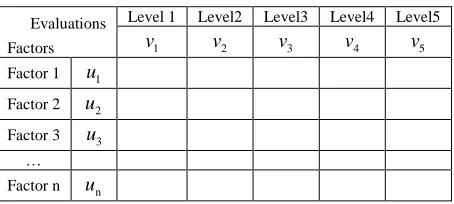
~ 2 ~ 1 ~ 2 ~ 21 ~ 21 ~ 1 ~ 12 ~ 11 ~ 2 1 ~ ~ ~ ~ (8) [image:3.595.194.421.618.720.2]The membership matrix can be constructed by way of the table 1, where each row represents a factor, its evaluation, and the evaluation of structural fill in the corresponding space on the corresponding column.
Table 1. The membership table (Sample)
Evaluations Factors
Level 1 Level2 Level3 Level4 Level5
1
v v2 v3 v4 v5
Factor 1 u1
Factor 2 u2 Factor 3 u3
The Weight Vectors
In the process of comprehensive evaluation, the weight problem is very important, only reasonable weight distribution, to correctly carry on the comprehensive evaluation. Set
~
A
is fuzzy subset of the U, it reflected the importance degree of various factors, called has coefficient vector:{
1,
2,
,
m}
A
=
a a
L
a
%
% %
%
∑
=
≥
=
m j
i
i
a
a
1~
0
,
1
(9)The specific calculation method is shown in the Section 2.2.
The Satisfaction Matrix
According to the weight set and fuzzy synthetic evaluation matrix
~
R
and~
A
, Fuzzy comprehensive evaluation to calculate the fuzzy subset~
B
, universally, like~
B
=~
R
×
~
A
,as:[
]
×
⋅⋅
⋅
=
mn m
m
n n n
r
r
r
r
r
r
r
r
r
a
a
a
B
~ ~
~
~ ~
~
~ ~
~
~ ~
~ ~
...
...
...
...
...
...
...
2 1
2 22
21
1 12
11
2
1 (10)
The Final Evaluation Score
[
]
[
]
Tn T
v
v
v
v
v
b
b
b
V
B
F
...
1,
2,
3,
4,
5~ 2 ~ 1 ~ ~
~
=
×
=
×
(11)
According to the maximum membership degree principle, the level of final evaluation was be determine by the formula (11).
B. Fuzzy evaluation in weight determination method
The influence of the factors in fuzzy evaluation is very important, therefore, this section will separately introduce the determination method. At home and abroad, at present more popular and mature methods including: Average distribution method, the antithesis method [8], the Klee method [8] and so on.
The Average Distribution Method
[image:4.595.198.414.569.688.2]The average distribution method is one of the most simple method to determine the evaluation index, the approach is to assign all n indexes are equally important, that is all for 1/n.
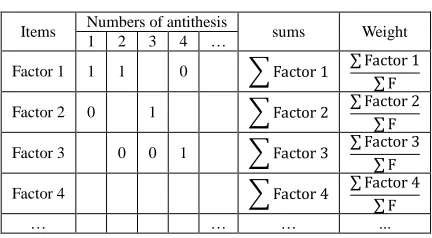
Table 2. The weights in comparison method
Items Numbers of antithesis sums Weight 1 2 3 4 …
Factor 1 1 1 0 Factor 1 ∑ Factor 1
∑ F
Factor 2 0 1 Factor 2 ∑ Factor 2
∑ F
Factor 3 0 0 1 Factor 3 ∑ Factor 3
∑ F
Factor 4 Factor 4 ∑ Factor 4
∑ F
… … … ...
The comparison method
The comparison method is one of the simple methods to determine evaluation index weights; the basic approach is that evaluation indexes of every alternative for comparison, to give higher ratings to relatively important indexes, according to the weight of each evaluation project
A
j can be obtained. Again, according to the main body of aAccording to the above ideas, the evaluation rates get by evaluation sheet for comparison, as shown in table 2. There:
Factors of ∑ i means the sums is the result of adding all the same factor together; ∑ F Means it was the sum of all ∑ i factors.
So, the weight of normalized processing results is to be obtained.
The Klee method
The Klee method is one of the most important methods to determine the weight in fuzzy evaluation, it was proposed first by A.I.Klee, and it is the improvements on the comparison method.
The evaluation idea is shown as following steps:
[image:5.595.232.379.294.377.2](1) To determine the important degree of evaluation indexes
A
j, as shown in table 3.Table 3 the weights in Klee method
Steps Items
W
jK
jA
j 1 Factor 1 a2 Factor 2 b 3 Factor 3 c 4 Factor 4 …
… … - 1 …… sum 1.000
In table 3, the first step is the comparing the important degrees of relationship between any factors i and j, then the weight is given according to its important degree of relationship, for example, the important of factor i is a times comparing to factor j, the cell crossing in the
W
j column and factor i is a; all such pair comparison will concludedthe
W
j.(2) Benchmark of
W
jSet a benchmark for processing the
K
j, to a final evaluation index as a benchmark, to its K value is 1, and K valueof bottom-up calculation for other factors, to find out all the factors of the K value, fill in the column
K
j(3) The normalization processing of
K
j. All number ofK
j, respectively in addition to all theK
value, get thefinal result is the weight of each factor of
K
j.In actually application of the above three methods are all have certain application base, the average distribution method is mainly used for various evaluation factors, weight is relatively balanced situation. Using the comparison method and Klee method to determine weight distribution of evaluation is more practical.
THE IMPROVEMENT OF FUZZY EVALUATION METHOD A. the discussion of the fuzzy evaluation method
The classic fuzzy evaluation method in the evaluation process, evaluation methods on the design are very scientific, but does that mean the method in the industrial wastewater pollution evaluation is the best method? Before answering this question, look at an example about the fuzzy evaluation:
emphasize particularly on, therefore, clear the characteristics of evaluation objects and evaluation aims to evaluate the oil pollution premise, on this basis to draw a correct evaluation. In the above calculation method, the evaluation of the same object even if choose the same evaluation index and the measured values, the final ensemble evaluation conclusion, there may be differences. If the weighted average method is adopted, each index or contribution accumulation method, and the parity, probably for the water quality of the village's "optimal". But if use one ticket is overruled make, can be immediately found the water quality for "bad". Which of these comments right? Or is there any way to get an objective evaluation result?
In the above problem, for there is a special polluted water bodies, one ticket is overruled make is reasonable. Such as the high content of cadmium in water, even if all the other indexes of "optimal", also cannot affect the water quality for the conclusion of "bad". But "one ticket veto" made the conclusion that all the heaviest items due to contamination, ignore the other indicators to judged by contribution, on the issue of the indicators is not prominent cases is not comprehensive enough. Say so, in the weighting scheme discussed above, although in order to highlight the pollution index, distributing the greater weight to the pollution index of serious, have to the system of "one ticket veto" declining trend, but also is not "one ticket veto" system, the distribution of the weight and the weight vector and membership degree matrix synthesis arithmetic operator to determine the distribution of the weight.
To sum up, the fuzzy evaluation method of classical cannot meet this case pollution degree weights assignment problem and the degree of pollution prediction, and evaluation of industrial wastewater pollution degree is the most common situation is the main pollutants by evaluation units have a certain understanding, emissions, proposed a correction method of fuzzy evaluation to solve industrial wastewater pollution degree evaluation are shown in this example has important significance.
B. to modify evaluation set
In order to solve the weight assignment problem is proposed above of the HSE degree, it need a new method to determine the important the degree of HSE, and can contribute to highlight the various factors on the dielectric constant of the parametric method of importance degree. Therefore, a new method is proposed in the paper based on the weights of the distribution vector, by a weight distribution coefficient diagonal matrix K:
[
]
×
=
=
m m
k
k
k
a
a
a
K
A
A
...
0
0
...
...
...
...
0
...
0
0
...
0
...
21
2 1
~ ~
~ ~
(12)
[
a
1a
2...
a
m]
=
There: K is the weights of the distribution coefficient matrix, the calibration according to the measurement requirements, and pollution of unrelated, but to highlight the various factors on the degree of pollution contribution. Based on the weight coefficient matrix, further calculation can be obtained by satisfaction degree matrix
B
right modified coefficient and comprehensive evaluation results of F.[
]
[
n]
mn m
m
n n m
b
b
b
r
r
r
r
r
r
r
r
r
a
a
a
B
...
~
...
~
~
...
...
...
...
~
...
~
~
...
~
...
2 1
1 1
2 21
21
1 ~ 12
11 ~
2 1
=
×
=
(13)
[
] [
]
T Tn
n
v
v
v
b
b
b
V
B
F
...
...
1 22
1
×
=
×
=
(14) Finally, according to the value of F, combined with the principle of maximum membership degree, determine the level of final evaluation.
CASE CALCULATION AND RESULT ANALYSIS
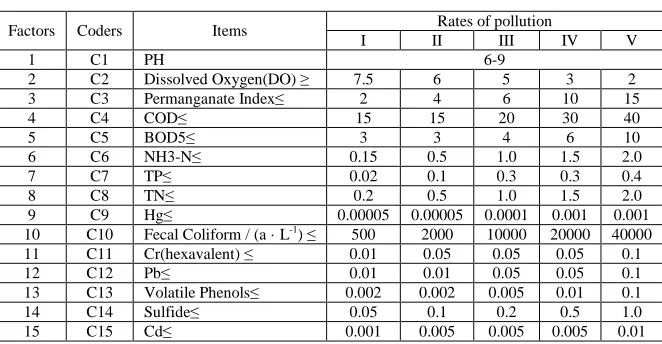
Now, we turn to the state of surface water environment quality standard of China (GB3838-2002), the water quality standards is shown in table 4 (because many parameter lists only part of the evaluation indicators related to this case, the data sampling table the same).
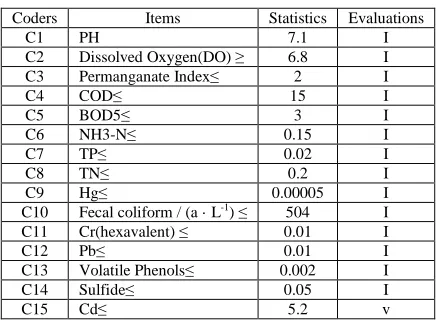
[image:7.595.141.472.546.718.2]On this basis, supporting the factors of table 4 are the evaluation factors in the factor set of the water sample, after the relevant physical and chemical analyzing, each sample data statistics is obtained, as shown in table 5. According to the water quality requirements of GB3838-2002, the water quality evaluation results are recorded in the "value" column of table 5.
In this case, according to the state of surface water environment quality standard of GB3838-2002 quality standard requirements (China), the weight of the above indexes is same, that is to say, the factors have the same polluting affections to the water. So, the average distribution method may be used in the case.
So, the weight
~
A
is:{
1
/
15
,
1
/
15
,
...
,
1
/
15
}
~
=
A
(15)In the case mentioned above and table 5, the pollution rate of factors may express as the matrix
R
:
=
=
1
...
0
0
...
...
...
...
0
...
0
1
0
...
0
1
...
15 2 1
~ ~ ~
~
R
R
R
R
(16) From the matrix
R
, we can know that all the factors are meeting the degree I excepting factor C15, the test result is filled in the last column of table 5.Table 4 the surface water environment quality standard of China (GB3838-2002)
Factors Coders Items Rates of pollution
I II III IV V 1 C1 PH 6-9
2 C2 Dissolved Oxygen(DO) ≥ 7.5 6 5 3 2 3 C3 Permanganate Index≤ 2 4 6 10 15 4 C4 COD≤ 15 15 20 30 40 5 C5 BOD5≤ 3 3 4 6 10 6 C6 NH3-N≤ 0.15 0.5 1.0 1.5 2.0 7 C7 TP≤ 0.02 0.1 0.3 0.3 0.4 8 C8 TN≤ 0.2 0.5 1.0 1.5 2.0 9 C9 Hg≤ 0.00005 0.00005 0.0001 0.001 0.001 10 C10 Fecal Coliform / (a · L-1)
≤ 500 2000 10000 20000 40000 11 C11 Cr(hexavalent) ≤ 0.01 0.05 0.05 0.05 0.1 12 C12 Pb≤ 0.01 0.01 0.05 0.05 0.1 13 C13 Volatile Phenols≤ 0.002 0.002 0.005 0.01 0.1 14 C14 Sulfide≤ 0.05 0.1 0.2 0.5 1.0 15 C15 Cd≤ 0.001 0.005 0.005 0.005 0.01
The classic fuzzy evaluation results
According to the classic fuzzy evaluation method, the evaluation process is computed as the following steps:
~ ~
~
A
R
B
=
×
[
]
×
=
mn m
m
n n m
r
r
r
r
r
r
r
r
r
a
a
a
~ ~
~
~ ~
~
~ ~
~
~ ~
~
...
...
...
...
...
...
...
...
1 1
2 21
21
1 12
11
2
1
[
]
[
14
/
15
,
0
,
0
,
...
,
1
/
15
]
1
...
0
0
...
...
...
...
0
...
0
1
0
...
0
1
15
/
1
,
...
,
15
/
1
,
15
/
1
=
×
=
[
] [
]
[
]
[
]
5
6667
.
4
1
,
2
,
3
,
4
,
5
15
/
1
,
...
,
0
,
0
,
15
/
14
...
...
1 22 1
~
≈
=
×
=
×
=
×
=
T T
n
n
v
v
v
b
b
b
V
B
F
[image:8.595.197.416.470.632.2]The result shows that the sample of water quality is very good according to the classic fuzzy evaluation method.
Table 5 the index statistics of the case
Coders Items Statistics Evaluations C1 PH 7.1 I C2 Dissolved Oxygen(DO) ≥ 6.8 I C3 Permanganate Index≤ 2 I C4 COD≤ 15 I C5 BOD5≤ 3 I C6 NH3-N≤ 0.15 I C7 TP≤ 0.02 I C8 TN≤ 0.2 I C9 Hg≤ 0.00005 I C10 Fecal coliform / (a · L-1) ≤ 504 I
C11 Cr(hexavalent) ≤ 0.01 I C12 Pb≤ 0.01 I C13 Volatile Phenols≤ 0.002 I C14 Sulfide≤ 0.05 I C15 Cd≤ 5.2 v
The evaluation results based on improved fuzzy evaluation method
The water had made some people getting strange disease, but the evaluation result shows the water didn’t been polluted according to the class fuzzy evaluation method, it is obviously different from the fact. So, the class fuzzy evaluation method arrives to a wrong result.
=
=
520
...
0
0
...
...
...
...
0
...
1
0
0
...
0
1
...
...
...
...
...
...
...
1 1 2 21 21 1 12 11 mn m m n nk
k
k
k
k
k
k
k
k
K
Step 2: to compute the new rate matrix of
~
A
according the average distribution method.
=
=
∑
∑
∑
∑
534
1
,...,
534
1
,
534
1
,
534
1
,...,
,
,
2 31 ~ i n i i i
a
a
a
a
a
a
a
a
A
Step 3: to compute the new rate matrix of
A
.K
A
A
~=
[
]
′
′
′
×
=
nk
k
k
a
a
a
m...
0
0
...
...
...
...
0
...
0
0
...
0
...
2 1 ~ ~ ~ 2 1[
a
1a
2...
a
n]
=
[
]
[
1
/
534
,
1
/
534
,
1
/
534
,
...
,
520
/
534
]
520
...
0
0
...
...
...
...
0
...
1
0
0
...
0
1
534
/
1
,
...
,
534
/
1
,
534
/
1
=
×
=
Step 4: to compute the new rate with the evaluation results based on improved fuzzy evaluation method.
[
]
×
=
×
=
mn m m n n mr
r
r
r
r
r
r
r
r
a
a
a
R
A
B
~ ~ ~ ~ ~ ~ ~ ~ ~ ~ ~ ~ ~ ~ ~...
...
...
...
...
...
...
...
1 1 2 21 21 1 12 11 2 1[
]
[
14
/
534
,
0
,
0
,
...
,
520
/
534
]
1
...
0
0
...
...
...
...
0
...
0
1
0
...
0
1
534
/
520
,
...
,
534
/
1
,
534
/
1
=
×
=
[
] [
]
[
]
[
]
1
1049
.
1
1
,
2
,
3
,
4
,
5
534
/
520
,
...
,
0
,
0
,
534
/
14
...
...
1 22 1
~
≈
=
×
=
×
=
×
=
T T
n
n
v
v
v
b
b
b
V
B
F
That is to say that the evaluation result of the case sample is bad by using the improved fuzzy evaluation method and the result is fit for the fact of the case. The evaluation result strongly suggests that the water is needed to be treated immediately.
In fact, the China's drinking water hygiene standards stipulated in the cadmium content must not exceed 0.005 mg/L. From table 5, two kinds of computing results and the actual situation of the sample water, to use the improved fuzzy evaluation method may obtain a more sound evaluation results, and the result may direct us carry out the Pollution Prevention more effectively.
CONCLUSION
In this paper, the classical fuzzy evaluation method is analyzed; the results indicate that the classic fuzzy evaluation method in the industrial wastewater pollution evaluation has some limitations. On this basis, a novel improving fuzzy evaluation method by fixed its weight coefficient of pollution evaluation factors is proposed for highlight focusing on the method of those factors. The case study shows that the improved fuzzy evaluation method for evaluation of the results more accurate. The method is proposed to solve the need to focus on some factors affecting the waste water pollution evaluation problem has certain practical value.
Acknowledgements
The research is supported by national science fund of China (51275547), Chongqing application technology research projects (cstc2012gg-yyjs40019), science and technology fund of Chongqing (CSTCjjA1481) and Chongqing municipal education commission research projects (KJ121413).
REFERENCES
[1] Ming Li. Based on dynamic neural network nonlinear adaptive inverse control research. Nanjing University of
Science and Technology, 2007.6.
[2] Wang Qingjin, Wang Juxiang and Wang Hongjiang, Technol. Eng., 2008, 1 (8) : 295-297. [3] Cao Dong and etc. Journal of Zhejiang University of Technology, 2003, 31 (4) : 355-359.
[4] Chen Yihua, Wang Kairong and He Renbing. The Optimization method. Chongqing University Mathematical
Institute. 2004.11.
[5] Hu Shangxu. Selective neural network ensemble algorithm research. Zhejiang University, 2008.7.
[6] Wang Hong. Key elements of the detectable matter-element extraction method research. Guangdong university of
technology, 2008.
[7] Deng Juli. Based on the dielectric constant of the oil pollution rapid testing technology research. Chongqing
university of industry and commerce, 2009.6.
[8] Wang Yingluo. Systems engineering. Machinery industry press. 2005.1.
[9] Liu Zhenxue Huang Ren and Tian Aimin. Experimental design and data processing. Chemical industry press.
2005.4.
[10] Xi Dan. Environmental detection. Higher Education Press. 2005.11 [11] Mohamed Tounsi. Expert Systems with Applications, 2005(29): 485-491.
[12] Nora F.Y. Tam,Teresa W.Y. Wong, Y.S. Wong. Marine Pollution Bulletin, 2005(51):1092-1100 [13] Yosuke Sano, Ki-Hyouk Choi, Yozo Korai.Isao Mochida. Fuel, 2005(5):903-910
[14] V. V. Ostrikov, G. D. Matytsin,S. A. Nagornov. Chemical and Petroleum Engineering, 2002(38):3-4 [15] Li Liu, Jianzhong Zhou and etc. Expert Systems with Applications, 2010(37):2517–2521.
[16] Morteza Pakdin Amiri. Expert Systems with Applications. 2010,37(9): 6218–6224.
[17] Piotr Jaskowski, Slawomir Biruk and Robert Bucon. Automation in Construction. 2010, 19(2): 120-126 [18] Mehmet Ekmekçioğlu,Tolga Kayaa, Cengiz Kahraman. Waste Management. 2010, 30(8–9): 1729-1736
126(2):370-378
[20]Vivien Y.C. Chen,Hui-Pang Lien and etc. Applied Soft Computing. 2011, 11(1):265-275
[21] Amin Afshar, Miguel A. Mariño, Motahareh Saadatpour and Abbas Afshar. Water Resources Management.
2011,25(2): 545-563
[22]Chiang Kao,Pei-Huang Lin. European Journal of Operational Research. 2011, 211(3):586-593
[23] André Lermontov, Lídia Yokoyama, Mihail Lermontov, Maria Augusta Soares Machado. Brazil. Ecological
Indicators. 2009, 9(6):1188-1197
[24]Ayub, Sohail, and Afzal Husain Khan. Journal of Chemical and Pharmaceutical Research. 2011,3(1): 685-697. [25]Aparna Y, Subhashini N J P. Journal of Chemical and Pharmaceutical Research, 2010, 2(3): 473-477.
[26]Gupta N, Kushwaha A K, Chattopadhyaya M C. Journal of Chemical and Pharmaceutical Research. 2011, 3(1): 284-296.