T h e I t ali a n t r a n si tio n a n d t h e
g e n e r a l e l e c tio n of 2 0 0 8
N e w e ll, JL
T i t l e T h e I t ali a n t r a n si tio n a n d t h e g e n e r al el e c ti o n of 2 0 0 8
A u t h o r s N e w ell, JL
Typ e C o nf e r e n c e o r Wo r k s h o p I t e m
U RL T hi s v e r si o n is a v ail a bl e a t :
h t t p :// u sir. s alfo r d . a c . u k /i d/ e p ri n t/ 1 0 3 9 2 /
P u b l i s h e d D a t e 2 0 0 8
U S IR is a d i gi t al c oll e c ti o n of t h e r e s e a r c h o u t p u t of t h e U n iv e r si ty of S alfo r d . W h e r e c o p y ri g h t p e r m i t s , f ull t e x t m a t e r i al h el d i n t h e r e p o si t o r y is m a d e f r e ely a v ail a bl e o nli n e a n d c a n b e r e a d , d o w nl o a d e d a n d c o pi e d fo r n o
n-c o m m e r n-ci al p r iv a t e s t u d y o r r e s e a r n-c h p u r p o s e s . Pl e a s e n-c h e n-c k t h e m a n u s n-c ri p t fo r a n y f u r t h e r c o p y ri g h t r e s t r i c ti o n s .
The Italian Transition and the General Election of 2008
JAMES L. NEWELL
European Studies Research Institute University of Salford
Salford M5 4WT [email protected]
The Italian Transition and the General Election of 2008
Introduction
What are the implications for the Italian transition of the general election of 2008? In the immediate aftermath of the campaign, it looked for a while as though the implications might be quite significant: the election had brought to office a government consisting of just two parties, and with a large majority – one that, from the point of view of its own power, was born in the most favourable circumstances a new government has ever enjoyed in the history of the Italian republic (Chiaramonte, forthcoming). Fragmentation among the parties of opposition had likewise declined dramatically and by far the largest of these, the Partito Democratico (Democratic Party, PD), had made conspicuous efforts to conduct a campaign that abandoned the demonising, anti-Berlusconi rhetoric of the past: wanting to convey an image of novelty for his party and to encourage ‘prospective’ voting, Walter Veltroni sought to avoid references to Silvio Berlusconi’s conflict of interests and past performance, as a focus on the past would inevitably have revived memories of the Prodi government – which was the last thing he wanted to do (Favretto, forthcoming). The situation in the election’s immediate aftermath, then, was one in which the main parties of government and opposition shared over 70 per cent of the vote and 78 per cent of the seats between them,1 and had apparently abandoned a style of competition – reciprocal denials of the claims of the other to legitimacy – that had hitherto contributed significantly to rendering institutional reform intractable, as well as being self-reinforcing.
It was therefore not altogether surprising that in May, Prime Minister and leader of the opposition seemed intent on a regular set of meetings with a view to finding mutually acceptable institutional reforms – even less surprising given the clear incentives both men had: successful reform arguably offered the opportunity of a place in Italian political history as the fathers of a new constitutional settlement, something that seemed likely to be especially attractive to the aging Berlusconi, reputed to want to crown his career at the end of his term as Prime Minister with election to the Presidency.
On the other hand, as Pasquino (forthcoming) has pointed out, ‘the thaw between the leaders of the two major parties lasted l’espace d’un matin’, Veltroni having underestimated the extent to which the decisions Berlusconi would have to take as Prime Minister would be affected by his unsolved conflict of interests – and, in fact, two of the Government’s earliest decisions (concerning rejection of the European Court’s decision that his Rete 4 Channel be shifted to satellite broadcasting, and an amendment that postpones one of his corruption trials) sent this conflict right to the top of the political agenda. Moreover, in dialogue with Berlusconi, Veltroni’s hands are somewhat tied for other reasons besides. One is that though he succeeded in expelling the far left from
1 Proportions higher than ever previously achieved since the war and well in line with the corresponding
Parliament, he has not succeeded in eliminating it as a force within the wider political system. Given what is suggested by the outcome of the 2008 election, and given what may be required at the sub-national levels of government with their different electoral systems, Veltroni may be obliged to re-admit the far left to the political game – with all the consequences this might potentially have for his leadership and the positions he would be able to take in constitutional reform negotiations with the Government.
So the likely impact on the transition of the election outcome for the moment appears unclear. Yet it is worth asking ourselves what, four months on from the elections, the current state of play is with regard to the Italian transition – simply because the concept has been so central to academic analyses of political changes since the early 1990s. This means that asking the question can help us clarify a number of issues relevant to understanding the current trajectory of change in Italian politics in general. With this in mind, the remainder of the paper is structured as follows. First, we consider the notion of ‘transition’ itself in order to establish the nature of the concept’s relevance to the Italian case. In the section following we explore what the effects of the election outcome have been in terms of the emergence of a unity of intents on constitutional change among significant actors, and the chances of it being achieved in the current legislature. In the fourth section, we consider whether, and if so in what sense, the 2008 election outcome constitutes a watershed in Italian politics. The final section concludes.
The notion of ‘transition’
As is well known, the concept of ‘transition’ refers to a state of ‘movement’ from one regime to another, where the term ‘regime’ means that complex of rules, norms and procedures which govern: recruitment to positions of political authority (e.g. as a consequence of the electoral system); the functioning of political institutions (e.g. Parliament); the definition of the political community itself (Pasquino, 2000: 202). Equally well known are the changes in Italian politics that are thought to give the term its relevance. In essence, the collapse of the Berlin Wall in 1989; the organisational disintegration of the then governing parties under the weight of a massive corruption scandal, and electoral-system change in 1993 had all brought a party-system transformation away from the traditional ‘polarised pluralist’ (Sartori, 1976) pattern in
the direction of fragmented bipolarism. On the one hand, then, party-system
the centre left, cohesion was undermined by the absence of any kind of coalition maker.2 So, while the average life of governments during the First Republic was somewhat less than a year (322 days), in the period from the 1994 election to the election of 2001 it was just over a year (422 days). Thus it was, that, in addition to the electoral reform of 1993, more thoroughgoing institutional reform was thought to be necessary in order to consolidate the changes that had been achieved thus far and to overcome the continuing weaknesses in the political system’s mode of functioning, in particular, the cohesion of governing majorities and thus their capacity for efficient and effective policy making.
But the conditions that underpinned convictions of the necessity for further institutional change were precisely those that made it difficult, if not impossible, to achieve that change. Already with the failure of the Bi-cameral Commission for Constitutional Reform under Massimo D’Alema in 1997, it was clear that party-system fragmentation had turned large numbers of parties into partisan veto players (Tsebeliss, 2002) all wanting change, but changes going in contrasting directions so that a majority in favour of any given set of changes became impossible to construct.
If this served to sustain the view that the Italian political system was somehow caught in mezzo al guado, in a ‘never ending’ transition, as some authors called it, then it also made it legitimate, after a certain point, to ask about the extent to which the term ‘transition’ was, in fact, any longer applicable. On the one hand, if one looked back to Italy’s last regime transition, the one that took place between 25 July 1943 and 1 January 1948, then one discovered that it was completed in less than five years. If one dates the onset of the current transition from the day, on 17 February 1992, that Mario Chiesa was caught by the Carabinieri flushing his bribes down the toilet, then one is forced to reckon with a ‘transition’ that has now been going on for over sixteen-and-a-half years. More importantly, if the term ‘transition’ implies a state of movement between two points, then it could be pointed out that the apparent absence of any political actor or group of actors sufficiently powerful to impose a solution that would end the transition in effect meant that the second of the two points did not exist, or at least could not be identified. And if it could not be identified, in what sense could the system be held to be in movement towards it, that is, ‘in transition’?
It is for these reasons that Martin Bull and I (2009) have written that rather than focussing on a supposed transition, it may be rather more fruitful for an understanding of Italian politics to analyse what, in substance, is distinctive about the period since the early 1990s: ‘the manner in which a debate over fundamental institutional (including electoral) reform has become entangled in day-to-day to politics’. That is to say, Italian political debate has, at least since the 1980s, been characterised, on the one hand, by a general consensus that fundamental institutional reform is needed, and, on the other, by a lack of agreement over what needs to be changed. ‘Furthermore, since the end of the 1990s, there has been deep-seated disagreement over the best (or ‘legitimate’) method by which such a reform might be achieved – beyond acceptance of the formal procedures for reform laid down by the Constitution. As a consequence of these three factors, the debate over
2 That is, a party which, because of its relative size, is able to dictate the terms on which coalition formation
institutional reform has become an intimate part of the substantive struggle for political power’ (Bull and Newell, 2009). And paradoxically, the enmeshing of ‘institutional’ and ‘political’ struggle made successful completion of any transition process less, rather than more likely – as the events surrounding the passage and the aftermath of the electoral law reform in December 2005, and the referendum on constitutional reform of June 2006, illustrated.
On the other hand, what seems equally true is that the generality of the changes that have overtaken the Italian system in the last fifteen years are sufficiently profound to sustain a case that in a broader sense, the Italian transition is already complete. In other words, if we detach the term ‘transition’ from an excessively close connection with formal, constitutional, change, then we may be able to detect a change in the workings of the political system sufficiently thoroughgoing to enable us to argue that, more broadly construed, ‘the fundamental rules of the game’ have indeed been transformed as compared to what they were before. So, in order to take analysis of the 2008 election and the Italian transition further, we have to do two things. One, taking the conventional understanding of the term, is to explore the extent to which the election outcome has enhanced the prospects for agreement among political actors having the power to engineer fundamental constitutional change capable of lasting: only if there are actors at least potentially capable of engineering lasting constitutional change does the term ‘transition’, conventionally understood, seem relevant. The other, construing ‘transition’ more broadly, is to explore what the election and its outcome means and is likely to mean for the performance of actors and the political system, generally speaking.
The prospects for a new constitutional settlement
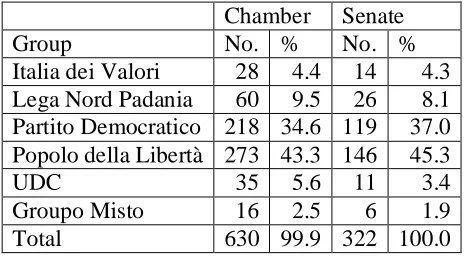
Article 138 of the Italian Constitution stipulates that amendments to it require each chamber of Parliament to vote in favour on two occasions separated by an interval of not less than three months; that those in favour must on the second occasion be a majority of the chambers’ members (not just of those voting); that citizens may subject the amendments to a referendum where, on the second occasion, they have been passed with the support of less than two thirds of the members of one or both chambers. This means that if a new constitutional settlement is to come in the present legislature, then it will have to be legislated for by the PD and the Popolo della Libertà (People of Freedom, PdL) working together. No other combination – see Table 1 – provides the two thirds required to avoid the risk of a repeat of the 2006 experience (Bull, 2007) when constitutional reform passed in opposition to the centre left provoked a referendum, which the centre right lost by a margin of almost two to one. However, if these two actors are successfully to conclude a reform, then they must (1) have a sufficient degree of commonality of outlook to enable them to do so; (2) sufficient desire to do so; (3) sufficient power to do so.
the eleventh; ‘Governing democracy’ – outlined a set of proposals for constitutional overhaul; but the issue was not addressed by the ‘Seven missions for the future of Italy’ of the PdL’s programme: perhaps an instance, rare in the 2008 campaign, of competition through ‘issue ownership’ rather than through debate over common issues (Budge and Farlie, 1983; Budge et al. 1987). True, the programmes did show a degree of overlap in terms of issues closely bound up with constitutional overhaul, notably, fiscal federalism, where the programmes converged ‘in envisaging a high level of local financial autonomy coupled with the decentralisation of service provision’ (Capriati, forthcoming). Given the electoral success of the Northern League (NL), the theme is likely to be an important one in the current legislature.
Somewhat more helpful are the volumes based on the leaders’ speeches, which set out their broader political visions: La Nuova Stagione (2007) for Walter Veltroni and
L’Italia che ho in mente (2000) for Berlusconi. The overlaps are evident. Veltroni’s book lists proposals a number of which were directly reflected in the PD’s programme (which is, perhaps, revealing of the much more centralised way in which the programme was drafted as compared to 2006 (Campus, 2008)): a single legislative chamber chosen using the two-ballot system, together with: a Senate representative of the sub-national tiers of government, an executive requiring the confidence of the Chamber only, and a Prime Minister with the power to request the President to revoke the appointment of individual ministers. Berlusconi’s book indicates (p. 59) support for the two-ballot system linking it, as does Veltroni, by implication, to the consolidation of bipolarism and alternation between compact governing and opposition line-ups. It also echoes (p. 61) Veltroni’s position concerning the relative roles and powers of the Chamber of Deputies and the Senate. Finally, Berlusconi’s echoes Veltroni’s book in looking for a reinforcement of the position of the Prime Minister, even though it goes beyond Veltroni in seeking to give the head of the executive ‘a direct popular mandate’ (p. 300) – a position which, as Pasquino (forthcoming) points out, has hitherto been resisted by narrow margins in debates on constitutional reform by those who argue that it would ‘risk transforming parliamentary and political crises into institutional crises’. In short, there appears, in broad outline, to be enough in common between the PD and the PdL to tip the balance of probability – at least on this ground – in favour of there being a new constitutional settlement some time during the course of the current legislature.
all, perceived as being both of the people and uniquely qualified to lead the people). But what appears at least equally true is that the need for constitutional overhaul is now an unquestioned and taken-for-granted matter of consensus right across the political spectrum at the elite level – and ultimately it may be this – the fact that politicians
themselves see things that way – that makes it meaningful to continue to apply to the Italian case the term ‘transition’, a term routinely used by politicians, as suggested by Veltroni’s book with its frequent references to ‘a long and so-far incomplete transition’ (p.7). So, when the PdL’s ‘Carta dei Valori’3 states that the process of constitutional reform will be restarted in the present legislature ‘with the common commitment to complete it’, we have to take this as evidence that the centre right too is committed to prioritising a new constitutional settlement.
What, then, of the power of the political protagonists actually to realise such a settlement? Here, much will depend on the capacity of the two principal line-ups to remain united, and on both sides there are forces potentially working for and against unity. On the centre right, the NL is numerically indispensable to the Government’s survival and the PdL is not yet a fully-fledged single entity. It might be hypothesised that on these fronts, economic developments are likely to be particularly significant. Italy is suffering at least as much as other European countries from the economic uncertainties instigated by the crisis of the US sub-prime mortgage sector and in the second quarter of 2008, recorded growth, at 0 per cent, was at its lowest level for five years (Troja, 2008: 12). If the Government starts becoming unpopular and looks like going down, the League will certainly not want to go down with it. In such circumstance, issues central to the League’s appeal, such as taxation and fiscal federalism, may provide major tests; for the decisions taken in these areas will have a significant impact on the coalition’s ability to deal with pressures to stimulate the economy and enhance household purchasing power at a time of deteriorating external conditions – while also preventing a reversal of the recent improvement in Italy’s public finances (the Economist, 2008). So the difficulties of
concluding any trade-off agreements that may be necessary to enable the executive both
to agree constitutional reform with the opposition and to retain the internal unity necessary for survival may go up considerably. A very similar hypothesis might be advanced with respect to unity of the PdL.
On the other hand, Berlusconi’s announcement at the beginning of August that the PdL was to become a political party within three months and hold its first national congress in January suggested moves to consolidate the unity of the body’s components as quickly as possible. And this may not be difficult: ‘their political and ideological compatibility…made the merger between Forza Italia and the National Alliance not only possible, but almost uncontroversial’ (Pasquino, forthcoming). National Alliance leader, Gianfranco Fini has long been fully behind the project, secure in the knowledge that he, of all potential contenders, is the best placed to assume the leadership, after Berlusconi. As for the League, its loyalty might be assured by the knowledge that it has been the clear winner in terms of the share out of government positions, having obtained four of the 21
ministers – a share much larger than its share of the vote. It also obtained portfolios (Home Affairs; Agriculture Food and Forests; Legislative Simplification; Federal Reform) closely reflecting the issues on which it has sought to construct its distinctive profile (Pasquino, forthcoming). This means that in any situation of tension with its allies, the calculation of whether, in terms of its support, it does better by breaking, or by staying on to exploit the potential of its offices is a much more difficult one to make than it would have been had its offices more closely reflected its share of the vote. Moreover, as long as any package of proposed constitutional and institutional reforms includes ‘federalism’, the NL may not care very much about many of the remaining matters. If, for example, the two largest parties were to agree on a reform of the electoral law based on the two-ballot system with single member constituencies as the PD’s programme proposed, then it could have little to object to given the geographical concentration of its vote.
On the centre left, the consolidation of the PD as unitary actor seems, as far as one can tell, to have taken place, so that from that perspective at least, its capacity compactly to reach an agreement on constitutional reform with the majority appears not to be in doubt. Internal ideological divisions between ex-communist and Catholic activists are likely to have been reduced by a political context in which abnegation of Communism on the one side had made room for adherence to a rather indistinct and eclectic set of reformist values – shared on the other side by the heirs to a political outlook – that of the left of the old DC – that already had a tradition of seeking accommodation with the Communists (Berselli, 2007: 45). And the power of losers from the project within the two main founding parties seems likely to have been neutralised by the steps taken (through the October 2007 ‘primaries’) to give those without any prior involvement with either party the opportunity to be involved in the foundation process on the same terms as those with such involvement.
Mannheimer, 2008). The upshot was that the largest formation on the centre left remained smaller than the largest centre-right formation, just as had been the case at every election but one since 1994: Table 2. Since the majority premium is awarded to the coalition or single list with the largest number of votes, and since we know that Italian voters are very unlikely to cross the basic centre-left/centre-right divide (Natale, 2002) (tending to deal with dissatisfaction by abstaining or switching to another party within the same coalition) Veltroni is left with this awareness: if he runs alone, he is always likely to be beaten by Berlusconi. This argues in favour of the construction of alliances, especially in view of the local elections due in 2009 when, it has been suggested, the PD will be in danger of losing a number of important local authorities if it refuses to ally itself with the far left (Pasquino, forthcoming). On the other hand, the construction of alliances is not without its own problems,4 so that the PD must also pay attention to the only alternative means it has of winning, namely, by somehow managing to broaden the base of its support to its right and to its left. The discussion of such strategic dilemmas seems likely to pose conundrums necessarily testing for Veltroni’s leadership and therefore for his ability to negotiate constitutional reform secure in the knowledge that he can take all of his followers with him.
Therefore, it remains unclear – to this author at least – that as conventionally understood, the term ‘transition’ is appropriate to the Italian context. While among the political elites there is some overlap of views on what a new constitutional settlement might look like, and while there is some commitment to the attempt to achieve it, the third vital ingredient – the existence of an actor of a group of actors with sufficient real power actually to make it a reality – is still not unambiguously present. It remains uncertain therefore, what it is that the Italian regime is supposedly in transition towards; and it remains the case that we will only be able to draw any conclusions about the applicability of the term after the event, that is, if and when a regime transition turns out in fact to have taken place. In the meantime, there do not appear to be any obvious theoretical benefits to be obtained from continuing to use the term. All of this throws a spotlight on the second issue: what does the outcome of the 2008 election imply for some broader notion of transition, that is, for the process of change in Italian politics more generally considered?
The more general implications of 2008
One seemingly widespread interpretation of 2008 appears to be that it has probably concluded the period of change begun in the early 1990s, an interpretation that has often
4 That is, if Veltroni seeks to beat Berlusconi by the construction of alliances with other parties, then, as the
been symbolised by use of the term ‘Third Republic’ (see, for example, Giannini, 2008). According to this view, in other words, the election has brought to a culmination that process of change initiated with the birth of the Second Republic (increasingly used without the inverted commas) in the 1990s and thus represents a genuine watershed. What are the cases for and against this view?
On the one hand, we have: the dramatic reduction in party-system fragmentation5
and the consolidation of bi-polar competition;6 a strong executive (the small number of whose parties and the narrowness of the ideological space they cover free it from the blackmail to which the previous government was exposed); a strong Prime Minister whose power was symbolised by the fact that he is said to have gone in to the customary post-election meeting with the President with the list of ministers already prepared, while the number of days separating the date of the election and the date the new government formally assumed office was the shortest in the history of the Republic: 24, for a post-war
average of 46. In August 2008, the American news magazine, Newsweek, seemed to offer
confirmation that the consequence had been a significant improvement in the quality of Italian government when it published an article under the title, ‘Miracle in 100 days, praising Berlusconi for having, as it put it, ‘brought order to chaotic Italy’, especially in relation to the Naples garbage crisis and illegal immigration (Barigazzi, 2008).
What seems undoubtedly true is that the Government is much better placed than
previous executives ever were to create the impression of an improvement in governing
performance. This is because it is much better placed than its predecessors, and especially the Prodi government, to engage in that permanent campaigning – using support
mobilisation as a key resource for governing, while using governing as an instrument to
build and sustain support – that is essential for survival in mediated democracies. Essential for permanent campaigning, in turn, is the effective use of use communication as a tool in the battle to control the political agenda. The Prodi government found this communication and this control even more difficult than most, essentially because it had to manage a coalition composed of large numbers of parties each driven to keep salient its own distinctiveness even as part of an alliance: by stipulating that all votes – even those of parties remaining below the (low) thresholds for the assignment to them of seats – count for the purposes of assignment to the coalition of the premium, the 2005 electoral law had removed almost all the political costs that might otherwise have been associated with voting for a minor formation belonging to one of the two major coalitions (Floridia,
5 The actual number of groups in the Chamber of Deputies declined to six from the fourteen in existence at
the end of the previous legislature, the effective number of groups (calculated, using the Laasko and Taagepera (1979) formula, as N = 1/ ∑ pi2, where N is the number of groups and pi is the fraction of seats
of the ith group) from 6.04 to 3.11.
6
2008). Vote-seeking parties, if they are to maximize their support, are obliged ‘to compete for media exposure and communication space…[But] attracting media attention requires provocation, division and confrontation’ (Paolucci and Newell, 2008: 289). It was no wonder, then, that the Prodi government found it so difficult to control the flow of information in its communications with citizens and thus keep control of the political agenda. Nor is it any wonder that it ended up with a reputation for ineffectiveness and became so bitterly unpopular. The Berlusconi government, with its coalition of two, and a cabinet in which the Prime Minister’s own party has an absolute majority, has none of these difficulties.
It seems distinctly possible, not to say likely, then, that what will come to pass is a reinforcement of widespread, but potentially very misleading, impressions of a significant improvement in government performance as compared to the largely negative balance sheet of the current government’s predecessor. Such impressions are potentially misleading since the already deeply rooted assumptions that the performance of the Prodi government was poor, are themselves misleading. What is undoubtedly true is that the Prodi government was unpopular – but that is a different matter. It was unpopular, not because its performance was poor, but because it was unstable and because of what this did for the way in which it was portrayed in the mass media.
In terms of sheer performance, any dispassionate account must surely see the Government as having produced a ‘mixed bag’ – much like most governments. It is an open question whether more could have been achieved had the Government not been so polarised and litigious; but what is certain is that ‘the Government had some notable achievements to its credit, ones that were especially notable precisely because of its structural weaknesses’ (Paolucci and Newell, 2008: 284). Among the most significant were the actions on public debt (the budget deficit going from 4.3 per cent of GDP in 2005 to 3.4 per cent a year later and to 1.9 per cent in 2007) and tax evasion (producing an increase in revenue that may have amounted to as much as 1 per cent of GDP (MEF, 2008) and the resumption of economic growth (which was 1.8 per cent and 1.5 per cent in 2006 and 2007 respectively, as compared to an average of 0.6 per cent over the previous five years). The Government’s tax changes meant that the highest earners paid less income tax in 2007 than they did in 2004. It introduced ‘class actions’ to enable consumer groups to claim compensation for damages caused by business. Its liberalisation measures brought estimated savings to families of between €2.4 and €2.8 billion a year. It introduced a series of measures designed to increase the security of employment. It delivered on is promise to reduce the so-called cuneo fiscale through tax concessions and reductions for businesses (for details of all these measures, see Capriati, forthcoming). In the area of foreign policy, the government’s commitment to multilateralism arguably gave it a number of successes – such as leadership of the peacekeeping mission in Lebanon – increasing the country’s prestige and therefore its influence in the international arena (Fois, forthcoming; Walston, 2008).
were nevertheless essential for its survival. This too was potentially misleading: parties such as Communist Refoundation, the Party of Italian Communists and the Greens were arguably placed in a situation of weakness, not of strength, because of their indispensability – because what this did was to place them in the classic dilemma faced by radical parties when in government. That is, they risk losing votes if they are insufficiently forthright in defending their supporters’ interests; but they also risk losing votes if they are perceived to behave ‘irresponsibly’. But more generally the Government’s problem was that being unable, precisely because of its heterogeneity, to use communication to ensure its survival, it was able to do little to counteract the tendency of the media, in their constant search for the newsworthy, to highlight feuds and divisions and so frame the government as ‘catastrophic’ (Roncarolo and Belluati, 2008). In doing so, willingly or otherwise, the media necessarily gave credence to the opposition’s portrayal of the Government – so fuelling the downward trajectory in its poll ratings, shortly after it took office. And the more the Government was portrayed as litigious and unstable, the more likely it was actually to be so as the parties, first, argued about how to retrieve the position and then came to be driven by a logic of si salvi chi può.
Conclusion
Whether the outcome of the 2008 election will prove to be the catalyst that gives Italy the long hoped-for constitutional overhaul remains highly uncertain. And since the existence of a process of transition can necessarily be conclusively established only after the event, this suggests that as conventionally understood – that is, as formal change in the nature of the regime – the term is now best abandoned in analyses of Italian politics.
References
Albertazzi, D., McDonnell, D. and Newell, J.L. (2007) ‘Di lotta e di governo: The Lega Nord and Rifondazione Comunista in coalition’, paper presented to the panel, ‘Outsider parties in Western Europe: the opposition in government? I’, at the 57th Annual Conference of the UK Political Studies Association, 11 -13 April, University of Bath.
Barigazzi, J, (2008), ‘Miracle in 100 days. How Berlusconi brought order to chaotic Italy
and what comes next’, Newsweek, 9 August, http://www.newsweek.com/id/151669
/output/print
Berselli, E. (2007) ‘Destra e sinistra: Con chi e come fondersi’, la Repubblica, 10 April, p.45.
Budge, I. and Farlie, D. (1983) Explaining and Predicting Elections: Issue Effects and Party strategies in Twenty-Three Democracies, London: Allen and Unwin.
Budge, I., Robertson, D. and Hearl, D. (1987) (eds.) Ideology, Strategy and Party Change: Spatial Analysis of Post War Election Programmes in 19 Democracies, Cambridge: Cambridge University Press.
Bull, M.J. (2007) ‘La grande riforma del centre-destra alla prova del referendum’, pp. 123-145 in J-L Briquet and A. Mastropaolo (eds), Politica in Italia I fatti dell’anno e le interpretazioni, Bologna: il Mulino.
Bull, M.J. and Newell, J.L. (2009) ‘Still the Anomalous Democracy? Politics and Institutions in Italy’ Government and Opposition 10(1): forthcoming January 2009.
Buzzanca, S. (2008) ‘Sinistra Arcobaleno, un voto su due al Pd’, la Repubblica, 17 April, p.13.
Berlusconi, S. (2000) L’Italia che ho in mente, Milan: Mondadori.
Campus, D. (forthcoming) ‘Campaign themes and issues’, forthcoming in J. L. Newell (ed.), The Italian General Election of 2008, London and Basingstoke: Palgrave.
Capano, G. and Giuliani, M. (2001) ‘Governing Without Suviving? An Italian paradox: law-making in Italy 1987-2001’, Journal of Legislative Studies 4: 13-36.
Capano, G. and Giuliani M. (2003) ‘The Italian Parliament: In Search of a New Role?’,
Journal of Legislative Studies 9(2): 8-34.
Capriati, M. (forthcoming) ‘The economic context’, forthcoming in J. L. Newell (ed.),
Carbone, M. and Newell, J.L. (2008), ‘Towards the end of a long transition? Bipolarity and instability in Italy’s changing political system’, Politics, fortcoming, October.
Chiaramonte, A. (forthcoming) ‘Italian voters: Berlusconi’s victory and the ‘new’ Italian party system’, forthcoming in J. L. Newell (ed.), The Italian General Election of 2008, London and Basingstoke: Palgrave.
Consortium (2008), ‘Elezioni del 13-14 aprile 2008: Analisi dei flussi elettorali
riguardanti i 5 maggiori partiti’, Istituto Piepoli SpA, available at:
http://www.istitutopiepoli.it/images/Articoli/ANALISI_FLUSSI_ELETTORALI.pdf
the Economist (2008), ‘Reforms in Italy’, the Economist, 29 May, http://www.economist.com/displayStory.cfm?story_id=11470004
Favretto, I. (forthcoming) ‘The parties of the centre left’, forthcoming in J. L. Newell (ed.), The Italian General Election of 2008, London and Basingstoke: Palgrave.
Floridia, A. (2008) ‘Gulliver Unbound. Possible Electoral Reforms and the 2008 Italian Election: Toward an end to ‘Fragmented Bipolarity?’’, Modern Italy 13(3): 317-332.
Fois, G.A. (forthcoming) ‘The EU and international contexts’, forthcoming in J. L. Newell (ed.), The Italian General Election of 2008, London and Basingstoke: Palgrave.
Giannini, M. (2008), ‘Terza repubblica, stesso cavaliere’, la Repubblica, 15 April, http://www.repubblica.it/2008/04/sezioni/politica/elezioni-2008-uno/giannini-voto
/giannini-voto.html
Laasko, M. and Taagepera, R. (1979) ‘“Effective” Number of Parties: A Measure with Application to West Europe’, Comparative Political Studies 12(1): 3-27.
Mannheimer, R. (2008c), ‘Vince il bipolarismo Carroccio e Di Pietro nuove «ali radicali»’, Corriere della Sera, 15 April, p.3.
Mastropaolo, A. (forthcoming) ‘The Political Context 2006 - 2008’, forthcoming in J. L. Newell (ed.), The Italian General Election of 2008, London and Basingstoke: Palgrave.
MEF [Ministero dell’Economia e delle Finanze] (2008) Relazione Unificata
sull’Economia e la Finanza Pubblica, Rome, 20 March.
Natale, P. (2002) ‘Una fedeltà leggera: i movimenti di voto nella II Repubblica’, in R. D’Alimonte, R. and S. Bartolini (eds), Maggioritario finalmente?, Bologna: Il Mulino.
Newell, J.L. (2006) ‘Characterising the Italian Parliament: legislative change in longitudinal perspective’, Journal of Legislative Studies 12(3-3): 386-403.
Italy 13(3): 283-291.
Pasquino, G. (2000) La transizione a parole, Bologna: il Mulino.
Pasquino, G. (forthcoming) ‘The formation of the fourth Berlusconi government’, forthcoming in J. L. Newell (ed.), The Italian General Election of 2008, London and Basingstoke: Palgrave.
Roncarolo, F. and Belluati, M. (2008) ‘Surfing and trying to keep afloat. The political communication process in a highly fragmented coalition led by a ‘Great Mediator’’,
Modern Italy 13(3): 333-348.
Sartori, G. (1976), Parties and Party-systems: A Framework for Analysis, Cambridge: Cambridge University Press.
Troja, L. (2008), ‘Istat: l’Italia è a crescita zero allarme recessione di Confindustria’, la Repubblica, 9 August, p.12.
Tsebellis, G. (2002) Veto Players: How Political Institutions Work, Princeton N.J.: Princeton University Press-Russell Sage Foundation.
Vassallo, S. (2007), ‘Government under Berlusconi: The Functioning of Core Institutions in Italy’, West European Politics 30(4), pp. 692-710.
Veltroni, W. (2007) La Nuova Stagione, Milan: Rizzoli.
Table 1 Composition of the parliamentary groups, Chamber of Deputies and Senate, 2008
Chamber Senate
Group No. % No. %
Italia dei Valori 28 4.4 14 4.3
Lega Nord Padania 60 9.5 26 8.1
Partito Democratico 218 34.6 119 37.0
Popolo della Libertà 273 43.3 146 45.3
UDC 35 5.6 11 3.4
Groupo Misto 16 2.5 6 1.9
Table 2 Percentage of the vote won by the two largest lists fielded by the centre right and centre left respectively, Chamber of Deputies elections, 1994 – 2008
Note: in order to compare ‘like with like’, for each of the elections, the lists on the basis of whose scores the above percentages are arrived at, are as follows:
in 1994: Forza Italia (FI) and the Partito Democratico della Sinistra (Democratic Party of the Left, PDS);
in 1996: FI and the PDS;
in 2001: FI and the Democratici di Sinistra (Left Demorats, DS);
in 2006: the combined vote of FI and Alleanza Nazionale (National Alliance, AN), for the centre right, and the Ulivo (formed of the DS and the Margherita), for the centre left;
in 2008: the Popolo della Libertà (People of Freedom, PdL) formed of FI and AN
for the centre right, and the Partito Democratico (Democratic Party, PD) formed of the DS and the Margherita, for the centre left.
Election
Largest list for: 1994 1996 2001 2006 2008
Centre right 21.0 20.6 29.4 36.0 37.3
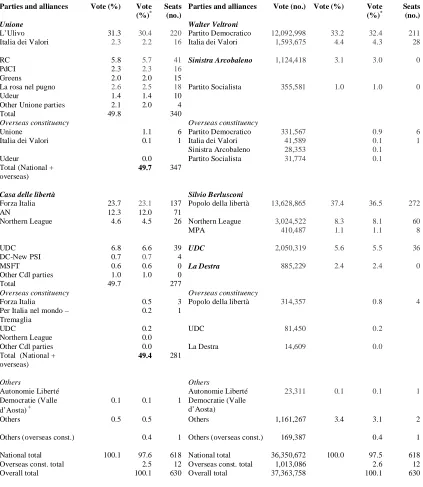
Table 3 Chamber of Deputies election results 2006 and 2008
2006 election 2008 election
Parties and alliances Vote (%) Vote (%)*
Seats (no.)
Parties and alliances Vote (no.) Vote (%) Vote (%)*
Seats (no.)
Unione Walter Veltroni
L’Ulivo 31.3 30.4 220 Partito Democratico 12,092,998 33.2 32.4 211
Italia dei Valori 2.3 2.2 16 Italia dei Valori 1,593,675 4.4 4.3 28
RC 5.8 5.7 41 Sinistra Arcobaleno 1,124,418 3.1 3.0 0
PdCI 2.3 2.3 16
Greens 2.0 2.0 15
La rosa nel pugno 2.6 2.5 18 Partito Socialista 355,581 1.0 1.0 0
Udeur 1.4 1.4 10
Other Unione parties 2.1 2.0 4
Total 49.8 340
Overseas constituency Overseas constituency
Unione 1.1 6 Partito Democratico 331,567 0.9 6
Italia dei Valori 0.1 1 Italia dei Valori 41,589 0.1 1
Sinistra Arcobaleno 28,353 0.1
Udeur 0.0 Partito Socialista 31,774 0.1
Total (National + overseas)
49.7 347
Casa delle libertà Silvio Berlusconi
Forza Italia 23.7 23.1 137 Popolo della libertà 13,628,865 37.4 36.5 272
AN 12.3 12.0 71
Northern League 4.6 4.5 26 Northern League 3,024,522 8.3 8.1 60
MPA 410,487 1.1 1.1 8
UDC 6.8 6.6 39 UDC 2,050,319 5.6 5.5 36
DC-New PSI 0.7 0.7 4
MSFT 0.6 0.6 0 La Destra 885,229 2.4 2.4 0
Other Cdl parties 1.0 1.0 0
Total 49.7 277
Overseas constituency Overseas constituency
Forza Italia 0.5 3 Popolo della libertà 314,357 0.8 4
Per Italia nel mondo – Tremaglia
0.2 1
UDC 0.2 UDC 81,450 0.2
Northern League 0.0
Other Cdl parties 0.0 La Destra 14,609 0.0
Total (National + overseas)
49.4 281
Others Others
Autonomie Liberté Democratie (Valle d’Aosta)+
0.1 0.1 1
Autonomie Liberté Democratie (Valle d’Aosta)
23,311 0.1 0.1 1
Others 0.5 0.5 Others 1,161,267 3.4 3.1 2
Others (overseas const.) 0.4 1 Others (overseas const.) 169,387 0.4 1
National total 100.1 97.6 618 National total 36,350,672 100.0 97.5 618
Overseas const. total 2.5 12 Overseas const. total 1,013,086 2.6 12
Overall total 100.1 630 Overall total 37,363,758 100.1 630
Sources:
http://www.repubblica.it/speciale/2006/elezioni/camera/index.html (2006 figures).
http://www.repubblic..it/speciale/2008/elezioni/camera/index.html (2008 figures).
Notes:
*
The percentages in this column are based on the overall total of votes cast, i.e. including the overseas constituency
+ Autonomie Liberté Democratie was associated with the Unione. Votes cast in the single-member Valle d’Aosta constituency are not