Evaluating ecommerce trust using fuzzy
logic [article]
Meziane, F and NeftiMeziani, S
Title Evaluating ecommerce trust using fuzzy logic [article]
Authors Meziane, F and NeftiMeziani, S
Type Article
URL This version is available at: http://usir.salford.ac.uk/2214/
Published Date 2007
USIR is a digital collection of the research output of the University of Salford. Where copyright permits, full text material held in the repository is made freely available online and can be read, downloaded and copied for noncommercial private study or research purposes. Please check the manuscript for any further copyright restrictions.
Evaluating E-Commerce Trust Using Fuzzy Logic
Farid Meziane and Samia efti
School of Computing, Science and Engineering University of Salford,
Salford, M5 4WT, United Kingdom
Abstract: Trust is widely recognised as an essential factor for the continual development of Business to Customer Electronic Commerce (B2C EC). Many trust models have been developed,
however, most are subjective and did not take into account the vagueness and ambiguity of EC
trust and the customers’ intuitions and experience when conducting online transactions. In this
paper, we develop a fuzzy trust model using fuzzy reasoning to evaluate EC trust. This trust
model is based on the information customers expect to find on an EC website and that is shown
to increase customers trust towards online merchants. We argue that fuzzy logic is suitable for
trust evaluation as it takes into account the uncertainties within E-commerce data and like human
relationships, it is often expressed by linguistics terms rather then numerical values. The
evaluation of the proposed model will be illustrated using two case studies and a comparison with
1. Introduction
Business to Consumer (B2C) Electronic Commerce (EC) has seen a phenomenal growth since
the development of the internet and there is a growing interest from many organisations to use it
as a way to improve their competitiveness and reach a wider customer base. In B2C EC, the
concept of trust is crucial because it affects a number of factors essential to online transactions,
including security and privacy. It is widely acknowledged that without trust EC cannot reach its
full potential [Cheskin, 1999]. Among the most cited concerns of EC customers are the low level
of personal data security, inconvenience systems, disappointing purchases, unwillingness to
provide personal details and mistrust of the technology [Shapiro et al., 1992; Mayer et al.,1995;
Lewicki and Bunker, 1996; Cheskin, 1999; Matthew and Turban, 2001].
Kasiran and Meziane (2002) developed a trust model for B2C EC that is based on the kind of
information customers are looking for on a vendor’s website to help them decide whether to
engage in a transaction or not. The model identified four major factors that need to be present on
a merchant’s website to increase customers’ trust when shopping online. These factors are:
Existence, Affiliation, Policy and Fulfilment. The information the customer needs to collect to
satisfy the existence factor include physical existence such as the merchant’s telephone number,
fax number and postal address; mandatory registration and peoples’ existence. These are known
as variables. The affiliation factor looks at third party endorsement, membership and portal and
the policy factor looks at information with regards to customer satisfaction policy, privacy
statement and warranty policy. Finally, the fulfilment factor looks at delivery methods, methods
of payment and the community comments. Hence, a total of twelve variables have been identified
EXISTECE AFFILIATIO
MERCHAT TRUST
FULFILMET POLICY
Customer Satisfaction Policy Mandatory Registration
Privacy Statement
Physical Existence People Existence
Payment Delivery Third Party
Endorsement
Membership
Portal
[image:4.595.145.455.84.223.2]Warranty Policy Community Comment
Fig. 1: The Trust Model [Kasiran and Meziane, 2002]
Given the large amount of information the model requires, an information extraction system has
been developed to automate the data collection process [Meziane and Kasiran, 2003, Meziane
and Kasiran, 2005]. Indeed it has been reported that users are finding it difficult to identify
specific information on websites [Center for the Digital Future, 2004]. In addition we do
recognize that users may not be able to make proper use of the collected information. For this
purpose, we developed tools to evaluate the trustworthiness of an EC website based on the
collected information. Two models have been developed in [Meziane and Kasiran, 2005] for
evaluating the trust factor; the linear model and the parameterised model. More details about
these two models will be provided in the comparison section (section 5).
However, for both models, we do recognise that this is not the natural way customers use to
evaluate their trust towards online merchants or make the decision to buy or not. As with any
other business transaction, customers develop in their mind some sort of ambiguity and
uncertainties when purchasing online [Mohanty and Bhasker, 2005]. The customer may wish to
classify the merchants using different preferences or take into accounts other parameters such as
user’s human intuitions, common sense and experience rather then on the availability of clear,
concise and accurate data [Akhter, Hobbs and Maamar, 2005]. In this paper, we develop a new
trust evaluation model using fuzzy reasoning to evaluate the trust factor as it allows the encoding
of the information available on the merchant’s website in a form that can be used to reflect the
way customers reach the decision to engage in an EC transaction.
The remaining of the paper is organised as follows. In sections 2 and 3 we describe the Fuzzy
inference and fuzzy logic system and we construct the rules base in section 4. We evaluate the
newly developed fuzzy model in section 5 and we compare it with the linear and parameterised
models in section 6. In section 7 we report some related work and underline the advantages of our
fuzzy system and we conclude in section 8.
2. The Fuzzy Inference System
There are two concepts within fuzzy systems which play a central role in our application domain.
The first one is a linguistic variable, i.e. a variable whose values are words or sentences in a
natural or synthetic language. Fuzzy set theory, which is based on such paradigm, deals with the
ambiguity found in semantics [Zadeh, 1965]. The second concept is that of a fuzzy IF-THEN
rules in which the antecedent and the consequent parts are propositions containing linguistic
variables [Mamdani, 1994]. These two concepts are effectively used in the fuzzy logic controller
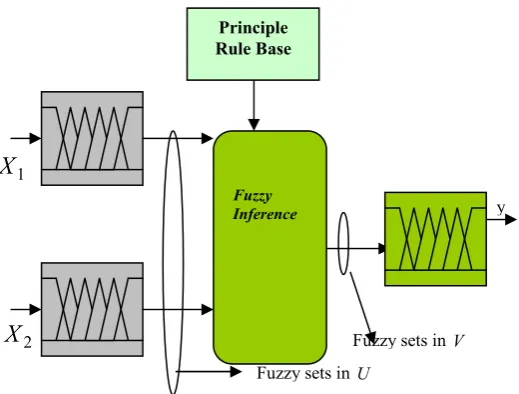
paradigm as shown in Fig. 2. The numerical values of the inputs xi∈Ui with (i=1,...,n) are fuzzified into linguistic values F1,F2,...,Fn where Fj’s are defined as fuzzy sets in the input
universe of discourse n
n
U U
U
Fig. 2: The Fuzzy logic controller
A fuzzy inference engine judges and evaluates several linguistic values G1,G2,...,Gn in the output universe of discourse V by using fuzzy IF-THEN rules which are defined in the rule base:
j j n n j i j G y Then F x and and F x IF
R( ): ∈ 1 ... ∈ ∈ (1) where (j=1,...M)and M is the number of rules in the principle base. Each fuzzy IF-THEN rule in the form of (1) defines a fuzzy set F1j×F2j×...×Fnj →Gj n the product space U×V . Let 'A
be an arbitrary input fuzzy set in U. A fuzzy set Bm in V can be calculated as:
[
( ,..., ) ( ,..., , )]
) ,..., ( ) ( 1 ... 1 ' 1 ' 1 y x x x x U x x y n G F F n A T n RA nm
m n m
m =⊕ ∈ µ ⊗µ × × →
µ o (2)
where t-norm ⊗and s-norm ⊕ are used for the intersection and the union operations
respectively. The final output is a fuzzy set in V , which is a combination of the M fuzzy sets, )
,.... (
' R(1) R(M)
Ao . The membership function of this inferred fuzzy set will be: )
( )
( (1) ( )
) ( ) 1 ( ,..., ) ' ... ' (
' R RM y A R A R M y
Ao
µ
oµ
oµ
= ⊕ ⊕ (3)The above membership function defines the fuzzy value of the output action
µ
B(y). The crispvalue of the output action can be obtained, say, by using the Centre of Gravity (COG) Fuzzy sets in V
Fuzzy Inference Principle Rule Base 1 X 2 X
Fuzzy sets in U
defuzzification method, where the shape of membership function, ( )
) ,..., (
' R(1) R(M) y Ao
µ
, is consideredto determine the crisp value of the output action
∑
∑
=
B B
y y
µ
µ
' .
3. Fuzzy Logic for the Trust Model
Trust relationships among customers and vendors are hard to assess due to the uncertainties and
ambiguities involved in evaluating trust in EC. For example, in the proposed trust model, the
community comments variable in the fulfilment factor has a wide range of values as we may have
a small or a large number of customers providing positive or negative feedback to the vendor.
Hence, the number of comments and their nature will affect the decision made by the associated
evaluation module. In addition, in the trust model used, there are dependencies between some
variables. For example the mandatory registration variable in the existence factor is dependent on
the membership and third party endorsements variables in the affiliation factor. Indeed, if an
organisation is a member of an association or endorsed by a third party, we assume that this
organisation is fully registered with the required authorities even though the mandatory
registration was not extracted by the information extraction system.
Thus, the use of fuzzy reasoning is justified as an adequate approach to deal with evaluating trust
in EC as it has the ability to quantify imprecise data and quantify uncertainties in measuring the
trust factor of the vendors and to deal with variable dependencies in the system by decoupling
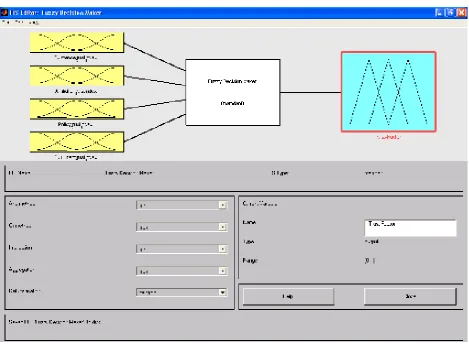
The general trust model proposed in this section is composed of five modules. Four modules will
be used to quantify the trust measure of the four factors identified in our trust model (Existence,
Affiliation, Policy and Fulfilment) and the fifth module will be the final decision maker to
[image:8.595.64.534.177.521.2]quantify the trust factor as illustrated in Fig. 3.
Fig. 3: The Ecommerce Fuzzy trust Model
The inputs of the Existence module are the Physical Existence, People Existence, Mandatory
Registration variable and the output of the affiliation module. Indeed, as explained earlier in this
section, the mandatory registration variable is dependent on the third party endorsement and
membership variables of the affiliation module. We also note here that the physical existence
and the Physical Address. For the affiliation module, the inputs are the Third Party Endorsement,
Membership and Portal variables. For the policy module, the inputs are the Customer
Satisfaction, Privacy and Warranty variables. Finally, the fulfilment module has as inputs the
Delivery, Payment Methods and Community Comments variables. The decision maker has as
inputs the outputs of the four modules which are Existence_Trust_Index,
Fulfilment_Trust_Index, Policy_Trust_Index and the Affiliation_Trust_Index. The output of this
module is the trust factor of the merchant’s website. In our model, this trust factor will be
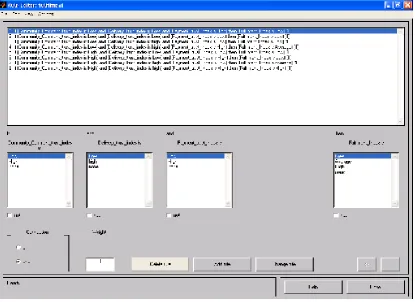
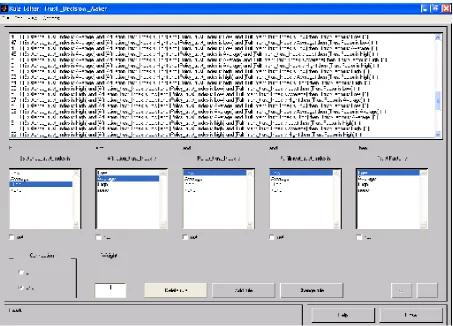
determined by the aggregations of the trust indices of all modules. Fig. 4 and Fig. 5 show a
sample of the IF-THEN rules for the Existence and Fulfilments modules respectively.
Fig. 5: The Fulfilment Module Rules
In the fuzzification phase, two membership functions described by the labels “Low” and “High”
will be used for each variable related to each module. However, we introduce a third membership
function “Average” for the outputs. For the decision maker module, we use all three membership functions for the inputs and output corresponding to Low, Average and High degree of trustworthiness of the website. These membership functions are represented by Gaussians defined
by the centre and the standard deviation parameters. The output values are normalised within the
interval [0, 1], with 1 for full trust and 0 for no trust. For example a vendor’s website with 0.75
The inference rules are subject to the users choice based on criteria of the risk and the gain as
defined by Tao and Thoen (2001). Fuzzy inference is a process to assess the trust index in five
steps: (1) Register the initial values of each variable as defined by the information extraction
system. (2) Use the membership functions to generate membership degrees for each variable
related to each module. (3) Apply the fuzzy rule set defined for each module onto the output
space (trust index) through fuzzy ‘and’ and ‘or’ operations. (4) Aggregate the outputs from each
rules related to each module, and (5) derive the trust index through a defuzzification process
using the centroid method. These same steps will also be used for the decision maker module to
generate the trust factor. From Fig. 6 we can see that the trust index increases with the increase of
the contributing attribute of all trust indices values and decrease when the decrease of all the
[image:11.595.89.511.389.690.2]attribute. Fig. 7 shows a sample of the IF-THEN rules for final decision maker module.
Fig. 7: The Final Decision Maker Module Rules
4. The Construction of the Rules Base
The decision to trust or not to trust EC as a shopping medium is up to consumers’ evaluation
which can be based on many factors such as price, convenience, selection of choice and the
information available on the merchant’s website like those defined in our model. It is widely
accepted that if the economic gain is greater than the risk involved then the transaction is
reasonably viable. Based on this assumption, Tao and Thoen (2001) formalised the process as:
b b
b PL
transaction if the potential gain is greater than the potential lost and will be indifferent if both
values are equal. Thus one has either to maximise the gain Gb or minimise the risk Pb. The risk can be minimised by providing all the information required by the customer on the vendor’s
website. Based on this model, we assume that if a large amount of information is available on a
vendor’s website and if this information is valid then the vendor can be trusted. However, the
importance of these factors can differ from one user to another. To validate our rules we
conducted a survey through the use of an online questionnaire.
5. System Evaluation
To evaluate the fuzzy model developed in this paper, we have chosen two random websites. The
first case study is the Denimjunkies1 site, a vintage clothing shop selling used collectable items
such as jeans, jackets and shirts and the second case study is the Mesh Computers2 website, a
company selling PCs and peripherals. For each factor, a set of three variables will be considered
hence, a total of 13 variables (including the output of the affiliation module which is used as an
input to the existence module). Thus combining all variables yield to a total of 12288 possible
combinations for each website. Since we use two membership functions for all the inputs except
the output from the affiliation module which has three membership functions. Given the
complexity of the problem, it becomes apparent why we grouped our variables into four factors
which are processed by separate modules as defined earlier. This allows us to consider only 8
possible combinations per module except the existence module which has 24 combinations. For
the final decision support module, three membership functions are used Low, Average and High
and this gives a possible total of 81 combinations. Table 1 summarises the information extracted
[image:14.595.94.505.167.379.2]from the two case studies.
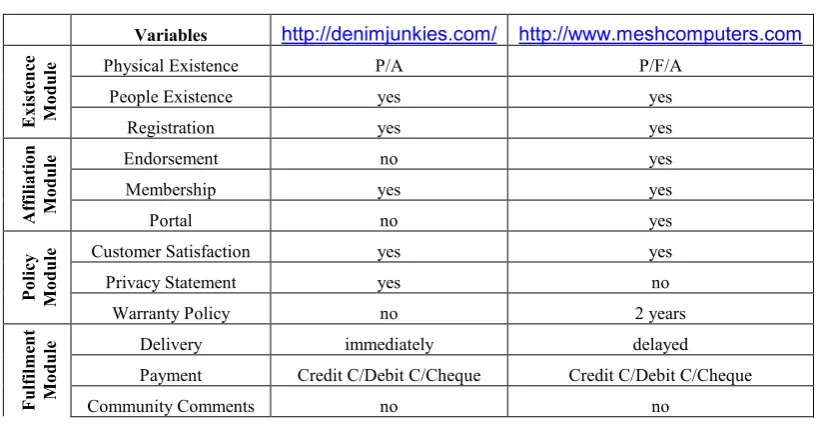
Table 1:The extracted information for the case studies
Variables http://denimjunkies.com/ http://www.meshcomputers.com
E x is te n ce M o d u le
Physical Existence P/A P/F/A
People Existence yes yes
Registration yes yes
A ff il ia ti o n M o d u le
Endorsement no yes
Membership yes yes
Portal no yes
P o li cy M o d u le
Customer Satisfaction yes yes
Privacy Statement yes no
Warranty Policy no 2 years
F u lf il m en t M o d u le
Delivery immediately delayed
Payment Credit C/Debit C/Cheque Credit C/Debit C/Cheque
[image:14.595.94.503.174.378.2]Community Comments no no
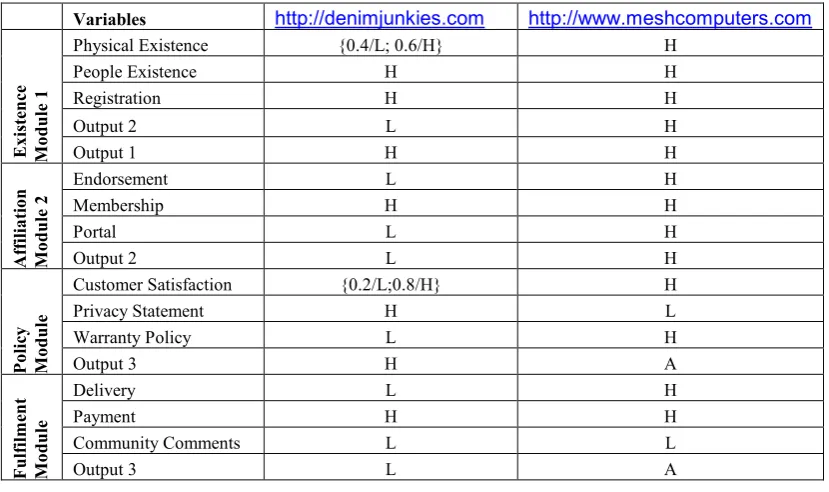
Table 2 shows the fuzzification of the extracted values related to each variable. In the first case
study, the information extraction system found two sub-variables (phone number and address) out
of a possible three; hence a value of 0.6 is assigned to the physical existence variable, thus after
the fuzzification step the degree of membership function of this value is 0.4 for Low and 0.6 for
High. The remaining two variables (people existence and mandatory registration) in the existence factor were assigned the membership functions 1 (or High) In the second case study, all information related to the existence factor was found; thus the degree of membership function of
all three existence variables will be 1. After all the selected rules were inferred in parallel, the
fuzzy operator ‘and’ is applied to determine the support degree of the rules. The ‘and’ results are
aggregated and the final trust factor for case study 1 and 2 were is generated by defuzzifying the
Table 2: the fuzzification of the extracted information for the case studies
Variables http://denimjunkies.com http://www.meshcomputers.com
E x is te n ce M o d u le 1
Physical Existence {0.4/L; 0.6/H} H
People Existence H H
Registration H H
Output 2 L H
Output 1 H H
A ff il ia ti o n M o d u le 2
Endorsement L H
Membership H H
Portal L H
Output 2 L H
P o li cy M o d u le
Customer Satisfaction {0.2/L;0.8/H} H
Privacy Statement H L
Warranty Policy L H
Output 3 H A
F u lf il m en t M o d u le
Delivery L H
Payment H H
Community Comments L L
Output 3 L A
Example of rules used to process the policy_trust_index for the case study 1 are as follows:
IF customer_satisfaction is Low and privacy_statement is High and warranty_policy is low THE<
Policy_trust_index is Low .
IF customer_satisfaction is High and privacy_statement is High and warranty_policy is low THE<
Policy_trust_index is Average.
The rules used for the aggregation of the final results for the case studies 1 and 2 and the outputs
of the decision maker module are summarised in table 3.
Table 3:The trust factor of the case studies
Outputs http://denimjunkies.com http://www.meshcomputers.com
Existence_trust_index High High
Affiliation_trust_index Low High
Policy_trust_index High Average
Fulfilment_trust_index Low Average
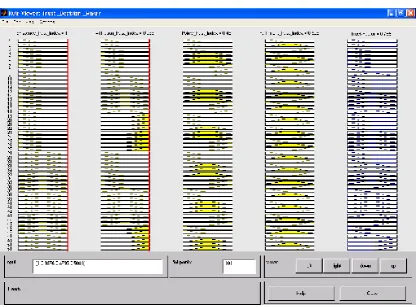
Fig. 8: Rules Aggregations and Output for Case Study 1
[image:16.595.90.511.392.699.2]6. Comparison of the Fuzzy Model with Other Models
Meziane and Kasiran (2005) developed two models to evaluate EC trust using the same model
shown in Fig 1, the linear model and the parameterised model. Both models were based on the
presence or not of the variables on the EC website. The linear model is used for new or
inexperienced users. The system automatically assigns the value of 1 when a variable is found
and 0 otherwise. The total is then divided by the number of variables (12) and a trust factor with a
value in the interval [0,1] is calculated using equation (4) were T is the trust factor and
i
v .represents one of the 12 variables of the trust model.
=
∑
= 12 1 12 1 i i vT (4)
The parameterised model is used with more experiences users which are asked to evaluate the
importance (according to their perception) of each variable by assigning the value 1 if the
variable is judged important, 0.5 if the variable is fairly important and 0 if it is not important.
These values are used as weights to the linear model variables and again a trust factor Tin the interval [0,1] is calculated using equation (5).
+ + + =
∑
∑
∑
∑
∑
∑
∑
∑
= = = = = = = = 3 1 3 1 3 1 3 1 3 1 3 1 3 1 3 1 4 1 l i l i i k i k i i j i j i i i i I i iw
w
F
w
w
P
w
w
A
w
w
E
T (5)
In both cases, the closer to 1 the trust factor is the higher the trust is towards the merchant’s
website. We have compared the results obtained by the Fuzzy model with those obtained by the
linear and parameterised model and the results are shown in Table 4. The weights used for the
existence (1), People existence (0), Mandatory registration (1), Third Party endorsement (1),
Membership (0.5), Portal (0.5), Customer Satisfaction (1), Privacy statement (1),Warranty (1),
Delivery (0.5), Payment (0), Community comments (0.5).
Table 4: Trust Models Comparison
Fuzzy Model Linear Model Parameterised Model
Case study 1 0.62 0.66 0.60
Case study 2 0.765 0.83 0.79
The results obtained by the linear model, which are those provided for a new or inexperienced
user, are high compared to those obtained by the other two models. The linear model results are
only based on the existence or non existence of the variables on the merchant’s website and this
may be misleading as not all variables are of the same importance. The results of the fuzzy and
parameterised models are close as in this particular experiment, those who choose the weights for
the parameterised model, the authors, are themselves experts and have experience in EC
transactions and hence the results are similar to those produced by the fuzzy systems were experts
have produced the IF-THEN rules. By developing the fuzzy model, there is now no need for the
use of the parameterised model as the expertise, on a general scale rather then chosen by
individual users, is incorporated in the evaluation process. Users experience is also subjective and
the use of the fuzzy model will provide a stronger and a more objective tool to all users
regardless of their expertise and experience.
7. Related Work
Akhter et al., (2005) developed a Fuzzy logic based system for assessing the level of trust in B2C
EC. In their model the trust (T) is composed of three variables which are security (S), familiarity
is a function of trust and Competitiveness and formulated as LB2C = g(T,C). However, in their model they are not clear on what factors they use to evaluate each of the three variables S, F and
D. They assume that users by just using a website can decide if the trust is high, average or low with regards to these three variables. Studies on the use of websites design for example to convey
trust are well documented and the characteristics well defined [Basso et al., 2001, Riegelsberg
and Sasse, 2001, Hu et al., 2004].
Manchala (2000) proposes a model for the measurement of trust variables and the fuzzy
verification of E-Commerce transactions. He highlights the fact that trust can be determined by
evaluating the factors that influence it, namely risk. He defines cost of transaction, transaction
history, customer loyalty, indemnity and spending patterns as the trust variables. Each variable is
measured using semantic labels. His notation is focused on defining when two trust variables are
related by an EC Trust Relationship (ECTR). Using this ECTR, a trust matrix is constructed
between the two variables and a Trust Zone is established. He also describes a method for trust
propagation and the construction of a single trust matrix between vendor and customer that
governs the transaction. The problem with Manchala’s model is that it is unclear (1) which
variables should be used by default for the best results; (2) if it is actually possible for a computer
to automatically establish that two variables are related by an ECTR. In his definition, he
mentions a semantic relationship between the variables, but neglects to mention how this fact will
be specified to the computer so that evaluation can be automated and (3) if ECTR merging will
scale in the face of large trust matrices. These concerns are all related to the viability of
implementing his model. These models do not support a theoretic approach to trust and they are
Fuzzy logic was also used for product classification in EC [Mohanty and Bhasker, 2005]. When
faced with a choice of many products, users need to make a decision on which product to
purchase. Taking the case of a car purchase, the authors used 5 variables which are the cost,
re-sale value, mileage, comfort and Maintenance cost. A typical statement would be then to
purchase a car with a price around a particular value, a high resale price, with a mileage around
certain mileage, comfortable and a low maintenance cost. Such systems would work only on a
specific type of products (cars in this case) if one wishes to purchase a Personal Computer for
example, the variables would change as is the fuzzy logic system.
From a technology perspective Jøsang (1998) has shown that it is possible to develop a model for
trust and that this model is a model for beliefs. In developing this model Jøsang has formulated a
framework which he calls “subjective logic” which is an extension of standard logic and in part
probability theory. It is the assessment mechanism that must be used to evaluate the probability
associated to the information and the assessment will then be used to assist in the establishment
of the requisite trust. Since the concept of trust is subjective, it creates a number of unique
problems that obviates any clear mathematical result..
8. Conclusion and Future Work
In this paper, we presented a system based on fuzzy logic to support the evaluation and the
quantification of trust in EC. Although, the system has addressed many issues that other systems
did not such as taking into account the fuzzy nature of trust and using a substantial number of
variables, we believe that the system can be improved in many ways. As stated in many trust
models, there are other aspects that contribute to the completion of online transactions. This
effective decision support system, future development should include some if not all of these
aspects. The price of the item is certainly an important variable as it is shown in many studies that
if the price is reasonably low, customers are ready to take the highest risk to purchase the item.
Online transactions also depend on customer’s experience and personality. Some customers may
value some variables more then others. Hence we believe that future systems should allow
customers to rank trust variables according to their own perception and experience.
References
Ahuja V. (2000), Building Trust in Electronic Commerce, IT Professional,2(3): 61-63.
Akhter F., Hobbs D. and Maamar Z. (2005), A fuzzy logic-based system for assessing the level of
business-to-consumer (B2C) trust in electronic commerce, Expert Systems with Applications 28:623–628.
Ba S. (2001), Establishing Online Trust Through a Community Responsibility System, Decision Support Systems,
(13):323-336.
Basso A., Goldberg D., Greenspan S. and Weimer D. (2001), First impressions: emotional and cognitive factors
underlying judgments of trust e-commerce, Proceedings of the 3rd ACM conference on Electronic Commerce,
p.137-143, Tampa, Florida, USA
Cheskin Research group (1999), eCommerce Study Trust,
http://www.studioarchetype.com/cheskin/assets/images/etrust.pdf, 1999.
Guo J. and Sun C. (2004), Global Electronic Markets and Global Traditional Markets, Electronic Markets
Han K.S. and Noh M.H. (1999), Critical Failure Factors that Discourage the Growth of Electronic Commerce,
International Journal of Electronic Commerce, 4(2):25-43.
Hu J., Shima K., Oehlmann R., Zhao J., Takemura Y. and Matsumoto K. (2004), An empirical study of audience
impressions of B2C web pages in Japan, China and the UK, Electronic Commerce Research and Applications,
(3):176-189.
Jøsang A. (1998), Modelling Trust in Information Society, PhD Thesis, Department of Telematics, Norwegian
University of Science and Technology, Trondheim, Norway.
Kasiran M.K. and Meziane F. (2002), An Information Framework for a Merchant Trust Agent in Electronic
Commerce, In Yin H., Allinson N., Freeman R., Keane J. and Hubbard S. (Eds), Intelligent Data Engineering and
Automated Learning, LNCS 2412, pp 243-248, Springer.
Kasiran M.K. and Meziane F. (2004), The Usage of Third Party Endorsement in Ecommerce Websites, 7th
International Conference on Work with Computing Systems (WWCS2004), Kuala Lumpur, Malaysia, pp. 794-798.
Lewicki R.J. and Bunker B.B. (1996), Developing and Maintaining Trust in Working Relationships, In Kramer R.M.
and Tyler T. (Eds.), Trust in organizations, Thousand Oaks, CA: Sage, pp. 114–139.
Mamdani E. (1994), Application of Fuzzy Algorithms of Simple Dynamic Plants, Proceedings of IEEE, 121,
585-588.
Manchala D.W. (2000), E-Commerce Trust Metrics and Models, IEEE Internet Computing, March-April, pp.36-44
Matthew K.O. and Turban E. (2001), A Trust Model for Consumer Internet Shopping, International Journal of
Mayer R.C., Davis J.H. and Schoorman F.D. (1995), An Integrative Model of Organizational Trust, Academy of
Management Review, 20(3):709–734.
Meziane F. and Kasiran M.K (2003), Extracting Unstructured Information From the WWW to Support Merchant
Existence in E-Commerce, in Dusterhoft A. and Thalheim B. (Eds), Lecture Notes in Informatics, Natural Language
Processing and Information Systems, pp.175-185, GI-Edition, Bonn, Germany.
Meziane F. and Kasiran M.K. (2005), Strategizing Consumer Logistic Requirements In Ecommerce Transactions:
Evaluation of Current Implementations, Proceedings of the 3rd European Conference on Intelligent Management
Systems in Operations, Salford, Manchester, UK, June 2005, pp.116-125, The Operational Research Society.
National Fraud Information Centre, http://www.fraud.org/2002intstats.htm
Riegelsberger J. and Sasse M.A. (2001), Trustbuilders and trustbusters: The role of trust cues in interfaces to
e-commerce applications, Proceedings of the 1st IFIP Conference on e-commerce, e-business, e-government, pp. 17-30,
Kluwer.
Shapiro D., Sheppard B.H. and Cheraskin L. (1992), Business on a Handshake, The Negotiation Journal, pp. 365–
378, October.
Tao-Huan T. and Theon W. (2001), Towards a Generic Model of Trust in Electronic Commerce, International
Journal of Electronic Commerce, 5(2):61–74.
Tyrone W. A. Grandison (2003), Trust Management for Internet Applications, PhD Thesis, Imperial College of
Science, Technology and Medicine University of London, Department of Computing.
![Fig. 1: The Trust Model [Kasiran and Meziane, 2002]](https://thumb-us.123doks.com/thumbv2/123dok_us/8731832.887122/4.595.145.455.84.223/fig-the-trust-model-kasiran-meziane.webp)