S T U D Y P R O T O C O L
Open Access
The effectiveness of a web-based brief alcohol
intervention in reducing heavy drinking among
adolescents aged 15 to 20 years with a low
educational background: study protocol for a
randomized controlled trial
Carmen V Voogt
1*, Evelien A P Poelen
1, Lex A C J Lemmers
2and Rutger C M E Engels
1Abstract
Background:The serious negative health consequences of heavy drinking among adolescents is cause for concern, especially among adolescents aged 15 to 20 years with a low educational background. In the Netherlands, there is a lack of alcohol prevention programs directed to the drinking patterns of this specific target group. The study described in this protocol will test the effectiveness of a web-based brief alcohol intervention that aims to reduce alcohol use among heavy drinking adolescents aged 15 to 20 years with a low educational background.
Methods/design:The effectiveness of the What Do You Drink (WDYD) web-based brief alcohol intervention will be tested among 750 low-educated, heavy drinking adolescents. It will use a two-arm parallel group cluster randomized controlled trial. Classes of adolescents from educational institutions will be randomly assigned to either the
experimental (n = 375: web-based brief alcohol intervention) or control condition (n = 375: no intervention). Primary outcomes measures will be: 1) the percentage of participants who drink within the normative limits of the Dutch National Health Council for low-risk drinking, 2) reductions in mean weekly alcohol consumption, and 3) frequency of binge drinking. The secondary outcome measures include the alcohol-related cognitions, attitudes, self-efficacy, and subjective norms, which will be measured at baseline and at one and six months after the intervention.
Discussion:This study protocol presents the study design of a two-arm parallel-group randomized controlled trial to evaluate the effectiveness of the WDYD web-based brief alcohol intervention. We hypothesized a reduction in mean weekly alcohol consumption and in the frequency of binge drinking in the experimental condition, resulting from the web-based brief alcohol intervention, compared to the control condition.
Trial registration:Netherlands Trial Register NTR2971
Keywords:Heavy drinking, adolescents with a low educational background, web-based brief alcohol intervention
Background
Heavy alcohol use among adolescents continues to be a great public health concern in most Western coun-tries, given the immediate and long-term health con-sequences [1]. In the Netherlands, the prevalence of heavy drinking is particularly high among adolescents
with a low educational background, aged 15 to 20 years [2-4].
Adolescents with a low educational background not only engage in heavy drinking more often, but also start drinking at a younger age compared to higher educated peers [4-6]. Possible explanations for this difference are that they spend more time with friends, are raised more often in single-parent families, experience less rule set-ting and monitoring by the mother, and engage more often in externalizing behaviors [3].
* Correspondence:[email protected]
1
Behavioural Science Institute, Radboud University Nijmegen, Montessorilaan 3, 6525 HR Nijmegen, The Netherlands
Full list of author information is available at the end of the article
Both early drinking onset and heavy drinking can place low-educated adolescents at an increased risk for devel-oping acute and long-term health consequences, such as alcohol-related violence [7], drunk driving, injuries and risky sexual behavior [8]. This behavior is also associated with brain impairment and neurocognitive deficits, which have implications for learning and intellectual de-velopment [9,10]. In the long term, heavy drinking is predictive of, among other things, problematic adult al-cohol use [11], liver cirrhosis [12], specific types of can-cer, and cardiovascular disease [1]. From a public health viewpoint, it is crucial to develop alcohol prevention programs directed at adolescents with lower education levels to encourage them to change their risky drinking practices, especially considering that 60% of all adoles-cents, following secondary education in the Netherlands, are low-educated [3]. The study described in this proto-col will test the effectiveness of the WDYD web-based brief alcohol intervention that aims to reduce alcohol use among heavy-drinking adolescents aged 15 to 20 years with a low educational background.
The school system in the Netherlands comprises sev-eral types of education. After eight years of primary edu-cation, pupils go directly to secondary eduedu-cation, which consists of preparatory secondary vocational education (VMBO), senior general education (HAVO), and preuni-versity education (VWO). Pupils with a VMBO diploma are able to attend a secondary vocational education (MBO), which has four learning routes: 1) the theoretical route allowing admission to MBO or HAVO, 2) a mixed educational route, 3) the vocationally oriented route, and 4) a vocational route allowing pupils to enter the labor market directly. HAVO prepares pupils for higher pro-fessional education (HBO), while VWO prepares pupils for university.
In the Netherlands, there is a lack of evidence-based alcohol prevention programs targeting adolescents fol-lowing the lower education levels [13,14]. The existing programs are mainly concentrated on first- and second-year MBO pupils, while less attention is paid to third-and fourth-year MBO pupils, partly due to the increas-ing difficulty of reachincreas-ing them as a consequence of their internship commitments [14]. Moreover, the prevention programs are inadequately tuned to the influence of the direct social environment (that is, friends, peers and par-ents) that is related to the heavy drinking patterns of this specific target group [3]. Therefore, it is essential to de-velop and evaluate the effectiveness of alcohol preven-tion programs aimed at adolescents following the lower education levels.
Prior research has demonstrated that web-based brief alcohol interventions can be effective in reducing heavy alcohol use in adolescents and students [15-21]. Inter-ventions delivered electronically via the internet have
large practical advantages compared to the more con-ventional methods [22-24]. The internet is easily
access-ible and particularly appealing to young people.
Furthermore, it allows the participants to access the intervention in the privacy of their homes at a conveni-ent time, which may enhance their feelings of anonym-ity. Brief interventions are especially easy to implement by creating links on websites or providing the link of this website in promotion and education materials. More-over, these interventions can be provided in an auto-mated, cost-effective and flexible way [25]. Finally, the majority of adolescents in Western countries have access to the internet and make frequent use of internet tech-nologies [26,27], which make web-based brief alcohol interventions particularly suitable for our target group.
Objectives and hypotheses
The objective of the study described in this protocol is to evaluate the effectiveness of the What Do You Drink web-based brief alcohol intervention among heavy-drinking adolescents aged 15 to 20 years with a low edu-cational background. A two-arm parallel-group rando-mized controlled trial will be conducted with two follow-up assessments (that is, after one and six months) to examine the effectiveness of the intervention. Two hypotheses will be tested. First, we expect that a larger percentage of participants in the experimental condition will drink within the normative limits of the Dutch Na-tional Health Council for low-risk drinking [28] when compared to the control condition as a result of the WDYD intervention. This means that participants’ sumption will not exceed a mean heavy alcohol use con-sumption of more than seven (girls aged 15 to 16 years), twelve (boys aged 15 to 16 years), fourteen (women aged 17 to 20 years) or twenty-one (men aged 17 to 20 years) glasses of standard units of alcohol per week and/or, in the case of binge drinking, five or more glasses of stand-ard units of alcohol on one drinking occasion at least once per month and week for boys and girls aged 15 to 16 years and men and women aged 17 to 20 years, re-spectively, at one month and six months after the inter-vention. Second, we expect that participants in the experimental condition will reduce their mean weekly al-cohol consumption and frequency of binge drinking. Thus, it is hypothesized that exposure to the WDYD intervention will be more effective compared to no intervention.
Methods/design Trial design
adolescents with a low educational background aged 15 to 20 years: 375 are in the experimental condition (web-based brief alcohol intervention) and 375 are in the con-trol condition (no intervention).
Procedure and participants
Participants will be recruited at VMBO and MBO tions in the Netherlands. The VMBO and MBO institu-tions will be selected from a list of all educational institutions in different regions in the Netherlands. The selected educational institutions will receive an invitation letter with additional information about the study. A stan-dardized cover story will be used in which institutions are informed that their students will participate in a study examining newly developed health education materials addressing alcohol use. After two weeks, the institutions will be contacted by telephone to establish whether or not they are willing to participate in the study. Those institu-tions that are willing to cooperate in the study will be asked to participate with as many as possible classes. Add-itionally, they will be requested to distribute letters to the parents of adolescents aged 15 to 16 years to inform them about the institution’s study participation. The parents will be given the opportunity to refuse participation by email or telephone during the entire study period. The informed consent materials will state clearly the expectations of fre-quency, duration and extent of study participation.
From the participating institutions, none of the adoles-cents will be excluded from study participation to avoid stigmatization and social exclusion. However, after the re-cruitment and enrolment of the institutions in the trial, an online baseline assessment will be carried out to establish whether the adolescents of the participating classes can be included in the study sample. Therefore, participants must: 1) be between 15 and 20 years old, 2) report heavy drinking in the past six months, and 3) be willing to change their alcohol consumption. Our definition of heavy drinking is based on measures of heavy alcohol use and binge drinking, which differs across participants’sex and age. To fulfill the sample inclusion criteria, adolescents should be a heavy alcohol user and/or a binge drinker. However, problem drinkers who show symptoms of alco-hol abuse or dependence (that is, an AUDIT score of 20 or above [29]) and/or of receiving treatment for alcohol-related problems will be excluded from participation since the WDYD intervention focuses on the prevention of heavy drinking rather than the prevention of problem drinking. The Ethical Committee (ECG) of the Faculty of Social Sciences of Radboud University Nijmegen in the Netherlands has approved the trial protocol.
Intervention
Originally, the WDYD intervention had been developed for heavy-drinking young adults aged 18 to 24 years.
Therefore, minor adaptations have been made concern-ing the usability (that is, use of language) of the inter-vention to make it more appropriate for the target group of adolescents with a low educational background aged 15 to 20 years. Detecting and reducing heavy drinking of adolescents who are willing to decrease their alcohol consumption is the main aim of the WDYD interven-tion. Motivational Interviewing principles [30] and parts of the I-Change model [31] are incorporated in the intervention, in which knowledge, social norms, and self-efficacy are embedded as the most changeable
deter-minants of behavior change. To increase adolescents’
motivation to adapt their drinking behavior, discrepant personal information is presented [32]. Therefore, the first part of the WDYD intervention consists of a screen-ing procedure and a form of personalized feedback based on the screening outcomes. The second part of the WDYD intervention focuses on goal-setting, action plan-ning, and strengthening adolescents’ drinking refusal self-efficacy (for more details of the intervention see [33]).
Intervention conditions
Participants in the experimental condition will be exposed to the WDYD intervention, while participants in the control condition will receive no further intervention.
Data collection
The recruitment, enrolment in the trial, online baseline assessment, and randomization is scheduled during the period of October to December 2011. The follow-up assessments will be obtained one and six months after the intervention, that is, in the period November to December 2011 and April to May 2012. In addition, the participating VMBO and MBO institutions will be offered an incentive in the format of the DVD workshop
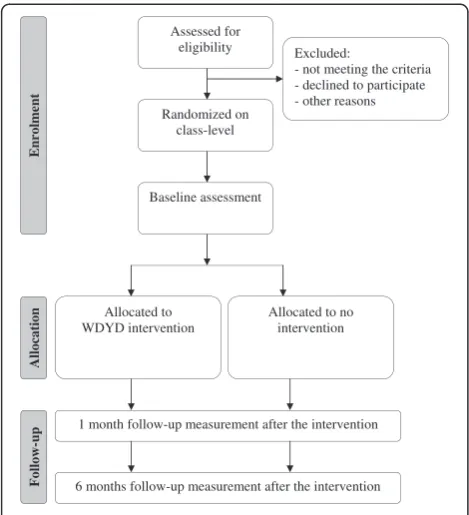
‘Advertisement agency’, after their students have com-pleted the total follow-up period. The workshop, designed by the Trimbos Institute (Netherlands Institute of Mental Health and Addiction), is developed for ado-lescents and focuses on alcohol, tobacco, and drugs use and peer pressure. An overview of the measurements is given in Figure 1.
Outcomes
The Dutch version of the Alcohol Weekly Recall [34] will be used to measure participants’ average glasses of standard alcohol units in the previous week. To assess frequency of binge drinking, respondents will be asked how often they consumed five or more glasses of stand-ard alcohol units on one drinking occasion at least once per month (boys and girls aged 15 to 16 years) and week (men and women aged 17 to 20 years) in the past month and week, respectively.
Attitudes towards alcohol use reflect the extent to which respondents have a positive or negative regard of alcohol use. Respondents will be asked about the per-ceived effects of alcohol (for example,‘Drinking alcohol makes me feel less shy’and‘Drinking alcohol makes me fat’). Respondents will complete 10 positive and 10 nega-tive attitude items and respond on a 4-point scale ran-ging from (1)‘strongly disagree’to (4)‘strongly agree’.
Self-efficacy will be measured with a modified version of Young’s Drinking Refusal Self-Efficacy Questionnaire Revised Adolescents Version (DRSEQ-RA: [35,36]), which assesses respondents’ability to resist drinking al-cohol in various situations. This measure was modified by adding additional risk situations in which respon-dents find it hard to resist alcohol. Additional items
were generated by the authors (for example, ‘When I
have finished my exams’). Respondents will complete 26 items and respond on a 6-point scale from (1)‘I am very sure I cannot resist alcohol’to (6)‘I am very sure I can resist alcohol’, with higher scores reflecting higher DRSEQ-RA. The measure incorporates three subscales
that reflect drinking refusal self-efficacy relating to social pressure (for example,‘When my friends are drinking’), emotional relief (for example,‘When I am angry’) and opportunity to drink (for example,‘When I am watching TV’).
Descriptive norms will be assessed by measuring per-ceived alcohol use among best friend, partner, parents, and typical same-sex student. Respondents will be asked about the frequency of their best friend’s/partner’s/parents’ and typical same-sex student’s alcohol use in the previous four weeks. The respondents can respond on a 6-point scale ranging from (1)‘have not been drinking’to (6)‘every day’ [37]. The intensity of their best friend’s/partner’s/parents’/ typical same-sex student’s drinking will be assessed by ask-ing the respondents the number of glasses of standard alco-hol units their best friend/partner/parents/typical same-sex student had drunk in the previous week in the contexts of at home and outside the home [38]. By asking about these four specific situations, respondents are forced to increase the reliability of response [39]. The scores on these four questions will be summed up to get an indication about the total number of glasses of standard alcohol units the best friends/partner/parents/typical same-sex student of each adolescent consumed in the past week.
Injunctive norms will be assessed by measuring the per-ceived acceptability of drinking among adolescent’s best friend, partner and typical same-sex student. Respondents will be asked: ‘Do you think that (1) your best friend, (2) your partner and (3) the typical same-sex student would mind if you drink a lot?’Responses will be coded using a 4-point scale anchored by (1)‘not at all’to (4)‘a lot’. A higher score indicates more liberal norms towards adolescent drinking. Thus, both proximal and distal reference groups will be used to assess social norms.
Sample size
The power calculation of our study reflects the notion that we aim to detect an increase in the percentage of partici-pants showing low-risk drinking after one month of 42% in the experimental group versus 31% in the control group [40]. A total sample size of 750 respondents (n = 375 per condition) will be required to test the hypothesis in a two-sided test at alpha = 0.05, a power of (1-beta) = 0.80, and expecting a worst-case scenario of totally 15% loss-to-fol-low-up after randomization. The fact that the data are clus-tered (participants are nested in classes) was taken into account in the power calculation. The intraclass correlation is expected to be between 0.03 and 0.06 indicating that there is a low degree of similarity between participants within classes [41].
Randomization
Randomization will occur by class level within the edu-cational institutions to avoid contamination between the Assessed for
eligibility Excluded:
- not meeting the criteria - declined to participate - other reasons
Allocation
Enrol
ment
Fo
llow-u
p
Randomized on class-level
Baseline assessment
1 month follow-up measurement after the intervention Allocated to
WDYD intervention
Allocated to no intervention
[image:4.595.56.291.88.346.2]6 months follow-up measurement after the intervention
conditions. Thus, classes of adolescents from a VMBO or MBO institution will be randomly assigned to either the experimental or the control condition. A blocked randomization scheme (block size four) will be used. An independent researcher of the Behavioural Science Insti-tute will perform the allocation with a computerized random number generator after baseline assessment.
Statistical methods
Descriptive analyses will be conducted to explore whether the randomization has resulted in a balanced distribution of participants’demographic characteristics across condi-tions. The potential non-independence of the clustered data, due to the fact that participants are nested in classes, will be taken into account in the analyses.
Data will be analyzed in accordance with the intent-to-treat principle and the completers-only framework in SPSS and/or Mplus. For the intention-to-treat analyses, missing data at follow-up assessments will be handled using multiple imputations using the predictive mean matching method (continuous data) and the logistic
re-gression method (categorical data). Additionally,
completers-only analyses will be conducted on partici-pants with scores on all measurements.
Logistic and linear regressions will be performed in both the intention-to-treat and the completers-only ana-lyses to test how the WDYD intervention is related to the alcohol outcomes (that is, heavy drinking, mean weekly alcohol consumption, and frequency of binge drinking) one and six months after the intervention. Be-sides testing the main effects of the WDYD intervention, moderating effects of age, sex, and drinking status will be investigated to establish whether subgroups are more likely to benefit from the WDYD intervention. More-over, mediating processes will be examined to: 1) test whether the WDYD intervention modifies the mediating factors (that is, attitudes, social norms and self-efficacy: ASE-model [42]), 2) provide insights into how the WDYD intervention achieves its effects (that is, which mediating factors are modified by the WDYD interven-tion that are related to alcohol outcomes), and 3) reveal which mediating factors are the most important for real-izing change in the alcohol outcomes [43]. Three steps will be performed to analyze the mediating effects [44]. First, it will be analyzed whether the WDYD interven-tion has an effect on the mediating factors. Then, the effects of the mediating factors on the alcohol outcomes will be analyzed, while controlling for the effect of the WDYD intervention. Finally, it will be analyzed whether or not the size of the mediated effects are statistically significant [44,45].
The study will be performed in accordance with the CONSORT (Consolidated Standards of Reporting Trials) guidelines [46].
Discussion
The current study has described a study protocol for evaluating the effectiveness of the What Do You Drink web-based brief alcohol intervention for 15- to 20-year-old adolescents with a low educational background by using a two-arm parallel-group cluster randomized con-trolled trial. Evaluation of the WDYD intervention will provide insights into its effectiveness, which will be communicated to scientists and health professionals.
One of the strengths of this program concerns the the-oretical underpinning of the WDYD intervention, which is based on Motivational Interviewing principles and so-cial influence models. Both have been proven to be
ef-fective when used in web-based brief alcohol
interventions aimed at reducing heavy drinking among students [15-19,21]. Further, the web-based approach of the tailored intervention may be more effective over the more traditional delivery methods [32]. In addition, WDYD is a short intervention (about 20 minutes), which makes it less time-consuming than regular prevention programs and, therefore, easier to implement. Finally, standardized responses will be ensured by providing an overview of standard units for various beverages. How-ever, this study has several limitations that are worth mentioning. First, a convenience sampling strategy will be used to recruit participants at VMBO and MBO insti-tutions, which may limit generalizability. Second, all measurements are based on self-report measures, pos-sibly resulting in over- or underreporting of alcohol
out-comes due to social desirability [47]. However,
Trial status
The status of the trial is ongoing at the time of manu-script submission. The recruitment of participants is expected to be completed by December 2012.
Competing interests
All authors declare that they have no competing interests.
Acknowledgements
The major funding agency ZonMw, The Netherlands Organisation for Health Research and Development, provided a grant for this study (project no. 50-50110-96-682).
Author details
1
Behavioural Science Institute, Radboud University Nijmegen, Montessorilaan 3, 6525 HR Nijmegen, The Netherlands.2Trimbos Institute, Netherlands
Institute of Mental Health and Addiction, Da Costakade 45, 3500 AS, Utrecht, The Netherlands.
Authors’contributions
CV is responsible for the data collection, data analysis, and reporting the study results. The other authors are supervisors and grant applicators. All authors read and approved the final protocol.
Received: 18 November 2011 Accepted: 15 June 2012 Published: 15 June 2012
References
1. Rehm J, Mathers C, Popova S, Thavorncharoensap M, Teerawattananon Y, Patra J:Global burden of disease and injury and economic cost attributable to alcohol use and alcohol-use disorders.Lancet2009, 373:2223–2233.
2. Schrijvers CTM, Schoenmaker CG:Spelen met gezondheid: leefstijl en psychische gezondheid van de Nederlandse jeugd (Playing with your health: lifestyle and mental health in the Dutch youth population). Bilthoven, the Netherlands: RIVM (National Institute for Public Health and the Environment); 2008.
3. Schrijvers CTM, Schuit AJ:Middelengebruik en seksueel gedrag van jongeren met een laag opleidingsniveau (Substance use and sexual behavior of adolescents with a low educational level). Bilthoven, the Netherlands: RIVM (National Institute for Public Health and the Environment); 2010. 4. Stolte IG, Schilthuis W, Van der Wal MF:Genotmiddelengebruik onder 1e-jaars
MBO leerlingen in Amsterdam (Substance use in first year MBO students in Amsterdam). Amsterdam, the Netherlands: GGD (Municipality of Health Services); 2005.
5. Monshouwer K, Verdurmen J, Van Dorsselaer S, Smit E, Gorter A, Vollenberg W:Jeugd en riskant gedrag 2007: Kerngegevens uit het peilstationsonderzoek scholieren (Youth and risky behavior: Core data 2007,Smoking, drinking, drug use and gambling in pupils over 10 years old). Utrecht, the Netherlands: Trimbos Instituut (Trimbos Institute); 2008.
6. Van Dorsselaer S, Zeijl E, Van den Eeckhout S, Ter Bogt T, Vollebergh W:
HBSC 2005. Gezondheid en welzijn van jongeren in Nederland (HBSC 2005. Health and well-being of adolescents in the Netherlands). Utrecht, the Netherlands: Trimbos-instituut (Trimbos Institute); 2007.
7. Komro KA, Tobler AL, Maldonado-Molina MM, Perry CL:Effects of alcohol use initiation patterns on high-risk behaviors among urban, low-income, young adolescents.Prev Sci2010,11:14–23.
8. Mason WA, Hitch JE, Kosterman R, MacCarty CA, Herrenkohl TI, Hawkins JD: Growth in adolescent delinquency and alcohol use in relation to young adult crime, alcohol use disorders, and risky sex: a comparison of youth from low- versus middle-income backgrounds.J Child Psychol Psychiatry
2010,51:1377–1385.
9. Bava S, Tapert SF:Adolescents brain development and the risk for alcohol and other drug problems.Neuropsychological Review2010,20:398–413. 10. Clark DB, Thatcher DL, Tapert SF:Alcohol, psychological dysregulation, and adolescent brain development.Alcohol Clinical and Experimental Research2008,32:375–385.
11. O’Neill SE, Parra GR, Sher KJ:Clinical relevance of heavy drinking during the college years: Cross-sectional and prospective perspectives.Psychol Addict Behav2001,15:350–359.
12. Norstrom T, Ramstedt M:Mortality and population drinking: a review of the literature.Drug Alcohol Rev2005,24:537–547.
13. Van Hasselt N:Preventie van schadelijk alcoholgebruik en drugsgebruik onder jongeren (Prevention of harmful consumption of alcohol and drug use among adolescents). Utrecht, the Netherlands: Trimbos Institute (Netherlands Institute of Mental Health and Addiction); 2010.
14. Von Heijden A, Collard D:Inventarisatie van leefstijlinterventies binnen de mbo-setting (Inventory of lifestyle interventions within institutions for secondary vocational education).’s-Hertogenbosch, the Netherlands: W.J.H. Mulier Instituut (W.J.H. Mulier Institute, Centre for Research on Sports in Society); 2011.
15. Chiauzzi E, Green TC, Lord S, Thum C, Goldstein M:My student body: a high-risk drinking prevention web site for college students.J Am Coll Health2005,53:263–274.
16. Kypri K, Saunders JB, Williams SM, McGee RO, Langley JD, Cashell-Smith ML, Gallagher SJ:Web-based screening and brief intervention for hazardous drinking: a double-blind randomized controlled trial.Addiction2004, 99:1410–1417.
17. Doumas DM, McKinley LL, Book P:Evaluation of two web-based alcohol interventions for mandated college students.J Subst Abuse Treat2009, 36:65–74.
18. Kypri K, Hallett J, Howat P, McManus A, Maycock B, Bowe S, Horton NJ: Randomized controlled trial of proactive web-based alcohol screening and brief intervention for university students.Arch Intern Med2009, 169:1508–1514.
19. Neighbors C, Larimer ME, Lewis MA:Targeting misperceptions of descriptive drinking norms: Efficacy of a computer-delivered
personalized normative feedback intervention.J Consult Clin Psychol2004, 72:434–447.
20. Neighbors C, Lewis MA, Bergstrom RL, Larimer ME:Being controlled by normative influences: Self-determination as a moderator of a normative feedback alcohol intervention.Health Psychol2006,25:571–579. 21. Bewick BM, Trusler K, Barkham M, Hill AJ, Cahill J, Mulhern B:The
effectiveness of web-based interventions designed to decrease alcohol consumption - A systematic review.Prev Med2008,47:17–26.
22. Borsari B, Carey KB:Effects of brief motivational intervention with college student drinkers.Journal of Consultancy and Clinical Psychology2000, 68:28–33.
23. Moyer A, Finney JW, Swearingen CE, Vergun P:Brief interventions for alcohol problems: a meta-analytic review of controlled investigations in treatment-seeking and non-treatment-seeking populations.Addiction
2002,97:279–292.
24. Wild TC, Cunningham JA, Roberts AB:Controlled study of brief personalized assessment-feedback for drinkers interested in self-help.
Addiction2007,102:241–250.
25. Riper H, van Straten A, Keuken M, Smit F, Schippers G, Cuijpers P:Curbing problem drinking with personalized-feedback interventions: a meta-analysis.Am J Prev Med2009,36:247–255.
26. Gross EF:Adolescent internet use: what we expect, what teens report.
J Appl Dev Psychol2004,25:633–649.
27. The UCLA Internet Report:Surveying the digital future. Year three.
http://www.digitalcenter.org/pdf/InternetReportYearThree.pdf. 28. Gezondheidsraad:Richtlijnen voor gezonde voeding 2006 (Guidelines for
healthy nutrition 2006). Den Haag, the Netherlands: Gezondheidsraad (Dutch National Health Council); 2006.
29. Babor T, Higgins-Biddle JC, Saunders J, Monteiro MG:The alcohol use disorders identification test: guidelines for use in primary care, InWorld Health Organization. Department of Mental Health and Substance Dependence.
2001:1–40.
30. Miller WR, Rollnick S:Motivational interviewing: Preparing people for change. New York: Guilford Press; 2002.
31. De Vries H, Dijkstra M, Kuhlman P:Self-efficacy: The third factor besides attitude and subjective norm as a predictor of behavioral intentions.
Health Educ Res1988,3:273–282.
of normative feedback in reducing underage drinking: A randomized controlled trial.J Med Internet Res2010,12:e65.
33. Voogt CV, Poelen EAP, Kleinjan M, Lemmers LACJ, Engels RCME:Targeting young drinkers online: the effectiveness of a web-based brief alcohol intervention in reducing heavy drinking among college students: study protocol of a two-arm parallel group randomized controlled trial.BMC Publ Health2011,11(213).
34. Lemmens P, Tan ES, Knibbe RA:Measuring quantity and frequency of drinking in a general population survey: a comparison of five indices.
J Stud Alcohol1992,53(5):476–486.
35. Oei TPS, Hasking PA, Young RM:Drinking refusal self-efficacy questionnaire-revised (DRSEQ-R): a new factor structure with confirmatory factor analysis.Drug Alcohol Depend2005,78:297–307. 36. Young RM, Hasking PA, Oei TPS, Loveday W:Validation of the drinking
refusal self-efficacy questionnaire - revised in an adolescent sample (DRSEQ-RA).Addict Behav2007,32:862–868.
37. Engels RCME, Knibbe RA:Alcohol use and intimate relationships in adolescence: When love comes to town.Addict Behav2000,25:435–439. 38. Engels RCME, Knibbe RA, Drop MJ:Visiting public drinking places: an
explorative study into the functions of pub-going for late adolescents.
Subst Use Misuse1999,34:1261–1280.
39. Bot SM, Engels RCME, Knibbe RA:The effect of alcohol expectancies on drinking behavior in peer groups: observations in a naturalistic setting.
Addiction2005,100:1270–1279.
40. Boon B, Risselada A, Huiberts A, Riper H, Smit F:Curbing alcohol use in male adults through computer generated personalized advice: randomized controlled trial.J Med Internet Res2011,13:e43. 41. Kutasha K, Banks S, Duchnowskia A, Lynna N:Implications of nested
designs in school-based mental health services research.Eval Program Plann2007,30:161–171.
42. Kok GJ, De Vries H, Mudde AN, Strecher VJ:Planned health education and the role of self-efficacy: Dutch research.Health Educ Res1991,6:231–238. 43. Koning IM, Van den Eijnden RJJM, Engels RCME, Verdurmen JEE, Vollebergh
WAM:Why target early adolescents and parents in alcohol prevention? The mediating effects of self-control, rules and attitudes about alcohol use.Addiction2011,106:538–564.
44. MacKinnon DP, Taborga MP, Morgan-Lopez AA:Mediation designs for tobacco prevention research.Drug Alcohol Depend2002,68:S69–S83. 45. Bryan A, Schmiege SJ, Broaddus MR:Mediational analysis in HIV/AIDS research: estimating multivariate path analytic models in a structural equation modeling framework.AIDS Behav2007,11:365–383. 46. Schulz KF, Altman DG, Moher DM:CONSORT 2010 Statement: updated
guidelines for reporting parallel group randomised trials.BMC Med2010, 8:18.
47. Offer D, Kaiz M, Howard KI, Bennett ES:The altering of reported experiences.J Am Acad Child Adolesc Psychiatry2000,39:735–742. 48. Engels RCME, Van der Vorst H, Dekovic M, Meeus W:Correspondence in
collateral and self-reports on alcohol consumption: a within family analysis.Addict Behav2007,32:1016–1030.
49. Winters KC, Stinchfield RD, Henly GA, Schwartz RH:Validity of adolescent self-report of alcohol and other drug involvement.Int J Addict1991, 25:1379–1395.
50. Poelen EAP, Scholte RHJ, Willemsen G, Boomsma DI, Engels RCME:Drinking by parents, siblings, and friends as predictors of regular alcohol use in adolescents and young adults: a longitudinal twin-family study.Alcohol Alcohol2007,42:362–369.
doi:10.1186/1745-6215-13-83
Cite this article as:Voogtet al.:The effectiveness of a web-based brief alcohol intervention in reducing heavy drinking among adolescents aged 15 to 20 years with a low educational background: study protocol for a randomized controlled trial.Trials201213:83.
Submit your next manuscript to BioMed Central and take full advantage of:
• Convenient online submission
• Thorough peer review
• No space constraints or color figure charges
• Immediate publication on acceptance
• Inclusion in PubMed, CAS, Scopus and Google Scholar
• Research which is freely available for redistribution