April 3, 1995
SRC
Research
Report
136
A Functional Specification of the Alpha AXP
TMShared Memory Model
Manfred Broy
d i g i t a l
Systems Research Center130 Lytton Avenue
Systems Research Center
The charter of SRC is to advance both the state of knowledge and the state of the art in computer systems. From our establishment in 1984, we have performed ba-sic and applied research to support Digital’s business objectives. Our current work includes exploring distributed personal computing on multiple platforms, network-ing, programming technology, system modelling and management techniques, and selected applications.
Our strategy is to test the technical and practical value of our ideas by building hard-ware and softhard-ware prototypes and using them as daily tools. Interesting systems are too complex to be evaluated solely in the abstract; extended use allows us to investi-gate their properties in depth. This experience is useful in the short term in refining our designs, and invaluable in the long term in advancing our knowledge. Most of the major advances in information systems have come through this strategy, includ-ing personal computinclud-ing, distributed systems, and the Internet.
We also perform complementary work of a more mathematical flavor. Some of it is in established fields of theoretical computer science, such as the analysis of algo-rithms, computational geometry, and logics of programming. Other work explores new ground motivated by problems that arise in our systems research.
We have a strong commitment to communicating our results; exposing and testing our ideas in the research and development communities leads to improved under-standing. Our research report series supplements publication in professional jour-nals and conferences. We seek users for our prototype systems among those with whom we have common interests, and we encourage collaboration with university researchers.
A Functional Specification of the Alpha AXP
TMShared Memory Model
Manfred Broy
Manfred Broy is at the Institut f¨ur Informatik, Technische Universit¨at M¨unchen, D–80290 M¨unchen, Germany.
E-mail:[email protected]
This work was partially sponsored by the German Sonderforschungsbereich 342 “Methoden und Werkzeuge f¨ur die Nutzung paralleler Rechnerarchitekturen”
Alpha AXP is a registered trademark of Digital Equipment Corporation.
c
Digital Equipment Corporation 1995
Abstract
Contents
1 Introduction 1
2 The Model 2
2.1 Basic Components . . . 2
2.2 Actions. . . 2
2.3 The Model of the Architecture . . . 4
3 The Memory Architecture 6 3.1 Scheduling the Memory Requests . . . 8
3.2 Responding to the Scheduled Memory Requests . . . 10
4 The Processors 11 5 Summary of the Model 12 6 The Model at Work 13 6.1 Mathematics of the Model . . . 13
6.2 Causal Loops. . . 14
6.3 Sequential Execution of Processors . . . 16
6.4 Speeding Up Executions . . . 16
6.5 Optimizations of Processor Behavior . . . 17
6.6 Assumptions about Executions. . . 22
7 Locking 24 7.1 Extension of the Model to Locking . . . 24
7.2 Analysis of a Simple Locking Discipline. . . 27
8 Conclusion 28
A Appendix: A More Liberal Scheduling Concept 28
1
Introduction
The Alpha AXP architecture is a RISC architecture that was designed for high per-formance and longevity (see [AARM 92]). A major design goal was to avoid any elements that would become limitations during a 15-25 year design horizon. The ar-chitecture allows and supports a factor-of-1000 increase in performance. It allows multiple instruction streams and the execution of many instructions per clock cy-cle, as well as multiple data streams and instruction stream memory management. The interaction between the processors and the memory is highly underspecified to allow implementations to be very flexible in adopting future speed-up techniques.
We give a functional specification of the Alpha architecture and in particular of the Alpha Shared Memory using a data flow model. The “nondeterminism” in the architecture is modeled by underspecification.
The mathematical basis for the functional model is “streams” and “stream pro-cessing functions” (for a short introduction see the appendix B or, for more details, [Broy 90]). Every device in the Alpha architecture is described by a logical formula that characterizes the stream processing functions representing the behavior of the components and the streams flowing between the components. This way the be-havior of the processors and the bebe-havior of the memory are described by separate logical formulas. The behavior of the overall system is obtained by a composition of the formulas describing the behaviors of the subsystems. This structure supports independent reasoning about the different devices. It is possible to reason about the behavior of the complete system by using the specification of its components.
al-lows us to define the correctness for processor behavior using the strictly sequential behavior as the reference. Roughly speaking, the behavior of a processor is correct if it is an optimization of the behavior of a strictly sequential processor. We prove that for such optimizations the results of programs that run without shared mem-ory are effectively equivalent to the results that we obtain for the processors with strictly sequential behavior and a memory that does not reorder memory accesses. In section 7 we extend the model to memory access with locked loads and con-ditional stores. We show for a simple example how to prove properties of programs using synchronization protocols.
In appendix A we give a more liberal scheduling strategy for the memory re-quests of the processors than the one described in [AARM 92]. In appendix B we include the essentials of the mathematics of the functional system model.
2
The Model
In this section we describe the structure of the mathematical model that we suggest for the Alpha architecture.
2.1
Basic Components
The Alpha architecture consists of a number of processors and a memory. The mem-ory consists of a set of locations in which data can be stored. By PRC we denote the set of processors, by LOC we denote the set of locations, by DATA we denote the set of data values. The set DATA includes instructions.
2.2
Actions
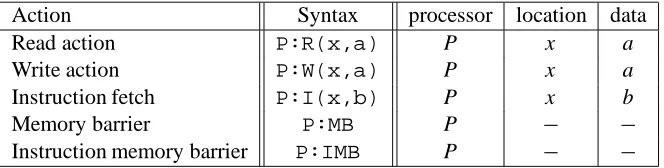
In the Alpha architecture the relevant actions for the interaction between the pro-cessors and the memory are read and write actions, instruction fetches, and memory and instruction barriers. The table given in Figure 1 lists the syntax of the actions and introduces some useful selector functions.
Action Syntax processor location data
Read action P:R(x,a) P x a
Write action P:W(x,a) P x a
Instruction fetch P:I(x,b) P x b
Memory barrier P:MB P − −
[image:9.612.126.458.135.219.2]Instruction memory barrier P:IMB P − −
Figure 1: Table of memory actions and selector functions processor, location and data
Action name Syntax Memory Request Response
Read action P:R(x,a) P:R?x P:R(x,a)
Write action P:W(x,a) P:W(x,a) −
Instruction fetch P:I(x,b) P:I?x P:I(x,b)
Memory barrier P:MB P:MB −
Instruction memory barrier P:IMB P:IMB −
Figure 2: Table of actions and their split into requests and responses
Let P be a processor, x be a location, and a be some data element. A memory request is one of the following:
- a write request, represented by the actionP:W(x,a);
- a read request, represented by the actionP:R?x;
- a memory barrier request, represented by the actionP:MB;
- an instruction fetch request, represented by the actionP:I?x;
- or an instruction memory barrier request, represented by the actionP:IMB.
By REQ we denote the set of memory requests.
The memory replies to a read memory request by a read response message. A read response message is represented byP:R(x,a). The memory replies to an instruction fetch memory request by an instruction fetch response message. An in-struction fetch response message is represented byP:I(x,a). By RFR we denote the set of read response and instruction fetch response messages.
cv
- D csPn
-csP1
-.. .
Pn
P1
crPn
-crP1
-ms ct- mm cv
Alpha AXP Architecture
[image:10.612.138.469.166.297.2]Processors Memory
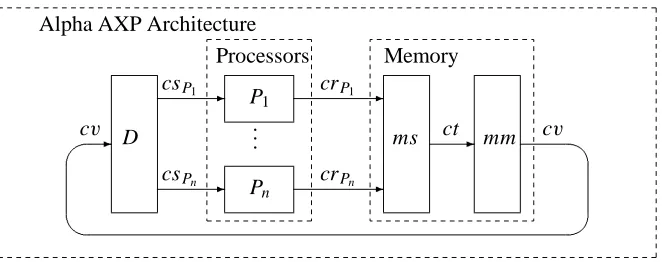
Figure 3: Data flow graph of the Alpha architecture
The decomposition of actions into requests and responses has a number of ad-vantages. This way we are able to distinguish between the issue order of memory requests, determined by the processors, the access order of memory requests, deter-mined by the memory, and the reception order of the responses by the processors. This allows us to model the scheduling discipline of memory access more explicitly and modularize the model more effectively.
2.3
The Model of the Architecture
We model the Alpha architecture by a data flow model as given in Figure 3. In the data flow model the processors and the memory are independent units that commu-nicate asynchronously via message exchange. The processors are connected to the memory by channels. The channels are denoted by cv, csP, crP , and ct where P
is a processor.
Each processor sends a stream of memory requests to the memory and receives a stream of read response messages from the memory. In a computation of the Al-pha architecture the behavior of each processor P ∈ PRC is modeled by a stream
processing function
fP : RFRω→REQω
In a computation a stream is associated with each of the channels cv, csP, crP,
and ct . These streams will be denoted bycEv,csE P,crEP , andct respectively.E
The memory receives the streams of memory requests from the processors and sends back in response a stream of read response messages. Mathematically the memory is modeled by a stream processing function
md :(PRC →REQω)→RFRω
Since each response message is labeled by the identifier of the processor that has requested it, the stream of read response messages produced by the memory can easily be split into individual streams of responses for each of the processors.
The Alpha architecture is modeled as follows: for every processor P we repre-sent the history of messages exchanged between the processor and the memory by the input streamcsEP ∈RFRωand the output streamcrEP ∈REQωof the processor.
Of course, the streamcrE P is the result of the processor function fP applied to the
streamcsEP of memory responses. This is expressed mathematically as:
E
crP = fP(csEP)
Bycr we denote the mapping that associates with each processor its request streamE
produced by the processors in PRC . Bycs we denote the mapping that associatesE
with each processor its response stream produced by memory for the processor in
PRC . Formallycr is a mapping that associates a stream of memory requests withE
every processor:
E
cr : PRC →REQω
andcs is a mapping that associates the input stream of memory request responsesE
with every processor:
E
cs : PRC →RFRω
We specify the history of messages between the memory and the processors by a streamcEv∈RFRωthat represents the stream of all read request responses produced by the memory. We do not assume any responses for write or barrier requests.
By the split component called D in the data flow graph given in Figure 3 we obtain the input streamscsEP for each of the processors fromcEv.
the functions associated with each of the components. In the case of the scheduler, the choice of the function representing the behavior of the scheduler is constrained by specific properties of the streams that form the fixpoints. This modelling tech-nique, where there is a dependency between the selected behavior function and its actual input stream, is called “input choice specification” and is described in detail in [Broy 93].
Causality is a decisive notion in information processing and message passing systems. It imposes a “physical law” on the flow of information. Roughly speaking, we understand by the phrase “action a is causal for action b” that b cannot take place before a has happened. In distributed systems that consist of a set of components that exchange messages via channels between the components, we distinguish two forms of causality:
• component causality: a component cannot issue an output message before it
has received the input required for computing the content of the output mes-sages. This form of causality between input and output for a component is captured in the functional model by the monotonicity constraint.
• information exchange causality: a message is not received before it has been
sent. This is captured in the functional model by the least fixpoint principle for the recursive stream equations for the channels.
These two forms of causality are an integral part of the functional system model. They are the basis for ruling out “causal loops”.
3
The Memory Architecture
We formalize the requirements for the behavior of the memory by characterizing the relation between its input streams and its output stream. The requirements for the memory fall into the following two categories:
• Proper memory access scheduling: the memory requests of the individual
processors are rescheduled and merged; the scheduling is restricted with re-spect to memory barriers and memory instruction barriers as well as read and write requests for the same location.
• Read/write consistency: in response to read requests, those data elements are
Both requirements are described in [AARM 92] in a semiformal way that does not provide explicit answers to a number of critical questions. For instance, it is not clear whether so-called causal loops are implicitly excluded. Certainly they are not explicitly excluded in [AARM 92]. We shall come back to the issue of causal loops after we have introduced the mathematical model.
To keep the model simple and to achieve a good separation of concerns, we de-compose the function md modeling the behavior of the memory into two prefix con-tinuous stream processing functions, the memory scheduler
ms :(PRC →REQω)→REQω
which takes care of the proper memory access scheduling and determines the access stream and thus the access order, and the memory manager
mm : REQω→RFRω
which models read/write consistency (see Figure 3). The function md then is simply obtained by composing ms and mm. Mathematically we specify the result stream of the function md for all the streams of memory requests r : PRC →REQωby the following equation:
md(r)=mm(ms(r))
Precise specifications of the functions ms and mm are given in the following sec-tion.
As shown in the data flow diagram given in Figure 3, we specify the history of messages between the memory scheduler and the memory service by an access stream
E
ct ∈REQω
and the history of messages between the memory service and the processors by a stream of read and instruction fetch response messages
E
cv∈RFRω
The streamct denotes sequence of scheduled requests for the memory and deter-E
mines the outcome of the function ms. Mathematically, this is expressed by the following equation:
E
ct =ms(crE )
The streamct denotes the access order of the memory requests.E
The streamcEvdenotes the outcome of the function mm. Mathematically, this is expressed by the equation:
E
1st↓\2nd→ P:I?x P:R?x P:W(x,b) P:MB P:IMB
P:I?x < < < <
P:R?x < < < <
P:W(x,a) < < < <
P:MB < < < <
[image:14.612.145.465.146.230.2]P:IMB < < < < <
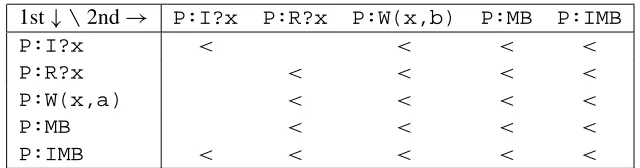
Figure 4: Table of relations between requests in the issue order and the access order
¿From the streamcEvthe input streamscsEP ∈ RFRωof memory responses for the
individual processors P ∈PRC can easily be computed.
3.1
Scheduling the Memory Requests
We give the specification for the function ms by the relation between the streams
E
crP andct . The function ms merges and reschedules its input streams. This mergeE
and rearrangement follows the rules described in [AARM 92]. In this section we formalize these rules.
The table given by Figure 4 is taken from [AARM 92]. It shows the reordering restrictions that are imposed by the issue streamscrEP onto the access streamct .E
The table expresses the following requirement in terms of the mathematical model: for every pair of memory requests c1,c2for process P for which we have c1 <c2 in the table in Figure 4, their relative order in the issue streamcrE P and in access
streamct coincide. Mathematically we writeE
c1<c2⇒[c1 <c2] in [crE P,ct ]E
Here (for arbitrary streams r,t ) the proposition
[c1 <c2] in [r,t ]
stands for the following two conditions: condition (1) expresses that all requests c1 and c2in r are eventually scheduled in t , and only requests that have been issued are scheduled. Its formalization is rather straightforward. Every memory request c in each of the issue streams r also appears in the access stream t . Since all requests are labeled by the processors, all elements in issue streams of different processors are distinct. Mathematically expressed condition (1) reads as follows (for the definition of the filter function “x|M” see the appendix B):
Condition (2) expresses that the requests c1 compared to the requests c2may not come later in the stream t than in stream r . In other words, the scheduler may not move the requests c2to the left over the requests c1to obtain the substream of the requests c1and c2in t from that in r . Mathematically expressed, condition (2) reads as follows:
∀k ∈ IN : hk(r)|{c1} vhk(t)|{c1}
where
hk(s)=(s|{c1,c2})[1 : k]
Here we use the following notation. For a stream s we denote by s[1 : k] the first k elements of the stream. If a stream s has less than k elements then s[1 : k]=s.
The relationship between the issue streams and the access stream as formalized above has the following consequence: for every set M of requests of the processor
P that are all pairwise in the<-relation, the substreams of the requests in M in the issue streams and the access stream are identical. Mathematically expressed:
(∀c,d ∈M : c<d∨d <c)⇒ EcrP|M = Ect|M
This can be shown for finite streamscrE P andct by induction on the length of theE
streamct . For infinite streams it follows by the continuity of the function that filtersE
out a substream.
Based on the notation introduced above, we can now formulate the correctness requirement of the scheduling function. We decompose the requirements for the scheduler into the safety and liveness properties. In a first step we give just the safety property. It is represented by a simple predicate characterizing the set of scheduling functions that are correct with respect to safety. The liveness condition for the function ms is not a simple predicate on ms, but depends also on the partic-ular request streams in the data flow model. A function
ms :(PRC →REQω)→REQω
is called a safe scheduling function if for all request streams r∈ (PRC →REQω)
for which rP contains only requests issued by processor P we have
∃t∈REQω: ms(r)vt∧
∀c1,c2,P : c1 <c2 ⇒[c1<c2] in [rP,t ]
particular request streams in the data flow model. It will therefore be added as a constraint for the scheduler functions ms with respect to the streamcr in the net-E
work modeling the Alpha architecture in section 5 where we summarize the model.
3.2
Responding to the Scheduled Memory Requests
The behavior of the memory manager is represented by the function mm, which ex-ecutes the memory requests in the order produced by the memory request scheduler
ms. Its specification is rather simple. In response to each read request the memory
manager sends the data element that has been written by the most recently executed write request. According to the rescheduling of requests, the execution order is not necessarily identical to the issue order.
We ignore here the possibility that the memory may be initialized by other means than memory write requests. Explicit initialization can easily be included, however. For our mathematical model, we express read/write consistency by the follow-ing formula: for all streams u, w ∈REQ∗,s ∈REQωwe assume:
(u_w)|RI = hi ∧w|W(x) = hi
⇒
mm(u_Q:W(x,a)_w_P:R?x_s)=P:R(x,a)_mm(u_Q:W(x,a)_w_s)
∧
mm(u_Q:W(x,a)_w_P:I?x_s)=P:I(x,a)_mm(u_Q:W(x,a)_w_s)
where W(x)is the set of all write requests for location x :
W(x)= {P:W(x,a)∈REQ : P∈PRC ∧a∈DATA}
and R I is the set of all the read requests and instruction fetch requests:
R I = {P:R?x: P ∈PRC ∧x ∈ LOC} ∪ {P:I?x: P ∈PRC ∧x ∈LOC}
The streamcEvis the result of applying the memory function mm to the streamct ofE
memory requests.
E
cv=mm(ctE )
The streamcEvof read request and instruction fetch responses produced by the mem-ory manager mm can easily be decomposed into one memmem-ory request response streamcsEP for each processor P. We specify:
E
where the set R(P)of read request responses of the processor P is specified as fol-lows:
R(P)= {e∈RFR : pr ocessor(e)= P}
Of course, there are other ways to decompose the memory function md. For in-stance, we may introduce a merge function that interleaves all streams of read re-quests produced by the processors in a stream of read rere-quests. Using this merge function we can then either introduce for each processor an individual memory scheduler that reschedules all memory requests before they are merged, or merge all streams of read requests produced by the processors in a stream of read requests and then do the memory scheduling by rescheduling this stream.
4
The Processors
The behavior of a processor is modeled by a prefix continuous stream processing function. In this section we show only schematically how we model the instruction cycle of an Alpha processor by such a function.
A processor has a local state that consists of all the entries in its registers and maybe additional information. The set of states of a processor is denoted by PRC-State. Initially, a processor starts from an initial state by issuing a finite sequence of memory requests.
Whenever a processor receives a memory request response, it changes its local state and issues a finite (possibly empty) sequence of memory requests. For formal-izing this behavior of a processor, we introduce the following two functions:
mr : PRCState ×RFR →REQ∗ sc : PRCState ×RFR →PRCState
The function mr yields the sequence of memory requests issued by the processor in a state when receiving a memory response. The function sc yields the successor state of the processor. The behavior of the processor P is defined by the function
fP. We specify this function by the following equation:
fP(s)=init_ex ec(σP,s)
whereσP is the initial state of the processor P , init is the initial sequence of
mem-ory requests, and ex ec is the function
specified by
ex ec(σ,c_s)=mr(σ,c)_ex ec(sc(σ,c),s)
Of course, a processor P issues only memory requests labeled by P .
We do not give a more detailed description of the individual instructions and their execution here. We come back to this issue in section 6.
5
Summary of the Model
In this section we summarize the functional model of the Alpha architecture as a reminder for the readers.
As indicated in Figure 3, we assume that the streamscrE P ,csEP andct are theE
least fixpoints of the following equations:
E
crP = fP(csEP) for all processors P ∈PRC
E
csP = Ecv|R(P) for all processors P ∈PRC
E
cv = mm(ms(crE ))
where for all processors P∈PRC the function fP and also the functions mm and
ms are stream processing functions. This means in particular that they are prefix
continuous. The function fP is assumed to be a processor behavior. The function
ms is required to be a safe scheduling function. The function mm fulfills the
fol-lowing requirement: for all streams u, w∈REQ∗,s ∈REQω:
u_w|RI = hi ∧w|W(x) = hi
⇒
mm(u_Q:W(x,a)_w_P:R?x_s)=P:R(x,a)_mm(u_Q:W(x,a)_w_s)
∧
mm(u_Q:W(x,a)_w_P:I?x_s)=P:I(x,a)_mm(u_Q:R(x,a)_w_s)
For the function ms we require the following liveness condition: every request c is eventually scheduled, mathematically expressed:
E
crP|{c}=ms(crEP)|{c}
This is a liveness condition that restricts the choice of the scheduling function ms in addition to the safety properties required for ms making sure that all requests are eventually scheduled.
6
The Model at Work
In this section we start with a short analysis of the functional model and then show how it can be used to formalize further properties of the processors and their exe-cution of instruction streams.
6.1
Mathematics of the Model
The model given in the previous sections is based on the following mathematical concepts:
• prefix continuous stream processing functions,
• recursive stream equations and least fixpoint interpretations for them,
• liveness constraints for the scheduling function.
These concepts are well suited as a mathematical basis for data flow models. Hard-ware systems can also be understood as data flow systems. A large number of ex-amples have demonstrated that the concepts work well for both.
The purpose and benefits of mathematical or formal models for information processing systems are manifold:
• Mathematical system models provide a consistent and precise description of the properties of a system, but nevertheless give freedom by leaving certain aspects deliberately unspecified; we speak of underspecification.
• In the process of deriving mathematical system models from informal de-scriptions, flaws, inaccuracies and omissions can be detected and clarified.
• Mathematical system models provide a reference basis for understanding and discussion.
• Mathematical system models provide a basis for a formal reasoning about a system, by which specific properties can be derived (and therefore verified).
• Mathematical system models provide a precise requirement specification for implementations by hardware or software systems.
Definition 1 (Feasible Response Streams) A response stream s ∈RFRωis called
feasible for a processor with behavior fP, if all the instances of responses in s are
triggered by requests in the request streams fP(s). A response stream s is triggered
by the request stream fP(s), if every prefixs of the stream s contains for every in-˜
stance of a read request and every instance of an instruction fetch request in fP(s˜)
at most one corresponding response. Mathematically expressed, a stream s is a fea-sible response stream for the behavior fPof processor P, if for all its prefixess˜vs
the following two conditions are fulfilled:
#s˜|{P:R?x} ≤# fP(s˜)|R(x)
and
#s˜|{P:I?x} ≤# fP(s˜)|I(x)
where
R(x)= {P:R(x,a): a ∈DATA}
I(x)= {P:I(x,a): a∈DATA}
We then write:
fP ,→P s
If the inequalities above are strengthened to equalities fors˜ =s, then the stream s
is called a complete and feasible response stream for the processor behavior fP.
2
It is a straightforward exercise to show that in our model for the Alpha architec-ture according to the definition of the memory device for every processor P , every streamcsEP is a feasible response stream for fP.
6.2
Causal Loops
In this subsection we study the problem of causal loops. It is widely accepted that there is a natural causality flow in information processing systems. More techni-cally speaking, a particular message value cannot be sent by an interactive message passing system before all values on which it depends have been received.
To make our discussion more concrete, let us look at a simple example. We as-sume that the processors P and Q execute the following two little programs. We use some pidgin assembler language here which has the two commands L D (for load) and S T (for store) only and works with the local registers of the processors. The registers are denoted by R1,R2,etc. Consider for the processor P the following program
L D R1 x S T R1 y
and for the processor Q the following program
L D R2 y S T R2 x
Let us assume that initially the value 0 is stored both in location x and in location
y.
Of course, we may expect that, independent of the scheduling, the effect of ex-ecuting these programs is that both the locations x and y invariantly have the value 0. Now let us consider the following access stream
P:R?x Q:R?y P:W(y,1) Q:W(x,2)
and the corresponding response stream:
P:R(x,2) Q:R(y,1)
This sequence of actions is certainly read/write consistent (only values are read that have been written before). It also fulfills all the requirements of memory access scheduling. So one may argue that it is a feasible access stream according to what is required in [AARM 92] for the memory. However, if we consider in addition the processor functions fP and fQ, we realize that this access order violates the
causality requirements of the processors. For the processor P the write request can be issued only after the response to the read request has been received.
6.3
Sequential Execution of Processors
We do not want go into the definition of all the details of the execution of particular instructions in the Alpha AXP architecture. We therefore introduce as a reference for the behavior of the processors the behavior of a processor with a conservative sequential execution strategy. Such a behavior is obtained, if the processor sequen-tially executes the classical instruction cycle. This cycle first fetches the instruction indicated by the program counter, then computes the operand address and reads the operand from the memory or writes a value into the memory or issues a barrier re-quest and then starts the cycle again.
This sequential execution strategy corresponds in our model to a particular stream processing function for the processors P∈PRC which we denote by
fPseq : RFRω →REQω
This function will be used as a point of reference for formalizing the correctness of the behaviors of processors with a nonsequential execution strategy in the follow-ing.
6.4
Speeding Up Executions
In a most conservative implementation every processor issues just one memory re-quest, then waits until it gets the response to this rere-quest, and only then issues the next request. This is the behavior represented by the function fPseq.
In contrast to this conservative sequential behavior, a more aggressive processor may send several memory requests before it receives some of the responses from the memory. This can lead to a speed-up in the interaction between the memory and the processor. We call such behavior, where several requests can be issued before a response is received, issuing lookahead requests.
We distinguish between the following strategies of processors in issuing looka-head requests.
If a processor issues only memory requests whose responses are certainly needed for the execution, we speak of issuing conservative lookahead requests. In this case, any missing response from the memory will eventually bring the processor to a waiting state.
A lookahead request processor may even issue memory read requests or instruc-tion fetch requests whose responses it might not need. We call this strategy issuing
speculative lookahead requests. It may lead to a considerable speed-up in accesses
be unnecessary. Clearly speculative write requests are not a safe concept and not considered therefore.
A further optimization can be obtained in cases where it can be recognized in advance that responses to certain read and instruction fetch requests that appear in the strictly sequential behavior are irrelevant for the further course of computation. Such requests need not even be issued. We call this shortcut optimization. One may argue that in a well–written program such irrelevant requests should not occur. However, even when doing multiplication of two values read from the memory, one of the values may turn out to be not relevant, if the other one is zero.
Shortcut optimization leads to a more radical change in the behavior of pro-cessors than lookahead optimizations. Responses to read and instruction fetch re-quests are generally needed by a processor to get the information (instructions and operands) required to continue its execution. Moreover, the arrival of responses is used to trigger further requests. This is most obvious in the conservative sequential behavior. The processor issues a request only when the response to the request is-sued previously has been received. So there is a causal relation between responses and the following requests. In lookahead optimizations, read and instruction fetch requests are issued earlier and more of them may be issued, but at least all the quests that appear in the nonoptimized behavior are eventually issued. Write quests and barrier requests are issued before the corresponding responses are re-ceived only as long as there are no actual data dependencies. In shortcut optimiza-tions fewer requests may be issued by avoiding ones whose responses would be irrelevant. This may change the causality flow of a processor more radically.
It is one of the basic ideas of the Alpha AXP architecture that processors may issue lookahead memory requests, in order to speed up the general execution by parallelizing the memory accesses. In the following section we give a definition of the properties required for a processor to make sure that the replacement of a sequential processor by a processor with lookahead and shortcut optimizations does not change the effects of the executed programs as long as the program runs without any access to shared memory.
6.5
Optimizations of Processor Behavior
For instance, if a value of a location is requested from the memory and later the transmitted value is multiplied by 0, its value is certainly not relevant. Of course, in practice it is very difficult to determine whether a response is relevant, since ir-relevant responses may even trigger further read requests that lead to responses that turn out to be irrelevant, too. Optimized processors nevertheless may make use of the fact that a response is irrelevant. In this case a response might even not be re-quested.
Request streams have two effects on the memory: write requests change the state of the memory locations and therefore can be effectively observed by other processors, read and instruction fetch requests trigger responses by the memory and this way allow the processor to observe the current state of locations. Memory and instruction barrier requests restrict the memory access order. So it is not important for the effect of a request stream on the memory, how many barrier requests are created, but only how they restrict the access order. This leads us to the following definition.
Definition 2 (Feasible Schedulings of Memory Request Streams) For a request
stream r1 ∈ REQω of processor P ∈ PRC we call a request stream r2 ∈
(REQ “{P:MB,P:IMB})ω a feasible scheduling for the stream r1, if there exists a stream r0∈REQωsuch that for all requests c1,c2∈REQ we have:
c1<c2⇒[c1<c2] in [r1,r0]
and
r2=r0|M where M =REQ “{P:MB,P:IMB}
2
For the correctness of optimizations it is decisive to identify under which conditions two request streams have the same effects for the memory such that they lead to the same set of possible observations by the processors. We may change the behavior of a processor such that it issues a different request stream as long as this is ob-servably equivalent to the previous request stream. Along these lines we define the effective equivalence of request streams. The memory barrier and the instruction fetch barrier requests restrict only the rescheduling of the memory requests. Two request streams of a processor P are considered to be effectively equivalent, if they lead to the same effects and therefore can be called observation equivalent.
Definition 3 (Effective Equivalence of Memory Request Streams) Two
request streams r1,r2 ∈ REQωare called effectively equivalent for processor P , if their sets of feasible schedulings coincide. We write then r1
e
∼r2.
2
To have a basis to speak about the substreams of relevant and irrelevant responses, we use the concept of the decomposition of streams.
Definition 4 (Decomposition of Streams) For an arbitrary stream s ∈ Mω two streams s1and s2are called a decomposition of s, if the stream s can be split into the substreams s1and s2. Mathematically expressed, if there exists an oracleβ ∈
{1,2}∞such that for i ∈ {1,2}
si =disi(s, β)
where the functions disi : Mω× {1,2}ω→Mωare specified by
disi(m_s,i_β)=m_disi(s, β)
and
i6= j ⇒disi(m_s, j_β)=disi(s, β)
2
Based on this definition we can now define when for a processor a behavior is a lookahead optimization and when it is a shortcut optimization of another behavior.
Definition 5 (Lookahead Optimization) We consider the two behavior functions
f1, f2: RFRω→REQω
for the processor P . The behavior f2 is called a lookahead optimization of f1, if, for every response stream s2 ∈ RFRω that is feasible for f2, the following condi-tion holds: there is a decomposicondi-tion of s2into a response stream s1∈RFRωand a response stream u1such that s1is a feasible response stream for f1and the request streams f1(s1)and f2(s2)are effectively equivalent.
2
Note that by the definition above, the processor with behavior f2is a refinement of the processor with behavior f1 since every behavior that f2 shows is an optimized behavior of a behavior of f1.
Definition 6 (Shortcut Refinement of Issue Streams) We define a relation
e
;: REQ
ω×REQω
that defines the allowed shortcut optimizations. We give axiomatic rules:
(∀c1,c2: c1 <c2⇒[c1<c2] in [r1,r2])⇒r1
e
;r2 r1
e
;r2∧r2
e
;r3 →r1
e
;r3 r1_MB_MB_r2
e
;r
_
1 MB_r2
r1_P:W(x,a)_P:W(x,b)_r2
e
;r
_
1 P:W(x,b)_r2
r1_P:R?x_r2
e
;r
_
1 r2
2
This definition essentially expresses that in a shortcut optimization we may leave out superfluous write requests, read requests and memory barriers. Of course, a read request may not be left out if the requested value is needed by the processor.
Definition 7 (Shortcut Optimization) Let us consider the two behavior functions
f1, f2: RFRω→REQω
for the processor P. The behavior f2is called a shortcut optimization of f1, if, for every response stream s2 ∈ RFRω that is feasible for f2, the following condition holds: there exists a response stream s1that is feasible for f1 such that f1(s1)
e
; f(s2).
2
The definition essentially says that in a lookahead optimization, for every response stream feasible for f2 we can find a response stream for f1such that the response streams coincide after we get rid of some irrelevant responses for f2and the remain-ing requests are effectively equivalent.
A shortcut optimization can lead to a processor behavior with a quite differ-ent processor causality. This allows sophisticated optimizations where certain re-quests and the corresponding responses are recognized as unnecessary and therefore avoided even though they are relevant in the control flow of f1, since there they trig-ger further relevant requests.
than the number of received responses. Mathematically, for a processor P with the behavior function fPseq the following property holds:
˜
s v EcsP ⇒ ˜s= EcsP∨1+#s˜=# f seq P (s˜)|RI
where R I is the set of read and instruction fetch requests. To get a less restricted behavior, we allow that certain requests are issued earlier. We extend the notion of processor correctness by shortcut and lookahead optimization. Based on the con-cept of sequential behavior and optimization, we can now define a notion of cor-rectness of processor functions.
Definition 8 (Correct Processor Function) A processor P with processor
func-tion
fP : RFRω→REQω
is called correct, if it is a shortcut optimization of a lookahead optimization of fPseq.
2
Based on this definition, it is possible to prove that the observable behavior of the Alpha AXP architecture does not depend on the particular choice of the processor functions as long as all of the functions are correct.
Theorem 1 (Scheduling Robustness) When all processors P ∈PRC execute the
sequential behavior represented by fPseq, the access stream is effectively equivalent to the access stream obtained, as long as all processor functions are correct,
- the processors do not share any memory, and instruction fetch locations and
- write locations are disjoint
Sketch of Proof: Since every processor function is correct, we can assume a
re-sponse stream sP and a request stream rP corresponding to a lookahead
optimiza-tion for the response stream sseqP and the request stream rPseqthat we obtain for the sequential behavior such that the following holds: we can decompose the response stream sP and the request stream rP on one hand into substreams of the response
streamcsEP and the request streamcrE P that we obtain for the considered
behav-ior. On the other hand, we can decompose the response stream sP and the request
stream rP into substreams of the response stream sseqP and the request stream rseqP
The theorem shows that, although different scheduling strategies can be used as well as different strategies for read and instruction fetch lookahead, as long as shared memory is not used and no writes occur to locations that occur in instruction fetch requests, the produced sequences of memory states for each of the processors coin-cide.
6.6
Assumptions about Executions
We have given only a very schematic description of the behavior of the processors, so far. In this section, we introduce a fundamental assumption about the behavior of processors. In a first definition, we introduce the notion of the equivalence of response streams.
Definition 9 (Equivalence of Response Streams) Two memory response streams
s1,s2∈RFR are called equivalent and we write:
s1∼s2
if read response messages and instruction fetch response messages for the same cations are identical and in the same order: mathematically expressed, if for all lo-cations x , the following proposition holds:
s1|L(x) =s2|L(x)
where
L(x)= {P:R(x,a) : a∈DATA} ∪ {P:I(x,a): a ∈DATA}
2
Based on the notion of equivalence of response streams, we next define what it means that a processor is robust against reorderings of its response stream.
Definition 10 (Response Delay Robustness) For a processor P , a processor
func-tion
fP : RFRω→REQω
is called response delay robust if, for all short cut optimizations g of fP and all
response streams s1and s2that are feasible for fP and for which s1∼s2holds, we have:
g(s1)
e
This leads to the following basic assumption about the behavior of processors:
• Assumption: Response Delay Robustness: for every processor P, its
behav-ior function fP is response delay robust.
Response delay robustness makes sure that the behavior of a processor does not critically depend on the order in which its memory requests are executed, as long as the scheduling constraints are fulfilled.
Let us next briefly analyze how significant the requirement is that the streams
E
csP,crEP,ctE,cEvare least fixpoints. To answer this question, we also ask whether
there exist solutions to the recursive equations for these streams that are not least fixpoints.
To be able to answer this question we need a further assumption, however. We did not say anything about the behavior of a processor in the case where it gets a re-sponse for which it did not send a request. We may assume, however, that a proces-sor that has terminated its execution and comes to a halt does not issue any further requests even when it receives further (unrequested) responses.
Definition 11 (Response Satisfaction Property) A processor P with the behavior
function fP fulfills the response satisfaction property if, for all response streams
s∈RFR , the following proposition is fulfilled:
fP ,→P s ∧s complete for fP ∧s v ˜s ⇒ fP(s)= fP(s˜)
This proposition expresses that the processor P with behavior fPdoes not issue
fur-ther memory requests after all its requests have been satisfied even if it gets furfur-ther memory responses that it has not requested.
2
By assuming the response satisfaction property for all processors, we can prove that all fixpoints of the recursive equations are unique.
Theorem 2 (Uniqueness of Fixpoints) Let us assume the response satisfaction
property for all processors. If the streamscsE P,crEP,ctE,cEvare fixpoints of the
defin-ing equations and fulfill the constraints, then they are least fixpoints.
Proof: Assume the streamscsE P,crEP,ctE,cEv fulfill the equations and constraints
further that the streamss˜P,r˜P,t˜,v˜ also fulfill the equations and constraints for the
same functions fP,ms,md and furthermore:
˜
sP v EcsP ∧ ˜rP v EcrP ∧ ˜tv Ect ∧ ˜v v Ecv
The streamscsEP are feasible responses for the streams fP. Formally expressed,
we have fP ,→P csEP andcsE P is complete for fP. According to the satisfaction
property of the processors from s˜P v EcsP and fP ,→P csEP we may conclude
˜
rP = EcrP. By straightforward equational reasoning we obtain
˜
t= Ect ∧ ˜v = Ecv ∧ ˜sP = EcsP
This shows that every set of streams that fulfills both the equations and the con-straints is a least fixpoint as long as we assume the response satisfaction property for all processors.
2
This theorem is of some importance for proofs about the execution of Alpha pro-grams using the functional model. It indicates that in proofs we do not have to rely on least fixpoint properties, but we may just work with fixpoint properties. Hence we can work with purely equational reasoning.
The theorem does not say that there is only one fixpoint, it says that there is only one fixpoint for each feasible scheduler function ms. Due to the underspeci-fication in the scheduler, there are many different scheduler functions ms that may have different fixpoints.
7
Locking
In order to synchronize programs properly, we need more sophisticated concepts than the ones treated so far. For the Alpha architecture load locked instructions and store conditional instructions are available. So far we have not said anything about locking. In this section, we briefly show how loads with locks and conditional stores can be treated in our model.
7.1
Extension of the Model to Locking
Action name Syntax Memory Request Response
Load locked P:K(x,a) P:K?x P:R(x,a)
Store conditional successfully P:S(x,a) P:S(x,a) P:S(x,L)
Store conditional failed P:S(x,a) P:S(x,a) P:S(x,O)
[image:31.612.127.492.136.205.2]Store conditional failed P:S(x,O) P:S(x,O) P:S(x,O)
Figure 5: Table actions for locking and their split into requests and responses
Conditional stores can be successful or they may fail. A successful conditional store action is represented byP:S(x,a). A failed conditional store action is repre-sented byP:S(x,O). A memory request issued by the processor P for executing a locked read on location x is represented byP:K?x. A memory request issued by the processor P for executing a successful conditional store is represented by P:S(x,a). A memory request issued by the processor P for executing a failed conditional store is represented byP:S(x,O).
It looks strange that a processor can issue a request for a failing store action, but this is used to model the following situation. Let us assume that the instruction stream contains a conditional store instruction. When the processor executes this instruction, the failure of the corresponding conditional store may depend on the situation inside the processor. Then the processor issues an instruction store request that is condemned to failure.
Memory requests issued by the processor P for executing locked read or con-ditional store instructions both require responses. A response to a memory request issued by the processor P for executing a locked read on location x is represented byP:R(x,a). A response to a memory request issued by the processor P for ex-ecuting a conditional store is represented byP:S(x,L), if it was successful. A memory request issued by the processor P for executing a conditional store is rep-resented by the response messageP:S(x,O), if it failed.
The table given in Figure 5 shows these additional actions and their decompo-sition into memory requests and responses to them.
For convenience, when writing the specification, we use an additional artificial request message with syntaxP:K!x. It stands for locked loads in the access stream that have been executed already. The execution of a locked load requestP:K?xin the access stream leads to a read responseP:R(x,a)with the most recent written value a. In the access stream, the markerP:K!xindicates the position in the access stream, in which the lock has been executed. All other locks of processor P get cleared.
In our mathematical model, we express read/write consistency for locked loads by the following formula: for all streams u, w ∈REQ∗,s ∈REQωwe assume:
(u_w)|RI S K = hi ∧w|W(x) = hi ∧w|N O L(P) = ˜w∧u|N O L(P) = ˜u
⇒
mm(u_Q:W(x,a)_w_P:K?x_s)=
P:R(x,a)_mm(u˜_Q:W(x,a)_w˜_P:K!x_s)
where W(x)is the set of all the write requests for location x :
W(x)= {P:W(x,a)∈REQ : P∈PRC ∧a∈DATA}
and N O L(P)is the set of all the requests different from lock markers for processor
P :
N O L(P)=REQ “{P:K!x∈REQ : x ∈LOC}
and R I S K is the set of all requests that require responses, namely the set of all the read requests, instruction fetch requests, store conditional requests, and load locked requests:
R I S K = {P:R?x∈REQ : P ∈PRC ∧x ∈LOC} ∪
{P:I?x∈REQ : P ∈PRC ∧x ∈LOC} ∪
{P:K?x∈REQ : P ∈PRC ∧x ∈LOC} ∪
{P:S(x,a)∈REQ : P ∈PRC ∧x ∈LOC ∧a∈DATA ∪ {O}} This shows that a locked load request is processed like a read request, but after ex-ecution a marker is kept indicating the place in the access stream where the lock occurred.
A conditional store on location y is successful if it is marked as successful by the issuing processor P and if there is an executed lockP:K!xin the access stream and there are no writes to the location x between this lock and the conditional store in the access stream. The success of a conditional store is expressed by the following formula (with a∈DATA ):
(u_w)|RI S K = hi ∧w|W(x) = hi ∧w|K(P) = hi ∧u|N O L(P) = ˜u
⇒
where K(P)is the set of all the lock markers for the process P :
K(P)= {P:K!x∈REQ : x ∈LOC}
and W(x)is the set of all the write requests to location x as specified above. A conditional store to location x fails if there is a write to location x between the last locked load and the execution of the store request.
(u_w)|RI S K = hi ∧w|W(x) 6= hi ∧w|K(P) = hi ∧u|N O L(P) = ˜u
⇒
mm(u_P:K!x_w_P:S(y,a)_s)=P:S(y,O)_mm(u˜_w_s)
A conditional store also fails if there is no lock marker that was issued by the pro-cessor still valid.
u|RI S K = hi ∧u|K(P) = hi
⇒
mm(u_P:S(x,a)_s)=P:S(y,O)_mm(u_s)
The failure of a conditional store request marked as failing is expressed by the fol-lowing formula:
u|RI S K = hi ∧u|N O L(P) = ˜u
⇒
mm(u_P:S(x,O)_s)=P:S(x,O)_mm(u˜_s)
Whether a conditional store request issued by a processor is marked as condemned to failure or as successful if not interfered with by another processor is left unspec-ified. In [AARM 92], page (I) 4-9, this is called unpredictable. In the functional model of a processor, it is part of the specification of the behavior of the proces-sor to describe under which conditions a conditional store request is condemned to failure or as successful. In the mathematical model these conditions can also be left unspecified, and thus unpredictable. However, more sophisticated fairness condi-tions can also be formulated.
7.2
Analysis of a Simple Locking Discipline
In this section we show how a simple mutual exclusion scheme does work with the described memory scheduling discipline.
its critical phase:
tr y again : L D L R1 x
< modify y >
S T C R1 x
B E Q R1 no st or e
...
no st or e : B R tr y again
Our specification allows us to conclude that the store conditional request can be suc-cessful only if it is issued as sucsuc-cessful by the processor, and if in the access stream there is no write to location x between the load locked and the store conditional. The specification of the memory function allows us to prove that according to these facts this simple protocol works.
8
Conclusion
The purpose of this report is to give a mathematical model of the Alpha shared mem-ory system. It provides a consistent description of the Alpha shared system and of the locking rules as given in [AARM 92]. It is, of course, still a simplification, since it does not consider interrupts or exceptions.
It is nevertheless helpful for analyzing some of the properties of the Alpha ar-chitecture and the programs that run on it. It moreover clarifies some issues not treated explicitly in [AARM 92] such as the treatment of causal loops.
This report also shows the usefulness and flexibility of functional system mod-els. It demonstrates that functional system specifications can be used to describe system architectures and properties thereof of considerable complexity.
Acknowledgement: This work was mainly carried out during my stay at DIGITAL
Systems Research Center in April 1993. The excellent working environment and stimulating discussions with the colleagues at SRC, in particular Jim Horning, Yuan Yu, and Jim Saxe are gratefully acknowledged. I thank Jim Horning for his careful reading of a version of the manuscript and his most useful comments.
A
Appendix: A More Liberal Scheduling Concept
memory. Therefore, if two locations x and y that are initially 1 are updated to 2, then it is impossible that one process receives the response stream
R(y,2) R(x,1) R(x,2)
as reaction to its request stream
R?y MB R?x MB R?x
and the other process obtains
R(x,2) R(y,1) R(y,2)
as reaction to its request stream
R?x MB R?y MB R?y
This is excluded by the assumption of consistent updates of a global memory lead-ing to serializability for the access stream.
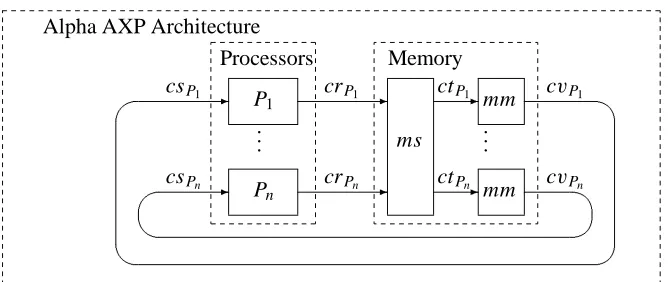
We model a more liberal memory scheduling for the Alpha architecture by a data flow model as given in Figure 6. In this data flow model the memory is dis-tributed. Every processor has its own copy of the memory. The processors are con-nected to their memory by channels. The channels are denoted by csP, crP, and ctP
where P denotes the corresponding processor.
Each processor sends a stream of memory requests to the scheduler and receives a stream of read response messages from its memory. In a computation of the Al-pha architecture, the behavior of each processor P ∈ PRC and the function mm
are modeled as before. In a computation, a stream is associated with each of the channels csP, crP , and ctP. These streams will be denoted bycsE P,crEP , andctEP
respectively.
We formalize the requirements for the behavior of the scheduler component by a function
ms :(PRC →REQω)→(PRC →REQω)
which models the proper memory access scheduling and determines the access streams and thus the access orderings and the memory service
mm : REQω→RFRω
csPn
-csP1
-.. .
Pn
P1
crPn
-crP1
-ms
ctPn
-ctP1
-.. .
mm mm
cvPn
cvP1
Alpha AXP Architecture
[image:36.612.136.471.142.283.2]Processors Memory
Figure 6: Data flow graph of the Alpha architecture
We give the specification for the function ms by the relation between the streams
E
crP andctEP. The function ms merges and reschedules its input streams.
Two streams s1and s2are called consistent and we write
s11s2
if
s1vs2∨s2 vs1
For the function ms we require the following safety conditions:
• for all locations x the access streams are consistent for all processors P and
Q:
ms(r)P|W(x) 1ms(r)Q|W(x)
where
W(x)= {P:W(x,a) ∈REQ : P ∈PRC ∧a ∈DATA}
• for each processor P, the restriction of the access order with respect to the issue order is obeyed in its access stream; for all r ∈ (PRC → REQω)we have
∃t ∈REQω: ms(r)P vt∧
∀c1,c2∈ R(P): c1<c2⇒[c1<c2] in [rP,t ]
where
• for each processor P in its access stream ms(r)P only read requests for P
occur.
For the scheduler we require the following liveness condition: for any pair of mem-ory requests c1,c2of processor P for which we have c1 <c2in the table given in section 3, their relative order in the issue streamcrE P and in access stream ms(crE )
coincide. Expressed mathematically the liveness condition is
c1 <c2⇒[c1 <c2] in [crE P,ms(crE)P ]
This is a liveness condition that restricts the choice of the scheduling function ms in addition to the safety properties required for ms making sure that all requests are eventually scheduled.
B
Appendix: Mathematical Basis
A stream represents a communication history for a channel. A stream of messages over a given message set M is a finite or infinite sequence of messages. We define
Mω=d f M∗∪M∞
We briefly repeat the concepts from the theory of streams that are used in the spec-ifications. More comprehensive explanations can be found in [Broy 90].
• By x_y we denote the result of concatenating two streams x and y. We
as-sume that x_y =x , if x is infinite.
• Byhiwe denote the empty stream.
• By f t(x)we denote the first element in a stream; if the stream x is empty, it is undefined.
• By r t(x)we denote the stream obtained from x by dropping its first element; if the stream x is empty, the resulting stream is empty.
• If a stream x is a prefix of a stream y, we write xv y. The relationvis called
prefix order. It is formally specified by
The behavior of deterministic interactive systems with n input channels and m out-put channels is modeled by(n,m)-ary stream processing functions
f :(Mω)n →(Mω)m
We use some notions from domain and fixpoint theory that are briefly listed:
• A stream processing function is called prefix monotonic, if for all tuples of streams x,y ∈(Mω)nwe have
x vy ⇒ f(x)v f(y)
• BytS we denote a least upper bound of a set S, if it exists.
• A set S is called directed, if for any pair of elements x and y in S there exists an upper bound in S.
• A stream processing function f is called prefix continuous if f is prefix monotonic and for every directed set S ⊆Mωwe have:
f(tS)= t{f(x): x ∈S}
• A partially ordered set is called complete if every directed set has a least upper bound.
The set of streams and the set of tuples of streams are complete. Note that every directed set of streams has a least upper bound.
In specifications we use the filter function in infix notation. Let S be an arbitrary subset of the set M and x∈ Mωbe a stream over M. We specify:
(m_x)|S=x|M0⇐ ¬(m∈S)
(m_x)|S =m_(x|M0)⇐m∈ S
hi|M0= hi
Furthermore we use the function
# : Mω→ IN∪ {∞}
that yields the length of a stream. It is specified by (for m ∈M):
#(m_x)=1+#x
We model the behavior of interactive components by sets of continuous (and there-fore by definition also monotonic) stream processing functions. Monotonicity mod-els causality between input and output. Continuity modmod-els the fact that for every behavior the systems reaction to infinite input can be predicted from the reactions of the component to all finite prefixes of this input1. Monotonicity reflects the fact that in an interactive system previous output cannot be changed when further in-put arrives. The empty stream represents the information “further communication unspecified”.
A specification describes a set of stream processing functions that represent the behaviors of the specified systems. If this set is empty, the specification is called
inconsistent. If the set contains exactly one element, then the specification is called determined. If this set has more then one element, then the specification is called un-derdetermined and we also speak of underspecification. An unun-derdetermined
spec-ification can also be used to describe hardware or software units that are
nondeter-ministic. An executable system description is called nondeterministic, if it is
un-derdetermined. Then the underspecification in the description of the behaviors of a nondeterministic system allows nondeterministic choices carried out during the execution of the system. In the functional modeling of interactive systems there is no difference in principle between underspecification and the operational notion of nondeterminism. In particular, it does not make any difference in such a framework whether these nondeterministic choices are taken before the execution starts or step by step during the execution.
1This does not exclude the specification of more elaborate liveness properties including fairness.
References
[AARM 92] R.L. Sites (ed.): Alpha Architecture Reference Manual. DIGITAL Press 1992
[Attiya, Friedmann 94] H. Attiya, R. Friedmann: Programming Alpha Based Multiprocessors the Easy Way. Unpublished Manuscript.
[Broy 90] M. Broy: Functional Specification of Time Sensitive Communicating Systems. REX Workshop. In: J. W. de Bakker, W.-P. de Roever, G. Rozenberg (eds.): Step-wise Refinement of Distributed Systems. Lecture Notes in Computer Science 430, Springer 1990, 153-179
[Broy 93] M. Broy: Functional Specification of Time-Sensitive Communicating Systems. In: ACM Transactions on Software Engineering and Methodology 2:1, 1993, 1-46