STUDY OF WIND POWER SHORT-TERM PREDICTION OF
WIND FARM BASED ON NWP AND FUZZY NEURAL
NETWORK
1GU BO, 2AN CHAO, 1LIU XINYU
1
North China Institute of Water Conservancy and Hydroelectric Power, Institute of Electric Power,
Zhengzhou 450011, China
2 Yellow River Engineering Consulting Co., Ltd, Zhengzhou 450003, China
E-mail: [email protected]
,
2[email protected]ABSTRACT
Wind power prediction of wind farm plays a decisive role in stable electric power system operation. Firstly to introduce fuzzy neural network’s basic principle; secondly to use 60 days numerical weather prediction (NWP) data and power data, from Jun.08 to Aug.08, as the training data of fuzzy neural network to train the fuzzy neural network; finally to use the next 2 days NWP data, from Aug.09 to Aug.10 as input data of fuzzy neural network, to predict the next 2 days output power of wind farm. The training process and prediction result show that fuzzy neural network has fuzzy decision and judgment, and has good self-learning and adaptive ability, which improves the stability of prediction system and prediction accuracy.
Keywords: Wind Power Prediction Of Wind Farm; Numerical Weather Prediction (NWP); Fuzzy Neural Network; Prediction Error
1. INTRODUCTION
Energy is the material foundation to support the progress of human civilization, also is an integral part of the basic conditions for the development of modern society. In China to realize modernization and common prosperity of all the people, the energy is always an important strategic issue. Vigorously developing new and renewable energy is a key strategic measure for promoting the multiple and clean development of energy, and fostering emerging industries of strategic importance. It is also an urgent need in the protection of the environment, response to climate change and achievement of sustainable development. At the end of "Twelfth Five-Year Plan ", non fossil energy consumption accounts for the proportion of primary energy consumption will reach 11.4%; non-fossil energy power installed a proportion to achieve 30% [1].
Wind power is the most potential energy of renewable energy in the world, has been widely developed and utilized. However, due to the randomness of the wind speed, the wind power has great volatility and uncertainty; this Influences the stable operation of the power system, which limits the power system to absorb the wind power. The
single prediction algorithm, but the calculation time is longer than the single prediction algorithm.
This paper first introduces the fuzzy neural network’s basic principle; Secondly, using 60 days numerical weather prediction (NWP) data and power data, from Jun.08 to Aug.08, as the training data of fuzzy neural network to train it; finally to use 2 days NWP data, from Aug.09 to Aug.10 as input data of fuzzy neural network, to predict the
next 2 days output power of wind farm. The training process and the prediction results show that, the fuzzy neural network has fuzzy decision and judgment, and has good self-learning and adaptive ability, it overcomes the disadvantages of fuzzy logic about strong subjective factors, it also overcomes the disadvantages of neural network which is easy to fall into local minimum and slow convergence speed, improves the stability and the prediction accuracy of the prediction system.
0 500 1000 1500 2000 2500 3000 3500 4000 4500
-2 0 2 4 6 8 10 12x 10
4
sample size
P
o
w
e
r/
(M
W
)
Real power
[image:2.612.114.496.220.398.2]fuzzy neural network output power
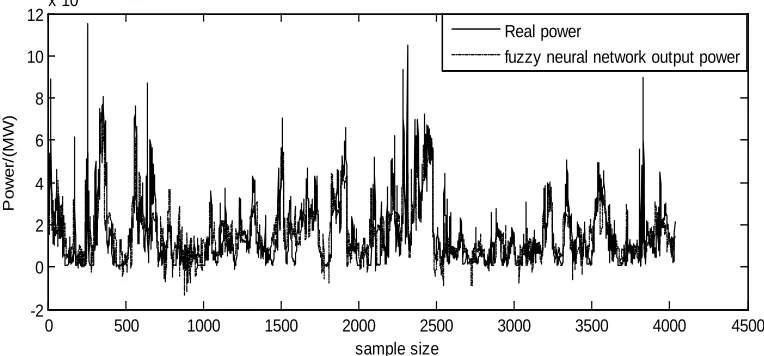
Figure 5: Real Power And Prediction Power
2. DATA ANALYSIS AND FUZZY SUBSET
NWP data for the wind farm, which mainly includes wind speed, wind direction, temperature, humidity and pressure of the 5 data. Wind turbine during operation, have the function to aim at the wind direction automatically, so the wind direction on the influence of wind power output cannot be considered in. For temperature, humidity and pressure the 3 NWP data, humidity on the influence of wind power output is more significant, and the changes in temperature and pressure can be reflected through the humidity. So this paper only considers the humidity information, then the wind speed fuzzy subset and humidity fuzzy subset can be got.
(1) Wind speed fuzzy subset
Wind speed and wind power have 3 power relations, the change of wind speed in wind power change plays a decisive role. Therefore, in the wind power fuzzy subset division, you should as far as possible divide the scope of the fuzzy subset into smaller. Commonly the wind speed range of wind turbine operation is between 3-20m /s, the wind speed change for every 2m /s is divided into a subset; 9 wind fuzzy subsets can be obtained.
(2) Humidity fuzzy subset
In china, all the year round the humidity change range is 10%-100%, every 10% humidity change is divided into a fuzzy subset, and 9 humidity fuzzy subsets can be got.
3. THE ESTABLISHMENT OF FUZZY
NEURAL NETWORK MODEL
3.1 The Structure of Fuzzy Neural Network Fuzzy neural network has five layers, namely input layer, fuzzy layer, fuzzy reasoning layer, de-fuzzy layer and output layer.
(1) Input Layer
This layer plays the role to transmit the training data of network to the next layer, the number of its input node is decided by the dimension of the input vector. For the prediction system in this paper, the input data are wind speed and humidity, which can identify the number of the fuzzy neural network’s input layer neuron, the number is 2.
(2) Fuzzy Layer
set membership function value. The following equation is used to express as:
( )
1, 2 = 1, 2
,
j j
i i
x
ii =
j
m
iµ
=
µ
(1)
In equation (1),
x
i is the firsti
component ofthe input variables, and
m
i is the number of thefuzzy grade division of
x
i . According to theprinciple of fuzzy subset classification presented in the last section, two input variables of the fuzzy
grade respectively are
m
1=
9
andm
2=
9
, so thetotal number of this layer is 2 2
1
18
i i
N m
=
=
∑
= .Due to the Gaussian function has the characteristics of smooth transition; therefore, the membership function uses Gaussian function in this paper. The equation as:
( )
[ (
) ]
ij
i ij 2 A i
ij
x - c
μ x = exp
-σ
(2)In equation (2),
c
ij is the first j fuzzy gradecenter of the input components
x
i, andσ
ijis thefirst j fuzzy grade width of the input
components
x
i.(3) Fuzzy reasoning layer
Each node in this layer represents a fuzzy rule and it used to match the former parts, and then calculate the fitness of each rule, its computation equation as show:
j1 j2 j 1 2
a =
μ μ
(3)In equation (3),
j
1∈
{1, 2,
9}
j
2∈
{1, 2, 9}
,9 9
81
j
= × =
.So the number of node in this layeris 81(
N
3= =
j
81
).(4) de-fuzzy layer
This layer realizes the normalized calculation, and the calculation equation as:
81
1
,
1, 2,
81
j j j
j
a
a
a
j
=
=
∑
=
(4)In this layer the number of node is the same as the third layer.
(5) Output layer
The output layer realizes the clear calculation, as:
181
j 1
1, 2,
81
j
j
y
ω
a
j
=
=
∑
=
(5)In equation (5),
ω
j is the connection weightbetween the fourth layer and the fifth layer, the number of node in this layer is
N
5=
1
, the node isthe output value of the prediction result. So the fuzzy neural network model structure is 2-18-81-81-1. The fuzzy neural network structure is shown in figure 1.
︙ ︙
︙ ︙
︙ ︙
︙ ︙
︙ ︙
︙ ︙ ︙ ︙
Wind speed
Humidity First layer
Second layer
Third layer
Fourth layer
Fifth layer Prediction
results
Figure 1: Fuzzy Neural Network Structure
3.2. Parameter Adjustment
The parameters of fuzzy neural network are adjusted in the training process, and finally satisfied requirements of the model parameter values. These parameters which are adjusted include the membership function center value
c
ij and widthvalue
σ
ij of the fuzzy layer and the connectionweights
ω
j between the de-fuzzy layer and outputlayer. The training algorithm of fuzzy neural network commonly include gradient descent, least square, error back propagation and hybrid learning algorithm, etc. In this paper, the error back
propagation algorithm is used to train of
c
ij,σ
ijand
ω
j . The training process is as follows:(1) The training process of connection weights
(
1
)
( )
(
)
j
t
jt
y
dy a
jx
iω
+ =
ω
+
β
−
⋅
(6)In equation (6),
t
represents the number oftraining time,
β
is learning rate,(
y
d−
y
)
is the(2) The training process of central value
c
ijandwidth value
σ
ij(
1
)
( )
ij ij
ij
E
c
t
c
t
c
β ∂
+ =
+
(7)(
1
)
( )
ij ij
ij
E
t
t
σ
σ
β
σ
∂
+ =
+
(8)
Where
2
1
(
)
2
dE
=
y
−
y
(9)4. NETWORK TRAINING AND DATA
ANALYSIS
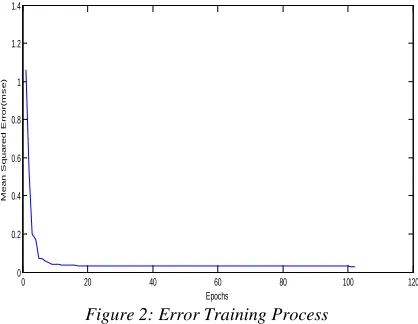
NWP data during 60 days were collected as input data, to train fuzzy network. The training times were 120, and the training error is 0.03, error training process as shown in figure 2. From the figure 2, it is known that when training time is 105, the mean square error has reached the training requirements.
0 20 40 60 80 100 120
0 0.2 0.4 0.6 0.8 1 1.2 1.4
Epochs
M
ean S
quar
ed E
r
r
or
(
m
s
[image:4.612.143.523.70.474.2]e)
Figure 2: Error Training Process
The initial membership function distribution about the fuzzy subset of wind speed was shown in figure 3 figure 4 is the trained membership function distribution about the subset of wind speed. From figure 3 and figure 4, it is known that the parameters change is not obvious between the initial membership function and the trained membership function about fuzzy subset of wind speed; this indicate that it is reasonable to divide wind speed range into 9 fuzzy subsets.
Figure 5 is a comparison result between the fuzzy neural network prediction power and the real
[image:4.612.305.523.175.425.2]power from wind farm. In this figure the solid line represents the actual output power of the wind farm, the dotted line represents fuzzy neural network prediction power. From the changes of the two curves, it can be seen that fuzzy neural network accurately reflects the variation rule of the wind farm output power with the NWP data.
Figure 3: Initial Membership Function
Figure 4: Trained Membership Function
5. CONCLUSION
This paper analyzes the fuzzy neural network’s basic principle, and proposes the wind power prediction model based on NWP data and fuzzy neural network algorithm. Firstly, to analyze and process the NWP data, then selects the wind speed data and humidity data as the fuzzy neural network’s input data, the input data is fuzzified; Secondly, fuzzy neural network construction process and training process are presented. Finally, a complete fuzzy neural network model is established.
[image:4.612.91.300.415.577.2]subjective factors of the fuzzy logic, easy to fall into local minimum of the nerve network and slow convergence speed. The fuzzy neural network prediction system improves the stability of prediction system and prediction accuracy.
ACKNOWLEDGEMENT
This work has been partially supported by the Natural Science Foundation of China (Project No.31101085).
REFERENCES
[1] News Office of State Council Issues’ on 24"China’s Energy Policy (2012)"the White Paper, Beijing: Xinhua News Agency, 2012. [2] Yuan Tiejiang, Chao Qin and LI Yijan, et al,
“Short-Term Wind Power Output Forecasting Model for Economic Dispatch of Power System Incorporating Large-scale Wind Farm”, Proceedings of the CSEE, vol. 30, no. 13, pp.23-27, 2010.
[3] Guo Zhenjhai, Wu Jie and Lu Haiyan, et al, ”A Case Study on a Hybrid Wind Speed Forecasting Method using BP Neural Network”, Knowledge-Based Systems, vol.24,pp.1048-1056, 2011.
[4] Maria Grazia De Giorgi, Antonio Ficarella and Marco Tarantino,”Assessment of the Benefits of Numerical Weather Predictions in Wind Power Forecasting Based on Statistical Methods”, Energy, vol.36,pp.3968-3978, 2011. [5] J. P. S. Catalão and H. M. I. Pousinho,”Hybrid Wavelet-PSO-ANFIS Approach for Short-Term Wind Power Forecasting in Portugal”, IEEE Transactions on Sustainable Energy, vol.2, no.1, pp.50-58, 2011.
[6] Fang Jiangxiao, Zhou Hui and Huang Mei, et al, ”Short-Term Wind Power Prediction Based on Statistical Clustering Analysis”, Power System Protection and Control, vol.39, no.11, pp.67-73, 2011.
[7] Meng Yangyang, Lu Jiping and Sun Huali, et al, ”Short-Term Wind Power Forecasting Based on Similar Days and Artificial Neural Network “,Power System Technology, vol.34,no.12,pp.163-167, 2010.
[8] Zhao Jiyin, Li Jianpo and Zheng Ruirui, ”Application of Adaptive Learning Rate Method in Power Transformer Fault
Diagnosis”, Journal of Jilin
University,vol.26,no.4,pp.415-419, 2008.