A NEURAL NETWORK FILTER TO ESTIMATE THE DOA OF
SMALL TARGETS
1DONG ZHIMING, 2ZENG JIANKUI
1Asstt Prof., School of Electrical & Information Engineering,
Chongqing university of science and technology, Chongqing, China
2
Asstt Prof., School of Electrical & Information Engineering,
Chongqing university of science and technology, Chongqing, China
E-mail: [email protected], [email protected]
ABSTRACT
Direction-of-arrival (DOA) estimation is an important problem in many applications such as communication and navigation. Many methods have been presented for this problem. The Maximum Likelihood (ML) is one of the good solutions. But, in traditional algorithms for ML Nonetheless, the computational load is very heavy and multivariate nonlinear maximization problem is serious. To deal with these problems, this paper describes an application of neural network (NN) for obtaining the global optimal solution of ML DOA estimation. It overcomes the local optima problem existing in some ML DOA estimation algorithms and improves the estimation accuracy. The computation complexity is modest.
Keywords: Artificial Neural Network (ANN), DOA Estimation, Maximum Likelihood
1. INTRODUCTION
In many applications such as communication and navigation, the estimation of target direction-of-arrival (DOA) is one of the important problems. Lots of techniques for this problem have been proposed over past decades. The Maximum Likelihood technique is one of the first to be investigated and best in theory [1]. Nonetheless, because of the high computational load of the multivariate nonlinear maximization problem involved, it does not become popular. Instead, suboptimal method with reduced computational load has governed the field. The better known ones are the MUSIC method of Schmidt [2] and the minimum norm method of Reddi [3] and Kumaresan and Tufts [4].
However, the ML method over-performs other methods in many aspects [5], especially, when the target echo is very small, or when the noise or clutter is very strong. In fact, many techniques cannot deal with the circumstances of coherent signals.
Many researchers have proposed various algorithms to maximize the likelihood function, wanting to guarantee global convergence within less computing time. Alternating projection method [6], simulated annealing algorithm [7], grid search
approach, data-supported grid search [8], can approximately obtain the ML estimation. But most of them cannot guarantee global convergence in general case [9].
In this paper, a global optimization of neural network [10] is developed to search for the nonlinear global optimization solution of the maximum likelihood. And then, we study the performance of NN algorithm.
This paper is organized as followed. Section 2 presents the problem of target direction-of-arrival estimation. In section 3, we propose the general neural network algorithm. And then, in section 4 the NN algorithm is applied to DOA estimation problem. Section 5 gives some simulation to verify the efficiency of our algorithm. Section 6 gives a conclusion to the whole paper.
2. PROBLEM FORMULATION
Consider an antenna array which is constituted of
M
sensors with arbitrary locations and arbitrary directional characteristics.It is assumed that
L
narrow-band plane waves arriving on the antenna array fromL
locations
θ θ … θ
1, , ,
2 L.propagation delays of the signals across the array are much smaller than the reciprocal of the bandwidth of the signals. So, it follows that the complex envelopes of the signals received by the array can be expressed as
1
( )=
(
) ( )
( )
L
k k k
t
θ
s t
t
=+
∑
X
a
n
(1)Where
X
( )
t
is theM
×1
vector1 2
( )
t
=
[ ( ),
x t x t
( ),
,
x
M( )]
t
TX
(2)In formula (2),
T
denotes the transpose. And(
θ )
ka
is the steering vector of the array towarddirection
θ
k.0 1( ) 0 ( ) 1
(
)
[ (
)
k,
,
(
)
M k]
k
j j T
k M k
a
e
ω τ θa
e
ω τ θθ
θ
−θ
−=
a
(3)1 2
( )
[ ( ),
( ),
,
( )]
T Mt
=
n t n t
n
t
n
(4)Here:
( )
i
x t
=the signal received by thei
th sensor.( )
k
s t
=the signal emitted by thek
th source.(
θ )
i k
a
=the amplitude response of thei
thsensor to a wave-front impinging from location
θ
k( )
i
n t
=the noise at thei
th sensor.Then, consider of the clutter signal, it is similar to target echo. But it is a random signal which can
be described by a coefficient
ζ
Jk1
( )=
(
)
L
Jk k k
C t
ζ
θ
s
=∑
a
(5)So, the signal received can be expressed as
1
( )=
(
) ( )
( )
( )
L
k k k
t
θ
s t
C t
t
=+
+
∑
X
a
n
(6)The vector of the received signals
x
( )
t
can be expressed more compactly as( )
t
=
(Θ) ( )
t
+
( )
t
.
x
A
s
n
(7)Where the
A
(
Θ)
is theM
×
L
matrix of thesteering vectors
A
(
Θ) [ ( ), , ( )]
=
a
θ
1
a
θ
L . And( )
t
s
isL
×1
vector of the signals which can beexpressed as
s
( )
t
=
[ ( ),
s t
1
,
s t
L( )]
The localization of target problem is to
estimate the locations
θ θ … θ
1, , ,
2 L of the sources fromN
target signal samples ("snapshots") of the received signals. The maximum likelihood estimation of the source localization problem is derived as [6]Θ
(Θ) Θ
ˆ
arg{max (
Θ)}
arg{max (
)}
L
tr
Θ =
=
P
AR
.
(8)
Where tr [ ] is the trace of the bracketed matrix,
1
(Θ)
(
Θ)(
(
Θ) (Θ))
(
Θ)
H − H
=
A
P
A
A
A
A
is theprojection operator onto the space spanned by the columns of the matrix
A
(Θ)
.Where,
1
1
( )
( )
N H
i i
i
t
t
N
==
∑
R
X
X
is thesample covariance matrix, and
H
denotes the Hermitian conjugate. In this paper, we use the proposed neural network algorithm as the optimization tool, searching for the global optimal solution.3. NEURAL NETWORK ALGORITHMS
object location map. False alarm rates can be controlled by threshold selection strategies, low thresholds being favored at the detector stage so as not to preclude any targets from subsequent stages. The requirements for the detection stage are a high detection rate with a low false alarm rate.
The Hopfield model neural network is a single layer of fully inter-connected neurons that update their outputs upon sampling the outputs of other neurons in the network, via the synaptic link.
The synaptic link between the ith and the jth
neurons, in a network of P neurons, form a symmetric matrix T which elements obey follow formula
; 1
ij ji ii
t = −t t =
(9)
The network changes state using the following dynamic equation
K i
i ij j i j
du
C k w N
dt =
∑
+(10)
Where Matrix Cis the input capacitance of the
ith neuron, it is the external input, and is the internal state of the neuron. The output state Viof the neuron is given by the following nonlinear transformation:
{
}
1
1 1, 1
i
i i v
i
v g e for v
η
−
= =
+ ∈ − +
(11)
Where githe sigmoid transfer is function of the
ith neuron, and 1
η is the gain of the neuron. The
network dynamic equation defines a complex system, but it is possible to find an energy function satisfying the Liapunov's stability Criterion
1
2 ij i j i i
E= −
∑∑
w v v −∑
v I(12)
Under above conditions, the Hopfield model implements a gradient descent algorithm, and given the complex multimodal cost function of the feature extra problem, the network is liable to find a local rather than the global minimum. To overcome this problem and increase the probability of finding the global minimum, some modifications have been proposed.
The decision space of a P -neuron network is
represented by a P -dimensional
hypercubeD([0,1] )p . Each corner of this hypercube represents a possible digit output state of the network; one of these corners represents the solution state, and one or more of the other corners represents the local- minima of the energy function. The network starts from some initial state within
([0,1] )p
D and developed towards one of the corners that corresponds to minimum.
For a digit neuronal trader function, the global minimum must be one of the comers of the hypercube. However for an analog network with a sigmoid transfer function, due to the reason of an analog transfer function represent a perturbation to the energy function; the global minimum must not be one corner of the hypercube.
Yet provided that the neuronal gain is high enough to eliminate the perturbation of the digit energy function, the analog network can be replaced by digital network.
Therefore the global minimum may be thought to be one of the corners of hypercube. We can calculate the energy of all m e m on the hypercube directly so long as theP is not very large. Then after the computation of the energy of all formula, the Pis the global minimum which we need. Here we call it Energy Comparing method (ECM).The advantage of ECM that any other modification doesn’t pose is that it ultimate the local minimum completely. And the computational complexity does not increase obviously so long as the number of neurons is not very large.
For the pulse radar, first supposed that the target moves so slowly that the return sequences of the target in the H times Pulse repetition interval PRI are at the same position. The changing pattern of the return sequences of the target will manifest some specific distributions in the amplitude and frequency feature spaces. Fourth-more, the distribution will possess considerable stability in a distance range.
Supposed is the column vector composed of the
th
t sampling point in the each return sequence.
4. THE NN-BASED ML ESTIMATION
The course of synthesizing two kinds of distinct features is, in fact, a course of features integration which transforms distinct input feature spaces into the same output space so as to make detection and decision.
Consider the simple case of a continuous function mapping from a 2-dimensional z, y input space to a 1-dimensional z output space. It is theoretically possible to model this mapping with a number of 2-dimensional radial functions. A radial function is one whose evaluation depends upon a radial distance from the function center.
Our networks use Gaussian radial functions which, in 2-dimensions, look like bumps or hills. The Gaussian bumps are placed in a flat z = 0 function space at input locations where the desired mapping output is known, i.e. training points. The bumps mold the space to the correct answer for the training samples and distort the space around the training point in a continuous fashion. Multiple bumps overlap to model complex areas. The bumps may change their location, width, and height during training to encompass additional samples. Theoretically, this method can approximate any continuous function to any degree of accuracy. The challenge lies in selecting an appropriate set of training samples to place sufficient bumps in the function space to model the function to the desired accuracy. A neural network for an element antenna uses an input space with 14 dimensions (the sine and cosine of 7 phase differences). The inputs are mapped to an output space of “energy bins” representing azimuth angles off antenna broadside. Energy in the bins represents areas with targets.
A DOA estimation network consists of three layers of nodes, input, Gaussian, and output, which are fully-connected by two layers of arcs, center and weight. “Fully-connected” means all nodes in layer
iare connected to all nodes in layeri+1. There are no connections between nodes in the same layer. The function space is primarily shaped by the Gaussian nodes.
The input nodes,I in the DOA estimation network accept preprocessed input data and fan it out to the center arcs. The center arcs connect each input to each Gaussian node and calculate the distance for that dimension from the current input value to a given Gaussian, k, i.e.
ij j jk
C =I −m
WhereI , is the jthinput dimension and mjkis the center of the kth Gaussian node in the kth input dimension. If the distance from center to input in each dimension is small or zero, that Gaussian is
“relevant” to the answer, i.e. its center in the function space is near the current input.
[image:4.612.327.507.229.373.2]In ML estimation problem, we want to maximize the function
L
(
Θ)
in (6). According to NN algorithm, we first initialize some parameters, and then a set of data is employed to train to neural network to get the neuron parameters. At last, when new signal data is arriving, they are processed by the trained neural network to estimate the direction-of-arriving of the target.Figure 1 In The Second Experiment, The Scenario Is The Same As In The First One, Except That This Time We Fix The SNR To 20 Db. Fig. 2 Shows The Resulted Rms Error Of The First Source As A Function Of The Number Of
Snapshots.
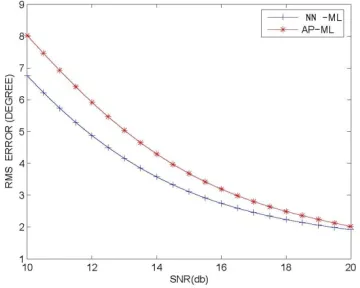
From The Experiment, We Can See NN Algorithm Outperforms AP Algorithm. Moreover, In Our Experiment, AP Algorithm Sometimes Does Converge To
A Local Optimum. And We Solved It Successfully By NN Algorithms.
5. SIMULATIONS
alternating projection method proposed by Ziskind and Wax [6].
In the simulations, the array is linear and uniform with three isotropic sensors spaced half a wavelength apart. The sources are two equal power narrow-band emitters, and the noise is additive and uncorrelated from sensor to sensor and with the signals.
In every experiment we perform 100 Monte-Carlo runs and compute the root-mean-square (rms) error for each direction-of-arrival.
In the first simulation we simulate two uncorrelated emitters impinging from 0°and 20°. The number of snapshots taken is 20. Fig. 1 shows the resulted rms error (in degrees) of the first source as a function of the SNR, defined as SNR =
2 2
10log(s /σ ) (where
s
2 andσ
2 are the average power of the signals and the noise, respectively) .The improved performance of the NN based ML estimator at low and moderate SNR is evident.6. CONCLUSION
In this paper, we have proposed a new algorithm for computing the ML estimator of the direction of multiples source in the far field by using NN technique. This method can obtain the global optimal solution of ML DOA estimation. It overcomes the local optima problem existing in some ML DOA estimation algorithms and improves the estimation accuracy .The algorithm is iterative. It over-perform traditional algorithm in the aspect of computational load.
But this method has also shortcomings. The detector needs the knowledge of the covariance matrices both of the non-Gaussian clutter and of the Gaussian disturbance (clutter plus thermal noise), but in a real radar scenario, these quantities are usually unknown and must be estimated from the data.
On the other hand, detection of small targets in an strong clutter environment such as oceanic environment using our method has proven to be a
very challenging problem. All this defects in our method will be researched.
REFRENCES:
[1] F. C. Schweppe, "Sensor array data processing for multiple signal sources," IEEE Trans. On Inform. Theory Vol. 14, No. 3, pp.294-305, 1968.
[2] R. O. Schmidt, "Multiple emitter location and signal parameter estimation," IEEE Trans.,on Antennas Propagat., Vol. 34, No. 3, pp. 276- 280, 1986.
[3] S. S. Reddi, "Multiple source location- A digital approach," IEEE Trans. Aerosp. Electron. Syst., vol. AES-15, pp 95-105, 1979.
[4] R. Kumaresan and D. W. Tufts, "Estimating the angles of arrival of multiple plane waves,"IEEE Trans. Aerosp. Electron. Syst., vol.AES-19, pp. 134-139, 1983.
[5] L. C. Godara, "application of Antenna Array to mobile Communications,Part II: Beam-Forming and Direction-of-Arrivial Considerations" Proc.IEEE, vol.85,pp.1195-1245,1997
[6] I. Ziskind and M. Wax, "Maximum likelihood localization of multiple sources by alternating projection," IEEE Trans. on Acoust., Speech, Signal Processing, Vol. 36,No. 10,pp.1553-1560,1988
[7] K. Sharman, "Maximum Likelihood estimation by simulated annealing", Proc., ICASSP’88, New York,pp.2741-2744,1988
[8] P. Stoica and A. B. Gershaman, "Maximum-Likelihood DOA Estimation by Data-Supported Grid Search", IEEE Signal Processing Letters, vol.6,pp.273-275,1999
[9] P. Stoica and K. C. Sharman, "Maximum Likelihood Methods for Direction-of-Arrivial estimation", IEEE Trans. Acoust.,Speech,Signal Processing, vol.38,pp.1132-1143,1990
[10]F.Obernosterer and W.F. Oehme, " application of a neural network for detection at strong nolinear intersymbol interference", IEEE transactions on magnetics , Vol.33,No.5, pp.2974-2976. september,1997