TOWARDS A NEW WEB-BASED SERIOUS GAMES
GENERATOR BASED ON FUZZY EXPERT SYSTEM
1
ELAACHAK LOTFI1, 2AMINE BELAHBIB AND 3MOHAMMED BOUHORMA
1, 2, 3Computer science, systems and telecommunication Laboratory (LIST) Faculty of Sciences and
Technologies Abdelmalek Essaadi University, Tangier, Morocco
E-mail: [email protected], [email protected] , [email protected]
ABSTRACT
With the big success that serious games have known in education field a huge need has been created to develop such video games in order to satisfy the demand that does not cease to increase, but the time, the cost, and the interaction of several actors during the creation process of video games can influence on the envisaged result and create several unexpected problems, to avoid such problems we propose in this article a new web-based serious games generator that adapts the process of video game development by replacing game design and game development phases by both programmed game design and gameplays, this new concept will allow the game creators to focus more in pedagogical aspect and pedagogical objectives that the players must acquire during a video game sequence, instead of wasting much time in game design and game development. In addition, the proposed game generator will be equipped with a fuzzy expert system to assist the users during the game generation process; the proposed serious games generator will be able to generate several web based video games that are both educational and fun. An evaluation of how our proposed game generator proved successful along with an outlook on future research concludes this paper.
Keywords: Web Based Serious Games, Fuzzy Expert System, Game Generator, Gameplay, and AHP.
1. INTRODUCTION
The creation of serious games requires the collaboration of several experimented actors, and usually a big amount of work is done by the development team which ensures the integration of resources and mechanisms envisaged in the video game, the programming part and technological choices can prove decisive, and in most of cases the programming is done via several tools for creating video games or by reusing another game's source code, it’s possible to change the existing to achieve the intended result. Among the tools used in video game creation there are game engines which are designed to create a simple video game. The core functionality typically provided by a game engine includes a rendering engine which supports 2D or 3D graphics, a physics engine with collision detection and other useful components like sound,
scripting, animation, artificial intelligence,
networking, streaming, memory management, threading, localization support, and a scene graph[1]. The combination of the game engine, with a preprogrammed gameplays, and the several APIs services, provides a platform called game generator, the main role of this platform is the generation of video games according to the need of the users. In
general, the game generator is dedicated for the non-experts in the video games creation field, it allows them to create different video games in an easy way without the interaction of the game designer, the development team nor the artistic team. Among the main objectives of this new concept is saving the time and the cost of the game creation process. In this perspective of research and development we aim to develop a serious game generator equipped with a fuzzy expert system that guides and gives the indications to the users during the game generation process. The proposed game generator will be able to generate several web-based serious games according to the chosen game genre. In this way, making serious games won‘t require anymore, neither learning programming
languages, nor the implication of game
programmers.
2. RELATED WORK
generators, platforms and tools dedicated for
serious games, have been developed by different organizations, laboratories and universities these recent years. Among those solutions there is a framework for serious game-based learning design[2] created through mEducator project, the framework uses mEdiator scenario editor that mixes between visual programming and workflow management, letting designers, model how the game should react to user input, the serious game editor offers the flexibility and the ability to the educators to create bespoke serious games to serve their learning objectives. LUDOCORE[3] a logical game engine based on event calculus, it allows linking game rules to the formal logic used by automated reasoning tools in artificial intelligence. It serves as a bridge from the concerns of game design to logic-based Artificial intelligence tools, it has also served as the basis for implementing interactive prototypes. The TARGET platform [4] supports the TARGET Learning Process, consisting of multiple tools and services, which can be extended. The core service is the Virtual Business Environment, which is a serious game targeting
fields related to project management and
innovation. In the health care field there is Open Wonderland [5], which is a toolkit for building 3D virtual worlds, it’s designed primarily for developers familiar with the Java programming language and allows to theme the creation of dynamic learning environments, collaborative business applications, or interactive, multi-user simulations. <e-adventure>[6] is a platform developed in java programming language, based on XML interpretation engine and a graphical user interface that allows the creation of the games graphically, which is aim to facilitate the creation of adventure serious games, realized as part of a research project of the Complutense in Madrid University. the process of creation thought this platform begins when the user chooses a condition from a predefined list, then associate divers actions e.g.” add objects, change scene, or establish a conversation, etc.” to the chosen condition. Concerning the conversations, they will be related to each character via a dedicated editor, each conversation is composed of several phrases. The video games created through this platform can be integrated into LMS via the Scorm standards.
All of the platforms mentioned above have as objective the creation of serious games, but the problem is that most of them require technical skills like programming, artistic and conceptual skills and logical reflection, in addition the communication between actors might require other skills like
management and coordination, and as a result we can talk about a game that is limited to one game genre. One more thing is the user-friendly interface, all the examples have lack of a system that guides the user through the creation or generation process in order to create a video games that are both pedagogic and fun in the same time. In this perspective of research, and according to the ideas extracted from the use of those different game engines, platforms and frameworks, our research team aims to develop a new game generator that allows to the non-experts in the serious game industry to generate their own serious games according to their needs. In order to facilitate the task for the users, the proposed game generator will be equipped with a fuzzy expert system that guides and notices them to create their own video games without the interaction of any game designers or development team.
3. THE MAIN ISSUE
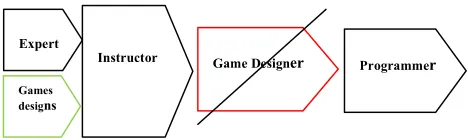
[image:2.595.302.536.600.670.2]The first actors in the process of serious game creation are the instructors and the experts in the field, thing that leads to scenarios oriented content more than scenarios oriented game, then, the game designer that must create and balance between content and gameplay to create a gameplay that sticks to selected content and message Figure 1.
Figure 1: The process of serious games creation
However what if we give a list of most of gameplays to the instructors or the experts in the field who can choose which will be the right mechanism for such content. With this second approach we avoid the intermediate party between programmers and experts / instructors Figure 2.
Figure2: Process of serious games creation without game designer
In the third approach we aim to eliminate from the process two profiles that are programmers and game designer, to make way for the experts and the instructors who can choose one of the mechanisms
Expert Instructor Game Designer Programmer
Expert
Instructor
Programmer
Game Designer
previously designed by the game designer and
programmed by the programmers Figure 3.
Figure3: The process of serious games creation with programmed game designs
This third approach will allow to the instructor and expert to generate their own video games that meet their needs, by using the game generator based on the programmed game designs and gameplays, with this approach the game creator can spend more time to define the pedagogical objectives that will be transmitted to the learners during the sequence of the video game, the concept of the proposed game generator will be detailed in the next section.
4. THE CONCEPT OF THE GAME GENERATOR
Based on the study[7] about gameplays classification, and that proposes the model G/P/S of classification, we can extract the basic gameplay bricks, with which we could create the most serious games. By linking the bricks each other we can include any kind of existing standard games, but bind, chain and attach the bricks cannot be done randomly, in addition linking and communicating between the bricks can be very contentious. In this section we will describe the concept of the proposed game generator, with the general rules that will be respected by the user to lead to the envisaged results.
4.1 The concept of proposed game generator Before proceeding to the definition of unit blocks and the nature of the relationship, we must emphasize the big lines that make an educational game:
• Knowledge and educational messages
• Distraction
• Evaluation
These three points are the basis of any serious game Figure 4, where the educational message is the main objective, the distraction allows the learner to hang in the game, the evolution of the player and whether he has succeeded has mastered the learning
objective it is necessary to set up a monitoring dispositive and statistics.
Figure4: The architecture illustrating the three basic elements
The proposed serious game generator is a platform that allows the creation of a cross platforms serious games; it will be dedicated to the non-experts e.g. “professors, instructors and trainers”. The concept of the proposed game generator is based on different gameplay bricks; each gameplay brick has a specific role in the created video game, the main task of these bricks is summed up in the fact that they allow video games to be playable.
According to different studies of our research team, we have specified three types of gameplay bricks, this specification takes into account the nature of the gameplay brick, if it’s educational or entertaining. We have in the first place the gameplay bricks for education able to transfer the knowledge to the learners, then the gameplay bricks for entertainment that have as main role the attraction and maintain the desire into the player to keep playing, and the third type of bricks which are neutral gameplay bricks, they aren't neither educational nor entertaining. The gameplay bricks are categorized as below.
Educational gameplay bricks: Create, Manage, Select, Write, and Message.
Entertaining gameplay bricks: Avoid, Match, Destroy, Move, and shoot.
Neutral gameplay bricks: Random, and media gameplay bricks.
This classification of gameplay bricks on three different types will be exploited by the fuzzy expert system, which is detailed after in this paper.
4.2 The architecture of the serious game generator
The proposed serious game generator will generate a web based serious games, therefore these kinds of games will need just a web browser to be Expert
Programmed game designs Instructor
Avoid Move
Play
Dialog Media
Message
Select Match
Evaluation
played. Concerning the architecture of such system,
as in the Figure 5 the generator is developed by using a combination several technologies e.g. “java, JavaScript APIs, webGL, etc.’ and it’s deployed in a server application. The instructor can establish scenario and levels of the game by using web interfaces where the he can drag and drop several components in order to generate a serious game.
4.3 The process of game generation
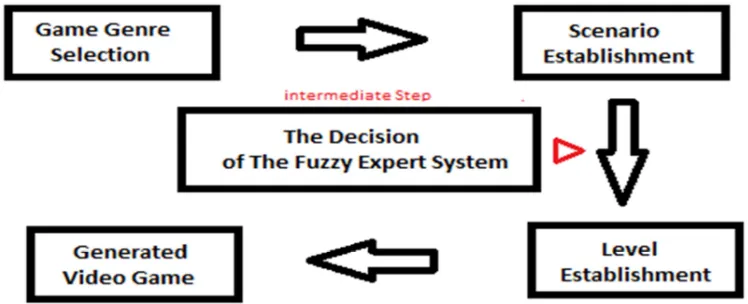
[image:4.595.118.492.484.636.2]The process of the game generation “Figure 6” is composed of three principal steps “Game genre selection, scenario establishment based in gameplay bricks and levels establishment”. In each step the user of the game generator has to do some manipulations in order to pass to the next step, until the generation of the serious game.
Figure 5: The Architecture of the Web-Based serious Game Generator
An intermediate step is added to the generation process, this step provides the validation for the
transition from the step of the scenario
establishment to the step of the level
implementation, in this intermediate step the fuzzy
expert system will control the percentage of each type of gameplay bricks, to provide the guidance to the user with the aim of generating a video game that is both fun and educational.
Figure6: The Process of the game generation
4.3.1 Game genre selection
The first step in the process of game generation is the game genre selection [8], this step serves as guidance for other steps that will come later and consists to choose different parameters like age, field and game properties e.g.“Speed, Skills based,
Intelligence, Precision, Reflection, Decision,
study concerning different properties of online video games that exist on the web.
Figure7: The web application based on the AHP method for the game genre selection
After the selection of the game genre, the game generation process moves to the second phase, where the user sets up the bricks that from the scenario, this scenario is the kernel of the generated serious game.
4.3.2 Scenario establishment based on gameplay bricks
After the selection of game genre according to the parameters passed by the user and the AHP ranking algorithm described in the section above, the user can build his own scenarios by using the scenario editor Figure 8.The use of the scenario editor will make the task very easy by dragging and
dropping the gameplay bricks, message bricks, media bricks and game object bricks to form one main block that contains all the game mechanics, messages, and media components that will be included in the generated video game. This concept of the scenario editor is based on the visual programming concept [9], where the user can manipulate program elements graphically. Each brick can be parameterized according to the need of the user; with the proposed interactive web interface the user can create a variety of scenarios, without the interaction of any expert in game design neither the game developers.
Figure8: The scenario web interface based on gameplay bricks
4.3.3 Levels establishment
The level design is a discipline in the process of game development involving the creation of stages, missions or map locations. In most cases the levels
JavaScript library to generate web based video
games. In addition, with the use of the objects of palette the user can place objects and characters in different places on the map of level Fig 9. Then he
can set up the level with the possibility to test the course of the scene of the video game, to see the unfolding of objects, in order to modify it if necessary.
Figure9: The level editor of the proposed game generator
5. FUZZY EXPERT SYSTEM
As mentioned above the game generator will be equipped with a fuzzy expert system, its main role is the support of the users via the notifications that will guide them to generate video games that are educational and fun. In this section we will present the fuzzy expert system, and its design and implementation.
5.1 Introduction to fuzzy expert system
The fuzzy expert system [10, 11, 12, 13] is an expert system that uses a fuzzy logic [14] instead of Boolean logic; more precisely is a collection of membership functions and rules that are used to reason about data, in general it’s composed of three units: Fuzzifier, inference engine and Defuzzifier Figure 10.
Figure10: Fuzzy expert system architecture
The Fuzzy expert system is categorized into two types:
• First is fuzzy control system that accepts
inputs as numbers then the input number
is translated into a linguistic term. In fuzzy control system the application domain is defined.
• The second type is fuzzy reasoning
which that attempt to emulate human thinking where the domain is not defined. Such system deals with numbers and linguistic variables.
The process of fuzzy logic flows successive steps, in the beginning the crisp set of input data are gathered and converted to a fuzzy set using fuzzy linguistic variables through the fuzzy linguistic terms and membership functions, this step is known as Fuzzication. Then, an inference is made based on a set of rules. At the end, the resulting fuzzy output is mapped to a crisp output using the membership functions, in the Defuzzication step, the fuzzy logic algorithm is explained below:
1. Define the linguistic variables and construct
the membership functions (initialization).
2. Construct the rule base (initialization).
3. Convert crisp input data to fuzzy values
using the membership functions
(Fuzzification).
4. Evaluate the rules in the rule base
(inference).
5. Combine the results of each rule (inference).
6. Convert the output data to non-fuzzy values
Linguistic Variables
Linguistic variables are the input or output variables of the system whose values are words or sentences from a natural language, instead of numerical values. A linguistic variable is generally decomposed into a set of linguistic terms.
Membership Functions
Membership functions are used in the
Fuzzication and Defuzzication steps of a fuzzy logic system, to map the non-fuzzy input values to fuzzy linguistic terms and vice versa. There are different forms of membership functions such as triangular, trapezoidal, piecewise linear, Gaussian, or singleton.
Fuzzy Rules
A rule base is constructed to control the output variable. A fuzzy rule is a simple IF-THEN rule with a condition and a conclusion.
Defuzzication
After the inference step, the overall result is a fuzzy value. This result should be Defuzzied to obtain a final crisp output. This is the purpose of the Defuzzier component of a fuzzy logic system. Defuzzication is performed according to the member ship function of the output variable.
5.2 Modeling the fuzzy expert system
The establishment of any complex system requires a design process composed of different steps followed by the designer to build it; in this perspective there are many steps that make the implementation of fuzzy expert system possible with a result that respects the need related to concerned field. The Process of designing a fuzzy expert system can be pursued using the following steps:
5.2.1 Specify the need and define the linguistic variables
The specification of the need is always the first step to begin the design of any complex system, including the fuzzy expert system, in this step the designer has to describe the need that lead to build the fuzzy expert system for the concerned field. When the need is specified, come then the definition of linguistic variables that take linguistic values e.g. “Age is old” to determine the fuzzy sets thereafter.
The specification of the need
The idea is to equip the game generator by the fuzzy expert system that will accompany the users during the creation process of their own serious games; by giving them indications and instructions
that will help them to create both educational and entertained games.
Define linguistics variables
There are three main linguistic variables for the fuzzy expert “FES”: Educational Gameplay bricks,
Entertaining Gameplay Bricks, and Neutral
Gameplay Bricks, Table 1.
Table1: Linguistic variables and their numerical ranges
Linguistic variable : Educational Gameplay bricks
Linguistic value Notation Numerical range
low L [0 ,25, 50]
medium M [25, 50,75]
high H [50 ,75, 100]
Linguistic variable : Entertaining Gameplay Bricks
low L [0 , 25, 50]
medium M [25 , 50,75]
high H [50 ,75, 100]
Linguistic variable : Neutral Gameplay Bricks
low L [0 ,25, 50]
medium M [25 ,50, 75]
high H [50 ,75, 100]
5.2.2 Fuzzification
For each input and output variable selected, we define two or more membership functions (MF), normally three but can be more. We have to define a qualitative category for each one of them.
Determine fuzzy sets
Fuzzy sets can have a variety of shapes. However, a triangular or a trapezoidal can often provide an adequate representation of the expert knowledge, and at the same time, significantly simplifies the process of computation.
0 x
x mid
low mid
min
x
mid
x mid
max mid
mid
0 x
0 x
x mid
low mid
min
x
1 low
x
high
x mid
max mid
high
0 x
Trapezoidal: f (x|min, low, high ,max)
The Fuzzy sets in FES
[image:8.595.92.508.74.401.2]All the Fuzzy set of the Fuzzy expert system are presented in the Figure 11.
Figure 11: Fuzzy sets of the Fuzzy Expert System
5.2.3 Construct the fuzzy rules
To accomplish this step the designer of the system has to describe how the problem can be solved using the fuzzy linguistic variables defined
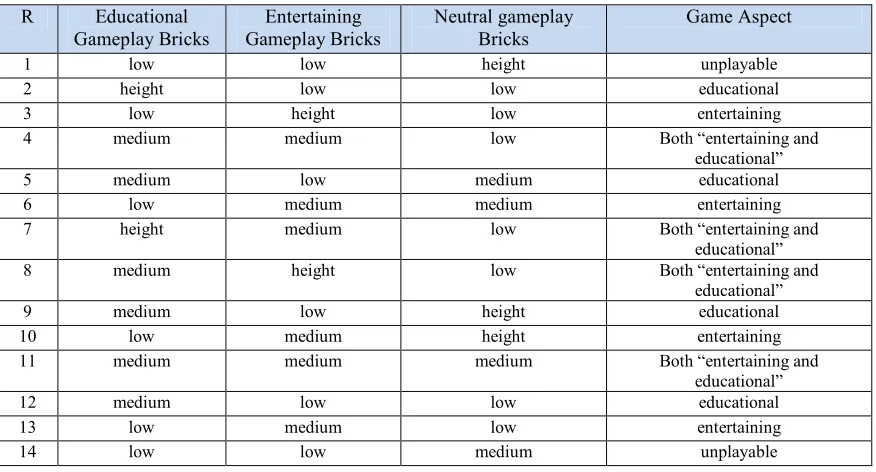
previously. The required knowledge can be collected from different sources such as computer databases, flow diagrams and observed human behavior, interviews with experts of the fields. The Table 2 resumes all the rules that define our fuzzy expert system.
Table 2: The rules of the fuzzy expert system
R Educational
Gameplay Bricks
Entertaining Gameplay Bricks
Neutral gameplay Bricks
Game Aspect
1 low low height unplayable
2 height low low educational
3 low height low entertaining
4 medium medium low Both “entertaining and
educational”
5 medium low medium educational
6 low medium medium entertaining
7 height medium low Both “entertaining and
educational”
8 medium height low Both “entertaining and
educational”
9 medium low height educational
10 low medium height entertaining
11 medium medium medium Both “entertaining and
educational”
12 medium low low educational
13 low medium low entertaining
[image:8.595.114.485.208.382.2] [image:8.595.89.527.492.728.2]5.2.4 Defuzzification
During the Defuzzification the value for each
variable is calculated using the selected
Defuzzification method, which can be:
• Centre of gravity: !" #$ !" #$
• Centre of gravity singleton:∑ &' ('∑ !')
)
• Center of area: * | 01/ ," #- .
,"
#-1 /
• Rightmost Max: arg maxx [µ(x) = max
(µ(x))]
• Leftmost Max: arg minx [µ(x) = max
(µ(x))]
• Mean Max: mean(x) | µ(x) = max (µ(x))
In our case we have used the center of gravity Defuzzification method, it consists of finding the centroid of the area bounded by the controller output membership functions and its abscissa is taken as the crisp controlling value [15, 16, and 17]. The Center of Gravity method takes into account the rules and at the maximum membership level. It has the disadvantage of not allowing control actions towards the extremes of the action range [18].
6. RESULTS
As mentioned before, the process of game generation is composed of three main steps
described in the sections above. In each step the user does some manipulation in order to pass to another step. In the first step the user chooses the game genre based on AHP algorithm, then he establishes the video game scenario by using the gameplay bricks, during the scenario establishment the fuzzy expert system will validate this step, by controlling the combination of gameplay bricks , messages bricks and media bricks in order to create a scenario that is both educational and entertaining, the fuzzy expert system will notice the user by given him indications and instructions, in the example illustrated in the Figure 12 the user has add tow entertaining gameplay brick “Avoid , Shoot” one neutral gameplay brick “Media” and one educational gameplay brick “Message”, the fuzzy expert system has shown a message alert mentioned that the generated serious game will be more entertaining then pedagogical therefore the user have to add more educational gameplay bricks, the message shown on the screen will be changed according interpretation of the fuzzy expert system algorithm which takes into account the number of each type of gameplay bricks add by the user, after validation of this step, he can establish the levels of video game by building the map and dragging and dropping several “2D, 3D”objects and characters into the map.
Figure12: Instruction and Indication given by the fuzzy expert system to the user
After stepping through all steps of the generative process, the end result is the generation of a serious game which is intended the user specification. The
run, and it is both educational and entertaining,
because during the establishment of the scenario the user has used a combination of educational gameplay bricks that is capable to transmit messages and knowledge to the learners that play the game, and he has also used the entertaining gameplay bricks that creates envy and desire into them to play more as game progression. Among the features of the game generator is the possibility to modify the generated video game, this feature will offer to the user the flexibility to modify the scenario or the level to address all issues related to the wrong implementation of the scenario, levels of the video games, pedagogical objectives and entertaining mechanisms that will be included into the generated video games. According to the selection of game genre the game generator will be able to generate pltaformer video games Figure 13, flash video games Figure14 and other video game genres, which will create a diversity of serious games generated. The first game is the prototype "sweetlands" where we the player use a bunny character and that that have to jump using mouse click to avoid falling, then further on the game the user should use the mouse to catch bonus. The educational objective of this game is to teach young kids to use the mouse of the computer.
Figure13: Screenshot from the generated platformer video game
In order to value the learning and the assessment of the pedagogical objectives we gave the game to 5 kids who never used a computer before. We gave them a test where they have to click 10 spots on the screen using the specific order, and then we made them play the game until they gave up playing, then we made the test with the 10 spot, and here are the results Table 3:
Table3: Table of results by Learner
Before After
Kid1 16s 12s
Kid2 12s 9s
Kid3 15s 11s
Kid4 18s 12s
Kid5 10s 8s
AVG 14.2 10.4
From this study we noticed that the kids enjoyed playing the game, and concerning the educational objective we saw a decent improvement of the speed, around 26.77% faster than the first attempts. The second prototype game witch called " Qiup" it's a small flash game where the user should guess the next geometry. The main pedagogic objective of this game is to train the brain and rise up the QI of the player.
Figure14: Screenshot from the editor video game (flash genre)
7. CONCLUSION
generator requires lot financial and personal
resources.
Among the perspectives envisaged for the future works is the improvement of the current game generator in order to be able to generate other video games genres e.g. “RPG, RTS, Adventure, etc.” and in addition, the establishment of a system that evaluate a player performance based on educational data mining that will present continuity in the learning process through the serious game.
REFRENCES:
[1] Ward,J, “What is a Game Engine?” [Online] Availableat:www.gamecareerguide.com/feature
s/529/what_is_a_game_.php,2008. [Accessed
22 February 2014].
[2] Aristidis P, Laurent A, Ian D, Sara F, Panagiotis P, Sylvester A, Simon S, Maurice H.“Scenario-based serious games repurposing” SIGDOC '11 Proceedings of the 29th ACM international conference on Design of communication, 2011, pp. 37-44.
[3] Adam M. Smith, Mark J. Nelson, and Michael Mateas, “LUDOCORE: A logical game engine for modeling videogames” Computational Intelligence and Games (CIG), 2010 IEEE Symposium, pp. 91 - 98.
[4] Lachin M, “Methodology for Development of Serious Gaming Scenario for Life Cycle Analysis Using TARGET platform ”M.A. thesis, University Polytechnic of Milano, Italy, 2011.
[5] Jonathan K, Nicole Y, "Open Wonderland: An Extensible Virtual World Architecture," IEEE Internet Computing, vol. 15, no. 5, pp. 38-45, Sept.-Oct.
[6] Torrente, J., Moreno-Ger, P., Fernández-Manjón,
B., & Blanco, Á. (2009). Game-Like
Simulations for Online Adaptive Learning: A Case Study. In Proceedings of the 4th International Conference on E-Learning and Games: Learning by Playing. Game-based Education System Design and Development,
Edutainment '09 (pp. 162–173). Berlin,
Heidelberg: Springer-Verlag.
doi:http://dx.doi.org/10.1007/978-3-642-03364-3_21.
[7] Damien D, Julian A, Jean-Pierre J, “Classifying Serious Games: The G/P/S Model” Handbook of Research on Improving Learning and
Motivation through Educational Games:
Multidisciplinary Approaches. Patrick Felicia (Eds.), IGI Global, 6, p. 118-136, 2011.
[8] Elaachak Lotfi, Belahbib Amine and Bouhorma Mohammed. Article: Application of Analytic Hierarchical Process Method for Video Game Genre Selection. International Journal of Computer Applications 96(16):30-37, June 2014. Published by Foundation of Computer Science, New York, USA.
[9] Brad A. Myers Taxonomies of Visual
Programming and program Visualization,
School of Computer Science Carnegie Mellon
University Pittsburgh, PA 15213-3890,
September 20, 1989.
[10] Siler, W. and J. Buckley. “Fuzzy Expert Systems and Fuzzy Reasoning” John Wiley & Sons, Inc., New Jersey, 2005.
[11] Hadjimichae M., P. Kuciauskas., P. Tag., R. Bankert. And J. Peak. "A Meteorological Fuzzy Expert System Incorporating Subjective User
Input", Knowledge and Information
Systems,Vol. 4 (3), 2002, pp. 350-369.
[12] Hawng, G. «A New Environment for Developing Fuzzy Expert Systems", JOURNAL
OF INFORMATION SCIENCE AND
ENGINEERING,Vol 15,1999,pp. 53-69. [13] Leung, K. S. and W. Lam. "Fuzzy Concepts in
Expert Systems",IEEE Computer,Vol. 21 (9), 1988, pp.43-56.
[14] Zadeh L. "From Computing with Numbers to Computing with Words− From Manipulation of Measurements to Manipulation of Perceptions", IEEE TRANSACTIONS ON CIRCUITS AND SYSTEMS I: FUNDAMENTAL THEORY AND APPLICATIONS, VOL. 45, NO. 1, JANUARY 1999, pp. 105-119.
[15] H. Hellendoorn and C. Thomas,
"Defuzzification in fuzzy controllers," Journal of Intelligent and Fuzzy Systems, vol. 1, no. 2,pp. 109-123, 1993.
[16] S. Roychowd hury and B. -H. Wang, "Cooperative neighbors in Defuzzification," Fuzzy Sets and Systems, vol. 78, no. 1, pp. 37-49, 26 Feb. 1996.
[17] T. A. Runkler, "Selection of appropriate Defuzzification methods using application specific properties," IEEE Trans. Fuzzy Systems, vol. 5, no.1, pp. 72-79, Feb. 1997. [18] E. H. Mamdani, H. J. Efstathiou, and K.