5
IV
April 2017
www.ijraset.com Volume 5 Issue IV, April 2017 IC Value: 45.98 ISSN: 2321-9653
International Journal for Research in Applied Science & Engineering
Technology (IJRASET)
©IJRASET: All Rights are Reserved
50
Accident Prevention System
Ms. Devkar Priyanka B.1, Ms. Barkade Varsha H2, Prof. S. S. Kuchekar3
1,2
Student, B.E. (Electronics), 3Associate Prof., Electronics Dept. PES, C. O .E. Phaltan
Abstract: technical approach for detecting and monitoring tiredness levels of driver tiredness continue to emerge and many are now in the development, validation testing, or early implementation stages. Previous studies have reviewed available tiredness detection and prediction technologies and methodologies. As the name indicates this project is about advanced technologies in cars for making it more intelligent and interactive for avoiding accidents on roads. Now a day’s increases the road accident due to over speed. to avoid this kind of accident we choose this topic. You’ve seen them on the highway. Many drivers ignore the speed limit and drive 10, 20 and sometimes 30 mph over the limit. Speed kills, and traveling above the speed limit is an easy way to cause a car accident.
Keywords: Number plate detection, Image processing software, GSM module ( Sim 900).
I. INTRODUCTION
An general idea of Existing System: When you consider of work-related protection hazard, you perhaps think about what goes on inside the workplace. But one of the greatest intimidations to your safety is not in the workplace, but rather on the road. Someone is indignant every 18 seconds. Over 2 million of those injuries turn out to be disabling. A person dies in a crash on U.S. roads every 11 minutes. In fact, motor vehicle accidents are the most common reason of bereavement in the United States more than tumor or heart attacks. When we think about the grave accident, it could change your life- and not for the better. As of now most of the investigate and implementation on with perfunctory road accidents.
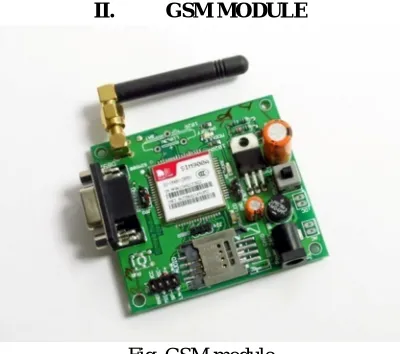
[image:2.612.206.406.381.558.2]II. GSM MODULE
Fig. GSM module
Technology (IJRASET)
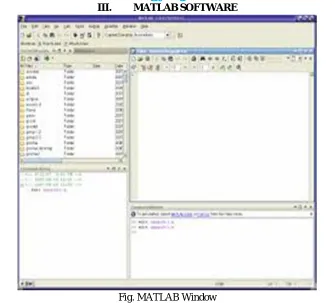
[image:3.612.139.474.75.378.2]III. MATLAB SOFTWARE
Fig. MATLAB Window
MATLAB is Associate in Nursing interactive program for numerical computation and information visualization; it's used extensively by management engineers for analysis and elegance. There are utterly completely different toolboxes offered that stretch the essential functions of MATLAB into different application areas; in these tutorials, we'll produce thorough use of the management Systems chest. MATLAB is supported on OS, Macintosh, and Windows environments; a student version of MATLAB is accessible for personal computers. For lots of knowledge on MATLAB, please visit the MathWorks link at the best of the page. By using MATLAB we easily detect number plate and send to the next toll.
IV. WORKING PRINCIPLE
We use this method on highway to observe speed for avoiding accident associated with over speed. First of all we have a tendency to capture the image of variety plate, observe {the variety |the amount |the quantity} plate and send the capturing time and number to the second piece of land.
At second toll once more we have a tendency to capture the pictures, observe the image and compare this variety thereupon pictures that square measure sent through first piece of land. If the amount is matched then we have a tendency to compare time need to the
automobile from first toll to 2nd toll. And by victimisation the speed= distance*time formulae we have a tendency to observe the
speed of automobile. If speed is over than most restricted speed then we have a tendency to assign fine at 2nd toll. And if the speed
of automobile is below than most speed we have a tendency to take regular toll. By victimisation this method we have a tendency to observe the speed and take a look at to stop accident occurring thanks to over speed. we have a tendency to use image process technique to observe the amount plate image use this technique on expressway to detect speed for avoiding accident related to over speed. firstly we capture the image of number plate, detect the number plate and send the capturing time and number to the second toll plaza.
At second toll again we capture the images, detect the image and compare this number with that images which are sent through 1st
toll plaza. If the number is matched then we compare time require to the car from 1st toll to 2nd toll. And by using the speed=
distance*time formulae we detect the speed of car. If speed is over than maximum limited speed then we assign fine at 2nd toll. And
www.ijraset.com Volume 5 Issue IV, April 2017 IC Value: 45.98 ISSN: 2321-9653
International Journal for Research in Applied Science & Engineering
Technology (IJRASET)
©IJRASET: All Rights are Reserved
52
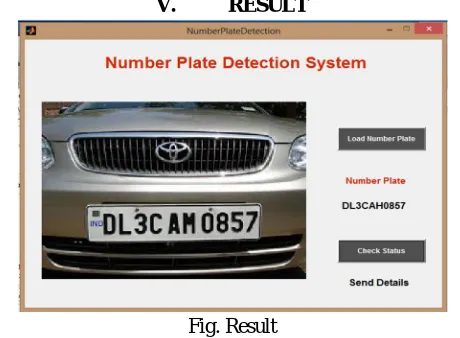
[image:4.612.190.420.80.249.2]V. RESULT
Fig. Result
In this result we see the detected number plate. And by using check status we decided assigning the fine or not to that vehicle, its depend on the time period required to reach that vehicle.
VI. FUTURE SCOPE
On toll center online smart card technique can be used. Cash can withdrawal from online money transition service at the toll.
VII. OBJECTIVE
The main objective of this system is to over-speed related accident & save the human life. we use image processing technique to detect the number plate and using this number detect the speed of car. If the speed of car is high then assign fine to that person, by using this technique we easily control the over-speed , overcome the accident relate to over-speed.
VIII. CONCLUSION
By implementing this system, we can easily control the over-speed of vehicle, and prevent accident on Expressway.
IX. ACKNOWLEDGMENT
Today on accomplishment of this project report, the persons we need to thank the most who have facilitated us throughout the making of this report and without whose help it would not have seen the light of the day.
Primarily, we submit our appreciation and genuine thanks to our guide and head of department Prof. A. A. Ranaware, for their constant inspiration and support during the progression of the work in the last six month. We truly appreciate and value their respected guidance and encouragement from the establishment to the end of this work.
We would like to thank our principal Dr. M. K. Phadatare who encouraged us and formed a healthy environment for all of us to learn in best possible way. Miss Devkar Priyanka B. Barkade Varsha H.
REFERENCES
[1] R.C. Gonzalez, R.E. Woods, S.L. Eddins, (2004) Digital Image Processing Using Matlab , Prentice Hall, Upper Saddle River, New Jersey.
[2] A. Bevilacqua, Effective Shadow Detection in Traffic Monitoring Applications, “ARCES.DEIS” (Department of Electronics, Computer Science and Systems) University of Bologna, Viale Risorgimento, ITALY.
[3] P. L. Rosin, Inst. Remote Sensing App, Joint Research Centre spra (VA), Italy, Image difference Threshold strategies and shadow detection, Tim Ellis, “Centre for Info. Eng,” City University London, EC1V 0HB, UK.
[4] Y. Matsushita, E. Ofek, X. Tang, and H. Shum, Full- Frame Video Stabilization, “Microsoft Research Asia Beijing Sigma Center,” No.49, Zhichun Road, and Haidian District.
[5] W. k. Pratt, “Digital image processing,” fourth Edition, Pixel Soft, Inc. Los Altos, California, Willy. [9] R. C. Gonzalez University of Tennessee, Richard E. Woods MedData Interactive, “Digital Image Processing,” Second Edition, Prentice Hall.
[6] ] M. Bertozzi, A. Broggi, M. Cellario, A. Fascioli, P. Lombardi, and M.Porta, “Artifical vision in road vehicles,” Proceedings of the IEEE, vol. 90,no. 7, pp. 1258–1271, 2002.
[7] S. Tsugawa and Sadayuki, “Vision-based vehicle on japan: Machine vision systems and driving control systems,” IEEE Trans. on Ind. El.???, vol. 41, no. 4, pp. 398–405, 1994.