5
VIII
August 2017
Implementation of Memory Polynomial Based
Adaptive Digital Post distortion for Coherent
Optical System
Monika Mehra1, Dr. Harsh Sadawarti2, Dr. M. L. Singh3
1Ph.D. Research Scholar, I. K. Gujral Punjab Technical University, Jalandhar, Punjab, India 2Campus Director ,CT Group Of Institutions ,Jalandhar, India
3Professor, Department of Electronics Technology, Guru Nanak Dev University, Amritsar, India
Abstract: The exponential growth in the ever –increasing demand of information require highly spectral efficient coherent optical systems with advanced modulation formats which allow the detection of in-phase and quadrature components of both polarizations and doubles the available capacity and spectral efficiency but the optical signal is severely degraded by linear and nonlinear transmission impairments after passing through the fiber. We have designed and implemented adaptive digital post distortion model to reduce fiber nonlinear impairments using memory polynomial for single channel DP-16QAM coherent system.
Keywords: Digital Post distortion DPost-D, DP-16QAM, Memory polynomial, Coherent system, ACPR
I. INTRODUCTION
II. MEMORY POLYNOMIAL MODEL FOR DPOSTD
Nonlinear systems with memory are mainly modeled by the Volterra series [25]but its main disadvantage is the implementation complexity which increases with the increase in the nonlinearity order and memory depth [26] Volterra series consisting of multidimensional convolution describing a nonlinear system with memory can be written as[27]
( ) ( )
Where ( ) =∑ ∑ ∑ ℎ ( , … … )∏ ( − )
is a k dimensional convolution of the input with volterra kernel ℎ . ( − ) is the delayed version of the input signal u(n) by samples,V(n) are the samples of the output signal, ℎ ( , … … ) represents the pth order volterra kernels of the system, highest nonlinear order of the system is K. Memory polynomial is a truncation of volterra series which considers only diagonal kernelsless is complex as compared to volterra series which can be used to model DPost-D and fiber system. The coefficients of memory polynomial are estimated using least square criterion. Memory polynomial expression for the output is formulated as
( ) = , ( − )| ( − )|
Where ( − ) and y(n) are the complex baseband input and output signals, , are the polynomial co-efficients,L is the memory
length and K is the nonlinearity order [28-29]. One of the main advantage of the Memory polynomial (MP) model is that beside providing the co-efficients in the linear form,they can be estimated by least square estimation algorithms with complexity of MP developlinearity with K and M.
III. EXPERIMENTAL SETUP DESCRIPTION
To validate the proposed memory polynomial digital post distortion (DPostD) model ,simulation of 112Gb/s single channel DP-16QAM transmission system was done using optisystem .. The narrow bandwidth 0.1MHz continuous wave laser operating at 193.1THz at different powers is modulated byMach Zehnder Modulator( MZM) to generate dual polarization 16quadrature amplitude modulation (DP-16QAM)signal which is amplified by an amplifier of gain16 dB and noise figure 4 dB .The signal is passed through a transmission link consisting of SSMF of 80km was characterized by attenuation 0.2dB/Km , dispersion coefficient of 16ps/nm-km, effective area 80µm2 , nonlinear coefficient of and EDFA ( erbium doped fiber amplifier) with gain 16dB and noise figure 4dB to compensate attenuation through the fiber. The received optical signal is post processed in MATLAB. After the transmission through the fiber,, the signal is filtered using 2nd order Gaussian filter with bandwidth of 50GHz and then received at the receiver by phase and polarization diverse coherent receiver and passed through the ADC(Analog to digital converter)for digital signals. The digitized signal is processed by a set of digital signal processing algorithms. Order of polynomial (K)and memory length(Q) are the key parameters that decide how well the DPostD model works.
IV. RESULTS AND DISCUSSIONS
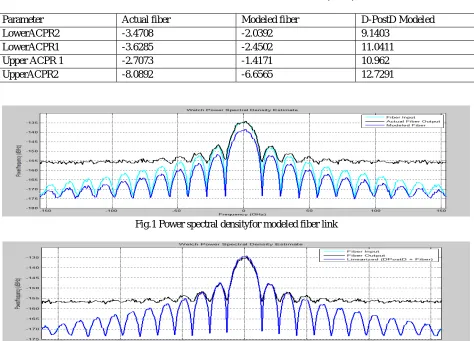
From the Table1 it is concluded that the best compensation of fiber non linearities is obtained with Q=1 and K=3 as the error is minimum for this combination i.e. 0.0113. The memory length of 1 and polynomial degree of 3 is sufficient for modeling of optical fiber link. By keeping memory length same i.e 1 with increase in polynomial degree or keeping polynomial degree same i.e. 3 with increase in memory length, increases the error. The ACPR values of actual fiber link, modeled fiber link and modeled DPost-D for =1 and K=3 are shown in the Table2. Due to high ACPR improvement capability adaptive digital Dpost-D can be used for compensation of fiber nonlinearities.
TABLE I
ACPR measurement for different memory length and polynomial degree
Memory length(Q)
Polynomi al degree(K
LowerAC PR2
LowerACPR1 Upper ACPR 1 UpperACPR2 Error
1 3 -2.0392 -2.4502 -1.4171 -6.6565 0.0113
1 5 0.3794 2.9799 0.5948 -3.1511 0.0207
2 3 -2.3822 -2.5038 -1.3134 -6.4241 0.0116
[image:4.612.72.543.201.352.2]2 5 3.3759 7.6404 2.1984 1.6638 0.0171
TABLE II
ACPR measurement for modeled fiber and DPost-D(in dB)
Parameter Actual fiber Modeled fiber D-PostD Modeled
LowerACPR2 -3.4708 -2.0392 9.1403
LowerACPR1 -3.6285 -2.4502 11.0411
Upper ACPR 1 -2.7073 -1.4171 10.962
[image:4.612.70.544.373.714.2]UpperACPR2 -8.0892 -6.6565 12.7291
Fig.1 Power spectral densityfor modeled fiber link
V. CONCLUSION
This paper proposed the memory Polynomial modeling of optical fiber link for different combinations of memory length and polynomial order which can enhance the modeling accuracy . Simulation results were analyzed and it was observed that the memory length 1 and polynomial order 3 is sufficient to model the optical fiber link. Due to ease of implementation and high ACPR improvement capability, adaptive D-PostD (Digital Post Distortion) is one of the approach that can be used tof compensation of optical fiber link nonlinearities.
VI. ACKNOWLEDGMENTS
I would like to thanks I.K Gujral Punjab Technical University Jalandhar, for providing me opportunity and technical support to complete the research work.
REFERENCES
[1] Splett, C. Kurtzke, and K. Petermann, “Ultimate transmission capacity of amplified fiber communication systems taking into account fiber nonlinearities,” Proc. of 19th European Conference on Optical Communication (ECOC), MoC2.4 (1993).
[2] A. D. Ellis, Z. Jian, and D. Cotter, “Approaching the non-linear Shannon limit,” J. Lightwave Technol.,vol. 28,pp. 423–433,Feb.2010. [3] D. J. Richardson, “Filing the Light Pipe,” Science ,vol.330, pp.327–328,Oct.2010.
[4] E. Temprana, E. Myslivets, B. P.-P. Kuo, V. Ataie, N. Alic, and S. Radic, “Overcoming Kerr-induced capacity limit in optical fiber transmission,” Science ,vol.348, pp. 1445–1448 (2015).
[5] P. J. Winzer, “Scaling Optical Fiber Networks: Challenges and Solutions,” Opt. Photon. News ,vol.26, pp. 28–35,Mar.2015.
[6] R. Essiambre, G. Kramer, P. J. Winzer, G. J. Foschini, and B. Goebel, “Capacity limits of optical fiber networks,” J. Lightwave Technol., vol. 28,pp. 662– 701,2010
[7] M.Mehra, H.Sadawarti,M.L.Singh, “Performance analysis of coherent optical communicationsystem for higher order dual polarization modulation formats”Journal of OPTIK,vol no.135,pp.174-179,Jan2017
[8] M.Mehra, H.Sadawarti,M.L.Singh, “Challenges to coherent optical communication systems and their mitigation techniques –A Review” International Journal of Engineering Science and Technology.vol no.9, pp.582-586,Jun2017
[9] M. Morshed, L. B. Du, and A. J. Lowery, “Mid-span spectral inversion for coherent optical OFDM systems: fundamental limits to performance,” J. Lightw. Technol., vol. 31, pp. 58–66, Jan. 2013
[10] D. Rafique, T. Rahman, A. Napoli, and B. Spinnler. “Intra super-channel fiber nonlinearity compensation in flex-grid optical networks,” Opt. Exp., vol. 21, pp. 32063–32070, Dec. 2013
[11] S. Oda, T. Hoshida, H. Nakashima, Y. Aoki, Z. Tao, and J. C. Rasmussen. “Impact of perturbation back-propagation on carrier phase recovery in 224 Gb/s DP-16QAM transmission,” presented at the Optoelectron. Commun. Conf., Kyoto, Japan, 2013, Paper WR4–1.
[12] Y. Gao, J. C. Cartledge, A. S. Karar, S. S. Yam, M. O. Sullivan, C. Laperle, A. Borowiec, and K. Roberts. “Reducing the complexity of perturbation based nonlinearity pre-compensation using symmetric EDC and pulse shaping,” Opt. Exp., vol. 22, pp. 1209–1219, Jan. 2014
[13] V.E.S.Parahyba,et al. “Performance against implementation of digital backpropagation for high-speed coherent optical systems,”Electron. Lett. ,vol.51,pp. 1094–1096, Sept.2015.
[14] S.B.Amado,et al. “Low complexity advanced DBP algorithms for ultra-long-haul 400G transmission systems,” J. Lightw.Technology, vol.34 ,pp. 1793– 1799.Dec.2015.
[15] Napoli,A.; at el. “ Reduced complexity digital back-propagation methods for optical communication systems,” J. Lightw.Technol., vol. 32,pp. 1351– 1362.Jan.2014.
[16] Rafique,D.;et al. “ Compensation of intra-channel nonlinear fibre impairments using simplified digital back-propagation algorithm,”Opt. Express,vol. 19,pp. 9453–9460.
[17] Lei Ding, et al, “ A robust digital baseband predistorter constructed using memory polynomials,” IEEE Trans. Commun.,vol. 52,pp.157–164, Jan.2004 [18] L.C. Vieira and N.J. Gomes, “ Baseband behavioral modeling of OFDM-radio over fiber link distortion,” IEEE Microwave Photonics Int. Top.
Meet.,pp.188-191,Sept (2012).
[19] Yu Cuiping, Liu Yuanan and Li Shulan, “ Triangular memory polynomial predistorter,” International Conference on Wireless Communications, Networking and Mobile Computing, Sept.2009, pp. 1–4.
[20] T. Du, C. Yu, Y. Liu, J. Gao, S. Li and Y. Wu, “A new accurate volterra-based model for behavioral modeling and digital pre distortion of RF power amplifiers”, Prog.Electromagnet. Res. vol. 29 ,pp. 205–218,May.2012.
[21] Gan Li, Emad Abd-Elrady and Gernot Kubin, “ A simplified predistorter for distortioncompensation of parallel wiener-type systems based on direct learning archi-tecture,” Digital Signal Processing Workshop and fifth IEEE Signal Processing Education Workshop, 2009, pp. 72–77.
[22] Liu Taijun, Slim Boumaiza, Fadhel M. Ghannouchi, “ Augmented Hammerstein predistorter for linearization of broad-band wireless transmitters,” IEEE Trans.Microwave Theory Tech.vol. 54 ,pp.1340–1349, Apr.2006.
[23] A. Hekkala, M. Hiivala, M. Lasanen, J. Perttu, L.C. Vieira, N.J. Gomes and A. Nkansah, “Predistortion of radio over fiber links: algorithms, implementation and measurements,” IEEE Trans. Circuits Syst. vol.59 ,pp. 664–673,Mar.2012.
[24] L.C. Vieira, N.J. Gomes, A. Nkansah and F. van Dijk, “Study of complex-envelop behavioral models for radio over fiber link nonlinearities,” Symposium on Selected Area in Communications, 2012, pp. 3098–3103.
[25] M. Schetzen, The Volterra and Wiener Theories of Nonlinear Systems, Wiley, 1980
[27] D. Morgan, Z. Ma, J. Kim, M. Zierdt, and J. Pastalan, “A generalized memory polynomial model for digital predistortion of RF power amplifiers,” IEEE Trans. Signal Proces. Vol. 54,pp. 3852–3860,Sept.2006.
[28] H. Singh and A.Sappal,” Power Amplifier Linearization Using Digital Pre-Distortion Techniques Based On Memory Polynomial Model and Estimated By Self Organizing Migrating Algorithm.” Journal of Communication and Engineering Research,vol.3,pp.10-15,2016