
R E V I E W
Open Access
Alignment-free sequence comparison:
benefits, applications, and tools
Andrzej Zielezinski
1, Susana Vinga
2, Jonas Almeida
3and Wojciech M. Karlowski
1*Abstract
Alignment-free sequence analyses have been applied to problems ranging from whole-genome phylogeny to the classification of protein families, identification of horizontally transferred genes, and detection of recombined sequences. The strength of these methods makes them particularly useful for next-generation sequencing data processing and analysis. However, many researchers are unclear about how these methods work, how they compare to alignment-based methods, and what their potential is for use for their research. We address these questions and provide a guide to the currently available alignment-free sequence analysis tools.
Introduction
The 1980s and 1990s were a flourishing time not only for pop music but also for bioinformatics, where the emergence of sequence comparison algorithms revolu-tionized the computational and molecular biology fields. At that time, many computational biologists quickly be-came stars in the field by developing programs for se-quence alignment, which is a method that positions the biological sequences’ building blocks to identify regions of similarity that may have consequences for functional, structural, or evolutionary relationships. Many successful alignment-based tools were created including sequence similarity search tools (e.g., BLAST [1], FASTA [2]), multiple sequence aligners (e.g., ClustalW [3], Muscle [4], MAFFT [5]), sequences’ profile search programs (e.g., PSI-BLAST [1], HMMER/Pfam [6]), and whole-genome aligners (e.g., progressive Mauve [7], BLASTZ [8], TBA [9]); these tools became game-changers for anyone who wanted to assess the functions of genes and proteins.
All alignment-based programs, regardless of the underlying algorithm, look for correspondence of indi-vidual bases or amino acids (or groups thereof ) that are in the same order in two or more sequences. The pro-cedure assumes that every sequence symbol can be cate-gorized into at least one of two states—conserved/ similar (match) or non-conserved (mismatch)—although
most alignment programs also model inserted/deleted states (gaps). However, as our understanding of complex evolutionary scenarios and our knowledge about the pat-terns and properties of biological sequences advanced, we gradually uncovered some downsides of sequence comparisons based solely on alignments.
Five cases where alignment-based sequence ana-lysis might be troublesome
First, alignment-producing programs assume that hom-ologous sequences comprise a series of linearly arranged and more or less conserved sequence stretches. How-ever, this assumption, which is termed collinearity, is very often violated in the real world. A good example is viral genomes, which exhibit great variation in the num-ber and order of genetic elements due to their high mu-tation rates, frequent genetic recombination events, horizontal gene transfers, gene duplications, and gene gains/losses [10]. These large-scale evolutionary pro-cesses essentially occur all the time in the genomes of other organisms. As a result, each genome becomes a mosaic of unique lineage-specific segments (i.e., regions shared with a subset of other genomes). Furthermore, the alignment approach may often overlook rearrange-ments on an even smaller scale; for instance, the linear and modular organization of proteins is not always pre-served due to frequent domain swapping, or duplication or deletion of long peptide motifs [11, 12].
Second, the accuracy of sequence alignments drops off rapidly in cases where the sequence identity falls below a certain critical point. For protein sequences, there are 20 * Correspondence:[email protected]
1Department of Computational Biology, Faculty of Biology, Adam Mickiewicz
University in Poznan, Umultowska 89, 61-614 Poznan, Poland Full list of author information is available at the end of the article
possible amino acid residues, and any two unrelated se-quences can match at up to 5% of the residues. If gaps are allowed, then the percentage can increase to 25% [13]. Thus, in practical applications, the area of 20–35% identity is commonly regarded as the “twilight zone” [14], where remote homologs mix with random sequences. Below 20% identity, in the realm of the“midnight zone”, homologous relationships cannot be reliably determined with plain pairwise alignments, often requiring more sophisticated alignment-based solutions, like profiles (e.g., PSI-BLAST) and hidden Markov models (e.g., HMMER). This failure is especially problematic in the annotation of protein super-families where the members retain structural kinship even when the average intersequence identity is 8–10% [15]. For nucleotide sequences, the accuracy of the alignments is even more disappointing. For instance, two randomly related DNA/RNA sequences can show up to 50% se-quence identity when gaps are allowed, and the edge of the twilight zone can encompass nucleotide matches of up to 60–65% [16–18].
Third, alignment-based approaches are generally memory consuming and time consuming and thus are of limited use with multigenome-scale sequence data. The number of possible alignments of two sequences grows rapidly with the length of the sequences (for two se-quences of length N there are (2N)!/(N!)2 different gapped alignments [19], which results in about 1060 alignments for two sequences of length 100). Although there is a method, called dynamic programming, that guarantees obtaining a mathematically optimal (highest scoring) alignment without listing all possible solutions, it is also computationally demanding (time complexity is in the order of the product of the lengths of the input sequences) [20]. Therefore, despite the wealth of tools and more than 15 years of research [7, 21–25], the prob-lem of long sequence alignment is not fully resolved [26]. In addition, available sequence evolutionary models may not directly apply to complete genomes, as recently implicated by the Alignathon project, where over 50% of the aligned positions—at the nucleotide level—were in-consistent between pairs of 13 tested methods [26]. Therefore, even the designers of the alignment algo-rithms and browsers do not claim that their results are correct at all sites across entire genomes [27].
Fourth, the computation of an accurate multiple-sequence alignment is an NP-hard problem, which means that the alignment cannot be solved in a realistic time frame. This situation explains why more than 100 alternative faster methods have been developed over the past three decades [28]. However, the speed optimization does not come without“cost”. These techniques rely on various shortcuts (heuristics) that do not guarantee the identification of the optimal and highest scoring align-ment and often result in inaccuracies that limit the
quality of many downstream analyses (e.g., phylogen-etic). The complexity of the sequence alignment prob-lem even calls for crowdsourcing solutions (e.g., creating the online game Phylo to improve computer-created multiple sequence alignments) [29].
Finally, a sequence alignment depends on multiple a priori assumptions about the evolution of the sequences that are being compared. These various parameters (e.g., substitution matrices, gap penalties, and threshold values for statistical parameters) are somewhat arbitrary, which additionally strains Occam’s razor to breaking point. Moreover, the scoring system is not consensual between applications, and many reports have shown that small changes in the input parameters can greatly affect the alignment [30]. Despite the awareness of the problem, how to choose alignment parameters may often cause problems and usually requires a trial and error approach. (i.e., if an alignment is not good enough, then one can tweak input parameters to get “better-looking” results). Furthermore, reference substitution matrices required for protein alignments (e.g., different series of BLOSUM and PAM) are often used without verifying whether they are representative of the sequences being aligned. Intri-guingly, BLOSUM matrices, which are the most com-monly used substitution matrix series for protein sequence alignments, were found to have been miscalcu-lated years ago and yet produced significantly better alignments than their corrected modern version (RBLO-SUM) [31]; this paradox remains a mystery.
What is alignment-free sequence comparison? Alignment-free approaches to sequence comparison can be defined as any method of quantifying sequence similar-ity/dissimilarity that does not use or produce alignment (assignment of residue–residue correspondence) at any step of algorithm application. From the start, such restric-tion places the alignment-free approaches in a favorable position—as alignment-free methods do not rely on dy-namic programming, they are computationally less expen-sive (as they are generally of a linear complexity depending only on the length of the query sequence [32]) and there-fore suitable for whole genome comparisons [33–36]. Alignment-free methods are also resistant to shuffling and recombination events and are applicable when low se-quence conservation cannot be handled reliably by align-ment [37]. Finally, in contrast to alignalign-ment-based methods, they do not depend on assumptions regarding the evolu-tionary trajectories of sequence changes. Although these characteristics apply to all alignment-free methods, there are more than 100 techniques to consider [37].
content between full-length sequences (information-the-ory based methods). There are also methods that cannot be classified in either of the groups, including those based on the length of matching words (common [40], longest common [41], or the minimal absent [42, 43] words between sequences), chaos game representation [44], iterated maps [45], as well as graphical representa-tion of DNA sequences, which capture the essence of the base composition and distribution of the sequences in a quantitative manner [46, 47].
All of the alignment-free approaches are mathematic-ally well founded in the fields of linear algebra, informa-tion theory, and statistical mechanics, and calculate pairwise measures of dissimilarity or distance between sequences. Conveniently, most of these measures can be directly used as an input into standard tree-building software, such as Phylip [48] or MEGA [49].
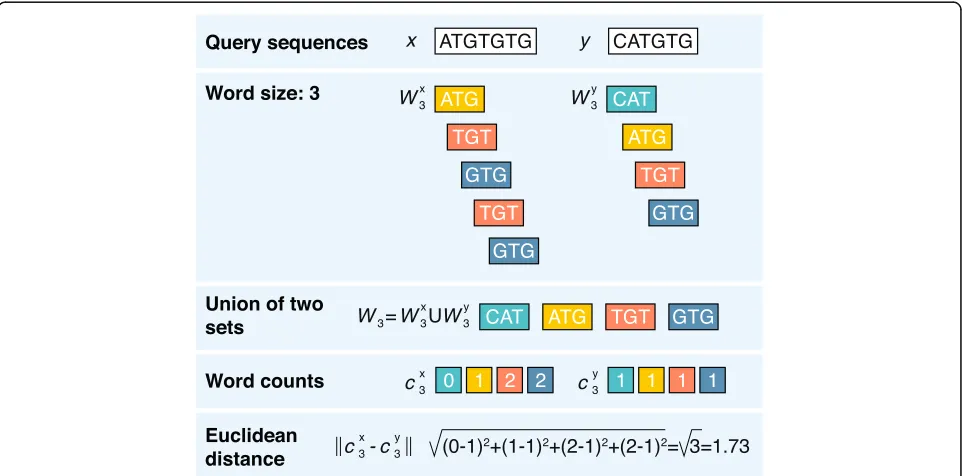
How do word frequency-based methods work? The rationale behind these methods is simple: similar se-quences share similar words/k-mers (subsequences of length k), and mathematical operations with the words’ occurrences give a good relative measure of sequence dissimilarity. The method is also tightly coupled with the idea of genomic signatures, which were first introduced for dinucleotide composition (e.g., GC content) [50] and further extended to longer words. This process can be broken into three key steps (Fig. 1).
First, the sequences being compared must be sliced up into collections of unique words of a given length. For
example, two DNA sequences x =ATGTGTG and y = CATGTG and a word size of three nucleotides (3-mers) produces two collections of unique words: WX3={ATG, TGT, GTG} andWY3={CAT, ATG, TGT, GTG}. Because some words are often present in one sequence but not in the other sequence (i.e., CAT in y but not in x), we create a full set of words that belong to at least WX3 or WY3 to further simplify the calculations, resulting in the union setW3={ATG, CAT, GTG, TGT}.
The second step is to transform each sequence into an array of numbers (vector) (e.g., by counting the number of times each particular word (fromW3) appears within the sequences). For sequences x and y, we identify two real-valued vectors:cX3=(1, 0, 2, 2) andcY3=(1, 1, 1, 1).
The last step includes quantification of the dissimilar-ity between sequences through the application of a dis-tance function to the sequence-representing vectors cX3 and cY3. This difference is very commonly computed by the Euclidean distance, although any metric can be ap-plied [51]. The higher the dissimilarity value, the more distant the sequences; thus, two identical sequences will result in a distance of 0.
Word-based alignment-free algorithms come in differ-ent colors and flavors, with methodological variations at each of the three basic steps. In the first step, one can try any resolutions of word lengths—it is important to choose words that are not likely to commonly appear in a sequence (the shorter the word, then the more likely it will appear randomly in a sequence). In practice, the word size (k) of 2–6 residues produces stable and
[image:3.595.58.539.463.701.2]optimal protein sequence comparisons across a wide range of different phylogenetic distances [52, 53]; in nu-cleotide sequence analyses, k can safely be set to 8–10 for genes or RNA [54], 9–14 bases for general phylogen-etic analyses [34, 55, 56], and up to 25 bases in case of comparison of isolates of the same bacterial species [33, 57]. As a rule of thumb, smaller k-mers should be used when sequences are obviously different (e.g., they are not related) whereas longerk-mers can be used for very similar sequences [55, 58]. Alternatively, DNA/RNA or protein alphabet can be reduced to a smaller number of symbols based on chemical equivalences. This procedure may increase the detection of homologous sequences that display very low identity [53]. For example, the four-letter DNA alphabet can be distilled to two-letter purine–pyrimidine encoding [55], and proteins can be represented by 5, 4, 3, or even 2 letters according to their different physical–chemical properties [52]. The second step (mapping sequences onto vectors) is by far the most customizable; instead of using vectors of word counts or word frequencies, there are many other ways to create vectors, which range from weighting tech-niques to normalization and clustering [32]. Addition-ally, because word-based methods operate on vectors, their mathematical elegance allows the employment of more than 40 functions other than the Euclidean dis-tance, such as the Pearson correlation coefficient [38], Manhattan distance, and Google distance [59].
How do information theory-based methods work? Information theory-based methods recognize and com-pute the amount of information shared between two an-alyzed biological sequences. Nucleotide and amino acid sequences are ultimately strings of symbols, and their digital organization is naturally interpretable with infor-mation theory tools, such as complexity and entropy.
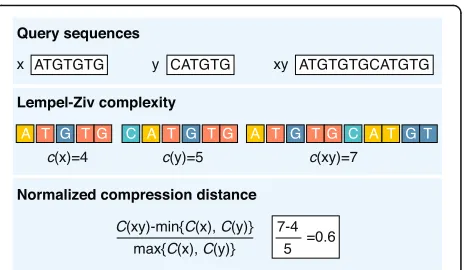
For example, the Kolmogorov complexity of a se-quence can be measured by the length of its shortest de-scription. Accordingly, the sequence AAAAAAAAAA can be described in a few words (10 repetitions of A), whereas CGTGATGT presumably has no simpler de-scription than specification nucleotide by nucleotide (1 C, then 1 G and so on). Intuitively, longer sequence de-scriptions indicate more complexity. However, Kolmogo-rov did not address the method to find the shortest description of a given string of characters. Therefore, the complexity is most commonly approximated by general compression algorithms (e.g., as implemented in zip or gzip programs) where the length of a compressed se-quence gives an estimate of its complexity (i.e., a more complex string will be less compressible) [60]. The cal-culation of a distance between sequences using complex-ity (compression) is relatively straightforward (Fig. 2). This procedure takes the sequences being compared (x
= ATGTGTG andy= CATGTG) and concatenates them to create one longer sequence (xy= ATGTGTG-CATGTG). If x and y are exactly the same, then the complexity (compressed length) of xy will be very close to the complexity of the individualxor y. However, ifx andy are dissimilar, then the complexity ofxy(length of compressed xy) will tend to the cumulative complexities of x and y. Of course, there are as many different information-based distances as there are methods to cal-culate complexity. For example, Lempel–Ziv complexity [61] is a popular measure that calculates the number of different subsequences encountered when viewing the sequence from beginning to end (Fig. 2). Once the com-plexities of the sequences are calculated, a measure of their differences (e.g., the normalized compression dis-tance [62]) can be easily computed. Many DNA-specific compression algorithms are currently being applied to new types of problems [63].
Another example of an information measurement often applied to biological sequences is entropy. This measurement is not similar to the entropy referenced in thermodynamics. Reportedly, Claude Shannon, who was a mathematician working at Bell Labs, asked John von Neumann what he should call his newly developed measure of information content; "Why don't you call it entropy," said von Neumann, "[…] no one understands entropy very well so in any discussion you will be in a position of advantage […]" [64]. The concept of Shannon entropy came from the observation that some English words, such as "the" or "a", are very frequent and thus unsurprising. Thus, these words are redundant because the message can probably be understood without them. The real essence of the message comes from words that are rare, such as "treasure" or "elixir". Therefore, Shan-non developed a formula to quantify the uncertainty
[image:4.595.308.540.86.221.2](entropy) of finding a given element (word) in an analyzed sequence (text). Using Shannon's concept, Kullback and Leibler [65] introduced a relative entropy measure (Kull-back–Leibler divergence, KL) that allowed for a compari-son of two sequences. The procedure involves the calculation of the frequencies of symbols or words in a sequence and the summation of their entropies in the compared sequences (Additional file 1: Figure S1).
Both information-theory concepts (complexity and en-tropy) have a clear association despite their methodical differences. For instance, a low-complexity sequence (e.g., AAAAAAAAA) will have smaller entropy than a more complex sequence (e.g., ACCTGATGT). The ap-plication of information theory in the field of sequence analysis and comparison has exploded in recent years, ranging from global (block entropies and coverage) to local genome analyses (transcription factor binding sites, sequences as time-series and entropic profiles) [39]. Additionally, retrieving higher-level correlations in gene mapping and protein–protein interaction networks and the striking resemblance with communication systems is attracting research attention to this field.
How are alignment-free methods used in next-generation sequencing data analysis?
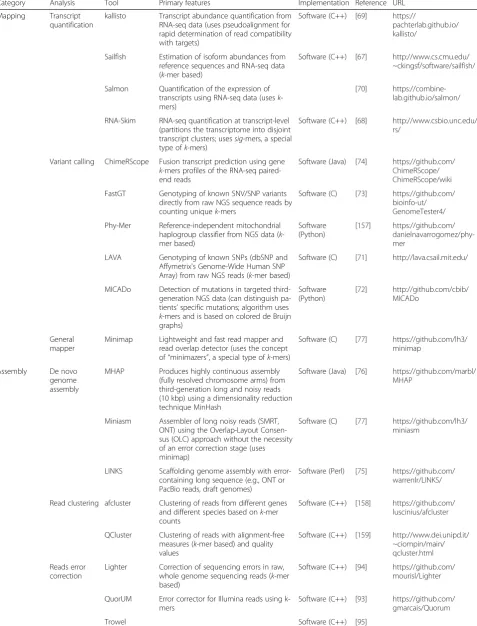
The data volume of samples sequenced so far (estimated to be only 10−20% of the total DNA on Earth [66]) is already challenging the storage and processing capacities of modern computers. In particular, the amount of data generated via next-generation sequencing is swiftly out-pacing analytics capabilities, mainly due to the computa-tionally intensive multiple alignment step. Alignment-free methods not only provide a significant increase in speed over primary next-generation sequencing applications (e.g., expression profiling [67–70], genetic variant calling [71–74], de novo genome assembly [75–77], phylogenetic reconstruction [78–81], and taxonomic classification in metagenomic studies [82–86]) (Table 1), but also offer ways to obtain biologically meaningful information dir-ectly from raw next-generation sequencing data.
For example, alignment-free tools for transcript quan-tification (Kallisto [69], Sailfish [67], Salmon [70]) show that most of the information provided by aligners is not necessary for high-quality estimation of transcript levels. These tools build an index of k-mers from a reference set of transcripts and then calculate the expression by matching them to each sequencing read directly. Such “pseudoalignment” [69] describes the relationship be-tween a read and a set of compatible transcripts. Group-ing pseudoalignments belongGroup-ing to the same set of transcripts allows one to directly infer the expression of each transcript model. This approach to quantify gene/ transcript expression levels from RNA sequencing reads is both 10–100 times faster than any of the
alignment-based methods and at least as accurate as best-performing alignment-based workflows (e.g., TopHat-Cufflinks) [87, 88].
Another major application of next-generation sequen-cing technologies includes profiling of genomic variabil-ities, such as single nucleotide/variant polymorphisms. These genomic alterations are typically detected by genotype calling on mapped reads (e.g., Samtools mpi-leup [89] and GATK HaplotypeCaller [90]). However, alignment-free tools (FastGT [73] and LAVA [71]) allow for genotyping of known variants directly from next-generation sequencing data, based on k-mer analysis. Since these methods are 1–2 orders of magnitude faster than traditional mapping-based detection, they seem to be ideally suited for clinical applications, where sequen-cing data from a large number of individuals need to be processed in a timely manner. For example, MICADo analyzes third-generation sequencing reads for each pa-tient sample within the context of the data of the whole cohort in order to capture patient-specific mutations [72] and ChimeRScope predicts fusion transcripts with potential oncogenic functions, based on the k-mer pro-files of the RNA-seq paired-end reads [74].
Conventional next-generation sequencing computation came of age with the emergence of the MapReduce functional pattern to orchestrate parallelization of order-free operations [90]. It is, therefore, of no surprise that it would be advantageous to implement alignment-free methods for the same pattern. Such a solution comes naturally to the word counting implementation ofk-mer analysis and may have further reaching implications for the molecular applications discussed in the previous paragraph, and it is also found to be a natural fit to scale-free approaches to alignment-free methods [91]. This solution was successfully put to the test in the sim-ultaneous screening of 20Streptococcus pneumoniae ge-nomes for shared suffixes in a volunteer distributed computing implementation of that alignment-free MapReduced implementation [92].
One of the most demanding tasks in today's biology includes assembly of the newly sequenced genomes. In standard applications, it requires an error correction step and construction of the genome scaffold based on read similarity (sequence overlaps). Several alignment-free tools have been created to correct sequencing reads (e.g., Quorum [93]), designed mainly to be fast and memory efficient (e.g., Lighter [94] using sampling ofk -mers instead of counting), as well as highly accurate (e.g., Trowel [95] using quality threshold rather than coverage cut-off in order to extract trustedk-mers).
Table 1Alignment-free sequence comparison tools available for next-generation sequencing data analysis
Category Analysis Tool Primary features Implementation Reference URL
Mapping Transcript quantification
kallisto Transcript abundance quantification from RNA-seq data (uses pseudoalignment for rapid determination of read compatibility with targets)
Software (C++) [69] https://
pachterlab.github.io/ kallisto/
Sailfish Estimation of isoform abundances from reference sequences and RNA-seq data (k-mer based)
Software (C++) [67] http://www.cs.cmu.edu/ ~ckingsf/software/sailfish/
Salmon Quantification of the expression of transcripts using RNA-seq data (usesk -mers)
[70] https://combine-lab.github.io/salmon/
RNA-Skim RNA-seq quantification at transcript-level (partitions the transcriptome into disjoint transcript clusters; usessig-mers, a special type ofk-mers)
Software (C++) [68] http://www.csbio.unc.edu/ rs/
Variant calling ChimeRScope Fusion transcript prediction using gene
k-mers profiles of the RNA-seq paired-end reads
Software (Java) [74] https://github.com/ ChimeRScope/ ChimeRScope/wiki FastGT Genotyping of known SNV/SNP variants
directly from raw NGS sequence reads by counting uniquek-mers
Software (C) [73] https://github.com/ bioinfo-ut/ GenomeTester4/ Phy-Mer Reference-independent mitochondrial
haplogroup classifier from NGS data (k -mer based)
Software (Python)
[157] https://github.com/ danielnavarrogomez/phy-mer
LAVA Genotyping of known SNPs (dbSNP and Affymetrix's Genome-Wide Human SNP Array) from raw NGS reads (k-mer based)
Software (C) [71] http://lava.csail.mit.edu/
MICADo Detection of mutations in targeted third-generation NGS data (can distinguish pa-tients’specific mutations; algorithm uses
k-mers and is based on colored de Bruijn graphs)
Software (Python)
[72] http://github.com/cbib/ MICADo
General mapper
Minimap Lightweight and fast read mapper and read overlap detector (uses the concept of“minimazers”, a special type ofk-mers)
Software (C) [77] https://github.com/lh3/ minimap
Assembly De novo
genome assembly
MHAP Produces highly continuous assembly (fully resolved chromosome arms) from third-generation long and noisy reads (10 kbp) using a dimensionality reduction technique MinHash
Software (Java) [76] https://github.com/marbl/ MHAP
Miniasm Assembler of long noisy reads (SMRT, ONT) using the Overlap-Layout Consen-sus (OLC) approach without the necessity of an error correction stage (uses minimap)
Software (C) [77] https://github.com/lh3/ miniasm
LINKS Scaffolding genome assembly with error-containing long sequence (e.g., ONT or PacBio reads, draft genomes)
Software (Perl) [75] https://github.com/ warrenlr/LINKS/
Read clustering afcluster Clustering of reads from different genes and different species based onk-mer counts
Software (C++) [158] https://github.com/ luscinius/afcluster
QCluster Clustering of reads with alignment-free measures (k-mer based) and quality values
Software (C++) [159] http://www.dei.unipd.it/ ~ciompin/main/ qcluster.html Reads error
correction
Lighter Correction of sequencing errors in raw, whole genome sequencing reads (k-mer based)
Software (C++) [94] https://github.com/ mourisl/Lighter
QuorUM Error corrector for Illumina reads using k-mers
Software (C++) [93] https://github.com/ gmarcais/Quorum
Table 1Alignment-free sequence comparison tools available for next-generation sequencing data analysis(Continued)
https://sourceforge.net/ projects/trowel-ec/ Metagenomics Assembly-free
phylogenomics
AAF Phylogeny reconstruction directly from unassembled raw sequence data from whole genome sequencing projects; provides bootstrap support to assess uncertainty in the tree topology (k-mer based)
Software (Python)
[78] https://github.com/ fanhuan/AAF
kSNP v3 Reference-free SNP identification and estimation of phylogenetic trees using SNPs (based onk-mer analysis)
Software (C) [80,81] https://sourceforge.net/ projects/ksnp/files/
NGS-MC Phylogeny of species based on NGS reads using alignment-free sequence dis-similarity measures d2* and d2Sunder dif-ferent Markov chain models (usingk -words)
R package [79,160] http://www-rcf.usc.edu/ ~fsun/Programs/NGS-MC/ NGS-MC.html
Species identification/ taxonomic profiling
CLARK Taxonomic classification of metagenomic reads to known bacterial genomes using
k-mer search and LCA assignment
Software (C++) [84] http://clark.cs.ucr.edu/
FOCUS Reports organisms present in
metagenomic samples and profiles their abundances (uses composition-based ap-proach and non-negative least squares for prediction)
Web service Software (Python)
[161] http://edwards.sdsu.edu/ FOCUS/
GSM Estimation of abundances of microbial genomes in metagenomic samples (k -mer based)
Software (Go) [162] https://github.com/ pdtrang/GSM
Mash Species identification using assembled or unassembled Illumina, PacBio, and ONT data (based on MinHash dimensionality-reduction technique)
Software (C++) [163] https://github.com/marbl/ mash
Kraken Taxonomic assignment in metagenome analysis by exactk-mer search; LCA assignment of short reads based on a comprehensive sequence database
Software (C++) [83] https://ccb.jhu.edu/ software/kraken/
LMAT Assignment of taxonomic labels to reads byk-mers searches in precomputed database
Software (C+ +/Python)
[82] https://sourceforge.net/ projects/lmat/
stringMLST k-mer-based tool for MLST directly from the genome sequencing reads
Software (Python)
[86] http://
jordan.biology.gatech.edu/ page/software/stringMLST Taxonomer k-mer-based ultrafast metagenomics tool
for assigning taxonomy to sequencing reads from clinical and environmental samples
Web service [164] http://taxonomer.iobio.io/
Other d2-tools Word-based (k-tuple) comparison (pairwise dissimilarity matrix using d2S measure) of metatranscriptomic samples from NGS reads
Software (Python/R)
[56,165] https://code.google.com/ p/d2-tools/
VirHostMatcher Prediction of hosts from metagenomic viral sequences based on ONF using various distance measures (e.g., d2)
Software (C++) [153] https://github.com/ jessieren/VirHostMatcher
MetaFast Statistics calculation of metagenome sequences and the distances between them based on assembly using de Bruijn graphs and Bray–Curtis dissimilarity measure
Software (Java) [166] https://github.com/ctlab/ metafast
The up-to-date list of currently available programs can be found athttp://www.combio.pl/alfree/tools/. Accessed 23 August 2017
data demands dedicated solutions to access more com-plex genomes. The MinHash Alignment Process was de-signed for this task employing probabilistic, locality-sensitive hashing. Integration of the MinHash Alignment Process with the Celera Assembler enabled reference-grade de novo assemblies of several eukaryotic genomes [76]. Another example includes currently developed Miniasm de novo assembler [77], which uses an overlap-layout-consensus approach [96]. Miniasm requires all-versus-all read self-mappings as input, which can be ob-tained by the alignment-free Minimap tool. Finally, LINKS [75] is a genomic tool designed for scaffolding genome assemblies with long reads (including draft ge-nomes). The major advantage of this method is the use of paired k-mers from variable long sequence sources without a need of read correction.
Metagenomics, the study of genomic sequences ob-tained directly from the environment (e.g., aquatic ecosys-tems, human body), has become a primary application of alignment-free methods, in particular programs desig-nated for fast and precise profiling of microbial communi-ties. For example, Kraken [83] and CLARK [84] are top-performing tools designed for this task—they assign taxo-nomic labels to individual reads in large datasets with near perfect accuracy (precision > 99%), even in the presence of unknown organisms. These programs perform metage-nomic classification of next-generation sequencing reads based on the analysis of sharedk-mers between an input read and each genome from a precomputed database. Kra-ken additionally assigns eachk-mer to the lowest common ancestor of all organisms whose genomes contain corre-spondingk-mers (Additional file 1: Figure S2). The evalu-ation of the accuracy and speed of 14 widely used metagenome analysis tools [97] showed that Kraken and CLARK are top state-of-the-art tools with the highest speed, accuracy, and sensitivity (i.e., the fraction of reads that is correctly classified).
The alignment-free techniques are continuously being applied to new next-generation sequencing based solu-tions, for example, phylogenomics (reviewed in [57]), where advances have facilitated construction of high-quality phylogenies directly from raw, unassembled gen-ome sequence data, bypassing both gengen-ome assembly and alignment. Assembly and alignment-free phylogen-etic tools are already available on the market (AAF [78], NGS-MC [79], and kSNP [80, 81]) and although algo-rithmically different (e.g., based on single-nucleotide polymorphism calls or various dissimilarity measures), all of them are capable of phylogeny reconstruction of non-model species even in cases of low sequence cover-age or lack of a reference genome. In addition, the AAF program provides bootstrap support to assess the confi-dence of tree topology and addresses problems of homo-plasy, sequencing error, and incomplete coverage.
Where else can alignment-free sequence compari-son methods be applied?
Progress over the past two decades has led alignment-free research from bioinformatics “curiosities” to a broadening range of successful applications that accom-pany mainstream biology [37].
Distantly related, remote sequences that evolve beyond recognizable similarity are one of the most classic appli-cations of alignment-free mastering. For example, alignment-free approaches were successfully employed in functional annotation of unknown G-protein-coupled receptor (integral cell membrane proteins that play a key role in transducing extracellular signals and have great relevance for pharmacology) sequences that could not be assigned to any previously known receptor family [98]. Another rising trend for the use of word-based alignment-free methods is the detection of functional and/or evolutionary similarities among regulatory se-quences (e.g., promoters, enhancers, and silencers) to es-timate their in vivo activities in different organisms (flies and mammals, including humans) [99–103].
Sequence rearrangements are particularly well handled by alignment-free sequence analyses. Recent studies de-scribed the mosaic structure of viral and bacterial ge-nomes (e.g., by characterizing the recombination break points in HIV-1 strain and Escherichia coli genomes). This analysis provides new evidence for the long-held suspicion that animal E. coli pathogens can also infect humans [104]. Another study [105] discovered a clear signal for a pair of E. coli genomes that had undergone an engineered 125-kb horizontal gene transfer 20 years ago. Alignment-free measures were also applied to de-tect domain shuffling signatures in proteins [106] and to identify the members of complex multidomain proteins, such as kinases [107].
Horizontal gene transfer strongly complicates the task of reconstructing the evolutionary history of genes and species, and alignment-free methods have also proved to be helpful in this field. For example, in a comprehensive study of bacterial genomes, the authors used oligonucle-otides as genomic signatures and showed that horizontal gene transfers accounted for 6% of the genomes on aver-age [108]. Furthermore, the statistical relationships be-tween genomic signatures among several thousand species provided information about possible donor taxa for the identified foreign sequences. In other studies [109, 110], alignment-free approaches were applied to the genomes of the human pathogen Staphylococcus aureusand recovered regions of lateral origin that corre-sponded to genes involved in transport, antibiotic resist-ance, pathogenicity, and virulence.
of prokaryotes, such as the whole-genome phylogeny of E. coli O104:H4, which was the strain that caused the 2011 outbreak in Germany. The analysis revealed a direct line of ancestry leading from a putative typical enteroaggregativeE. coliancestor through the 2001 strain to the 2011 outbreak strain [113]. The alignment-free based phylogeny of almost a hundred Zika virus strains suggested that this mosquito-borne flavivirus originated from Africa and then spread to Asia, the Pacific islands, and throughout the Americas [119]. Alignment-free methods have recently been applied to infer phylogenetic relationships among eukaryotic species (fungi [120], plants [121], and mammals [35]); the resulting trees were extremely similar to the species trees created by the manually curated NCBI taxonomic database, which re-flects the current taxonomic consensus in the literature.
Sequence classification is another field that might benefit from bringing together different alignment-free approaches, such as grouping expressed sequences tags that originate from the same locus or gene family [122], clustering expressed sequence tag sequences with full-length cDNA data [123], and aggregating gene and pro-tein sequences into functional families [124–126]. Alignment-free methods are also used to recognize and classify antigens that are encoded in a sequence in a subtle and recondite manner that is not identifiable by sequence alignment. A recent approach [127, 128] based on the statistical transformation of protein sequences into uniform vectors with various amino acid properties showed an impressive prediction accuracy of up to 89% in discriminating positive and negative sets of bacterial, viral, and tumor antigen datasets. Another common use of alignment-free methods is the classification of species based on a short DNA sequence fragments that can act as true taxon barcodes [129–133].
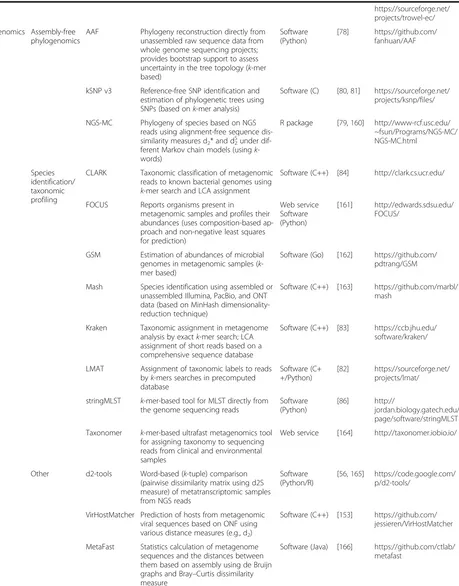
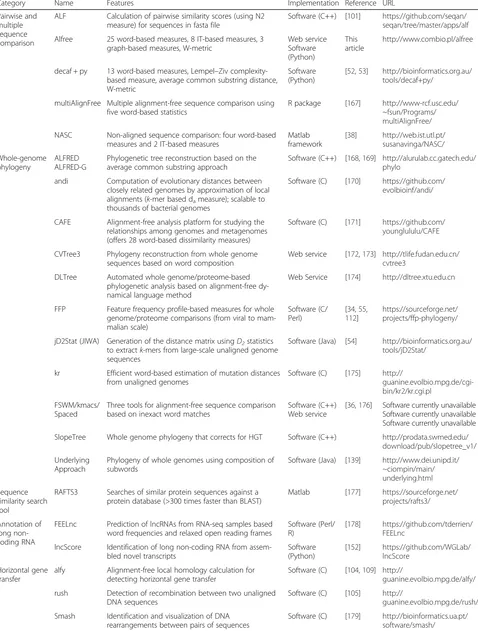
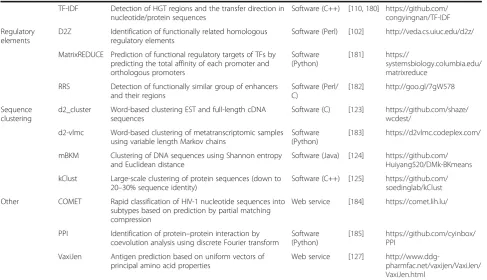
The available alignment-free-based software for gen-eral sequence comparison are listed in Table 2. For con-venience, we categorized the listed programs into basic research tasks, such as small scale pairwise/multiple se-quence comparisons, whole genome phylogeny (from viral to mammalian scale), BLAST-like sequence similar-ity search, identification of horizontally transferred genes and recombination events, as well as annotation of long non-coding RNAs and regulatory elements.
How to use alignment-free methods for research purposes
Among programs listed in Table 2, CAFE is an example of a general purpose alignment-free software that allows exploration of relationships among multiple DNA se-quences through a graphical user interface. The tool in-tegrates 28 dissimilarity measures based on k-mer analysis, including ten conventional (e.g., Euclidean, Manhattan, d2), 15 based on presence/absence ofk-mers (e.g., Jaccard and Hamming distances) and three
state-of-the-art measures based on background adjusted k -mer counts (i.e., CVTree, d*2anddS2). The resulting pair-wise dissimilarities among the sequences form a distance matrix, which can be directly saved in a standard PHY-LIP format. In addition, CAFE presents pairwise dissimi-larity measures in a form of different visualizations, including dendrogram (i.e., tree illustrating the cluster-ing of the sequences), heatmap, principal coordinate analysis, and network display.
Most of the listed tools, including CAFE, are stand-alone programs (only a few were implemented as web services) and therefore may require some specific instal-lation procedures. In this summary article, we have launched a novel, publicly accessible web application for alignment-free sequence comparisons/phylogeny, in a way that anyone can give it a try without any program-ming deployment effort (no expertise required). The web application (http://www.combio.pl/alfree) uses 38 popular alignment-free methods to calculate distances among given nucleotide or protein sequences. By default, running an analysis is a “one-step process”—after pro-viding the input sequences the server will execute the alignment-free analysis in a fully automated mode with-out the need for further user intervention. The results are reported as a consensus phylogenetic tree that sum-marizes the agreement between various individual methods’trees, thus allowing users to assess the reliabil-ity of given phylogenetic relationships across different methods (Fig. 3). Users can also browse trees obtained by individual methods as well as inspect distance mea-sures for any pair of query sequences by using inter-active heat maps and tables.
How well do alignment-free methods work? The performance of alignment-free methods has im-proved greatly since the introduction of the first alignment-free measure exactly 30 years ago [134]. The challenge today, however, is not a lack of alignment-free algorithms (there are almost 100 published methods),
but the number of benchmarking approaches to
alignment-free sequence comparison—once a new method is published, a new evaluation procedure and/or selected dataset is also introduced. For example, the ma-jority of algorithms have been evaluated using various sets of simulated DNA sequences [54, 135, 136], pri-mate/mammalian mitochondrial genomes [40, 61, 137, 138], whole prokaryotic genomes/proteomes [117, 139], selected plant genomes [121, 140], small subsets of hom-ologous genes [141, 142], and different combinations thereof [36, 139].
Table 2Alignment-free sequence comparison tools available for research purposes
Category Name Features Implementation Reference URL
Pairwise and multiple sequence comparison
ALF Calculation of pairwise similarity scores (using N2 measure) for sequences in fasta file
Software (C++) [101] https://github.com/seqan/ seqan/tree/master/apps/alf Alfree 25 word-based measures, 8 IT-based measures, 3
graph-based measures, W-metric
Web service Software (Python)
This article
http://www.combio.pl/alfree
decaf + py 13 word-based measures, Lempel–Ziv complexity-based measure, average common substring distance, W-metric
Software (Python)
[52,53] http://bioinformatics.org.au/ tools/decaf+py/
multiAlignFree Multiple alignment-free sequence comparison using five word-based statistics
R package [167] http://www-rcf.usc.edu/ ~fsun/Programs/ multiAlignFree/ NASC Non-aligned sequence comparison: four word-based
measures and 2 IT-based measures
Matlab framework
[38] http://web.ist.utl.pt/ susanavinga/NASC/ Whole-genome
phylogeny
ALFRED ALFRED-G
Phylogenetic tree reconstruction based on the average common substring approach
Software (C++) [168,169] http://alurulab.cc.gatech.edu/ phylo
andi Computation of evolutionary distances between closely related genomes by approximation of local alignments (k-mer based dameasure); scalable to thousands of bacterial genomes
Software (C) [170] https://github.com/ evolbioinf/andi/
CAFE Alignment-free analysis platform for studying the relationships among genomes and metagenomes (offers 28 word-based dissimilarity measures)
Software (C) [171] https://github.com/ younglululu/CAFE
CVTree3 Phylogeny reconstruction from whole genome sequences based on word composition
Web service [172,173] http://tlife.fudan.edu.cn/ cvtree3
DLTree Automated whole genome/proteome-based phylogenetic analysis based on alignment-free dy-namical language method
Web Service [174] http://dltree.xtu.edu.cn
FFP Feature frequency profile-based measures for whole genome/proteome comparisons (from viral to mam-malian scale)
Software (C/ Perl)
[34,55, 112]
https://sourceforge.net/ projects/ffp-phylogeny/
jD2Stat (JIWA) Generation of the distance matrix usingD2statistics to extractk-mers from large-scale unaligned genome sequences
Software (Java) [54] http://bioinformatics.org.au/ tools/jD2Stat/
kr Efficient word-based estimation of mutation distances from unaligned genomes
Software (C) [175] http://
guanine.evolbio.mpg.de/cgi-bin/kr2/kr.cgi.pl
FSWM/kmacs/ Spaced
Three tools for alignment-free sequence comparison based on inexact word matches
Software (C++) Web service
[36,176] Software currently unavailable Software currently unavailable Software currently unavailable
SlopeTree Whole genome phylogeny that corrects for HGT Software (C++) http://prodata.swmed.edu/ download/pub/slopetree_v1/ Underlying
Approach
Phylogeny of whole genomes using composition of subwords
Software (Java) [139] http://www.dei.unipd.it/ ~ciompin/main/ underlying.html Sequence
similarity search tool
RAFTS3 Searches of similar protein sequences against a protein database (>300 times faster than BLAST)
Matlab [177] https://sourceforge.net/ projects/rafts3/
Annotation of long non-coding RNA
FEELnc Prediction of lncRNAs from RNA-seq samples based word frequencies and relaxed open reading frames
Software (Perl/ R)
[178] https://github.com/tderrien/ FEELnc
lncScore Identification of long non-coding RNA from assem-bled novel transcripts
Software (Python)
[152] https://github.com/WGLab/ lncScore
Horizontal gene transfer
alfy Alignment-free local homology calculation for detecting horizontal gene transfer
Software (C) [104,109] http://
guanine.evolbio.mpg.de/alfy/ rush Detection of recombination between two unaligned
DNA sequences
Software (C) [105] http://
guanine.evolbio.mpg.de/rush/ Smash Identification and visualization of DNA
rearrangements between pairs of sequences
The first benchmark, by Vinga and Almeida (2004) [143], compared the accuracy of six word-based methods in rec-ognition of structurally and evolutionary relationships among proteins. Höhl and Ragan [52, 53] tested the accur-acy of nine alignment-free methods in the construction of phylogenetic trees using homologous proteins represent-ing a wide range of phylogenetic distances. Both research groups showed that, in general, tested alignment-free methods can be as good as alignment algorithms and, as reported in [52], may perform even better in case of pro-tein sequences that underwent domain shuffling events. Dai and colleagues (2008) [99] confronted nine alignment-free distance measures and two alignment-based ap-proaches (Needleman–Wunsch and Smith–Waterman alignment methods) in annotation of functionally related regulatory sequences in human and fly. Almost all tested alignment-free methods detected statistically relevant similarities in sequence compositions in contrast to alignment-based methods that showed only limited cor-respondence recognizable by alignments. In a recent benchmark, Bernard and colleagues (2016 [33]) used sim-ulated and empirical microbial genomes to test the sensi-tivity of nine alignment-free methods under different evolutionary schemes. All approaches generated biologic-ally meaningful phylogenies—alignment-free methods were most sensitive to the extent of sequence divergence, less sensitive to low and moderate frequencies of
horizontal gene transfer, and most robust against genome rearrangements.
We extended the benchmark of Vinga and Almeida (2004) to test 33 popular alignment-free methods (as well as the Smith–Waterman algorithm—the most ac-curate algorithm for sequence alignments) in the classifi-cation of structural and evolutionary relationships between protein sequences from the SCOPe/ASTRAL database [144]. This resource provides a high-quality structural classification of proteins at four levels: class, folds, superfamilies, and families (for details see Add-itional file 2: Table S1). As in the previous study [143], we used a representative subset of the SCOPe database (containing proteins sharing less than 40% identity) as a reference to test 25 word-based and eight information theory-based alignment-free methods along with differ-ent combinations of their input parameters, such as word size (from 1 to 4) and vector type (e.g., counts, fre-quencies, etc.). The performance of each method was assessed using AUC statistics (area under the receiver operating curve; for details about methods see Add-itional file 3: Supplementary methods).
[image:11.595.56.544.100.380.2]The alignment-based algorithm (Smith–Waterman al-gorithm) was outperformed at all SCOP levels—i.e., class, class fold, superfamily, family (AUCs 0.62, 0.67, 0.78, 0.81)—by two word-based measures: normalized Google distance [59] (AUCs 0.63, 0.78, 0.80, 0.84) and Table 2Alignment-free sequence comparison tools available for research purposes(Continued)
TF-IDF Detection of HGT regions and the transfer direction in nucleotide/protein sequences
Software (C++) [110,180] https://github.com/ congyingnan/TF-IDF Regulatory
elements
D2Z Identification of functionally related homologous regulatory elements
Software (Perl) [102] http://veda.cs.uiuc.edu/d2z/
MatrixREDUCE Prediction of functional regulatory targets of TFs by predicting the total affinity of each promoter and orthologous promoters
Software (Python)
[181] https://
systemsbiology.columbia.edu/ matrixreduce
RRS Detection of functionally similar group of enhancers and their regions
Software (Perl/ C)
[182] http://goo.gl/7gW578
Sequence clustering
d2_cluster Word-based clustering EST and full-length cDNA sequences
Software (C) [123] https://github.com/shaze/ wcdest/
d2-vlmc Word-based clustering of metatranscriptomic samples using variable length Markov chains
Software (Python)
[183] https://d2vlmc.codeplex.com/
mBKM Clustering of DNA sequences using Shannon entropy and Euclidean distance
Software (Java) [124] https://github.com/ Huiyang520/DMk-BKmeans kClust Large-scale clustering of protein sequences (down to
20–30% sequence identity)
Software (C++) [125] https://github.com/ soedinglab/kClust Other COMET Rapid classification of HIV-1 nucleotide sequences into
subtypes based on prediction by partial matching compression
Web service [184] https://comet.lih.lu/
PPI Identification of protein–protein interaction by coevolution analysis using discrete Fourier transform
Software (Python)
[185] https://github.com/cyinbox/ PPI
VaxiJen Antigen prediction based on uniform vectors of principal amino acid properties
Web service [127]
http://www.ddg-pharmfac.net/vaxijen/VaxiJen/ VaxiJen.html
The up-to-date list of currently available programs can be found athttp://www.combio.pl/alfree/tools/. Accessed 23 August 2017
Bray–Curtis distance [145] (AUCs 0.63, 0.77, 0.80, 0.84) (Additional file 2: Table S1). Three other word-based methods, including two variants of Squared Euclidean distance [53] as well as the Canberra distance [146], though less accurate in recognition of relationships within class, obtained higher overall scores (AUCs 0.744, 0.733, and 0.725, respectively) than the Smith–Water-man algorithm (AUC 0.72). These results support the
assumption—very often taken for granted—that
alignment-free methods can produce more accurate re-sults than alignment-based solutions when applied to homologous sequences of low similarity. Interestingly, the Smith–Waterman algorithm was outperformed only
by word-based methods with shortk-mers of one to two residues, indicating that the conservation and order of longer sequence stretches are generally not preserved in the sequences, and the relationship between alignment similarity score and structural/evolutionary relationship breaks down. As alignment-free methods do not depend on where the words are found in the sequence, they are typically not confused by the complexities caused by mismatches, gaps, and sequence inversions that are often found in this type of distantly related homolog. It is also interesting to note that word-based methods achieved higher accuracy (AUC 0.67 ± 0.04) than information-theory based solutions (AUC 0.61 ± 0.06)
Fig. 3Snapshot of the results returned by the alignment-free web tool (Alfree) for“example 1”: HIV viral sequences obtained from dental patients in Florida [186]. Briefly, in the late 1980s some patients of an HIV-positive dentist in Florida were diagnosed as infected with HIV. An investigation by the Centers for Disease Control and Prevention did not uncover any hygiene lapses that could result in infection of patients. However, sequence comparison of the gene encoding gpg120 isolated from HIV strains from the dentist, his patients, and other individuals revealed thatPATIENT_A,PATIENT_B,
[image:12.595.58.533.88.449.2](Additional file 2: Table S1). Although explanation of this fact is not straightforward, it may indicate that com-pression procedures included in currently selected methods do not decipher the complexity of highly vari-able protein sequence, which would explain the broader application of the information-theory based methods in DNA sequence analyses. The full results of the bench-mark can be interactively explored [145].
Remarkably, the duration time for the calculation of ap-proximately 22 million pairwise protein comparisons by the Smith–Waterman algorithm took exactly 3 days, which was more than 1000-fold slower than the alignment-free methods (Additional file 3: Supplementary methods). On average, these methods need 4 minutes to complete the task, and the fastest approach (Hamming distance [146]) ran the analysis in only 19 seconds.
The implementations of all alignment-free methods used in this study are provided as a stand-alone Python application [147]. We also supplement this article with the benchmark dataset [148] for reference analysis that can be readily reproduced by enthusiasts or developers building new alignment-free solutions.
Conclusions
As sequencing technology becomes less expensive and more ubiquitous, the computational challenges of se-quence analyses will become even more prominent. This issue pushes the current focus of development towards faster alignment-independent solutions. Will these new techniques spell doom for traditional alignments? Most likely not in the authors’ lifetime. Alignment is still ir-replaceable in many aspects of today's biology, such as the annotation of conserved protein domains and motifs, tracking phenotype-related sequence polymor-phisms, reconstruction of ancestral DNA sequences, determining the rate of sequence evolution, and homology-based modeling of three-dimensional pro-tein structures. In addition, the research on, and the development of, alignment-free methods is still rela-tively young, holding considerable potential for im-provement, whereas alignment approaches are already mature and only a few alignment-free methods have really challenged the validity and reliability of alignment-based techniques.
Most published articles about alignment-free sequence comparison methods are still mainly technical, exploring their mathematical foundations and theoretical perform-ance (versus alignment-based approaches), very often evaluated with individually selected, mostly simulated, data sets. Although many alignment-free programs exist (as shown in Tables 1 and 2), the majority of published alignment-free methods are still not supplemented with software implementations and thus cannot easily be compared on common sets of data. The absence of
well-defined benchmarks covering various evolutionary sce-narios of sequence divergence creates a major obstacle for researchers who simply need to know the current “best” tool. Consequently, it is still difficult to state which alignment-free method might be particularly suited for a certain task. The stage thus appears to be now set for application of alignment-free methods on real world data sets, which seems to be the only way for these methods to be widely accepted by scientists in biology and related fields [149].
Although alignment-free methods are computationally relatively easily scalable to multigenome data, they do have some“skeletons in their closet”. For example, using longk-mers in word-based methods may impose a sub-stantial memory overhead (the total number of possible DNA words of length 14 is 414, which is about 4 GB). Although information-theory methods that are based on the compression algorithms are more memory efficient and computationally inexpensive, they may fail to de-cipher complex organization levels in the sequences [39] (also shown in results obtained in this study; Additional file 2: Table S1). Some of these issues have already been addressed; for example, recent reports demonstrate the reasonable memory usage of word-based approaches (with long 25-mers) for phylogenetic reconstruction of more than 100 bacterial genomes [54, 150].
Nevertheless, alignment-free algorithms are rapidly ex-tending the range of their applications [151–154] and answering previously intractable questions in phyloge-nomics and horizontal gene transfer (reviewed in [57]), population genetics (reviewed in [111]), evolution of regulatory sequences, and links between the genome and epigenome (reviewed in [155]). Disadvantages of next-generation sequencing data processing and analysis seem to be particularly well addressed by the alignment-free methods (reviewed in [156]). The currently dominantk -mer approaches are bound to novel measures for bio-logical applications (e.g., Google distance [59]) and ap-plication of advanced information theory-based methods should improve the available alignment-free and alignment-based tool box. From this fair competition be-tween alignment-based and alignment-free camps, scien-tists can get only the best. In this respect, the next years should be very exciting.
Additional files
Additional file 1:Figures S1.andFigure S2.Kraken algorithm for taxonomic labeling of metagenomic DNA sequences (based on Wood and Salzberg, 2014) [83]. (DOCX 864 kb)
Additional file 2: Table S1.Ranking list of alignment-free methods and the Smith-Waterman algorithm based on the area under the curve measures across four structural levels of the SCOP2 database. (DOCX 39 kb)
Authors’contributions
AZ and WMK conceived and designed the study. AZ implemented the web application and performed analyses. SV and JA designed the benchmark framework. AZ, SV, JA, and WMK wrote the manuscript. All authors read and approved the final manuscript.
Funding
This work was supported by the KNOW RNA Research Centre in Poznan (No. 01/KNOW2/2014) and partially by FCT through projects UID/EMS/50022/2013 and IF/00653/2012.
Availability of data and materials
Alfree web application is available at http://www.combio.pl/alfree. The protein sequences used for the benchmark analysis in this manuscript were obtained from the SCOPe/STRAL database.
Ethics approval and consent to participate Not applicable.
Competing interests
The authors declare that they have no competing interests.
Author details 1
Department of Computational Biology, Faculty of Biology, Adam Mickiewicz University in Poznan, Umultowska 89, 61-614 Poznan, Poland.2IDMEC, Instituto Superior Técnico, Universidade de Lisboa, Av. Rovisco Pais 1, 1049-001 Lisbon, Portugal.3Stony Brook University (SUNY), 101 Nicolls Road, Stony Brook, NY 11794, USA.
References
1. Altschul SF, Madden TL, Schäffer AA, Zhang J, Zhang Z, Miller W, et al. Gapped BLAST and PSI-BLAST: a new generation of protein database search programs. Nucleic Acids Res. 1997;25:3389–402.
2. Pearson WR, Lipman DJ. Improved tools for biological sequence comparison. Proc Natl Acad Sci U S A. 1988;85:2444–8.
3. Thompson JD, Higgins DG, Gibson TJ. CLUSTAL W: improving the sensitivity of progressive multiple sequence alignment through sequence weighting, position-specific gap penalties and weight matrix choice. Nucleic Acids Res. 1994;22:4673–80.
4. Edgar RC. MUSCLE: multiple sequence alignment with high accuracy and high throughput. Nucleic Acids Res. 2004;32:1792–7.
5. Katoh K, Misawa K, Kuma K, Miyata T. MAFFT: a novel method for rapid multiple sequence alignment based on fast Fourier transform. Nucleic Acids Res. 2002;30:3059–66.
6. Finn RD, Bateman A, Clements J, Coggill P, Eberhardt RY, Eddy SR, et al. Pfam: the protein families database. Nucleic Acids Res. 2014;42:D222–30. 7. Darling AE, Mau B, Perna NT. ProgressiveMauve: multiple genome alignment
with gene gain, loss and rearrangement. PLoS One. 2010;5:e11147. 8. Schwartz S, Kent WJ, Smit A, Zhang Z, Baertsch R, Hardison RC, et al.
Human-mouse alignments with BLASTZ. Genome Res. 2003;13:103–7. 9. Blanchette M, Kent WJ, Riemer C, Elnitski L, Smit AF, Roskin KM, et al.
Aligning multiple genomic sequences with the threaded blockset aligner. Genome Res. 2004;14:708–15.
10. Duffy S, Shackelton LA, Holmes EC. Rates of evolutionary change in viruses: patterns and determinants. Nat Rev Genet. 2008;9:267–76.
11. Song N, Joseph JM, Davis GB, Durand D. Sequence similarity network reveals common ancestry of multidomain proteins. PLoS Comput Biol. 2008; 4, e1000063.
12. Terrapon N, Weiner J, Grath S, Moore AD, Bornberg-Bauer E. Rapid similarity search of proteins using alignments of domain arrangements.
Bioinformatics. 2014;30:274–81.
13. Xiong J. Essential bioinformatics. 1st ed. Cambridge: Cambridge University Press; 2006.
14. Rost B. Twilight zone of protein sequence alignments. Protein Eng. 1999;12:85–94. 15. Chattopadhyay AK, Nasiev D, Flower DR. A statistical physics perspective on alignment-independent protein sequence comparison. Bioinformatics. 2015; 31:2469–74.
16. Eddy SR. Where did the BLOSUM62 alignment score matrix come from? Nat Biotechnol. 2004;22:1035–6.
17. Gardner PP, Wilm A, Washietl S. A benchmark of multiple sequence alignment programs upon structural RNAs. Nucleic Acids Res. 2005;33:2433–9. 18. Capriotti E, Marti-Renom MA. Quantifying the relationship between
sequence and three-dimensional structure conservation in RNA. BMC Bioinformatics. 2010;11:322.
19. Lange K. Mathematical and statistical methods for genetic analysis. 2nd ed. New York, NY: Springer New York; 2002.
20. Eddy SR. What is dynamic programming? Nat Biotechnol. 2004;22:909–10. 21. Darling ACE, Mau B, Blattner FR, Perna NT. Mauve: multiple alignment of conserved
genomic sequence with rearrangements. Genome Res. 2004;14:1394–403. 22. Angiuoli SV, Salzberg SL. Mugsy: fast multiple alignment of closely related
whole genomes. Bioinformatics. 2011;27:334–42.
23. Pevzner P, Tesler G. Genome rearrangements in mammalian evolution: lessons from human and mouse genomes. Genome Res. 2003;13:37–45. 24. Kent WJ, Baertsch R, Hinrichs A, Miller W, Haussler D. Evolution’s cauldron:
duplication, deletion, and rearrangement in the mouse and human genomes. Proc Natl Acad Sci U S A. 2003;100:11484–9.
25. Schwartz S, Zhang Z, Frazer KA, Smit A, Riemer C, Bouck J, et al. PipMaker—a web server for aligning two genomic DNA sequences. Genome Res. 2000;10:577–86.
26. Earl D, Nguyen N, Hickey G, Harris RS, Fitzgerald S, Beal K, et al. Alignathon: a competitive assessment of whole-genome alignment methods. Genome Res. 2014;24:2077–89.
27. Prakash A, Tompa M. Measuring the accuracy of genome-size multiple alignments. Genome Biol. 2007;8:R124.
28. Chatzou M, Magis C, Chang J-M, Kemena C, Bussotti G, Erb I, et al. Multiple sequence alignment modeling: methods and applications. Brief Bioinform. 2015;17:1–15.
29. Kawrykow A, Roumanis G, Kam A, Kwak D, Leung C, Wu C, et al. Phylo: a citizen science approach for improving multiple sequence alignment. PLoS One. 2012;7:e31362.
30. Wong KM, Suchard MA, Huelsenbeck JP. Alignment uncertainty and genomic analysis. Science. 2008;319:473–6.
31. Styczynski MP, Jensen KL, Rigoutsos I, Stephanopoulos G. BLOSUM62 miscalculations improve search performance. Nat Biotechnol. 2008;26:274–5. 32. Bonham-Carter O, Steele J, Bastola D. Alignment-free genetic sequence
comparisons: a review of recent approaches by word analysis. Brief Bioinform. 2014;15:890–905.
33. Bernard G, Chan CX, Ragan MA. Alignment-free microbial phylogenomics under scenarios of sequence divergence, genome rearrangement and lateral genetic transfer. Sci Rep. 2016;6:28970.
34. Jun S-R, Sims GE, Wu GA, Kim S-H. Whole-proteome phylogeny of prokaryotes by feature frequency profiles: An alignment-free method with optimal feature resolution. Proc Natl Acad Sci U S A. 2010;107:133–8. 35. Sims GE, Jun S-R, Wu GA, Kim S-H. Whole-genome phylogeny of mammals:
evolutionary information in genic and nongenic regions. Proc Natl Acad Sci U S A. 2009;106:17077–82.
36. Leimeister C-A, Sohrabi-jahromi S, Morgenstern B. Fast and accurate phylogeny reconstruction using filtered spaced-word matches. Bioinformatics. 2017;33:1–9.
37. Vinga S. Editorial: Alignment-free methods in computational biology. Brief Bioinform. 2014;15:341–2.
38. Vinga S, Almeida J. Alignment-free sequence comparison—a review. Bioinformatics. 2003;19:513–23.
39. Vinga S. Information theory applications for biological sequence analysis. Brief Bioinform. 2014;15:376–89.
40. Ulitsky I, Burstein D, Tuller T, Chor B. The average common substring approach to phylogenomic reconstruction. J Comput Biol. 2006;13:336–50. 41. Haubold B, Pierstorff N, Möller F, Wiehe T. Genome comparison
without alignment using shortest unique substrings. BMC Bioinformatics. 2005;6:123.
42. Pinho AJ, Ferreira PJSG, Garcia SP, Rodrigues JMOS. On finding minimal absent words. BMC Bioinformatics. 2009;10:137.
43. Yang L, Zhang X, Wang T, Zhu H. Large local analysis of the unaligned genome and its application. J Comput Biol. 2013;20:19–29.
44. Jeffrey HJ. Chaos game representation of gene structure. Nucleic Acids Res. 1990;18:2163–70.
45. Almeida JS. Sequence analysis by iterated maps, a review. Brief Bioinform. 2014;15:369–75.
47. RandićM, Zupan J, Balaban AT. Unique graphical representation of protein sequences based on nucleotide triplet codons. Chem Phys Lett. 2004;397:247–52.
48. Felsenstein J. PHYLIP (Phylogeny Inference Package) version 3.6. Distributed by the author. Seattle: Department of Genome Sciences, University of Washington; 2005.
49. Kumar S, Stecher G, Tamura K. MEGA7: Molecular Evolutionary Genetics Analysis Version 7.0 for Bigger Datasets. Mol Biol Evol. 2016;33:1870–4. 50. Deschavanne PJ, Giron A, Vilain J, Fagot G, Fertil B. Genomic signature:
characterization and classification of species assessed by chaos game representation of sequences. Mol Biol Evol. 1999;16:1391–9.
51. Vinga S. Biological sequence analysis by vector-valued functions: revisiting alignment-free methodologies for DNA and protein classification. In: Pham TD, Yan H, Crane DI, editors. Advanced computational methods for biocomputing and bioimaging. New York : Nova Science; 2007. p. 70–105. 52. Höhl M, Rigoutsos I, Ragan MA. Pattern-based phylogenetic distance
estimation and tree reconstruction. Evol Bioinform Online. 2006;2:359–75. 53. Höhl M, Ragan MA. Is multiple-sequence alignment required for accurate
inference of phylogeny? Syst Biol. 2007;56:206–21.
54. Chan CX, Bernard G, Poirion O, Hogan JM, Ragan MA. Inferring phylogenies of evolving sequences without multiple sequence alignment. Sci Rep. 2014;4:6504. 55. Sims GE, Jun S, Wu GA, Kim S. Alignment-free genome comparison with
feature frequency profiles (FFP) and optimal resolutions. Proc Natl Acad Sci U S A. 2009;106:2677–82.
56. Wang Y, Liu L, Chen L, Chen T, Sun F. Comparison of metatranscriptomic samples based on k-tuple frequencies. PLoS One. 2014;9, e84348. 57. Bernard G, Chan CX, Chan Y, Chua X-Y, Cong Y, Hogan JM, et al.
Alignment-free inference of hierarchical and reticulate phylogenomic relationships. Brief Bioinform. 2017;286:1443a.
58. Wu T-J, Huang Y-H, Li L-A. Optimal word sizes for dissimilarity measures and estimation of the degree of dissimilarity between DNA sequences. Bioinformatics. 2005;21:4125–32.
59. Lee JC, Rashid NA. Adapting normalized google similarity in protein sequence comparison. International Symposium on Information Technolnology. September 2008. p. 1–5.
60. Li M, Vitányi P. An introduction to Kolmogorov complexity and its applications. New York, NY: Springer New York; 2008.
61. Otu HH, Sayood K. A new sequence distance measure for phylogenetic tree construction. Bioinformatics. 2003;19:2122–30.
62. Li M, Chen X, Li X, Ma B, Vitanyi PMB. The similarity metric. IEEE Trans Inf Theory. 2004;50:3250–64.
63. Giancarlo R, Rombo SE, Utro F. Compressive biological sequence analysis and archival in the era of high-throughput sequencing technologies. Brief Bioinform. 2014;15:390–406.
64. Tribus M, McIrvine EC. Energy and information. Sci Am. 1971;225:179–88. 65. Kullback S, Leibler RA. On information and sufficiency. Ann Math Stat.
1951;22:79–86.
66. Microbiology by numbers. Nat Rev Microbiol. 2011;9:628.
67. Patro R, Mount SM, Kingsford C. Sailfish enables alignment-free isoform quantification from RNA-seq reads using lightweight algorithms. Nat Biotechnol. 2014;32:462–4.
68. Zhang Z, Wang W. RNA-Skim: a rapid method for RNA-Seq quantification at transcript level. Bioinformatics. 2014;30:i283–92.
69. Bray NL, Pimentel H, Melsted P, Pachter L. Near-optimal probabilistic RNA-seq quantification. Nat Biotechnol. 2016;34:525–7.
70. Patro R, Duggal G, Love MI, Irizarry RA, Kingsford C. Salmon provides fast and bias-aware quantification of transcript expression. Nat Methods. 2017;14:417–9. 71. Shajii A, Yorukoglu D, William Yu Y, Berger B. Fast genotyping of known
SNPs through approximate k-mer matching. Bioinformatics. 2016;32:i538–44. 72. Rudewicz J, Soueidan H, Uricaru R, Bonnefoi H, Iggo R, Bergh J, et al.
MICADo–looking for mutations in targeted PacBio cancer data: an alignment-free method. Front Genet. 2016;7:214.
73. Pajuste F-D, Kaplinski L, Möls M, Puurand T, Lepamets M, Remm M. FastGT: an alignment-free method for calling common SNVs directly from raw sequencing reads. Sci Rep. 2017;7:2537.
74. Li Y, Heavican TB, Vellichirammal NN, Iqbal J, Guda C. ChimeRScope: a novel alignment-free algorithm for fusion transcript prediction using paired-end RNA-Seq data. Nucleic Acids Res. 2017;45:1–18.
75. Warren RL, Yang C, Vandervalk BP, Behsaz B, Lagman A, Jones SJM, et al. LINKS: scalable, alignment-free scaffolding of draft genomes with long reads. Gigascience. 2015;4:35.
76. Berlin K, Koren S, Chin C-S, Drake JP, Landolin JM, Phillippy AM. Assembling large genomes with single-molecule sequencing and locality-sensitive hashing. Nat Biotechnol. 2015;33:623–30.
77. Li H. Minimap and miniasm: Fast mapping and de novo assembly for noisy long sequences. Bioinformatics. 2016;32:2103–10.
78. Fan H, Ives AR, Surget-Groba Y, Cannon CH. An assembly and alignment-free method of phylogeny reconstruction from next-generation sequencing data. BMC Genomics. 2015;16:522.
79. Ren J, Song K, Deng M, Reinert G, Cannon CH, Sun F. Inference of Markovian properties of molecular sequences from NGS data and applications to comparative genomics. Bioinformatics. 2016;32:993–1000. 80. Gardner SN, Hall BG. When whole-genome alignments just won’t work:
kSNP v2 software for alignment-free SNP discovery and phylogenetics of hundreds of microbial genomes. PLoS One. 2013;8:e81760.
81. Gardner SN, Slezak T, Hall BG. kSNP3.0: SNP detection and phylogenetic analysis of genomes without genome alignment or reference genome. Bioinformatics. 2015;31:2877–8.
82. Ames SK, Hysom DA, Gardner SN, Lloyd GS, Gokhale MB, Allen JE. Scalable metagenomic taxonomy classification using a reference genome database. Bioinformatics. 2013;29:2253–60.
83. Wood DE, Salzberg SL. Kraken: ultrafast metagenomic sequence classification using exact alignments. Genome Biol. 2014;15:R46. 84. Ounit R, Lonardi S. Higher classification sensitivity of short metagenomic
reads with CLARK-S. Bioinformatics. 2016;32:3823–5.
85. Roosaare M, Vaher M, Kaplinski L, Möls M, Andreson R, Lepamets M, et al. StrainSeeker: fast identification of bacterial strains from raw sequencing reads using user-provided guide trees. PeerJ. 2017;5:e3353.
86. Gupta A, Jordan IK, Rishishwar L. stringMLST: a fast k-mer based tool for multilocus sequence typing. Bioinformatics. 2017;33:119–21.
87. Everaert C, Luypaert M, Maag JLV, Cheng QX, Dinger ME, Hellemans J, et al. Benchmarking of RNA-sequencing analysis workflows using whole-transcriptome RT-qPCR expression data. Sci Rep. 2017;7:1559.
88. Jin H, Wan Y-W, Liu Z. Comprehensive evaluation of RNA-seq quantification methods for linearity. BMC Bioinformatics. 2017;18:117.
89. Li H, Handsaker B, Wysoker A, Fennell T, Ruan J, Homer N, et al. The Sequence Alignment/Map format and SAMtools. Bioinformatics. 2009;25:2078–9. 90. McKenna A, Hanna M, Banks E, Sivachenko A, Cibulskis K, Kernytsky A, et al.
The Genome Analysis Toolkit: A MapReduce framework for analyzing next-generation DNA sequencing data. Genome Res. 2010;20:1297–303. 91. Almeida JS, Grüneberg A, Maass W, Vinga S. Fractal MapReduce
decomposition of sequence alignment. Algorithms Mol Biol. 2012;7:12. 92. Wilkinson SR, Almeida JS. QMachine: commodity supercomputing in web
browsers. BMC Bioinformatics. 2014;15:176.
93. Marçais G, Yorke JA, Zimin A. QuorUM: An error corrector for Illumina reads. PLoS One. 2015;10:1–13.
94. Song L, Florea L, Langmead B. Lighter: fast and memory-efficient sequencing error correction without counting. Genome Biol. 2014;15:509. 95. Lim EC, Müller J, Hagmann J, Henz SR, Kim ST, Weigel D. Trowel: A fast and
accurate error correction module for Illumina sequencing reads. Bioinformatics. 2014;30:3264–5.
96. Li Z, Chen Y, Mu D, Yuan J, Shi Y, Zhang H, et al. Comparison of the two major classes of assembly algorithms: overlap-layout-consensus and de-bruijn-graph. Brief Funct Genomics. 2012;11:25–37.
97. Lindgreen S, Adair KL, Gardner PP. An evaluation of the accuracy and speed of metagenome analysis tools. Sci Rep. 2016;6:19233.
98. Suwa M. Bioinformatics tools for predicting GPCR gene functions. In: Filizola M, editor. G protein-coupled receptors–modeling and simulation. Springer: Netherlands; 2014. p. 205–24.
99. Dai Q, Yang Y, Wang T. Markov model plus k-word distributions: a synergy that produces novel statistical measures for sequence comparison. Bioinformatics. 2008;24:2296–302.
100. van Helden J. Metrics for comparing regulatory sequences on the basis of pattern counts. Bioinformatics. 2004;20:399–406.
101. Göke J, Schulz MH, Lasserre J, Vingron M. Estimation of pairwise sequence similarity of mammalian enhancers with word neighbourhood counts. Bioinformatics. 2012;28:656–63.
102. Kantorovitz MR, Robinson GE, Sinha S. A statistical method for alignment-free comparison of regulatory sequences. Bioinformatics. 2007;23:i249–55. 103. Ivan A, Halfon MS, Sinha S. Computational discovery ofcis-regulatory
![Fig. 3 Snapshot of the results returned by the alignment-free web tool (Alfree) forsequences from the dentist, the dentist “example 1”: HIV viral sequences obtained from dental patients inFlorida [186]](https://thumb-us.123doks.com/thumbv2/123dok_us/8595030.864350/12.595.58.533.88.449/snapshot-returned-alignment-forsequences-sequences-obtained-patients-inflorida.webp)
