Technology (IJRASET)
Imperative Study on WIMAX Technology
Nnochiri, I.U., Ugboaja S.
Department of Computer Science, Michael Okpara University of Agriculture, Umudike, Abia State, Nigeria
Abstract: Worldwide Interoperability for Microwave Access (WiMAX) is a recent wireless broadband standard that has promised high bandwidth over long-range transmission. The standard specifies the air interface, including the medium access control (MAC) and physical (PHY) layers, of BWA. In this paper, an extended overview of the Worldwide Interoperability for Microwave Access (WiMAX) is presented. It looks at the technology behind WiMAX and networks design and deployment factors that impact WiMAX coverage.
Index words: Bandwidth, Networks, WiMAX, Technology, Transmission, Wireless, Broadband
I. INTRODUCTION
WiMAX is a wireless broadband technology based on wireless metropolitan area networking (WMAN) standard developed by IEEE 802.16 group. WiMAX networks provides high data rates, last mile wireless access, point to multipoint communication, large frequency range and quality of services for various type of applications. There are two WiMAX standards, IEEE 802.16d-2004 (also known as Fixed WiMAX) and IEEE 802.16e-2005 (also known as Mobile WiMAX)
Fixed WiMAX supports fixed and nomadic applications while mobile WiMAX provides support to mobile, portable, fixed and nomadic applications. WiMAX is convergence of wireless with the internet. In other words, WiMAX promises to deliver the internet throughout the globe connecting the last mile of communication services [1].
WiMAX provides solution to constantly increasing demands for broadband wireless applications. The bandwidth and range of WiMAX make it suitable for following potential applications: (i) providing portable broadband connectivity across cities and countries through variety of devices, (ii) providing wireless alternative to cable and digital subscriber line (DSL) for "last mile broadband access”, and (iii) providing data, telecommunication (VoIP) and IPTV services (triple play).
WiMAX operates both in 10GHz-66GHz (licensed frequency band) as well as 2 Ghz-11Ghz (unlicensed frequency band) for Line of Sight (LOS) and Non-line of Sight operation respectively [2]. The WiMAX Network technology is an evolutionary one as it uses orthogonal frequency division multiplexing which makes transmission resist fading and minimizes multipath effect. In addition, a WiMAX network can work as a point-to-point backhaul trunk with a transmission capability of 72Mbps at a transmission distance over 30 miles. With its technological advantages of power, throughput, transmission range and versatility,
WiMAX might be a strong competitor of other technologies, such as WiFi and 3G. It is the capability of WiMAX networks in providing high bandwidth with QoS deployed over large areas which is seen as key advantage of WiMAX.
The 802.16e-2005 standard is the amendment of standard 802.16d-2004.The major difference between fixed and mobile WiMAX is that mobile variant enables a hand-off from one base station to another as the user, in one session, moves from the coverage zone of one base station to another. This is known as mobility management [3]. Other important difference is that the fixed 802.16-2004 standard uses OFDM 256 technology for its PHY whereas mobile 802.16-2005 standard utilizes scalable OFDMA. Orthogonal Frequency Division Multiplexing (OFDM) breaks the wireless carrier into 256 sub-carriers. Orthogonal Frequency
Division Multiple Access (OFDMA) breaks the subcarrier into group of sub carriers known as sub channels (up to 2048 sub carriers). As the importance of WiMAX Networks has increased, quite a few research efforts have been made in different aspects. Here, we list the previous works related to the same aspects in which we have pursued our research.
Technology (IJRASET)
nodes, distance from base station and mobile speed.
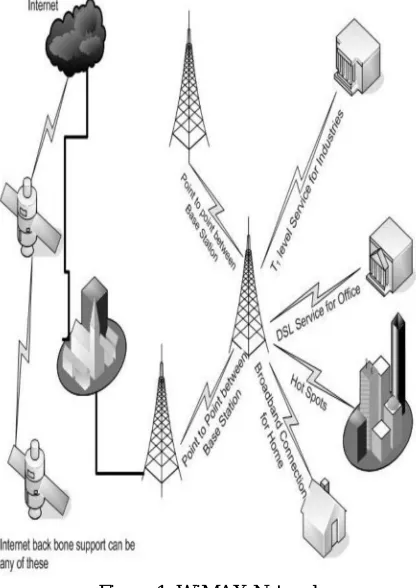
[image:3.612.201.409.158.452.2]Research in [6] investigated the distance effects on performance degradation of mobile WiMAX. Several scenarios had been created and the mobile WiMAX topology had been tested. The data of the simulation results was gathered and the percentages of performance degradation with the effects of distance between mobile station and base station were analyzed. Based on the results obtained, the data rate degrades slightly when the distance between base station and mobile station is more than 10000 meters.
Figure 1: WiMAX Network
II. KEY CHARACTERISTICS OF WIRELESS TECHNOLOGY
The key characteristics for which the most powerful next generation wireless technology is evaluated in this research paper are: efficiency, maximum range, dependability, security, market issue and mobility.
A. Efficiency
Efficiency of wireless technology is measured in terms of bandwidth and latency. Efficiency is a major issue to determine what type of applications can be run on a network. A less bandwidth network only feasibly for small application and normally support simple data application for example transferring text files. A higher bandwidth network normally used for big application such as audio and video and many more powerful applications. Another major issue in case of real-time applications like voice is latency which is very much crucial issue. The maximum range of latency should not be more than 20 ms, anything higher than that be warring for establishing echo free wireless network.
B. Maximum Range
Technology (IJRASET)
base stations.
C. Dependability
Dependability is defined as how much a wireless technology is dependable to the end user. Whether end user think that is it reliable to use or not? Dependability measure with few important metrics like average number of packet loss, average number of disconnects of calls, and whether the wireless technology is hampered by environmental issues such as line of sight, weather, etc. Dependability is very crucial because some applications may require a reliable connection. If a connection is not dependable, in that case packets may loss and that affect the network for that reason the speed of the network will decrease. This would have certainly impact on the performance of any applications, hence decreasing the applications that will use on the wireless network
D. Security
Today’s internet is open for all. And user exchange many personal data in internet. So normally end user wants security.
Security is obtained from the level of encryption of the data and the authentication of the device is provided by each technology. For many applications such as exchanging bank information require a secure connection to transmit confidential information. Mainly the end user will not want to expose themselves and they also want that the secret information not being viewed by unauthorized individuals.
That’s why security is needed in wireless connection.
E. Mobility
Mobility is one of the major issues in case of building wireless access infrastructure. It is the speed of the mobile access point at which the technology can remain connected to the global world without losing packets or service interruption. Naturally, a wireless infrastructure environment needs to be mobile to provide connection to the end user at any place they visit. The network must sustain connection at vehicular speeds.
F. Market comparison
The last characteristics to consider when evaluating wireless technology is a market. Actually the popularity of any technology is determined by the market. Mainly markets certify a technology whether it is accepted by end user or not.
So based upon the market we can decide which technology is most attractive to the wireless world.
III. KEY ELEMENTS OF WIMAX TECHNOLOGY
One of the main elements of WiMAX technology is the interoperability of WiMAX equipment that results in mass volume and confidence by service providers in the interoperability of equipment from various companies.
The WiMAX Forumhas brought together leaders in the communications and computing industries to drive a common platform for the global deployment of IP-based broadband wireless services.
The IEEE 802.16 Air Interface Specification contains options for a number of physical layers for different frequency bands and region-by-region frequency regulatory rules other key elements are cost of deployment, coverage, capacity and standard for both fixed and mobile wireless access. A combination of following factors makes WiMAX technology as the best candidate for successful rollouts of mobile broadband services [7].
A. Advanced performance
WiMAX high-capacity base stations offer high per-user throughput and low latency, and supports all of those applications supported by a wired broadband connection, including real-time and bandwidth-intensive applications.
B. A wide variety of devices
Technology (IJRASET)
WiMAX is a technology developed and optimized for packet-based data applications and offers some of the most advanced functionality and spectral efficiency among commercially available wireless data technologies. Its native IP core network and support of IP Multimedia Subsystem (IMS) and Multi-Media Domain (MMD) will make it easier and cheaper to roll out new data applications and to interwork with other IP-based technologies. The use of Orthogonal Frequency Division Multiple Access (OFDMA), the multiplexing mechanism that is at the core of most next-generation technologies, including Third Generation Partnership Project’s (3GPP) Long Term Evolution (LTE), brings higher throughput and improved indoor coverage. Quality of Service (QoS) functionality enables mobile operators to offer advanced services and to prioritize traffic from different applications. Finally, advanced antenna techniques like Multiple Input Multiple Output (MIMO) and beam forming bring further enhancements in throughput and range.
D. Support for mobility
WiMAX technology supports seamless handoffs at vehicular speeds that enable subscribers to maintain their connection as they move across areas covered by different base stations.
E. Cost effectiveness
WiMAX technology features spectral efficiency that enables network operators to carry more traffic and to deploy a cost-effective infrastructure. Manufacturing economies of scale are expected to drive down product production costs and promote wide product availability. Operator cost savings can be passed on to subscribers, thus widening the appeal and adoption of mobile broadband services to the mass market.
F. Commercial availability
Mobile WiMAX technology is based on the Institute of Electrical and Electronics Engineers (IEEE) 802.16e-2005 standard, approved in December 2005, and on European Telecommunications Standards Institute (ETSI) High Performance Radio Metropolitan Area Network (Hyper MAN). WiMAX Forum certification of Mobile WiMAX products will begin in mid-2007. Mobile WiMAX enjoys a two-to-four-year time advantage compared to cellular technologies like LTE and Evolution Data Optimized (EV-DO) Rev C at a time when the availability of affordable mobile broadband is not sufficient to meet demand for the service.
G. Worldwide Availability
Mobile WiMAX operates in three spectrum bands (2.3-2.4 GHz, 2.496-2.69 GHz, and 3.4-3.6 GHz) which have common allocations in most countries. It is a global technology that subscribers can use worldwide with a single device. The WiMAX Forum certification program tests equipment from different vendors for interoperability and standards conformance thus facilitating the use of the same equipment across markets. WiMAX fully supports roaming capabilities and the WiMAX Forum is already working towards a worldwide roaming framework.
IV. KEY CRITICAL TECHNOLOGIES TO WIMAX ADVANCED PERFORMANCE
The key critical technologies to Wimax advanced performance are:
A. Orthogonal Frequency Division Multiple Access (OFDMA):
This is a multiplexing technique well suited to multi-path environments that gives network operators higher throughput and capacity, great flexibility in managing spectrum resources, and improved indoor coverage. OFDMA has emerged as the technology of choice for next-generation mobile networks. 3GPP has incorporated OFDMA in its LTE specification and 3GPP2 is moving in the same direction.
B. Time Division Duplex (TDD) and Frequency Division Duplex (FDD)
Technology (IJRASET)
C. Multiple Input Multiple Output (MIMO) and beamformingThese advanced antenna technologies bring a substantial improvement in throughput and coverage.
D. Multiple handoff mechanisms
WiMAX implementations support a variety of handoff mechanisms that allow subscriber devices to maintain a connection while traveling at vehicular speeds.
E. IP core network
The use of a common IP platform simplifies inter-working with other wired and wireless technologies.
F. IP Multimedia Subsystem (IMS) and Multimedia Messaging Service (MMD)
Support for IMS and MMD further facilitates inter-working and removes existing redundancies in the core network. With IMS and MMD, network operators can develop applications independently of the access technology within a flexible, layered architecture in which application modules can easily be modified or reused. To foster integration with other technologies, the WiMAX Forum has established the Networking Working Group which closely collaborates with service providers, the IEEE, ETSI, 3GPP and 3GPP2 to assure a unified network architecture that facilitates inter-working, roaming and infrastructure sharing with current and emerging cellular and wired technologies.
G. Global roaming
It allows subscribers to access different networks using the same device and a single, familiar interface. The WiMAX Forum is working towards a framework that will encourage the establishment of global roaming relationships among service providers.
V. LIMITATIONS
A commonly-held misconception is that WiMAX will deliver 70 Mbit/s over 50 kilometers. In reality, WiMAX can do one or the other — operating over maximum range (50 km) increases bit error rate and thus must use a lower bitrate. Lowering the range allows a device to operate at higher bitrates. Typically, fixed WiMAX networks have a higher-gain directional antenna installed near the client (customer) which results in greatly increased range and throughput. Mobile WiMAX networks are usually made of indoor "customer premises equipment" (CPE) such as desktop modems, laptops with integrated Mobile WiMAX or other Mobile WiMAX devices. Mobile WiMAX devices typically have an omni-directional antenna which is of lower-gain compared to directional antennas but are more portable. In practice, this means that in a line-of-sight environment with a portable Mobile WiMAX CPE, speeds of 10 Mbit/s at 10 km could be delivered However, in urban environments they may not have line-ofsight and therefore users may only receive 10 Mbit/s over 2 km [8].
Higher-gain directional antennas can be used with a Mobile WiMAX network with range and throughput benefits but the obvious loss of practical mobility. Like most wireless systems, available bandwidth is shared between users in a given radio sector, so performance could deteriorate in the case of many active users in a single sector. In practice, many users will have a range of 2-, 4-, 6-, 8-, 10- or 12 Mbit/s services and additional radio cards will be added to the base station to increase the capacity as required. Because of this, various granular and distributed network architectures are being incorporated into WiMAX through independent development and within the 802.16j mobile multi-hop relay (MMR) task group. This includes wireless mesh, grids, network remote station repeaters which can extend networks and connect to backhaul.
VI. FUTURE OF WIMAX
Technology (IJRASET)
WiMAX, with the goal of having WiMAX transmitters being able to support both fixed and mobile connections.
Although the 802.20 group will be back at work later, the 802.20 technology is alluring, with promises of low-latency 1-Mbps connections being sustained even at speeds of up to 150 mph, but we are going to have to wait a couple of years for it.
VII. CONCLUSION
WiMAX is a technology that promises to deliver better quality of service. It’s ideal for service providers that want to offer mobile broadband high speed internet connectivity. Being based on IP network, WiMAX is built for future scalability, which means that as deployment and performance increases, the cost per bit decreases. WiMAX offers a cheaper and more reliable solution for wireless broadband networks.
REFERENCES
[1] G. Cayla, S. Cohen and D. Guigon, “WiMAX an Efficient Tool to Bridge the Digital Divide,” WiMAX Forum, November, 2005, pp. 2. [2] P. Yegani, Cisco Systems white paper, “WiMAX Overview,” IETF-64 Nov. 7-11, Vancouver, Canada, 2005,
pp. 4.
[3] Loutfi Nuaymi, WiMAX Technology for Broadband and Wireless Access, J. Wiley, New York, 2007.
[4] White paper, “A comparative Analysis of Mobile WiMAX Deployment Alternatives in the Access Networks”, May 2007, WiMAX Forum.
[5] Abdulrahman Yarali, Bwanga Mbula, Ajay Tumula,” WiMAX: A Key to Bridging the Digital Divide”, Proceedings of IEEE SoutheastCon 2007, Rcihmond, VA. [6] T he Implications of WiMax for Competition and Regulation, OECD document [dated March 2,2006].
[7] V. Singh and V. Sharma, Efficient and fair scheduling of uplink and downlink in IEEE 802.16 OFDMA Networks, IEEE WCNC, April 2006.