Technology (IJRASET)
Experimental Study of Self Compaction Concrete
by Using Flyash and GGBS
M. Vimalanathan1
1
Civil and Structural Engineering, SCSVMV University
Abstract: Self compacting concrete (SSC) is a following concrete mixture that is able to consolidate under its own weight. The highly fluid nature of SSC makes its suitable for placing in difficult conditions and in section with congested reinforcement. Use of SSC can also help in minimize hearing related damage on the work site that is induced by vibration of concrete. In this paper experimental studies are carried out to understand the fresh and hardened properties of SSC in which cement is replaced by GGBS and fly ash in various properties for M40 grade concrete. The properties in which cement replaced are 10%, 20% of GGBS and fly ash and add 10%constantly. The strength behaviour, flexural behaviour and split tensile strength behaviour of SSC are studied. The parameters are tested at different ages in accordance with BIS for the various properties in which cement is replaced and also the obtained parameters are compared with normal SSC(100% cement). Super plasticizer GLENIUM B233 a product from BASF is used to maintain workability with constant water-binder ratio.
Keywords: Waste product, Aggregate, Compressive Strength, GGBS, Flyash
I. INTRODUCTION
The development of Self-Compacting Concrete (SCC) has recently been one of the most important developments in the building industry. The purpose of this concrete concept is to decrease the risk due to the human factor, to enable the economic efficiency, more freedom to designers and constructors and more human work. It is a kind of concrete that can flow through and fill gaps of reinforcement and corners of moulds without any need for vibrations and compacting during the pouring process. Because of that, SCC must have sufficient paste volume and proper paste geology. Paste volumes are usually higher than for conventionally placed concrete and typically consist of high powder contents and water-powder ratios.
The main advantage of using SCC is that it offers high homogeneity, fluidity and less segregation, minimal concrete voids and uniform concrete strength. Since low cement ratio is adopted it is possible to achieve early strength, quicker remoulding and faster use of elements and structures. The impact due to the use of vibrators is eliminated by the use of SCC in construction. Compaction of SCC is carried out in all parts of the formwork, including the hardly accessible parts, without any additional external force and no gravitational force that is as a result of self weight of concrete.
The filling ability and stability of SCC in the fresh state can be defined by four key characteristics: passing ability, flow ability, segregation resistance and viscosity. Such properties are achieved by addition of chemical additives to the concrete. The growing use of concrete in special architectural configurations and closely spaced reinforcing bars have made it very important to produce concrete that ensures proper filling ability, good structural performance and adequate durability.
II. GENERAL
A. SELF COMPACTING CONCRETE
is certainly the way forward for both insitu and precast concrete construction. The health and safety benefits and the improved construction and performance results make it a very attractive solution.
B. NEED FOR SCC
To make durable concrete structures, sufficient compaction is required. Compaction of conventional concrete is done by vibrating. Over vibration can easily cause segregation. In conventional concrete it is very difficult to ensure uniform material quality and good density in heavily reinforced locations. The SCC concept can be stated as the concrete that meets the special performance and uniformity requirements that cannot always be obtained by using conventional ingredients normal mixing procedure and curing practices. The SCC is an engineered material consisting of cement, aggregate, water and chemical admixtures to take care of specific requirements such as high flow ability, compressive strength, high workability, enhanced resistances to chemical or mechanical stresses, lower permeability, durability, resistance against segregation and possibility under dense reinforcement conditions.
C. ADVANTAGES OF SELF COMPACTING CONCRETE
1) Improved quality of concrete and reduction of onsite repairs. 2) Faster construction times.
3) Lowers the overall costs.
4) Facilitation of introduction of automation into concrete construction.
5) Improvement of health and safety is also achieved through elimination of handling of vibrators. 6) Reduction of environmental noise loading on and around a site.
7) Possibilities for utilization of “dusts”, which are currently waste products and which are costly to dispose of. 8) Better surface finishes.
9) Easier placing.
10) Thinner concrete sections. 11) Greater Freedom in Design.
12) Improved durability, and reliability of concrete structures.
13) SCC makes the level of durability and reliability of the structure independent from the existing on – site conditions relate to the quality of labour, casting and compacting systems available.
14) The high resistance to external segregation and the mixture self – compacting ability allow the elimination of macro – defects, air bubbles, and honey combs responsible for penalizing mechanical performance and structure durability.
D.properties of scc
The three main properties of SCC in plastic state as
1) Filling ability (excellent deformability)
2) Passing ability
3) High resistance to segregation
E. Materials Used
All materials used in this study are commonly available. Cement – OPC of 53 grade
Sand – 4.75 mm maximum size Coarse aggregate – 12.5 mm size Cement partial replace with GGBS Add 10% with flyash
F. Ggbs
Technology (IJRASET)
K. Ganesh Babu and V. Sree Rama Kumar (2008), has shown an effort to quantify the 28-day cementitious efficiency of ground granulated blast furnace slag (GGBS) in concrete at the various replacement levels. The replacement levels in the concrete studied varied from 10% to 80% and the strength efficiencies at the 28 days were calculated. Overall, the prediction of the strength of concretes varying from 20 to 100 MPa with GGBS levels varying from 10% to 80% by this method was found to result in a regression coefficient of 0.94, which was also the same for normal concretes. Finally, it was observed that for obtaining equal strength in concretes at 28 days, by adopting the efficiencies evaluated in the present investigation, it will be required to have an additional 8.5% and 19.5% increase in the total cementitious materials at 50% and 65% cement replacement levels, agreeing well with the values 10% and 20% additional material reported earlier.
Dubey (2012), studied the effect of blast furnace slag on concrete by replacing cement from 5% to 30%; from the experimental studies it was observed that the optimum replacement of ground granulated blast furnace slag was 15 % without much reduction in the compressive strength. Only a reduction of 5 % in strength was observed .Concrete cubes were cast of size 150 × 150 × 150 mm and cured for 7, 14 and 28 days. It was concluded that increasing the percentage of blast furnace slag resulted in decrease in compressive strength.
Tamilarasan & Perumal (2012), conducted an experimental study for the effects of replacing cement with ground granulated blast furnace slag on the compressive, split tensile and flexural strengths of concrete. In this study GGBS was used to replace cement from 0 to 100% in 5% increments, for this study M20 and M25 grades of concrete were used and it was concluded that tensile, compressive and flexure strength increased in all levels of replacements adopted. Compression tests were carried out at 3, 7 and 28 days curing, split tensile and flexure were carried out at the end of 28 days. The results obtained for M20 grade concrete were all above 20 MPa.
The compressive strength increased up to 30% (optimum mixes) thereafter there was a decrement observed till 60% replacement level. Tensile and flexural strength increased with an in replacement of GGBS up-to 60% level.
Deepa (2012),conducted a comparative study on mechanical properties of different ternary blended concrete by incorporating ground granulated blast furnace slag, silica fume and fly ash.
The properties investigated included workability, compressive strength and flexural strength. Mix design for M30 grade concrete was carried out, the dosage of super plasticizer used was 0.78% of cement weight. The specimens were prepared by using both hand compaction and using vibrating table; curing of the specimens was done for 28 days and 90 days. The ternary blends replacements were done from 0 to 30% in 5% increments. Silica fume replacement gave the highest strength in flexure after 28 and 90 days. Silica fume also gave the highest compressive strength after 90 days. The author also concluded that by using industrial waste materials environment can be made more sustainable.
Maiti & Raj (2010), did an experimental study on concrete mix design on Portland cement replacements by GGBS from 50 to 65% for M20 grade concrete. Tests were conducted to determine the compressive strength of concrete after moist curing of 28 and 90 days. The test results led to the conclusion that with the increase of percentage of GGBS in concrete, the chloride ion permeability decreases. It was recommended to increase more than 50% GGBS in concrete to reduce harmful alkali-silica reaction. The heat of hydration of concrete using flyash and GGBS was less than that of concrete with only ordinary Portland cement. Ground granulated blast furnace slag is the safest option to mitigate alkali – silica reaction in concrete.
Mohamed (2012), conducted an investigation on the locally available ground granulated blast furnace slag to protect the environment against waste dumping and to promote local products. The slag content such (20, 30, 40, 50, 60 and 80%) was used. Blast furnace slag had shown a positive effect on both the flexural and compressive strength of concrete after 28 days. The real gain in strength was noticed after the 28 day mark especially when 120 grade GGBFS was used. The long term strength of slag cement depended on many factors such as the amount of slag and Portland cement, and water to cement ratio. Clinkers have well reacted with slag, but a slight difference in the resulting resistance was observed mainly at medium and long term. The best resistance at 28 days was obtained with higher C3S and the C3A content.
Technology (IJRASET)
IV.METHODOLGY
V. RESULT AND DISCUSSION
A. General
In this chapter the experimental results of the control specimen and specimen replaced by 10%, 20% of GGBS and adding constant proportion of fly ash 10% are being compared. Their behaviour throughout the test is described using mechanically obtained the load carrying capacity. All the specimen is tested for their ultimate strengths find out.
Literature
Collection of materials
Properties of materials
Testing of materials
Mix design
Specimen casting
Curing
Testing of specimen
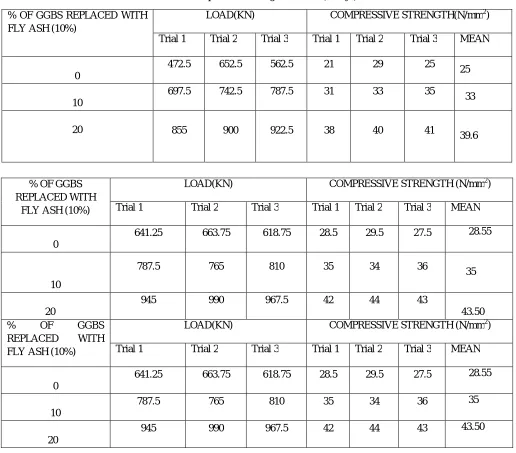
Table 1 Compressive Strength for Cube (7 Days) % OF GGBS REPLACED
WITH FLY ASH (10%)
LOAD (KN) COMPRESSIVE STRENGTH (N/mm2)
Trial 1 Trial 2 Trial 3 Trial 1 Trial 2 Trial 3 MEAN
0
450 473 495 20 21 22
21
10
652.5 675 697.5 29 30 31
30
20
742.5 765 787.5 33 34 35
[image:7.612.49.565.255.708.2]34
Table 2 Compressive Strength for Cube (7 Days)
Table 3 Compressive Strength for Cube (28 Days) % OF GGBS REPLACED WITH
FLY ASH (10%)
LOAD(KN) COMPRESSIVE STRENGTH(N/mm2)
Trial 1 Trial 2 Trial 3 Trial 1 Trial 2 Trial 3 MEAN
0
472.5 652.5 562.5 21 29 25
25
10
697.5 742.5 787.5 31 33 35
33
20 855 900 922.5 38 40 41 39.6
% OF GGBS REPLACED WITH
FLY ASH (10%)
LOAD(KN) COMPRESSIVE STRENGTH (N/mm2)
Trial 1 Trial 2 Trial 3 Trial 1 Trial 2 Trial 3 MEAN
0
641.25 663.75 618.75 28.5 29.5 27.5 28.55
10
787.5 765 810 35 34 36
35
20
945 990 967.5 42 44 43
43.50
% OF GGBS
REPLACED WITH FLY ASH (10%)
LOAD(KN) COMPRESSIVE STRENGTH (N/mm2)
Trial 1 Trial 2 Trial 3 Trial 1 Trial 2 Trial 3 MEAN
0
641.25 663.75 618.75 28.5 29.5 27.5 28.55
10
787.5 765 810 35 34 36 35
20
Technology (IJRASET)
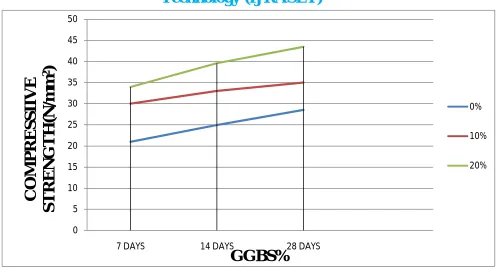
0 5 10 15 20 25 30 35 40 45 507 DAYS 14 DAYS 28 DAYS
[image:8.612.65.563.70.338.2]C
OM
P
R
E
S
S
IIV
E
S
T
R
E
N
GT
H(
N
/m
m
2)
GGBS%
0% 10% 20%Fig 2 Chart Comparison
Compressive Strength It may be noted from above Table and compressive strength for GGBS based SCC of M40 grade is 43.50 MPa(28 days), which is about more than the design strength of the normal cube.
Strength will increase gradually to the both 10%, 20% mix.
VI.SUMMARY AND CONCLUSION
A. General
In this project the study on compressive strength of SCC with GGBS and FLY ASH.
Cubes are casted with different curing period. The ultimate load to be find out and test result compare with nominal mix.
VII. CONCLUSION
Based on the experimental results from this project the following conclusions are made.
The study of properties of SCC gives favourable results with Flow ability and Passing ability of concrete for M40 grade mix proportion.
A. Compressive strength of cubes values gradually increase different replacement of ggbs and fly ash content
B. Various curing period 7, 14 and 28 days compressive strength increase high compare to normal cube.
C. All the cubes are tested for their ultimate strength to be find out.
D. Its cost effective method.
E. Waste material by product using effective manner.
F. Scc technology can save time, cost, durability.
REFERENCES
[1] Japan Society of Civil Engineers, ―Recommendation for Construction of Self Compacting Concrete, 157- 164 pp., 1998.
[2] Siddique, R., ―Properties of self-compacting concrete containing class F fly ash, Journal of Materials and Design, Vol. 32, 1501-1507 pp., 2011.
[3] IS: 12089 (Specification for Granulated Slag for Manufacture of Portland Slag Cement), Indian Standard Code of Practice, 1987.
[4] Nan Su., Kung-Chung Hsu., and His-Wan Chai., ―A simple mix design method for self-compacting concrete, Journal of Cement Concrete Research Vol. 31,
No. 12, 1799-1807 pp., Dec. 2001.
[5] Dinakar, P., Kali, P.S., Umesh, C.S., ―Design of self-compacting concrete with ground granulated blast furnace slag, Journal of Material and Design, Vol. 43, 161–169 pp., Jan 2013.
[8] IS: 10262 (Concrete Mix Proportioning- Guidelines), Indian Standard Code, 2009.
[9] Khayat, K.H., Hu, C., Monty, H., ―Stability of SCC, advantages and Potential applicationsǁ, In: Proceedings of RILEM international conference on self-compacting concrete, Rilem Publications SARL, 143-152 pp., 1999.
[10] Pai .B.H.V, Nandy M., K.H, Sarkar.P.K, Ganapathy.C.P, -Experimental study on self-compacting concrete containing industrial by-products, European