Max-Min Ant System Based Web Crawler
Komal Upadhyay1, Er. Suveg Moudgil2
1Department of Computer Science (M. TECH 4th sem) Haryana Engineering College Jagadhri, Kurukshetra University, Haryana,
India
2Associate Professor Department of Computer Science Haryana Engineering College, Jagadhri, Kurukshetra University, Haryana,
India.
Abstract: A focused crawler is Web crawler that traverses the Web to explore information that is related to a particular topic of interest only. This study, aims to find the Indian academicians webpages from foreign universities websites by selecting the features of webpage and determine its relevance on an unknown dataset. Therefore, a feature selection algorithm based on Max-Min Ant System (MMAS) is presented to improve the accuracy of focused crawler and classification process. The weights to features are assigned using cosine similarity to determine the relevancy of webpages. MMAS finds the best solution and select best fitted URLs from a large pool of URLs. The performance of the proposed methodology classification result is compared with manual classification result for Lancaster University, Stanford University and Harvard University dataset. The performance of the proposed methodology is measured using recall parameter.
Keywords:Max Min Ant System (MMAS), Ant System,Term Frequency-Inverted Document Frequency(TF-IDF).
I. INTRODUCTION (INTRODUCTION TO MMAS)
The World Wide Web is a very big warehouse that contains and connects millions of webpages and Web resources. These interlinked resources using hypertext links, are identified using the Uniform Resource Locator (URL) and are accessed via the Internet. This information system is spread on servers all over the world in the form of webpages. It is not possible to handle all these webpages by humans. Search engines are software systems, designed to find all these webpages in a fast way. Web search engines get their information through the Web, crawl from site to site by following the hyperlinks. Web crawlers are the drivers of search engines, which update the database whenever any webpage gets added or removed from the Web. Web crawlers also known as Web robots, Web spiders, and Web ants are software that browse the Web and download the webpages in an automated manner (Manning, Raghavan, & Schütze, 2008). Web crawler algorithm is quite simple as it starts with a prepared list of links also known as seed URLs, adds them in a queue and traverses each of these webpages. It identifies new links on that particular webpage and further adds them to the queue. It traverses all the links found according to a set of policies recursively. In short, a Web crawler downloads the webpages, creates their index of the webpages and maintains them in a repository or database (Micarelli & Gasparetti, 2007).
A. Types Of Web Crawlers
1) General Purpose Web Crawler: -General purpose crawlers are also known as universal crawlers download all the webpages without regard to any specific subject or topic. The goal is to cover as much Web as possible within given time. These are large scale crawlers and incur high cost in terms of network bandwidth usage, but this cost is amortised over many number of queries by users (Manning, Raghavan, & Schütze, 2008). Also, the repository needs to be updated more often in general purpose crawlers.
B. Incremental crawler
Incremental crawler crawl the Web continuously and revisit webpages periodically. During its
continuous crawl, it may also oust some webpages that are stored locally to make space for
newly crawled webpages. The incremental crawler has two goals: to keep the fresh collection stored locally and to improve quality of the collection. Depending upon the alteration frequency of webpages, it visits the webpages with high alteration rate more frequently and the other webpages less frequently. The advantage of incremental crawler is that it saves network bandwidth, since only webpages with high change rate are downloaded instead of all the webpages being downloaded.
C. Parallel crawler
performs the basic functionality of a single general purpose crawler. The parallel crawler can be geographically distributed or can be on a local network. All crawler installed on different machines have access to common memory. The webpages are downloaded from the Web and are stored locally. The URLs are extracted and their links are traversed. The goal is to reduce the total crawling time significantly (Cho & Garcia-Molina, 32002). Thus, bulk of webpages can be downloaded in reasonable amount of time. Parallel Crawler has many advantages like network-load dispersion, network-load reduction.
D. Distributed crawler
Distributed crawlers are multiple instances of a crawler that download pages from the Web and are executed at geographically distant locations. It based upon the idea of distributed computing. In order to achieve wide coverage of the Web, many crawlers are geographically distributed on the Internet and a central server is used for management of communication and synchronization of the distributed nodes. Each crawler does the crawling of the part of the Web assigned to it in a distributed manner. Its advantage is that it is robust against the system crash and balance network load (Boldi, Codenotti, Santini, & Vigna, 2004).
E. Focused Crawler
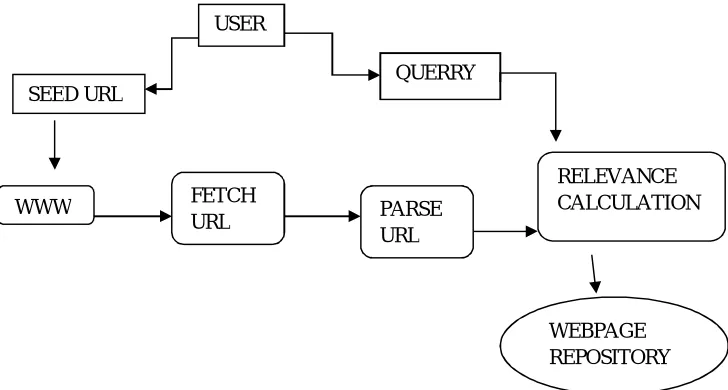
[image:3.612.82.446.386.581.2]Focused crawler downloads webpages on specific topic or subject. The goal of focused crawler is to retrieve the maximal set of relevant webpages while concurrently traversing the minimal number of irrelevant webpages on the Web. A Focused Web crawler learns to identify webpages that are relevant to the interest of user (Zhang, Du, & Li, 2009). User defines the seed URLs and query. Seed URLs are the starting point of the focused crawler and such URLs are related to query. User defines query to search in seed URLs and other originating links from such URLs. The fetch module fetches the webpage from the corresponding URL using HTTPS/HTTP protocol. The parse module performs scanning of a webpage to identify different HTML tags of a webpage. The page relevancy is calculated using relevance calculation module so that only those URLs that are related to query are stored in crawler queue and rest of the URLs are ignored. The webpage repository is a database where are the parsed URLs are stored for future reference.
Figure 1 shows the working of basic focused crawler.
II. PROBLEM STATEMENT AND OBJECTIVE
A. problem statement
The problem statement is to design “MAX-MIN Ant System Based Focused Crawler”. This study aims to find the Indian faculty’s WebPages by means of crawling the foreign universities websites using the proposed focused crawler.
B. Objectives
1) To study various existing focused crawler schemes and techniques. Mostly, includes ant colony optimization techniques.
2) To design ant colony optimization based focused crawler
3) To deploy configurable simulation framework for crawler with aim to find the Indian faculty’s WebPages working at foreign
USER
SEED URL
QUERRY
WWW FETCH
URL PARSE
URL
RELEVANCE CALCULATION
university.
III. EXPERIMENTAL SETUP
A. System Specification
All the implementations for experiments have been coded in Java programming language using NetBeans IDE 7.0 and stored all feature in database MySQL 5.7. Jsoup Java library is used for parsing and extracting HTML tags. The hardware used in the experiment has 3GB of RAM and Intel Core i3 CPU M 2.53 GHz processor. The operating system is Windows 7.
B. Dataset
The aim is to find the Indian academicians from foreign universities websites by selecting features from the webpage and determine its relevance. There is no uniformity, in other words there is no particular standard in structures of different universities websites. Each university website has its own structure, so it is an unknown data set. Therefore, the model is proposed to work on such unknown data set. For experiment, Lancaster University, Stanford University and Harvard University website is used as dataset. To determine the effectiveness of proposed crawler, retrieved classification results are compared with manual classification results.
C. Mmas Parameters
After performing series of experiment, the parameters of MMAS are assigned such as
1) Initial pheromones values are same for all URLs.
2) No. of ants = no. of URLs.
3) Best ant = URL with highest weight.
4) Max weight = highest weight value.
5) Min weight = 0 i.e. no matching of lists.
IV. METHODOLOGY
A. Steps
max crawl depth. analysing the website structure of 50 foreign universities websites and faced one of the major challenges of a crawler is the problem of tunnelling
B. Url Screening
In this phase, URLs are filtered from a large pool of URLs obtained from the above phase.
C. Feature Extraction
In this phase, terms from these tags are extracted after analyzing that these tags contain valuable information.
D. Weight Calculation
In this phase, the extracted features along with their terms are stored in the database. These terms are compared with three lists namely surname list, designation list and Indian premier universities list
E. Url Screening
In this phase, all URLs with weights are given as input to MMAS. Each ant performs two main functions: tour construction and pheromone update.
V. RESULTS
It has been found that the number of possible relevant URLs can be maximized by setting max crawling depth up to 6. This limit is set to stop the infinite working of crawler. This also avoids the problem of tunnelling. In this way, every possible faculty’s URL has been considered. All URLs have been screened to get relevant and moderately relevant URLs. URLs like dead ULRs, empty URLs, duplicate URLs, bookmarks, social-networking URLs, out of domain URLs have been removed as these URLs are useless and hence reduces massive load for the crawler. Furthermore, different URLs belonging to the same webpage are also screened.
A. Comparison
Ant System comprises certain limitations and boundations that is being improved in max min ant system as follows:
its validations i.e. Duplicate url, empty url, irrelevant url etc. All such are being avoided in MMAS since it filters the url according to the depth of the url.
Second parameter is efficiency per iteration. Ant system comprises a database that includes all urls irrespective of the similarity with the searching parameter hence comprises more space to database which results in decresed efficiency per iteration that is avioded in MMAS and hence comprises no change in eficiency or in best cases increased efficiency per iteration.
B. Snapshots
The output obtained at each step using the proposed methodology is shown in form snapshots. The snapshots with description are discussed below.
Figure depicts the MMAS crawler first stage output as number of filtered URLs for the Stanford University website. These include URLs related to faculty, staff, people, groups etc.
VI. CONCLUSION AND FUTURE WORK
study concludes that due to no uniformity among websites, sometimes it is difficult for focused crawler to extract all the relevant information. Therefore, websites structure should be analysed and parameters should be adjusted accordingly in order to get high accuracy. However, problem of tunnelling is removed and recall obtained for the Lancaster University, Stanford University and Harvard University are 0.86, 0.87 and 0.83 respectively. For future work, the proposed model is to be implemented for other university websites. We also intend to improve recall parameter for the proposed methodology and reduce the crawling time and space.
VII. ACKNOWLEDGEMENT
I would like to express deepest gratitude to my adviser Mr. Suveg Moudgil for his full support,expert guidance, understanding and encouragement throughout my study without whom it would have been impossible to attain success.
REFRENCES
[1] Aggarwal, C., Al-Garawi, F., & Yu, P. (2001). Intelligent crawling on the World Wide Web with arbitrary predicates. Proceedings of the 10th international conference on World Wide Web (pp. 96-105). ACM.
[2] Aghdam, M. H., Ghasem-Aghaee, N., & Basiri, M. E. (2009). Text feature selection using ant colony optimization. Expert systems with applications, 36(3) , 6843-6853.
[3] Boldi, P., Codenotti, B., Santini, M., & Vigna, S. (2004). UbiCrawler: A scalable fully distributed Web Crawler. Software: Practice and Experience 34.8, 711-726.
[4] Brin, S., & Page, L. (2012). Reprint of: The anatomy of a large-scale hypertextual web search engine. Computer networks 56, no. 18, 3825-3833.
[5] Chakrabarti, S., Berg, M. V., & Dom, B. (1999). Focused crawling: a new approach to topic-specific Web resource discovery. Computer Networks, (pp. 1623-1640).
[6] Chakrabarti, S., Dom, B. E., & Berg, M. v. (9 Jul. 2002). System and method for focussed web crawling. U.S. Patent No. 6, 418-433. [7] Cho, J., & Garcia-Molina, H. (2002). Parallel Crawlers. Proceedings of the 11th international conference on World Wide Web. ACM.
[8] De Bra, P., Houben, G.-J., Kornatzky, Y., & Post., R. (1994). Information retrieval in distributed hypertexts. Intelligent Multimedia Information Retrieval Systems and Management-Volume 1 (pp. 481-491). le centre de hautes etudes internationales d'informatique documentaire.
[9] Dorigo, M., & Gambardella, L. M. (1997). Ant colony system: a cooperative learning approach to the traveling salesman problem. IEEE Transactions on evolutionary computation 1, no. 1, 53-66.
[10] Dorigo, M., Maniezzo, V., & Colorni, A. (1996). Ant system: optimization by a colony of cooperating agents. IEEE Transactions on Systems, Man, and Cybernetics, Part B (Cybernetics) 26, no. 1, 29-41.
[11] Edwards, J., McCurley, K., & Tomlin, J. (2001). An adaptive model for optimizing performance of an incremental web crawler. Proceedings of the 10th international conference on World Wide Web (pp. 106-113). ACM.
[12] Gasparetti, F., & Micarelli, A. (2003). Adaptive Web Search Based on a Colony of Cooperative Distributive Agents. Cooperative Information Agents, Springer , 168-183.
[13] Heydon, A., & Najork, M. (1999). Mercator: A scalable, extensible web crawler. World Wide Web 2, no. 4, 219-229.
[14] Holden, N., & Freitas, A. (2004). Web page classification with an ant colony algorithm. International Conference on Parallel Problem Solving from Nature (pp. 1092-1102). Springer Berlin Heidelberg.
[15] Kim, S., & Zhang, B.-T. (2003). Genetic mining of HTML structures for effective web-document retrieval. Applied Intelligence 18, no. 3, 243-256. [16] Manning, C., Raghavan, P., & Schütze, H. (2008). Introduction to Information Retrieval. Vol. 1. Cambridge University Press.
[17] Menczer, F., Pant, G., Srinivasan, P., & Ruiz, M. (2001). Evaluating topic-driven web crawlers. Proceedings of the 24th annual international ACM SIGIR conference on Research and development in information retrieval (pp. 241-249). ACM.
[18] Micarelli, A., & Gasparetti, F. (2007). Adaptive focused crawling. In The Adaptive Web (pp. 231-262). Springer Berlin Heidelberg.
[19] Navrat , P., Jastrzembska, L., & Jelinek, T. (2009). Bee hive at work: Story tracking case study. Web Intelligence and Intelligent Agent Technologies (pp. 117-120). IEEE/WIC/ACM International Joint Conferences on. Vol. 3. IET.
[20] Özel, S. (2011). A web page classification system based on a genetic algorithm using tagged-terms as features. Expert Systems with Applications 38, no. 4, 3407-3415.