© 2016, IRJET | Impact Factor value: 4.45 | ISO 9001:2008 Certified Journal
| Page 481
Performance Evaluation of Energy Efficient Systems Based OFDM
Technique and LEACH Protocols Using Various Wireless Channels
Hemang Shah
1, Dr. Rajesh Bansode
21
PG Student
Information Technology, Thakur College of Engineering and Technology
2
Associate Professor
Information Technology, Thakur College of Engineering and Technology
---***---Abstract -
The demand of high-data-rate applications isincreasing every day and with its use the energy consumption in wireless networks has also increased which challenges the guarantee of enhancing quality of service. The data rate is expected to meet as per standards of 4G systems which is ranging between few tens of Mbps to around 1Gbps.Reducing energy consumption in wireless communications with the use of efficient energy based protocols has attracted increasing attention recently. The various performance measurements based on reported result analysis use various optimal metrics for energy efficient wireless communication system. The energy efficient wireless communication protocols that are being used in the current work includes viz. data transfer rate, packet size, protocol used, energy efficiency, number of nodes, square topology area, distance between nodes and base station. The parameters achieved during simulation for prototype design of energy efficient network initiated with 250 nodes, clustered into 50 each forming such 5 major clusters, distance between clusters is maintained up to 200m, with 50 iterations/rounds the data packets received is up to 16kbps within the clusters, with square topology area of 1250mx1250m , power consumption of up to24dB,wireless channel type considered during simulation are AWGN & Rayleigh, SNR measured up to 20dB, probability of error as 10-3, Modulation as QPSK, for energy efficient comparison between technique considering OFDM and various protocols LEACH,M-LEACH and LEACH-SAGA.
Key Words: Metrics, Wireless Communication Network, OFDM, LTE, 4G, LEACH, Wireless Systems.
1.INTRODUCTION
The reduction in energy consumption of wireless communication systems has attracted increasing attention recently. The new network architectures deployed test for various energy efficiency include heterogeneous networks, distributed antennas, multi-hop cellular, etc.; as well as radio and network resource management schemes that use
various cross layer optimization algorithms, dynamic power saving and multiple radio access technologies coordination have been proposed to address this issue. More than 50% of the total energy is consumed by the radio access part, where 50-80% is used for the power amplifier (PA).[1]
Most of the mobile communications techniques plan to maximize the performance metrics such as the throughput, reliability as QoS parameters which are given little attention in the area of energy consumption of network devices. Devices and systems are designed to result in performance oriented manner for better energy efficiency. In an over-provisioning condition, the electrical power cannot be dynamically adjusted depending on the networking or traffic conditions thereby, energy saving gain of most of the green techniques is achieved usually at the cost of degradation of QoS, or say “performance compromise”. The tradeoff between the performance and the energy consumption is required to be carefully exploited.[2]
2.LITERATURE REVIEW
The whole literature review is focused on the following literary works being done by an array of scholars and researchers from the field of energy efficient wireless communication systems. The following papers are selected for review keeping in mind the traditional and conventional approaches of various protocols along with the emerging techniques.
© 2016, IRJET | Impact Factor value: 4.45 | ISO 9001:2008 Certified Journal
| Page 482
is used for the power amplifier (PA). It is also pointed outthat the energy bill accounts for approximately 18% of the Operation Expenditure.[1].
[image:2.595.30.271.229.320.2]G.Miao, Nageen Himayat and Geoffrey Ye Li has discussed in ” Energy-Efficient Link Adaptation in Frequency-Selective Channels" that the comparison of the performance of energy efficient OFDM transmission with that of traditional transmission schemes. The system parameters are listed in Table
Table -1: Parameters used
Carrier frequency 1.5 GHz
User antenna height 1.6 m
BS antenna height 40 m
Circuit power 100 mW
Modulation M-QAM
Haitao Zhang, Shiwei Zhang and Wenshao Bu has discussed in “A Clustering Routing Protocol for Energy Balance of Wireless Sensor Network based on Simulated Annealing and Genetic Algorithm” that in LEACH-SAGA protocol at the time of selection of cluster heads, residual energy of the sensor node and the average energy of the cluster are considered, the sensor node having residual energy greater than the average energy of the cluster and which is near to the cluster centre is selected as cluster head. In the ready phase, the ordinary sensor nodes send the sensed data to the cluster head and further cluster head sends the integrated data to the sink through one hop or multi-hop mode of communication.
LEACH is completely distributed, requiring no control information from the base station, and the nodes do not require knowledge of the global network for LEACH to operate. Distributing the energy among the nodes in the network is effective in reducing energy dissipation from a global perspective.
3. METHODOLOGY
The various energy efficient wireless networks are discussed in literature survey so far in the research work, the existing system has been studied and the optimal metrics which are suitable for the performance measurement are discussed below.
3.1 Proposed Methodology
a) To consider 250 nodes for developing a network generation, with 50 nodes in each cluster resulting in 5 major clusters
b) To consider a square topology area of 1250m*1250m and simulate the nodes to measure the network performance with the support of OFDM and LEACH protocol design.
c) Sectorizing the nodes in a cluster of 50 each, such 5 clusters comprising of 250 nodes are generated, followed by handshake among nodes of different clusters.
d) To measure the OFDM system performance with SNR and power consumption for 250 nodes network with QPSK as modulation scheme in presence of Rayleigh & AWGN channel sat BER of up to 10-4.
e) To cluster the nodes as per the design for various types of LEACH protocols namely LEACH-SAGA, M-LEACH
f) To measure number of dead nodes in the network and then measure the LEACH protocol performance.
g) The performance of various LEACH protocols is measured for energy consumption with number of data packets received of up to 16kbps.
4. EXPERIMENTAL RESULTS
The research carried out with different metrics that are being used to measure energy efficiency the performance of energy efficient systems. Two types of network systems are deployed and different metrics are measured for the same.
4.1 Initialization Phase
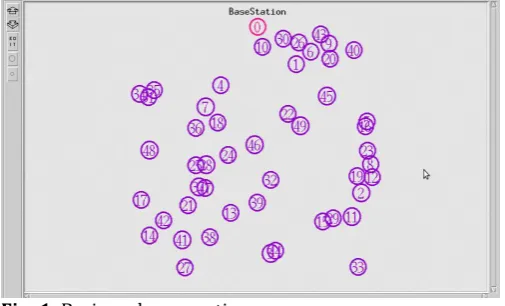
[image:2.595.308.561.477.630.2]The Initialization Phase consists of 50 nodes which are deployed in a 1000m x 1000m environment. The energy allocated to the nodes is random; except assumption is made that the energy of the base station is infinite and BS is far away from the sensor node. The base station is assumed to be node 0 and it is labeled red. The base station is fixed while other nodes are mobile in specific time interval. Fig -1 depicts a Base Station and remaining sensor nodes deployed in the network field.
Fig -1:Basic node generation
4.2 Clustering the nodes and parent selection as base
station.
© 2016, IRJET | Impact Factor value: 4.45 | ISO 9001:2008 Certified Journal
| Page 483
Fig -2 Clustering the nodes in group of 50Every node selects a parent node from its neighbor list based on their energy level and neighbor count. The neighbor with high residual energy level and neighbor is selected as parent node. Each sensor node will broadcast and select the neighbor if it is lying 250m in the vicinity. Each node will maintain the neighbor count and the energy of their neighbours. The parent node selection is done by calculating the weight of all the nodes. The node with the weight is selected as the parent. The weight of the node considers the neighbour count and the energy level of the node.
Fig -3 Parent selection as base station
4.3 Metrics calculation for OFDM Network
[image:3.595.308.563.55.266.2]The performance of OFDM system is measured in terms of BER and SNR is calculated using QPSK as shown in Fig -4 below, which depicts that the SNR measurement of 24dB at Bit error rate (BER) of 10-3.
[image:3.595.32.289.72.249.2]Fig -4 SNR of OFDM
Fig -5 depicts the energy consumption of OFDM system. The power consumption in the OFDM system is shows the theoretical (blue line) and the measured (red color) which depicts that there is an reduction in power consumption among nodes with increase in frequency. It is observed that at the values 100, 200, 300 power usage increases to 20dB/Hz.
Fig -5 Power consumption of OFDM
[image:3.595.317.567.362.510.2] [image:3.595.35.287.380.530.2]© 2016, IRJET | Impact Factor value: 4.45 | ISO 9001:2008 Certified Journal
| Page 484
Fig -6 SNR of QPSK Modulation using Rayleigh channel4.4 Metrics calculation for LEACH, LEACH-SAGA and
ML-LEACH protocols
Cluster head distribution for LEACH protocol is shown in Fig -7 LEACH protocol selects the cluster heads randomly. It does not consider the residual energy of the sensor node while selecting the node as a cluster head. Thus, it leads to the uneven distribution of the cluster heads resulting in creation of the energy hole problem.
LEACH-SAGA protocol uses simulate annealing and genetic algorithm for clustering of sensor nodes. It considers the residual energy of the sensor node while selecting the node as a cluster head. Thus, it leads to uniform distribution of the cluster head nodes, balancing the energy consumption of the sensor nodes, leading to the extension life cycle of the wireless sensor network. Cluster head distribution for LEACH-SAGA protocol is shown in Fig -7. Sink is shown as blue solid color circle in the figure. Sink is located at the centroid of wireless sensor network.
Fig -7 LEACH protocol cluster head distribution
[image:4.595.34.290.75.247.2]The energy consumption (J) vs number of rounds (time steps) is depicted in the Fig -8. After completion of all iterations/rounds, total energy consumed by M-LEACH is less than LEACH-SAGA and LEACH. Thus, it is observed that M-LEACH is more energy efficient than LEACH-SAGA and LEACH as it consumes less energy by around 100J. Thus, M-LEACH does better energy balancing which is most energy efficient clustering routing protocol for wireless sensor network.
Fig -8 Energy Consumption
[image:4.595.309.552.344.490.2]The data packets received (bits) by sink vs number of rounds (time steps), total data packets received (bits) by M-LEACH is more than LEACH-SAGA and LEACH as shown in Fig -9 below. Thereby M-LEACH can receive more data at the cost of same energy. So, M-LEACH is considered as ideal candidate for better load balancing than LEACH-SAGA and LEACH.
Fig -9 Data packets received
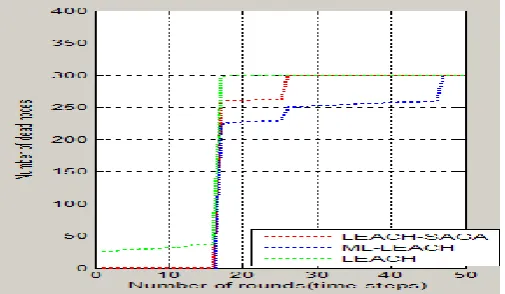
The number dead nodes vs number of rounds (time steps) is observed in Fig -10 below which depicts that rounds or time required for the first node & the last node to become dead is more for M-LEACH than LEACH-SAGA and LEACH. Thus, life cycle of M-LEACH is longer than LEACH-SAGA and LEACH.
[image:4.595.39.277.477.604.2] [image:4.595.309.562.562.709.2]© 2016, IRJET | Impact Factor value: 4.45 | ISO 9001:2008 Certified Journal
| Page 485
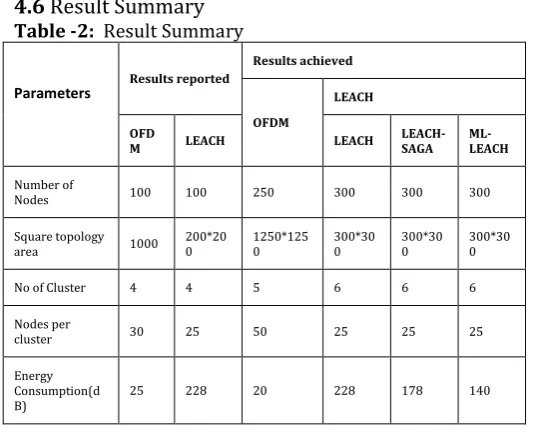
4.6 Result Summary
Table -2: Result Summary
Parameters Results reported
Results achieved
OFDM
LEACH
OFD
M LEACH LEACH LEACH-SAGA ML-LEACH
Number of
Nodes 100 100 250 300 300 300
Square topology
area 1000 200*200 1250*1250 300*300 300*300 300*300
No of Cluster 4 4 5 6 6 6
Nodes per
cluster 30 25 50 25 25 25
Energy Consumption(d B)
25 228 20 228 178 140
5. CONCLUSIONS
In this research two different types of wireless network systems are compared and observed the energy efficiency of each network. For the research OFDM is used as Infrastructure based system technique along with LEACH being used as ad-hoc systems. From the results, it is observed that OFDM consumes less energy as no of nodes increases and the bit error rate decreases, while in the ad-hoc network ML-LEACH consumes less energy compared to LEACH and LEACH-SAGA. In OFDM number of nodes are increased to 100% and in LEACH it is 50%. There is decrement of energy consumption by 25% in OFDM and 40% in the LEACH that shows improved energy efficiency in both the systems. Clustering the node and selecting the parent node to transfer the data reduces the packet drop in the system, that improves the packet delivery ratio.
REFERENCES
[1] D.Eng., C.Jiang, G.Lim, L.J. Cimini, G.Feng and Geoffrey Ye
Li, "A Survey of Energy- Efficient Wireless Communications,” IEEE Communications Surveys & Tutorials, vol. 15, no.1, pp 167-178., Jan. 2013.
[2] Haitao Zhang, Shiwei Zhang and Wenshao Bu “A
Clustering Routing Protocol for Energy Balance of Wireless Sensor Network based on Simulated Annealing and Genetic Algorithm”, International Journal of Hybrid Information Technology Vol.7, No.2 (2014), pp.71-82
[3] G. Ye Li, Z. Xu, C.Xiong, C. Yang, S. Zhang, Y. Chen and S.
Xu,” Energy-Efficient Wireless Communications: Tutorial, Survey, And Open Issues,” IEEE Wireless Communications, pp. 1536-1284, Dec. 2011.
[4] S. Caban, J. Antonio G. Naya, and M. Rupp,” Measuring
the Physical Layer Performance of Wireless Communication Systems,” IEEE Instrumentation & Measurement Magazine, pp 1094-6969 , Oct. 2011.
[5] Qing Chen, Mustafa CenkGursoy,” Energy Efficiency
Analysis in Amplify-and-Forward and
Decode-and-Forward Cooperative Networks,” IEEE WCNC2010, Apr. 2010.
[6] G.Miao, NageenHimayat, Geoffrey Ye Li,”
Energy-Efficient Link Adaptation in Frequency- Selective Channels,” IEEE Transactions on Communications , vol. 58, no. 2,pp 545-554, Feb. 2010.
[7] Albrecht J. Fehske, Fred Richter, and Gerhard P.
Fettweis,” Energy Efficiency Improvements through Micro Sites in Cellular Mobile Radio Networks,” IEEE GLOBECOM Workshops, pp 1-5, Nov. 2009.
[8] VolkanRodoplu, Teresa H. Meng,” Throughput metrics
in beyond 3G wireless systems with complex rate variability and QoS,” Personal, Indoor and Mobile Radio Communications, pp 1-5, Sept. 2008.
[9] VolkanRodoplu, Teresa H. Meng,” Bits-per-Joule
Capacity of Energy-Limited Wireless Networks,” IEEE Transactions on Wireless Communications, vol. 6, no. 3, pp 857-865, Mar. 2007.
[10] U. C. Kozat, I. Koutsopoulos and L. Tassiulas,”
Cross-Layer Design for Power Efficiency and QoS Provisioning in Multi-Hop Wireless Networks,” IEEE Transactions on Wireless Communications, vol. 5, NO. 11, pp 3306-3315, Nov. 2006.
[11] C. E. Jones, K.M. Sivalingam , P. Agrawal and J.C. Chen,” A
Survey of Energy Efficient Network Protocols for Wireless Networks,” Wireless Networks, vol. 7, pp 343 - 358, Jan.2007.
[12] David N. C. and S. V. Hanly,” Linear Multiuser Receivers:
Effective Interference, Effective Bandwidth and User Capacity,” IEEE Transactions on Information Theory, vol. 45, NO. 2, pp 641-657, Mar.1999.
[13] H. Yan, S. A. Watterson, D. K. Lowenthal, K. Li, R.
Krishnan, and L. L. Peterson,” Client- Centered, Energy-Efficient Wireless Communication on IEEE 802.11b Networks,” IEEE Transactions on Mobile Computing, vol. 5, pp.1575-1590, Nov. 2006.
[14] Q. Wu, M. Tao, D. W. Kwan Ng, W. Chen, and R. Schober,
"Energy-Efficient Resource Allocation for Wireless Powered Communication Networks,” IEEE Transactions on Wireless Communications, pp 1536-1276, 2015.
[15] W. Stark, H. Wang, A. Worthen, S. Lafortune, and D.
Eneketzis,” Low-Energy Wireless Communication Network Design,” IEEE Wirelessn Communications, vol.2, pp 60-72, Aug. 2002
[16] F. Lamonaca, A. Gasparri, E. Garone, and D. Grimaldi,