
© 2018, IRJET | Impact Factor value: 6.171 | ISO 9001:2008 Certified Journal | Page 868
Enabling distributed intelligence assisted Future Internet of Thing
Controller (FITC)
Puja Kale
1, Prof. A. R. Pimpalapure
21Student, Dept. of CSE Engineering, Anuradha , College, Maharashtra,India 2 Professor, Dept .of CSE Engineering, Anuradha College, Maharashtra,India
---***---Abstract -
The exceptional pervasiveness of universaldetecting will change the Future Internet where best in class Internet-of-Things (IoT) is accepted to assume the urgent part. In the quick sending IoT worldview, many billions of things are evaluated to be sent which would offer ascent to a tremendous measure of information. Distributed computing has been the overarching decision for controlling the associated things and the information, and giving insight in view of the information. In any case, reaction time and system stack are on the higher side for cloud based arrangements. As of late, edge registering is increasing developing thoughtfulness regarding overcome this by utilizing principle based knowledge. Nonetheless, prerequisites of tenets don't scale well with the multiplication of things. In the meantime, rules flop in indeterminate occasions and just offer pre-expected knowledge.
To counter this, this paper proposes an original thought of utilizing the conviction connect with the edge figuring to use as an IoT edge-controller the point of which is to offer low-level insight for IoT applications. This low-low-level insight along-side cloud-based knowledge frame the appropriated knowledge in the IoT domain. Moreover, a learning approach like fortification learning has been proposed. The approach, i.e. empowering a Future IoT Controller (FITC) has been checked with a recreated Smart-Home situation which demonstrates the attainability of the low-level knowledge regarding lessening rules mastery, quicker reaction time and expectation through learning encounters at the edge.
Key-Words: Internet of things, Distributed intelligence,
Small data, Big data, Raw data, Edge computing, Cloud computing.
1. INTRODUCTION
Future Internet is expected to be by the prevalence of Internet of Things (IoT) where it is envisioned that anything can be connected. The hype around IoT is that it is the next technological revolution of the current world where hundreds of billions of things will be interconnected. IoT has started to shape into reality from its hype by and large due to recent advancements in ubiquitous technologies such as Radio Frequency Identification (RFID)/Near Field Communication (NFC), Wireless Personal Area Network (WPAN), high speed communication (4G/5G), Bluetooth Low Energy (BLE), etc.
Advanced developments in the sensing and actuating technologies also contribute to the rise of the IoT popularity. This rise in connected things has already taken it number beyond current world’s population and expected to impact every aspect of human life. Currently, there are almost two connected things for every human. The ratio is expected only to accelerate in the coming days. The challenge of collecting and sharing the context information (ConIn) from these connected things has been addressed in earlier research [3-8].
The challenge has been addressed by architecting IoT platforms via mostly middleware solutions. Each middleware solution addresses different IoT challenges; for example, device management, context information collection and sharing, context-awareness, interoperability, etc. However, there is no single middleware solution or IoT platform that solves all these IoT challenges. An ideal IoT platform capable of providing solutions to all IoT aspects has not yet been designed. Furthermore, most of the IoT platforms solutions are cloud centric; recently Cisco coined the term fog computing, i.e. edge computing closer to the actual devices [9].
Definition of IoT:
There is no unique definition available for Internet of Things that is acceptable by the world community of users. In fact, there are many different groups including academicians, researchers, practitioners, innovators, developers and corporate people that have defined the term, although its initial use has been attributed to Kevin Ashton, an expert on digital innovation. What all of the definitions have in common is the idea that the first version of the Internet was about data created by people, while the next version is about data created by things. The best definition for the Internet of Things would be:
“An open and comprehensive network of intelligent objects that have the capacity to auto-organize, share information, data and resources, reacting and acting in face of situations and changes in the environment”[4].
© 2018, IRJET | Impact Factor value: 6.171 | ISO 9001:2008 Certified Journal | Page 869 the concept of the internet of things, internet becomes more
[image:2.595.42.281.121.247.2]favorable to have a smart life in every aspects .
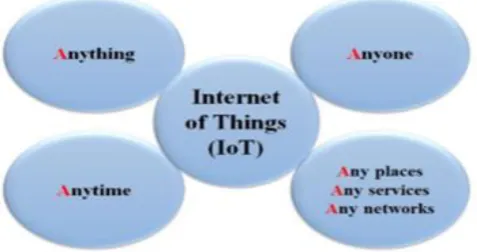
Figure 1: Internet of things Concept
Internet of Things is a new technology of the Internet accessing. By the Internet of Things, objects recognize themselves and obtain intelligence behavior by making or enabling related decisions thinks to the fact that they can communicate information about themselves. These objects can access information that has been aggregated by other things, or they can added to other services. Figure 1 reviews that with the internet of things, anything’s will able to communicate to the internet at any time from any place to provide any services by any network to anyone. this concept will create a new types of applications can involve such as smart vehicle and the smart home, to provide many services such as notifications, security, energy saving, automation, communication, computers and entertainment .
2. LITERATURE REVIEW
IoT was first coined by Kevin Ashton back in 1999, it was proposed in the context of supply chain management [15]. Making sense of IoT data, that is, to reap value from the IoT data is the current topic and challenge of IoT research. IoT started with the vision from these physical objects. Therefore, the earlier proposals of analyzing and taking decisions at the cloud made sense since initial objective was to collect data from the physical objects about real world by employing things rather than relying only on human-entered data on the Internet[4]. The objective was simple: to collect data and let computers or higher-level devices take decisions by analyzing data. Today the objective lies in harvesting value from the collected data. However, cloud centric solutions fail to provide low-latency which is one of the IoT requirements[6]. IoT further requires computing to be done as closer to the things as possible. Both cloud and edge computing provide advantages that are useful and solve many challenges in IoT paradigm. For example, cloud computing can offer large storage, complex processing ; analytics and visualization tools ;anywhere access, contextualization / personalization; publish / subscribe ;and edge computing can offer faster processing ; better sustainability and energy efficiency; distributed computing; data pre-processing and filtering ; mobility support;
heterogeneity and interoperability; computing closer to the actual things, etc. Besides these, edge computing reduces burden on cloud computing in terms of data storage, bandwidth, geographic coverage, analytical dependency, communication overhead, etc. Earlier research showed advantages of edge computing over cloud computing in IoT in terms of: efficiency in energy, data filtering, providing notifications in a Smart-Health application [3].
3. ARCHITECTURE
3.1 Propose System:
Internet-of-Things (IoT) is a network of things where things are anything from a physical object to a virtual object. The primary objective of IoT is to connect anything anytime and anywhere. However, once things get connected via any path, challenge is to reap value from things’ data, i.e. information. That corresponds to catering the information-of-things. Earlier many argued that things’ capability of providing this information in the IoT domain makes the things smart; however, recently others argue that this capability only makes the things connected- not necessarily smart. In order to make things smart or make sense of information-of- things, providing intelligence is a prerequisite. Thus, it necessitates to provide intelligence-of-things. As inefficiency of cloud computing leads to edge computing; therefore, it is necessary to look into other solutions to counter data closer to the things which some researchers have started calling small data[17].
© 2018, IRJET | Impact Factor value: 6.171 | ISO 9001:2008 Certified Journal | Page 870 Fig-2 : A typical simplified three-layer IOT
architecture
3.2 Properties:-
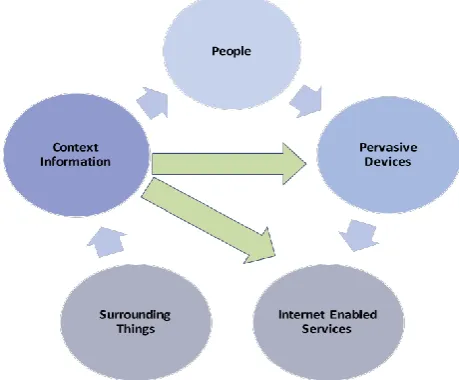
Properties of future IoT, i.e., IoE, correspond to a cycle as seen from Figure 3. This cycle can be compared with the vision of autonomic computing loop[16]. The autonomic loop executes self-X algorithms in order to make an autonomous entity. Execution of self-X algorithms depend on the policies embedded into a controller a human-administrator. Whenever a policy needs to be modified or added or removed, human-administrator usually is consulted. This can also be seen from AWS IoT’s rule-engines where rules (policies) are added whenever required and further in Xpert-Rule[18]. However, in the IoT scenario where each controller might control thousands of things, updating rules or policies should be done automatically (as to reduce time and complexity) preferably by learning from the past experiences. Recently big players in the industry like IBM, Amazon, and Microsoft have started to tie up machine learning with. This tying up is expected to offer unprecedented impact on IoT. In future, IoT and Artificial Intelligence (AI) thereby, machine learning will be inseparable.
The reason is that up until now IoT only focused on collecting and sharing raw-data, it did not focus on providing insight to the raw-data. Existing approaches for edge intelligence are heavily reliant on predefined rules and are time consuming where in order to define new rules a person is reliant on cloud- based intelligence. Therefore, to counter the short comings of the current and previous approaches, this seminar proposes to provide intelligence at the edge where IoT controller would learn from the past experiences .The proposal proposes an IoT controller to provide three important operations: Decision making, Action, and Prediction (DAP) for the connected things at the edge.
The idea is to provide low-level intelligence to the small data at the edge before providing high-level intelligence for the so-called big data at the cloud; thus, enabling distributed intelligence. The need for two-level intelligence was also highlighted earlier in. Providing intelligence at edge implies reaping value from the collected raw-data by the gateway,
i.e. an IoT controller (this report regards a device as gateway which only collects and forwards raw-data, and in addition to this when a device provides the portrayed low-level intelligence is regarded as controller). However, raw- data collected from IoT applications do not actually provide any usefulness unless insight is harvested. To reap value from the raw-data, the data need to put into context to provide intelligence for converting into knowledge. Currently, only rules are employed to provide edge-intelligence. However, as the number of connected thing escalate the required number of rules also rockets.
Depending only on rules could break the intelligence if new or uncertain events occur. Furthermore, predefined rules’ domination would only provide pre-assumed intelligence. In order to provide further intelligence to improve the performance of an IoT controller mandates the controller to learn from the experiences by employing machine learning algorithms. In light of the above, the followings can be considered as vital challenges to provide edge-intelligence: contextualization of the raw-data; minimizing dependency only on rules for executing tasks; improving performance of tasks through experiences, i.e. learning; predicting an outcome in the event of uncertainties; efficient routing of the data; self-organization of the things, i.e. sensors and actuators;
Fig-3.Prorerties of internet of everything
In order to demonstrate the feasibility of the proposed approach, two IoT applications namely Smart-Home and Smart-Farming have been used for references and further, Smart-Home application was exploited for verifying the algorithms for providing intelligence at the edge. In order to execute the DAP; the controller necessitates having algorithms that can help in executing these operations [20].
3.3 Distributed intelligence:-
[image:3.595.323.553.402.592.2]
© 2018, IRJET | Impact Factor value: 6.171 | ISO 9001:2008 Certified Journal | Page 871 scenario, raw-data is any data that is collected from a thing,
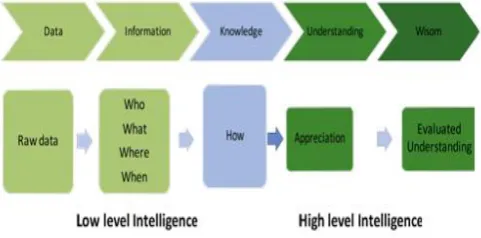
[image:4.595.44.285.226.345.2]e.g. sensor or actuator. Raw-data is usually collected and fed forward by a gate-way. There are many protocols that can be exploited by IoT to collect raw-data from the things. Some of the promising protocols are MQTT, CoAP etc The things can further be controlled via employing self-organizing algorithms such as presented earlier in. This part of connecting and collecting raw-data is beyond the scope of this particular work. The next two steps are relevant to this particular paper, i.e. information and knowledge. As shown in figure 4.
Fig- 4. Distributed (Two level) intelligence for IOT
Information:
As seen from above fig. information corresponds to answering few of the fundamental questions. This also refers to contextualizing a thing. The collected data is fed into the contextualization algorithm (see Algorithm1) which by answering the questions like: who, what, where, when, etc. provides more meaning to the raw-data. Here, who refers to thing’s identity, what refers to the actual data, where refers to its origin, and when refers to its time of occurrence. There could be more context information added at this step for example its relation to other things and/or context information.
Knowledge:
This step then provides further low-level intelligence based on the contextualized data. Although the figure shows knowledge as part of the low-level intelligence; in essence, knowledge would be distributed to both low-level and high-level intelligence. The reason being that the proposed IoT controller at the edge would run on resource-constrained devices which might not be able to provide all the required knowledge. High-level knowledge would come from more advanced computational devices.
Understanding & Wisdom:
These two operations are meant for operations like extracting meaningful information from data. Since understanding deals with appreciation of the data and wisdom is for evaluating the data which are analytical; and require all the previous steps and synthesizing knowledge
from earlier knowledge and information. Wisdom on the other hand requires human intervention as this is the last and highest level, so it extends the previous steps to infer new knowledge or understanding. A data scientist or a researcher perhaps would infer this new knowledge or understanding .Or in future deep learning based AI solution might be able to provide the required wisdom.
To understand the above steps, let’s consider an IoT application in a Smart-Home scenario where things such as sensors and actuators are installed for home automation. The sensors and actuators are controlled via an IoT edge controller. The controller collects data from the things and executes DAP. The following Example explain the above concept.
Example 1
Raw-data
Example raw-data from sensors and actuators Light: 40
Temp: 18 Nutrition: 26 Moisture: 43 Soil moisture: 30
Information
Contextualized Nutrition Sensor
Who: nutritionsensor1.gateway2@adamsfarm What: 26%
When: 03:00 PM
Where: Zone 2, Row 3, Column 4 Which: Fertilizer
Contextualized Soil Moisture Sensor Who: soilsensor.gateway5@adamsfarm What: 30%
When: 05:00 PM Where: Zone 4 Which: Sprinklers
Knowledge
© 2018, IRJET | Impact Factor value: 6.171 | ISO 9001:2008 Certified Journal | Page 872 plant-growth; therefore, it would have been fitting in the era
of connected world to let the IoT controller decide when to execute a task at the farm. For example, a farm could employ different sensors for collecting data as shown above and the controller would control DAP execution if and when to trigger a task. The task could be to start water sprinkle if soil moisture is below the thresh- old (a value which is specific to application and implementation) but before starting the task, controller would check weather forecast and based on the weather information it would decide how much, and if, water needs to be poured. Similarly, when the nutrition level drops below a desired value, the controller would try to execute the task of providing fertilizer; but fertilizing can also depend on the plant growth meaning if the plants are ready to harvest then there is no need to fertilize the plants.
3.4 Design:-
Design of internet of things mainly consist of following three architecture as follows.
Three layer architecture
Five layer architecture
Six layer architecture
3.4 .1 Three layer architecture
It has three layers, namely, the perception, network, and application layer
(i) The perception layer- is the physical layer, which has sensors for sensing and gathering information about the environment. It senses some physical parameters or identifier other smart objects in the environment.
(ii) The network layer- is responsible for connecting to other smart things, network devices, and servers. Its features are also used for transmitting and processing sensor data.
(iii)The application layer- is responsible for delivering application specific services to the user. It defines various applications in which the Internet of Things can be deployed, for example, smart homes, smart cities, and smart health
Fig-5. Three layer architecture
3.4.2 Five layer architecture:-
It consists of five layer as follows:
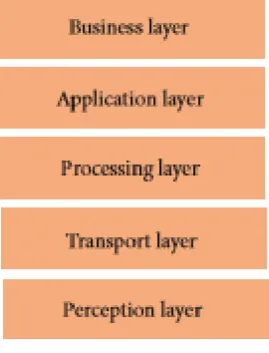
(i) Perception Layer- This layer collects information through the sensing devices such as RFID, Zig-bee and all kinds of sensors. Radio Frequency Identification (RFID) technology enables the design of microchips for wireless data communication and helps in automatic identification of anything they are attached to, acting as an electronic barcode.
(ii) Transport Layer- Transport layer supports secure data transfer over the sensor networks and responsible for routing. It transfers the information through wireless technology such as Wi-Fi, Bluetooth, and Infrared etc. Hence, this layer is mainly responsible for transferring the information from perception layer to upper layer.
(iii) Processing layer - In this layer the collected information can be stored in database cluster and performs information processing and based the result it takes required decision. This layer is responsible for service management related tasks.
(iv) Application Layer- This layer provides the delivery of all services in various fields. It includes cloud computing, intelligent transportation, environmental monitoring etc. Management of application is smart home, smart city etc.
[image:5.595.366.501.547.724.2](v) Business Layer - The top most layer business layer responsible for the analysis and it determines the future actions. This layer uses different analytics techniques of produce intelligent knowledge to the user and provides an interactive GUI to visualize the data gather.
© 2018, IRJET | Impact Factor value: 6.171 | ISO 9001:2008 Certified Journal | Page 873 3.4.3 Six layer architecture
It Consist of six layer as follows:
(i) Coding Layer –Coding layer is the foundation of IoT which provides identification to the objects of interest. In this layer, each object is assigned a unique ID which makes it easy to discern the objects.
(ii) Perception layer -This is the device layer of IoT which gives a physical meaning to each object. It consists of data sensors in different forms like RFID tags, IR sensors or other sensor networks which could sense the temperature, humidity, speed and location etc. of the objects. This layer gathers the useful information of the objects from the sensor devices linked with them and converts the information into digital signals which is then passed onto the Network Layer for further action.
(iii) Network Layer - The purpose of this layer is receive the useful information in the form of digital signals from the Perception Layer and transmit it to the processing systems in the Middleware Layer through the transmission mediums like Wi-Fi, Bluetooth.
(iv) Middleware Layer - This layer processes the information received from the sensor devices. It includes the technologies like Cloud computing, which ensures a direct access to the database to store all the necessary information in it.
(v) Application Layer - This layer realizes the applications of IoT for all kinds of industry, based on the processed data. Because applications promote the development of IoT so this layer is very helpful in the large scale development of IoT network. The IoT related applications could be smart homes, smart transportation, smart planet etc.
(vi) Business Layer - This layer manages the applications and services of IoT and is responsible for all the research related to IoT. It generates different business models for effective business strategies.
Fig-7. Six layer architecture [11]
3.5 Algorithm:
The proposes to provide distributed intelligence to counter the influx of context information in the IoT domain by providing intelligence both at the edge and at the cloud as illustrated in Fig.4 Edge-intelligence implies that intelligence based on raw- data collected by the IoT controller from the things would be provided as fast as possible.
3.5.1 Contextualization
Contextualization, algorithm deals with answering questions to provide more meaning to the raw-data from a connected thing. This also corresponds to the second step of the knowledge hierarchy as shown in Fig.4.The algorithm takes the sensed raw-data as input and outputs the contextualized data
Contextualization Algorithm
1. Initialize Connection/communication to collect data
2. while there is sensed data do
3. if sensed data is not contextualized then 4. what: raw-data
5. where: origin of the raw-data 6. when: time of occurrence 7. who: originator of the raw-data
8. else if sensed data is contextualized then 9. find its frequency
10. frequency at the given ConIn
11. what other ConIn it is related to, e.g. some actuation
[image:6.595.329.532.91.282.2]© 2018, IRJET | Impact Factor value: 6.171 | ISO 9001:2008 Certified Journal | Page 874 14. determine Task(TConIn);
15. addToAConIn(); 16. addToTConIn(); 17. end while
3.5.2 Determine Task
This Algorithm demonstrates the determine task part, it then decides whether to activate an action based on the available thing’s ConIn (TConIn) or forwards the ConIn to learn experiences.
Determine Task Algorithm
1. Fetch TConIn 2. for all TConIn do
3. while TConIn is not empty do
4. Look up the prior-belief for each ConIn
5. Calculate probability of tasks related to TConIn (Eq. (1))
6. if probability of task > threshold then 7. Execute task(s), i.e. decision
8. end if 9. end while
10. while TConIn is not empty do 11. findAConIn(TConIn)
12. predict (TConIn); 13. end while
14. find Experience(TConIn, AConIn); 15. end for
3.5.3 Find experience
This algorithm finds experiences of a thing in the IoT domain. It takes TConIn and AConIn as input and returns thing’s experiences. This algorithm checks each of the ConIn and stores frequency for each tuple of ConIn (e.g. {what, when}, {what, when, where}, {what, when, where, who}
Find Experience Algorithm
1. Fetch TConIn
2. for each what (sensed data) do 3. for each when (time) do
4. add to tuple
5. increase frequency
6. for each where (location) do 7. add to tuple
8. increase frequency
9. for each who (originator) do 10. add to tuple
11. increase frequency
12. find AConIn
13. add to tuple (TConIn, AConIn) to learn experiences 14. learn Belief(TConIn, AConIn);
15. end for 16. end for 17. end for 18. end for
3.5.4 Prediction
This algorithm is employed to predict missing values in a set of ConIn. This algorithm takes TConIn as input with missing values, and finds other ConIn (OConIn) for the available ConIn.
Prediction Algorithm
1. for each available tuple of ConIn do 2. find OConIn for this tuple
3. for each available tuple of ConIn do 4. fetch frequency
5. if frequency of OConIn equals highest frequency then
6. ConIn predicted 7. end if
8. end for 9. end for
4. ADVANTAGES:
Following are some advantages
I. Efficient transmission of electricity.
II. Quicker restoration of electricity after power disturbances.
III. Reduced operations and management costs for utilities, and ultimately lower power costs for consumers.
IV. Time saving technology.
V. Change the investment management business model.
VI. IoT unearths new investment opportunities. VII. IoT undermines derivatives in corporate bond
market.
VIII. Bank as platforms for micropayment.
IX. Absolutely safe and secure communication with elements at the network edge.
X. Energy saving robust and reliable smart sensors/actuators.
5. APPLICATIONS:
© 2018, IRJET | Impact Factor value: 6.171 | ISO 9001:2008 Certified Journal | Page 875 applications such as smart cities, homes, transportation,
energy and smart environment.
5.1 Smart Cities:
In addition to support people by the internet in every place to accessing the database of airports, railways, transportation tracking operating under specified protocols, cities will become smarter by means of the internet of things.
5.2 Smart Home and Buildings:
By the concept of the internet of things, homes and buildings may operate many devices and objects smartly, of the most interesting application of IoT in smart homes and buildings are smart lighting, smart environmental and media, air control and central heating, energy management and security [20].
5.3 Smart Energy and the Smart Grid:
Many applications can be handling due to the internet of things for smart grids, such as industrial, solar power, nuclear power, vehicles, hospitals and cities power control. the most important application may be enabled by the internet of things as in smart grid aspect[2].
5.4 Smart Health:
It replaces the process of having a health professional come by at regular intervals to check the patient’s vital signs, instead providing a continuous automated flow of information. In this way, it simultaneously improves the quality of care through constant attention and lowers the cost of care by reduces the cost of traditional ways of care in addition to data collection and analysis.
5.5 Smart Transportation and Mobility:
The development in transportation is one of the factors to indicate the wellbeing of the country. A road condition monitoring and alert application is one of the most important of IoT transformation application.
5.6 Smart Factory and Smart Manufacturing:
The smart factory will fundamentally change how products are invented, manufactured and shipped. At the same time it will improve worker safety and protect the environment by enabling low emissions and low incident manufacturing.
5.7 Smart Environment:
Smart environment is an important technology in our everyday life which provides many facilities and solutions for many environmental applications such as water and air pollution, weather and radiation monitoring, waste management, natural disaster, and many other environment indicator.
6. CONCLUSION:
Internet of things is an emerging field which has improved the quality of human life with its vast automated applications. The functionalities provided by IoT can save time and computational power of users to help improve results in the diverse application areas. This paper presented the overview of the enabling technologies and applications of IoT in different fields. Further, some of the security issues regarding the wireless technologies involved in deployment of IoT are presented along with their possible countermeasures. The future of internet is IoT, but there is still a need for further research in this field because of the ever increasing demands of users. Due to internet of things, anything’s will be able to communicate with internet at any time from any place to provide any service by the network to anyone. This all can be done by using sensors and actuators which can be use to collect information or raw data from the environment.
The paper has presented an AI base distributed- intelligence assisted Future Internet of Things Controller (FITC) that utilizes both edge and cloud based intelligence. More specifically, edge controller is employed to provide low-level intelligence and cloud controller would provide high-level intelligence.
REFERENCES
1] H. Sundmaeker, P. Guillemin, P. Friess, S. Woelffle, Vision and Challenges for Realising the Internet of Things Technical Report,
[2] M. Ali Feki, F. Kawsar, M. Boussard, L. Trappeniers, The Internet of things: Rosario Miceli. Energy Management and Smart Grids. Energies 2013
[3] J.Gubbi, R. Buyya, S. Marusic, M. Palaniswami, Internet of things (IoT): a vision,
[4] M. Wu, T.-J. Lu, F.-Y. Ling, J. Sun, and H.-Y. Du,“Research on the architecture of internet of things,” in Proceedings of the3rdInternationalConferenceonAdvancedComputerTheory and Engineering.
[5] Open IoT: Open Source Solution for the Internet of Things into the Cloud, January 2012. <http://openplatforms.eu/library/openiot-the-open-source-internet-of-things/>(Last Accessed sept -2017)
[6] H. Rahman, R. Rahmani, T. Kanter, Enabling scalable publish/subscribe for logical-clustering in crowd sourcing via media sense, in: IEEE Science and Information (SAI) Conference 2014, August 27–29, 2014, London, UK, 2014.
© 2018, IRJET | Impact Factor value: 6.171 | ISO 9001:2008 Certified Journal | Page 876 16,http://dx.doi. org/10.1016/j.future.2015.08.005(Last
Accessed sept-2017)
[8] A. Botta, W. de Donato, V. Persico, A. Pescapé, On the integration of cloud computing and internet of things, in: 2014 International Conference on Future Internet of Things and Cloud, Barcelona, 2014, pp. 23–30. http://dx.doi.org/10.1109/FiCloud. 2014.14.(Last Accessed Sept-2017)
[9] Cisco White Paper, Fog Computing and the InternetofThings:ExtendtheCloudtoWheretheThingsAre<htt ps://www.cisco.com/c/dam/en_us/solutions/trends/iot/do cs/computingoverview.pdf>(Last Accessed Sept-2017)
[10] C. Perera, P.P. Jayaraman, A. Zaslavsky, P. Christen, D. Georgakopoulos, MOSDEN: an internet of things middleware for resource constrained mobile devices, in: 2014 47th Hawaii International Conference on System Sciences, Waikoloa, HI, 2014, pp. 1053– 1062.http://dx.doi.org/10.1109/HICSS.2014.
[11] A Liu, and D. Salvucci, Modeling and Prediction of Human Driver Behavior, Intl. Conference on HCI , 2001.
[12]RaspberryPi.<https://www.raspberrypi.org/> (last accessed: January 2017). Exploiting smart e-Health gateways at the edge of healthcare Internet-of- Things: a fog computing approach, Future Gener. Comput. Syst. (2017)
[13] A.M. Rahmani, T.N. Gia, B. Negash, A. Anzanpour, I. Azimi, M. Jiang, P. Liljeberg
[14]AmazonAWSIoT.https://aws.amazon.cm/iot/> (last accessed: sept-2017).
[15] K. Ashton, That ‘‘Internet of Things’’ thing, RFiD J. (2009)
[16] H. Rahman, T. Kanter, R. Rahmani, Supporting self-organization with logical- clustering towards autonomic management of Internet-of-things, Int. J. Adv. Comput. Sci. Appl. (IJACSA) 6 (2) (2015), http://dx.doi.org/10.14569/ IJACSA.2015.060204(Last Accessed Sept -2017)
[17] M. Kavis, Forget Big Data – Small Data is Driving The Internet of Things.
[18] XpertRule Software Ltd. <http://xpertrule.com/> (last accessed: Sept-2017)
[19]CNET-Smar-Home CNET. <http://www.cnet.com/smart-home/>(last accessed: Sept- 2017).
[20] Smart-Things: Smart Home, Intelligent Living. <https://www.smartthings.com/>(last accessed: Sept- 2017).
BIOGRAPHY :
Miss. Puja Kale Pursuing Bachelor of Engineering in Computer Science & Engineering Department from Anuradha Engineering College of SGBAU Amravati.
![Fig-7. Six layer architecture [11]](https://thumb-us.123doks.com/thumbv2/123dok_us/8137123.798616/6.595.329.532.91.282/fig-six-layer-architecture.webp)
