International Research Journal of Engineering and Technology (IRJET) e-ISSN: 2395-0056
Volume: 04 Issue: 08 | Aug -2017 www.irjet.net p-ISSN: 2395-0072An Enhanced Method to Detect Copy Move Forgery in Digital
Images processing using 2D-DWT Approach
Rajni
1, Mr. Parminder Singh
21
M.Tech Student, Department Of ECE, Doaba Institute of Engineering & Technology, Punjab, India
2
Assistant Professor , Department Of ECE, Doaba Institute of Engineering & Technology Kharar , Punjab, India
---***---Abstract -
Communication in visual form is very important in itself. It is also a very convincing medium of transfer of information. Numerous fields of technology depend vastly o n better quality and correctness of source image. But digital image forgery creates problems for these technologies. Mani pulation of images is now a very easy job due to availability of numerous images editing software’s. It is now possible to add, modify, or remove important features from an image w ithout leaving any perceptual traces of tampering. Image fo rensics is a domain dedicated to stop such attempts and pres erve the data in an image. Through this project, we would li ke to detect a faulty image from image move forgery attack.
Key Words:
GIMP, SIFT, RANSAC, DWT, SURF, FFT, L
DP
1. INTRODUCTION
Images are one of the natural sources of information. Curre ntly they are the most common and convenient way for exp ressing and transmitting information. Information express ed in thousands of words can be easily expressed by a digit al image. The human being visual system has a high ability i n deriving pictorial information from digital images. Nowa days, digital images play a very important role in our comm unity, in a wide variety of applications.
There are mainly three types of image tempering technique s. Enhancing Tempering, Compositing Tempering, and Cop y Move Tempering: In Compositing tempering, two or more images are used to make the new tempered image. It chan ges the whole content of the image. In Copy - Move temperi ng , technique some parts of the image are copied than past ed into same image then some post processing steps are ap ply to tempered image. It is difficult to identify which parts of image is copy and where it is pasted. It is difficult to iden tify this type of tempering.
Tempering detection methods : Active method, Passive method.
Active method : In Active method, some information are ad ded in the original images. When unauthorized person can change the content of image by applying any post processin g techniques, it is identify by the comparing tempered imag e with original image and we can detect the tempering. In t his method Water marking and digital signature are used t o detect tempering. it use algorithm or key to add the infor mation in the original image. Some camera available in mar
ket which automatically add the algorithm or key into imag e to authenticate the images. But this method is not robust because it require knowledge of image source like digital ca mera.
Passive method: In passive method, this method sometime known as blind method to detect image tempering. This me thod take advantage of processing steps like acquisition an d storage of digital images. This trace can be treated as the watermarking/digital signature of digital images. This tech nique not required any prior knowledge of original image/ camera sources. When we applying post processing step to original images its cause change the image characteristic an d it is key to detect tempering in digital images. Passive met hod can be categorized by statistical method, this method d epend on the pixel value of the images, and it required mor e images to estimate the internal traces and another metho d based on visualization. But this method is fail because of s ome tie user can’t identify the tempering in digital image be cause of availability of post processing tool such as Adobe P hotoshop.
1.1 Related Work
Recently, there has been growing research on passive foren sic methods devoted to the security and protection of multi media information. Each technique targets addressing diffe rent aspects related to verifying the authenticity of digital d ata. This introduces the techniques and methods currently available in the area of digital image tempering detection. A survey of the current research is presented as well as an a nalysis of the current techniques and methods available to detect image tampering. This area of research is relatively new and only a few sources exist that directly Related to th e detection of image forgeries, therefore techniques are pre sented that apply to general digital image processing, but s how promise in the detection of digital forgeries..
1.2 Types of Image Forgery
There are basically three types of digital image forgery. It i ncludes image enhancing or retouching, image composition /splicing and image copy - move forgery.
1.2.1 Image enhancing or retouching Forgery
International Research Journal of Engineering and Technology (IRJET) e-ISSN: 2395-0056
Volume: 04 Issue: 08 | Aug -2017 www.irjet.net p-ISSN: 2395-0072 [image:2.595.51.274.170.319.2]an image to make it more attractive but it is ethically wron g.
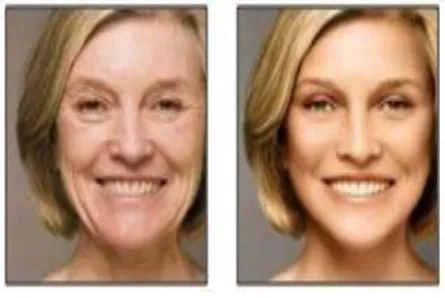
Figure 1 shows an original image of lady’s face whereas fig ure 2 shows the same face with enhanced effects applied to it.
Fig -1 Original Image Fig-2 Enhanced Image
1.2.2 Image composition or splicing Forgery
It is a technique that involves a composite of two or more i mages to create a fake image. Regions from various images are combined together in base image is known as image co mposition. Figure 3 shows a base image. Figure 4 shows sh ark inside sea. From figure 4region occupied by shark is co pied and it is pasted below the helicopter in the base image. This copy-paste operation from one image into another im age forms a spliced image as shown in figure 5.
1.2.3 Image copy-move forgery
It is a technique that copy background or other features fr om one part of the image and paste into the same image at another location to hide or alter regions from the image. In this type, instead of having an external image as the sourc e, it uses portion of the original base image as its source. P art of the original image is copied and moved to desired lo cation and pasted into it.
Figure 6 shows original image of a garden view.
In figure-7 a region occupied by a deer is copied and pas ted on the grass at front side in the same view. [2]
Figure 6: Original Image Figure 7: Forged Image
The copy-move forgery is one of the difficult forgeries to de tect in image processing. It is common image tampering tec hnique used now a day. In this some part of the image need s to be covered to add or remove information of an image. There are two approaches for detecting digital image forge ry. One is active approach and the other is passive approac h [2].
2. LITERATURE SURVEY
Bharat M. Prajapati, Nirav P. Desai[8] - Digital images have been widely used from last few years in various application s such as forensic evidences, medical, insurance and militar y etc. With easy availability of low - cost image modification and editing software such as Adobe Photoshop, GIMP (GN U Image Manipulation Program), paint etc. digital image co ntent is not considered as safe. There are various types of i mage tempering techniques but Copy - move is the mostly used. In this technique, some part of image is copied then it is pasted on same Image, which changes the visual conten ts of image.
•An efficient algorithm for image copy-move forgery d etection based on DWT and SVD [2014] In this paper, an efficient algorithm is presented for image copy-move forg ery detection and localization based on DWT and SVD.
Experiment results demonstrate that our proposed algorit hm can effectively detect multiple copy-move forgery and precisely locate the duplicated regions, even when an imag e was distorted by Gaussian blurring, JPEG compression an d their mixed operations [1]
•A Survey of Copy-Move Forgery Detection Techniques for Digital Images [April 2015] The objective of copy- m ove forgery may be to conceal some unwanted features, or to add some local features which are otherwise absent. Ext ensive research has been done to device methods to detect copy-move forgery in both intensity domain and frequenc y domain. Various image analysis techniques using image moments, dimensionality reduction, texture analysis etc. H as been experimented. This paper presents a study of vari ous image forgery techniques a survey of various attempts in copy-move forgery detection. A comparative analysis of major techniques is also presented.[2]
[image:2.595.39.286.484.568.2]•Forensic analysis of digital image tampering [June 20 15] In recent decades, digital images have been used In a g rowing number of applications such as medical, Insurance, Fig 3: Base Image Fig 4: Shark image Fig5: Base image
International Research Journal of Engineering and Technology (IRJET) e-ISSN: 2395-0056
Volume: 04 Issue: 08 | Aug -2017 www.irjet.net p-ISSN: 2395-0072military and forensic analysis etc. With Increasing popular ity and the availability of low-cost image Editing software such as Adobe Photoshop, GIMP (GNU Image Manipulation Program), paint etc. So the integrity of Digital image conte nt can no longer be taken for granted. In this some part of i mage is copy then it is pasted on same Image, it cause chan ge visual contents of image. This paper introduces a new methodology for the forensic analysis of Digital image tem pering. In this, we propose detection Method based on SIF T (Scale Invariant Features Transform).This method is rob ust and less time required to detect tempering in digital im ages than other Method. [3]
•A Scheme for Copy-Move Forgery Detection in Digital Images Based on 2D-DWT [Sep 2014] In this paper, a co py-move image forgery detection Scheme is developed bas ed on a block matching algorithm. Instead of considering s patial blocks, 2D-DWT is performed on The forged image a nd then DWT domain blocks are considered, Where only a pproximate DWT coefficients are utilized. In order To redu ce the computational burden, unlike conventional Approac hes, instead of performing block matching operation amon g all blocks, some candidate blocks are first selected from The no overlapping blocks based on a similarity measure. [ 4]
•Detecting Multiple Copies of Copy-Move Forgery Base d on SURF [March 2014] An Extensive growth in softwar e Technologies results in tampering of images. A major Pro blem that occurs in the real world is to determine whether an image is authentic or forged. Copy-Move Forgery Detec tion is a special type of forgery detection Approach and wi dely used under digital image forensics. In copy-move forg ery, a specific area is copied and then Pasted into any othe r region of the image. The main Objective of this paper is t o detect the multiple copies of The same region and differe nt regions. In this paper, Key point-based method is used. I n key point-based Method, SURF (Speeded Up Robust Feat ures) method is Used for feature extraction. The g2nn strat egy is done for identifying the matched points. Then the Ag glomerative Hierarchical Clustering is done on the matche d points so that false detection rate can be reduced [5]
•A Review on Copy Move Forgery Techniques [March 2 015] With the presence of image editing software and d igital cameras, techniques for digital image tampering are Becoming more and more sophisticated and widespread. How to prove the integrity and authenticity of digital imag es Becomes a more and more urgent problem at present, e specially in some critical applications, such as court eviden ce, News broadcast photos, medical images, defense photo s, sports pictures etc., in which preserving the exact fidelit y of The original image is a legal, moral or technical requir ement. In this paper an overview of passive image authenti cation is presented and the different copy move Forgery d etection techniques are reviewed.[6]
3. PROPOSED METHOD
In copy-move forgery, there exists a strong correlation bet ween the copied and pasted parts which can used as evide nce for detecting copy-move forgery. Given a tampered im age of size M*N, the major steps involved in the detection i s as follows.
A. Pre-processing
The aim of pre-processing is the improvement of image da ta that suppresses unwanted distortions or enhances some image features important for further detection. The given image is converted into grey-scale (color conversion). Wh en applicable (except for algorithms that require color cha nnels). Other pre-processing techniques includes, dimensi on reduction, image resizing, low-pass filtering etc. In both block-based and key-point based methods necessary pre-processing can be applied.
B. Feature Extraction
For block-based methods, feature vectors are extracted for each block. While for key-point based methods, feature ve ctors are computed only key-points in the image such as re gions with entropy etc.
C. Matching
After feature extraction, the potential copy-move pairs are identified by searching blocks with similar features. High s imilarity between feature descriptors can be interpreted a s duplicated regions. In block-based method lexicographic ally sort similar features and Best-Bin-First search method to get approximate nearest neighbor in key-point based m ethods helps in the feature matching.
D. Filtering
International Research Journal of Engineering and Technology (IRJET) e-ISSN: 2395-0056
Volume: 04 Issue: 08 | Aug -2017 www.irjet.net p-ISSN: 2395-0072Fig 8: Filtering Method
4. RESULT ANALYSIS
In this section we first show a few examples of copy–move forgery and their corresponding detection result, then giv e the statistic results of experiment. The experiments were carried out with MATLAB 2016A with a total of 220 image s. User can also add images as per his/her need. You just h ave to put images in the folder given with the code.
While detecting these images, following cases could be tru e.
1. Tampered image detected HIT 2. Tampered image not detected MISS 3. Good image detected HIT
4. Good image detected as tampered image MISS
We have conducted this experiment on MICC-F220 set of i mages available to download http://www.micc.unifi.it/do wnloads/MICC-F220.zip. These examples include copied a nd pasted multi-regions and ones with rotation and scale. From these experimental results we can see the proposed method can detect copy-move forgery, even Tampered reg ion operated by geometrical transform. Following are the t ype of images we have used in the process.
Below Image for the (set 1) with Result:
International Research Journal of Engineering and Technology (IRJET) e-ISSN: 2395-0056
Volume: 04 Issue: 08 | Aug -2017 www.irjet.net p-ISSN: 2395-00721. Good images with no tampering
2. Tampered image with same scale tampering 3. Tampered image with different scale tampering 4. Tampered image with scaled down and rotated
tampering
Our algorithm was able to detect these images effectively. We can conclude easily that the above mentioned processing stands fit to detect copy move forgery attacks in images.
I j
Fig.9. Copy Move forgery and its implementation. (i)Original image, (j) Resultant Image.
I j
Fig.10. Copy Move forgery and its implementation. (i)Original image, (j) Resultant Image
4.1 Comparison of Average Forgery Detection:
5. CONCLUSIONS AND FUTURE SCOPE
In this project firstly we find the image that is tempered or not tempered with the method of key points matching feature. Then we computed three main parameters named hit rate, miss rate and false detection ratio on the different set of images accordingly and found the exact values of that three parameters. Then in the last we computed the average values of these three parameters and found the hit rate nearly 97%. Local invariant features are widely used
in image recognition and image retrieval. In this project we introduce them for copy-move image forgery. Since SIFT feature is a type of good local invariant feature with strong stability and distinctness, the proposed method in this project combines SIFT feature and matching technique based k-d tree and BBF, and gets better performance for copy-move forgery. It can detect tampered regions with some post-operations such as JPEG compression, Gaussian blurring, rotation, scale. Fortunately tampers seldom work in these areas because the forgeries are detected by eyes easily. Copy-move forgery detection based on local invariant feature is a direct method, its performance is decided by local feature algorithm and matching technology. Next work will concentrated on improving existing feature extracting and matching method.
REFERENCES
[1]“Feng Liu, Hangzhou” and Hao Feng “ An efficient algorithm for image copy-move forgery detection based on DWT and SVD” International Journal of Security and Its Applications Vol.8, No.5 (2014), pp.377-390 http://dx.doi.org/10.14257/ijsia.2014.8.5.33
[2] “Rani Susan Oommen Sree Buddha” “A Survey of Copy-Move Forgery Detection Techniques for Digital Images” International journal of innovations in engineering and technology (IJIET).
[3] “Bharat M. Prajapati and Nirav P.Desai” “Forensic analysis of digital image tampering” International Journal For Technological Research In Engineering
Volume 2, Issue 10, June-2015.
[4] “S. A. Fattah M.M.I. Ullah. M.Ahmed I. Ahmmed and C. Shahnaz ”“A Scheme for Copy-Move Forgery Detection in Digital Images Based on 2D-DWT”
[5]“K.Kiruthika,S.Devi Mahalakshmi, K.Vijayalakshm” Detecting Multiple Copies of Copy-Move Forgery Based on SURF” ISSN (Online): 2319 -8753ISSN (Print) : 2347 -6710 International Journal of Innovative Research in Science, Engineering and Technology Volume 3, Special Issue ,3, March 2014
[6]“Rajdeep Kaur and Amandeep Kaur” A Review on Copy Move Forgery Techniques” International Journal of Computer Science and Information Technology & Security (IJCSITS), ISSN: 2249-9555 .6, No.2, Mar-April 2016.
[7]“Muhammad Hussain and Sahar Qasem “ “Evaluation of Image Forgery Detection Using Multi-scale Weber Local Descriptors [2015]” International Journal of Artificial Intelligence Tools 24(4) · August 2015 with 24 Reads DOI: 10.1142/s0218213015400163
International Research Journal of Engineering and Technology (IRJET) e-ISSN: 2395-0056
Volume: 04 Issue: 08 | Aug -2017 www.irjet.net p-ISSN: 2395-0072Rajni has received B.Tech degree in Electronics and Communication Engineering from Shaheed Udham Singh of Engineering and Technology, Tangroain Punjab Technical University, Jalandhar, Punjab. She is currently pursuing M.Tech degree in Electronics and Communication Engineering from Doaba Institute of Engineering and Technology, I.K.Gujral Punjab Technical University, Jalandhar, Punjab.