
© 2016, IRJET | Impact Factor value: 4.45 | ISO 9001:2008 Certified Journal | Page 931
FACIAL AGING PATTERN RECOGNITION AND
AUTOMATION OF AGE ESTIMATION
Kamal Kishor Sahu Sonu Agrawal
M.E. (CTA) Associate Prof. (CSE Dept) SSCET, Bhilai, India SSCET, Bhilai, India
Abstract: Age estimation from facial pictures is an essential problem in computer system vision and example acknowledgment. Commonly the objective is to anticipate the sequential age of a man given his or her face picture. It is sometimes to concentrate on a related issue, that is, how old does a man look like from the face photograph? It is called evident age estimation. A key contrast between evident age estimation and the traditional age estimation is that the age marks are commented on by human assessors as opposed to the genuine sequential age. The test for obvious age estimation is that there are very few face pictures accessible with clarified age marks. Encourage, the commented on age names for every face photograph may not be predictable among various assessors. We concentrate on the issue of obvious age estimation by tending to the is-sues from various perspectives, for example, how to use an extensive number of face pictures without evident age marks to take in a face representation utilizing the profound neural systems, how to tune the profound systems utilizing a predetermined number of examples with clear age names, and how well the machine learning techniques can perform to assess clear ages.
Keywords: Age Estimation, Age Range, Face Image, Facial Aging Pattern
I.
I
NTRODUCTIONAge estimation is a critical issue in computer system vision and example acknowledgment. Assessing the age from facial pictures has gotten extraordinary interests as of late [9, 8, 15]. Ordinarily the objective of age estimation is to anticipate the ordered age of a man given his or her face picture [3,5]. An age estimation framework more often than not includes two parts, i.e., maturing design representation and maturing capacity learning. A related yet extraordinary issue is clear age estimation, where the attention is on the prediction such as "how old does the individual resemble?" as opposed to "what is the genuine age of this individual?" It is generally new to contemplate the issue of evident age estimation [6]. A key contrast between obvious age estimation and the conventional age estimation is that the age marks are commented on by
human assessors instead of the genuine sequential age. In all actuality, a few people may look more youthful than the genuine sequential age, while some may look more established. Subsequently, the evident age might be very unique in relation to the genuine age for every subject. The test for obvious age estimation is that there is very few face pictures accessible with commented on age marks. Promote, the clarified age names for every face photograph may not be steady among various assessors.
© 2016, IRJET | Impact Factor value: 4.45 | ISO 9001:2008 Certified Journal | Page 932
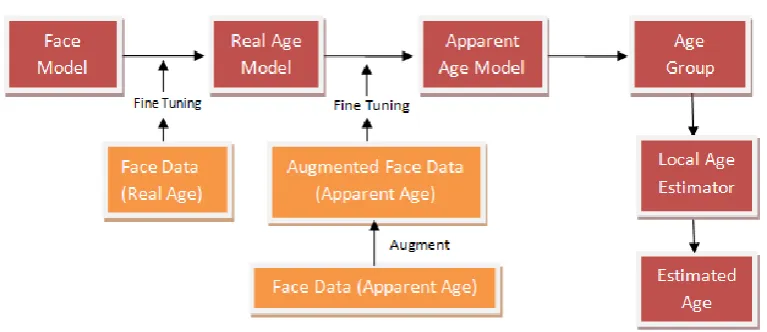
Fig. 1. Picture depicting the model for automatic age estimation.
II.
P
REPROCESSINGA. Face Detection and Landmark Detection
Given the picture information, we first connected face recognition and milestone restriction utilizing Microsoft Project Oxford API [2] and Face++ API [1]. Pictures are pivoted each 10 degrees for further recognition if no face is recognized in the original picture. Whatever is left of pictures that are still not identified by revolution are not utilized as a part of our approach. Amid the final accommodation, all the undetected pictures are set to the normal age from the general expectations as their age mark.
B. Data Augmentation
The face pictures from the age estimation test are gathered in the wild and the quantity of preparing pictures is exceptionally constrained (around 2500 pictures). There are different postures, brightening, and picture quality issues in the dataset. To handle this issue, we apply information enlargement to make new preparing tests from the given preparing information before fine-tuning the profound system. Every preparation case (in the wake of editing and arrangement) was irritated before introducing it to the system by arbitrarily turning, interpreting, scaling, including clamor
and alternatively flipping. By doing this information enlargement, for every preparation test, various new preparing tests can be produced so that the aggregate number of clear age information is in-wrinkled in the meantime the profound systems are relied upon to "see" more information with more varieties in learning.
III.
D
ATABASESIn this area, we display the databases that are utilized to prepare the profound models in a fell manner. We firstly pretrain a GoogLeNet demonstrate utilizing CASIA - WebFace database. At that point numerous databases with genuine age names are converted into one dataset for fine-tuning the profound model, for the genuine age estimation. At long last, the obvious age information from the test are utilized to fine-tune the profound model parameters for clear age estimation.
A. Transform Age Database
© 2016, IRJET | Impact Factor value: 4.45 | ISO 9001:2008 Certified Journal | Page 933 Hispanic, Asian, Indian, and Others. In spite of
the fact that Morph has an incredible number of confronts, it resemble mug-shot pictures, which is very not the same as the countenances in nature [7].
B. FGNET Age Database
FGNET [4] comprises of 1,002 pictures of 82 subjects, named with exact ordered age. Some of these photographs were gained under controlled conditions. One normal for this database is that it contains a considerable measure of tests of youthful ages, i.e., from 1-13 years.
C. Life expectancy Age Database
Life expectancy [14] is a database of 575 individual appearances running from ages 18 to 93, and it was created to be more illustrative of age gatherings over the life expectancy, with a unique accentuation on enlisting more seasoned grown-ups. The database has appearances of 218 grown-ups age 18-29, 76 grown-ups age 30-49, 123 grown-ups age 50-69, and 158 grown-ups age 70 and more seasoned. What's more, this database additionally contains the data of outward appearances, similar to nonpartisan, glad, irritated, crotchety, and astounded expressions [8]. The database was initially created in the brain science society, and was acquainted with the computer vision group for computational age estimation in [10,11].
D. Other Age Database
Other than the above open databases, in this work we additionally utilized a private age database. This database is made out of controlled face pictures which were caught in studio environment and in nature. Absolutely, we have around 8,941 countenances with age names in this dataset.
Another such database named as CACD is short for Cross-Age Celebrity Dataset [5], a large scale age database. It contains more than 160,000 im- ages of 2,000 celebrities with age
ranging from 16 to 62 years. It is originally designed for investigating the problem of age-invariant face recognition and retrieval.
IV.
E
XPERIMENTSA. Assessment Protocol
The age estimation test is another track at the ChaLearn LAP challenge 2015 [1,2]. A dataset of 4699 pictures is given, every picture is marked a genuine number from 0 to 100 showing the clear age. The pictures are gathered from two web-bases application and marked by no less than 10 distinct clients. Pictures in this dataset are taken in the wild, so there exists different stances, light and quality changes. The age estimation challenge goes for researching the execution of estimation techniques on apparent age instead of genuine ordered age[17]. The estimation result is assessed by fitting an ordinary distribution with the mean and standard deviation of the votes in favour of every picture. The mistake over every one of the pictures is registered as:
𝑒 = 1
𝑁 1 − 𝑒
−(𝑧−𝑢)
2
2𝜎2
𝑁
𝑖=1
where is the error, N is the number of test samples, x is the predicted age, μ is the mean age and σ is the standard deviation.
B. Aging Pattern
© 2016, IRJET | Impact Factor value: 4.45 | ISO 9001:2008 Certified Journal | Page 934 Pattern [12, 13], which is the premise of AGES.
Formally a maturing example can be characterized as a progression of individual face pictures sorted in time arrange.
V.
A
GER
ANGE-BASEDE
STIMATIONThe above methodologies may experience an issue that the subsequent model would be skewed toward the age go that has more occurrences in the preparation set. With a specific end goal to check this, the ages (0-69) in the FG-NET Aging Database are isolated into three age runs as 0-5, 6-30, 31-69, which are predictable with the age bunches found by breaking down the progressions. The MAEs of AGES in various age extents are appeared in the principal line of Table 2. As can be seen, the MAE in 31-69 is much higher than others because of the way that the preparation tests in that range is deficient (allude to Table 1).
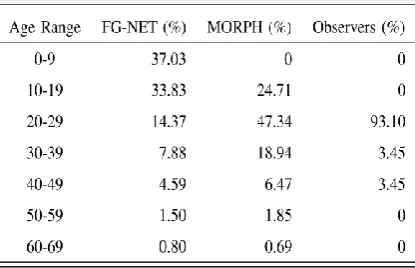
Table 1: Age Range Distribution of the Images in the Databases and the Human Observers Participating the Experiment.
It can be seen that the MAEs of AGESr in the initial two age ranges with generally bounteous pictures, are like those of AGES. Be that as it may, its MAE in 31-69 is astoundingly lower than that of AGES in light of the fact that the free preparing in this range keeps the model from being one-sided to other age ranges with all the more preparing tests. Take note of that the MAEs of AGESr are gotten under the supposition that the age scope of the test picture is known. At the point when this does not hold, an age run estimator is required.
AGES can be straightforwardly utilized for age go estimation in the wake of relabeling the preparation information with the age ranges where the relating ages fall into. The subsequent forecast will be an age run name showing which subspace to use for further estimation of the correct age. The MAE of such two-layer age estimation is 6.52 (appeared in brackets in Table 2), which enhances the general MAE of AGES (6.77).
Fig 2.
[image:4.595.303.561.253.353.2]Examples of aging effects simulated by AGES. The ages are marked at the right-bottom corner of the images.
Table 2: MAE of AGES and AGESr in Different Age Ranges
[image:4.595.335.518.393.445.2] [image:4.595.39.247.408.542.2]© 2016, IRJET | Impact Factor value: 4.45 | ISO 9001:2008 Certified Journal | Page 935 primary test confront, the reproduced confront
looks moderately more not the same as the exhibition confront. This may be on the grounds that the display confronts wears glasses, which is difficult to foresee in view of the 4-year-old test confront.
VI.
C
ONCLUSIONThe current edge pre-handling approach in AGES is predicated on numerous milestone focuses in the face photos, at long last those points of interest must be chosen with the guide of making utilization of robotized land stamping calculations like [14]. Besides, the present day pre-prepares does no longer keep the data about the external shape length of the face. Be that as it may, confront length changes crosswise over ages, particularly amid early life. Henceforth, as future works, taking the measurements and type of the face form into thought would potentially considerably improve the precision of AGES, specifically for age estimation on youths' countenances. Other than age estimation, AGES might be connected in various framework vision works. For instance, with the ability to recreate facial maturing results, AGES might be utilized for face prevalence all through ages, which has been tried in the analyses. By and large, posture and enlightenment varieties are always troublesome in computer vision frameworks [18]. Like AGES with pictures at different ages, pictures underneath unique posture and light circumstances can be managed as a whole (undifferentiated from a maturing test). This thought has been investigated in face acknowledgment, known as the "Eigen light-region". In order to adaptation the light-range, a "routinely happening instruction information set" is required in such works, which contains confront pictures underneath all doable stance and enlightenment circumstances. In any case, this isn't generally accessible in truth.
R
EFERENCES[1] C.-C. Chang and C.-J. Lin. Libsvm: A library for support
vector machines. ACM Transactions on Intelligent Systems
and Technology (TIST), 2(3):27, 2011.
[2] B.-C. Chen, C.-S. Chen, and W. H. Hsu. Cross-age reference
coding for age-invariant face recognition and retrieval.
In European Conference on Computer Vision, pages 768–
783. Springer, 2014.
[3] E. Eidinger, R. Enbar, and T. Hassner. Age and gender
estimation of unfiltered faces. Information Forensics and
Security, IEEE Transactions on, 9(12):2170–2179, 2014.
[4] FGNET. The fg-net aging database. In
http://www.fgnet.rsunit.com/, 2002.
[5] Y. Fu, G.-D. Guo, and T. S. Huang. Age synthesis and
estimation via faces: A survey. IEEE Trans. Pattern
Analysis and Machine Intelligence, 32(11):1955–1976,
2010.
[6] G.-D. Guo. Human age estimation and sex classification. In
C. Shan, F. Porikli, T. Xiang, and S. Gong, editors, Video An-
alytics for Business Intelligence, pages 101–131.
Springer,2012.
[7] G.-D. Guo, G. Mu, Y. Fu, C. Dyer, and T. S. Huang. A study on
automatic age estimation on a large database. In IEEE
International Conference on Computer Vision, pages 1986–
1991, 2009.
[8] G.-D. Guo and X. Wang. A study on human age estimation
under facial expression changes. In IEEE Conf. on Computer
Vision and Pattern Recognition, 2012.
[9] G. B. Huang, M. Ramesh, T. Berg, and E. Learned-Miller.
Labeled faces in the wild: A database for studying face recognition in unconstrained environments. Technical re- port, Technical Report 07-49, University of Massachusetts, Amherst, 2007.
[10]Y. Jia, E. Shelhamer, J. Donahue, S. Karayev, J. Long, R. Gir-
shick, S. Guadarrama, and T. Darrell. Caffe: Convolutional
architecture for fast feature embedding. In Proceedings of
the ACM International Conference on Multimedia, pages
675–678. ACM, 2014.
[11]Andreas Lanitis, et al. “Comparing Different Classifiers for
Automatic Age Estimation” IEEE Transactions On Systems, Man, And Cybernetics—Part B: Cybernetics, Vol. 34, No. 1, pp. 621–628, February 2004.
[12]Narayanan Ramanathan, et al. “Face Verification Across
Age Progression” IEEE Transactions On Image Processing, Vol. 15, No. 11, pp. 3349-3361, November 2006.
[13]Xin Geng et al. “Automatic Age Estimation Based on Facial
Aging Patterns” IEEE Transactions on Pattern Analysis and Machine Intelligence, Vol. 29, No. 12, pp. 2234-2240, December 2007.
[14]N. Duta, A.K. Jain, and M.-P. Dubuisson - Jolly, “Automatic
Construction of 2D Shape Models” IEEE Trans. Pattern Analysis and Machine Intelligence, vol. 23, no. 5, pp. 433-446, May 2001.
[15]Jinli Suo et al. “A Compositional and Dynamic Model for
Face Aging” IEEE Transactions on Pattern Analysis and Machine Intelligence, Vol. 32, No. 3, pp. 385-401, March 2010.
[16]K. Ricanek Jr and T. Tesafaye. Morph: A longitudinal image
database of normal adult age-progression. In 7th
Interna- tional Conference on Automatic Face and Gesture
© 2016, IRJET | Impact Factor value: 4.45 | ISO 9001:2008 Certified Journal | Page 936
[17]Yun Fu et al. “Age Synthesis and Estimation via Faces: A
Survey” IEEE Transactions on Pattern Analysis and Machine Intelligence, Vol. 32, No. 11, pp. 1955-1976, November 2010.
[18]Alireza Keshavarz Choobeh “Improving Automatic Age
![[13- 21] on the mechanical behavior of different grades of](data:image/gif;base64,R0lGODlhAQABAIAAAP///wAAACH5BAEAAAAALAAAAAABAAEAAAICRAEAOw==)