http://dx.doi.org/10.4236/psych.2015.61009
How to cite this paper: Kira, I. A., Omidy, A. Z., Fawzi, M., Rice, K. G., Fawzi, M., Lewandowski, L., & Bujold-Bugeaud, M.
Are the Negative Mental Health Effects of
Gender Discrimination (GD) Salient across
Cultures? Does Self-Esteem Mediate These
Effects: GD as a Continuous Traumatic Stress
and the Pathways to Its Negative Dynamics?
Ibrahim A. Kira
1, Andrea Z. Omidy
2, Mounir Fawzi
3, Kenneth G. Rice
4, Mohab Fawzi
3,
Linda Lewandowski
5, Mireille Bujold-Bugeaud
11Center for Cumulative Trauma Studies, Stone Mountain, GA, USA 2Boston Medical Center, Boston, MA, USA
3Zaqaziq University, Zaqaziq, Egypt 4Georgia State University, Atlanta, GA, USA 5University of Massachusetts, Amherst, MA, USA Email: [email protected]
Received 31 December 2014; accepted 18 January 2015; published 23 January 2015
Copyright © 2015 by authors and Scientific Research Publishing Inc.
This work is licensed under the Creative Commons Attribution International License (CC BY).
http://creativecommons.org/licenses/by/4.0/
Abstract
theory, counseling and social justice, and for future research were discussed.
Keywords
Gender Discrimination, Appraisal, Coping, Type III Chronic traumas, Developmentally-Based Trauma Framework (DBTF)
1. Introduction
While gender differences are normative and positive for both interdependent genders (Wood & Eagley, 2003), gender discrimination against females is not normative and is culturally constructed. Gender discrimination (GD) is not a natural fact that is simply derived from biological and sex differences. It is rather a complex social, his-torical, and cultural phenomenon that regulates, in critical way, social life and social institutions around male’s dominance and female’s subjugation. It includes negative attitudes, beliefs, and behaviors that devalue, deni-grate, stigmatize, or restrict females. Gender discrimination (GD) (by family and/ or by social institutions and cultures) is chronic identity trauma that includes prejudice and unfair disadvantageous treatment and/ or nega-tive perception based on a person’s female gender. It includes the differential disparity in status, power and prestige and may include the belief that a male is intrinsically superior, especially in the case of oppression of women by men. GD usually inflates the dominant gender and deflates the subjugated gender identity and self- worth (esteem and efficacy), potentially hurting both genders. Research suggested that gender discrimination is a risk factor for females and protective factor, and can potentially be a risk factor as well, for males (Kira et al., 2012a). It was found that GD contributes to lower self-esteem, and associated higher internalizing disorders in females and, higher empowerment, or inflated self-esteem and associated with higher risk-taking behaviors and externalizing disorders (and authoritarianism) in males (Kira et al., 2012a; Rosenfield, Lennon, & White, 2005; Kaufman, 2009). Gender discrimination as identity type III trauma, for females is a systemic social-structural inter-gender trauma, comprises micro (e.g., insults and exclusions) as well as macro aggressions (e.g., gender- based violence, trafficking). Macro-aggressions terrorize and increase the targeted individual’s sensitivity to mi-cro-aggressions that can be proxies for the anticipated macro aggressions and can be re-traumatizing and re- terrorizing for the victims. Gender discrimination is based, in such cultures, on an organizing principle and an immutable fact of men’s superiority and dominance over women on familial, social, political, religious and economic institutions. Even systems of knowledge and dominant cognitions reflect mostly men’s gendered views of the natural and social world and their production of gendered knowledge. The severity of Gender in-equality varies tremendously across cultures and sub-cultures., and is usually higher within conservative cultures (e.g., Daly & Chesney Lind, 1988). Feminist theorists (e.g., Enns, 2004; Kira et al., 2012) propose that tradi-tional gender role socialization and experiences of external and internalized oppression negatively impacts the mental health and wellbeing of both genders. Several liberal, cultural, and radical feminist theories have been influential in articulating the various ways rigid gender role socialization and gender stereotypes promote de-valuation of women, systemically enhances patriarchy, male domination and control over of women (Enns, 2004; Jaggar & Rothenberg, 1993; Worell & Remer, 2003).
demographics have been used, in research, as proxies to such inequalities, discriminations and social structural violence, instead of measuring its impact. The demographic variable “gender”, used in research, is mostly a proxy of such poorly articulated GD (in addition to potential normative differences) that exists and varies across cultures. We propose that most of differences found in research using the demographic variable “gender” are due, at least in great part, to the GD’s stress and trauma dynamics.
GD as a serious continuous life-trauma for females, does not only make them more vulnerable, but also has the potential of yielding or exasperating symptoms of PTSD, depression, complex PTSD and other post-trauma spectrum disorders as well as cumulative mental and physical health disorders’ comorbidity. GD was found, us-ing mostly western samples, to be associated with physical and psychiatric disorders (Kira et al., 2010; Landrine, Klonoff, Gibbs, Manning, & Lund, 1995). One of the significant GD related disorders are eating disorders. In-ternalization of the pervasive male-centered norms of women’s objectification may minimize their competence, and deny them their agented qualities and negatively affect their performance (Quinn, Kallen, Twenge, & Fre-drickson, 2006) and is related to increasing high rate of eating disorders amongst females (compared to males). Such disorders may develop to comply with such norms set by male dominated culture (e.g., Ferreiro, Seoane, & Senra, 2011). GD has been shown to negatively impact the mental health of both genders in torture survivors from over 20 countries (Kira et al., 2010, 2012a). Additionally, DBTF posits that GD intersects with other kinds of identity traumas, (e.g., discrimination and oppression) (Shields, 2008). The effects of Interlocking systems of oppression on females’ life move beyond the added experiences of each. DBTF proposes that gender oppression is amplified by such intersections and interactions and their linear and non-linear cumulative dynamics (Kira, Alawneh, Aboumediene, Lewandowski, & Laddis, 2014). Experimental and longitudinal data have shown strong evidence for the negative effect of perceived discrimination on well-being (Correa-Velez, Gifford, & Barnett, 2010; Schmitt, Branscombe, & Postmes, 2003). They have consistently documented the negative asso-ciations of different discriminations with health and quality of life across minority groups (for meta-analysis see: Pascoe & Richman, 2009).
One of the characteristics of such chronic type III traumas is its linear and non-linear cumulative negative ef-fects. While dose-response model (the parallel increase in effects caused by increased levels of exposure) de-scribes linear traumatogenic dynamics (e.g., Altshuler, 1981), cumulative trauma model proposes different addi-tional cumulative non-linear dynamics inherent in the threshold model (where a threshold value at which the behavior varies significantly) (Kira, 2010, Kira et al., 2006). Resilient female may have her breaking point with reactivation spreading of old and new traumatic stressors at which it could turn her to “snap” into a psychiatric casualty (for example, decompensation or suicide) or criminal acting out. Such non-linear dynamics of cumula-tive trauma are especially present in multiply traumatized victims of chronic traumas, such as GD (Kira, Ashby et al., 2012; Kira, Amer, & Wroble, 2014).
There are two primary distinct but intersected Cultural channels that may transmit andpropagate GD trauma-tization dynamics: social institutions and family. Social, religious and social institutions may perpetrate GD sys-temic betrayal trauma (GD-S). Parents, family members and significant others (intra-household members) may perpetrate GD (family betrayal Trauma) (GD-P). Attitudes, beliefs and practices from social institutions and the public that serve to exclude women are often deeply entrenched in cultural, social and religious norms with dif-ferent intensities (Freyd, DePrince, & Gleaves, 2007; Kira, Lewandowski, Chiodo, & Ibrahim, 2014). These gendered institutions have pivotal influence on people’s professional and economic trajectories. There are many types of institutional and systemic gender discrimination and can range from workplace discrimination to violent hate crimes against women.
Gender Discrimination by parents, family members and significant others (GD-P) can have similar or differ-ent impact compared to gender discrimination by social and political institutions (GD-S). The outcome may be dependent on the severity of each and on the age of exposure. (For example adolescents may be more dependent on family and significant others and thus more affected by GD-P, while adults are more affected by GD-S). The differential physical and mental health effects of these two types of gender discrimination (GD-P and GD-S) are understudied. There is a need to explore the differential impact of each in each group and their stability cross- culturally. Current study will explore such differences or similarities across specific cultural groups.
Further, there are powerful pressures from dominant gender actors who have a vested interest in maintaining a discriminatory status quo to minimize or disregard the presence of GD (e.g., Garcia, Schmitt, Branscombe, & Ellemers, 2010; Kaiser, 2007). Even some members of the same disadvantaged group, to cope with distress re-lated to GD, disapprove an individual who claims or emphasizes GD (Garcia et al., 2010). Indeed many females especially in traditional cultures deny experiencing discrimination even in the face of objective indicators to the contrary (Crosby, 1984). A motivation to justify the unjust GD may lead individuals to endorse explanations that portray gender differences as stemming from deep, essential cause (Brescoll, Uhlmann, & Newman, 2013). System justification theory suggests that people have an essential motive to view their social system as just, fair, and good and will engage in different conscious or unconscious strategies to justify the status quo (Jost, Banaji, & Nosek, 2004; Sidanius & Pratto, 1999, Yeung, Kay, & Peach, 2014). Justification of the status quo is sus-tained by motivated reasoning (Kay et al., 2009; Kunda, 1990), such as positive appraisal of GD. Appraisal strategies, for females, according to the DTBF framework are developed, at least in part, in an attempt to cope with the continuous distress of GD. Coping with GD continuous traumatic stress can arise through the internali-zation and acceptance of the self in a second-class status (or give up) to reduce distress, or through resistance. Acceptance coping may result in lowered self-esteem and submission to dominance. Positive appraisal of gender discrimination indicates mostly the acceptance and internalization of the female as having lower status as part of the established social order. Negative appraisal occurs through resistance of gender discrimination, at varying levels of intensity, for example through feminine ideology (Foster, 2009). While positive cognitive appraisal, in non-oppressive conditions, yield positive emotions and is usually associated with positive outcome and consi-dered a positive coping (e.g., Kira et al., 2011-a; Scherer, Shorr, & Johnstone, 2001), the opposite may be true in the case of oppression (e.g., Brondolo et al., 2006; Krieger, 1999). The typically positive relationship between positive appraisal and effective psychological functioning may be nullified within the context of oppression in some minority groups who positively appraised discrimination (Perez & Soto, 2011; Soto et al., 2012). Mathe-son, Skomorovsky, Fiocco and Anisman (2007) found in a study of psychologically or physically abused women, that coping strategies that might appear beneficial, when considered in the broader context may actually under-mine well-being. They suggest that in some contexts, reduced distress might limit active efforts to alter a dys-functional situation. Internalized oppression found to be correlated with higher psychological distress in the af-fected gender (e.g., Szymanski & Gupta, 2009).
However, each form of appraisal has its costs. Positive appraisal, leading to its acceptance, results in lowered self-esteem, lowered self-efficacy, and a relative loss of control. Negative appraisal, leading to resistance, can also have costs as women who succeed at male gender-typed tasks are frequently penalized for success (Heil-man & Okimoto, 2007). The dynamics of appraisal in the cases of internalizing or resisting GD, and its rela-tionship with self-esteem, have never been empirically studied. Current study, will examine such dynamics in one of such cultures with high GD.
As, we discussed earlier, the severity of GD varies tremendously across cultures, world regions and countries. GD can be more severe especially in some traditional patriarchal hierarchical cultures and among the repressed groups (e.g., American Indians, Palestinians, refugees and torture survivors). Studies of GD around the world found that Southeast Asia and Latin America, with relatively the least GD, and Sub-Saharan Africa, the Indian Subcontinent and the Middle East/North Africa (MENA) region with relatively the highest GD
(http://www.genderindex.org/countries). According to the gender inequality index developed by United nations Human development Program (UNDP, 2013), Norway, followed by Australia and United States is the highest in gender equality within 186 ranked nations, Palestinian occupied territories ranked 110, Egypt ranked 112, Iraq ranked 131, Bhutan ranked 140, Myanmar ranked 149, and Nepal ranked 157 (these countries will be represented in current study samples).
current husband while 16% were beaten in the past year (Diop-Sidibéa, Campbellb, & Beckerc, 2006). Women in Egypt are often subject to violence not only from family and community members, but also by agents of the state, including the police supposedly tasked with the protection of all citizens. In addition, women are con-stantly subjected to violence in the form of sexual harassment and abuse on the street, and approximately ninety- seven percent of Egyptian women are the victims of female genital mutilation (Diop-Sidibéa, Campbellb, & Beckerc, 2006).
Violence against Palestinian women and girls is a multifaceted issue with significant association between po-litical violence and increased domestic violence (Al Krenawi, Graham, & Sehwail, 2007). Women and girls who speak out are often blamed for the violence inflicted upon them and their families are shamed for not exerting greater control over their sexuality. The 2006 Palestinian Central Bureau for Statistics (PCBS)survey revealed that 61.7% of ever-married women were exposed to psychological violence; 23.3% exposed to physical violence, and 10.9% exposed to sexual violence at least once during the year. While one-third of women believed that there was no excuse for a man to beat his wife, a substantial percentage still justified wife beating under several conditions. These beliefs were attributed to an adherence to an internalized patriarchal ideology (Haj-Yahia, 1998).
Native American women suffer violent crime at a rate three and a half times greater than the national average in the USA. National researchers estimate that this number is actually much higher than has been captured by statistics; according to the Department of Justice over 70% of sexual assaults are never reported (e.g., Bachman, Zaykowski, Kallmyer, Poteyeva, & Lanier, 2008).
Refugees and torture survivors women, who do not enjoy the protection of their own governments, are among those most vulnerable to acts of violence, including sexual and gender-based violence (Kira et al., 2012). Gend-er-based violence (GBV) is most prevalent in environments where there is a general lack of respect for human rights. GBV occurs in most societies irrespective of culture, socioeconomic status or religion. Nevertheless, it has been identified that immigrant and refugee women are particularly at risk (Walter, 2001; Narayan, 1997). Krug et al. (2002) proposed that gender-based violence is usually at its highest point when communities and gender roles are in transition such is the case in refugees. GBV occurs during conflict, prior to flight, during flight, and in the country of asylum.
The current study aims at filling some of the gaps in the literature on GD. Specifically it evaluates the salience of the negative impact of GD on physical and mental health across different cultures (American Indians, Pales-tinians, Egyptians, and refugee torture survivors) and different measurement strategies, and test the traumatolo-gy perspective that emphasizes GD, as type III chronic identity trauma that may yield PTSD, Complex PTSD, eating disorders, and mental health comorbidities and reduced level of functioning . It explores the differential mental health impact of GD-P and GD-S across different cultures and measurement strategies. The study also examines, cross-culturally the effects of two different appraisal coping strategies, one by potentially internaliz-ing (positive appraisal) and one by potentially resistinternaliz-ing (negative appraisal) of gender discrimination and ex-amine the dynamics of these effects in one of the samples.
The authors reanalyze material from four data sets in four prior studies in Egypt, Palestine, and the USA. All of the studies used the same comprehensive measure of cumulative stress that was developed based in the DBTF framework, the Cumulative Trauma Scale (Kira et al., 2008). This scale included a two-item sub-scale for mea-suring GD, GD-S and GD-P, and measured appraisal of each type (negative and positive appraisals). Each study collected community samples data (two community-based samples and two community clinics-based samples). The first study utilized a sample of American Indians (AI) living in the United States (Omidy, 2012; Kira, Omi-dy, & Ashby, 2014). The second study conducted on a sample of Palestinians living in Gaza (e.g., Kira et al., 2011, 2013; Kira, Omidy, & Ashby, 2014). The third study consisted of clients from a mental health clinic in Egypt (Kira, Fawzi, & Fawzi, 2012b). The fourth study consisted of clients from a torture survivor’s clinic in the United States, with representation from 32 countries (Kira et al., 2010, 2012). While all the four samples used the same Cumulative Trauma Scale that included a subscale of GD, there were variations in outcome measures specific to each study. However, three of the studies used the same measure of PTSD. The outcome measures will be used to explore the effects of GD across various assessment strategies of health and mental health.
Hypotheses
asso-ciated (linearly and non-linearly) with negative mental health, negative physical health, lowered self-esteem and lowered global assessment of functioning (GAF)after controlling for demographics. Specifically, for mental and physical health, it will:
1) Be associated with binge eating, lower physical and social functioning, lower general mental health, and perceived general health, as well as with psychiatric comorbidities, illegal drug use and substance abuse in American Indians;
2) Be associated with post-traumatic stress disorder (PTSD), cumulative trauma disorders (CTD) (complex PTSD) in torture clients;
3) Be associated with depression, anxiety, annihilation anxiety, and lower self-reported health in Palestinian participants;
4) Be associated with PTSD, depression, anxiety, and psychiatric co-morbidities in Egyptian mental Health Clients.
Hypothesis 2: Gender discrimination, as a type III systemic chronic (life-time) identity trauma that intersects with similar traumas according to DBTF, will be associated with identity salience, other collective identity traumas, with personal identity traumas (that include sexual abuse, incest, and rape and domestic violence), be-trayal or attachment, survival and secondary traumas. Further, because GD inhibits female achievement and self-efficacy, GD will be associated with achievement (self-actualization or role identity trauma).
Hypothesis 3: GD-P and GD-S will predict different levels of negative effects that are dependent on their rel-ative severity in each cultural group. GD-S will predict more distress and more negrel-ative effects, as it is more de-trimental in adult life (as contrasted by the potential different effects of GD-P on children).
Hypothesis 4: Appraisal of GD (negative or positive) is one of the coping strategies with such social structural oppression: Self-esteem mediates the effects of appraisal and GD on health and mental health. While negative appraisal increases self-esteem, positive appraisal decreases self-esteem and affects negatively physical and mental health and functioning. Figure 1 illustrates this hypothesis.
2. Method
2.1. Participants and Outcome Measures in the Four Samples
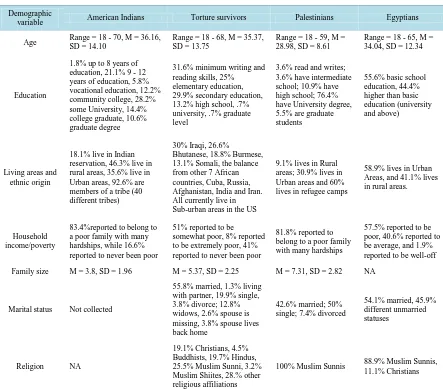
Table 1 summarizes the demographic characteristics of the four samples.Participants in sample 1: The first sample consisted of AI adults in the United Stated, primarily living in the state of Oklahoma. The fieldwork of this study was conducted between November of 2010 and May of 2011. Ninety-three percent of participants were enrolled members of a tribe, with representation from 45 different tri-bes. Data analysis focused on the females (N = 188).
Figure 1. Illustration of the hypothesized dynamics of appraisal with the mediation of self-esteem.
Table 1. The demographic variables of the four samples.
Demographic
variable American Indians Torture survivors Palestinians Egyptians
Age Range = 18 - 70, M = 36.16, SD = 14.10
Range = 18 - 68, M = 35.37, SD = 13.75
Range = 18 - 59, M = 28.98, SD = 8.61
Range = 18 - 65, M = 34.04, SD = 12.34
Education
1.8% up to 8 years of education, 21.1% 9 - 12 years of education, 5.8% vocational education, 12.2% community college, 28.2% some University, 14.4% college graduate, 10.6% graduate degree
31.6% minimum writing and reading skills, 25% elementary education, 29.9% secondary education, 13.2% high school, .7% university, .7% graduate level
3.6% read and writes; 3.6% have intermediate school; 10.9% have high school; 76.4% have University degree, 5.5% are graduate students
55.6% basic school education, 44.4% higher than basic education (university and above)
Living areas and ethnic origin
18.1% live in Indian reservation, 46.3% live in rural areas, 35.6% live in Urban areas, 92.6% are members of a tribe (40 different tribes)
30% Iraqi, 26.6%
Bhutanese, 18.8% Burmese, 13.1% Somali, the balance from other 7 African countries, Cuba, Russia, Afghanistan, India and Iran. All currently live in Sub-urban areas in the US
9.1% lives in Rural areas; 30.9% lives in Urban areas and 60% lives in refugee camps
58.9% lives in Urban Areas, and 41.1% lives in rural areas.
Household income/poverty
83.4%reported to belong to a poor family with many hardships, while 16.6% reported to never been poor
51% reported to be somewhat poor, 8% reported to be extremely poor, 41% reported to never been poor
81.8% reported to belong to a poor family with many hardships
57.5% reported to be poor, 40.6% reported to be average, and 1.9% reported to be well-off
Family size M = 3.8, SD = 1.96 M = 5.37, SD = 2.25 M = 7.31, SD = 2.82 NA
Marital status Not collected
55.8% married, 1.3% living with partner, 19.9% single, 3.8% divorce; 12.8% widows, 2.6% spouse is missing, 3.8% spouse lives back home
42.6% married; 50% single; 7.4% divorced
54.1% married, 45.9% different unmarried statuses
Religion NA
19.1% Christians, 4.5% Buddhists, 19.7% Hindus, 25.5% Muslim Sunni, 3.2% Muslim Shiites, 28.% other religious affiliations
100% Muslim Sunnis 88.9% Muslim Sunnis, 11.1% Christians
[image:7.595.92.535.256.645.2]scale: 0 = Never; 1 = once; 2 = two times; 3 = three times; 4 = many times).” CTS-S provides us with general scales for two of the cumulative trauma doses: Occurrence and frequency of happenings, two appraisal sub- scales: negative and positive appraisal. It includes, at this level, four sub-scales for each trauma types.
This instrument has shown adequate internal consistency (α = .85) (Kira et al., 2008, Kira, Fawzi, & Fawzi, 2012), and test-retest stability (.74 in 6 weeks). Predictive validity was shown as cumulative trauma was signifi-cantly correlated with Posttraumatic Stress Disorder (r = .54, p < .001), cumulative trauma related disorders (r = .24, p < .001), and poor health (r = .37, p < .001) (Kira et al., 2008). CTS-S has also shown divergent validity as it was significantly negatively correlated with sociocultural adjustment (r = −.25, p < .001), and futuristic orienta-tion (r = −.37, p < .001). CTS-S has been used with different clinical and community samples of adults and adolescents from a various sociocultural groups and has proven to have adequate reliability (Alpha ranged be-tween .85 and .92) and good construct validity (e.g., Kira et al., 2008, Kira, Lewandowski, Somers, Yoon, & Chiodo, 2012e,Kira et al., 2012b; Kira et al., 2011a; Kira et al., 2011b) and cross-cultural validity across dif-ferent cultural groups (e.g., Kira, Fawzi, & Fawzi, 2012). The two items gender discrimination sub-scale’s relia-bility found to be fair to adequate in previous studies (e.g., Kira, Ashby et al., 2012). The measure has been used in several studies as a comprehensive measure for stress and trauma (e.g., Head, Singh, & Bugg, 2012; Gillespie & Gates, 2013; Millender, 2013; Omidy, 2012). In the four studies that used the same scale, Chronbach’s a ranged from .83 - .92 for trauma occurrence, and from .83 to .96 for cumulative negative appraisal, and from .82 to .89 for cumulative positive appraisal. While appraisal was not measured in torture survivors, it was measured in the other samples.
Reliability and validity of GD single items:
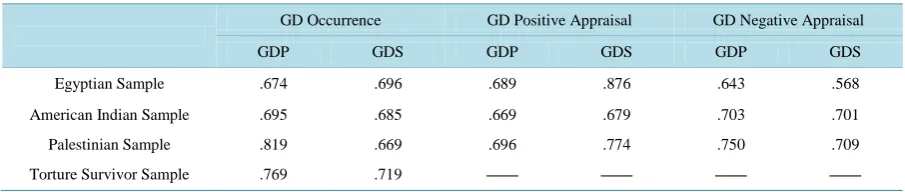
There is increased use of single items in research and single items were used to assess positivity/negativity of attitudes toward objects or events (Larsen, Norris, McGraw, Hawkley, & Cacioppo, 2009). Methodologists pro-posed that meaningful reliability estimates for single item measures can be calculated using correction of attenu-ation and factor analysis (e.g., Wanous & Hudy, 2001). Communality in factor analysis of the single item in-cluded in similar measures can be considered a conservative estimate of single-item reliability (e.g., Wanous & Hudy, 2001). Following Wanous and Hudy’s (2001) method of estimating single-item reliability, factor analyses were conducted between all trauma items in negative and positive appraisals and occurrence. Table 2 displays the communalities of GD variables in each sample which indicates fair to adequate reliability indicators. The predictive validity of GD and its single item measures was established in previous studies (Kira et al., 2010, Kira et al., 2012).
Outcome measures in sample 1:
Binge Eating Scale (BES; Gormally, Black, Daston, & Rardin, 1982) is a 16-item scale that measures binge- eating behaviors. Each item gives four statements and asks participants to circle the statement that best matches his or her eating behavior and emotions surrounding binge eating. Within each item, each statement is assigned points for the degree to which the statement describes binge eating (ranging from 0 - 3). Higher scores indicate more binge eating attributes. Scores of 17 or less indicated non-binge eating, scored of 18 - 26 indicated mod-erate binge eating, and severe binge eating was indicated by scores of 27 or higher. BES has shown adequate in-ternal consistency (α = .85) and test-retest reliability (r = .87, p < .001) (Gormally et al., 1982, Greeno, Marcus, & Wing, 1995). The measure had alpha of .87 in the current data.
Medical Outcome Study, Short-Form-36 version 2 (SF-36; Ware & Shelbourne, 1992). The SF-36 was de-veloped from the Medical Outcomes Study and has 36-items. It measured the following health concepts: physi-cal functioning, role limitations due to physiphysi-cal/emotional health issues, bodily pain, social functioning, general mental health, vitality, and perceived general health. Participants are asked to indicate their responses to each question based on a Likert-type response choice. Lower scores indicated higher disruptions to functioning based on limitations from physical and mental health. This instrument has shown adequate content, construct, and pre-dictive validity (Ware & Shelbourne, 1992). It has also shown internal consistency throughout the subscales (Chronbach’s α ranging from 0.73 to 0.96) and test re-test reliability (r ranging from .60 to .81). Convergent va-lidity was shown as groups were differentiated in regards to severity of symptoms within the physical health and the mental health constructs (McHorney, Ware, & Raczek, 1993). In the current data α = .76 for general health, α = .71 for the measure of mental health, and α = .94 for the measure of physical health.
Table 2. Factor analysis communalities of the GD occurrence and appraisals in the four samples as indicators of their relia-bilities.
GD Occurrence GD Positive Appraisal GD Negative Appraisal
GDP GDS GDP GDS GDP GDS
Egyptian Sample .674 .696 .689 .876 .643 .568
American Indian Sample .695 .685 .669 .679 .703 .701
Palestinian Sample .819 .669 .696 .774 .750 .709
Torture Survivor Sample .769 .719 ____ ____ ____ ____
Participants in sample 2: The participants in this sample consisted of 359 clients from the Center for Torture and Trauma Survivors (CTTS). Participants were screened at the center from April 2008 through September 2009. They include 160 females and 199 males. Ninety-five percent of the participants were new arrivals (2 - 6 months) to the United Stated, and less than five percent had been in the USA for more than a year. Data analysis focused on females (N = 160).
Construction and Translation of Measures
The intake protocol and other measures utilized in the center were first constructed in English and subse-quently translated into refugee major languages (Arabic, Bhutanese, and Burmese) by bilingual professionals. Measures were then back-translated by another fluent professional and reviewed for accuracy and culture ap-propriateness. After confirmation of the accuracy and cultural appropriateness of the translations, the measures were pilot tested in focus groups. Previous studies have supported the psychometrics of the translated instru-ments with Iraqi refugees (Kira et al., 2006, 2008). For clients who speak only dialects or other languages, an interpreter translated the questionnaire directly to them (Kira et al., 2013c).
Measures in sample 2: In addition to cumulative trauma scale, the following measures were administered: The Clinician-Administered PTSD Scale (CAPS-2) was developed by Blacke et al. (1990) and is widely used to assess PTSD. It is a structured clinical interview that assesses 17 symptoms rated on frequency and severity on a 5-point Likert-type scale. The CAPS has demonstrated high reliability (alpha ranges between .92 and .99) and has shown good convergent and discriminant validity (Weathers, Keane, & Davidson, 2001). In this study, we used the frequency sub-scale of CAPS-2 that is currently widely used in psychiatric literature. Elhai et al., 2006 found that the two symptom formats of CAPS (frequency and severity) were highly inter-correlated (from .86 to .93) and were not differentially related to summed PTSD severity scores or PTSD diagnoses. In ad-dition, Betemps, Smith, Baker, and Rounds-Kugler (2003) discovered that the frequency format was associated with both greater reliability and item discrimination than the intensity format. The scale used in this study has high reliability with an alpha of .97. The scale has four factor sub-scales: re-experiencing, avoidance, arousal and emotional numbness, detachment or dissociation (Palmieri et al., 2007). Reliability of the four sub-scales in our sample are adequate to high (alphas are .96, .92, .89 and .85 respectively).
Cumulative Trauma related Disorders Measure Scale (CTD)(Kira et al., 2012c): This 15-item measure was developed using data from six community and clinic samples from adults and adolescent who were Iraqi refu-gees, Arab Americans, African Americans, Palestinians and Egyptians. It is an index measure that covers 13 different symptoms: depression, anxiety, somatization, dissociation, auditory and visual hallucinations, avoid-ance of being with people, paranoid ideations, concentration and memory deficits, loss of self-control, feeling suicidal, and feeling like hurting oneself. Exploratory and confirmatory factor analyses found four factors: ex-ecutive function deficits, suicidality, dissociation, and depression/anxiety comorbidity. The CTD has demon-strated good reliability (ranging from .85 to .98 in five different studies Kira et al. 2012c). Test-retest reliability in a 6 week-interval was .76. This measure has also demonstrated good predictive validity. Different kinds of traumas, and cumulative trauma in general, accounted for significant variance as predictors of CTD symptoms (Kira, Clifford, & Al-Haider, 2003). Additionally, this measure was highly correlated with PTSD, DASS-A (an-xiety) and CES-D (depression) measures, further suggesting its convergent validity. This measure was also ne-gatively correlated with futuristic orientation, socio-cultural adjustment, and post-traumatic growth, supporting its discriminant validity (Kira et al., 2012c). In the current study, the measure had alpha of .90.
Translation of the measures
The measures used in this study, and in study 4, were previously pilot-tested in focus groups, and had pre-viously been shown to have adequate reliability and validity and cultural appropriateness with Iraqi and Arab populations and in Arabic and English languages (e.g., Kira et al., 2001, 2006, 2008). These measures were pre-viously translated into Arabic by three bilingual mental health professionals who met to establish a consensus on the final version. A fourth mental health professional reverse translated each measure to ensure their accuracy, fidelity, and cultural appropriateness (Kira et al., 2013b).
Measures in sample 3: In addition to CTS, PTSD and CTD measures, measures for depression, anxiety, an-nihilation anxiety, identity salience, self-reported health, and post-traumatic growth, were administered; as fol-lows:
The Center for Epidemiologic Studies Depression Measure (CES-D; Radloff, 1977): is a 20-item scale de-signed to measure depression in a normal population. Each item is assessed on a 4-point Likert-type scale and reflects the frequency that each symptom is experienced (0 = none of the time; 3 = all of the time). Adequate re-liability and validity have been reported for the CES-D. A cutoff score of ≥16 is commonly used for the CES-D to indicate a need for further assessment for the presence of major depressive disorder (Radloff, 1977). High re-liability results (ranging from .85 to .92) have been found for the CES-D among various groups. The measure has alpha = .91 in the current data.
The Depression Anxiety Stress Scales-Anxiety (DASS-A). The DASS is a 42-item scale developed by Lovi-bond and LoviLovi-bond (1995) that includes three sub-scales that measure depression, anxiety, and stress. The DASS-A is the sub-scale that measures anxiety and consists of 14-items. This measure is increasingly used in different clinical and research settings. Different studies suggest that DASS-A possesses adequate convergent validity, with reliability of .84 in non-clinical samples and .89 and 91 in clinical samples (Crawford & Henry, 2003; Lovibond & Lovibond, 1995). DASS-A had alpha of .95 in this study.
The Annihilation Anxiety scale (Kira et al., 2012f) is a three item scale based on the assumption that there are three main sources of annihilation anxiety (AA), personal identity, collective identity survival threats (traumas), and threats from societal structural inequalities (e.g., extreme poverty). These three sources represent the differ-ent sources of AA. The measure includes items that represdiffer-ent each area of annihilation concerns. For instance, the survey asks: “Because of what has happened to me personally or is happening to me personally, I sometimes worry that I just lose my sense of self (I worry that I will cease to exist as an individual person)”. The answer is structured on 5-pointLikert-type scale (5 being strongly agreed and 1 being strongly disagree). The 3-item scale has been used with Iraqi refugees in the United States and three samples of Palestinian adults and adolescents, and has shown to have good reliability (alphas ranged between .90 and .95). Kira et al. (2012f) have also pro-vided evidence for the discriminant and convergent validity for this measure. The measure had alpha of .92 in the current sample.
Identity Salience scale (Kira et al., 2011b) is a 10-items scale. The answer of scale questions is based on 7-point Likert-type scale (1 being completely disagrees and 7 being absolutely agree). High scores on the scale indicate higher group identity salience and low scores indicate more personal identity salience. Based on explo-ratory and confirmatory factor analysis, the measure has two sub-scales: Identity commitment, a 6-item subscale that measures the degree of commitment to one’s national or ethnic group. It asks questions like “When my group is threatened its interest come first before mine”. The second sub-scale measures identity militancy and has 4 items. It includes questions like “I am ready to die for the honor of my group to which I belong to”. The total scale alpha coefficient is .80in the current data.
Self-reported health is a single item on a 4-point Likert-type scale that asks about general health, with higher scores indicated poor health status. The scale, in the current study, is highly correlated with age (r = .46, p = .000), negative appraisal of traumatic events (r = .36, p = .001), CTD (r = .33, p = .001), cumulative trauma (r = .32, p = .001), PTSD (r = .30, p = .001), and fear of death, (r = .26, p = .001); and negatively correlated with stress related growth (r = −.13, p = .01) and futuristic orientation (r = −.12, p = .01).
Participants in sample 4: Participants were 432 mental health clients who attended the Zagazik University outpatient mental health clinic in Egypt. They included all patients admitted from May 1, 2010 to April 30, 2011. Data analysis focused on females (N = 207).
The Rosenberg self-esteem scale (RSES), developed by Dr. Morris Rosenberg (1965) and is a 10-item scale that measures global self-esteem. Each item is rated on a 4-point Likert-type scale from strongly agree to strongly disagree and scored from 0 - 3. The scale is divided by five positively worded and five negatively worded statements. The RSES has been translated and adapted to various languages including Arabic. Rosen-berg reported good psychometrics for the scale and its reliability ranging from .85 to .88. For the current Arabic sample alpha was .87.
Diagnostic Data: DSM-IV-TR five axes diagnoses, including GAF (general assessment of functioning) were assigned by the clinic psychiatrists. Comorbidity indexes for mental disorders and for physical disorders were established for each participant.
2.2. Procedures
The data were collected in previous studies and reported in previous publications, in which GD was reported only for the torture survivors’ data (Kira et al., 2010; Kira et al., 2012). These samples were chosen as they in-cluded the same measure of cumulative trauma and trauma types including GD, with different and similar out-come measures, and as they represent different cultures and populations which were optimal for pilot research to test the study hypothesis. All the four studies were previously reported in peer reviewed journals. The data sets were available as part of the archives of a research center for cumulative trauma that was coordinating different research projects. The authors received permission from the original authors to use the data.
3. Invariance Analysis
Although formal measurement invariance testing was not possible because GD measures were comprised of on-ly one or two items, we could explore sample invariance for the coefficients from the regressions of PTSD on GD (and later on CTD variables) in three of the samples that have the same PTSD outcome measure. These tests are comparable to tests of the sample x GD interaction effect. More specifically, we conducted multiple groups’ regression analyses and statistically compared regression coefficients between the different samples. We used the Model Test option (producing a Wald χ2) in Mplus to compare specific parameter estimates (beta coeffi-cients) between samples. In the present analysis, for PTSD, we used the Model Test option to conduct separate comparisons of beta coefficients (i.e., sample 2 (torture survivor samples) = sample 3 (Egyptian sample); sample 3 = sample 4 (Gaza sample); and sample 2 = sample 4).
We initially tested the two components of GD (discrimination by society and discrimination by parents). First, for discrimination by society, results revealed no significant differences between coefficients for all three of the comparisons, W = χ2 (1, N = 412) = .69, p = .405, W = χ2 (1, N = 412) < .00, p = .999, and W = χ2 (1, N = 412) = .64, p = .424, for the tests comparing samples 2 and 3, 3 and 4, and 2 and 4, respectively. Likewise, for discrimina-tion by parents, no significant differences emerged in all three comparisons, W = χ2 (1, N = 412) = .01, .18, and .03, respectively, ps > .671. Not surprising, tests involving the GD composite score also revealed no sample differences in the path coefficients, ps > .389.
4. Data Analysis
Partial correlations was conducted between gender discrimination, gender discrimination by parent, gender dis-crimination by society, negative appraisal of gender disdis-crimination, positive appraisal of gender disdis-crimination, and all outcome variables in each study, controlling for age, education, marital status, and socio-economic status. To test the theoretical model of the reversed outcome of positive appraisal of GD as outcome of oppression process and the mediation of the negatively affected self-concept, we tested a plausible path model for Egyptian sample (it is the only sample that has the self-esteem variable included in the measures) that match the discussed theoretical framework in hypothesis VI, for direct, indirect (mediated) and total effects of appraisals on mental health variables. We used IBM SPSS 22and AMOS22 software in data analysis. We chose maximum likelihood parameter estimation over other estimation methods (Kline, 2005). Because the percentage of missing data was less that 5% we used a mean imputation procedure. Model fit indices in SEM analyses were selected in accor-dance with several recommendations and included the normed 2 test statistic (2/df), the root mean square error of approximation (RMSEA) and the comparative fit index (CFI). 2/df values < 5.0 are considered acceptable; RMSEA values 0.05 indicate close fit, values 0.05 to 0.08 indicate reasonable fit, and values > 0.10 indicate poor fit. CFI values > 0.95 indicate good fit (e.g., Kline, 2005; Hu & Bentler, 1999). We trimmed the models by eliminating paths that were not significant to provide a more parsimonious summary of the inter-relationships among variables. The initial and final models do not deviate from the theoretical models. We used bootstrapping procedures (N = 10,000 samples) with bias-corrected confidence intervals to test the significance of the direct and indirect (mediated or partially mediated) effects of each variable in the model. Additionally, we tested the non-linearity hypothesis using curve-estimation procedure to test the nonlinear effects of cumulative dynamics hypothesis.
5. Results
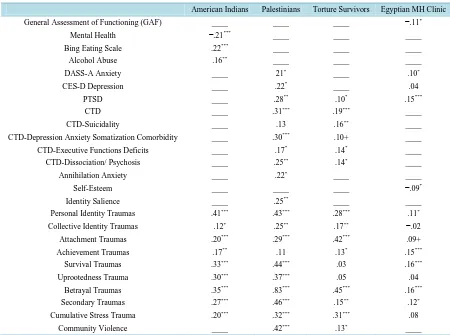
Results supported the first hypothesis. Gender discrimination was associated with decreased mental health, heightened PTSD, CTD, anxiety, and annihilation anxiety, in all the samples that these variables were measured. In AI/NA, GD was associated with binge eating, lower physical and social functioning, lower general mental health, and perceived general health, as well as with psychiatric comorbidities, illegal drug use and substance abuse. In Palestinians, GD was associated with CTD, PTSD, depression, anxiety, and annihilation anxiety. In torture survivors, GD was associated with CTD and PTSD. In Egyptians, GD was associated with PTSD, and anxiety. Gender discrimination was associated with suicidality in the sample of torture survivors (Sample 2), and with dissociation/psychosis, executive function deficits, in the sample of Palestinians (Sample 3) and torture survivors (Sample 2). It was also associated with decreased self-esteem, global assessment of functioning (GAF), and futuristic orientation (sample 4) (Table 3 includes more details).
Results of SEM indicated similar results. In the Egyptian sample, GD predicted negative self-esteem, reduced (GAF) and increased PTSD, depression and mental health comorbidity (the model had good fit: Chi Square = 20.574; d.f. = 12; p = .168; CFI = .971; RMSEA = .059). Self-esteem, as has been predicted, mediated the ef-fects of gender discrimination on mental health (see Figure 2; see also Kira et al., 2010, 2012, for torture survi-vors). Because all participants were from severely traumatized populations, to eliminate the potential effect of other trauma types (collective identity, personal identity, attachment, survival and secondary traumas), we added them to the models in separate analyses. While most of the other trauma types were predictive of negative men-tal health, GD and positive appraisal of GD continued to be highly predictive of negative menmen-tal and physical health outcomes.
Results supported the second hypothesis. Gender discrimination, as identity trauma that intersects with similar traumas, was associated with identity salience, personal identity, collective identity, role identity (achievement), attachment, secondary, betrayal, survival, cumulative stress, and community violence traumas. It was associated with uprootedness trauma in Palestinians and American Indians who suffered uprootedness. The highest associ-ations were with betrayal and personal identity traumas (Table 3). Gender discrimination may be related to feeling of betrayal be parents and social systems, and is directly related to identity.
Table 3. Partial correlation, between gender discrimination (GD) and mental health variables and trauma types, controlling for education, marital status and socio-economic status (SES).
American Indians Palestinians Torture Survivors Egyptian MH Clinic
General Assessment of Functioning (GAF) ____ ____ ____ −.11*
Mental Health −.21*** ____ ____ ____
Bing Eating Scale .22*** ____ ____ ____
Alcohol Abuse .16** ____ ____ ____
DASS-A Anxiety ____ 21* ____ .10*
CES-D Depression ____ .22* ____ .04
PTSD ____ .28** .10* .15***
CTD ____ .31*** .19*** ____
CTD-Suicidality ____ .13 .16** ____
CTD-Depression Anxiety Somatization Comorbidity ____ .30*** .10+ ____
CTD-Executive Functions Deficits ____ .17* .14* ____
CTD-Dissociation/ Psychosis ____ .25** .14* ____
Annihilation Anxiety ____ .22* ____ ____
Self-Esteem ____ ____ ____ −.09*
Identity Salience ____ .25** ____ ____
Personal Identity Traumas .41*** .43*** .28*** .11*
Collective Identity Traumas .12* .25** .17** −.02
Attachment Traumas .20*** .29*** .42*** .09+
Achievement Traumas .17** .11 .13* .15***
Survival Traumas .33*** .44*** .03 .16***
Uprootedness Trauma .30*** .37*** .05 .04
Betrayal Traumas .35*** .83*** .45*** .16***
Secondary Traumas .27*** .46*** .15** .12*
Cumulative Stress Trauma .20*** .32*** .31*** .08
Community Violence ____ .42*** .13* ____
Note: +p < .10 *p < .05. **p < .01, ***p < .001; ____ = variables were not measured. PTSD = post-traumatic stress disorder; CTD = cumulative trauma
related disorders (complex PTSD).
Note: GAF = general assessment of functioning; MH = mental health; GD-NA = gender discrimination negative appraisal; GD-PA = gender dis-crimination positive appraisal.
Figure 2. Path diagram for the direct standardized effects of negative and positive appraisal of GD, mediated by self-esteem on mental health variables in the Egyptian sample.
Egyptian Sample N = 207
Chi Square = 20.574, d.f. = 12, p= .057 CFI = .971
RMSEA = .059
.20
−.09
−.08 .02−.33
.66
.43 −.57
.68 .26
.80
.21
.64 .07
[image:13.595.161.467.482.671.2]were technical statistical difficulties in computing curve estimation regression. The effects of cumulative trauma on PTSD and CTD as well other important mental health variables were found to be linear and nonlinear in all samples). These results cautiously support the non-linear type III trauma model of GD.
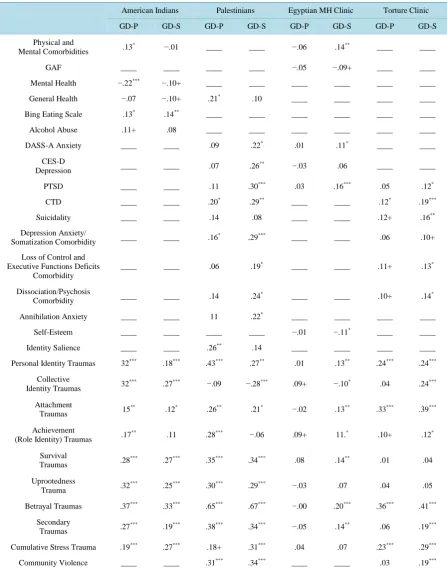
Results supported the third hypothesis and provided more specific data on the different nature of each type of GD. Gender discrimination by parents and family members was not associated with PTSD, DASS-Anxiety, CES-D depression, AA, or reduced self-esteem. Conversely, it was associated with decreased mental health, CTD, and CTD-depression and anxiety/somatization comorbidity, physical and mental health comorbidities, and with binge disordered eating. Gender discrimination by social institutions and interpersonal intergroup dynamics had the worst mental health effects, compared with gender discrimination by parents. It was associated with PTSD, DASS-A, anxiety, AA, ISMI, CTD, and CTD-executive function deficits, CTD-depression and anxiety comorbidity, CTD-dissociation and psychosis, and binge eating. However, gender discrimination by social in-stitutions was also associated with post-traumatic growth. Gender discrimination by social inin-stitutions seemed to be associated with more negative outcomes, when compared to gender discrimination by parents and family members, except for in AI/NAs. For AI/NA’s gender discrimination by parents and family members was either equal to or worse than gender discrimination by social institutions, in terms of severity (Table 4).
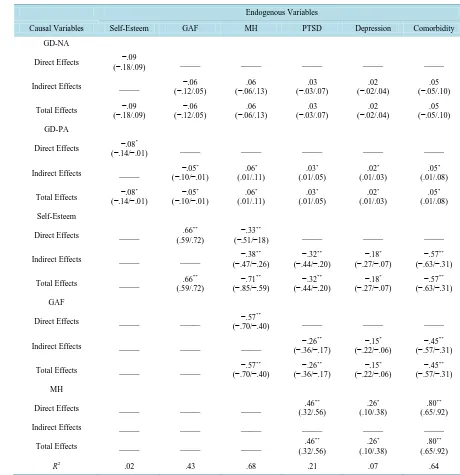
Hypothesis 4: Results supported the fourth hypothesis (The reverse effects of appraisal under the oppression condition), especially in the highly gender discriminating cultures. Results of SEM were straightforward in Egyptian sample that was feasible to analyze. In the Egyptian sample, self-esteem mediated the effects of both appraisal types on mental health. Positive appraisal of GD predicted significant decrease in self-esteem and GAF and increased PTSD, depression and mental health comorbidity (see Figure 2 and Table 5).
6. Discussion
Gender discrimination is associated with significant decreased in mental health across cultures regardless of the measurement strategy used to measure mental health. Its negative effects on physical health were found but not as consistently significant. The negative effects of gender discrimination by social institutions were consistent across cultures for these adult samples, while the negative effects of GD by parents were not as highly consistent which may depend on the severity of GD types in different cultures and in different age groups. However, we should emphasize that the found association are about symptoms (or their severity) and not a particular mental disorder or diagnosis per se. Gender discrimination, as identity trauma, intersected with other identity traumas across cultures. The negative effects of positive appraisal of GD mediated by self-esteem, found in the Egyptian sample highlighted important dynamics and need further replications.
The significance of the present study rests in three basic premises. It is the first study that uses the DBTF framework to study GD as type III continuous and ongoing trauma framework which has important ramification in the way we assess and treat its negative consequences, as we will further discuss. It is the first study to test the salience of the negative mental and physical effects of GD across different cultures and measurement strategies. Further it is the first study to assess the negative effects of internalizing GD (through positive appraisal), and the positive effects of rejecting GD (through negative appraisal that minimize the harm caused by GD to self-es- teem).
GD as Type III Continuous trauma
The traumatology perspective of GD proved to be a robust convincing approach across the four studies. The negative mental health associations with GD, as continuous traumatic independent stressors that proliferate to other dependent and related stressors, proved to be a robust finding across studies that represented different cul-tures and different healthy and unhealthy populations, using different measurement strategies to mental and physical health. Across the four samples, gender discrimination was shown to predict the severity of post-trauma spectrum symptoms including PTSD, complex PTSD and mental health comorbidities. The four studies used different samples from different cultures with different levels of GD intensity in each. The four studies used dif-ferent sample sizes that each has difdif-ferent characteristics, difdif-ferent recruitment methods, and difdif-ferent measures for health and mental health. However, the negative effects of GD, as type III chronic trauma for females were stable and the results were replicated across completely different populations in terms of cultures, religions, his-tory, demographics, and trauma profiles. These relationships hold across many assessment tools and across dif-ferent outcome measures.
Pathways to the Negative Effects of GD
Table 4. Partial correlation between gender discrimination by parents (GD-P), gender discrimination by social institutions (GD-S) and mental health variables and trauma types, controlling for education, marital status and socio-economic status (SES).
American Indians Palestinians Egyptian MH Clinic Torture Clinic
GD-P GD-S GD-P GD-S GD-P GD-S GD-P GD-S
Physical and
Mental Comorbidities .13
* −.01 ____ ____ −.06 .14** ____ ____
GAF ____ ____ ____ ____ −.05 −.09+ ____ ____
Mental Health −.22*** −.10+ ____ ____ ____ ____ ____ ____
General Health −.07 −.10+ .21* .10 ____ ____ ____ ____
Bing Eating Scale .13* .14** ____ ____ ____ ____ ____ ____
Alcohol Abuse .11+ .08 ____ ____ ____ ____ ____ ____
DASS-A Anxiety ____ ____ .09 .22* .01 .11* ____ ____
CES-D
Depression ____ ____ .07 .26
** −.03 .06 ____ ____
PTSD ____ ____ .11 .30*** .03 .16*** .05 .12*
CTD ____ ____ .20* .29** ____ ____ .12* .19***
Suicidality ____ ____ .14 .08 ____ ____ .12+ .16**
Depression Anxiety/
Somatization Comorbidity ____ ____ .16
* .29*** ____ ____ .06 .10+
Loss of Control and Executive Functions Deficits
Comorbidity
____ ____ .06 .19* ____ ____ .11+ .13*
Dissociation/Psychosis
Comorbidity ____ ____ .14 .24
*
____ ____ .10+ .14*
Annihilation Anxiety ____ ____ 11 .22* ____ ____ ____ ____
Self-Esteem ____ ____ ____ ____ −.01 −.11* ____ ____
Identity Salience ____ ____ .26** .14 ____ ____ ____ ____
Personal Identity Traumas 32*** .18*** .43*** .27** .01 .13** .24*** .24***
Collective
Identity Traumas 32
*** .27*** −.09 −.28*** .09+ −.10* .04 .24***
Attachment
Traumas 15
**
.12* .26** .21* −.02 .13** .33*** .39***
Achievement
(Role Identity) Traumas .17
** .11 .28*** −.06 .09+ 11.* .10+ .12*
Survival
Traumas .28
*** .27*** .35*** .34*** .08 .14** .01 .04
Uprootedness
Trauma .32
*** .25*** .30*** .29*** −.03 .07 .04 .05
Betrayal Traumas .37*** .33*** .65*** .67*** −.00 .20*** .36*** .41***
Secondary
Traumas .27
*** .19*** .38*** .34*** −.05 .14** .06 .19***
Cumulative Stress Trauma .19*** .27*** .18+ .31*** .04 .07 .23*** .29***
Community Violence ____ ____ .31*** .34*** ____ ____ .03 .19***
Table 5. The direct and indirect standardized effects of negative and positive appraisals of gender discrimination, their sig-nificance and 95% confidence intervals, on mental and physical health, mediated by self-esteem in the Egyptian females sample (N = 207).
Endogenous Variables
Causal Variables Self-Esteem GAF MH PTSD Depression Comorbidity
GD-NA
Direct Effects −.09
(−.18/.09) _____ _____ _____ _____ _____
Indirect Effects _____ (−.12/.05) −.06 (−.06/.13) .06 (−.03/.07) .03 (−.02/.04) .02 (−.05/.10) .05
Total Effects (−.18/.09) −.09 (−.12/.05) −.06 (−.06/.13) .06 (−.03/.07) .03 (−.02/.04) .02 (−.05/.10) .05
GD-PA
Direct Effects −.08 *
(−.14/−.01) _____ _____ _____ _____ _____
Indirect Effects _____ −.05
*
(−.10/−.01) .06
* (.01/.11) .03* (.01/.05) .02* (.01/.03) .05* (.01/.08)
Total Effects −.08 * (−.14/−.01) −.05* (−.10/−.01) .06* (.01/.11) .03* (.01/.05) .02* (.01/.03) .05* (.01/.08) Self-Esteem
Direct Effects _____ .66
**
(.59/.72)
−.33**
(−.51/−18) _____ _____ _____
Indirect Effects _____ _____ −.38
**
(−.47/−.26) −.32 **
(−.44/−.20) −.18 *
(−.27/−.07) −.57 ** (−.63/−.31)
Total Effects _____ .66
**
(.59/.72)
−.71**
(−.85/−.59) −.32 **
(−.44/−.20) −.18 *
(−.27/−.07) −.57 ** (−.63/−.31) GAF
Direct Effects _____ _____ −.57
**
(−.70/−.40) _____ _____ _____
Indirect Effects _____ _____ _____ −.26
**
(−.36/−.17) −.15 *
(−.22/−.06) −.45 ** (−.57/−.31)
Total Effects _____ _____ −.57
**
(−.70/−.40) −.26 **
(−.36/−.17) −.15 *
(−.22/−.06) −.45 ** (−.57/−.31) MH
Direct Effects _____ _____ _____ .46
** (.32/.56) .26* (.10/.38) .80** (.65/.92)
Indirect Effects _____ _____ _____ _____ _____ _____
Total Effects _____ _____ _____ .46
** (.32/.56) .26* (.10/.38) .80** (.65/.92)
R2 .02 .43 .68 .21 .07 .64
Note: GAF = general assessment of functioning; MH = mental Health; GD-NA = gender discrimination negative appraisal; GD-PA = gender dis-crimination positive appraisal. +p < .10, *p < .05, **p < .01.
2012), continuous identity threat (e.g., Purdie-Vaughns, Steele, Davis, Ditlmann, & Crosby, 2008), and gender- based rejection sensitivity (heightened sensitivity (expect, perceive and overreact) to rejection based on deva-lued status) (London, Downey, Romero-Canyas, Rattan, & Tyson, 2012).
Another possible pathway to the negative effects of GD is the profound traumatic primary and secondary im-pact of gender-based violence (GBV) (e.g., intimate partner violence; sexual abuse by non-intimate partners; sex trafficking, forced prostitution, exploitation of labor, and debt bondage of women and girls; physical and sexual violence against prostitutes; sex selective abortion, female infanticide, and the deliberate neglect of girls, rape in war , female genital mutilation, honor killing) on the lives of women and girls that reverberates socially with secondary and tertiary (across generation) traumatization (e.g., Watts & Zimmerman, 2002). GBV is dependent on the proliferation dynamics of GD. Some forms of GBV are not unique incidents but are ongoing, and can even continue for decades and proliferate to more different traumas. “Violence against women is one of the cru-cial mechanisms by which women are forced into a subordinate position compared with men.” (UN Declaration on the Elimination of Violence against Women, 23 February, 1994). GBV is a result of GD proliferation dy-namics (Kira et al., 2013a). Women exposed to physical/psychological intimate partner violence had a higher incidence and severity of depressive and anxiety symptoms, PTSD, and thoughts of suicide and a higher inci-dence of suicide attempts, and high comorbidity of PTSD with other disorders. The inciinci-dence of single PTSD diagnosis (without other comorbid disorders) is very rare (Pico-Alfonso, Garcia-Linares, & Celda-Navarro, 2006; Afifi, MacMillan, & Cox, 2009; Rees et al., 2011; Sullivan, 2012), which all have been showed cross-culturally in two samples of the current study that measured comorbidities.
One of the key dynamics leading to the negative effects of GD is its adverse impact on self-concept, and per-ceived efficacy which may impact negatively level of functioning. Females who are oppressed, discriminated against, or marginalized due to their gender, face threats to their social value. They may face sexism and gender related micro (e.g., sexual harassment) and macro-aggressions (e.g., gender-based violence) and threat to their sense of belonging and acceptance compared with the dominant, and more socially favored gender. Women, es-pecially in some traditional cultures, are assigned lower values placed on their social identities (Sidanius & Pratto, 1999; Pratto, Sidanius, & Levin, 2006). Such lower social value is inextricably linked to their individual feelings of lower self-concept, self-esteem, self-efficacy, and negative identity development. They may also face exclusion from specific jobs. The effects of GD on deflating self-concepts of females can affect their body-im- age (and related body-satisfaction/dissatisfaction). Body dissatisfaction in early adolescence found to signifi-cantly contribute to the development of gender differences in depressive symptoms and disordered eating across early to mid-adolescence (Ferreiro, Seoane, & Senra, 2014). Girls outnumber boys with disordered eating by a ratio of 3:1 (Ferreiro, Seoane, & Senra, 2012). Our current results confirm the effects of GD on disordered eat-ing in the American Indian sample. As the current results confirmed, GD was associated with reduced self-es- teem and self-esteem mediated the negative effects of positive appraisal on PTSD and general assessment of functioning (GAF). These findings substantiates the existence of this pathway to negative effects of GD. Perva-sive sexism was found to be associated with lower self-esteem (Schmitt, Branscombe, & Postmes, 2003). Lower levels of self-esteem have been related to greater mental health problems and substance abuse and to lower le-vels of life satisfaction in early adulthood (Boden, Fergusson, & Horwood, 2008).
Intersectionality Hypothesis
GD was found to be closely related and interface with other identity related traumas, providing evidence of the Intersectionality perspective (Shields, 2008), and lend evidence of GD proliferation and cumulative dynam-ics inherent in type III continuous identity traumas (Kira et al. 2013a). Special note is its association, not only with collective identity traumas (e.g., discriminations for race and ethnicities, uprootedness for American In-dians and Palestinians), but also with betrayal and personal identity traumas (e.g., sexual abuse, incest, aban-donment and domestic violence). This may be related to the findings that females are more affected by betrayal traumas (e.g., Tang, Shin, & Freyd, 2012) as well other personal identity traumas than males. Many females ex-perience gender-related issues as independent and/or secondary to race, class, age, or religion. Interconnected-ness of multiple personal and collective facets of identity is influenced by myriad social statuses and dynamics (Enns, 2010; Shields, 2008).
GD-P and GD-S
was the results of American Indian (AI) sample in which GD by parents and family members was either equal to or worse than gender discrimination by social institutions, in terms of the actual occurrence and associated se-verity of impact. AI/NA group lives in relatively less gender discriminating society in the US, while GD by fam-ily is still high. Native American women suffer GBV at a rate three and a half times greater than the national average (Bachman et al. 2008). American Indians live in relatively less gender discriminative social culture compared to Egyptian and Palestinians patriarchal cultures. Family culture may have slower change rate than social culture in AI/NA (BigFoot & Braden, 1998). More studies are needed to assess the differential effects of each (GD-P and GD-S) in different age and cultural groups and explore in detail its dynamics.
Appraisal and Coping of GD
As path analysis indicated in Egyptian sample, negative appraisal coping predicted, no negative effects on mental health, while positive appraisal of GD (a potential marker for internalizing GD) predicted significant in-crease in mental health markers, mediated by self-esteem (e.g., inin-creased depression, PTSD, and GAF). The re-sults were straightforward, however, we have to caution that appraising GD as negative may not mean active coping through resistance of GD, for example, through feminist ideology. Positive appraisal seems to be a cop-ing strategy that accepts and internalize discrimination to avoid confrontcop-ing the GD related distresscop-ing emotions. Positive appraisal seems to be counter-productive avoidant coping strategy as it predicted negative effects on self-esteem and mental health. What the participants meant by “positive appraisal” could be equivalent with “given-up”, which means that “positive” cognitive appraisal is not really “positive” in nature in this case. “Giv-en-up” to oppression is, in substance, a negative coping appraisal and thus related with lowered self-esteem. The results lend to the effects of oppression hypothesis on appraisal. The positivity expected from such positive ap-praisal, in effective coping with trauma in non-oppressive situations, was nullified or reversed in the context of the oppression involved in GD (compare, e.g., Soto et al., 2012, Perez & Soto, 2011, Matheson et al., 2007). Reduced distress, resulted from positive appraisal of dysfunctional situation might limit active efforts to alter such situation, and coping strategies that might appear beneficial, when considered in the broader context may actually undermine well-being (Matheson et al., 2007).
Theories and research of intergroup contact may shed some lights on the dynamics of internalizing gender discrimination by the disadvantage gender. Positive intergroup contact (e.g., between the two genders) found to enable the ideological legitimation of inequality perpetuating one’s own disadvantage, while in-group contact (contact with the same gender) has opposite effects (Sengupta & Sibley, 2013). Intergroup contact has sedative effects on disadvantaged-group members’ perceptions of intergroup inequality in ways that can undermine their support for social change toward equality (Saguy, Tausch, Dovidio, & Pratto, 2009). More cross-cultural re-search need to corroborate and generalize these results.
Implications for Therapy and Counseling
Feminist therapy emerged as an important psychotherapy framework for GD (e.g., Brown, 2006; Enns & Byars-Winston, 2010, Worell, & Remer, 2003). Transforming unequal gender relations and promoting shared power, control of resources, decision-making, and support for women’s empowerment is important. Gender mainstreaming and transformation should be a goal for social justice advocacy and counseling for both genders, especially in cultures and families with high level of GD such as AI/NA (e.g., Mann, 2008), and Arab Ameri-cans (Kira, Amer, & Wroble, 2014). Feminist therapy should address the interface of class, culture and gender in counseling (D’Andrea & Daniels, 2001). Addressing GD and promoting natural equality is likely to help both males and females by restoring self-esteem, reducing the associated chronic internalizing symptoms for affected females; and by decreasing inflated self-worth, related to domination of males with associated externalizing and high risk taking behaviors (Kira et al., 2012a).