© 2017, IRJET | Impact Factor value: 5.181 | ISO 9001:2008 Certified Journal | Page 1890
EFFECT OF LIMEWATER ON THE PROPERTIES OF BINARY BLENDED
CEMENTITIOUS COMPOSITE
MINNALKODI. G
1,
Dr. DHANALAKSHMI. G
21
M.E. (Structural Engineering), Department of Civil Engineering, Oxford Engineering College, Tiruchirappalli,
Tamilnadu , India
2
Professor & Head, Department of Civil Engineering, Oxford Engineering College, Tiruchirappalli, Tamilnadu, India
---***---
Abstract
- Industrial byproducts can be utilized to enhance the strength and water permeability characteristics of High Performance Concrete (HPC). The utilization of these industrial by products is becoming popular throughout the world because of the minimization of potential hazardous effects on environment. This study is planned to investigate the properties of Portland cement mixtures containing silica fume and mixed with saturated lime water. The main parameters were; type of mixing solution (water and lime-water) as well as the percentage of Portland cement replaced by silica fume in various percentages such as 10%, 20%, 30%, 40% and 50%. Initial and final setting time of cement, compressive strength development and tensile strength are the investigated properties in this work. The test results showed that using lime-water in mixing delays both initial and final setting times compared with normal water due to the common ion effect principles and the compressive strength, tensile strength and flexural strength are increased.Key words: Lime-Water, Portland cement, Silica
Fume, Consistency, Setting time, Mechanical properties.
1. INTRODUCTION
Concrete is a mixture of cement, sand, coarse aggregate and water. Its success lies in its versatility as can be designed to withstand most harsh environments while
© 2017, IRJET | Impact Factor value: 5.181 | ISO 9001:2008 Certified Journal | Page 1891 in pores, which would prevent the reinforcement passive
protection. Moreover, the effects of hydrated lime and SF on fly ash concrete in improving its early age strength and other properties were studied.
2. MATERIALS USED
2.1 Cement
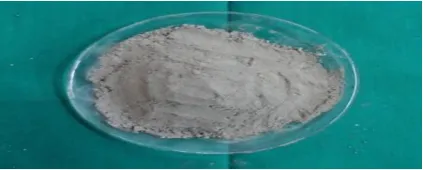
[image:2.595.315.557.94.212.2]The Cement used for this study is Ordinary Portland Cement 43 grade as per IS 12269-1987.
Fig -1: Ordinary Portland Cement
2.2 Sand
In this study, Grade I of particle size less than 2 mm and greater than 1mm for testing the strength of mortar was chosen. The zone of fine aggregate is based on the percentage of passing through the IS sieves. Zone of the fine aggregate used in this work is zone II.
2.3 Micro Silica
Silica fume is also known as micro silica. It is an amorphous (non-crystalline) polymorph of silicon dioxide. Silica fume is an ultrafine airborne material with spherical particles less than 1μm in diameter, the average being about 0.1μm. This makes it approximately 100 times smaller than the average cement particle.
Fig -2: Micro silica
2.4 Water (W)
A tap water available in the concrete laboratory was used in preparation of the mortar. The qualities of water samples are uniform and potable. pH value lies between 6 to 8 and the water is free from organic matter and the solid content should be within permissible limit.
2.5 Lime Water (LW)
Lime water is prepared by using the saturated calcium hydroxide mixed with normal water in the range of 4g per liter.
3. PROPERTIES OF MATERIALS
Table -1: Properties of Cement
S.NO. Property Result
1 Initial setting time 42 minutes
2 Final setting time 454 minutes
3 Consistency 31%
4 Specific Gravity 3.10
Table -2: Properties of fine aggregate
S.NO. Property Result
1 Fineness modulus 2.563
2 Specific gravity 2.13
[image:2.595.36.249.273.358.2]© 2017, IRJET | Impact Factor value: 5.181 | ISO 9001:2008 Certified Journal | Page 1892
Table -3 Physical properties of silica fume
S.NO. Property Result
1 specific gravity 2.2
2 physical state micronized powder
3 colour white
4. RESULTS AND DISCUSSIONS
4.1 Setting time of the cement paste mix
[image:3.595.35.282.345.631.2]
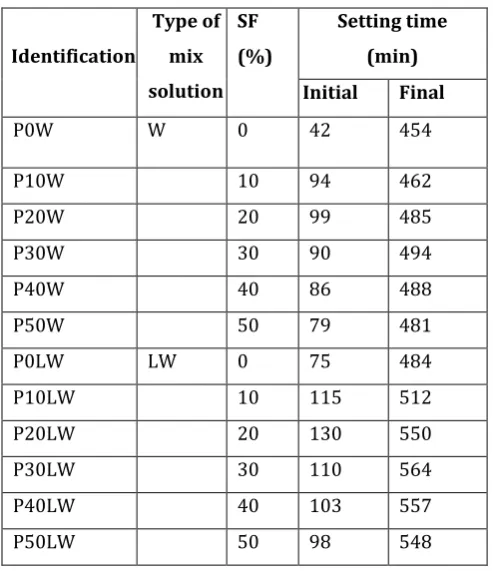
The initial and final setting time of the cement are tabulated below:
Table -4: Setting time of the cement paste mix
Identification
Type of mix solution
SF (%)
Setting time (min) Initial Final
P0W W 0 42 454
P10W 10 94 462
P20W 20 99 485
P30W 30 90 494
P40W 40 86 488
P50W 50 79 481
P0LW LW 0 75 484
P10LW 10 115 512
P20LW 20 130 550
P30LW 30 110 564
P40LW 40 103 557
P50LW 50 98 548
Chart -1: Comparison of Initial and final setting times of cement partially replaced by silica fume with and without limewater
To investigate the influence of using LW solution as mixing water, a preliminary study aimed at evaluating the degree of saturation on setting properties was conducted.
The attempted degrees of saturations are 0% and 100%. The recorded initial times of setting for the control mixes were 42 and 75 min at the degree of saturation 0% and 100% respectively. Whereas, the final setting times for the same mixes are 454 and 484 min, respectively. The above results concluded that the best retardation was achieved by using LW at 100% degree of saturation.
4.2 Compressive strength test of mortar cube
© 2017, IRJET | Impact Factor value: 5.181 | ISO 9001:2008 Certified Journal | Page 1893
Table -5: The compressive strength of mortar Identification SF
(%)
Compressive strength (MPa)
28th day 50th day
M0W 0 18.14 19.30
M10W 10 20.45 21.56
M20W 20 20.80 22.80
M30W 30 17.32 19.23
M40W 40 16.83 18.52
M50W 50 15.66 17.34
M0LW 0 18.10 18.90
M10LW 10 20.82 22.30
M20LW 20 22.11 24.21
M30LW 30 24.05 26.05
M40LW 40 23.60 24.89
M50LW 50 22.35 23.56
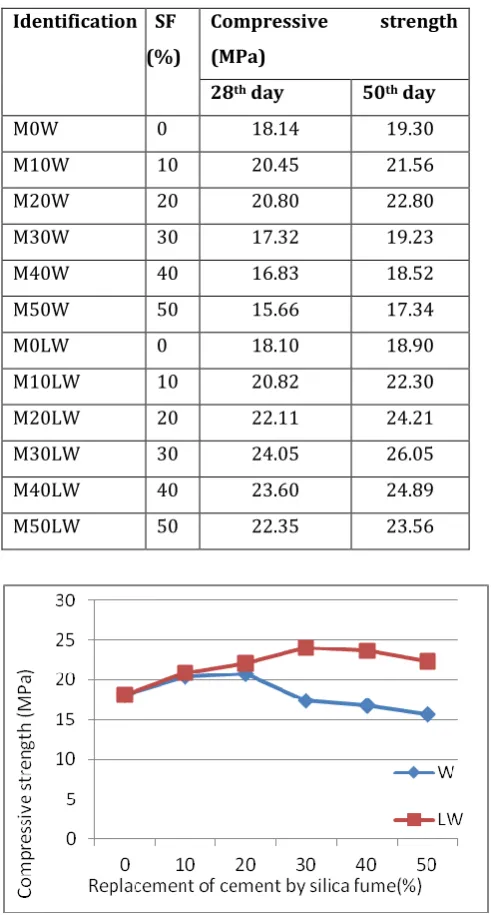
Chart -2: Compressive strength for various Percentage of silica fume with and without lime water at 28th day test
Chart -3: Compressive strength for various Percentage of silica fume with and without lime water at 50th day test
The results could be noticed that the compressive strength for mortar mixes increases with the increase of SF replacement with cement by weight up to a certain amount of SF content beyond which the strength was decreased.
The maximum enhancement in compressive strength was achieved at 20% SF for mix M20W as 18.13% over the control mix M0W at 28th and 50th day’s age when using normal water.
The maximum enhancement was recorded at 30% SF for mix M30LW as 34.71% over the control mix M0W when using lime water.
4.3 Tensile strength test
© 2017, IRJET | Impact Factor value: 5.181 | ISO 9001:2008 Certified Journal | Page 1894
[image:5.595.319.558.369.534.2]Fig -3: Tensile Strength test
Table -6: The tensile strength of cement mortar Identification SF
(%)
Tensile strength (MPa)
28th day 50th day
M0W 0 2.89 3.92
M10W 10 3.48 4.43
M20W 20 3.97 4.96
M30W 30 3.20 4.23
M40W 40 2.90 3.16
M50W 50 2.72 2.94
M0LW 0 2.47 3.50
M10LW 10 3.72 4.96
M20LW 20 4.34 5.62
M30LW 30 5.08 6.31
M40LW 40 4.60 5.85
M50LW 50 3.98 4.68
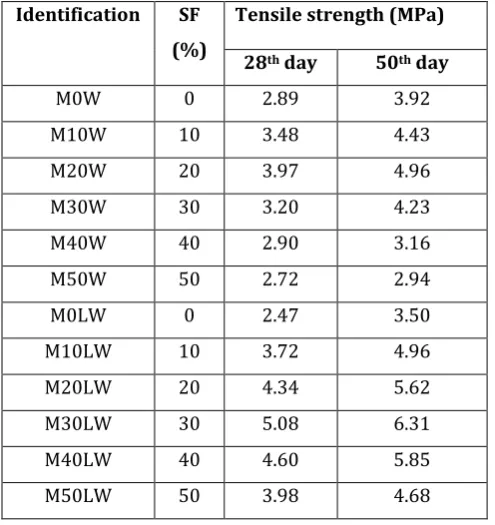
Chart -4: Split tensile strength for various Percentage of silica fume with and without lime water at 28th day test
Chart -5: Split tensile strength for various Percentage of silica fume with and without lime water at 50th day test
The maximum enhancement in tensile strength was achieved at 20% SF for mix M20W as 26.53% over the control mix M0W at 50 days age when using normal water.
© 2017, IRJET | Impact Factor value: 5.181 | ISO 9001:2008 Certified Journal | Page 1895
4.4 Flexural strength
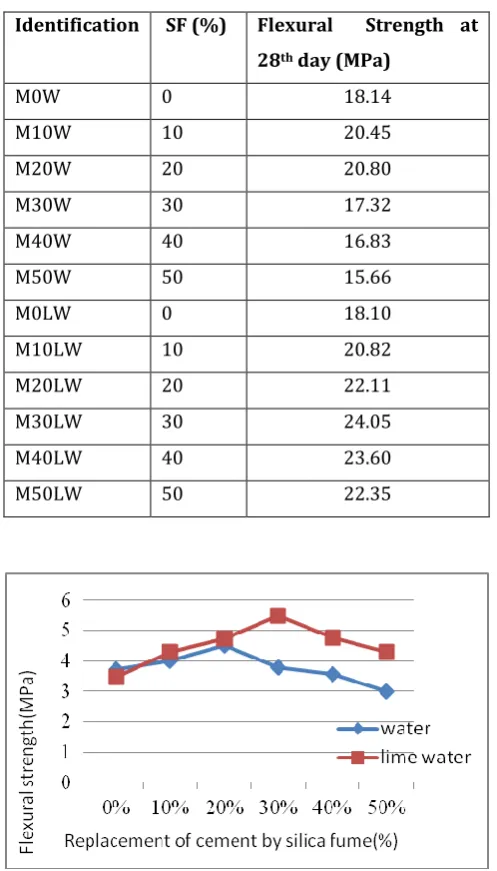
Table -7: Test results of mortar mixes flexural strength
Identification SF (%) Flexural Strength at 28th day (MPa)
M0W 0 18.14
M10W 10 20.45
M20W 20 20.80
M30W 30 17.32
M40W 40 16.83
M50W 50 15.66
M0LW 0 18.10
M10LW 10 20.82
M20LW 20 22.11
M30LW 30 24.05
M40LW 40 23.60
M50LW 50 22.35
Chart -6: Flexural strength for various Percentage of silica fume with and without lime water at 28th day
test
The maximum enhancement in flexural strength was achieved at 20% SF for mix M20W as 20.64% over the control mix M0W at 28th age when using normal water.
The maximum enhancement was recorded at 30% SF for mix M30LW as 46.91 % over the control mix M0W. In
contrary and for the mix without SF M0LW a reduction of the compressive strength was noticed at all ages when using lime water.
5. CONCLUSION
Based on the test results and discussions, the following conclusions could be drawn for the current study as follows:
Using Lime Water as a mixing solution delays both initial and final setting times for Portland cement based materials as well as mixes containing SF. The maximum delay was recorded for cement paste as 88 and 110 min for initial and final setting times for mixes P20LW and P30LW over the control mix P0W, respectively.
34.71% increase of the compressive strength was recorded for mix M30LW at 28th and 50 days age over the control mix which means 30% SF replacement instead of cement weight could be achieved and gives better enhancement in compressive strength when replacing tap water by LW in mixing.
60.96% increase of the tensile strength was recorded for mix M30LW at 28th and 50 days age over the control mix which means 30% SF replacement instead of cement weight could be achieved and gives better enhancement in compressive strength when replacing tap water by LW in mixing.
[image:6.595.34.283.168.604.2]© 2017, IRJET | Impact Factor value: 5.181 | ISO 9001:2008 Certified Journal | Page 1896
REFERENCES
[1] Jahren, p. (1983). “ Use of Silica Fume in Concrete,” Fly Ash, Silica Fume, Slag, and other mineral By-Products in Concrete, Proceedings of the First CANMET/ACI International Conference, SP-79, V. M. Malhotra, ed., American Concrete Institute, Farmington Hills, Mich., pp. 625-642.
[2] Lam L, Wong Y.L. and Poon C.S.(1988). “Effect of Fly Ash and Silica Fume on compressive and fracture behaviors of concrete”, Cement and Concrete research, volume 28, no. 2, pages. 271-283.
[3] Bayasi, Zing, Zhou, Jing, (1993) “Properties of Silica Fume Concrete and Mortar”, ACI Materials Journal, 90 (4) 349 - 356.
[4] Halit Yazici (2008). ‘The Effect of Silica Fume and High-Volume Class C Fly Ash on mechanical Properties, Chloride Penetration And Freeze– Thaw Resistance Of Self-Compacting Concrete”, Construction and Building Materials, Volume 22, Issue 4, Pages 456-462.
[5] Thanongsak, N., Watcharapong, W., and Chaipanich. A., (2009), “Utilization of Fly Ash with Silica Fume and properties of Portland Cement–Fly Ash–Silica Fume concrete”. Fuel, Volume 89, Issue 3, March 2010, Pages 768-774.
[6] Barbhuiya S.A., Gbagbo, J.K., Russeli, M.I., Basheer, P.A.M. (2009) “Properties of Fly Ash concrete modified with hydrated lime and Silica Fume”, a Centre for Built Environment Research, School of Planning, Architecture and Civil Engineering, Queen’s University Belfast, Northern Ireland BT7 1NN, United Kingdom
Received 28 January 2009; revised 1 June 2009; accepted 3 June 2009. Available online 15 July 2009.
[7] Solikin et al (2011) “The Influence of Lime Water as Mixing Water on The Compressive Strength Development of High Volume Ultra Fine Fly Ash Mortar”.