International Research Journal of Natural and Applied Sciences Vol. 3, Issue 10, October 2016 IF- 3.827 ISSN: (2349-4077)
© Associated Asia Research Foundation (AARF)
Website: www.aarf.asiaEmail : [email protected] , [email protected]
STANDARDIZATION OF DEGUMMING FOR ERI SILK: AN
EFFECTIVE ECO FRIENDLY PROCESSING TECHNOLOGY
R. Sujatha1 Dr. A. Sarada Devi2
1
Assistant Professor (Contract) , B.Voc. FTAD, SPMVV, Tirupati, India.
2
Dean of Home Science (Former), ANGRAU, Hyderabad, India.
ABSTRACT
India is the only country in the world which produces all varieties of silk namely
mulberry, Tussar, Eri and Muga and ranks second largest producer of both mulberry and non
mulberry silks next to Chaina. Both fibroin and sericin are protein in nature; the treatment
necessary to remove sericin from fibroins tends to hydrolyze both proteins. To address this
problem, enzymatic treatment was suggested to remove sericin in place of conventional soap
soda treatment. Proteases improved the degumming efficiency. Soft feel and maximum weight
reduction were possible without affecting the fiber strength and hairness. Concentration level of
3% enzyme and 3% soda was selected for degumming of eri silk. At this particular concentration
levels there was increased whiteness of the yarns from yellow. As the fiber production is
increased, it has become necessary to develop process that helps in improving its value chain.
Hence the present study was taken up with an objective of developing eco friendly finishing for
eri silk to promote its value chain.
Introduction
The history of silk traces back more than seven thousand years. It was a trade secret for
centuries and the trade route to Europe from Asia was popularly called as the “Silk route”.
with production averaging about 80,000 tons per annum. India has unique distinction of
producing all the four varieties of silk mulberry, eri, tussar and muga.
Eri and muga are the native silk varieties of Assam. In Arthasastra, Kautilya mentioned
that several regions of ancient Kamarupa (Assam) had produced three varieties of silk fabrics,
viz, Dakula, Khauma and Patrorna. Historians have identified Dhakula as muga (Antheraea
assama). Khauma as Eri (Philosamia ricini) and Patrorna as patar or patta (Bombax mori)
(Baishya, 1998). William Roberson revealed that plantation of mulberry was taken up by only
few families and the grandees, every cultivator had a patch of land in his homested, full of
Ricinus Communis (Castor) for rearing eri, the fabric of the common.
The word eri is derived from the castor plant, in Sanskrit i.e. eranda. Castor leaf is the
main food for the eri silk worms and so named as eri. It is also known as endi or errand. Eri is a
multivoltine silk spun from open ended cocoons, unlike other varieties of silk. Eri culture is a
house hold activity practiced mainly for protein rich pupae, a delicacy for the tribals
(Saratchandra B, 2003).
Now, eri silk is grown in the other parts of the country, in which Andhra Pradesh is
striving forward very fast. Eri silk cultivation has been initiated in Andhra Pradesh in recent
years due to the suitability of its climate and also abundant availability of host plants. The tribes
were trained in eri silk worm rearing and production is initiated. At present efforts are being
made by government to initiate spinning unit, better market abilities of eri within the state.
Eri silk is cotton like fiber obtained from eri silk cocoons. Eri silk is unique in its
characteristics. It is lustrous fibre that behaves like cotton, with warmth and bulkiness of wool
(Kariyappa, 2006). It has natural off white colour that provides aesthetic appeal. Eri silk can be
dyed in different shades. It is the only silk which is drawn without killing the pupae and hence
qualifies as most eco friendly and „ahimsa silk‟ among other varieties of silk. Besides
eco-friendly, Eri silk possess certain medicinal properties. Eri is silk friendly and it is best suited for
hosiery and apparels and may replace the synthetics that cause itching and other skin diseases.
According to Joy Oommen, Member secretary and CEO, Central Silk Board (2004), „Eri
area of cultivation. Tapioca (Cassava) and Kesseru plants, are very easy to cultivate and can be
grown anywhere in the country. These plants can be cultivated inter crops of other crops‟.
Even through eri silk farmers in Andhra Pradesh are able to produce eri cocoons in
sufficient quantities; the processing has not been taken up in Andhra Pradesh. Therefore
processing of eri silk and promotion of eri textiles are necessarily be taken up with immediate
effect to increase the demand for these products. As standard procedures of degumming, dyeing
and further processing are not available to the optimum level, need to be established at present.
Enzyme degumming with proteases carries more value to eri fiber and increases its surface
characteristics that make it suitable for apparels.
Methodology
Selection of yarn: Hand spun eri silk was selected for traditional degumming as well as
enzymatic degumming due to its ready availability. It was procured from Central Silk
Technology Research Institute (CSTRI), Bangalore.
Selection of chemicals for testing
The following chemicals of LR grade were used for conducting this research.
S.No Chemicals used Purpose
1 Sodium Carbonate Traditional degumming
2 Lycerin ESD powder (Enzyme) Enzymatic degumming
Selection of methods:
Experimental research design was selected for the study as it involved experiments and
laboratory tests.
Preparatory processes for fabrics
Traditional/ Alkaline degumming
Recipe:
Neutral soap/ Non ionic detergent - 5g per liter
Silk contains sericin, which interferes with the luster and dye absorption of silk fibers. Hence
sericin was removed by degumming process suggested and optimized by CSTRI. Silk was boiled
in 2g/liter soda and 5g per liter of non – ionic detergent solution maintaining the material to
liquor ratio 1:40 for 45 minutes. The yarn was then thoroughly rinsed to remove traces of
detergent and dried in shade. Care was taken to avoid entangling of yarns during degumming
process.
Enzymatic degumming
Recipe:
Liserin ESD powder - 2.0 -4%
Sodium Carbonate - 2.0-3.0g/ lt
ML Ratio - 1: 40
pH - 9.5
Two to four per cent Liserin ESD powder and 2-3 g/ lt sodium bi carbonate were mixed
thoroughly in water to maintain the material to liquor ratio 1:40. After placing the material in the
liquor, its temperature was raised slowly to 900C. the material was left for 30-45 minutes in the
liquor by stirring occasionally. Then the yarn was removed and washed and washed with cold
water and dried in shade.
Results and discussion
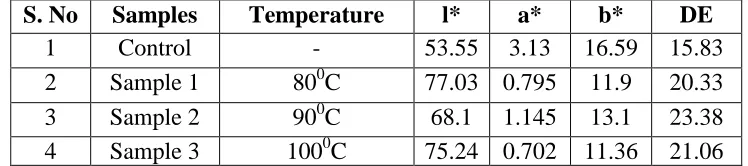
Traditional degumming method, which was standardized by Central Silk Technological
Research Institute (CSTRI), was adopted for degumming eri silk. However, there was deviation
in case of temperature among the varieties of silk. Hence the degumming temperature was varied
Table 1. Traditional degumming process
S. No Samples Temperature l* a* b* DE
1 Control - 53.55 3.13 16.59 15.83
2 Sample 1 800C 77.03 0.795 11.9 20.33
3 Sample 2 900C 68.1 1.145 13.1 23.38
4 Sample 3 1000C 75.24 0.702 11.36 21.06
As per the number of sequential experiments were conducted near boiling temperatures
i.e. 800C, 900C and 1000C. DE value of standard sample was found to be 15.83. Among 3
temperatures, 800C degummed sample was selected based on l*, a*, b* and DE values.
Compared with control sample, degummed samples showed good lusture and smoothness.
Standardization of enzymatic degumming
The enzymes, which are mainly protein, are biocatalysts. They are being introduced in
various stages of wet processing of textiles as enzymes are biodegradable and eco friendly and
do not cause any effluent problems. These enzymes generally reduce time of treatment,
considerably saving in energy, chemicals substantially increasing the production. Therefore,
chemicals were being replaced by enzymes (Pant. S and Sariya. R, 2000).
l*, a*, b* values and DE values of different varieties of degummed eri silk was measured
through colour flex spectrophotometer interfaced with computer under D 65 illumination and 100
observing angle. The results are given in table 2.
Table 1. Standardization of enzymatic degumming
S.No Enzyme (%)
Sodium Carbonate
l* a* b* DE
1 Control - 54.07 2.37 14.1 15.83
2 2 2 69.45 1.15 13.43 21.85
3 2 2.5 80.21 1.02 13.55 19.83
4 2 3 74.91 0.7 12.3 22.87
5 2.5 2 77.95 0.96 13.23 16.91
6 2.5 2.5 78.1 0.72 13.29 17.29
9 3 2.5 76.61 1.12 13.83 10.13
10 3 3 69.75 1.29 13.68 7.76
11 3.5 2 74.9 1.15 14.2 16.99
12 3.5 2.5 77.79 1.1 14.18 19.18
13 3.5 3 80.12 1.08 14.09 19.57
14 4 2 77.55 1.2 14.26 19.88
15 4 2.5 77.78 1.15 14.15 22.58
16 4 3 79.1 1.27 14.67 19.92
Indicates the selected concentrations of enzyme and sodium carbonate
In silk, sericin and fibroin are proteins but due to specific action of protease (Liserine ESD),
it only degrades sericin without damaging fibroin which is not possible otherwise with
conventional soap- soda treatment. It improves degumming efficiently, imparts soft feel and
ensures maximum weight reduction without affecting the fiber strength and hairiness.
(Kariyappa, 2003).
The enzyme percentage and sodium carbonate percentage were standardized based on the
DE values compared with control sample. The DE values of control sample was found 15.88.
Among the enzyme treated samples, concentration of 3% enzyme with 2.5% soda and also 3%
soda were found with lower DE values of 10.13 and 7.76 respectively showing the increased
whiteness of the yarns from natural yellow. The smoothness and lusture of the samples were
good compared with control sample and other enzymatic degummed samples. So the
concentration level of 3% enzyme and 3% soda was selected for dyeing eri silk.
The whiteness obtained by enzymatic treatment was more when compared to traditional
degumming method as indicated by DE values keeping the white as standard. In case of lusture
and brightness, enzymatic degummed samples showed better results compare with traditional
degummed samples. Enzyme treatment provided eri silk with white finish by decreasing
yellowness. Similar finding was reported by Pant. S and Sariya R (2000).
Summery and conclusion
Eri silk is one of the varieties of silk produced only in India. Recently eri culture was
introduced in Andhra Pradesh due to the availability of host plants. Eri silk fabrics are suitable in
the fields of apparel, furnishing and home textiles. Due to the market potential for eco- friendly
was undertaken with major objective of developing eco- friendly finishing for eri silk to promote
its value chain.
Eri is wild silk that cannot be reeled, due to piercing of cocoons by the moths. Hence it is
used for the production of spun yarn only. Importance of eri silk cannot be underestimated as a
fine textile fiber. It has got certain excellent textile properties and is unique in many respects.
Increased the awareness and concerns about the environment and pollution had paved
way for eco friendly process in wet processing. Traditional soap – soda boiling method of
degumming silk had many disadvantages coupled with the convenience of the time. Traditional
degumming method, which was standardized by CSTRI, was adopted for degumming eri silk.
The enzymatic degumming processes were gaining importance due to less degradation of eri silk
protein, ease of process control, better hand properties of silk besides being environmental
friendly.
The findings of the study were summarized as follows
Eri silk sample degummed at 800 C temperature was selected based on L*, a*, b* and DE
values. Compared with standard sample, degummed samples showed good lusture and
smoothness.
Concentration level of 3% enzyme and 3% soda was selected for degumming of eri silk,
based on good lusture and whiteness. The smoothness and lusture or these samples were
found good compared with control sample.
Enzymatic degummed eri silk yarns showed better lusture, smoothness and dye uptake
compared with traditional degummed eri silk yarns.
References
Baishya P 1998 Silk industry of Assam- a perspective. Indian silk 37(1-8): 17-20
Benchamin K V 2000 Muga and Eri cultures: subsistence to substantial farming. Indian silk 39(1-6): 51-54.
Biswas. N 2003 Eri culture brings prosperity. Indian silk 37(7-12):22-23.
Deepa R 1999 Enzyme application: An over view. Man made textiles in India 17 (10):231-234.
Gautam S 2006 Vanya silk- Eri; an Indian scenario. Asian textile journal:85-87.
Goel A 2007 Different methods of degumming: A comparision. Indian silk 45(9): 26-28.
Gowda K N N 2007 Eco friendly preparatory process for silk: degumming by protease enzyme. Man made textiles in India 50 (1):28-31.
Gulrajini and Shailaja 1995 Enzymatic processing of waste silk fabric. Indian Journal of Fabre and Textile Research 20(40): 192-195.
Kariyappa 2006 degumming of Eri cocoons for mill spinning Indian silk 44 (7-12)
Koshy T D 1998 Indian wild silk exports: Problems and prospects. Indian silk 37(1-8): 75-78
Krishna Rao J v 2003 Large scale development of eri culture in India. Indian silk 37(1-6): 27-31.
Krishna Rao J.V and Teotia R.S 2004 Eri culture in Andhra Pradesh: An initiative. Indian silk 43(1-6): 27-31.
Nadigar G S 1998 Non – mulberry silks – A synonym to Eco friendly textiles. Indian silk 37 (7-12): 71-73
Narain R 1995 Eri culture in Nagaland. Indian silk 33(1-12): 38-40.
Saratchandra B 2003 A thought for development of Eri culture in India. Indian silk 37(1-6): 25-28.
Singh B K 2003 Eco races of Eri silk worm. Indian silk 42(7-12): 7-10
Suman et.al 2000 A study on enzymatic treatment of silk effect on properties. Textile trend 23:37-40.