2018 International Conference on Computational, Modeling, Simulation and Mathematical Statistics (CMSMS 2018) ISBN: 978-1-60595-562-9
Temperature Effect on Tensile Behaviour of Sn-Pb Eutectic Solder
Yong-chao LIU
1, Wen-wu WANG
2, Feng-rui JIA
2,
Zheng-hu ZHU
3and Xu LONG
4, *1College of Mining Engineering, Liaoning Shihua University, Liaoning, China 2College of Petroleum Engineering, Liaoning Shihua University, Liaoning, China
3No. 8511 Research Institute, China Aerospace Science and Industry Corporation, Nanjing, China
4School of Mechanics, Civil Engineering and Architecture, Northwestern
Polytechnical University, Xi’an, China
*Corresponding author
Keywords: Sn-Pb solder, Temperature effect, Tensile behavior, Strain rate.
Abstract. The mechanical behaviour of tin-lead eutectic solder is experimentally investigated by performing tensile tests subjected to the temperatures ranging from -50°C to 150°C. It covers the widely-accepted extreme working environment of high-power electronic devices in the aerospace industry. The regime of strain rates between 1×10⁻⁴ s-1 and 1×10⁻³ s-1 are applied. Despite scatter of
the ultimate failures, experimental results demonstrate that tensile strength of Sn-Pb eutectic solder is mainly associated with strain rate and working temperature. With increasing the applied temperature above the room temperature, both Young’s modulus and tensile strength of Sn-Pb specimens exponentially decays.
Introduction
Even though solder materials are evolving to be lead-free as legislated by RoHS [1,2], tin/lead (Sn-Pb) eutectic solder materials are still widely applied in the defense and aerospace industries due to their outstanding solderability and reliability under complicated working conditions. However, as the dimensions of package sizes are miniaturizing, the mechanical reliability of solder joints attracts increasing attentions recently [3-9]. Ball grid array (BGA) has become one of the most popular packaging approaches to satisfy rigorous thermal and electrical requirements and high input/output capacity in the electronic packaging industry [10]. Nevertheless, mechanical reliability of Sn-Pb eutectic solder joints is becoming one of the concerned issues of miniaturized electronic devices, especially for high-power electronic devices in the aerospace applications with more challenging service environment. The failure of a single solder joint may lead to the complete failure of an important electronic chip and thus tremendous economic cost, as a limited space on a printed-circuit board makes it impossible to dispose the backup joints for every interconnect.
In the present study, tensile experiments are conducted to obtain the stress-strain response of Sn-Pb eutectic bulk solder material. In order to account for the high temperature which may be encountered in high-power electrical devices, the temperature of interest in the present study ranges from -50°C to 150°C to reveal the creep and plasticity mechanism during deformation subjected to low strain rates.
Experimental Study
A. Specimen preparation
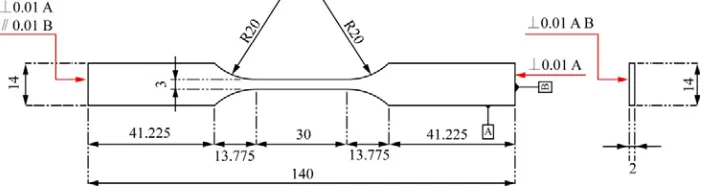
testing of metallic materials. It is regulated that the thickness should be between 0.1 mm and 3.0 mm, thus the geometrical details of specimen are correspondingly designed by proportional to the standard one, as shown in Fig. 1.
[image:2.612.132.484.157.250.2]Based on the optimized annealing condition [12], the machined specimens of 63Sn-37Pb solder alloy are annealed at 180°C for 6 hours in an electric forced-air heating furnace so as to eliminate the residual work stress and stabilize the microstructure of the solders.
Figure 1. Geometry of dog-bone type specimen made of bulk 63Sn-37Pb solder material.
B. Mechanical experiments and results
The tensile experiments were performed to the annealed specimens machined from solder bars. As the strain rate of 5×10⁻⁴ s-1 was found to be appropriate for the balance of creep and hardening
deformation [12], it was adopted as the strain rate to attain the saturation stress for the constitutive model of 63Sn-37Pb solder at the temperature of 10°C. Since the strain rate in this work is targeted to investigate the temperature effect on the contribution of creep and plasticity deformation mechanism, the tensile behaviour was experimentally studied for the strain rates of 1×10⁻³ s-1, 5×10⁻⁴
s-1 and 1×10⁻⁴ s-1 at working temperatures ranging from -50°C to 150°C. The temperature range
corresponds to the homologous temperature (T/Tm, where Tm is the melting temperature 183°C for
Sn-Pb eutectic alloy [13]) from 0.49 to 0.93. The strain rates and temperatures of interest in the current study cover the typical working conditions of solder joints at low strain rates. As the gauge length is about 30mm as deigned in Fig. 1, the applied velocity of clamps is calculated according to the respective strain rate.
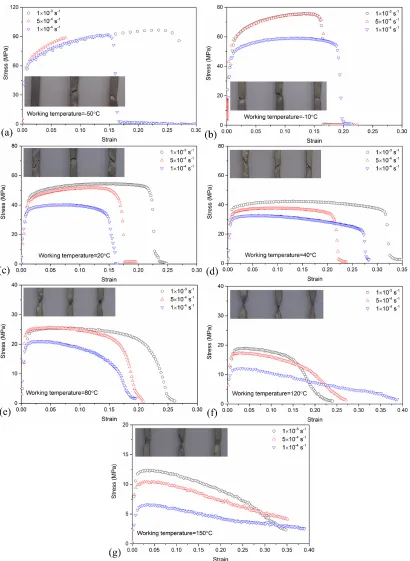
Tensile stress-strain response was recorded for each Sn-Pb specimen at different working temperatures. To maintain the objectiveness of experimental data, at least three specimens were repeated for each testing case and the averaged result was accepted as the reported stress-strain relationship in Fig. 2. The insets in Fig. 2 illustrate the typical failure mode, from which the transition between brittle and ductile failures can be conveniently identified. It should be noted that even though the experimental results of solder specimens may show a certain extent of scatter, the averaged tensile stress-strain response is treated as the intrinsic property of Sn-Pb eutectic solder material. Despite of slight inaccuracy due to a limited number of specimens, the obtained experimental results still bear a good representative of material characteristics.
Results
In terms of specimen stiffness at the initial deformation, Young’s modulus essentially depends on the working temperatures as shown in Fig. 2. As compared in Fig. 3 (a), the measured Young’s modulus in the present study is generally consistent with the values in NIST (National Institute of Standards and Technology) [14]. In order to well predict the slope region of the stress-strain relationship, the measured slope before the yielding stage at different working temperatures will be used instead in the numerical predictions.
different strain rates, as shown in Fig. 3 (c). It should be noted that the ultimate tensile strain is obtained from the sudden drop of tensile stress-strain response in Fig. 2. As softening behaviour lasts until the final failure of tensile specimens at high temperatures, their ultimate tensile strain is defined as the strain when fracture occurs.
Figure 3. Temperature dependent mechanical properties. (a) Young’s modulus; (b) Tensile strength; (c) Ultimate tensile strain.
Conclusion and Discussion
Experimental studies are conducted for the eutectic Sn-Pb dog-bone type specimens under different tensile strain rates and working temperatures. By analysing the experimental results in terms of stress-strain response, it is demonstrated that the tensile behaviour is mainly dependent on strain rate and working temperature, and the competition between creep and plasticity plays a crucial role. Compared with other published experimental data, the relationships between tensile strength and strain rate at different temperatures in this study is satisfactorily consistent and follow a good pattern when regressed in a log-log scale. According to the linear regression for the relationship between tensile strength and strain rate, it is interesting to find that all the regressed lines seem to converge at a certain location. By disregarding the physically validity, this phenomenological trend can be interpolated to estimate the tensile strength at certain strain rates and working temperatures within the regime of the present study.
It should be pointed out that if a better understanding is preferred about the evolution of deformation mechanisms at different strain rates and working temperatures, a theoretical or numerical investigation should be considered to benefit the benchmarking accuracy of the parameters incorporated in a constitutive model to reveal the evolution mechanism of creep and plasticity.
Acknowledgement
References
[1] European Union “95/EC of the European Parliament and of the Council of 27 January 2003 on the restriction of the use of certain hazardous substances in electrical and electronic equipment,” Official Journal of the European Union Vol. L37, No. (2003), pp. 19-23.
[2] Long, X., Feng, Y. and Yao, Y. “Cooling and annealing effect on indentation response of lead-free solder,” International Journal of Applied Mechanics Vol. 09, No. 04 (2017), 1750057. [3] Amagai, M., Watanabe, M., Omiya, M., Kishimoto, K. and Shibuya, T. “Mechanical characterization of Sn–Ag-based lead-free solders,” Microelectronics Reliability Vol. 42, No. 6 (2002), pp. 951-966.
[4] Long, X., Wang, Y., Keer, L.M. and Yao, Y. “Mechanical effects of isolated defects within a lead-free solder bump subjected to coupled thermal-electrical loading,” Journal of Micromechanics and Molecular Physics Vol. 01, No. 01 (2016), 1650004.
[5] Lau, C.S., Khor, C.Y., Soares, D., Teixeira, J.C. and Abdullah, M.Z. “Thermo-mechanical challenges of reflowed lead-free solder joints in surface mount components: a review,” Soldering & Surface Mount Technology Vol. 28, No. 2 (2016), pp. 41-62.
[6] Lv, X., Lin, P., Huang, Y., Jiang, X., Lian, B. and Yao, Q. (2015). The effects of Au film thickness on the reliability of Sn-Pb solder joints. 16th International Conference on Electronic Packaging Technology: 1321-1324.
[7] Kanchanomai, C., Miyashita, Y. and Mutoh, Y. “Low cycle fatigue behavior and mechanisms of a eutectic Sn-Pb solder 63Sn/37Pb,” International Journal of Fatigue Vol. 24, No. 6 (2002), pp. 671-683.
[8] Di Maio, D. and Hunt, C. (2008). High-frequency vibration tests of Sn-Pb and lead-free solder joints. Electronics System-Integration Technology Conference: 819-824.
[9] Mukherjee, S., Nuhi, M., Dasgupta, A. and Modarres, M. “Creep Constitutive Models Suitable for Solder Alloys in Electronic Assemblies,” Journal of Electronic Packaging Vol. 138, No. 3 (2016), 030801.
[10] Intel (2000). Ball Grid Array (BGA) Packaging. 2000 Packaging Databook, Intel Corp.
[11] Annual Book of ASTM Standards (2009). Standard test methods for tension testing of metallic materials. vol. 3.01. West Conshohocken, Pennsylvania, American Association State.
[12] Long, X., Wang, S., He, X. and Yao, Y. “Annealing optimization for tin-lead eutectic solder by constitutive experiment and simulation,” Journal of Materials Research Vol. 32, No. 16 (2017), pp. 3089-3099.
[13] Kumar, K.M., Kripesh, V. and Tay, A.A.O. “Influence of single-wall carbon nanotube addition on the microstructural and tensile properties of Sn–Pb solder alloy,” Journal of Alloys and Compounds Vol. 455, No. 1–2 (2008), pp. 148-158.