2018 2nd International Conference on Applied Mathematics, Modeling and Simulation (AMMS 2018) ISBN: 978-1-60595-580-3
A Fast-Iterative Algorithm Based on the Wirtinger Flow for
Phase Retrieval
Can PEI, Zheng-ming JIANG, Qiang LI, Lei HUANG and Ji-hong ZHANG
The College of Information Engineering, Shenzhen University, Shenzhen 518060, P.R. China
Keywords: Phase retrieval, Wirtinger Flow algorithm, Gradient descent.
Abstract. Reconstructing the original complex signal using amplitude-only measurements is referred to as the phase retrieval problem. In this paper, we develop a fast-iterative phase retrieval algorithm that can be considered as an enhanced version of the well-known Wirtinger Flow (WF) algorithm. The original WF algorithm is based on gradient descent scheme to tackle the phase recovery problem, however, the convergence speed of this WF algorithm is very slow. Compared with the original WF algorithm, the proposed fast-iterative WF (FWF) algorithm has a faster convergence speed, with an acceptable little more computational complexity. The proposed FWF algorithm is preferable not only due to its accelerated convergence speed but also due to its ability to converge to the global optimum. Experimental results show that the FWF algorithm is superior to the state-of-the-art algorithms in terms of the convergence speed.
Introduction
Recovering the original signal only from the phase-less amplitude measurements of it, is referred to as phase retrieval. Various methods have been proposed to solve phase retrieval problem in the last three decades, such as Gerchberg-Saxton [1], hybrid input-output algorithm [2] and its improved algorithm [3]. With the development of phase recovery techniques, they have been widely used in image encryption [4], optical imaging [5] and microscopic imaging applications [6]. Recently, Wirtinger Flow (WF) algorithm is introduced to guarantee signal recovery via a simple gradient descent scheme [7]. However, the convergence speed of WF is slow. In order to solve this problem, subsequently, reweighted WF (RWF) algorithm was proposed [8]. It makes the gradient descent scheme more liable to converge to the global minimum when the sampling complexity is low by reweighting the objective function in each iteration. However, the computational complexity of the RWF algorithm is greatly increased compared to WF. In order to further accelerate the convergence speed of WF and ensure the complexity of the WF algorithm, a fast-iterative WF (FWF) algorithm is proposed to deal with the phase retrieval problem. Results show that the FWF algorithm is superior to other existing basic algorithms in terms of convergence speed.
FWF Algorithm
As stated above, the phase retrieval problem is to recover the original signal only from phase-less amplitude measurements of it. Usually, it is difficult to solve the problem due to the missing phase information. With the development of compressive sensing and random matrix theory, the measurement vector of the recovered signal is not limited only by the determined type [8]. In this paper, we assume that the antenna array measures only the strength of the signal, and then establish a phase recovery model based on the magnitude of the signal measurements. Now, it is assumed
that in the noisy environment, the antenna array has measuredM signal amplitudes which is
expressed as z=
z z1, 2, ,zM
T. The model of signalzmeasured by antenna array can be expressedas:
2
A
z x . (1)
anNdimensional original incident signal,is anM dimension noise, Ais a known measurement
matrix. In our case,Ais a steering vector matrix which is expressed as:
1 2
1 2
2 (2 1)sin( )/ 2 (2 1)sin( )/ 2 (2 1)sin( )/
2 ( 1)sin( )/ 2 ( 1)sin( )/ 2 ( 1)sin( )/
1 1 1
N
N
j d
j d j d
j d M
j d M j d M
e e e
e e e
A
, (2)
Wheredis the distance between adjacent elements of the antenna array,is the wavelength of the
incident signal,M is the number of the array antenna elements,N is the number of signals, iis the
angle corresponding to the 𝑖𝑡ℎ incidence signal. When the noise follows a Gaussian distribution, then, we can formulate the phase retrieval problem in the form:
2 2
2
1
min ( ) | |
4
f
M
A
x x z x , (3) The operator is the Euclidean norm of a vector. The gradient of f( )x that can be obtained from formula (3) is:
2
1
diag( - )
H
f M
A z Ax Ax. (4)
Considering the unconstrained minimization problem of a continuously differentiable function
( )
f x , one of the simplest method for solving (3) is the gradient algorithm in [7] which generates a
sequence{xk}via:
1 ( 1)
k k tk f k
x x x , (5)
Wheretk 0is a suitable step-size,krepresents the iteration index. The key of the gradient algorithm is the choice of step-sizetk. In our algorithm, the selection of step-size is similar to that of WF algorithm, however, we set a constant step length.
0.4 4 2 k
t t
M
. (6)
For the gradient descent method, the sequence{xk}converges slowly to a solution. It is known that the sequence of function values f(xk)converges to the optimal function value 𝑓∗at a rate of
convergenceO(1k). In [9], the authors introduced a method that achieves a rate of convergence of
2
(1 )
O k , which is a significant improvement over the slow convergence behavior introduced by the
gradient descent method. In this paper, we are able to extend Nesterov’s method to handle the model in (3). We propose a fast-iterative algorithm based on WF to solve the phase retrieval
problem. The fast iterative WF (FWF) can achieve a rate of convergence ofO(1 k2).
In each iteration of the gradient descent, the original WF algorithm takes the point xk1as the
starting pointxkof the next iteration. The main difference between FWF and WF is that the iterative
operatorxkis not employed on the previous pointxk1, but rather at the new pointkwhich uses a specific linear combination of the previous two points{xk1,xk2}, which is given by
1
1 1 2
1
( )
k
k k k k
k
x x x , (7)
2 1 1 4 1
2 k k
. (8)
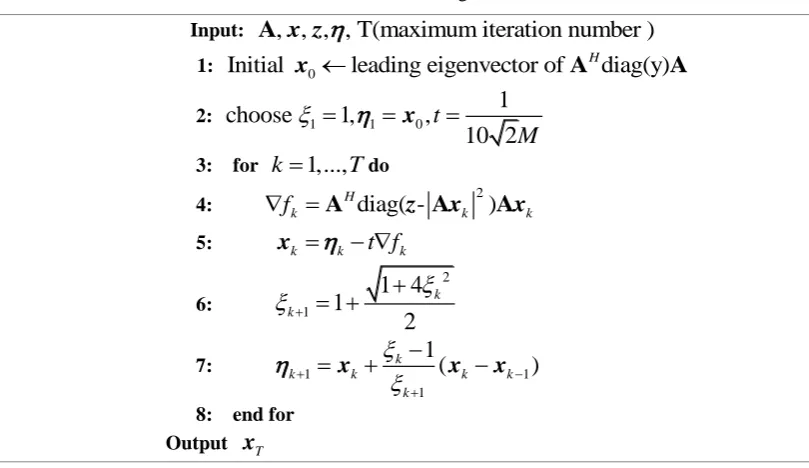
Compared with the WF algorithm, the FWF algorithm requires additional computations in steps (7) and (8), but it is easy to find that FWF is as simple as WF and shares the similar computational
effort of WF, namely, in the iterative operator xk , the remaining additional steps being
[image:3.595.93.498.208.442.2]computationally negligible[10]. But the FWF has faster convergence speed and converges to the global optimal value. The process of FWF algorithm with constant step-size is as Table 1.
Table 1. The FWF algorithm.
Input: A, , , , T(maximum iteration number )x z
1: Initial x0 leading eigenvector of AHdiag(y)A
2: choose 1 1, 1 0, 1
10 2
t
M
x
3: for k 1,...,Tdo
4: fk AHdiag( -z Axk 2)Axk
5: xk k t fk
6:
2
1
1 4 1
2 k k
7: 1 1
1
1
( )
k
k k k k
k
x x x
8: end for Output xT
Letx*be the solution of (1), obviously,x*ejalso satisfies (1) for any[0, 2 ] . In general, it is difficult to solve the problem due to the missing phase information. So, the uniqueness of the solution to (1) is often defined up to a constant phase factor. Therefore, an accurate constant phase factor needs to be calculated. After getting a solution *
x from the FWF algorithm, we define a
function of mean square error (MSE) as 0 2
2
( ) j
w x xe
, wheredenotes the constant phase factor. The derivative ofw( ) with respect toisw( ) j[(x)Hx0ej x0Hxej]. Setting the
derivative to zero, we can get 0
0
( ) ( )
H j
H
e
x x
x x .
j
eis the estimation of j
e. So, j *
e
x is the last
recovery signal.
Results
Experimental results are given in this section to show the convergence performance of FWF, WF and RWF. All the tests are carried out on the Lenovo desktop with a 3.410 GHz Intel Corel i7 processor and 8GB DDR3 memory. For the proposed FWF algorithm, we have tested its MSE performance and its recovery process. In all simulating testings, noise is a standard Gaussian
distribution with a mean of 0. x was created the complex Gaussian random vector
(0, 2) (0, 2)
N I jN I . We chose a random signal x0CN as the original signal and the
measurementsz Ax0 2.The dimensionN of the original complex signal is set to 10. Moreover, the
number of measurements isM 100and the signal-to-noise ratio (SNR) is 15 dB unless specified
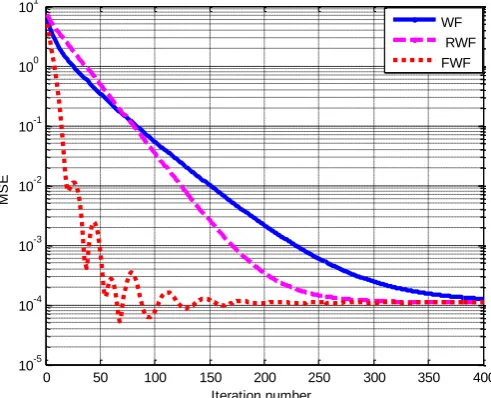
performance of different algorithms in the simulation testing is shown in Figure. 1. It is clear that all
the MSE curves can converge close to 1 10 -4, which agrees with the results obtained in [11] that
the original signal can be recovered when the measurements meetM NlogN. As shown in Figure.
[image:4.595.170.416.185.384.2]1, the WF algorithm has the slowest convergence rate in the case of low SNR, RWF converges after 300 iterations, while FWF converges after 160 iterations. Our FWF algorithm is superior to WF algorithm and RWF algorithm in terms of the convergence speed, because the FWF algorithm have used more priori-information.
Figure 1. The MSE curves iteration number.
In order to show the process of recovering the signal of the proposed algorithm, Figure. 2 shows the distribution of the recovered signal effect when the number of iterations is 3, 30 and 100 respectively. For the sake of convenience, the original signal distribution is also given in the figure. Since the initial value of the assumed recovery signal is a Gaussian random distribution, it can be seen from Figure. 2 that when the third iteration is completed, the recovery signal is greatly different from the original signal. When 30 iterations are completed, the recovery signal gradually approaches the original signal. When 100 iterations are completed, the recovery signal is basically close to the original one, which well proves the effectiveness of the WF algorithm. The recovery process of Figure. 2 corresponds to the MSE shown in Figure. 1.
Figure 2. The process of signal recovery.
0 50 100 150 200 250 300 350 400
10-5 10-4 10-3 10-2 10-1 100 101
Iteration number
M
S
E
WF RWF FWF
-8 -6 -4 -2 0 2 4 6 8 10
-5 0 5
the number of iterations of is 3
original signal recovered signal
-4 -2 0 2 4 6 8 10
-5 0 5
Th
e
r
e
a
l
p
a
rt
o
f
s
ig
n
a
l the number of iterations of is 30
original signal recovered signal
-8 -6 -4 -2 0 2 4 6
-10 0 10
The imaginary part of signal the number of iterations of is 100
Conclusion
For the phase recovery problem, we have proposed a FWF algorithm. The FWF further accelerates the convergence rate of the WF algorithm, and it is able to converge to a global minimum by using more priori-information. Experimental results showed that the FWF algorithm is superior to other existing basic algorithms in terms of convergence speed. In our future work, we will consider using the adaptive step-size to speed up the convergence rate of the proposed algorithm. We will also consider using large dimensional data to test the performance of the algorithm under different SNR conditions and sparse signal conditions.
Acknowledgement
The work described in this paper was supported by the National Natural Science Foundation of China under Grants U1501253, 61601304, 61501300, 61601300, 61501485, the Natural Science Foundation of Guangdong Province under Grant 2015A030311030 and by the Foundation of Shenzhen Government under Grants ZDSYS201507081625213, KC2015ZDYF0023A.
References
[1] Gerchberg R W. A practical algorithm for the determination of phase from image and diffraction plane pictures[J]. Optik, 1972, 35:237-250.
[2] Takajo H, Takahashi T, Shizuma T. Further study on the convergence property of the hybrid input–output algorithm used for phase retrieval[J]. Journal of the Optical Society of America A, 1999, 16(9):2163-2168.
[3] Jo J G, Cho S J, Park M C, et al. Modified hybrid input-output algorithm for phase retrieval[C]. Vacuum Nanoelectronics Conference. IEEE, 2012:1-2.
[4] Hennelly B, Sheridan J T. Fractional Fourier transform-based image encryption: phase retrieval algorithm [J]. Optics Communications, 2003, 226(1):61-80.
[5] Ma D M, Chen T Q, Liu Z X, et al. Application of phase retrieval technology in evaluation of optical imaging system[J]. Optics & Precision Engineering, 2009, 17(12):2912-2918.
[6] Kamura Y, Komatsu S. Phase Retrieval Microscope for Quantitative Imaging of a Weak Phase Object[J]. Japanese Journal of Applied Physics, 1998, 37(11):6018-6019.
[7] Candès E J, Li X, Soltanolkotabi M. Phase Retrieval via Wirtinger Flow: Theory and Algorithms[J]. IEEE Transactions on Information Theory, 2014, 61(4):1985-2007.
[8] Yuan Z, Wang H. Phase retrieval via reweighted Wirtinger flow[J]. Applied Optics, 2017, 56(9):2418.
[9] Nesterov Y E. A method for solving the convex programming problem with convergence rate 2
(1 )
O k [J]. Dokl.akad.nauk Sssr, 1983(3):543-547.
[10] Beck A, Teboulle M. A Fast Iterative Shrinkage-Thresholding Algorithm for Linear Inverse Problems[J]. Siam Journal on Imaging Sciences, 2009, 2(1):183-202.