D
ESIGN
H
EURISTICS
BY
S
EDAY
ILMAZ
A dissertatio fulfillment of the requn submitted in partialirements for the degree of
Doctor of Philosophy (Design Science) in The University of Michigan 2010
DOCTORAL COMMITTEE:
Professor Colleen M. Seifert, Co
an‐Henrik Andersen, Co‐Chair ‐Chair Associate Professor J
Professor Richard D. Gonzalez Professor Fiona Lee
To Mom and Dad whose support has been felt even from thousands of miles away.
ACKNOWLEDGEMENTS
Many people have contributed, directly or indirectly, to the completion of this thesis. I
would like to take this opportunity to express my sincere gratitude to all of them for their
help, patience, and friendship. In particular, I wish to thank my advisors, Colleen M.
Seifert and Jan-Henrik Andersen, for their constant feedback, encouragement, and
invaluable guidance. Special thanks are also due to Panos Papalambros and Richard
Gonzalez for their endless support and mentoring; Allen Samuels for inspirational
discussions on matters related to product design; Shanna R. Daly, for her helpful
comments and friendship; the many participants in the studies for their time and effort;
Zach Marshall, Abby R. Knoll, Colette A. McAfee, Igor Belopolsky, and Kathleen
Kedarbor for their many hours in the lab conducting studies, coding and analyzing the
data; Sarah Buckius for insightful conversations; and, finally, my sister for her patience
and care.
iv
T
ABLE OFCONTENTS
D E D I C A T I O N………....… ii
A C K N O W L E D G E M E N T S………... iii
L I S T O F F I G U R E S……….... viii
L I S T O F T A B L E S………..… xii
A B S T R A C T………..……… xiii
CHAPTER 1 - I N T R O D U C T I O N……….. 1
1.1. Background……….……...… 2
1.1.1. Processes of design generation and exploration…………... 3
1.1.2. The domain of industrial design………... 3
1.1.3. Design education………...…... 5
1.1.4. Design creativity………... 6
1.1.5. Designers’ cognitive processes………...……….. 8
1.1.6. Design expertise………... 11
1.2. Heuristics………..………... 14
1.2.1. Design heuristics………... 16
1.2.2. How design heuristics differ from other methods…………... 19
1.3. Research Aims………..…...… 21
1.3.1. Study motivation………..……. 22
1.3.2. Research questions………....……... 22
v
CHAPTER 2 – H E U R I S T I C U S E I N P R O D U C T D E S I G N………...…… 26
2.1. Introduction………. 26
2.1.1. Extracting heuristics from products……….. 28
2.1.2. Defining design heuristics……… 31
2.2. Results………. 35
2.2.1. Design heuristics identified……….. 35
2.2.2. A proposed method for using design heuristics……… 39
2.3. Discussion……….... 41
CHAPTER 3 – H E U R I S T I C U S E I N C O N C E P T U A L D E S I G N………..… 43
3.1. Introduction………..………… 43
3.2. Method……….………… 46
3.3. Results of the first 50 sketches………..…….. 48
3.3.1. Examples of local and transitional heuristic use………..…… 48
3.3.2. Quantitative analysis of heuristic use……… 52
3.4. Results of the entire set (210) of sketches……….…….. 56
3.4.1. Types of solutions………. 56
3.4.2. Process heuristics……….. 59
3.4.3. Local and transitional heuristics………... 63
3.5. Discussion……… 72
CHAPTER 4 – H E U R I S T I C U S E I N D I F F E R E N T D E S I G N T A S K S………..… 74
4.1. Introduction………..…… 74
4.2. Experimental design………..…... 76
4.2.1. The tasks………... 78
4.2.2. Analysis process……… 80
4.3. Results……….………. 81
4.3.1. Heuristic use……….. 83
4.3.2. The relationship between design heuristics and creativity…… 92
vi
CHAPTER 5 – V A L I D A T I O N O F D E S I G N H E U R I S T I C S………..….. 98
5.1. Introduction………..…… 98
5.2. Method……….… 100
5.2.1. Participants……… 100
5.2.2. Materials……… 101
The design tasks………... 101
Design heuristics training materials………. 103
5.2.3. Experimental design……….. 105
5.2.4. Procedure……….. 107
5.3. Results……….. 108
5.3.1. Rating Procedure………... 109
Average creativity ratings of designs………... 109
Average practicality ratings of designs……… 115
5.3.2. Heuristic use……….. 119
5.3.3. Task perceptions………... 128
5.4. Discussion……… 129
5.4.1. Evaluation of findings………... 130
CHAPTER 6 – D E S I G N I N G W I T H D E S I G N H E U R I S T I C S………..…… 133
6.1. The relationship of design heuristics to purpose……….…………. 133
6.2. Design heuristics……….………. 134
6.2.1. Process heuristics……….. 212
CHAPTER 7 – CO N C L U S I O N S………..…. 216
7.1. Conclusions……….……. 216
7.2. Using design heuristics……….……... 219
7.3. Educational implications………...……... 225
7.3.1. Heuristics in design education……….. 225
vii
7.3.3. An instructional course using design heuristics……… 232
7.4. Design practice………..……... 236
7.5. Future research………...……….. 238
BIBLIOGRAPHY……….………. 240
viii
L
IST OFF
IGURES
FIGURE 1.1. Model of the design process (French, 1985)………... 9
FIGURE 1.2A. Vase………... 18
FIGURE 1.2B. Exaggerated form………... 18
FIGURE 1.2C. Prototype………... 18
FIGURE 1.2D. “Flipped” final product………. 18
FIGURE 2.1. Heuristic extraction process……… 30
FIGURE 2.2A&2.2B. Example designs for heuristic example A………... 32
FIGURE 2.3A&2.3B. Example designs for heuristic example B……… 32
FIGURE 2.4A&2.4B. Example design for heuristic example C………. 33
FIGURE 2.5A&2.5B. Example design for heuristic example D………. 34
FIGURE 2.6A&2.6B. Example design for heuristic example E………. 34
FIGURE 2.7A. Eva solo bin, with a lid balancing on the top edge of the bin without hinges or other mechanisms………... 39
FIGURE 2.7B. Copco chopping bowl, with a rocker knife and knob handle…………...…… 39
FIGURE 2.8. Illustration of three separate heuristics’ application in generating concepts….. 40
FIGURE 3.1A. Initial ‘sink’ concept………. 48
FIGURE 3.1B. Example using the heuristic Simplifying the already existing, standard solution……… 48
FIGURE 3.2A&3.2B. Examples using the heuristic Adding on, taking out, or folding away components when not in use……… 49
FIGURE 3.3A& 3.3B. Examples using the heuristic Changing how the user physically interacts with the system………. 50
FIGURE 3.4A.Example using the heuristics Repeating the same form multiple times, and Reversing the repeated forms for various functions………... 51
ix
FIGURE 3.4C. Example using the heuristics Repeating the same form multiple times, and
Adding-on, taking-out, or folding away components when not in use………..…………. 51
FIGURE 3.5. Frequency of differing heuristics used in each concept sketch…………..……… 55
FIGURE 3.6A. Example of using a central base for aligning components…………...………... 58
FIGURE 3.6B. Example of using a railing system for aligning components………...………… 58
FIGURE 3.7A. Example of a system created by synthesizing concepts………...…... 62
FIGURE 3.7B. Example of a system focusing on the needs of people with wheelchairs……… 62
FIGURE 3.8A. Example using Reverse direction or angle of component for each function as a local heuristic………...………... 67
FIGURE 3.8B. Example using Reverse direction or angle of component for each function as a transitional heuristic………... 67
FIGURE 3.9A. Twin tower modules using the central component as a transferring unit between the two………... 68
FIGURE 3.9B. Snap-on components attached to standard bathtub and used for different functions………. 68
FIGURE 3.10A. Example using Slide components across product surface, and Control / Change in function through movement for a diverse solution……… 70
FIGURE 3.10B. Example using Change the direction of orientation, and Use a common base or railing system to hold multiple components for a diverse solution……..……….. 70
FIGURE 3.10C. Example using Offer optional components and adjustable features, and Change product orientation for each function for a diverse solution…………..…………... 70
FIGURE 4.1. Redesign task………..…… 78
FIGURE 4.2.Synchronized video example of one of the participants………. 79
FIGURE 4.3.Novel design task……… 80
FIGURE 4.4A. Example from redesign task using Attaching independent functional components within the product heuristic……… 86
FIGURE 4.4B. Example from novel design task using Attaching independent functional components within the product heuristic……… 86
FIGURE 4.5A&4.5B. Examples from novel design task using Folding product parts with hinges, bends, or creases to condense size………. 87
FIGURE 4.6. Sequential concepts generated by Designer 1……… 88
FIGURE 4.7. Sequential concepts generated by Designer 3………... 90
FIGURE 4.8. Sequential concepts generated by Designer 5……… 91
x
FIGURE 4.9B. Example using Compartmentalize functions into distinct parts for a creative
solution………... 94
FIGURE 4.10A. Example using Change where or how product will be used, and Add portability for a diverse solution……… 95
FIGURE 4.10B. Example using Replace solid material with flexible material, and Roll product around a pivot point for a diverse solution………... 95
FIGURE 5.1. Problem statement for the Redesign problem used in the empirical study. The blocks are presented in different colors in the study………... 102
FIGURE 5.2. Problem statement for the Novel Design problem used in the empirical study. The blocks are presented in different colors in the study………... 103
FIGURE 5.3. The eleven heuristics selected for the study, each proposing a way to change a form to increase the novelty and variety in the design………... 104
FIGURE 5.4. Overview of the experimental design………. 107
FIGURE 5.5. A design drawing from each condition receiving the highest creativity rating of "7”or “6.5”……….. 112
FIGURE 5.6A. Example using Repeat, Configure, and Rescale for a creative solution……….. 114
FIGURE 5.6B. Example using Repeat, Configure, and Rescale for a creative solution….……. 114
FIGURE 5.7A. Example using Repeat, Configure, and Rescale for a creative solution….……. 115
FIGURE 5.7B. Example using Nest for a creative solution………. 115
FIGURE 5.8. A design drawing from each condition receiving the highest practicality rating of "7” or “6.5”………... 118
FIGURE 5.9. Example of concepts generated in a session by one participant in the Heuristic Set 1, Serial Order 1 condition………... 120
FIGURE 5.10. Three separate final designs generated by different subjects in the Redesign Task in the Heuristics conditions………... 121
FIGURE 5.11. Three separate final designs generated by different subjects in the Novel Design Task in the Heuristics conditions………... 122
FIGURE 5.12. Other categories commonly observed for all design concepts………. 127
FIGURE 6.1. Definitions of each purpose used in the categorization of heuristics and their frequency in the heuristic presentations………. 134
FIGURE 7.1. Matrix showing how each heuristic corresponds to each criterion defined in the design problem ………...………... 221
FIGURE 7.2.A.Maurice Lacroix watch showing the mechanism………... 224
FIGURE 7.2.B.‘Hug’ salt and pepper shakers carrying human features………. 224
xi
FIGURE 7.4. Example set of drawings showing the application of design heuristics by a
design student ……… 230
FIGURE 7.5.A.Example sketch using Nest as a heuristic ………...…... 231
xii
L
IST OFT
ABLES
TABLE 2.1. Context-dependent heuristics identified in the product analysis… …… … … … . 36
TABLE 3.1. Design heuristics identified in sketches by coders………...……….. 53
TABLE 3.2. Types of solutions generated for the design problem ………... 57
TABLE 3.3. Process heuristics observed, and their descriptions………... 60
TABLE 3.4. Local (LH) and transitional (TH) heuristics identified in the content analysis of the entire set of 210 sequential sketches generated by the designer………... 63
TABLE 3.5. Local heuristics not observed in the entire set of 210 sequential sketches…..….. 71
TABLE 4.1. Number of concepts generated by each participant………... 82
TABLE 4.2. Local (LH) heuristics identified in the content analysis of concepts generated
by industrial designers……….. 83
TABLE 4.3. Transitional (TH) heuristics identified in the content analysis of concepts
generated by industrial designers……….. 88
TABLE 4.4. Average ratings and local heuristics observed for each participant………... 92
TABLE 5.1. Number of participants per condition……….... 106
TABLE 5.2. Interrater reliability statistics (Cronbach’s alphas) and average creativity ratings
for designs per condition………... 110
TABLE 5.3. Interrater reliability statistics (Cronbach’s alphas) and average practicality
ratings for designs per condition………... 116
TABLE 5.4. Observed frequency of six heuristics observed in designs using Heuristic Set 1 and the Control groups, including scores from the raters for eight conditions……….... 123
TABLE 5.5. Observed frequency of heuristic use in the designs using Heuristic Set 2 including scores from the raters for all four conditions where instruction was provided….... 125
TABLE 5.6. Mean ratings for the question "How did you find the task?” per condition…….. 128
TABLE 5.7. Mean ratings for the question "Please self-evaluate your success in the task” per
condition………... 128
xiii
ABSTRACT
This thesis describes research carried to investigate the evidence of design heuristics and
their role in the design ideation process. Design heuristics are guidelines that help the
designer to consider areas of possible designs that may not otherwise come to mind
during the idea generation stage. The research is cross-disciplinary bringing findings,
methods, and perspectives from cognitive psychology to product design domain. The
exploratory research work undertaken has produced a list of design heuristics that are
commonly used by designers in generating diverse concepts, inspiring design ideas that
in turn affect the design outputs produced through the creative design process.
By combining content analysis of real-world examples of expert designs and
investigation of expert and novice designers’ decision processes through case studies
using designers’ sketching processes, a set of design heuristics was constructed as an aid
for designers. A short list of heuristics was selected and validated through experimental
studies with novices. It was shown that designers employed cognitive heuristics in order
to enhance the variety, quality, and creativity of potential designs they generate during
the ideation stage. Specific design heuristics helped the designer to explore the problem
space of potential designs, leading to the generation of creative solutions. The
effectiveness of instruction on design heuristics in solving design problems was also
shown since, even for novice designers, a few minutes of text and illustration on
heuristics led to designs reliably judged as more creative and diverse. The evidence
suggested that research on design heuristics used in design problem solving can
contribute to our understanding of cognitive processes in design and the assessment of
design ability, help identify more effective instructional and computational tools to
support designers at any level of expertise, and improve pedagogical approaches to
1
C
HAPTER1
I
NTRODUCTION
“TO MAKE THIS PAINTING TOOK ME 10 MINUTES AND 80 YEARS.”
SENGAI (JAPANESE MASTER‐PAINTER)
O
VERVIEW
It has become widely accepted that business survival and prosperity is strongly linked to
the ability to innovate (Prahalad & Ramaswamy, 2003; Soosay & Hyland, 2004; Taghavi,
Hghiasi, Ranjan, Raje, & Sarrafzadeh, 2004). The increased market demands for new and
creative products, and the elevated levels of competition, require the ideation phase of the
design process to be shorter and more effective than ever. The need for increased quality
of ideas is compromised by the ever-shortening time in which they are to be produced.
Thus creative tools are required to aid designers in producing more ‘creative’ and
‘diverse’ ideas in shorter periods of time.
In recent years, many studies have taken place with the aim of identifying and
understanding aspects of creativity in design (Candy & Edmonds, 1996; Christiaans &
Dorst, 1992; Goldschmidt & Tatsa, 2005). These studies suggest that creative design
involves movement from one ‘solution space’ (Newell & Simon, 1972) to another.
2
rather than search of a well-defined solution space. This thesis presents a new model that addresses the cognitive processes involved in design exploration. It aims to identify and enhance designers’ abilities to explore designs through design heuristic use.
This research was initiated as an exploratory project focusing on the integration of the two domains, psychology and design, to address the question of how designers create novel designs. The methods include analyzing successful designs and sketching processes of expert designers, and conducting laboratory studies with non-designers. This diverse approach elicited commonalities and differences in design cognition while examining a wide range of expertise. The results led to the development of a theory of "design heuristics" to account for creativity in design, and provide a foundation for pedagogical innovations in design instruction.
This chapter provides the context of relevant literature examining issues such as design creativity, design education, cognitive strategies, and design expertise. Design heuristics are also described, and their differences from the other strategy tools are discussed. Finally, the questions addressed in this research and the organization of the thesis is specified.
1.1.
B
ACKGROUND
3
Previous research using protocol studies (Atman, Chimka, Bursic, & Nachtman, 1999; Benami & Jin, 2002; Cross, 1997) has proposed cognitive activity models of conceptual design. However, these experiments either focused only on one attribute, such as visual analogy, or they proposed a very general perspective. My approach is a combination of these two viewpoints to improve our understanding of how creative cognitive processes and design heuristics result in innovative products and effective design processes that are more effective.
1.1.1. PROCESSES OF DESIGN GENERATION AND EXPLORATION
Designers appear to generate questions and choose directions during a session while maintaining an internal dialogue. Understanding this process requires understanding the mental activities of the designer in relation to their design process. Jin and Chusilp (2005) claimed that design concepts are created through mental iterations of idea generation and evaluation. They defined these iterations as the repetition of cognitive activities occurring in designers’ thinking processes. Adams and Atman (1999) argued that these processes take place as designers attempt to gather and filter information about a design problem, and result in the revision, improvement, or modification of possible solutions. Even though these processes are believed to lead to better quality solutions at a faster pace, there is little research that identifies which processes may contribute to designers’ performance, creativity, and expertise.
This thesis concerns how designs are generated and solutions are explored by means of concept representations. It makes references to the cognitive processes evident during design, but it is not an enquiry into the mechanisms of the mind. The goal is to identify how designers create and transform concepts using heuristic rules.
1.1.2. THE DOMAIN OF INDUSTRIAL DESIGN
4
“Industrial design is a creative activity whose aim is to determine the formal qualities of objects produced by industry. These formal qualities include external features but are principally those structural and functional relationships which convert a system to a coherent unity both from the point of view of the producer and the user. Industrial design extends to embrace all aspects of human environment which are conditioned by industrial production.”
At least two aspects of this definition are of importance. The first is the concept of creativity, which is apparently an important criterion as to the quality of the design; and the second is related to the multidisciplinarity of industrial designing, ranging from the applied arts to engineering. In reviewing studies of design, Cross (1990) described what designers do, and what their abilities are:
• Resolve ill-defined problems
• Adopt solution-focusing strategies
• Employ abductive/productive/appositional thinking
• Use non-verbal, graphic/spatial modeling media
Products created by designers elicit specific emotions from consumers, such as happy or angry, secure or anxious. Products create bonds with users. For example, a watch may display a variety of personalities, such as playful, sporty, and elegant, and all aspects of the design (both functional and aesthetic) will be part of its engagement for the user.
5
separately. The question is, therefore, “How do successful industrial designers learn to design?”
1.1.3. DESIGN EDUCATION
Design is exploratory. It is emergent, opportunistic, rhetorical, reflective, risky, and an important human endeavor (Cross, 1999). This statement also reflects the intuitive, experienced-based nature of the field. Designers think in a specific way that is both ubiquitous and unique, often referred to as "design thinking" or "design cognition". Acquiring design thinking, for a number of reasons, is a very intricate activity.
First, in order to design a product, designers need to understand concepts and procedures from several different domains, emphasizing the interdisciplinary character of the field. Second, the design activity itself is usually thought to be a valuable teaching tool – ‘learning by doing’ (Anzai & Simon, 1979) – in that, students experience not only the
problem and the information needed, but also the cognitive strategies or heuristics. Third,
because of the complexity of design problems, it is almost impossible to give design students clear and detailed working methods to consistently attain a good design result.
6
Many design undergraduates are provided with general instructions about concept generation, and the importance of creativity in this stage of the design process. But it is less common to teach specific cognitive strategies that may lead to generating more
creative ideas. Design students need heuristics to take them out of the fixated thought
process (Jansson & Smith, 1991), as much as they need the technical skills to further develop functional ideas.
Prescriptive models are often used as a basis for current design methods (Cross, 2000; Pahl & Beitz, 1996), which claim to offer systematic methods concerning the execution of design. However, these models are not based on firmly validated theories. Moreover, they mostly offer rather general recommendations; for example, a prescribed sequence of design phases (concept generation, evaluation, concept selection, etc.). Thus, they are not validated methods for training individuals to design.
1.1.4.DESIGN CREATIVITY
Creativity is an integral and essential part of the industrial design process. As Boden (1995) notes, creativity is the ability to conceive or recognize novel and valuable ideas. Creative designs provide feasible solutions to relevant problems in new ways. Without creativity, there is no potential for innovation, which is where creative ideas are actually implemented (Mumford & Gustafson, 1988) and transformed into commercial value (Thompson & Lordan, 1999). A broad definition of creativity is that it concerns with the production of novel ideas that are in some sense useful, or an advance beyond previous conceptions (Eysenck & Keane, 2000). However, there are a wide variety of definitions, over 200 in the current literature alone (Goldenberg & Mazursky, 2002). But what is a creative product idea? In one study by Goldenberg and Mazursky (2002), a short of list of products’ creativity characteristics was defined: “original”, “simple”, “surprising”, “elegant”, and “changing conventions”. Jackson and Messick (1965) used “unusualness,
appropriateness, transformational power and condensation of meaning” as a definition.
7
none of them suggests innovation tools; instead, it is commonly assumed that creativity is something that occurs somewhere within a "conceptual design" stage of the engineering process (Gero, 1990; Hybs & Gero, 1992). In most models, there is no account of the process of developing ideas, (Howard, Culley, & Dekoninck, 2008). Most authors take the view that the ‘illumination’ stage is really a sudden perception of an idea (Cross, 1990; Lawson, 2006).
The main interest in creativity is in methods like Synectics, where the goal is explicitly to remove mental blocks inhibiting creativity. Several techniques have been developed to assist people in manipulate their knowledge to aid creativity. Brainstorming, for example, involves the manipulation of ideas based on different interpretations based on past experiences (Osborn, 1957). Another technique, TRIZ (Altshuller, 1984), provide paths to solutions based on past innovative patents and inventions. These method-based techniques suggest it is possible to enhance designers' creativity.
8
This conception of design as moving through a space of possibilities using heuristic guides is the central theme in my approach. Within this research study, the solution of a design problem is viewed as a search through a “problem space” of possible designs that satisfy multiple constraints (Goel & Pirolli, 1992). In most design problems, this space of possible designs is never fully defined, and may include new features not previously applied to the problem, and not already identified as relevant. The key to creative solutions is characterized as the strategies that assist the designer in exploring new parts of this potential design space. What kinds of strategies lead to designs that are original, differing from past designs? How do these strategies influence the efficiency of the process and the quality of the solutions?
1.1.5. DESIGNERS’ COGNITIVE PROCESSES
What are the processes that lead successful designers to creative products? According to Boden (1990), three general types of creativity in design have been identified:
• Combinational creativity, in which new ideas arise from the unusual combination
or association of familiar ideas.
• Exploratory creativity, which consists of applying search procedures within a
defined conceptual space, as with scientific discovery models.
• Transformational creativity, where models are based on evolutionary techniques
and include procedures for modifying parts of defined solutions.
Design researchers and cognitive scientists have further developed a variety of process models to account for creativity in design. These models are often based on observations of design processes in verbal protocols of experts solving design problems. Cross (2000) described a four-stage model of exploration, generation, evaluation, and communication. Benami and Jin (2002) introduced a cognitive model to capture interactions between cognitive processes, design entities, and design operations. French (1985) proposed a model that includes analysis of the problem, conceptual design, embodiment of schemes,
9
FIGURE 1.1. Model of the design process (French, 1985)
The first task in the design process is generally ‘analysis of the problem’, or clarification of the task. In order to analyze a problem, it is often necessary to go one step forward and generate design solutions as this will allow the designer to be engaged in the process further and redefine the problem according to his/her preferences. This indicates that designers learn about the problem as they generate solutions. Akin (2001) found that designers continue searching for alternative solutions through feedback loops even when they have already developed satisfactory design solutions.
In the a second stage, namely the ‘conceptual design stage’, designers generate broad
solutions and, according to French (1985), it is at this point where many significant decisions are taken. This stage can be broken down into: (i) generate an idea, (ii) record the idea – e.g. through visual representations – and (iii) decide whether to continue to
generate more ideas or explore the existing ones (Kolli & Pasman, 1993). It is estimated that 70% of a product’s cost is defined during conceptual design (Pahl & Beitz, 1996). Perhaps as a result, much research has investigated the cognitive processes that occur in
the idea generation phase of design creation (Adams & Atman, 1999; Chan, 1990;
Christiaans & Dorst, 1992; Dorst & Cross, 2001; Hybs & Gero, 1992; Kruger & Cross, 2001). The purpose of the concept generation phase is to conceive as many creative solutions as possible that fit the requirements defined by the design problem. By generating multiple alternatives, the designer can then select the best prospects for further development.
10
block the generation of new ideas (Duncker, 1945). In studies with design students and professional designers, Jansson and Smith (1991) found that designers are sometimes trapped by the characteristics of a possible solution that has been developed, or by existing precedents. On the positive side, analogies to past experiences in design can also be sources for design solutions (Dahl & Moreau, 2002). Most engineering designs are adaptations or variations of existing design, or creations of new designs on the pattern of previous designs (Eckert, Stacey, & Clarkson, 2000). The case-based design approach (Kolodner, 1993; Schank, 1982) reminds designers of their previous experiences (also called "design precedents" (Pasman, 2003) and uses them as building blocks to modify for new situations (Ball, Ormerod, & Morley, 2004; Klein, 1998; Maher & Gomez de Silva Garza, 1997; Scott, Lonergan, & Mumford, 2005). Such tools can assist designers in making use of previously created designs in new problems (Cross & Cross, 1998).
There have been some descriptions of the varieties of ways that new ideas are generated.
Finke et al. (1992) divided these creative processes into generative (analogical transfer,
association, retrieval, and synthesis) and exploratory (contextual shifting, functional
inference, and hypothesis testing). Shah et al. (2001) proposed a model of Design Thought Process involving brainstorming to describe generation and interpretation of ideas. Linsey et al. (2007; 2008) suggested a method for identifying analogies as part of the ideation process, and showed that memory representations influence the ability to use analogy to solve a design problem. Christensen and Schunn (2009) suggested studying the cues designers are using within creative cognitive processes to understand what leads to creative outcomes. They propose that, as a cue promotes one type of generative process, it may constrain another exploratory one. Alternatively, a cue might aid the cognitive process within the design domain, while hindering the information processing between domains. Therefore, a more detailed understanding of cognitive processes and their functions is needed.
11
generated and perceived, designers try to improve it by transforming the concept. According to Goel (1995), in the idea exploratory stages, two types of transformations can be identified: (1) lateral transformations that manipulate one idea into another one as a result of interpreting the first idea differently, and (2) vertical transformations that clarify lines and add detail to an idea. Finally, Jin and Chusilp (2005) identified repeated mental iterations of idea generation, followed by evaluation, as important features of cognitive processes during design. In these cognitive process models, the focus is on clarifying more general stages of thinking involved in the design process rather than identifying specific information involved in these steps.
The last stage of the design process is the ‘detailing stage’ in which more subtle, but
no less important, changes such as shape features, as well as colors and textures of the product, are laid down.
1.1.6. DESIGN EXPERTISE
What differentiates experts from novices? Several decades of research in cognitive
science have defined expertise as the skilled execution of highly practiced sequences of
procedures (Ericsson, Charness, Feltovich, & Hoffman, 2006). For example, a violinist may use a variety of exercises to learn the vibrato technique, requiring extensive repetition, over many pieces of music and performances, until it can be executed
automatically. By contrast, expert musical composition requires very different cognitive
processes, including conscious reflection and introduction of variation that leads to unique, creative music. Because each composition is intentionally novel, there is no highly practiced skill that allows seamless composition in the same way as mastering the vibrato technique. Design expertise appears more similar to composition: While a skill like sketching may be automatic, the process of creating a new design is unlike executing a well-learned procedure. Instead, it is the intentional, deliberately considered introduction of variation, sometimes resulting in a creative solution.
12
architect and a non-architect, found that the experiences architect possessed procedural knowledge to reduce fixation, where the novice did not, and was not able to generate anything other than a very conventional solution. They suggested that realizing a creative solution depends on simultaneously specifying a new set of frame of references that restructure the problem in such a way that the creative process is enhanced. Experts have better strategies, tend to use strategies that are better overall more often, are better able to select the circumstances to which a strategy best applies, and are better able to execute a given strategy (Schunn, McGregor, & Saner, 2005).
In studies of design, Ahmed et al. (2003) found clear differences between the behavior of novice and experienced engineers. They found that novices (graduates) used ‘trial and error’ techniques by generating a single design modification, implementing it, evaluating it, and then generating another, and so on through multiple iterations. Experienced engineers were observed to make a preliminary evaluation of their multiple tentative proposed solutions before implementing them and making a final evaluation. Thus, unlike the novice designers, they generated multiple possible solutions to be considered as a group before moving on to more detailed design phases. Lloyd and Scott (1994) studied experienced engineering designers’ protocols, and showed that more experienced designers used more ‘generative’ reasoning (bringing something new to the design situation) in contrast to ‘deductive’ reasoning (making the design problem in hand clearer). In particular, designers with specific experience with the problem type tended to approach the design task through problem/solution structuring using general discipline experience, rather than through problem analysis identifying needs of the specific problem. So, becoming an expert is not just a matter of getting faster or more accurate. It is a matter of finding alternative ways of doing things in order to transform the way one operates. One of the key principles behind the development of high levels of skill seems to be the change from a conscious struggle to effortless, even automatic, performance (Lawson & Dorst, 2009).
13
identifies a problem-solution pairing. Schon and Wiggins (1992) found that when designers are creatively exploring designs, they proceed through cycles of seeing-moving-seeing, in which seeing concerns a process of (re)interpretation of shapes and relationships in a design, and moving concerns transformations of these (re)interpreted shapes. During these creative periods of conceptual design, expert designers alternate quickly in shifts of attention between different aspects of their task or between different modes of cognitive activity. For example, Park et al. (2008) found that expert designers using generation, transformation, and external representation in performing a sketching task produced more creative alternatives than the ones who used perception, maintenance, and internal representation as defined by their visual reasoning model. This finding suggests that continuously exploring new solution spaces results in the designer considering a variety of options, activating the creativity stimuli.
In this research, my approach arises from the intuition that designers appear to generate questions and choose directions from within an internal dialogue, choosing to follow known strategies with or without conscious reflection. Observational studies of designers at various levels have demonstrated the use of such cognitive strategies (e.g. Adams & Atman, 1999). Other studies have identified some design strategies employed by expert designers in the product design process (e.g. Cross 2004; Kruger & Cross, 2006). For example, Kruger and Cross (2001) developed an expertise model of the product design process to study four different cognitive strategies employed by the designers. They found that designers using a solution-driven design strategy, where the focus is on generating solutions, tended to produce the best results in terms of the balance of overall solution quality as compared to designers using a problem-driven strategy, which consists of gathering data and identifying constraints to define the problem. However, little is known about these cognitive strategies, and whether their use leads to innovative designs. What are the basic strategies designers use to generate alternative designs? Which are the most effective? Does frequency of strategy use change among designers at varied levels of expertise? How can such strategies be effectively taught in engineering design courses?
14
1.2.
H
EURISTICS
In psychology, research in decision making has shown that judgment applied under uncertainty often depends on simplified heuristics (Kahneman, Slovic, & Tversky, 1982). “Heuristic” here refers to experimental and especially trial-and-error methods serving as an aid to learning, discovery, or problem-solving. The modern scientific name “Heuristic” was coined by French philosopher Rene Descartes (1596-1650), and is based on the Greek word “heurisko”, which roughly means “a discovery aid”. A heuristic method is particularly used to rapidly arrive at a solution that is reasonably close to the best possible answer or 'optimal solution'. Thus, heuristics are also considered "rules of thumb" (Nisbett & Ross, 1982), educated guesses, intuitive judgments, or simply common sense. Cox (1987) defines heuristic competencies as reasoning processes that do not guarantee a solution or a useful transformation, but derive their validity from the usefulness of their results. These rules work well under most circumstances, but in certain cases lead to systematic cognitive biases. Heuristics identified by Tversky, Slovic, and Kahneman (1982) include:
• Representativeness: People tend to judge the probability of an event by finding
a ‘comparable known’ event, and assume that the probabilities will be similar.
• Availability: People make a judgment based on what they can remember, rather
than complete data. In particular, they use this for judging frequency or likelihood of events.
• Anchoring and Adjustment: People tend to rely heavily on, or “anchor” on one
trait or piece of information when making decisions, and adjust from there.
Psychologists further identified general purpose (affect, availability, causality, fluency,
similarity, and surprise) and special purpose (attribution substitution, outrage, prototype,
recognition, choosing by liking, and choosing by default) heuristics (Gilovich, Griffin, & Kahneman, 2002).
15
more complex problem. Heuristics are intended to gain computational performance or conceptual simplicity, potentially at the cost of accuracy or precision. Riel’s (1996) “Object-Oriented Design Heuristics" describes 61 heuristics used by program developers includes this example:
All data should be hidden within its class.
• When a developer says “I need to make this piece of data public because…”
• They should ask themselves “What is it that I’m trying to do with the data, and
why doesn’t the class perform that operation for me?”
Users of a class must be dependent on its public interface, but a class should not be dependent on its users.
In human-computer interaction, heuristic evaluation is a usability-testing technique that identifies a design’s usability problems so that they can be addressed in iterative design process. In heuristic evaluation, experts review the user interface, assessing its compliance to usability heuristics (broadly stated characteristics of a good user interface), and recording violating aspects. Some of the heuristics Nielsen (1993) listed in his book “Usability Engineering” are:
• Speak the user's language (Match between system and the real world)
• Minimize user memory load (Recognition rather than recall)
• Consistency (Consistency and standards)
• Feedback (Visibility of system status)
• Clearly-marked exits (User control and freedom)
• Shortcuts (Flexibility and efficiency of use)
16
utilizing principles previously used to solve similar problems in other inventive situations. For example, a “wearing problem” in the manufacture of an abrasive product and a “wearing problem” with the cutting edge of a back hoe bucket were both solved utilizing the principle of “segmentation”, which is summarized as dividing an object into independent parts and increasing the degree of an object’s sections. Some engineering heuristics (Altshuller, 1984) include:
• Extraction: extract the “disturbing” part or property from an object.
• Universality: an object can perform several different functions; therefore, other
elements can be removed.
• Pneumatic or Hydraulic Construction: replace solid parts of an object with a
gas or liquid. These parts can now use air or water for inflation, or use pneumatic cushions.
Across these disciplines, heuristics share a common definition: they are effective means for generating possible solutions when the end product cannot be formally derived, but requires a leap across problem dimensions, referred to by Newell and Simon (1972) as
the "problem space" consisting of all potential solutions. This standard view of heuristics
proposes that they constrain search (Kaplan & Simon, 1990), facilitating navigation by selecting operators to move within an existing problem space. Thus, heuristics are more general than operators because they serve as strategies for selection among operators, or "short cuts" to move to an acceptable solution.
1.2.1. DESIGN HEURISTICS
Following Newell and Simon (1972), my approach is to consider the design process as occurring within a “design space” consisting of all possible designs. Some of these potential designs are easy to generate because they involve simple combinations of known features, or involve already-known elements. But a designer may never consider some features within this space, missing the opportunity to consider some solutions that don't come to mind during the idea generation process. An alternative process to assist in
exploring the design space is the application of design heuristics. Specific design
17
the generation of creative solutions. These cognitive strategies are applied to a design problem to take the designer to a different part of this space of potential design solutions. The key to generating innovative solutions, then, is successively applying different design heuristics that assist in generating novel candidate designs from within this potential design space.
I propose that designers employ cognitive heuristics in order to enhance the variety, quality, and creativity of potential designs they generate during the ideation stage. Design heuristics are transformational strategies that take a concept, and introduce intentional, systematic variation to produce a candidate design. Heuristics are not guaranteed to produce a high quality or innovative design, nor do they systematically take the designer through all possible designs. Instead, heuristics serve as a way to “jump in” to a new subspace of possible solutions. Design heuristics move the designer into other ways of looking at the same elements, and provide the opportunity for a novel design to occur. With the application of a heuristic, one is not merely recollecting previous solutions in order to apply them to similar problems, but instead, actively and dynamically constructing new solutions by applying a heuristic. Each heuristic provides a starting point for transforming an existing concept, altering it to introduce variation, or defines variations among individual design elements. This view of the ideation stage involves applying multiple heuristics successively to identify a large set of candidate designs.
18
For example, one design heuristic that can be used to introduce changes in a familiar
form is, Flipping. Consider the example of designing a desktop accessory (FIGURE 1.2
below). In a past design experience, I looked through a magazine of artistic designs for inspiration, and came across a flower vase that made use of circles with overlapping
edges (FIGURE 1.2B). By expanding on this form, I created a drawing of circular shapes
with one long end hanging from each circle, leading to the “J” shaped object in FIGURE
1.2C. Then, to add interest to the form, I “flipped” the larger, center piece to go in
opposition to the aligned J shapes (FIGURE 1.2D).
The resulting office accessory is striking in the novelty of its design. Where did the novelty come from? In this experience, I identified a heuristic strategy to create innovation: Refine a form by “flipping” its design (or portions thereof) across an axis.
FIGURE 1.2A Vase FIGURE 1.2B Exaggerated form FIGURE 1.2C Prototype FIGURE 1.2D “Flipped” final product
In this example, the innovation in design came from identifying a new area of the design space based on the transformation proposed by the heuristic.
19
as needs of the user, or a specific functional requirement, such as needing a secure closure. For each problem, some heuristics are better than others, and some are not appropriate for a given design problem. Heuristics may contradict with each other (e.g., when there is a conflict between decreasing complexity and increasing flexibility), and relevant heuristics will often fail to be considered. However, following these cognitive strategies can prevent lingering in recombinations of already-considered elements. Instead, the design heuristics allow the designer to “jump” to a new part of a very broad problem space of potential solutions that may never have been considered without the use of design heuristics.
The power of design heuristics is that they result in a more varied set of potential design solutions. Though design heuristics do not guarantee the best solution, they help to reduce search time, and may guide the designer toward discovering more creative solutions. Design heuristics help to propose alternative designs not yet envisioned, and set up a new design space to search with new features to consider.
1.2.2. HOW DESIGN HEURISTICS DIFFER FROM OTHER METHODS
Although the importance of design heuristics is well recognized (Finke, et al., 1992), little is known about whether designers apply them, what the specific heuristics are, and how they affect the quality and creativity of the resulting design. Design heuristics differ from previous approaches to idea generation in design, but share the goal of providing "idea triggers" that can assist in creating concepts using simple prompts. Several competing heuristic theories, SCAMPER (Eberle, 1995), Synectics (Gordon, 1961), and TRIZ (Altshuller, 1984), include specific transformations such as substitution, rearranging, iterating, and eliminating. These three approaches appear to drastically differ, but upon closer evaluation, it can be seen that there are similarities among them. These proposed heuristics include a wide variety of methods and processes, and may be applied based on form, function, and context for the intended design.
20
rearrange/reverse). No specifics are given to guide the designer about how or when to apply them to a problem. For example, given a design problem like redesigning a hand soap dispenser, applying the heuristic, "modify," provides little direction for exploring potential redesigns. The Synectics framework combines more and different heuristics to address needs at different phases of ideation. The heuristics proposed in Synectics provide very general theme suggestions, including "parody, prevaricate, metamorphose, and mythologize." A designer utilizing Synectics may try to “animate” the can by applying human qualities, such as adding a smiley face to the same can. Synectics highly relies on the fusion of opposites, both focusing on the use of past experiences and analogies. As a result, the heuristics proposed tend to centralize on known, specific mechanisms. These heuristics also focus on the in-context setting or meaning of the product, comparing it to markets and other similar products it may compete with.
Some of Synectics' idea "triggers" are very specific and concrete, while others offer broader, even very general theme suggestions in a style more similar to SCAMPER. For example, one Synectics trigger is "contradict," which is very similar to the "reverse" concept of SCAMPER. Other examples of this overlap include repeat, combine, and add vs. combine; superimpose and transfer vs. put to another use; change scale, distort, and add vs. modify; subtract and disguise vs. eliminate; and analogize vs. adapt. SCAMPER and Synectics both provide very broad heuristics at an abstract level, without much guidance about their application.
21
rigid enough for stacking purposes yet cost-effective for manufacturing). Then, using the “Increase the degree of an object's segmentation” principle, the wall of the can could be changed from a continuous wall to a corrugated one to increase durability. Because they are quite specific to engineering mechanisms, the majority of the TRIZ heuristics do not overlap with Synectics or SCAMPER. They are focused on specific engineering mechanisms (such as pneumatics), parameters and related conflicts and trade-offs.
In contrast to these very general (SCAMPER and Synectics) and very specific (TRIZ) heuristics, perhaps there are more useful heuristics for creating new designs during the ideation stage. These would occur at an intermediate level between these approaches: more general than TRIZ, but more specific than the broad suggestions posed in SCAMPER and Synectics. This intermediate level of description would provide a closer link between the heuristic and its application to a design, but provide greater applicability than the specific alternations of TRIZ. One goal of the present study is to identify the heuristics employed by experienced industrial designers, and determine an appropriate level of description to characterize the usefulness of these heuristics.
Most importantly, there is no empirical evidence assessing the success of these three past approaches to the use of heuristics in design creation. A second goal of the present study is to demonstrate the natural occurrence of heuristics in design, and to test whether the intentional use of design heuristics does in fact lead to more, and more creative, designs.
1.3.
R
ESEARCHA
IMS
22
Design heuristics may prove to be useful in conceptual ideation by generating and exploring designs through a trial and error process. These research studies identify common heuristics among expert designers, and examine how heuristic use differ with the criteria defined in the design problem. In further studies, design heuristics are tested and validated with novice designers through controlled experiments. The aim is to show that design heuristics can be successfully taught, and that they do then result in more creative designs. Although design exploration is performed in many stages of the design process, this research focuses on the early stages where the exploration of ideas is central.
1.3.1. STUDY MOTIVATION
This research seeks to impact the education and training of product designers. What process does a designer go through to result in a successful design? Little is known about how designers accomplish cognitive activities in this process, and which processes lead to more innovative designs. Learning to apply specific design heuristics during the design generation process may be a key feature of successful design. If so, it is a candidate for education and training for students in product design. This research on design heuristics can contribute to our understanding of the cognitive processes in design, and to the assessment of design ability. Ideally, the results will help to identify more effective instructional and computational tools to support designers at every level of expertise, and improve pedagogical approaches to teaching design.
1.3.2. RESEARCH QUESTIONS
The major question of this research is, “What are the cognitive heuristics used by designers in generating concepts?” Recognizing that the concept of design cognition is fairly broad, a specific focus has been selected for further investigation. The particular questions are:
Q1. Do designers use cognitive heuristics in generating diverse concepts within
the concept generation phase of product design process?
Q2. Can heuristics be extracted from successful product designs and expert
23
Q3. How do heuristics vary with the context of the design problem?
Q4. Which design heuristics are most frequently used?
Q5. Do design heuristics lead to more successful and creative designs?
Q6. How can design heuristics be implemented as pedagogy, and how can they
be effectively taught to novices?
Following these research questions, four main hypotheses will be tested:
H1. Designers access specific heuristics as part of generation process for creative
solutions (Chapter 2, Chapter 3, and Chapter 4)
H2. The usefulness of these heuristics depends on the nature of the design
problems (Chapter 4, and Chapter 5)
H3. More frequent and more diverse use of design heuristics leads to more
creative designs (Chapter 3, Chapter 4, and Chapter 5)
H4. Design heuristics can be taught to novices through simple instructional
sessions (Chapter 5)
1.3.3. THESIS OVERVIEW
This thesis is presented in three parts. Part One examines the heuristic use in the creative process of exploring designs, and then identifies the design heuristics extracted from three studies. Part Two presents the validation of a selected set of heuristics proposed in Part One in developing novel product concepts. Finally, in Part Three, the list of design heuristics is presented with their implications in design education and practice.
In order to tackle the research questions addressed, a variety of research methods are used in the studies. These studies are largely qualitative since the aim of the research is to gather an in-depth understanding of designers’ behaviors and the heuristics that govern such behavior.
24
PART ONE
EVIDENCE OF DESIGN HEURISTICS USE IN PROFESSIONAL PRACTICE
CHAPTER 2 examines the role of heuristics in design and presents a descriptive visual
content analysis as the research methodology for studying a set of successful, award-winning products. Heuristics extraction methodology is discussed, a set of forty heuristics are identified, and how each criterion influences the heuristic use is explored.
CHAPTER 3 presents an empirical study resulting from a case study using an expert
designer’s design sketches for an entire project to investigate how an expert industrial designer approaches to a design problem and generate and explore designs. This case study provides insight into design heuristics employed during design exploration, and offers how design heuristics can be used as an interchangeable and combined method. This study improves the findings in the first study: heuristics extracted in Chapter 2 are used as the basis for the analysis, and another thirty heuristics are added from observations. This case study also reflects the concept generation phase in the real-world setting of a long term design project.
CHAPTER 4 focuses on heuristic use in two types of design problems: a novel and a
redesign problem. The empirical studies included in this chapter explain the functioning of heuristics use in different contexts further. In addition to the design heuristics extracted from the first two studies, more heuristics are observed and they are classified according how they fit to each design task.
PART TWO
VALIDATION OF DESIGN HEURISTICS USE IN INSTRUCTION
CHAPTER 5 includes a comprehensive study where the validation of heuristics was
25
creativity, diversity and practicality of design concepts in twelve experimental conditions, and proposes a model of heuristic use in design pedagogy.
PART THREE
DESIGN HEURISTICS AND THEIR APPLICATION
CHAPTER 6 explains the design heuristics identified in detail, providing examples of
how they are used, and proposing how they serve to generate alternative concepts in the design process. This chapter also shows how design spaces can be expanded, contracted, or displaced as design exploration advances through the use of design heuristics.
CHAPTER 7 includes general conclusions and outlines the contributions presented in the
26
C
HAPTER2
H
EURISTICU
SE INP
RODUCTD
ESIGN
“WE CAN’T SOLVE PROBLEMS BY USING THE SAME
KIND OF THINKING WE USED WHEN WE CREATED
THEM.”
ALBERT EINSTEIN
O
VERVIEW
This chapter explores the use of design heuristics as cognitive strategies in the creation of
innovative products. Design heuristics are extracted from award-winning, successful
products using content analysis method, and a design heuristic methodology is proposed
for the idea generation phase of the design process. This methodology provides designers
with a set of heuristic principles demonstrated by designers and a process for applying
them to create new designs.
2.1.
I
NTRODUCTION
Designers want to satisfy consumer needs by integrating marketing, appearance,
functionality, and engineering requirements into a product solution (Tovey, 1989). In
order to meet these requirements, designers explore the design space from within a
27
concepts. A designer decides what to do (and when) on the basis of a personally perceived and constructed design task, which includes the design problem, a ‘hierarchy of consumer needs’ (Jordan, 2000), the design setting, the resources (time) available, and the designer’s own goals. According to Goldschmidt (1995), the expert designer is able to structure a design problem through transformations, make long interrelated chains of moves (retrieve larger knowledge chunks from memory), and identify "clues" to good designs.
The aim of this chapter is to introduce a new approach to the creation of novel designs,
that of successively applying different design heuristics that assist in generating novel
candidate designs from within the potential design space. Current design theory lacks a systematic methodology to identify the strategies used in the creation of innovative products. This chapter presents the hypothesis that innovative products often reflect the application of design heuristics in the creative process. The study examines the designs of 400 award-winning products to identify heuristics through a content analysis of key features and functional elements. These heuristics are defined according to their perceived role in transforming each product idea into a novel design. This methodology generates both a set of heuristic principles demonstrated to be useful to designers and proposes a process by which they can be applied to create new designs.
28
2.1.1. EXTRACTING HEURISTICS FROM PRODUCTS
Designs were selected from existing, independent award competitions, appearing in web reports and in published compendiums of well-known, successful products. The information available about each product included the product descriptions, design criteria, constraints, scenarios, and sometimes critiques from professional designers. The source of the example designs analyzed for this study includes:
• International Design Excellence Awards, 2009 (www.idsa.org) IDSA has
been honoring design excellence via the IDEA Awards since 1980.The
illustrations can be found in the http://www.idsa.org/IDEA_Awards/gallery/
• Red-Dot Product Design Awards, 2009 (www.red-dot.de) With more than
12,000 submissions from more than 60 countries, the international “red dot design award” is the largest and most renowned design competition in the world.
• iF Product Design Awards, 2008, (www.ifdesign.de) Since their introduction
in the year 1953, the iF design awards, with an international expert jury, have been a reliable indicator of outstanding quality in design.
• Good Design Awards, 2008-2009 (http://www.g-mark.org/english/) Awarded
by jury through the Japan Industrial Design Promotion Organization.
• National Design Awards, 2009, (www.nationaldesignawards.org) U.S.
national awards initiated by the Smithsonian’s Cooper-Hewitt, National Design Museum.
• Deconstructing Product Design: Exploring the Form, Function, Usability,
Sustainability, and Commercial Success of 100 Amazing Products, by William Lidwell and Gerry Manacsa, Rockport Publishers (November 1, 2009)
• Design Secrets: Products, by Industrial Designers Society of America,
Rockport Publishers (September 1, 2003)
• Design Secrets: Products 2: 50 Real-Life Product Design Projects Uncovered
(v. 2), by Lynn Haller and Cheryl Dangel Cullen, Rockport Publishers (October 1, 2006)
• Process: 50 Product Designs from Concept to Manufacture, by Jennifer
29
• 1000 New Eco Designs and Where to Find Them, by Rebecca Proctor,
Laurence King Publishers (June 10, 2009)
The initial database of innovative product designs included hundreds of products from these sources. A detailed investigation was performed on approximately 400 products providing a variety of distinct designs. Major elements and key features of the products were scored for functionality, form, user-interaction, and physical state. A content analysis was then performed identifying the needs, design criteria, and the design solution. After the products were analyzed, the ones with similar design features were grouped and compared in order to explore commonalities. The descriptions of each
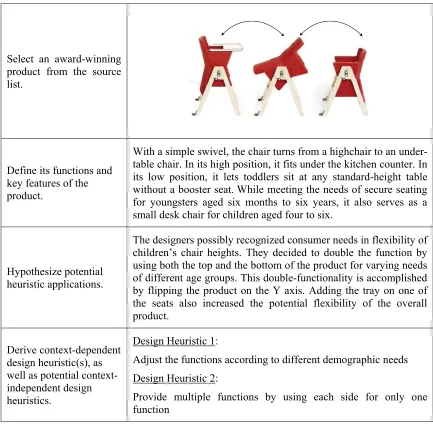
heuristic were then defined. This heuristic extraction process is illustrated in FIGURE 2.1.
Select an award-winning product from the source list.
Define its functions and key features of the product.
With a simple swivel, the chair turns from a highchair to an under-table chair. In its high position, it fits under the kitchen counter. In its low position, it lets toddlers sit at any standard-height table without a booster seat. While meeting the needs of secure seating for youngsters aged six months to six years, it also serves as a small desk chair for children aged four to six.
Hypothesize potential heuristic applications.
The designers possibly recognized consumer needs in flexibility of children’s chair heights. They decided to double the function by using both the top and the bottom of the product for varying needs of different age groups. This double-functionality is accomplished by flipping the product on the Y axis. Adding the tray on one of the seats also increased the potential flexibility of the overall product.
Derive context-dependent design heuristic(s), as well as potential context-independent design heuristics.
Design Heuristic 1:
Adjust the functions according to different demographic needs Design Heuristic 2:
[image:42.612.107.540.288.712.2]30
Context-independent Design Heuristics: 1. "Flipping" around a pivot
2. Repeating design elements for different functions
Identify design criteria
used in the product. Secure, comfortable, adjustable, multi-functional, and practical
Select another product that shares the same criteria and uses the same heuristic(s)
Describe how each similar product used the heuristic to identify different ways of implementation.
A secondary design element (the tabletop) is chosen for the durability of the form. Two different functions are assigned to this secondary element, and the functions differ when the component is "flipped" and placed back over the main structure to form a seating unit.
The form is split into four different functions (hammer, crow bar, board bender and splitter), which can be accessed by "flipping" the product from one direction to another.
FIGURE 2.1. Heuristic Extraction Process
31
2.1.2. DEFINING DESIGN HEURISTICS
The analysis of the 400 products resulted in 40 heuristics that facilitate the design process. At a general level, they can be organized as "content-independent heuristics,"
including addition, removal, distortion, orientation, and substitution. This list is similar
to the general heuristics in previous approaches like Synectics and SCAMPER. However, heuristics described at this general level are problematic because they give little indication of whether they can be applied to a specific design problem, and how to apply them to an existing concept.
Through the content analysis, a more specific description of heuristics was identified -- "context-dependent heuristics" -- that provides a motivation for applying them, and may consequently make the heuristics more specialized and valuable as aids to design. For
example, Twisting forms to create a playful look refers to distortion of the form.
However, the reason for applying this heuristic is directly related to the design criteria in hand, which is the intended audience of children (in the product analyzed, designing a stool for a playground). The design heuristics vary in that as some add functionality, suggest use of fewer resources, save space, provide ideas about visual consistency, and form relationships among the design elements. These more specific heuristics go beyond general transformations to identify why a particular heuristic might be advantageous.
Consider these examples of the extraction of heuristics from the set of innovative products in the study:
HEURISTIC EXAMPLE A. CONVERTING TWODIMENSIONAL MATERIALS INTO THREEDIMENSIONAL PRODUCTS
32
For example, FIGURE 2.2A shows a concept for a trash can that is made out of a
recycled sheet plastic rolled around its center. Since it can be entirely flat, it also
enhances the efficiency of transportation and storage. FIGURE 2.2B shows a light made
out of sheet metal twisted around to give directional options for controlling light intensity.
FIGURE 2.2A&2.2B. Example designs for heuristic example A
HEURISTIC EXAMPLE B. USING PACKAGING AS A FUNCTIONAL COMPONENT WITHIN THE PRODUCT
Embed the packaging within the product to perform a different function: Create a shell or cover for a component or the entire product using the package, and uncover it when it’s
used. In FIGURE 2.3A, a set of colored pencils is located inside a package that also
serves as a stand during use. In FIGURE 2.3B, the lighting unit is packed so it is enclosed
inside a wrapped form made out of the same material. When opened, the package supports the structure, and functions as a necessary shade component.