2019 International Conference on Computation and Information Sciences (ICCIS 2019) ISBN: 978-1-60595-644-2
L1 Transfer and Unlearning in the
Development of Interlanguage
Huazhi Xiao
ABSTRACT
By doing an empirical research based on a students’ English test corpus and a Chinese test corpus of a vocational college to discuss L1 transfer and unlearning in the development of interlanguage, it is figured out that there is a significant correlation between the ability of subjects’ Chinese writing and that of their English writing, and a marked correlation between the ability of English writing and English comprehensive ability. With the previous longitudinal and cross-sectional studies, further evidence is provided for the positive transfer of L1 Chinese in L2 English. It further proves that the proficiency of native language has great influence on the proficiency of the development of the target language. As well, native language can be unlearned gradually in the development of interlanguage.
1. INTRODUCTION
Although many studies on L1 transfer in L2 acquisition have been conducted, choosing this topic is still motivated by the following reasons: Firstly, the role of L1 in L2 has had a rocky history in L2 acquisition research. Language transfer is a central conceptual domain in the research of the role of L1 in SLA. The development of research in such fields as phonology, morphology, lexicon, syntax, semantics, and pragmatics reflects the development of research in the role of L1 in SLA in general. Secondly, researchers seem not to have reached a consensus on such issues as: 1) Does the proficiency of L1 or native language affect the development of the proficiency of learners’ interlanguage? 2) Will the negative
transfer of native language in L2 acquisition gradually disappear as the learners’ interlanguage is approaching the level of target language? Thirdly, it has been evident that the cross-linguistic findings from studies on transfer are sufficiently robust to constitute evidence for the influence of L1 on L2 acquisition of learners coming from different native language backgrounds ([1], [2], [3]), but few studies are made in the Chinese EFL context; and the bulk of studies within the field of language transfer are cross-sectional, therefore, longitudinal studies in this field are even fewer. Thus, this research is done by addressing the following questions: 1) Is it true that L1 Chinese proficiency will affect the development of the proficiency of L2 English? 2) Can Chinese learners of English gradually overcome the inhibition of L1 Chinese transfer to make L1 Chinese unlearned in the development of Chinese-English IL?
2. L1 TRANSFER AND UNLEARNING IN THE DEVELOPMENT OF LEARNERS’ INTERLANGUAGE
2.1 An Empirical Research
2.1.1 Background To The Research
To Both the Chinese proficiency test and the English proficiency test are held on the college level once an academic year. The subjects involved in these tests are selected randomly from the first-year students enrolled in the vocational college in 2017 and 2018 apart. Soon after they entered the college, they participated in the Chinese Language Proficiency Test held by the college. Besides other test questions, they were required to write an argument with not less than 800 words in the test. In addition, they were supposed to take part in an English Proficiency Test for the first-year students held in every October before they had college English classes.
2.1.2 DATA DESCRIPTION AND FINDINGS
TABLE I. PEARSON CORRELATIONS BETWEEN CHINESE WRITING AND ENGLISH WRITING IN GRADE 2017.
Chinese writing English writing
Chinese
writing Pearson Correlation
1 .132**
Sig. (2-tailed) .000
N 1753 1753
English writing Pearson Correlation .132** 1
Sig. (2-tailed) .000
N 1753 1753
**. Correlation is significant at the 0.01 level (2-tailed).
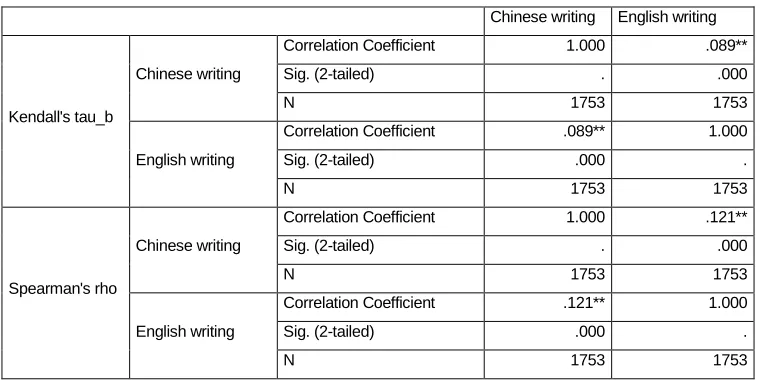
TABLE II. KENDALL AND SPEARMAN CORRELATIONS BETWEEN CHINESE WRITING AND ENGLISH WRITING IN GRADE 2017.
Chinese writing English writing
Kendall's tau_b
Chinese writing
Correlation Coefficient 1.000 .089**
Sig. (2-tailed) . .000
N 1753 1753
English writing
Correlation Coefficient .089** 1.000
Sig. (2-tailed) .000 .
N 1753 1753
Spearman's rho
Chinese writing
Correlation Coefficient 1.000 .121**
Sig. (2-tailed) . .000
N 1753 1753
English writing
Correlation Coefficient .121** 1.000
Sig. (2-tailed) .000 .
N 1753 1753
**. Correlation is significant at the 0.01 level (2-tailed).
[image:3.612.108.488.364.554.2]Sig. is 0.00, which illustrates that a marked correlation exists in these two sets of data.
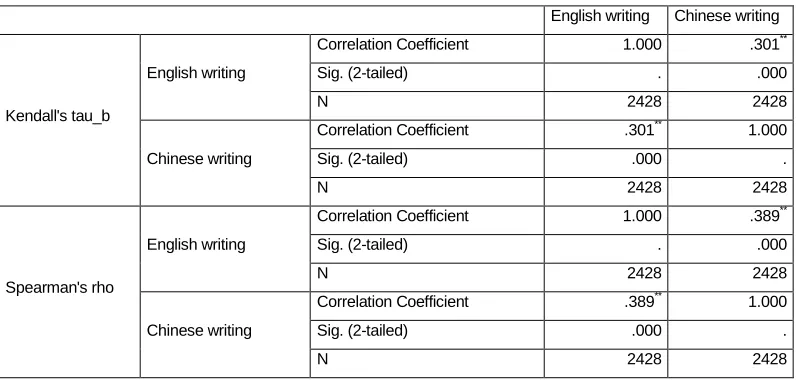
In TABLE III, the Pearson correlation coefficient is 0.421 and 2-tailed Sig. is 0.00. It is clear that there is a marked correlation between Chinese writing and English writing of the subjects in Grade 2018. The Kendall correlation in TABLE IV is 0.301 and 2-tailed Sig. is 0.00, the Spearman correlation coefficient is 0.389 and 2-tailed Sig. is 0.00, which indicates that there exists a significant correlation in these two sets of data.
TABLE III. PEARSON CORRELATIONS BETWEEN CHINESE WRITING AND ENGLISH WRITING IN GRADE 2018.
English writing Chinese writing
English writing
Pearson Correlation 1 .421**
Sig. (2-tailed) .000
N 2428 2428
Chinese writing
Pearson Correlation .421
**
1
Sig. (2-tailed) .000
N 2428 2428
[image:4.612.99.497.462.652.2]**. Correlation is significant at the 0.01 level (2-tailed).
TABLE IV. KENDALL AND SPEARMAN CORRELATIONS BETWEEN CHINESE WRITING AND ENGLISH WRITING IN GRADE 2018.
English writing Chinese writing
Kendall's tau_b
English writing
Correlation Coefficient 1.000 .301**
Sig. (2-tailed) . .000
N 2428 2428
Chinese writing
Correlation Coefficient .301** 1.000
Sig. (2-tailed) .000 .
N 2428 2428
Spearman's rho
English writing
Correlation Coefficient 1.000 .389**
Sig. (2-tailed) . .000
N 2428 2428
Chinese writing
Correlation Coefficient .389** 1.000
Sig. (2-tailed) .000 .
N 2428 2428
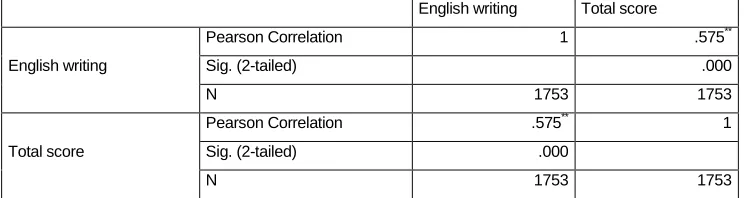
TABLE V shows that the Pearson correlation coefficient between English writing and the total score is 0.575 and 2-tailed Sig. is 0.00, which demonstrates that the two sets of data are extremely correlated. In TABLE VI, Kendall correlation coefficient is 0.414, and Spearman correlation coefficient is 0.560. These data manifest that, with a significance level of 99%, there is a hugely marked correlation between English writing and English comprehensive capacity of the subjects in Grade 2017.
TABLE V. PEARSON CORRELATION OF ENGLISH WRITING AND TOTAL SCORE IN GRADE 2017.
English writing Total score
English writing
Pearson Correlation 1 .575**
Sig. (2-tailed) .000
N 1753 1753
Total score
Pearson Correlation .575** 1
Sig. (2-tailed) .000
N 1753 1753
**. Correlation is significant at the 0.01 level (2-tailed).).
TABLEVI.KENDALLANDSPEARMANCORRELATIONSOFENGLISHWRITINGAND TOTALSCOREINGRADE2017.
English writing Total score
Kendall's tau_b
English writing
Correlation Coefficient 1.000 .414**
Sig. (2-tailed) . .000
N 1753 1753
Total score
Correlation Coefficient .414** 1.000
Sig. (2-tailed) .000 .
N 1753 1753
Spearman's rho
English writing
Correlation Coefficient 1.000 .560**
Sig. (2-tailed) . .000
N 1753 1753
Total score
Correlation Coefficient .560** 1.000
Sig. (2-tailed) .000 .
N 1753 1753
**. Correlation is significant at the 0.01 level (2-tailed).
[image:5.612.114.485.422.613.2]Spearman correlation coefficient is 0.594. All of these data indicate that the subjects in Grade 2018 who perform well with high scores in English writing will mostly perform well in the test.
TABLEVII.PEARSONCORRELATIONOFENGLISHWRITINGANDTOTALSCOREIN GRADE2018.
English writing Total score
English writing
Pearson Correlation 1 .610**
Sig. (2-tailed) .000
N 2428 2428
Total score
Pearson Correlation .610** 1
Sig. (2-tailed) .000
N 2428 2428
**. Correlation is significant at the 0.01 level (2-tailed).
TABLEVIII.KENDALLANDSPEARMANCORRELATIONSOFENGLISHWRITINGAND TOTALSCOREINGRADE2018.
English writing Total score
Kendall's tau_b
English writing
Correlation
Coefficient
1.000 .440**
Sig. (2-tailed) . .000
N 2428 2428
Total score
Correlation
Coefficient
.440** 1.000
Sig. (2-tailed) .000 .
N 2428 2428
Spearman's rho
English writing
Correlation
Coefficient
1.000 .594**
Sig. (2-tailed) . .000
N 2428 2428
Total score
Correlation
Coefficient
.594** 1.000
Sig. (2-tailed) .000 .
N 2428 2428
2.2. Discussion
Before we discuss the results of the empirical study, let’s discuss how we can evaluate an individual’s language proficiency. The Chinese test which the subjects took part in was designed according to the form of China’s only standardized test
— Chinese Proficiency Test, which is a test to evaluate the Chinese language proficiency of learners from non-Chinese background. Practical English Test for Colleges (PRETCO) is a standard examination to test English teaching and learning, approved by the Chinese Ministry of Education and designed by the Examination Committee of PRETCO. Its aim is to evaluate the communication ability in English of higher vocational college students in daily life and general business. Sheng [4] states that the subjects’ performance in PRETCO distinctly and positively reflects their learning strategies.
Comparing the scores that the subjects got in Chinese writing and English writing, we have concluded that there is a marked correlation between the students’ Chinese writing and English writing. That is to say, the learners' L1 Chinese proficiency can influence the development of the proficiency of L2 English. This is in agreement with the result of Cummins’ research. Cummins [5] points that that children with a good reading ability in their native language tend to have a good reading ability in the target language. Another longitudinal research [6] concludes that L1 and L2 are closely related in reading comprehension and L1 powerfully influences L2 reading comprehension in metacognitions. Jiang and Kuehn [7] say, “The level of proficiency reached in L1 influences the development of their proficiency in L2” They have testified quantitatively and qualitatively that positive transfer of native language can occur in linguistics and cognition in the development of the second language. Lee and Schallert [8] have had an empirical study and provided evidence that after learners acquire some necessary knowledge of an L2 per se, their ability in L1 reading can facilitate the ability development in their L2 reading.
The findings of the studies show that the linguistic level of the target language is affected by the proficiency of mother tongue. This fully explains that the positive transfer of L1 becomes increasingly apparent as learners know more about the second language. As well, a good command of knowledge and skills in mother tongue will have positive transfer on such aspects as writing of the target language. The Chinese learners who don’t know well the Chinese sentence components may have more difficulty than those who have a good master of them in learning English sentence structures.
study, we can see that the “foreign accent” in Marx’ L2 German slowly disappeared as her German got more proficient. Wei [10] has done a pseudo-longitudinal study on college students to prove that negative transfer of L1 Chinese can be unlearned in the acquisition of L2 English. All of these longitudinal and cross-sectional studies can provide further evidence for L1 transfer and unlearning in the development of interlanguage.
REFERENCES
1. Bardovi-Harlig, K. 1998. “Narrative structure and lexical aspect: Conspiring factors in second language acquisition of tense-aspect morphology,” Studies in Second Language Acquisition, l.20 (4):471-508.
2. Bardovi-Harlig, K. and A. Bergström. 1996. “The acquisition of tense and aspect in SLA and FLL: A study of learner narratives in English (SL) and French (FL),” Canadian Modern
Language Review, 52(2):308-330.
3. Bardovi-Harlig, K. and D. W. Reynolds. 1995. “The role of lexical aspect in the acquisition of tense and aspect,” TESOL Quarterly, 29(1):107-131.
4. Sheng, W. “Correlation between vocational college students’ English learning motivation, learning strategy and performance on PRETCO,” unpublished.
5. Cummins, J. 1979. “Linguistic interdependence and the educational development of bilingual children,” Review of Educational Research, 49(2):222-251.
6. Van Gelderen, A., R. Schoonen, R. D. Stoel, K. De Glopper and J. Hulstijn. 2007. “Development of adolescent reading comprehension in language 1 and language 2: A longitudinal analysis of constituent components,” Journal of Educational Psychology, 99(3):477-491.
7. Jiang, B. and P. Kuehn. 2001. “Transfer in the academic language development of post-secondary ESL students,” Bilingual Research Journal, 25(4)653-672.
8. Lee, J. and D. L. Schallert, 1997. “The relative contribution of L2 language proficiency and L1 reading ability to L2 reading performance: A test of the Threshold Hypothesis in an EFL context,”
TESOL Quarterly, 31(4):713-739.
9. Marx, N. 2002. “Never quite a ‘native speaker’: Accent and identity in the L2- and the L1,”
Canadian Modern Language Review, 59(2):264–281.
10.Wei, H. 2008. “A study on L1 negative transfer and unlearning in second language acquisition,”