R E S E A R C H
Open Access
Optimal bounds for arithmetic-geometric
and Toader means in terms of generalized
logarithmic mean
Qing Ding
1and Tiehong Zhao
2**Correspondence:
2Department of Mathematics,
Hangzhou Normal University, Hangzhou, 311121, China Full list of author information is available at the end of the article
Abstract
In this paper, we find the greatest values
α
1,α
2and the smallest valuesβ
1,β
2suchthat the double inequalitiesLα1(a,b) < AG(a,b) <Lβ1(a,b) and
Lα2(a,b) <T(a,b) <Lβ2(a,b) hold for alla,b> 0 witha=b, where AG(a,b),T(a,b) and
Lp(a,b) are the arithmetic-geometric, Toader and generalized logarithmic means of
two positive numbersaandb, respectively.
MSC: 26E60
Keywords: arithmetic-geometric mean; Toader mean; logarithmic mean
1 Introduction
Forp∈R, thepth generalized logarithmic meanLp(a,b) [] of two positive numbersaand
bis defined by
Lp(a,b) = ⎧ ⎪ ⎪ ⎪ ⎪ ⎪ ⎨ ⎪ ⎪ ⎪ ⎪ ⎪ ⎩
[b(pp+)(+–abp–+a)]/p, a=b,p= –,p= ,
e( bb
aa)/b–a, a=b,p= ,
b–a
logb–loga, a=b,p= –,
a, a=b.
(.)
It is well known thatLp(a,b) is continuous and strictly increasing with respect top∈R for fixeda,b> witha=b. Many remarkable inequalities for the generalized logarithmic mean can be found in the literature [–].
The classical arithmetic-geometric meanAG(a,b) of two positive numbersaandbis defined by starting witha=a,b=band then iterating
an+=
an+bn
, bn+=
anbn (.)
forn∈Nuntil two sequences{an}and{bn}converge to the same number. The well-known Gauss identity [] shows that
AG(,r)K√ –r=π
(.)
forr∈(, ), whereK(r) = π/( –rsint)–/dt,r∈[, ), is the complete elliptic integral of the first kind.
In [], the Toader meanT(a,b) of two positive numbersaandbwas given by
T(a,b) =
π
π/
acosθ+bsinθdθ
= ⎧ ⎪ ⎪ ⎪ ⎨ ⎪ ⎪ ⎪ ⎩
aE(√–(b/a))
π , a>b,
bE(√–(a/b))
π , a<b,
a, a=b,
(.)
whereE(r) = π/( –rsinθ)/dθ,r∈[, ] is the complete elliptic integral of the second kind.
Recently, the bounds for the arithmetic-geometric mean AG(a,b) and Toader mean
T(a,b) have attracted the attention of many mathematicians. The double inequality
L–(a,b) =L(a,b) <AG(a,b) <L/a/,b/ (.)
holds for alla,b> witha=b. The left inequality of (.) was first proposed by Carlson and Vuorinen [] and also was proved by different methods in [–]. Vamanamurthy and Vuorinen [] proved thatAG(a,b) < (π/)L(a,b) for alla,b> witha=b. The second inequality of (.) was proved by Borwein and Borwein [] and Yang [].
Vuorinen [] conjectured that
M/(a,b) <T(a,b) (.)
for alla,b> witha=b, whereMp(a,b) = [(ap+bp)/]/p (p= ) andM(a,b) = √
abis the power mean of orderp. This conjecture was proved by Qiu and Shen [] and Barnard et al. [].
In [], Alzer and Qiu presented a best possible upper power mean bound for the Toader mean as follows:
T(a,b) <Mlog/log(π/)(a,b) (.)
for alla,b> witha=b.
In [–], the authors proved that
L(a,b) <T(a,b) <L/(a,b), (.) S√/(a,b) <T(a,b) <S/(a,b) (.)
for alla,b> witha=b, whereLp(a,b) = (ap++bp+)/(ap+bp) denotes thepth Lehmer mean andSp(a,b) is the generalized Seiffert mean given bySp(a,b) =p(a–b)/arctan[p(a–
b)/(a+b)] ( <p≤,a=b),S(a,b) = (a+b)/(a=b) andSp(a,a) =a. Very recently, Chu and Wang [] proved that
Sp(a,b) <T(a,b) <Sq(a,b) (.)
for alla,b> witha=bif and only ifp≤/,q≥ andp≤,q≥/. Here thepth Gini mean of two positive numbersaandbis defined by
Sp(a,b) = ⎧ ⎨ ⎩
(ap–a++bbp–)/(p–), p= ,
(aabb)/(a+b), p= . (.)
The main purpose of this paper is to find the greatest valuesα,αand the smallest val-uesβ,βsuch that the double inequalitiesLα(a,b) <AG(a,b) <Lβ(a,b) andLα(a,b) <
T(a,b) <Lβ(a,b) hold for alla,b> witha=band give some new bounds for the com-plete elliptic integrals.
2 Basic knowledge and lemmas
In order to prove our main results, we need several formulas and lemmas, which we present in this section.
Forr∈(, ) andr=√ –r, the well-known complete elliptic integrals of the first and second kinds are defined by
⎧ ⎪ ⎪ ⎨ ⎪ ⎪ ⎩
K=K(r) = π/( –rsinθ)–/dθ, K=K(r) =K(r),
K() =π/, K() = +∞,
and
⎧ ⎪ ⎪ ⎨ ⎪ ⎪ ⎩
E=E(r) = π/( –rsinθ)/dθ, E=E(r) =E(r)
E() =π/, E() = ,
respectively, and the following formulas were presented in [], Appendix E, pp.-:
dK dr =
E–rK
rr ,
dE dr =
E–K
r ,
d(E–rK)
dr =rK,
d(K–E)
dr =
rE r,
(.)
E
√r
+r
=E–r
K
+r . (.)
In what follows, four special valuesE(√/),K(√/) andE(.),K(.) will be used. By numerical computations, these are given by
Lemma .(See [], Theorem .) For–∞<a<b<∞,let f,g: [a,b]→Rbe continu-ous on[a,b]and be differentiable on(a,b),let g(x)= on(a,b).If f(x)/g(x)is increasing
(decreasing)on(a,b),then so are
f(x) –f(a)
g(x) –g(a) and
f(x) –f(b)
g(x) –g(b).
If f(x)/g(x)is strictly monotone,then the monotonicity in the conclusion is also strict.
Lemma . ()The function r→(E–rK)/ris strictly increasing from(, )onto(π/, ); ()The function r→E–rKis increasing and log-convex from(, )onto(π/, ); ()The functionK/log(e/r)is strictly increasing from(, )onto(π/, );
()The function(K–E)/ris strictly increasing on(, );in particular,K–E> (π/)r for all r∈(, ).
Proof Parts () and () follow from [], Theorem .() and Exercise .().
Lemma . The equation
( +p)/p=π
has a unique solution p=p= .· · ·.
Proof Let
ϕ(p) = ⎧ ⎨ ⎩
( +p)/p–π/, p∈(–, )∪(, +∞),
e–π/, p= .
It is easy to verify that the functionϕis continuous and strictly decreasing from (–, +∞)
onto (, +∞). Therefore, Lemma . easily follows from the continuity and monotonicity ofϕtogether with the facts thatϕ(.) = .×–andϕ(.) = –.×
–.
Lemma . The function
f(r) =(E–r
K)/π– –r/
r
is strictly increasing from(, )onto(/, /π– /).
Proof Letf(r) = (E–rK)/π– –r/ andf(r) =r, thenf
() =f() = andf(r) =
f(r)/f(r).
A simple calculation yields
f(r) f(r)=
(E–rK) –πr
πr
f(r)
f(r), (.)
f(r) f(r)=
K–π
πr
f(r)
f(r), (.)
f() =f(), (.)
f(r) f(r)=
π ·
E–rK
r ·
r. (.)
Following from Lemma .() and (.) together with the monotonicity of /r, we clearly see that f(r)/f(r) is strictly increasing on (, ). Equations (.)-(.) and Lemma . lead to the conclusion thatf(r) is strictly increasing on (, ).
Therefore, Lemma . follows from the monotonicity off(r) together with the facts that
f(+) = / andf(–) = /π– /.
The following double inequalities can be obtained from Lemma . immediately.
Corollary . Inequalities
+r
+
r <
π
E–rK< +r
+
π –
r
hold for <r< .
Lemma . The inequality
( +r)/– ( –r)/ r
/ < +r
(.)
holds for <r< .
Proof In order to prove inequality (.), it suffices to prove that
g(r) =( +r)/– ( –r)/– r
+r
= ( +r)+ ( –r)– r
+r
– –r/
=g(r) –g(r) < (.)
for <r< , where
g(r) = ( +r)+ ( –r)– r
+r
,
g(r) = –r/.
Observe that
g(r) = – r
– r+ ,r+ ,r+ r+ r< , (.)
we conclude, from (.) and (.), that there existsr∈(., .) such thatg(r) > forr∈(,r) andg(r) < forr∈(r, ).
In order to prove (.), we divide it into two cases.
CaseAr∈[r, ). In this case, we clearly see thatg(r)≤ andg(r) > . This implies thatg(r) =g(r) –g(r) < .
CaseBr∈(,r). In this case,g(r) > . Letg(r) = – r+r– r, the difference betweeng(r) andg(r) yields
g(r) –g(r) = –r
(, + ,r+ r+ r)
, < . (.)
We know from (.) thatg(r) >g(r) > . Moreover,
g(r) –g(r) = –r
– r +r+r
r–
+
< ,
this in conjunction withg(r) > implies that
g(r) –g(r) < . (.)
Therefore, we clearly see thatg(r) = [g(r) –g(r)] + [g(r) –g(r)] < from (.) and
(.).
Lemma . Letη(r) = [( +r)p+– ( –r)p+]/r andω(r) = [( –r)p( +p
r) – ( +r)p( –
pr)]/r,then the functionsη(r)andω(r)both are strictly increasing on(, ).
Proof We assume that
η(r) = ( +r)p+– ( –r)p+, η(r) =r,
ω(r) = ( –r)p( +p
r) – ( +r)p( –pr), ω(r) =r,
thenη(r) =η(r)/η(r) andω(r) =ω(r)/ω(r). A simple calculation yields
η() =η() =ω() =ω() = , (.)
η(r)
η(r)= ( +p)
( +r)p– ( –r)p, (.)
ω(r)
ω(r)=
p(p+ )[( +r)p–– ( –r)p–]
. (.)
Lemma . and (.)-(.) lead to the conclusion thatη(r) andω(r) are strictly
increas-ing on (, ).
Lemma . Let
φp(r) =
π
E–rK–
( +r)p+– ( –r)p+ (p+ )r
/p ,
Proof It is well known thatLp(a,b) is strictly increasing with respect top∈Rfor fixed
a,b> witha=b, thenφp(r) is strictly decreasing with respect top∈R. In order to prove Lemma ., we divide it into three cases.
Casep= /.
From Corollary . and Lemma ., we clearly see that
φ/(r) =
π
E–rK–
( +r)/– ( –r)/ r
/
> +r
+
r –
( +r)/– ( –r)/ r
/
> r
>
for <r< .
Casep=p.
We divide it into two subcases.
SubcaseAφp(r) < forr∈(, .).
Sinceφp(r) is strictly decreasing with respect top∈R, we clearly see thatφp(r) <φ(r). It suffices to prove thatφ(r) < forr∈(, .).
Forr∈(,√/], it follows from Corollary . that
φ(r) =
π
E–rK–
( +r)– ( –r) r
/
< +r + π –
r–
+r
–
r
= –r – π – r
≤–r – π –
= –(π– )r
π < ,
where the first inequality easily follows from
( +r)– ( –r)
r –
+r
– r = r
+ –r+r> .
Forr∈(√/, .), taking the derivative ofφ(r) yields
φ(r) = (E–r
K)
πr –
r
( +r)/ =μ(r) +μ(r), (.)
where
μ(r) =(E–r
K)
πr –
r
, μ(r) =
r
– r
From Lemma .(), we clearly see that
dμ(r)
dr =
πr
K–E–π r
> (.)
forr∈(, ) and
dμ(r)
dr =
( +r)/– + r ( +r)/ >
[ + (/)r] – + r ( +r)/
= r –
( +r)/ > (.)
forr∈(√/, .). Equations (.)-(.) lead to the conclusion thatφ(r) is strictly in-creasing on (√/, .). This in conjunction with (.) implies that
φ(r) >φ(√/) = .· · ·> (.)
forr∈(√/, /). Therefore, from (.) we clearly see thatφ(r) is strictly increasing on (√/, .). This in conjunction with (.) yieldsφ(r) <φ(.) = –.· · ·< forr∈(√/, .).
SubcaseBφp(r) < forr∈[., ).
For .≤r< , taking the derivation ofφp(r) yields
φp
(r) =
(E–rK)
πr –
ω(r)
p(p+ )/pη(r)–/p
, (.)
whereω(r) andη(r) are defined as in Lemma .. From Lemma .(), we clearly see that (E–rK)/ris strictly increasing on (, ). Lemma . and (.), (.) lead to the conclu-sion that
φp(r)≥[E(.) – ( – .
)K(.)]
.π –
ω()
p(p+ )/pη(.)–/p = .· · ·– .· · ·= .· · ·>
for .≤r< .
Therefore, it follows from the monotonicity ofφp(r) on (/, ) thatφp(r) <φp() = [/π– /( +p)/p] = for <r< .
Case / <p<p.
Taking the Taylor series ofφp(r) atr= yields
φp(r) =
–
p
r+( – p+ p
+ p)r
, +o
r. (.)
From (.) we clearly see that there exists a sufficiently smallδ> such thatφp(r) < for
3 Main results
Theorem . Inequality L–(a,b) <AG(a,b) <L–/(a,b)holds for all a,b> with a=b,
where L–(a,b)and L–/(a,b)are the best possible lower and upper generalized logarithmic mean bounds for the arithmetic-geometric meanAG(a,b),respectively.
Proof Firstly, from (.) we clearly see thatL–(a,b) <AG(a,b) for alla,b> witha=b. Next, we prove thatAG(a,b) <L–/(a,b) for alla,b> witha=b. SinceAG(a,b) and
Lp(a,b) are symmetric and homogeneous of degree , without loss of generality, it suffices to give an assumption thata= >b. Lett=b∈(, ),r= ( –t)/( +t), then (.) and (.) lead to
AG(a,b) –L–/(a,b) =
π
K(√ –t)–
–t
( –√t)
= +r
π
K –
r
√
+r–√ –r
= h(r)
( +r)K(r), (.)
where
h(r) =π– +rK(r).
We can rewriteh(r) as
h(r) =π–λr· K
log(e/r), (.)
whereλ(r) = ( +r)log(e/r). A simple calculation yields
λr= –
r –logr
, (.)
λ() = , (.)
λr= –r
r > . (.)
Equations (.)-(.) lead to the conclusion thatλ(r) is strictly decreasing on (, ) with respect tor. Moreover, the functionr=√ –r is strictly decreasing on (, ). Hence the functionλ(r) is strictly increasing on (, ) with respect tor. It follows from (.) and Lemma .() thath(r) is strictly decreasing on (, ). This implies thath(r) < for <r< together withh() = .
Therefore,AG(a,b) <L–/(a,b) for alla,b> witha=bfollows from (.) andh(r) < . Finally, we prove thatL–(a,b) andL–/(a,b) are the best possible lower and upper gen-eralized logarithmic mean bounds for the arithmetic-geometric meanAG(a,b).
For any <ε< / and <x< , it follows from (.) and (.) that
lim
x→
AG(,x) –L–+ε(,x)
=lim
x→
π
K(√ –x)–
–xε ε( –x)
ε–
and making use of the Taylor expansion asx→, one has
AG(, –x) –L–/–ε(, –x)
= π
K(√x–x)–
– ( –x)/–ε
(/ –ε)x
– +ε
=
–x –
x
+o
x–
–x –
+ ε
x
+ox
= ε x
+ox. (.)
Equations (.) and (.) imply that for any <ε< / there exist δ =δ(ε)∈(, ) and δ =δ(ε)∈(, ) such that AG(,x) <L–+ε(,x) for x∈(,δ) and AG(, –x) >
L–/–ε(, –x) forx∈(,δ).
Theorem . Inequality L/(a,b) <T(a,b) <Lp(a,b)holds for all a,b> with a=b,
where pis defined as in Lemma.and L/(a,b),Lp(a,b)are the best possible lower and
upper generalized logarithmic mean bounds for the Toader mean T(a,b),respectively.
Proof From (.) and (.) we clearly see that bothT(a,b) andLp(a,b) are symmetric and homogeneous of degree . Without loss of generality, we assume thata= >b. Lett=b∈
(, ),r= ( –t)/( +t), then from (.) and (.) together with (.) we have
T(a,b) –Lp(a,b) =
πE
√ –t–
–tp+ (p+ )( –t)
/p
=
πE
√r
+r
–
+r
( +r)p+– ( –r)p+ (p+ )r
/p
= +r
π
E–rK–
( +r)p+– ( –r)p+ (p+ )r
/p
= φp(r)
( +r), (.)
whereφp(r) is defined as in Lemma ..
Therefore, Theorem . follows from (.) and Lemma ..
4 Corollaries and remarks
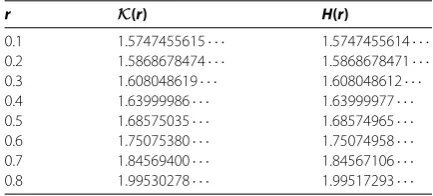
From Theorem . we get a lower bound for the complete elliptic integral of the first kind K(r) as follows.
Corollary . Inequality
K(r) >π[ + √
–r– ( –r)/]
( –√ –r) (.)
holds for all r∈(, ).
Table 1 Comparison ofK(r) withH(r) for somer∈(0, 1)
r K(r) H(r)
0.1 1.5747455615· · · 1.5747455614· · · 0.2 1.5868678474· · · 1.5868678471· · · 0.3 1.608048619· · · 1.608048612· · · 0.4 1.63999986· · · 1.63999977· · · 0.5 1.68575035· · · 1.68574965· · · 0.6 1.75075380· · · 1.75074958· · · 0.7 1.84569400· · · 1.84567106· · · 0.8 1.99530278· · · 1.99517293· · ·
Theorem . enables us to give new bounds for the complete elliptic integrals of the second kindE(r).
Corollary . Inequality
π
( – ( –r)/) ( –√ –r)
/
<E(r) <π
– ( –r)(p+)/ (p+ )( –
√ –r)
/p
(.)
holds for all r∈(, ),where p= .· · · is defined as in Lemma..
Competing interests
The authors declare that they have no competing interests.
Authors’ contributions
All authors contributed equally to the writing of this paper. All authors read and approved the final manuscript.
Author details
1College of Mathematics and Statistics, Hunan University of Finance and Economics, Changsha, 410205, China. 2Department of Mathematics, Hangzhou Normal University, Hangzhou, 311121, China.
Acknowledgements
The authors wish to thank the anonymous referees for their careful reading of the manuscript and their fruitful comments and suggestions. This research was supported by the National Natural Science Foundation of China (Grant no. 11301127), the general project Foundation of the Department of Education of Hunan Province (Grant no. 16C0265) and the scientific research Foundation for Young teachers in Hunan University of Finance and Economics (Grant no. Q201501).
Publisher’s Note
Springer Nature remains neutral with regard to jurisdictional claims in published maps and institutional affiliations.
Received: 15 February 2017 Accepted: 13 April 2017
References
1. Stolarsky, KB: Generalizations of the logarithmic mean. Math. Mag.48, 87-92 (1975)
2. Chu, YM, Hou, SW, Gong, WM: Inequalities between logarithmic, harmonic, arithmetic and centroidal means. J. Math. Anal.2(2), 1-5 (2011)
3. Chu, YM, Wang, MK: Optimal inequalities between harmonic, geometric, logarithmic, and arithmetic-geometric means. J. Appl. Math.2011, Article ID 618929 (2011)
4. Qiu, YF, Wang, MK, Chu, YM, Wang, GD: Two sharp inequalities for Lehmer mean, identric mean and logarithmic mean. J. Math. Inequal.5(3), 301-306 (2011)
5. Chu, YM, Xia, WF: Two optimal double inequalities between power mean and logarithmic mean. Comput. Math. Appl.60(1), 83-89 (2010)
6. Xia, WF, Chu, YM, Wang, GD: The optimal upper and lower power mean bounds for a convex combination of the arithmetic and logarithmic means. Abstr. Appl. Anal.2010, Article ID 604804 (2010)
7. Xia, WF, Chu, YM: Optimal inequalities related to the logarithmic, identric, arithmetic and harmonic means. Rev. Anal. Numér. Théor. Approx.39(2), 176-183 (2010)
8. Chu, YM, Xia, WF: Inequalities for generalized logarithmic means. J. Inequal. Appl.2009, Article ID 763252 (2009) 9. Shi, HN, Wu, SH: Refinement of an inequality for the generalized logarithmic mean. Chin. Q. J. Math.23(4), 594-599
(2008)
11. Li, X, Chen, CP, Qi, F: Monotonicity result for generalized logarithmic means. Tamkang J. Math.38(2), 177-181 (2007) 12. Chen, CP, Qi, F: Monotonicity properties for generalized logarithmic means. Aust. J. Math. Anal. Appl.1(2), Article 2
(2004)
13. Mond, B, Pearce, CEM, Peˇcari´c, J: The logarithmic mean is a mean. Math. Commun.2(1), 35-39 (1997)
14. Kahlig, P, Matkowski, J: Functional equations involving the logarithmic mean. Z. Angew. Math. Mech.76(7), 385-390 (1996)
15. Pittenger, AO: The logarithmic mean innvariables. Am. Math. Mon.92(2), 99-104 (1985) 16. Stolarsky, KB: The power and generalized logarithmic means. Am. Math. Mon.87(7), 545-548 (1980) 17. Lin, TP: The power mean and the logarithmic mean. Am. Math. Mon.81, 879-883 (1974)
18. Anderson, GD, Vamanamurthy, MK, Vuorinen, MK: Conformal Invariants, Inequalities, and Quasiconformal Maps. Wiley, New York (1997)
19. Toader, G: Some mean values related to the arithmetic-geometric mean. J. Math. Anal. Appl.218, 358-368 (1998) 20. Carlson, BC, Vuorinen, MK: Inequality of the AGM and the logarithmic mean. SIAM Rev.33, 653-654 (1991) 21. Sándor, J: On certain inequalities for means. J. Math. Anal. Appl.189, 602-606 (1995)
22. Neuman, E, Sándor, J: On certain means of two arguments and their extensions. Int. J. Math. Math. Sci.16, 981-993 (2003)
23. Yang, ZH: A new proof of inequalities for Gauss compound mean. Int. J. Math. Anal.4, 1013-1018 (2010) 24. Vamanamurthy, MK, Vuorinen, MK: Inequalities for means. J. Math. Anal. Appl.183, 155-166 (1994)
25. Borwein, JM, Borwein, PB: Inequalities for compound mean iterations with logarithmic asymptotes. J. Math. Anal. Appl.177, 572-582 (1993)
26. Vuorinen, MK: Hypergeometric functions in geometric function theory. In: Special Functions and Differential Equations, pp. 119-126. Allied Publ., New Delhi (1998)
27. Qiu, SL, Shen, JM: On two problems concerning means. J. Hangzhou Inst. Electron. Eng.17, 1-7 (1997) (in Chinese) 28. Barnard, RW, Pearce, K, Richards, KC: An inequality involving the generalized hypergeometric function and the arc
length of an ellipse. SIAM J. Math. Anal.31, 693-699 (2000)
29. Alzer, H, Qiu, SL: Monotonicity theorems and inequalities for the complete elliptic integrals. J. Comput. Appl. Math. 172, 289-312 (2004)
30. Chu, YM, Wang, MK: Optimal Lehmer mean bounds for the Toader mean. Results Math.61, 223-229 (2012) 31. Guo, BN, Qi, F: Some bounds for the complete elliptic integrals of the first and second kinds. Math. Inequal. Appl.14,
323-334 (2011)
32. Chu, YM, Wang, MK, Qiu, SL, Qiu, YF: Sharp generalized Seiffert mean bounds for Toader mean. Abstr. Appl. Anal. 2011, Article ID 605259 (2011)